Introduction
Delirium frequently occurs in patients undergoing outpatient and inpatient cancer therapy. In particular, hyperactive and mixed delirium that present agitation is challenging because its poor control can result in disturbances of the cancer treatment itself; thus, treatment of such delirium is extremely important in palliative care (Bond et al., Reference Bond, Dietrich and Shuster2012; Breitbart et al., Reference Breitbart and Alici2012). In general, oral antipsychotics are the first-line drug therapy for delirium (Breitbart et al., Reference Breitbart and Alici2012; Johnson, Reference Johnson2018). When oral administration is difficult because of stomatitis or nausea, the use of orally disintegrating tablets and liquid medications is also considered; however, adequate swallowing function is still required.
In dysphagia and aphagia, injections as well as gastric tube, gastrostoma, or intestinal fistula are considered for drug administration routes. Intramuscular injections however may exacerbate delirium because of strong pain and discomfort, intravenous route or gastric tube administration have safety issues especially in hyperactive delirium, and the use of gastrostoma and intestinal fistula is limited because of the very small number of patients. Furthermore, injections are problematic for homecare patients.
Asenapine, an antipsychotic medication approved in 2009 in the United States and currently used in many countries, is unique from the perspective that it is a sublingual tablet (Potkin, Reference Potkin2011; Stepanova et al., Reference Stepanova, Grant and Findling2018); therefore, swallowing is not necessary for its administration. In this case report, we describe a case in which delirium was unsuccessfully treated with commonly selected antipsychotics while swallowing was still functional, but sublingual asenapine administration, after developing aphagia with disease progression, was effective. Furthermore, we discuss the effectiveness of asenapine in hyperactive delirium as well as its usefulness in treating delirium in palliative care.
Case report
A 79-year-old woman was diagnosed with spinocellular carcinoma at the right cheek approximately two years ago and subsequently underwent resection. Approximately 18 months later, recurrence at the same site and lymph node metastasis in the right neck were discovered and the patient was admitted to our hospital for chemotherapy and radiation therapy (here, the day of admission is considered day 0). To control pain, the patient was referred to the palliative care team on day 9. Comorbidities included diabetes and hypertension. The patient did not have a history of mental illness. At the time of referral, pain from the right cheek to the neck was 8/10 on the numerical rating scale. A general blood test showed mild anemia but did not indicate abnormalities in renal or hepatic function. C-reactive protein level was increased to 22.26 mg/dL. Tumor markers squamous cell carcinoma antigen and cytokeratin 19 fragment were markedly elevated.
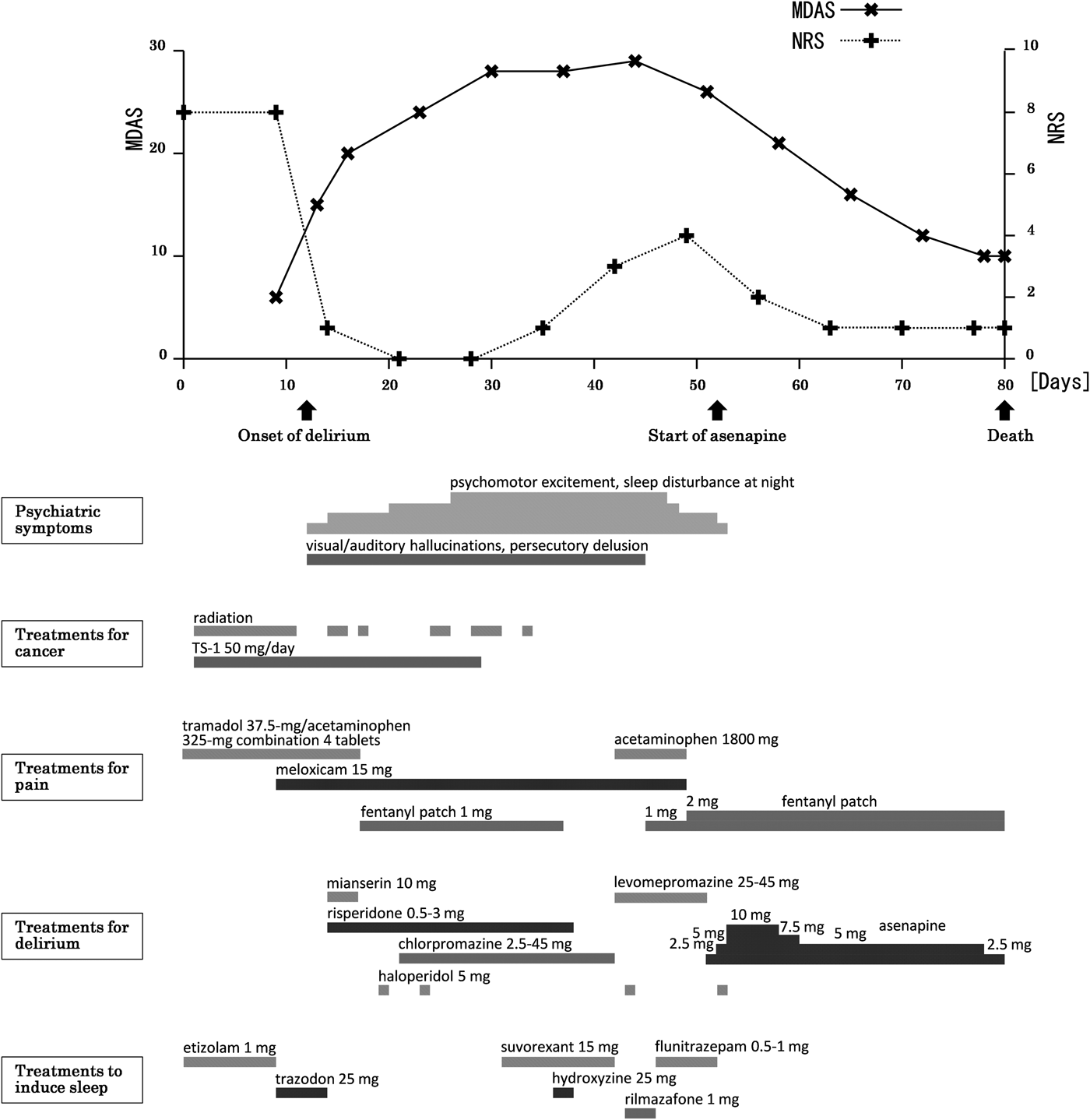
A summary of the patient's clinical course is shown in Figure 1. On day 9, meloxicam 15 mg/day was added to tramadol 37.5 mg/acetaminophen 325 mg combination tablet × 4 tablets/day, and the pain improved. Moreover, to reduce the risk of developing delirium, etizolam 1 mg/day at bedtime was discontinued and trazodone 25 mg was started. On the night of day 12, the patient presented with visual hallucination, auditory hallucination, and persecutory delusion; behaved abnormally such as touching another patient's belongings or wandering around in her underwear; and was subsequently diagnosed with delirium. The score on the memorial delirium assessment scale (Breitbart et al., Reference Breitbart, Rosenfeld and Roth1997) was 15/30. To treat delirium, the patient and family were given a verbal explanation that antipsychotics and mianserin, a medication recommended in Japan for treating delirium, will be used; that all of these drugs are unapproved for use (“off-label use”) in delirium; and that there are risks and benefits to these drugs. Drug therapy was started after obtaining written consent.
Patient clinical course. The memorial delirium assessment scale (MDAS) expresses the extent of delirium severity; the numerical rating scale (NRS) expresses the extent of pain.

Several tests were performed at the onset of delirium. The results are summarized in the following sections.
Blood test
Mild anemia was evident and inflammatory findings and tumor markers exceeded normal levels. These levels were markedly lower compared with the levels at the time the patient was referred to the palliative care team, however.
Imaging
Head magnetic resonance imaging showed an age-appropriate generalized mild brain atrophy. Mild chronic ischemic changes were detected at the deep white matter of the cerebrum. Head and neck magnetic resonance angiography revealed that the tumor wrapped around the right common carotid artery, but the visualization of the artery was satisfactory.
Electroencephalography
Background activity was slow at approximately 7 Hz. Generalized high-amplitude δ-waves of anterior predominance sometimes appeared.
Neuropsychological assessment
The Mini-Mental State Examination was performed three times. The score ranged from 15 to 20, and points were primarily deducted for items concerning temporal disorientation, calculation, and delayed recall.
On day 14, the patient switched from trazodone to antipsychotic risperidone 0.5 mg/day and mianserin 10 mg/day to treat delirium. Because delirium worsened thereafter, low doses of antipsychotics haloperidol, chlorpromazine, and levomepromazine were given but were not effective. From day 31, low doses of suvorexant, hydroxyzine, rilmazafone, and flunitrazepam were concomitantly given to improve delirium by inducing sleep, but were not effective. There were no marked side effects from antipsychotics including extrapyramidal symptoms and oversedation. Although a fentanyl patch that may have contributed to delirium was discontinued, delirium did not change.
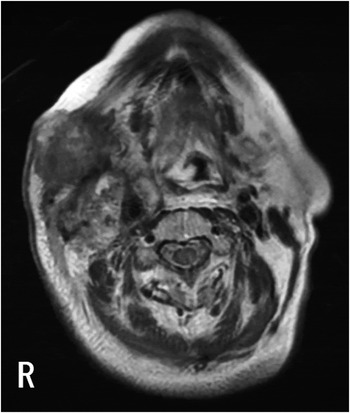
The neck tumor gradually enlarged, compressing and displacing the esophagus as shown in Figure 2, and this made it impossible for the patient to orally take medications. For this reason, one-half of a 5-mg asenapine tablet at bedtime was started from day 51. Because delirium rapidly improved after a gradual dose increase to a maximum of 10 mg/day, the dose was ultimately reduced to 2.5 mg/day. Delirium did not recur thereafter. Complaints of general malaise and condition of airway constriction gradually worsened, and the patient passed away on day 80. Based on the results of the diagnostic imaging and the autopsy at the time of death, the cause of death was determined to be respiratory arrest caused by airway constriction from the tumor.
Axial T1-weighted magnetic resonance imaging on day 46 shows that the patient's enlarged neck tumor was gradually compressing and displacing her esophagus.

Discussion
This is the first case report in which an asenapine sublingual tablet was effective without inducing side effects in a patient with delirium who developed aphagia after unsuccessful treatments with several antipsychotics. In drug therapy for delirium, several oral antipsychotics are generally used as the first-line treatment (Breitbart et al., Reference Breitbart and Alici2012; Johnson, Reference Johnson2018). When treatment resistance is evident, the medications are rotated or different combinations are given (Hui et al., Reference Hui, Dev and Bruera2016). We followed this approach, but a favorable effect was not observed.
Asenapine is a second-generation antipsychotic classified as a multiacting receptor targeted antipsychotic (Stoner et al., Reference Stoner and Pace2012). Compared with other multiacting receptor targeted antipsychotic drugs, asenapine induces fewer side effects of glucose metabolism abnormalities (Leucht et al., Reference Leucht, Cipriani and Spineliet2013), and is therefore considered to pose a relatively low risk for cancer patients. Moreover, it has relatively weak anticholinergic actions (Leucht et al., Reference Leucht, Cipriani and Spineliet2013) and is therefore considered to be relatively harmless in patients with thirst, constipation, and urinary retention. Because of its high affinity toward adrenergic α1 receptors and histamine H1 receptors (Allergan USA, Inc., 2017), a sedative effect can be anticipated, although side effects of oversedation must be monitored carefully. A randomized double-blind controlled study (Pratts et al., Reference Pratts, Citrome and Grant2014) demonstrated that a single administration of asenapine 10 mg is effective in treating acute agitation regardless of the type of mental illness. In addition, because of its antagonistic effects on serotonin 5-HT2C receptors, asenapine is known to increase deep sleep (Landolt et al., Reference Landolt and Wehrle2009). It is likely in the present case that, through such action, sleep was stabilized and delirium improved after starting asenapine.
Because asenapine has an extremely high first-pass effect through the liver with oral administration, it must be absorbed through the oral mucosa; it is introduced directly to the systemic circulation. A high bioavailability can therefore be achieved. Moreover, a fast effect can be anticipated because its blood concentration reaches a peak relatively quickly, about 0.5–1.5 hours after administration (Allergan USA, Inc., 2017). Although sublingual administration is the fundamental route, its effectiveness with buccal administration (between gum and cheek) has also been reported (Gerrits et al., Reference Gerrits, de Greef and Peeters2010).
Asenapine, a sublingual tablet, is more advantageous in palliative care than other antipsychotics. Specifically, this medication can be used not only in patients who present difficulties with oral administration because of stomatitis and nausea, but also in patients who present tumor-induced compression and displacement of gastrointestinal tract as described in the present case. Moreover, because it is not necessary to swallow, the burden of oral medication is also reduced in end-stage patients. Based on these features, asenapine may become an important option for treating delirium in palliative care. In addition, its management is easier compared with injections and drugs administered via gastric tube, gastrostoma, or intestinal fistula for healthcare professionals and family caregivers, and is therefore also useful for homecare patients.
In summary, we treated an end-stage cancer patient with aphagia who presented hyperactive delirium with sublingual asenapine and found that this drug was effective in hyperactive delirium even though other oral antipsychotics were ineffective. We also demonstrated that asenapine may be useful in treating delirium in palliative care. A clinical study to establish noninferiority to commonly used antipsychotics is an essential task in the future.