INTRODUCTION
The performance of the radiocarbon (14C) extraction line located at the Physics Institute at the University of Bern has been first described by Mészáros et al. (Reference Mészáros, Leya, Hofmann and Szidat2018). While the performance of the first setup of the system was already satisfactory, further improvements were necessary. Therefore, since the first publication, the system has undergone three significant changes and improvements concerning the gas extraction unit, especially considering the type of the heating apparatus and the material and setup of the crucible. Here, we present a summary of data for each improvement step and we list the advantages and disadvantages of each setup. Our aim is to inform the reader about the chain of technical developments to prevent making the same or similar detours for future projects in establishing 14C extraction systems for extraterrestrial samples. In addition, we discuss the analytical reproducibility and the accuracy of the current system and we describe our revised extraction protocol.
The major difference between ours and other 14C extraction systems is that we aim for a “closed system”, i.e., we want to be able to measure several samples in a row, without breaking the vacuum. This makes our system more time efficient and allows for a higher sample throughput. Currently, the system’s gas extraction unit is composed of a custom-made platinum (Pt) crucible coupled to a radio frequency generator (RF), allowing us to measure several samples before breaking the vacuum. Note, that high 14C concentrations in extraterrestrial samples allow for a closed system, while still measuring small sample aliquots. The same does not apply to systems designated for terrestrial samples where the 14C concentrations are significantly lower, hence larger sample aliquots must be used.
Amongst its well-known applications in archeology and earth sciences, radiocarbon dating is routinely used for terrestrial age determination of stony meteorites, in particular those found in hot deserts (e.g., Jull Reference Jull, Schmitz and Peuker-Ehrenbrink2001, Reference Jull, Lauretta and McSween2006). This method is based on the radioactive decay of cosmogenic insitu 14C, produced by spallation reactions induced by primary and secondary galactic cosmic ray (GCR) particles (Reedy and Arnold Reference Reedy and Arnold1972). The major target element for cosmogenic 14C production in stony meteorite and planetary surfaces is O, though spallation reactions on Mg, Al, Si, Ca, Fe, and Ni also produce insitu 14C. Their contributions, however, are significantly smaller (Born and Begemann Reference Born and Begemann1975; Leya et al. Reference Leya, Neumann, Wieler and Michel2001). Apart from the production in space, cosmogenic insitu 14C is also produced on the Earth’s surface, but in amounts approximately 220 to 1600 times smaller than in space (e.g., Lifton et al. Reference Lifton, Jull and Quade2001; Jull et al. Reference Jull, Giscard, Hutzler, Schnitzer, Zahn, Burr, McHargue and Hill2013). Therefore, contributions from terrestrial production of insitu 14C are usually considered negligible.
Samples of Interest
We focus on the study of chondritic meteorite strewn fields from hot deserts. The samples of interest were collected in the Sultanate of Oman (see Motivation section) and are readily available in the collection at the Natural History Museum in Bern. Chondrites account for ~80% of all observed meteorite falls and of ~90% of all recovered meteorites (Meteoritical Bulletin Database, as of 10 Oct. 2019; also see, e.g., Grady Reference Grady2000), hence sufficient material is available for study and comparison. Major minerals in which 14C is produced in ordinary chondrites are olivine ((Mg,Fe)2SiO4) and pyroxene ((Mg,Fe)SiO3). In a rock mixture, the melting point of olivine is ~1200°C and for pyroxene it is slightly below 1200°C. Consequently, our extraction system must be able to heat samples to >1200°C to ensure melting of the major minerals and extraction of insitu 14C.
The reference we have chosen as a test for the performance of our extraction system is the well-documented L6 chondrite Jiddat al Harasis (JaH) 073 strewn field found in the Sultanate of Oman in 2002. The strewn field covers an area of 114 km2 and consists of 3463 single stones with a total mass of 600.8 kg, as of 2009 (Gnos et al. Reference Gnos, Lorenzetti, Eugster, Jull, Hofmann, Al-Kathiri and Eggimann2009). The previously measured mean 14C age of JaH 073 is 19.7 ka (Al-Kathiri et al. Reference Al-Kathiri, Hofmann, Jull and Gnos2005) and the mean 14C/10Be age is 14.4 ka (Gnos et al. Reference Gnos, Lorenzetti, Eugster, Jull, Hofmann, Al-Kathiri and Eggimann2009).
METHODS
Motivation
Our major motivation to establish a 14C extraction system was to be able to study the terrestrial ages for the large number of meteorites collected over the years in the Omani-Swiss search campaigns (Hofmann et al. Reference Hofmann, Gnos, Eggenberger, Zurfluh, Boschetti and Al-Rahji2011, Reference Hofmann, Gnos, Greber, Federspiel, Burri, Zurfluh, Al-Battashi and Al-Rajhi2014). As described by Mészáros et al. (Reference Mészáros, Leya, Hofmann and Szidat2018), our combustion- and extraction-system is loosely related to the former 14C extraction line developed at ETH Zürich (Hippe et al. Reference Hippe, Kober, Baur, Ruff, Wacker and Wieler2009, Reference Hippe, Kober, Wacker, Fahrni, Ivy-Ochs, Akçar, Schlüchter and Wieler2013), which was recently replaced by a new design extraction line described in Lupker et al. (Reference Lupker, Hippe, Wacker, Steinemann, Tikhomirov, Maden, Haghipour and Syal2019). The former system at ETH used an electron bombardment furnace with a two-vacuum system, in which a tungsten tube hosted a sapphire tube, separating the outer from the inner vacuum. Samples, typically 5 g of purified quartz, were placed into a small Pt-crucible, which hanged inside the sapphire tube. After sample degassing, the inner vacuum would be broken, and the small Pt-crucible would be removed and cleaned for the next sample. While the blank of the system was impressively low, the sample throughput was moderate at best, with preparation and cleaning taking a few days for each sample. Please, note that for our purpose we define “combustion” as melting and oxidation, hence we refer to our system as a combustion-extraction system.
A system that claims fast and reliable sample throughput has recently been installed at the University of Cologne, Germany (Fülöp et al. Reference Fülöp, Wacker and Dunai2015). The extraction procedure consists of, first, an in-vacuo heating step at 10–8 mbar and 500°C for 2 hr. After this cleaning step samples, which are in fused-silica tubes, are sealed and weighted for the next step, the combustion. Here, the tube-sealed samples are placed in an air-resistance tube furnace and are heated to 1650°C under a continuous N2 flow for 2 hr. Subsequently, samples are again sealed and this time they are transferred to an all-metal UHV extraction system for cleaning. The advantage of this modular system is that samples are processed in batches of three to five. The major difference to most of the other 14C extraction systems is that sample degassing and gas cleaning steps are separated. Note that the recently presented 14C extraction line at the University of Wollongong, Australia, is a copy of the extraction line in Cologne, except that the number of samples per batch can vary between three and six (Fülöp et al. Reference Fülöp, Fink, Yang, Codilean, Smith, Wacker, Levchenko and Dunai2019).
The system recently installed at the 14C laboratory at the Purdue Rare Isotope Measurement Laboratory (PRIME Lab) has been automated with the goal to speed up gas extraction and cleaning (Lifton et al. Reference Lifton, Jull and Quade2001, Reference Lifton, Goehring, Wilson, Kubley and Caffee2015). This system originally started with an Al2O3-crucible that failed structurally. This has been changed to a mullite-type crucible (60% Al2O3 and 40% SiO2). Mullite softens at 1300–1325°C, i.e., much too low to be useful for melting quartz. Therefore, the system now uses LiBO2 (Lithium metaborate) as a flux agent to reduce the melting point for quartz to temperatures low enough that can be handled with the used extraction unit. However, a full analysis of a sample still requires more than one day and after each sample the vacuum must be broken (e.g. Lifton et al. Reference Lifton, Jull and Quade2001, Reference Lifton, Goehring, Wilson, Kubley and Caffee2015).
Modifications
In-air Convection Oven combined with an Al2O3 Crucible: November 2016 to February 2017
The first modification of the gas extraction system is already described by Mészáros et al. (Reference Mészáros, Leya, Hofmann and Szidat2018). In its original version, the extraction setup consisted of an in-air convection oven, i.e., while the inside of the crucible was under vacuum, the outside of the crucible was in air. Such a setup requires that the crucible can be heated in air up to 1800°C without being damaged, and equally important, that the crucible remains vacuum-tight. These requirements significantly limited our options for the crucible material. We considered aluminum oxide (Al2O3) a promising material and we manufactured Al2O3-crucibles, in which samples were combusted in O2 partial pressures of 30(±5) mbar (for a detailed description of the setup and the extraction procedure see Mészáros et al. Reference Mészáros, Leya, Hofmann and Szidat2018). During gas recovery experiments in which a known amount of CO2 gas was processed like a sample, i.e., the gas was introduced into the extraction system connected to the hot crucible, frozen into the cold finger charcoals, and was finally collected into a capillary, CO2 losses of up to 14% were detected. An inspection of the crucible showed no visible damage or cracks and there was also no measurable increase in porosity. Therefore, the CO2 loss remained unexplained; yet we speculate that the remainder of the material studied before (multiple pieces of aluminum foil together with meteorite aliquots) have become porous after several heating cycles and eventually began to partially take up CO2 gas. Note that Lifton (Reference Lifton1997) and Lifton et al. (Reference Lifton, Jull and Quade2001) also found that their Al2O3 furnace tube failed structurally. While the remaining blanks were very low the CO2 recovery was also low and the authors concluded that the alumina surface somehow got activated and started absorbing CO2. Note that the chemical reactions taking place inside a hot Al2O3-crucible and in an O2 partial pressure are complex and not well-understood.
Owing to the unexpected and poor behavior of the Al2O3-crucible, we changed the setup to an iridium (Ir) crucible. Though the Al2O3-crucible setup did not work as expected, its advantages would have been manifold. The extraction unit was relatively cheap, easily installed, and easily mended. The most expensive part was welding the Al2O3-crucible into the water-cooled metal flange. The major disadvantage (besides the structural failure) was a long heating cycle. For example, heating the crucible from room temperature up to 1600°C took ~160 min (10°C min–1 temperature increase) and cooling the crucible down to ~340°C took another ~180 min. The relatively long heating cycle was necessary to avoid cracking the crucible due to its low thermal conductivity. Note that longer heating cycles often produce higher blanks.
Convection Oven and Ir-Crucible: February 2017 to January 2018
The Ir-crucible replaced the Al2O3-crucible in February 2017. The meteorite data published by Mészáros et. al. (Reference Mészáros, Leya, Hofmann and Szidat2018) were all obtained using the Ir-crucible. The main advantages of this extraction unit were easy maintenance and a relatively quick heating cycle, with 50°C min–1 temperature change. The shorter heating cycles resulted in quicker extractions, usually producing lower blanks. The major disadvantage of this system was the high cost of the (custom-made) Ir-crucible. Though Mészáros et al. (Reference Mészáros, Leya, Hofmann and Szidat2018) managed to complete their measurements using this setup, as more samples were studied, the Ir-crucible started to degas. After thorough testing, we were able to demonstrate that the degassing had no effect on the measurements, i.e., the released gas was free of CO2. However, the system had to be continuously pumped to avoid pump damage and/or failure of other vacuum components. For example, introducing 25–27 mbar of CO2 gas into the cold crucible and disconnecting the extraction line from the pump resulted in a pressure increase of more than a factor of 50, i.e., from lower than 5.0 × 10⁻⁴ mbar to 0.1 mbar, in just 20 min. Though, this pressure is still much smaller than the 25–30 mbar O2 partial pressure used for the combustion, we nevertheless decided to again change the setup to have more confidence in the extraction unit and in the final data. After identifying the problem, the Ir-crucible was removed, emptied, and carefully examined, and no inherent damage was found. Therefore, currently the degassing cannot be explained but nevertheless it prohibited further use of the Ir-crucible. Note that Lifton et al. (Reference Lifton, Jull and Quade2001) also argued that metals can react with the carbon released from the sample, thus affecting the carbon yields.
High Frequency Generator, Double-walled Quartz Glass Crucible, and Combustion Catalyst: January 2018 to November 2018
Iron Pellets as a Combustion Catalyst
In all earlier setups, the crucibles proved to be the most problematic part of the system. The role of a crucible is to provide a vacuum barrier, thereby be resistant against oxidation and/or other types of alteration, while being heated in air (outside the crucible) or under oxygen partial pressure (inside the crucible). Finding suitable crucible materials proved to be challenging. Therefore, we decided to significantly change our combustion and extraction setup to one where the crucible is no longer directly heated. A system made of two quartz (Qtz) glass crucibles combined with RF heating was such a setup. The following changes were made: a high frequency generator (HFG) HTG-10.00/0.45 N (Linn High Therm®) replaced the formerly used convection oven, and the single crucible setup (either Al2O3 or Ir) was changed to a double-walled Qtz-crucible system. An outer Qtz-crucible, with a length of 350 mm, outer diameter of 20 mm, and wall thickness of 2 mm, served as a vacuum barrier. Inside the outer crucible, we placed an inner Qtz-crucible with the length of 330 mm, an outer diameter of 13 mm, and wall thickness of 1 mm. The bottom 2 cm of the outer crucible was filled with Qtz-granulate to prevent a direct contact between the inner and the outer crucible. Also, the bottom 1 cm of the inner crucible was filled with Qtz-granulate to prevent a direct contact of a heated sample with the crucible wall. The outer Qtz-glass crucible provided the vacuum barrier and was only heated by the energy radiated by the hot sample. However, RF induction heating only works for materials that are good electric conductors. While this may apply to freshly fallen and relatively iron-rich meteorites, it does not hold for old, highly weathered meteorites in which most of the metal has been oxidized. Most of the samples currently studied by us are ordinary chondrites (see Samples of Interest), most with significant signs of weathering. Consequently, they cannot be heated using RF. This shortcoming in combination with the desire to build an extraction system as versatile as possible, we decided to add two pellets of high purity iron (Fe; 99.99+%; 180 mg/piece) to each sample to act as the heating source. In our system, samples are introduced via a manual manipulator into the crucible from a sample storage holder located above the crucible. Therefore, the landing position of each sample inside the inner crucible is random and the hot sample might be in contact to the glass wall and potentially break it. The outer crucible in contrast is never in direct contact to the hot sample, which is a much safer setup. Even if the inner crucible breaks there is still the outer crucible acting as the vacuum barrier.
This setup had several advantages: It was easy and cheap to install and relatively inexpensive to run. In addition, a double-crucible setup is inherently safe. For example, after some measurements the inner crucible eventually cracked at the position where one of the samples got molten. However, even after the inner crucible had cracked, the system remained fully operational. As a precaution we decided to nevertheless replace the inner crucible in case it would no longer hold back the molten material, which in turn could pose a threat of damaging the outer crucible and breaking the vacuum. However, there were some major drawbacks for this setup. First, the walls of the inner crucible had to be cleaned with hydrochloric acid (HCl) to remove the significant iron oxide condensation. This cleaning was necessary at least after every second sample, i.e., after 8 measurements, and it took 1–2 days depending on the thickness of the iron oxide deposits. This significantly reduced the sample throughput. Second, the extraction setup worked only for two meteorite samples, i.e., 8 measurements, before the blanks increased to levels at which the number of extracted 14C atoms was similar to that for typical meteorite extractions.
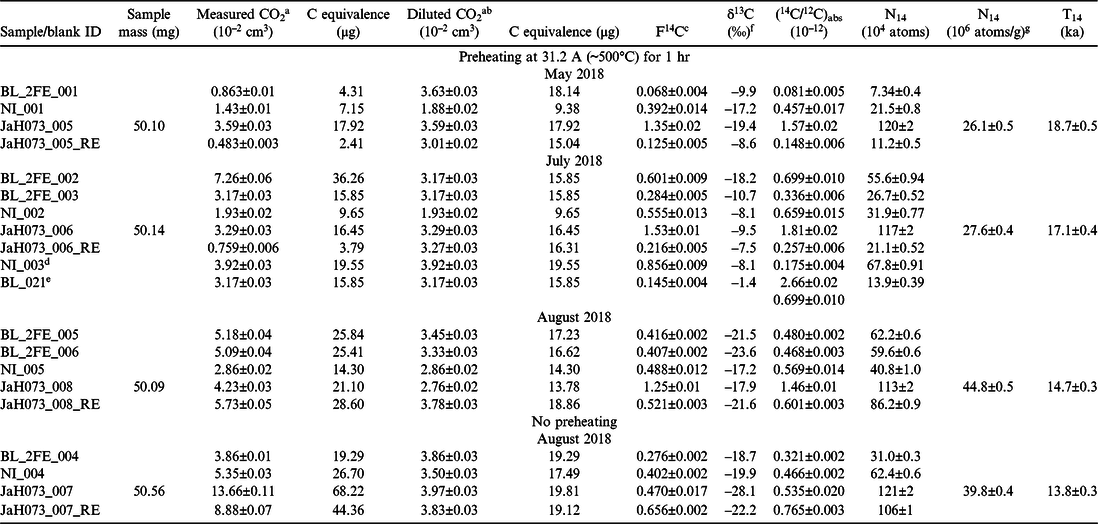
Table 1 summarizes all measurements completed using this setup. In total, four aliquots of the JaH 073 strewn field, our reference sample, were measured—three with applying a preheating procedure and one without preheating. The blank values given in Table 1 are distinguished into system blanks (BL_2FE) and procedural blanks (NI) (see also Mészáros et al. Reference Mészáros, Leya, Hofmann and Szidat2018). The first measurements of the JaH 073 aliquots were in good agreement with literature data (Gnos et al. Reference Gnos, Lorenzetti, Eugster, Jull, Hofmann, Al-Kathiri and Eggimann2009, Mészáros et al. Reference Mészáros, Leya, Hofmann and Szidat2018). Further measurements, however, suffered from a gradual increase in the number of extracted 14C atoms and it was never entirely clear whether the extra 14C atoms came from the previous, not completely combusted samples, from the Fe-pellets, or from both. Though the number of 14C atoms per gram sample was more or less consistent for all measured aliquots, the sample re-extractions showed a gradual increase in the number of extracted 14C atoms, clearly indicating that the previous samples were not completely extracted. For example, the re-extraction of a JaH 073 aliquot measured in August 2018 gave 86.2 (±0.9) × 104 14C atoms, whereas the main extraction of the sample itself gave 113 (±2) × 104 14C atoms, i.e., only slightly more. Therefore, with this setup was impossible to prove complete 14C extraction from samples and to guarantee that there was no cross contamination among the different samples.
Results of the extraction of system blanks, procedural blanks, and samples from the Fe-pellet experiments.

BL_2FE—system blank, NI—procedural blank, RE—sample re-extraction. All uncertainties are 1 σ.
a CO2 volumes are at 20°C.
b CO2 volumes submitted to AMS – in order to reach the measurable C amount gas expanded into a known volume and a portion collected, or with added 14C-free CO2 carrier.
c Fraction modern carbon normalized to δ13C of -25‰VPDB and AD 1950.
d Re-extraction measurement done by adding two Fe-pellets wrapped in Ni foil.
e CO2 shot blank.
f The measured δ13C of the sample, used to determine the 12C/CTOTAL for the sample.
g N14 per gram sample calculated using the sum of 14C atoms from sample and re-extraction measurements.
There were two major difficulties that prevented routine application of the described extraction system. First, once the Fe-pellets reached their melting temperature of ~1540°C, as indicated by the bright yellow to white glow and the changes in the shape of the pellets, they oxidized extremely fast, thereby losing their electric conductivity. Since RF heating is only applicable to electric conductors, the oxidized Fe pellets could no longer be heated and the mixture of sample and Fe-pellets rapidly cooled. Consequently, sufficient heating was only for a short time, in fact too short to entirely melt and oxidize the samples. Indeed, inspection of the leftover material inside the crucible after several measurements demonstrated that the nickel (Ni) foil used to wrap the samples was only partially molten and even retained its original shape. Even though the meteorite samples were powdered and were closely wrapped into the Ni-foil together with the two Fe-pellets, we were never certain if the meteorite aliquots were fully molten and oxidized. To make things worse, re-extractions to demonstrate complete melting and extraction of 14C were not possible because the already oxidized Fe-pellets could not be reheated. Hence, after a few samples the crucible was filled with an uncontrollable mix of partially to fully combusted samples together with fully and partly oxidized Fe-pellets; clearly unacceptable for high-quality measurements. During measurements in July 2018, two Fe-pellets wrapped in Ni foil (NI_003 in Table 1) was added directly after the re-extraction of the JaH 073 aliquot (JaH073_006) to check whether such a re-extraction procedure would be more successful. Indeed, the number of extracted 14C atoms was higher than the number of 14C atoms released from the previously measured procedural blanks. However, this finding does not necessarily demonstrate that the remainder of the meteorite aliquot was fully oxidized, considering that some of the subsequently measured Fe-pellets, which are used as system blanks, were relatively high in released 14C (e.g., BL_2FE_002). Second, though the pellets were of high purity Fe (99.99+), they nevertheless contained significant traces of carbon (not specified by the manufacturer), which was highly heterogeneous amongst the different pellets. This heterogeneity was tested for by measuring the amount of released CO2 as a function of pellet mass, but no correlation was found. Note that an ill-defined and non-reproducible background contribution of CO2 clearly prohibits high quality 14C extractions.
This setup was very similar to the system described by Minami and Nakamura (Reference Minami and Nakamura2001), which itself was modified after Jull et al. (Reference Jull, Donahue, Cielaszyk and Wlotzka1993). Briefly, in their method the authors mixed samples with about 2 g of high purity Fe and placed this mixture in an Al2O3-crucible. The crucible (and its lid) was preheated prior to their use. Samples were preheated at 500°C in a separate muffle furnace. Extraction of CO2 gas from the preheated samples in the preheated Al2O3-crucible was via RF heating. However, this system also suffered from incomplete sample combustion and a considerable background blank. In addition, the system is designed to break the vacuum, and change and clean the crucible after every measured sample. This limitation is exactly what we want to avoid in our system.
Stainless Steel (AISI 304) as a Combustion Catalyst
As demonstrated in the previous section, Fe-pellets were not suitable for our combustion and extraction setup for various reasons. First, the carbon content was high and variable, and second, they oxidized and therefore cooled too quickly to enable complete and throughout melting and oxidation of the samples. Thus, we decided to change the combustion catalyst to stainless-steel pellets with a certified carbon concentration (AISI 304, Fe/Cr18/Ni10, carbon concentration of 220 ppm). The known and homogeneous carbon content in the steel pellets would make it possible to prove whether all carbon from the steel pellet, and with it likely all carbon from the sample, was oxidized and released as CO2, enabling an internal quality control. In addition, stainless steel is known to be relatively resistant against oxidation. We therefore expected that stainless-steel pellets would stay at high temperatures for longer time than Fe-pellets, allowing for a more complete melting and oxidation of the samples. Note, however, that the higher resistance of stainless steel to oxidation was proven for atmospheric pressure and at room temperature but not for a partial pressure of 30 mbar UHP O2 and at 1600°C. For preparing the catalysts, we used a stainless-steel rod (6 mm diameter and 250 mm length) from Advent Research Materials Ltd. The rod was cut into thin disks using a diamond rock saw. The individual disks were then polished using a rock polisher to remove rough edges. The produced pieces varied in mass from 155 mg to 477 mg. In total we produced seven pieces.
Initial tests with the stainless-steel disks were promising; the stainless steel did not oxidize before reaching its melting temperature of ~1450°C. Equally important, the disks stayed at the maximum temperature for the entire extraction. The first analysis of a 155 mg stainless-steel disk released 37.1 μg of carbon; the second and third re-extractions released additionally 8.6 μg of carbon. From the released carbon and the mass of the studied pellet, we calculate a carbon concentration of 295 ppm, which was higher than the specified value pf 220 ppm. A second steel disk of 477 mg, however, only released ~180 ppm carbon, indicating that either the steel was not as homogeneous as expected with respect to carbon and/or that the extraction procedure was not as reproducible as anticipated. Turning the argument around, the extraction of 155 mg steel pellet together with our homogeneous sample powder resulted in 4.31 mbar of CO2 in the capillary. Therefore, extracting the CO2 from a 477 mg steel disk should result in 13.3 mbar of CO2 from the steel alone, not to mention the CO2 released from the sample. In contrast, we extracted only 5.46 mbar of CO2, i.e., far too little.
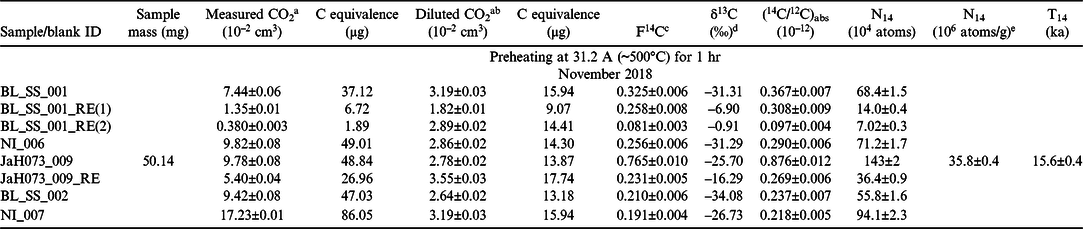
In addition to the problem of fully releasing the CO2from the steel and the sample, AMS measurements demonstrated an increase of the 14C blank after each sample, even though re-extractions were performed for all samples (Table 2). Again, the data indicated that complete melting and carbon release could not be achieved. Eventually the system behaved very similar to the setup using Fe-pellets, hence we concluded that using stainless steel as a combustion catalyst is not feasible in our extraction system. We therefore changed the system to its current final setup (see below). Note that the previously mentioned system in Japan (Minami et al. Reference Minami, Terui, Takaoka and Nakamura2006) has also undergone many changes over the years. For example, in their system instead of adding pure Fe to the samples, steel with a known carbon concentration of 0.0519±0.0012 wt% is added. The reason for choosing this steel is its carbon content, i.e., combustion of 3 g of the steel delivered ~1 mg of carbon, an amount necessary for the AMS measurements. In their current system, the Al2O3-crucible is preheated at 1000°C and the samples are preheated in a muffle furnace at 500°C in air before combustion using RF heating (Minami et al. Reference Minami, Terui, Takaoka and Nakamura2006). Though the system gives reliable results, it is still necessary to break the vacuum, and clean and change the crucible after every sample, significantly reducing sample throughput.
Results of the extraction of system blanks, procedural blanks, and samples from the stainless-steel experiments.

BL_SS—system blank, NI—procedural blank, RE—sample re-extraction. All uncertainties are 1 σ.
a CO2 volumes are at 20°C.
b CO2 volumes submitted to AMS—in order to reach the measurable C amount gas expanded into a known volume and a portion collected, or with added 14C-free CO2 carrier.
c Fraction modern carbon normalized to δ13C of –25‰VPDB and AD 1950.
d The measured δ13C of the sample, used to determine the 12C/CTOTAL for the sample.
e N14 per gram sample calculated using the sum of 14C atoms from sample and re-extraction measurements.
Current Analytical Setup: High Frequency Generator and Pt-Crucible
From the various setups presented before, the RF heating approach proved to be a good solution for one of the major problems for all heating experiments—unnecessary heating of a large portion of crucible material to finally heat a small sample. Heating a large and heavy crucible usually increases the blank due to, first, longer heating cycles and, second, more heated material. This was the argument for the combustion catalyst, which, however, remained to be the problematic part; either it produced a too high CO2 background and/or it oxidized too quickly to guarantee a throughout melting and oxidation of the samples. For RF heating and combustion, the material used either as a crucible or as a combustion catalyst must be conductive, inert against oxidation, and should not change its properties even when heated several times. Platinum (Pt) became the material of our choice and hence, a Pt-crucible was ordered from Labor-Platina Ltd with the following dimensions: 14 mm outer diameter, 1 mm wall thickness, 80 mm length, and 3 mm bottom thickness.
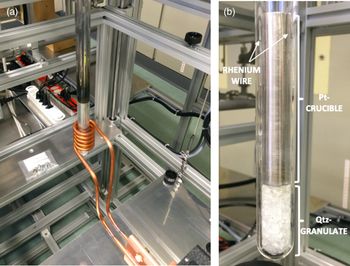
The Pt-crucible was placed inside an outer Qtz-glass crucible (Figure 1), analogous to the double-walled Qtz-crucible system used before. Again, the bottom 2–3 cm of the Qtz-crucible was filled with Qtz-granulate on which the Pt-crucible was placed to avoid direct contact between the hot Pt-crucible and the outer Qtz-crucible. For safety reasons, a rhenium wire placed between the upper part of the Pt-crucible and the outer Qtz-crucible prevented the Pt-crucible to touch the outer glass because, again, direct contact could locally heat and break the glass, and thus the vacuum. Multiple heating tests were performed before first meteorite aliquots were measured. First, tests were performed to see if the crucible can reach the temperature needed for extraction, i.e., what is the maximum temperature that can be reached without melting or damaging the platinum, <1768°C. With our setup is it not straightforward to directly measure the temperature; however, the glow-color indicates that the temperature is indeed approaching the melting temperature of Pt. The temperatures of the Qtz- and Pt-crucibles were measured during preheating and extraction using an infrared (IR) thermometer camera (see below). Second, we performed the same tests but with an O2 flow of 30 mL/min to check if and how the gas flow cools the crucible. It was indeed observable that the O2 flow resulted in a cooling of the Pt-crucible, but it was easy to still reach the required temperature by simply adjusting the power of the RF generator. Still, the required temperature can be reached at just one third of the maximum power available with this type of RF generator. Third, first samples were measured to determine the preheating settings for this system. The tests gave pre-extraction currents of 90.2 A (~500°C) and extraction currents of 210 A (~1600°C) (also see below). Note that the new home-made RF coil recently installed is even more efficient than the original commercial one. The major advantage of this new coil setup is that introducing an O2 flow or an O2 partial pressure no longer results in a cooling of the crucible. Therefore, with or without O2 flow the extraction current is always close to 120 A, which is only about 20% of the maximum that can be reached with this type of RF generator.
(a) The current analytical setup of the combustion-extraction system. The RF coil is placed around the Qtz-crucible, hosting the Pt-crucible inside; (b) A close-up of the crucible setup. The Pt-crucible rests on a layer of Qtz-granulate. On the top of the Pt-crucible two pieces of rhenium wire are visible, separating the Pt- and the Qtz-crucible.

Up to now, 17 sets of samples (system blank, procedural blank, sample, sample re-extraction) were performed. In addition, seven smaller sets of measurements were performed to determine the preheating current for the new coil (see above). Therefore, in total, 23 pieces of Al foil and 17 meteorite aliquots are already inside the Pt-crucible at the time of writing (September 2019). The extraction system remained fully functional for 17 meteorite aliquots without cleaning and without breaking the vacuum. For the last three meteorite samples, however, the AMS measurements revealed a successively lower yield of 14C atoms. This finding, in addition with the finding, that procedural blanks did not produce any CO2 gas, indicates that the Pt-crucible was too full and heating was no longer effective. Consequently, both crucibles were emptied and cleaned.
All initial heating tests were performed by continuously inspecting the interior of the crucible, which is visible through the glass opening at the top of the sample holder, located directly above the crucible. After a few measured samples, some of the Al from the molten foils unfortunately condensed onto the glass window and prohibits a direct view into the crucible. Although this is an inconvenience, it is not a limitation for the performance of the system. For the initial tests, the temperature was regularly checked using an IR thermometer. In the following, “top” refers to the part of the Qtz-crucible that is visible directly above the RF coil, and “bottom” refers to the part of the Qtz-crucible that is visible directly below the coil, i.e., the part filled with Qtz-granulate. During preheating, the top of the Qtz-crucible is at a temperature of ~180°C and the bottom is at ~90°C. During extraction, the top of the Qtz-crucible is at max. 550°C and the bottom is at max. 250°C. Immediately after the RF heating has been switched off, the top of the Qtz-crucible is at ~350–400°C and the bottom is at ~200°C. The temperature reading therefore clearly indicates an efficient cooling of the Qtz-crucible. Remember that the outside of the outer Qtz-crucible is in contact to air and therefore convection is a very efficient way of cooling. For the temperature measurements of the Qtz-crucible we used an emissivity (ϵ) of 0.90, which is valid for glass. The IR camera was also used to measure the temperatures of the Pt-crucible during preheating and extraction. Temperature measurements of the Pt-crucible were done by setting the emissivity ϵ to 0.16 (platinum typically ~0.14-0.18). Based on ten temperature measurements, the bottom of the Pt-crucible, i.e., the thickest part of the crucible, reaches 498±6°C during preheating. During extraction, the temperature reading showed 2024±68°C, which is unreasonable because it is far above the melting point of Pt. Note that despite this temperature reading no damage to the Pt-crucible or to the Qtz-crucible could be observed. After each measurement, the inside of the crucible is inspected from above, through the opening in the sample holder. So far, we observe efficient melting of all samples.
CURRENT ANALYTICAL PROCEDURE
The current extraction protocol contains minor changes in the heating protocol, relative to the one described earlier by Mészáros et al. (Reference Mészáros, Leya, Hofmann and Szidat2018), however the sample preparation is still conducted according to the procedure previously stated. In summary, after sample milling, the sample fraction with a grain-size of 125–250 µm is treated first for 30 min with 6.0 N HCl to dissolve carbonates, and then with ethanolamine-thioglycollate (EATG) for 2 days to remove iron oxides and hydroxides. As shown by Mészáros et al. (Reference Mészáros, Leya, Hofmann and Szidat2018) this leaching procedure removes unwanted compounds without affecting the primary minerals (see Introduction), which contain the insitu produced 14C.
In the current setup, sample preheating is at a RF current of 60.5 A, which corresponds to ~500°C. Currently, the preheating step lasts for 1 hr and takes place in a continuous UHP O2 flow with continuous pumping. This step removes adsorbed water and terrestrial contaminants. Next, the crucible is disconnected from the pump, an O2 partial pressure of 30(±5) mbar is established, and the generator current is gradually increased in 10 A steps (50°C min–1). After each increase of the current, the glow-color of the crucible and the decrease in the O2 partial pressure inside the crucible are noted. A drop in O2 pressure during extraction is expected because the aim of the extraction protocol is to oxidize the sample.
The evolved gases are expanded into a high-temperature gas purification furnace (Carbolite-Gero®), working in the temperature range between 500°C and 1000°C. The furnace contains quartz spherules, silver wool, and copper-oxide, supporting purification and/or oxidation of the gas. The expanded gas is collected in a helix that is cooled with liquid nitrogen (LN2). The total extraction lasts for 10 min at a current of 121.0 A (~1600°C). After extraction, the current of the RF generator is reduced to 60.5 A (~500°C), the crucible cools down, and any remaining O2 can be pumped away safely. After the system is back to its minimum background pressure below 5×10⁻⁴ mbar, the gas purification and CO2 collection steps are carried out as described by Mészáros et al. (Reference Mészáros, Leya, Hofmann and Szidat2018). In brief, the gases collected in the helix are expanded into a known volume and the pressure is noted. Next, the water trap is cooled to a temperature of –78°C to remove remaining water. Next, the remaining gas is transferred to a cold finger cooled with LN2. Any remaining unfrozen gas is pumped away, the LN2 is removed, and a cold trap set to a temperature of –100°C is applied to the cold finger. The released CO2 gas is trapped in a glass capillary that is cooled with LN2. The collected CO2 gas is expanded into a known volume above and including the capillary and the pressure is noted. If the amount of collected carbon is too low (<10 μg C) for a reliable 14C/12C measurement using the MICADAS system at the Department of Chemistry and Biochemistry, University of Bern, we add extra 14C-free CO2 (see also Mészáros et al. Reference Mészáros, Leya, Hofmann and Szidat2018).
AMS MEASUREMENTS AND DATA REDUCTION
The 14C analyses to determine the 14C/12C ratios were conducted using the MICADAS at the Laboratory for the Analysis of Radiocarbon with AMS (LARA) at the Department of Chemistry and Biochemistry, University of Bern (Szidat et al. Reference Szidat, Salazar, Vogel, Battaglia, Wacker, Synal and Türler2014), as described in Mészáros et al. (Reference Mészáros, Leya, Hofmann and Szidat2018). In summary, glass ampules containing the collected CO2 gas were introduced into the gas interface of the MICADAS, cracked open, the CO2 gas was mixed with helium gas, and this mixture was transferred to the gas ion source. The 14C results are expressed as F14C (fraction modern carbon) values. For calculating the 14C terrestrial ages we are using the 14C data reduction equations given by Hippe et al. (Reference Hippe, Kober, Wacker, Fahrni, Ivy-Ochs, Akçar, Schlüchter and Wieler2013) and Hippe and Lifton (Reference Hippe and Lifton2014). To start, the absolute 14C/12C ratio is determined using the measured F14C value and this ratio is used to calculate the number of 14C atoms (N14). The number of 14C atoms per gram of sample is then used to calculate the specific activity (dpm/kg) of the sample. Finally, the terrestrial age is calculated using the specific activity of the samples and the saturation activity for the studied meteorite type. For a detailed description of the data reduction calculations the reader is referred to Mészáros et al. (Reference Mészáros, Leya, Hofmann and Szidat2018). For most of the terrestrial ages, though, we now use the 14C-10Be dating technique, which is more reliable than using 14C alone.
CURRENT PERFORMANCE: RESULTS AND DISCUSSION
System and Procedural Blanks
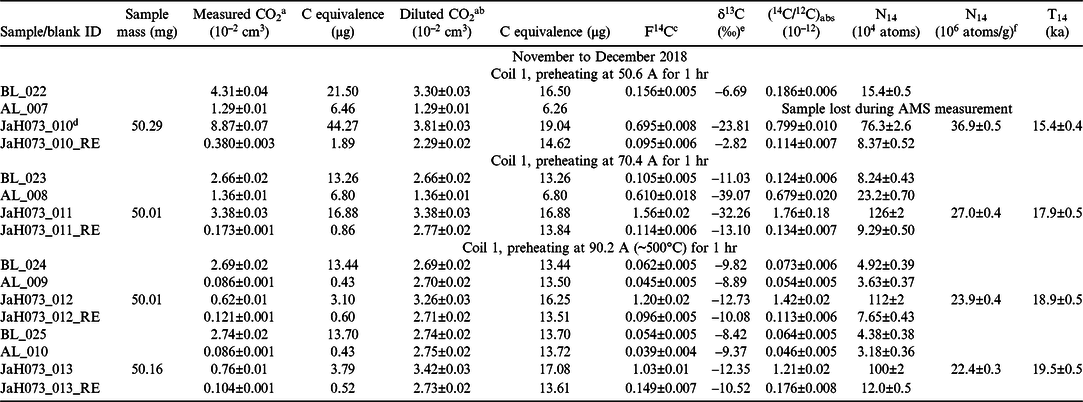
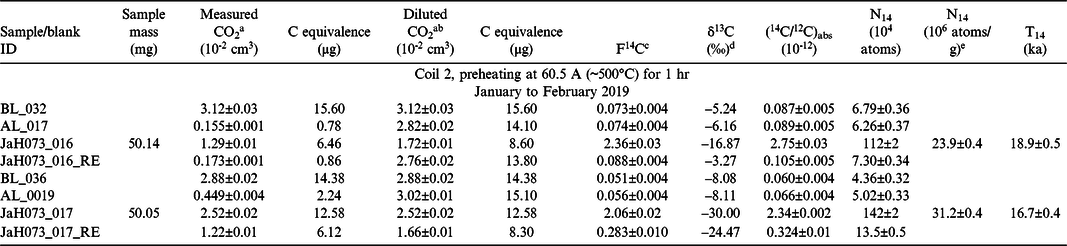
As already described by Mészáros et al. (Reference Mészáros, Leya, Hofmann and Szidat2018), we distinguish two types of blanks: system blanks and procedural blanks. The abbreviation used in Tables 3 and 4 for system blanks is BL and for procedural blanks it is AL. For the current extraction system, as it has been for the setup used by Mészáros et al. (Reference Mészáros, Leya, Hofmann and Szidat2018), system blanks are performed by introducing a known amount of 14C-free CO2 gas into the system and applying the normal gas separation and gas cleaning steps (see above). For procedural blanks we measure an Al-foil, used to wrap the samples, in the same way we usually measure the samples. Table 3 summarizes the results of the measurements of the various aliquots of the JaH 073 strewn field together with the associated system and procedural blanks at three different preheating currents. One can see that both system and procedural blanks become lower with higher preheating current. From the data we concluded that a preheating current of ~90 A is highly efficient for the removal of terrestrial contamination but is still low enough to not release the cosmogenic 14C from the sample. The extracted number of 14C atoms (N14) for our system and procedural blanks is comparable to that reported by Mészáros et al. (Reference Mészáros, Leya, Hofmann and Szidat2018), where the N14 values for blanks were well-established for preheating at 500°C using the convection oven system, where temperature could be directly monitored. We also spotted that successive heating cycles helped cleaning the crucible and with every heating cycle, i.e., blank and sample measurement, both system and procedural blanks became lower. Importantly, for the established preheating procedure (1 hr at 90.2 A) the system and procedural blanks are almost indistinguishable, i.e., they range between 3.18×10⁴ 14C atoms to 4.92×10⁴ 14C atoms, which is a minor correction for the number of 14C atoms usually released from the sample, which is in the range of 100×104 or more. If we compare our system blanks to the system blanks by Mészáros et al. (Reference Mészáros, Leya, Hofmann and Szidat2018) obtained using an earlier setup we find that our blanks for Coil 1 and a preheating current of 90.2 A are relatively constant in the range of 4.28×10⁴ and 4.92×10⁴ 14C atoms, with an average of 4.6(±0.3)×104 14C atoms. In comparison, the earlier set up gave system blanks ranging from 1.35×10⁴ to 5.06×10⁴ 14C atoms, with an average of 2.6×10⁴ 14C atoms (Mészáros et al. Reference Mészáros, Leya, Hofmann and Szidat2018). The system blanks obtained using Coil 2 are in the range 4.36×10⁴ and 6.79×10⁴ 14C atoms with an average of 5.6(±1.2)×104 14C atoms. The upper limit is slightly higher compared to the one obtained by using Coil 1. This slight increase is most likely due to the fact that we had to replace the outer Qtz-crucible because it cracked after 37 measurements/heating cycles. We cannot exclude that the new Qtz-crucible might have released some 14C during the first few times of usage. In addition, in the setup using Coil 1 and the old outer Qtz-crucible, a rhenium wire was used to separate the top of the inner Pt-crucible from the outer Qtz-crucible. After changing to Coil 2 and replacing the outer Qtz-crucible, we changed to a tungsten wire for the separation. Apparently, the tungsten wire releases slightly more 14C atoms than the rhenium wire. This finding is also supported by the visual inspection; the tungsten wire clearly oxidised, its colour changed gradually with each heating cycle to pale yellow. With the next crucible cleaning, the tungsten wire will be discarded and replaced a by rhenium wire.
Results of the extraction of system blanks, procedural blanks, and samples from tests using Coil 1.

BL—system blank, AL—procedural blank, RE—sample re-extraction. All uncertainties are 1 σ.
a CO2 volumes are at 20°C.
b CO2 volumes submitted to AMS—in order to reach the measurable C amount gas expanded into a known volume and a portion collected, or with added 14C-free CO2 carrier.
c Fraction modern carbon normalized to δ13C of –25‰VPDB and AD 1950.
d Not corrected with blank.
e The measured δ13C of the sample, used to determine the 12C/CTOTAL for the sample.
f N14 per gram sample calculated using the sum of 14C atoms from sample and re-extraction measurements.
Results of the extraction of system blanks, procedural blanks, and samples from tests using Coil 2.

BL—system blank, AL—procedural blank, RE—sample re-extraction. All errors are 1 σ.
a CO2 volumes are at 20°C.
b CO2 volumes submitted to AMS – in order to reach the measurable C amount gas expanded into a known volume and a portion collected, or with added 14C-free CO2 carrier.
c Fraction modern carbon normalized to δ13C of –25‰VPDB and AD 1950.
d The measured δ13C of the sample, used to determine the 12C/CTOTAL for the sample.
e N14 per gram sample calculated using the sum of 14C atoms from sample and re-extraction measurements.
As already discussed by Mészáros et al. (Reference Mészáros, Leya, Hofmann and Szidat2018), due to high procedural blanks produced from the non-preheated Al-foil, all measurements have to be performed with a preheating step; we no longer conduct measurements without preheating. The procedural blanks used to correct the samples are listed in Tables 3 and 4. As already mentioned, these blanks fall gradually with increasing preheating current. Procedural blanks using Coil 2 were slightly higher than for Coil 1. Unfortunately, no procedural blank is available for measurements with a preheating current of 50.6 A, because the sample was lost during AMS measurements.
The blank of 2.6×10⁴ 14C atoms obtained using Coil 1 is about a factor of 8–9 lower than the extraction blanks published by Lifton et al. (Reference Lifton, Jull and Quade2001, Reference Lifton, Goehring, Wilson, Kubley and Caffee2015) but is comparable to the blank level reached at the new extraction system established at ETH Zürich of 1.92(±0.56)×104 (Lupker et al. Reference Lupker, Hippe, Wacker, Steinemann, Tikhomirov, Maden, Haghipour and Syal2019). Assuming now that we can safely detect 14C concentrations more than three times higher than the blank, i.e., we can safely detect 8×10⁴ 14C atoms/g and assuming further that we measured samples masses in the range 50 mg we calculate that we can relatively safely measure terrestrial ages up to 45 ka.
Reproducibility: JaH 073 Strewn Field Data
The reproducibility of sample measurements is satisfying, though from the first data it seems that the reproducibility was slightly better for the setup using Coil 1 (after preheating with 90.2 A) than for the setup using Coil 2 (after preheating with 60.5 A). Note that the second JaH 073 aliquot (MS_JaH073_017) measured using Coil 2 was measured after replacing the outer Qtz-crucible, hence the higher number of extracted 14C atoms rather indicates contamination adhering to the inside of the Qtz-crucible than problems with the reproducibility (Table 4). The JaH 073 strewn field sample consists of a homogenized sample powder, therefore sample heterogeneity is not expected. The found deviations therefore likely indicate the reproducibility of the total sample extraction and cleaning procedure. From the four measurements we calculate a grand average specific 14C concentration of 25.3×10⁶ atoms/g with a 1σ standard deviation of 2.0×10⁶ atoms/g, i.e., 7.8%. For future studies we consider the standard deviation of 2.0×10⁶ atoms 14C/g as the external systematic reproducibility of our extraction procedure for meteorite samples with a 14C terrestrial age measured in the range of 0 to 20 ka, i.e., for specific 14C concentrations in the range (20–70)×106 atoms/g.
CONCLUSIONS
The 14C extraction line at the University of Bern has undergone three major improvements concerning the extraction and combustion system since its first description by Mészáros et al. (Reference Mészáros, Leya, Hofmann and Szidat2018). In its final form, the extraction and combustion system comprises of an outer wall Qtz-glass-crucible with an inner Pt-crucible, heated by radio-frequency. The blanks are reasonably constant and low in the range 2.6×10⁴ 14C atoms, which is comparable to other sophisticated systems (e.g., Lupker et al. Reference Lupker, Hippe, Wacker, Steinemann, Tikhomirov, Maden, Haghipour and Syal2019) and lower than some of the other systems (e.g., Lifton et al. Reference Lifton, Jull and Quade2001, Reference Lifton, Goehring, Wilson, Kubley and Caffee2015). The system shows the tendency of decreasing blanks with increasing number of heating cycles, which indicates that in future routine applications the blank levels can even be lower. The current blank levels enable determining terrestrial ages up to about 45 ka. Using our reference sample from the JaH 073 strewn field, we first determined the adequate preheating and extraction RF currents, and second, we tested the system for reproducibility. The latter is in the range 7–8% for 14C concentrations in the range (20–30)×106 atoms, i.e., for meteorites with terrestrial ages in the range 0–20 ka. Finally, with the current system we have reached our goal to measure a large number of meteorites for 14C samples without breaking the vacuum. Currently, measurements of other previously measured strewn fields, such as Jiddat al Harasis 091, as well as strewn fields not yet measured for 14C are in progress.
Acknowledgments
The authors would like to thank Maarten Lupker and the anonymous reviewer of this paper for their constructive comments, which helped us to improve the manuscript. The samples used in this study were collected during the Omani–Swiss Meteorite Search campaigns. This study was supported by the Swiss National Science Foundation, grant 200020_166251, under the project “Meteorite Accumulations of Arabia.”