Implications
Dietary resistant starch (RS) can negatively impact the energetic efficiency in pigs. By contrast, RS forms a type of dietary fiber that may affect the host beneficially by stimulating intestinal fermentation. The present meta-regressions support the capacity of RS type 2 to decrease hindgut pH, shift the fermentation profile to more propionate in the mid-colon and to support growth of lactic acid-producing bacteria in the distal hindgut. Increasing the RS level in pig’s diet may be used to stabilize the intestinal homeostasis especially post-weaning and in the early growing period.
Introduction
Starchy feedstuffs represent the largest fraction of pig diets. However, dietary starches from different sources are digested at different rates and to different extents depending on the source of starch, feed processing and animal related factors (Giuberti et al., Reference Giuberti, Gallo, Moschini and Masoero2015). The rate, extent and gastrointestinal site where the starch is degraded will cause different physiological effects related to nutrient absorption, metabolic response and pig performance (Regmi et al., Reference Regmi, Metzler-Zebeli, Gänzle, van Kempen and Zijlstra2011; Haenen et al., Reference Haenen, Zhang, da Silva, Bosch, van der Meer, van Arkel, van den Borne, Pérez Gutiérrez, Smidt, Kemp, Müller and Hooiveld2013; Metzler-Zebeli et al., Reference Metzler-Zebeli, Eberspächer, Grüll, Kowalczyk, Molnar and Zebeli2015a and Reference Metzler-Zebeli, Schmitz-Esser, Mann, Grüll, Molnar and Zebeli2015b). The starch digestibility in feedstuffs ranges from rapidly digestible to resistant to α-amylase digestion in the small intestine. The RS fraction is regarded as a type of dietary fiber and has received substantial attention in human (Birt et al., Reference Birt, Boylston, Hendrich, Jane, Hollis, Li, McClelland, Moore, Phillips, Rowling, Schalinske, Scott and Whitley2013) and pig nutrition (Giuberti et al., Reference Giuberti, Gallo, Moschini and Masoero2015). As it escapes digestion in the small intestine, RS serves as substrate for fermentation in the hindgut and has been associated with increased digesta mass, short-chain fatty acids (SCFA) production and stimulation of amylolytic and butyrogenic bacteria (Birt et al., Reference Birt, Boylston, Hendrich, Jane, Hollis, Li, McClelland, Moore, Phillips, Rowling, Schalinske, Scott and Whitley2013). Despite potential health benefits mediated via the action of SCFA (especially butyrate) such as ameliorated intestinal integrity and immunity, the dietary RS fraction has a controversial status in pig nutrition due to its potential negative impact on energetic efficiency and hence animal growth (Giuberti et al., Reference Giuberti, Gallo, Moschini and Masoero2015). Like other types of dietary fiber, RS may exert prebiotic effects and may be considered a functional dietary ingredient rather than an energy feedstuff (Bird et al., Reference Bird, Vuaran, Crittenden, Hayakawa, Playne, Brown and Topping2009; Nielsen et al., Reference Nielsen, Lærke, Theil, Sørensen, Saarinen, Forssten and Knudsen2014). As such, RS may contribute to an improved intestinal homeostasis and disease resistance, thereby supporting growth performance in weaned and growing pigs. Yet, reported effects of RS on fermentation metabolites, such as SCFA, in pigs are inconsistent (Bird et al., Reference Bird, Vuaran, Crittenden, Hayakawa, Playne, Brown and Topping2009; Regmi et al., Reference Regmi, Metzler-Zebeli, Gänzle, van Kempen and Zijlstra2011; Nielsen et al., Reference Nielsen, Lærke, Theil, Sørensen, Saarinen, Forssten and Knudsen2014) which may be associated with factors like source and inclusion level of RS, feed composition and the age of the animal. Currently, five different types of RS have been described (Birt et al., Reference Birt, Boylston, Hendrich, Jane, Hollis, Li, McClelland, Moore, Phillips, Rowling, Schalinske, Scott and Whitley2013), whereby physically inaccessible starch (RS1; e.g. intact cereal and seed grains), resistant granules (RS2; e.g. raw potatoes, high-amylose cereals (maize, barley)), and retrograded starch (RS3) are the most relevant RS types in pig diets (Giuberti et al., Reference Giuberti, Gallo, Moschini and Masoero2015). RS1 and RS2 are mainly found in unprocessed cereal grains, legumes and tubers, whereas RS3 forms in heat-processed feedstuffs (Giuberti et al., Reference Giuberti, Gallo, Moschini and Masoero2015).
Collectively, more research evidence is available for RS2 effects on gut microbial metabolites and bacteria in pigs than for the other RS types from the literature. Therefore, the primary objective of the present meta-analysis was to quantify the effect of dietary RS2 on intestinal fermentation metabolites, pH and certain key bacterial taxa for intestinal health in weaned, growing and finishing pigs. We used a meta-analytical approach, because, opposite to qualitative reviews, meta-analyses can consider changes in the direct (type and dose) and indirect factors (e.g. age of the animal) influencing starch digestion, fermentation metabolites and pH in pig’s gastrointestinal tract which can cause varying results across research studies (Sales, Reference Sales2014). In that way, the overall treatment effect across studies is generalized (Charbonneau et al., Reference Charbonneau, Pellerin and Oetzel2006). Effects of RS2 on apparent total tract digestibility (ATTD) were further examined for the selected research articles from which gut microbial data were extracted. Moreover, this meta-analysis aimed to derive recommendations for dietary RS levels from RS2 sources leading to physiological effects in pigs.
Material and methods
Literature search
The public search generators PubMed, Google Scholar, Web of Science (Core collections), and Scopus were used to search for literature. Research articles which investigated the effect of RS2 from purified or natural sources on the bacterial abundance and intestinal fermentation and were published in scientific journals between the years 2000 and February 2017 were considered for data extraction. Adequate articles were identified by applying the following search terms in different combinations: RS, high-amylose starch, slowly digestible starch, pig, piglet, swine, gastrointestinal tract and individual segments, gut/intestine, fermentation, microbial metabolites, total and individual SCFA (or volatile fatty acids), lactic acid, neutral and anionic forms of fermentation acids, bacteria, microbiota, microflora and microbiome.
Construction of database
The construction of the database was similar to that previously described (Metzler-Zebeli et al., Reference Metzler-Zebeli, Trevisi, Prates, Tanghe, Bosi, Canibe, Montagne, Freire and Zebeli2017). Of the 35 identified articles, 24 were eligible for the present meta-analysis by meeting a sufficient number of quality criteria (Supplementary Material Table S1). Quality assessment criteria included information about dietary composition, RS level and source (purified concentrate or natural source), details on pig (breed, age, BW, age, sex, production stage), housing condition, number of pigs within treatment groups, duration of the experimental period, experimental design including randomization of treatment groups, description of statistical analysis, and intra-study error (if standard deviation was provided, it was converted into standard error), as well as bacterial abundances, microbial metabolites (i.e. SCFA and lactate) and pH values in digesta of stomach, ileum, cecum, proximal, mid and distal colon and feces (rectum). In addition, average daily feed intake (ADFI), average daily weight gain (ADG) and ATTD data were extracted. Only in vivo studies were included in the present meta-analysis. The main information extracted from each research article is presented in Table 1. When the dietary concentration of RS was not provided, the RS amount in the diet was estimated using published values for similar RS2 sources. In general, different analytical methodologies, including different in vitro α-amylase digestion approaches (e.g. Champ, Reference Champ1992; Morales et al., Reference Morales, Escarpa and González1997) or total starch and RS assay kits (e.g. Megazyme assay kits), the official AOAC method (2002), and the determination of RS according to Englyst and Cummings (Reference Englyst and Cummings1984), were applied to determine the dietary RS concentration. Or the dietary RS content was calculated by using the manufacturer’s specifications in the various research studies.
Descriptive statistics for predictor and response variables for resistant starch (RS) type 2 effects in pigsFootnote 1

ADFI=average daily feed intake; ADG=average daily weight gain; ATTD=apparent total tract digestibility; CI=confidence interval; n treat=number of treatment means included; SCFA=short-chain fatty acids.
1 Separate data sets for response variables pH, short-chain fatty acids, bacteria and performance/digestibility were built.
In order to consider maturational changes from weaned to finisher pigs, pig’s BW at the beginning of the experiment (start BW) was used as an additional predictor variable. Likewise, the length of the experimental period was considered as additional predictor variable because the microbial response to a dietary treatment may change over time.
From the original dataset including all studies, sub-data sets for the individual dependent variable categories were compiled, that is, one sub-dataset each for bacterial abundances, pH values, microbial metabolites including SCFA and lactate, as well as for performance-related variables such as ADG, ADFI and ATTD. Data for individual SCFA were analyzed as concentrations and molar proportions of total SCFA.
Three studies were set as minimum requirement to quantify the combined effect size (Lipsey and Wilson, Reference Lipsey and Wilson2001), together with a minimum of 10 single observations (treatment means) per dependent variable as well as the respective SEM of each variable. Only dependent variables which met these minimum requirements will be presented.
Absolute bacterial abundances were extracted from studies using quantitative PCR(n=7), terminal-fragment-length polymorphism (n=1) and culturing (n=2). Although being different methods of quantification, log10 colony forming units (CFU) were previously shown to highly correlate (0.979 to 0.998) to log10 gene copy numbers per gram of sample (Hein et al., Reference Hein, Lehner, Rieck, Klein, Brandl and Wagner2001). In applying this correlation, we expressed the available bacteria data from PCR-based and culturing-based approaches in log10 gene copies per gram intestinal digesta or feces. Nevertheless, it needs to be kept in mind that CFU and quantitative PCR-based amplification of short sequences of the 16S rRNA gene, are different analytical approaches. Therefore, present regression results should be regarded as an approximation. If provided on DM basis, microbial metabolites and bacterial abundances were converted to fresh matter basis.
Data analysis
Descriptive statistics on predictor (i.e. dietary RS level, start BW and duration of the experimental period) and dependent variables (i.e. bacteria, microbial metabolites, pH, performance and digestibility) was performed using the MEANS procedure of SAS (SAS Institute Inc., version 9.4) similar to Metzler-Zebeli et al. (Reference Metzler-Zebeli, Trevisi, Prates, Tanghe, Bosi, Canibe, Montagne, Freire and Zebeli2017). Mixed modeling of each dependent variable was performed using the MIXED procedure as previously described (Metzler-Zebeli et al., Reference Metzler-Zebeli, Trevisi, Prates, Tanghe, Bosi, Canibe, Montagne, Freire and Zebeli2017). The slope and intercept by study, start BW, duration of experiment and dietary RS content were included as random effects and an unstructured variance-covariance matrix (type=UN) was used to avoid a positive correlation between intercepts and slopes (St-Pierre, Reference St-Pierre2001). Breed and sex were initially included in the model but omitted in the final model as non-influential. By weighing the dependent variable by the inverse of its squared SEM (SEM of treatment means from single studies), the unequal variance among studies was taken into account. In order to test quadratic relationships between the dietary RS level and dependent variables, its squared term was included in the model using variance components (TYPE=VC) as variance-covariance matrix. However, quadratic relationships were not detectable. Data were visualized using the GPLOT procedure. Estimates, RMSE and R 2 were computed and used to evaluate the goodness of fit. Significance was declared at P<0.05 and trends at 0.05<P<0.10.
Backward elimination analysis (Metzler-Zebeli et al., Reference Metzler-Zebeli, Trevisi, Prates, Tanghe, Bosi, Canibe, Montagne, Freire and Zebeli2017) was used to obtain a more precise prediction of influencing factors on dependent variables that were influenced by the dietary RS level. This allowed for the simultaneous evaluation of the predictor variables dietary RS level, squared dietary RS level, start BW and length of the experimental period on the response variables. Model overparameterization was limited by allowing for a variance inflation factor of <10 (which assumes no significant multicollinearity among predictor variables tested) for every continuous independent variable tested.
Results
Database description
The RS2 originated mainly from corn, potato, pea, barley and tapioca (Supplementary Material Table S1). In the majority of studies included, diets were semi-purified with the test starch as the principal starchy component. The results of the descriptive statistics for the predictor and dependent variables are presented in Table 1. The mean and median dietary RS levels amounted to 28.8% and 23.0% of the diet (DM basis), respectively, with dietary inclusion levels ranging from 0% to 78% RS (Table 1). The BW of pigs at the beginning of the experimental period ranged between 4.6 and 105 kg with a mean and median BW of 23.7 and 30.4 kg, respectively. Pigs were fed the test diets between 7 and 100 days with a mean and median duration of the experimental period of 28.7 and 21 days, respectively. Pigs were often restrictively fed; therefore, the impact of RS2 on ADFI and ADG was not further assessed. The ranges of the predictor variables (dietary RS content, BW of the pigs at the start of the experimental period and the duration of the experimental period) in the sub-data sets for nutrient digestibility, gastrointestinal pH, microbial metabolites and bacterial counts are provided in Supplementary Material Table S2.
Resistant starch type 2 effect on intestinal and fecal pH
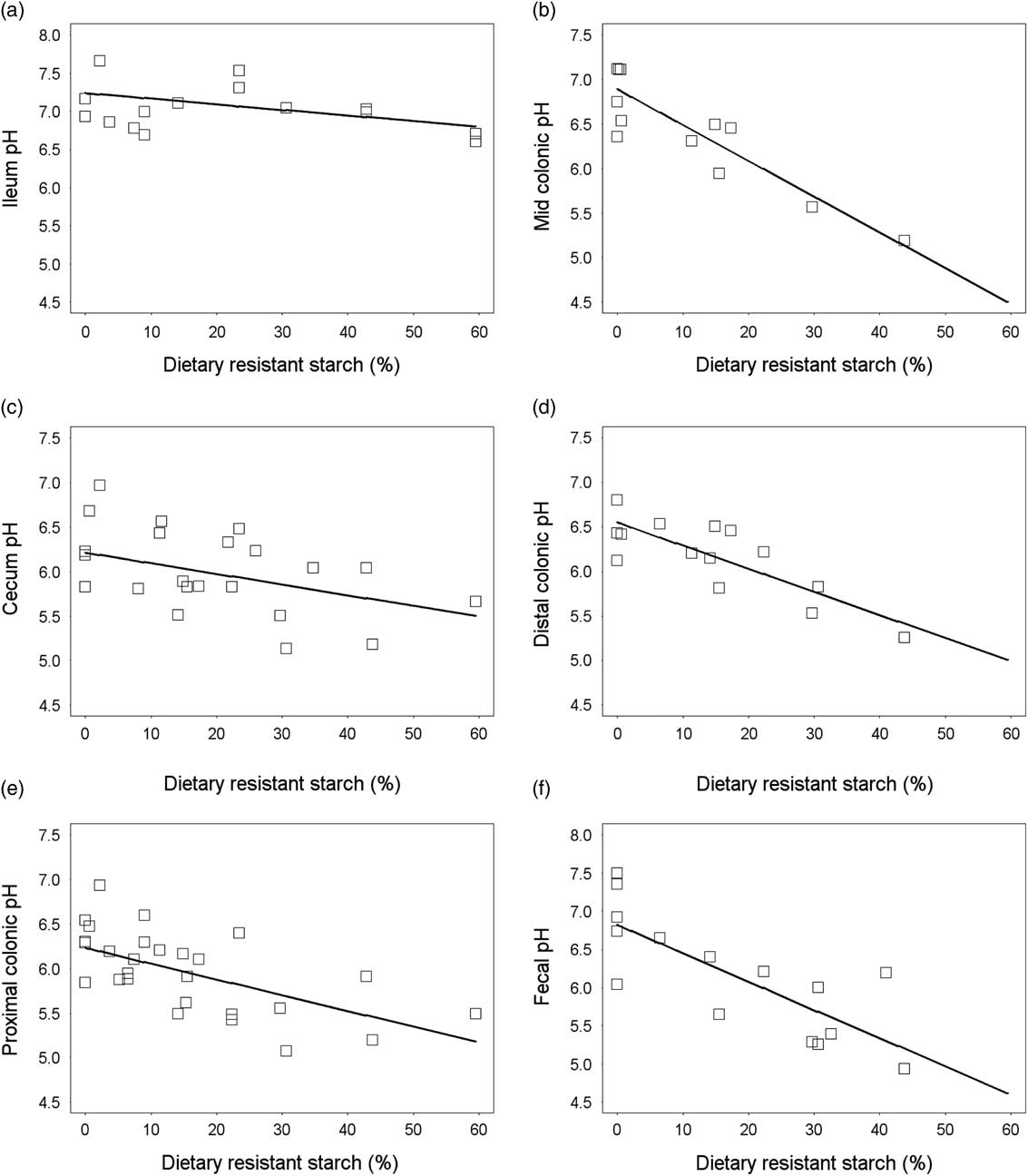
Established relationships between dietary RS level and intestinal and fecal pH showed that the lowering effect of RS on luminal pH became stronger from the ileum to the distal segments of the large intestine and feces. In fact, increasing RS levels tended to decrease the ileal pH (R 2=0.16; P<0.10) and decreased the pH of digesta in cecum (R 2=0.19; P<0.05), proximal, mid and distal colon, and feces (R 2=0.37 to 0.81; P<0.001; Figure 1). According to the present equations, the diet would need to comprise 30% and 20% RS to decrease the ileal and cecal pH by 0.2 units, respectively, whereas a dietary amount of 15% would lower the pH in the proximal, mid and distal colon, and feces by 0.2, 0.6, 0.4 and 0.6 units, respectively.
Linear relationships between dietary resistant starch type 2 (RS2) level and intestinal pH in pigs. Best-fit linear model of luminal pH (Y) in response to dietary RS2 level (X) (a) ileum; (b) cecum; (c) proximal colon; (d) mid-colon; (e) distal colon; and (f) feces.

Resistant starch type 2 effect on intestinal and fecal microbial metabolite concentrations
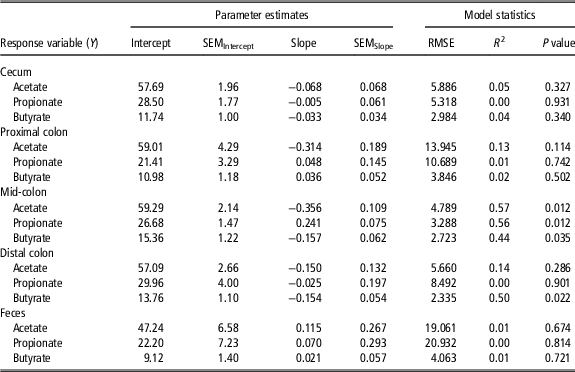
Sufficient information was available for SCFA, whereas the available information for lactate did not meet the minimum requirement to quantify the combined effect size. According to the present regressions, increasing the dietary level of RS did not affect total and individual SCFA concentrations in ileal, cecal and colonic digesta and feces (Supplementary Material Table S3). When comparing the molar proportions of the main SCFAs acetate, propionate and butyrate, relationships between the dietary RS level and the SCFA profiles became apparent. As such, regressions showed that increasing dietary RS levels decreased the molar proportion of acetate and butyrate but increased that of propionate in mid-colonic digesta (R 2=0.44 to 0.57; P<0.05; Table 2). In distal colonic digesta, only the molar proportion of butyrate was negatively related to increasing dietary RS levels (R 2 =0.50; P=0.022). A minimum of 20% of dietary RS would be needed to elevate the molar propionate proportion by 5% in mid-colonic digesta.
Prediction of molar proportions of individual short-chain fatty acids (SCFA mol/100 mol) in cecal and colonic digesta and feces as affected by dietary resistant starch content (%) in pigs

Resistant starch type 2 effect on bacterial abundances
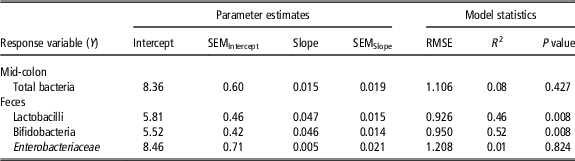
Sufficient information was available for total bacteria in colonic digesta and for lactobacilli, bifidobacteria and Enterobacteriaceae in feces (Table 3). According to the present regressions, increasing the RS level did not affect the total bacterial number in colonic digesta, whereas it promoted the presence of lactobacilli (R 2=0.46, P<0.001) and bifidobacteria (R 2=0.52, P<0.001) in feces. To achieve a physiological relevant increase in fecal lactobacilli and bifidobacteria, a minimum of 10% RS in the diet may be required.
Prediction of absolute bacterial abundance (log10 gene copies/g) in colonic digesta and feces as affected by dietary resistant starch content (%) in pigs

Resistant starch type 2 effect on apparent total tract digestibility
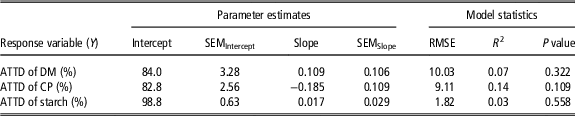
The ATTD of DM, CP and starch was not modified by increasing dietary RS levels (Table 4).
Prediction of apparent total tract digestibility of nutrients as affected by dietary resistant starch content (%) in pigs

ATTD=coefficient of total tract apparent digestibility.
Backward elimination analysis
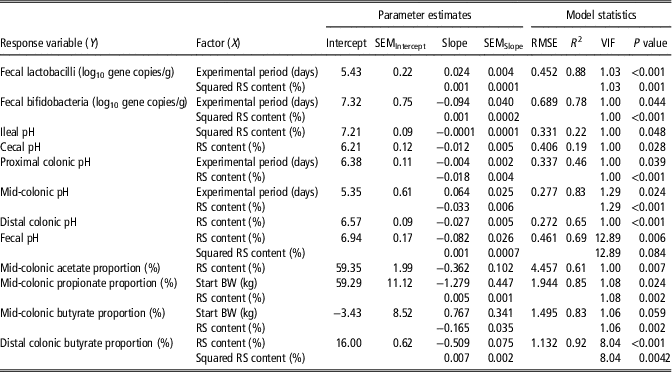
Backward elimination analysis showed that the starting BW of pigs and length of the experimental period influenced the effect of dietary RS2 on the response variables (Table 5). The response variables cecal pH, distal colonic pH and mid-colonic acetate proportion were mainly affected by the increasing dietary RS level (R 2=0.19 to 0.65; P<0.05). According to the squared effect of the RS level, the response variables fecal lactobacilli and bifidobacteria, ileal pH and distal colonic butyrate proportion followed an asymptotic approximation with increasing RS levels (P<0.05). Moreover, backward elimination showed that, besides the positive relationship with dietary RS, the duration of the experimental period increased the fecal numbers of lactobacilli (R 2=0.88; P<0.05) but decreased those of bifidobacteria (R 2=0.78; P<0.05). The duration of the experiment also potentiated the negative relationship between dietary RS level and proximal colonic pH (R 2=0.46; P<0.05), whereas it counteracted the decline in mid-colonic pH with increasing dietary RS level (R 2=0.83; P<0.05). Moreover, BW at the start of the experiment influenced mid-colonic propionate (P<0.05) and mid- (P<0.10) and distal colonic butyrate proportions (P<0.05) in opposite directions.
Best-fit equations showing the coefficients of microbial response variables and average daily weight gain in relation to increasing dietary resistant starch (RS) content, pig’s starting BW and length of the experimental period using backward elimination

VIF=variance inflation factor.
Discussion
The present study aimed to systematically and statistically evaluate the capability of dietary RS2 to modulate intestinal bacterial abundances and fermentation. In particular, meta-regressions demonstrated that, with a minimum amount of 10% to 15% actual RS in the diet, RS2 can effectively decrease the luminal pH in the hindgut of pigs and promote lactic acid-producing bacteria in pig’s feces. Although the extracted data covered a wide range of experimental conditions, it should be considered for the interpretation of the present regressions that most information was available for luminal pH in the cecum and proximal colon with 21 to 30 treatment comparisons. For the other response variables, often only low numbers of treatment comparisons could be extracted. Also, as indicated by the mean and median BW of pigs, present relationships are more applicable to smaller pigs.
Due to its low digestibility in the small intestine, it is generally assumed that RS2 promotes fermentation especially in the proximal regions of the large intestine (Bach Knudsen et al., Reference Bach Knudsen, Hedemann and Lærke2012; Giuberti et al., Reference Giuberti, Gallo, Moschini and Masoero2015). As a consequence, most research data on RS2 effects on SCFA were available for the cecum, colon and feces. Fermentation data for stomach, duodenum and jejunum from research articles between the years 2000 and 2017 were scarce and only response variables in ileal digesta met our minimum requirements for inclusion in this meta-analysis. This was despite the fact that the pig harbors a highly diverse and numerous microbial community in the stomach where fermentation of carbohydrates already commences (Metzler-Zebeli et al., Reference Metzler-Zebeli, Mann, Schmitz-Esser, Wagner, Ritzmann and Zebeli2013; Motta et al., Reference Motta, Trevisi, Bertolini, Ribani, Schiavo, Fontanesi and Bosi2017).
Due to the fermentation occurring prececally, the dietary concentration of RS is one of the critical factors for the effectiveness of RS2 to modify SCFA concentrations in the hindgut of pigs. Moreover, endogenous RS levels in low-amylose cereal grains and legumes, depending on the variety, range from 1% to 20% (Birt et al., Reference Birt, Boylston, Hendrich, Jane, Hollis, Li, McClelland, Moore, Phillips, Rowling, Schalinske, Scott and Whitley2013; Giuberti et al., Reference Giuberti, Gallo, Moschini and Masoero2015) and may have masked potential RS effects if dietary levels were too low. There was only one study in which RS2 was supplemented at very low levels of 0.5% and 1% RS in powder form or as a capsule (Heo et al., Reference Heo, Agyekum, Yin, Rideout and Nyachoti2014). In all other studies, higher RS (amylose) contents were examined, which should have been sufficient to produce detectable effects of the respective RS2 source on intestinal parameters. Many studies utilized semi-purified diets, thereby greatly circumventing that effects may have been masked by other fermentable dietary ingredients. Using semi-purified diets though may reduce the transferability of results to whole-grain cereal and legume meal diets due to interactions among ingredients of more complex diets. It is very probable that other dietary carbohydrates (e.g. pectins, arabinoxylans, β-glucans, cellulose) modified the RS2-induced effects on intestinal SCFA, bacterial abundances and digestibility of starch in the research studies. However, those carbohydrate fractions could not be incorporated in the present meta-analysis as the chemical composition of experimental diets was poorly reported in more than half of the included research articles. Moreover, different analytical methodologies or the specification of the manufacturer that provided the starch were used to estimate the dietary RS content which may have added a certain variability with respect to the interpretation of the RS2 effects among the included research articles. With RS2 effects detectable for certain parameters (i.e. luminal pH along large intestinal segments, bacteria in feces and SCFA profiles in mid and distal colon), the slopes of the regression equations indicated that minimal dietary amounts between 10% and 20% RS are necessary to cause measurable physiological effects along the large intestine.
The intestinal pH is indicative of microbial activity and has been used as measure for intestinal health in pigs by suppressing the growth of opportunistic pathogens (Heo et al., Reference Heo, Agyekum, Yin, Rideout and Nyachoti2014). The pH in the large intestine is largely affected by the amount of dietary fermentable carbohydrates entering the large intestine, thereby stimulating microbial activity and generation of SCFA which consequently acidify the digesta (Wang et al., Reference Wang, Zhu, Li, Wang and Jensen2004; Heo et al., Reference Heo, Agyekum, Yin, Rideout and Nyachoti2014). Present meta-regressions supported this principle for RS2, showing greater acidification of digesta in the large intestine with increasing dietary RS levels. Notably, relationships between the dietary RS content and digesta pH became stronger in the distal segments of the large intestine. Due to the high degradability of RS2 sources, for example, raw potato starch and high-amylose cornstarch, fermentation intensity has been often assumed to be highest in cecum and proximal colon (Haenen et al., Reference Haenen, Zhang, da Silva, Bosch, van der Meer, van Arkel, van den Borne, Pérez Gutiérrez, Smidt, Kemp, Müller and Hooiveld2013; Sun et al., Reference Sun, Zhou, Fang, Su and Zhu2015). Therefore, it seems plausible that the steeper slopes for the pH decline in the mid and distal colon and feces can be partly associated with an accumulation of protons in digesta. Within a luminal pH range of 6 to 7 (Bergman, Reference Bergman1990), lactate and SCFA are ionized and require monocarboxylate transporters for uptake (Sepponen et al., Reference Sepponen, Ruusunen, Pakkanen and Pösö2007), whereas protons remain in the intestinal lumen, thereby increasing digesta acidity. In addition, proton exchangers reduce the intracellular proton load after uptake of the acid form of lactate and SCFA into enterocytes, thereby further acidifying the intestinal lumen (Collins et al., Reference Collins, Honda, Knobel, Bulus, Conary, DuBois and Ghishan1993; Thwaites and Anderson, Reference Thwaites and Anderson2007). Backward elimination results of luminal pH indicated that an adaptation of the microbiota may increase the production of SCFA and hence acidification in the proximal colonic digesta when pigs are fed the RS2 for a longer time period, leading to a stronger pH decline. Increased microbial degradation of RS in the proximal large intestine and a reduced substrate flow to the mid-colon may subsequently explain the positive relationship between mid-colonic pH and a longer experimental period.
There are several possible explanations for the missing relationship between dietary RS and SCFA along the large intestine and feces. As data for SCFA were provided as concentrations, they do not fully represent the total amount of SCFA produced on a daily basis (Regmi et al., Reference Regmi, Metzler-Zebeli, Gänzle, van Kempen and Zijlstra2011). Fermentable fiber increases the digesta bulk in the hindgut (Bach Knudsen et al., Reference Bach Knudsen, Jensen and Hansen1993; Pluske et al., Reference Pluske, Montagne, Cavaney, Mullan, Pethick and Hampson2007); therefore, daily production of SCFA may be still increased by the present RS2 sources but not reproducible from the data available from the individual research studies. Second, increased synthesis of SCFA stimulates their mucosal uptake which may have lowered concentrations measured in digesta (Cummings and Macfarlane, Reference Cummings and Macfarlane1991). Nevertheless, meta-regressions support that dietary RS levels can decrease the molar proportion of acetate and increase that of propionate in the mid-colon, thereby supporting results from individual studies (e.g. Martinez-Puig et al., Reference Martínez-Puig, Pérez, Castillo, Andaluz, Anguita, Morales and Gasa2003). Changes in the Lachnospiraceae, Clostridiaceae and Bacteroidaceae families, which comprise propionate-producing bacteria (Reichardt et al., Reference Reichardt, Duncan, Young, Belenguer, McWilliam Leitch, Scott, Flint and Louis2014), have been reported in pigs fed RS2 (Sun et al., Reference Sun, Zhou, Fang, Su and Zhu2015 and Reference Sun, Su and Zhu2016). Enhanced generation of propionate may have an important impact on host physiology by regulating gene expression and as signaling molecule (Louis and Flint, Reference Louis and Flint2017). Propionate exerts anti-inflammatory properties at the intestinal mucosa and, after absorption, contributes to gluconeogenesis in the liver and can promote satiety (Morrison and Preston, Reference Morrison and Preston2016). Although some studies reported a stimulating effect of RS2 on butyrate fermentation (Mentschel and Claus, Reference Mentschel and Claus2003), our findings of negative relationships between the butyrate proportion and dietary RS level in the mid and distal colon were rather unexpected. Maturational processes within the intestinal microbiota may have influenced the outcome of the various individual studies as indicated by the best-fit equations with decreasing propionate and increasing butyrate proportion with increasing starting BW. Also, the aforementioned discrepancy between SCFA produced on a daily basis and those measured per gram digesta should be considered in this context.
Overall, the three dominant phyla of the porcine microbiota, Firmicutes, Bacteroidetes and Actinobacteria, comprise important starch-degrading bacterial species (Haenen et al., Reference Haenen, Zhang, da Silva, Bosch, van der Meer, van Arkel, van den Borne, Pérez Gutiérrez, Smidt, Kemp, Müller and Hooiveld2013; Sun et al., Reference Sun, Zhou, Fang, Su and Zhu2015 and 2016). Amylase and pullulanase activities have been reported, among others, for lactobacilli, bifidobacteria, Microbacterium, Turicibacter, Blautia, Ruminococcus, especially Ruminococcus bromii- phylotypes, and Bacteroides (Louis et al., Reference Louis, Scott, Duncan and Flint2007; Sun et al., Reference Sun, Zhou, Fang, Su and Zhu2015 and 2016; Louis and Flint, Reference Louis and Flint2017). Other bacteria, such as Faecalibacterium, Coprococcus, Megasphaera and Mitsuokella, were shown to prosper on RS2-containing diets (Sun et al., Reference Sun, Zhou, Fang, Su and Zhu2015 and 2016), probably via cross-feeding of fermentation metabolites. Particularly, cross-feeding of lactate and succinate to propionate-producing bacteria (Louis and Flint, Reference Louis and Flint2017) may explain the relationships of dietary RS level with colonic SCFA profiles. The extractable data from the research articles that met the eligibility criteria and the minimum requirement to quantify the combined effect size, however, only allowed for assessing relationships between dietary RS levels and total bacterial numbers in colonic digesta and the three best investigated bacterial groups lactobacilli, bifidobacteria and Enterobacteriaceae in feces. The missing relationship between RS level and total bacteria in the colon may confirm that RS2-associated alterations in the overall bacterial community structure and diversity may be expected rather than changes in their total numbers as reported in some individual studies (Sun et al., Reference Sun, Zhou, Fang, Su and Zhu2015). Current meta-regressions further support the promotion of fecal lactobacilli and bifidobacteria by dietary RS2 sources in pigs. High intestinal abundance of lactobacilli and bifidobacteria has been generally associated with intestinal health, as these genera can contribute to suppress the growth of opportunistic pathogens (Schmidt et al., Reference Schmidt, Claesson, Jensen, Ravn and Kristensen2010; O’Shea et al., Reference O’Shea, Sweeney, Bahar, Ryan, Thornton and O'Doherty2012; Yang et al., Reference Yang, Galle, Le, Zijlstra and Gänzle2015; Wang et al., Reference Wang, Wang, Chen, Ma, Yang, Zhang and Jiang2016) and exert immunomodulatory effects (Kandasamy et al., Reference Kandasamy, Chattha, Vlasova, Rajashekara and Saif2014; Kamiya et al., Reference Kamiya, Watanabe, Makino, Kano and Tsuji2016). Although these relationships were obtained for feces, they likely reflect the conditions in the distal hindgut. Although belonging to pig’s commensal microbiota, Enterobacteriaceae were mostly investigated because they comprise opportunistic pathogens, such as Salmonella or enterotoxigenic Escherichia coli (Fairbrother et al., Reference Fairbrother, Nadeau and Gyles2005). As pH-sensible bacteria, Enterobacteriaceae abundance may have been decreased by the RS-related decrease in luminal pH in the distal large intestine, which was not confirmed by the present regression analysis. The RS concentration in digesta consecutively decreases along the large intestine, which may lead to different effects in the modulation of microbial taxa from the proximal to distal large intestine (Haenen et al., Reference Haenen, Zhang, da Silva, Bosch, van der Meer, van Arkel, van den Borne, Pérez Gutiérrez, Smidt, Kemp, Müller and Hooiveld2013). Therefore, relationships obtained for the distal segments in the current meta-analysis should not be used to predict relationships in the cecum or proximal colon. Moreover, data from culturing and PCR-approaches were combined which should be considered when interpreting the present relationships for colonic digesta and feces. By showing a squared effect of dietary RS level, backward elimination confirmed that a minimum dietary RS amount is necessary to enhance lactobacilli and bifidobacterial numbers. Best-fit equations also suggested short-term and long-term effects of RS2, which were opposite for lactobacilli and bifidobacteria. As both genera comprise starch-degraders, the decrease in bifidobacteria over time may be related to a competition with other starch-degrading bacteria, such as amylolytic lactobacilli, and to age-related changes in the bacterial community post-weaning (Yang et al., Reference Yang, Galle, Le, Zijlstra and Gänzle2015; Bian et al., Reference Bian, Ma, Zhu, Su, Zoetendal, Mackie, Liu, Mu, Huang, Smidt and Zhu2016).
Evidence exists that high dietary RS levels negatively impact ileal DM and energy digestibility (Giuberti et al., Reference Giuberti, Gallo, Moschini and Masoero2015). As the focus of the present meta-analysis was on intestinal bacterial action and not on nutrient digestibility, data for apparent ileal digestibility of DM, energy and nutrients that could be extracted were limited and very likely not representative. Results support that the ATTD of starch is almost complete which can be clearly explained by the high fermentability of the various RS2 sources. However, less energy can be gained from intestinal fermentation than from host enzymatic starch digestion (Bach Knudsen et al., Reference Bach Knudsen, Jensen and Hansen1993), leading to the often reported depression in growth performance with increasing dietary RS intake (Giuberti et al., Reference Giuberti, Gallo, Moschini and Masoero2015).
Conclusion
According to the present meta-regressions, dietary RS2 sources can effectively decrease the luminal pH in the large intestine, especially in the more distal regions, of pigs, which may be helpful to suppress the growth of opportunistic pathogens. Moreover, relationships supported that lactic acid-producing bacteria such as lactobacilli and bifidobacteria in feces and SCFA generation, especially propionate in the mid-colon, can be promoted by increasing dietary RS levels. However, present estimations indicated that, in order to achieve physiologically relevant changes, the actual dietary RS concentration should surpass 10% to 15%. Moreover, it needs to be considered that for many response variables, only low numbers of treatment comparisons were available and no differentiation between different RS2 sources could be made.
Acknowledgments
This article is based upon work from COST Action FA1401 PiGutNet, supported by COST (European Cooperation in Science and Technology).
Declaration of interest
The authors declare no potential conflict of interest.
Ethics statement
The present meta-analyses used statistical regression methods to analyze previously recorded data and did not require ethical approval.
Software and data repository resources
Data were not deposited in an official repository.
Supplementary material
To view supplementary material for this article, please visit https://doi.org/10.1017/S1751731118001003