During the past ten years, the European Union (EU) has paid increased attention to the issue of violence against women. It has issued a number of reports, communications, resolutions, and recommendations aimed at combating this problem. Although the EU has stopped short of adopting binding legislation and establishing jurisdictional authority, or hard law,1
According to European Commission 2004, 11, member states are to retain jurisdiction on matters of gender violence.
Snyder 1994, 198, defines soft law as “rules of conduct which in principle have no legally binding force but which nevertheless may have practical effects.” Communications, recommendations, and resolutions are soft law policies, as opposed to the more binding legal status of EU directives and treaties.
For a more detailed account of how the EU has exerted influence over member and candidate states to reform the laws on violence against women, see Montoya 2007.
Capacity building is important because it is a means of facilitating state compliance with international objectives. Noncompliance may be related to a government's lack of commitment to a given policy issue; however, it may also be a function of limited political or economic capacity.4
See Young 1992; Chayes and Chayes 1993 and 1995; Chayes, Chayes, and Mitchell 1998; Tallberg 2002; and Börzel 2003.
Tallberg 2002.
Raustiala and Slaughter 2002 provides a review of compliance theory that takes a closer look at these two approaches.
Barnett and Finnemore 2004.
Capacity building is an important part of an international organizations' repertoire. International organizations can help by providing resources, such as technology, expertise, administrative services and personnel, and money.8
Börzel 2003.
See Smith, Chatfield, and Panuco 1997; Keck and Sikkink 1998; Boli and Thomas 1999; Guidry, Kennedy, and Zald 2000; and O'Brien et al. 2000.
See Risse and Sikkink 1999; True and Mintrom 2001; Naples and Desai 2002; Moghadam 2005; and Ferree and Trip 2006.
True 2003, 377.
This research note focuses on the use of capacity building, through resource distribution and network facilitation, as an EU strategy for addressing the issue of violence against women in member and candidate states. In order to provide empirical evidence of these capacity building efforts, I focus on the Daphne program, which is the EU's primary mechanism for addressing gender violence. Using data collected from Daphne projects, I have put together a database that provides the unique opportunity to study empirically two types of capacity building initiatives. First, I use Daphne project data to show how the EU distributes important resources to domestic advocacy groups. Second, I demonstrate Daphne's facilitation of transnational cooperation by employing social network analysis (SNA). SNA is a widely used method to visualize complex network relationships that has profound, but often overlooked, utility in the study of international organizations and transnational advocacy. Although scholars have suggested the ability of international organizations to facilitate networking, there has been little supporting empirical evidence. The application of SNA to Daphne data provides compelling evidence of the EU's role in facilitating an extensive and still-expanding advocacy network.
The EU's Daphne Project and Resource Distribution
Of the measures taken by the EU in relation to violence against women, the most extensive advocacy endeavor is the Daphne project. Daphne was started by the European Commission in 1997 as a response to growing European concern about the abuse and sexual exploitation of children and women. The purpose of this program was to develop a coordinated and comprehensive approach to dealing with the issue of violence in European society by supporting and promoting cooperation with and among nongovernmental organizations (NGOs), increasing and improving the research on violence to provide more accurate information, developing preventative measures, and strengthening the protection of victims.
As an organization with members that include some of the wealthiest countries in the world, the EU has extensive resources. The Daphne program is just one initiative through which the EU has designated and distributed resources to address various issues; however, the program serves as a good and timely example of how the EU directs resources at measures focused on building capacity at the local level. To date, the EU has allocated almost €200 million to the Daphne program. In turn, Daphne has provided program funding for hundreds of local organizations in EU member and candidate states.
Daphne has run in three phases: the Daphne Initiative (1997–99); the Daphne Program (2000–2003); and Daphne II (2004–2008). The Daphne Initiative began with a budget of €3 million per year, which was increased to €5 million in 1999. It was open to all member states, although candidate states could be included as associate organizations. The first call for proposals was relatively specific, placing priority on projects that set up or reinforced European anti-violence networks, provided training and exchanges for personnel of NGOs and private associations, demonstrated European (as opposed to country-specific) interest and value, conducted studies and research, disseminated information to raise awareness, subsidized NGOs or voluntary organizations working for the rights and protection of children and women from violence, and promoted cooperation between NGOs and public authorities.12
European Commission 2005.
Over the years the criteria have been refined; however, the process remains very similar. In order to receive funding, applicants undergo a rigorous and competitive review process. Proposals are evaluated based on the following criteria: ability to present added value at the European level (not only local, regional, or national), innovation, aims to promote best practices, ability to permit transnational exchanges, and target transferable results containing result indicators related to the objectives with detailed provisions for monitoring against these indicators. After receiving funding, organizations must provide detailed reports on the grant-supported activities. These reports are made public so as to contribute in the effort of expanding information and sharing best practices. During this first phase, ninety-seven gender violence projects were funded: twenty-eight in 1997, thirty-four in 1998, and thirty-five in 1999.13
Daphne has also provided money to efforts addressing child abuse. This research note only includes data on projects that address violence against women. Daphne codes projects as applying to violence against women, youth, and/or children. Only the projects that included women are included in the analysis presented in this article.
The Daphne Initiative was followed by a second phase, the Daphne Program. During the second phase, the program expanded the focus on NGOs and the voluntary sector to include local public institutions and extend more fully to the applicant states. With a renewed budget of €20 million, extending for four years, Daphne increased its range to fund multi-annual projects. As with the preceding initiative, the Daphne Program supported a number of studies and research that examined the causes of violence and methods of intervention, prevention, and support. It continued work toward the dissemination of information through seminars, conferences, and publications and reaffirmed its commitment to “European” focused projects. During this second phase, Daphne funded ninety-five projects: thirty-one in 2000, twenty in 2001, twenty-four in 2002, and twenty in 2003. The number of projects funded each year on average dropped in comparison to the first phase of Daphne; this was largely because of the inclusion of the multi-annual projects.
The third phase of Daphne, Daphne II, was established for the time period 2004–2008. The biggest change made in Daphne II was that with the completed accession of the new members, more countries' organizations were allowed to initiate projects. While candidate organizations were allowed to participate in Daphne projects, it was only in Daphne II when full membership had been attained that these countries were granted greater access and latitude in applying for Daphne funding. This broadening of the EU, as well as the high number of proposals submitted in the first two phases of Daphne, provided the justification for a budget increase. For Daphne II, the budget was increased to €50 million extending over five years (€10 million per year). The increased budget has allowed the funding of a wider array of activities aimed at addressing violence. In the first two years of Daphne II, sixty-six projects were funded: thirty-five in 2004 and thirty-one in 2005.
Daphne resources support a number of projects that help organizations to better address policy development or implementation (see Figure 1). From 1997–2004, almost 20 percent of Daphne projects dealt with legislation. This included research projects that gathered information and evaluated national and European legislation on violence against women, as well as projects that were more specifically focused on developing or lobbying for new legislation. Forty-seven percent of projects were involved in raising public awareness about different forms of gender violence. Half of the projects involved conducting research that focused on gender violence itself as well as on developing solutions to better combat it. A number of projects were focused more specifically on the implementation of gender violence policy. In the same time period, 33 percent of projects were aimed at providing or improving training of personnel working with victims of violence (that is, medical practitioners, police, social workers, and so on). Twenty-three percent of projects were focused on providing or improving victim services, such as shelters, crisis centers, and hot lines.

Activities funded by Daphne 1997–2004
Note: This figure illustrates the percentage of Daphne projects reporting the various types of activities addressing violence against women. A report for an individual project may have included more than one of the above activities.
In funding these projects, the Daphne program has become an important new source of resources for advocacy organizations. These resources include not only money, but also information and expertise. The distribution of these resources can potentially play an important part in expanding the capacity of local organizations to more effectively combat violence against women. For some organizations, these resources may be supplementary to those provided by national governments or private sources. This is likely to be the case in countries that are already supportive of measures to combat violence against women. For others, they may be the primary means of support. Recognizing the importance of this program, the EU approved the next phase, Daphne III, allocating a budget of €120 million to cover the time period from 2007–13.
Daphne and Transnational Network Facilitation
In addition to providing resources for gender violence projects, the Daphne program's emphasis on transnational cooperation has helped facilitate the creation and expansion of transnational gender violence networks. As mentioned earlier, transnational networks are a means of extending political opportunities and resources for domestic advocacy groups. Daphne has helped to facilitate transnational networking directly, by requiring organizations from multiple countries to team up on projects, and indirectly, by supporting projects that are aimed at building transnational cooperation. Thirty-three percent of projects funded from 1997–2004 listed networking as one of the project objectives. Twenty-four percent of projects funded included the planning and/or running of a transnational conference. Forty-three percent of projects involved an exchange of good practices.
Daphne has also facilitated networking indirectly by making transnational partnership a prerequisite for funding. This stipulation provides a unique opportunity to examine empirically the way that the EU has facilitated transnational networking, and how that network has evolved over time. In order to illustrate the gender violence network built through Daphne cooperation, I employ social network analysis (SNA). SNA is the mapping and measuring of relationships and flows between people, groups, and organizations. It provides a visual and mathematical analysis of relationships between entities. This type of analysis maps out the location of actors within the network; it can illustrate which actors are most central to the network and which operate on the periphery. Used cross-temporally, SNA can show the changes or developments to a network over time.
Two concepts central to SNA are nodes and links. Nodes are the individual actors within a network (that is, people, groups, organizations, and so on). The links, or ties, between the nodes denote the relationships between actors. In applying SNA to Daphne, the nodes represent the gender violence organization's country of origin. Because this application of SNA is meant to measure the degree of transnational cooperation, state of origin is used as the level of analysis rather than the individual organization. The links represent the cooperation between groups on Daphne- funded projects. Thus, this analysis focuses on the networking that has occurred through project partnership. Focusing on project partnership provides a conservative estimate of the amount of transnational networking facilitated by Daphne, as some of the projects funded are conferences and/or workshops that included participants from more countries than those represented in the planning of the event.14
For example, organizations from Spain and Italy may be project partners in planning a gender violence conference that organizations from all countries attend. The network analysis demonstrates only the partnership between Spain and Italy.
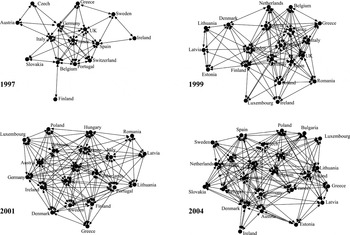
The SNA employed in this research note is relatively simple. Using the data on project partnerships from the database I created using Daphne project reports, I constructed a binary matrix of project partnerships between countries for each year. This data was then transformed into a graphic visualization of the Daphne networks, as seen in Figure 2.15
The program NetDraw was used to produce these graphics. Netdraw uses several different algorithms for laying out nodes in a two-dimensional space. For more information on Netdraw or to download the program, go to 〈http://www.analytictech.com/downloadnd.htm〉. Accessed 24 January 2008.
Daphne keeps a public record of the projects it has supported available through the “Daphne Toolkit” maintained on the Daphne website. Included is a summary of the project, as well as relevant reports and documents. The projects all contain links to a final report of their activities.
Some of these projects are focused only on women, while others are categorized as focusing on women and children.

Daphne initiative networks
Evolution and Expansion of the Network
The number of organizations participating in Daphne projects has increased over the past nine years. The diversity of organizations participating also has increased,with organizations originating in a wider array of European countries. In addition, transnational cooperation has increased through the expansion of project networking. Thus, the expansion of the network can be seen not only by the increase in the number of countries that have organizations receiving funding, but also in the increased number of partnerships.
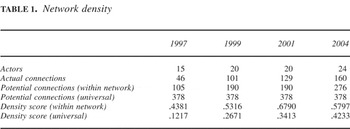
The utilization of cross-temporal SNA provides an effective means of demonstrating the evolution and expansion of these networks. As a network develops and evolves, it can become denser, meaning there are more ties between actors or, in this case, there is more transnational cooperation. The comparative density can be seen in the graphic representation of the network (see Figure 1) and with a density measure (see Table 1). The graphics in Figure 1 provide a compelling visual demonstration of the Daphne network development, particularly from 1997 to 1999 and from 1999 to 2001, where expansion and increased density can be seen.
Network density

The density measures are the mathematical representations of the network characteristics illustrated in the graphs. A density score is the number of actual connections divided by the number of possible connections. Table 1 has two density scores. The first measure, the within network density, divides the number of actual connections by the number of connections possible. In other words, when only fifteen countries have organizations participating in a given year, the number of potential connections is based on the number of possible connections between the fifteen countries. This density measure shows an increase in density from 1997 to 1999, and again from 1999 to 2001, but not from 2001 to 2004. Using this measure, the network density does not merely level off, which might be a more likely expectation in the development of any network, but drops off. In this case, the network density score is low for 2004 because more countries are represented in the network, albeit with fewer connections per country. Therefore, I have also used a second measure; the universal density score divides the number of actual connections by the number of total connections possible had all the countries eligible to participate in Daphne projects actually participated. The universal density score avoids underestimating the network density as additional countries are added. When viewed in terms of the universal density score, the increase in density from year to year is consistent.
Both the network graphics and the density measures demonstrate that the Daphne networks have expanded each year both in terms of the number of actors and the number of connections. From 1997 to 1999, there is an increase in the number of countries engaging in transnational cooperation and in the overall amount of transnational cooperation. The comparison between 1999 and 2001 is particularly interesting because while the number of projects funded drops from thirty-five to twenty (resulting from the inclusion of multi-annual projects) and the number of countries represented in the network remains the same, the network continues to expand in terms of increased transnational cooperation. From 2001 to 2004, there is an increase in the numbers of countries represented such that in 2004, almost all of the EU member states have organizations participating in Daphne-funded projects, and there is an increase in overall transnational cooperation; however, the rate of increase has leveled off. The density of connections between actors has not increased proportionately to the number of actors involved.
Compositional Characteristics of the Network
In addition to providing an overview of network development and expansion, SNA can illustrate the location of actors within a network. This element helps highlight the relationships between individual actors or, more generally, the location of actors within the larger network. In SNA, central actors are those with comparatively more partnerships with more diverse partners. Peripheral actors may still participate in numerous projects (although it is less likely), but they have fewer partnerships with a smaller group of partners. While the individual level analysis of country location within the network is outside the scope of this research note, an aggregate level analysis of actor position serves to reiterate claims made about the evolution of the Daphne network.
The graphic representation of networks, as found in Figure 1, presents telling information about which actors are more central to the network. Countries with organizations that are more actively involved in the network—those with more partnerships with organizations in different countries—are placed in the center of the network illustration. For example, in 1997, organizations in France partnered with organizations in ten different countries, placing France at the center of the network, and thus the center of the first illustration in Figure 1. Those countries that have organizations with fewer partnerships or with partners from fewer countries, are considered at the periphery of the network, and are thus placed further from the center of the network illustration. For example, in 1997, organizations in Finland were only partnered with organizations in Belgium, so Finland is placed at the periphery of the network illustration.
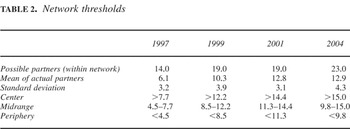
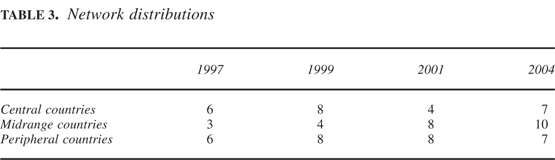
The supplementary measure for this element is called degree centrality. Degree centrality is simply the number of connections a certain actor has within the network. Actors with higher degree centrality scores (more connections) are more central within the network. Actors with lower degree centrality scores (less connections) are more peripheral in the network. To give these terms more distinct meaning, thresholds are set. Table 2 contains the thresholds and the number of countries to be found within each grouping. The thresholds were set at one-half of a standard deviation above and below the mean. Countries are then identified as being located within the center, the middle range, or the periphery of the network. A strong indicator for widespread transnational cooperation is a well-balanced network in which member states are able to gain comparable access. If there are distinct divisions between central and peripheral actors, the network is not well balanced. A more normally distributed positioning of actors translates into a more accessible and equitable network. Table 3 shows the distribution of the actors within the network.
Network thresholds

Network distributions

In the first year of Daphne (1997) the network was polarized, with most actors located at the center or at the periphery of the network, and only three countries operating in the middle range of the network. Although a few Eastern European accession countries are included in the network, they are positioned in the periphery. By the end of the Daphne Initiative (1999) the network had increased the number of actors and transnational cooperation. Some of the same countries remained in the center of the network; however, because of the expansion of the network, the thresholds regarding network placement increased. Whereas having partnerships in at least eight different countries placed a country in the center of the network in 1997, center actors in 1999 partnered with more than twelve different countries. Thus, two countries moved from the center to the midrange of the network; however, several new countries moved to more central locations in the network. More candidate countries were included in this year; however, all of them remained at the periphery. Overall, the distribution of actors was still polarized, with more actors being located in the center and periphery than in the middle range.
Moving into the second phase of Daphne, the distribution of actors started to normalize, although it was skewed in the direction of peripheral countries. In 2001, there were only four countries in the center; meanwhile, there was a significant increase in countries operating in the middle range, while the number in the periphery remains somewhat constant.
In the first year of the third Daphne phase (2004) almost every member state had organizations funded by Daphne and the distribution of countries operating in different locations in the network had normalized. Most striking was the increased participation of the newly accessioned postcommunist states. Daphne II's coincidence with the accession of many postcommunist countries resulted in a significant growth of opportunities for their gender violence organizations within the Daphne network. In addition to increased participation in Daphne projects, organizations from these countries had also moved to more central locations in the gender violence network. Like Hungary, the Czech Republic moved from the periphery to the center of the network, while Latvia and Bulgaria both jumped into midrange locations.
The changing compositional characteristics of the network reiterate some of the findings relating to the evolution of the network in terms of increased participation by a more diverse set of actors and an increase in transnational cooperation. In addition, the compositional characteristics demonstrate that the network has also evolved in terms of accessibility to organizations in all member states. A continuation in this direction would provide a scenario in which more domestic organizations are able to participate and, in turn, reap the benefits of transnational cooperation in their advocacy efforts.
Conclusion
This work offers two contributions. First, it provides an empirical examination of ways in which the EU, if not other international organizations, can attempt to build the capacity of local organizations. The focus on the Daphne program and the use of data gathered from Daphne-funded projects provides evidence of resource distribution and the facilitation of transnational cooperation as a means of capacity building. Second, it demonstrates the utility of using SNA as a means of studying transnational networks. Whereas much scholarly attention has been given to the importance of transnational networks to opening political opportunities and providing resources for local advocacy groups, little empirical evidence has been offered regarding the formation, expansion, and composition of these networks. However, this study only represents a starting point. Further research is needed to more fully examine the nature of the European violence network as well as the ultimate impact of these efforts on violence against women.
While the SNA provides suggestive data that the EU has facilitated the growth of a transnational gender violence network, supplemental research is required to further analyze the nature of this network. While SNA illustrates the presence of connections made by transnational cooperation, it does not access the strength of connections. How enduring is the network? Are the partnerships facilitated by Daphne temporary utilitarian relationships, or do they endure past the span of the project? Are partnerships truly cooperative efforts, or do they reflect power differentials between stronger and weaker organizations or locales? Most importantly, have these partnerships improved the ability of local organizations to more effectively combat violence against women? The Daphne program's monitoring efforts have provided some assessment of transnational cooperation, however, a more in-depth examination through survey or interview data would provide a strong supplement to the SNA.
The goal of distributing resources and facilitating networks is to increase the capacity of local groups to address policy issues, in this case violence against women. However, it may be too early to tell what effect this has on violence against women. Whereas better resources may result in better responsiveness to the problem (that is, more shelters and hotlines, increased awareness and training for medical and legal personal, mandatory sentencing, and so on), whether or not programs will result in decreasing violence against women is much harder to determine. At the same time, better responsiveness can go a long way to improving the situation for battered women. Thus, determining effective means of building capacity has important normative as well as scholarly implications.