Introduction
Gender non-conformity (GNC) describes the extent to which a person's behaviour, appearance and/or identity do not conform to culturally defined gender norms based on their sex presumed at birth (Turban & Ehrensaft, Reference Turban and Ehrensaft2018). Individuals may identify as transgender (trans) when their gender identity does not align with their sex presumed at birth. Worldwide, mental health disparities are a consistent empirical finding amongst GNC and trans groups, including child and adolescent groups (Eisenberg et al., Reference Eisenberg, Gower, Mcmorris, Rider, Shea and Coleman2017; Macmullin, Aitken, Nabbijohn, & Vanderlaan, Reference Macmullin, Aitken, Nabbijohn and Vanderlaan2019; Van Der Miesen, Nabbijohn, Santarossa, & Vanderlaan, Reference Van Der Miesen, Nabbijohn, Santarossa and Vanderlaan2018; Wang et al., Reference Wang, Yu, Yang, Drescher, Li, Yin and Chen2020). These findings are well-documented amongst clinic-referred trans young people seeking supportive interventions at specialist gender clinics (Aitken, Vanderlaan, Wasserman, Stojanovski, & Zucker, Reference Aitken, Vanderlaan, Wasserman, Stojanovski and Zucker2016; De Graaf et al., Reference De Graaf, Steensma, Carmichael, Vanderlaan, Aitken, Cohen-Kettenis and Zucker2020; De Vries, Steensma, Cohen-Kettenis, Vanderlaan, & Zucker, Reference De Vries, Steensma, Cohen-Kettenis, Vanderlaan and Zucker2016; Drummond, Bradley, Peterson-Badali, Vanderlaan, & Zucker, Reference Drummond, Bradley, Peterson-Badali, Vanderlaan and Zucker2018; Olson, Schrager, Belzer, Simons, & Clark, Reference Olson, Schrager, Belzer, Simons and Clark2015; Peterson, Matthews, Copps-Smith, & Conard, Reference Peterson, Matthews, Copps-Smith and Conard2017), and also for GNC and trans young people from the general population (Becerra-Culqui et al., Reference Becerra-Culqui, Liu, Nash, Cromwell, Flanders, Getahun and Millman2018; Van Der Miesen et al., Reference Van Der Miesen, Nabbijohn, Santarossa and Vanderlaan2018). Suicidal ideation (SI) and attempts (Macmullin et al., Reference Macmullin, Aitken, Nabbijohn and Vanderlaan2019; Mak et al., Reference Mak, Shires, Zhang, Prieto, Ahmedani, Kattari and Goodman2020; Spivey & Prinstein, Reference Spivey and Prinstein2018; Strauss et al., Reference Strauss, Cook, Winter, Watson, Toussaint and Lin2020), and generalised anxiety disorders (Chodzen, Hidalgo, Chen, & Garofalo, Reference Chodzen, Hidalgo, Chen and Garofalo2019), for example, are much more prevalent in GNC and trans young people compared to their age-matched, gender-conforming (GC) peers. Reasons for poor mental health outcomes in these groups are multifactorial but stem from a combination of body dysphoria and minority-related stressors, which often include societal and family non-acceptance, victimisation, and internalised prejudices (Chodzen et al., Reference Chodzen, Hidalgo, Chen and Garofalo2019; Rabasco & Andover, Reference Rabasco and Andover2020; Reisner et al., Reference Reisner, Poteat, Keatley, Cabral, Mothopeng, Dunham and Baral2016; Roberts, Rosario, Slopen, Calzo, & Austin, Reference Roberts, Rosario, Slopen, Calzo and Austin2013; Robles et al., Reference Robles, Fresán, Vega-Ramírez, Cruz-Islas, Rodríguez-Pérez, Domínguez-Martínez and Reed2016; Strauss et al., Reference Strauss, Cook, Winter, Watson, Toussaint and Lin2020; Zucker, Wood, & VanderLaan, Reference Zucker, Wood and VanderLaan2014).
To date, there is a paucity of population-based longitudinal studies examining associations between GNC in childhood and adolescence and mental health outcomes later in life (Reisner et al., Reference Reisner, Poteat, Keatley, Cabral, Mothopeng, Dunham and Baral2016). The majority of studies have used cross-sectional designs using non-probability samples, particularly convenience samples, many of which are clinically derived and are not representative of the broader population.(Henderson, Blosnich, Herman, & Meyer, Reference Henderson, Blosnich, Herman and Meyer2019; Reisner et al., Reference Reisner, Poteat, Keatley, Cabral, Mothopeng, Dunham and Baral2016) However, collective data from the extant literature provide preliminary support for the conjecture that a history of GNC in childhood is a vulnerability factor for mental health difficulties later in life. For example, one relevant U.S. population-based cohort of children from the Growing Up Today Study (N = 10 655) found that a childhood history of GNC, measured before 11 years, was associated with an elevated risk of mild to moderate depression in adulthood (Roberts et al., Reference Roberts, Rosario, Slopen, Calzo and Austin2013). Bennett, Borczon, and Lewis (Reference Bennett, Borczon and Lewis2019) found that GNC behaviours, measured at 4–5 years, predicted greater depressive symptoms at 16–17 years, although the sample size was small (n = 125 with just n = 10 GNC). In these studies, GNC was either assessed by parent-report, or participants were asked to recall gender role behaviours retrospectively, which may be subject to recall bias. Information on gender was collected at one point in childhood in these studies, but it has been observed that gender expression and identity sometimes change from childhood to adolescence to adulthood (Reilly, Desousa, Garza-Flores, & Perrin, Reference Reilly, Desousa, Garza-Flores and Perrin2019).
Although an important research priority (Calzo & Blashill, Reference Calzo and Blashill2018; Chen, Tishelman, Edwards-Leeper, & Stancin, Reference Chen, Tishelman, Edwards-Leeper and Stancin2019; Nolan, Kuhner, & Dy, Reference Nolan, Kuhner and Dy2019; Roberts et al., Reference Roberts, Rosario, Slopen, Calzo and Austin2013; Selkie, Reference Selkie2018), our understanding of GNC in childhood and adolescence, and its relationship with identity and mental health later in life, remains unclear. Longitudinal research is urgently warranted to provide insight into trajectories of mental health over time, identify vulnerable developmental points, explore wellbeing in adulthood, and develop effective mental health promotion and intervention approaches tailored to this population. To address these gaps, we analysed data from the Raine Study, a multigenerational, longitudinal cohort study from Perth, Western Australia, where mental health outcomes have been recorded at multiple points over childhood, adolescence, and early adulthood. Item 110 from the parent-report Child Behaviour Checklist (CBCL) (Achenbach & Ruffle, Reference Achenbach and Ruffle2000) ‘wishes to be of opposite sex’, and item 110 of the from the Youth Self Report (YSR) (Achenbach, Reference Achenbach1991) ‘I wish I were of the opposite sex’, have also been collected throughout childhood and adolescence. This diverse, population-based cohort not only allows for exploration of cross-sectional group comparisons on a range of mental health outcomes at different points in time, but also offers a rare opportunity to examine associations between these variables across childhood and adolescence, and into adulthood. Here, we report on data collected between age 5 and 27 years, spanning a 22-year period in seven waves of data collection, one of the longest longitudinal studies of mental health outcomes in this area of enquiry to date.
Methods
Study design
Data were from the Raine Study, a prospective pregnancy cohort study examining familial risk factors, intrauterine development, and environmental factors relating to health outcomes in infancy and adulthood.(Newnham, Evans, Michael, Stanley, & Landau, Reference Newnham, Evans, Michael, Stanley and Landau1993) Between May 1989 and November 1991, pregnant women from the public antenatal clinic at King Edward Memorial Hospital in Perth, Western Australia, and nearby private clinics were invited to participate. Women were eligible if they were between 16 and 20 weeks pregnant, had sufficient language proficiency in English, and intended to stay in Western Australia to allow for follow-up assessments of their child. Follow-up data were collected in person at Princess Margaret Hospital, Telethon Kids Institute, and the University of Western Australia. The Raine Study continues to follow participants into middle adulthood. Ethical approval was obtained by the King Edward Memorial Hospital Ethics Committee, and participants were reconsented in writing at 18 years of age.
Study participants
A total of 2868 women (Gen1) were enrolled in the study, with 2868 live births (Gen2). Gen2 has been followed up over multiple time points over infancy, childhood, adolescence and early adulthood, providing extensive phenotypic and behavioural data. The present study reports on Gen2 data collected between 1995 and 2018, at ages 5 (N = 2236), 8 (N = 2140), 10 (N = 2048), 14 (N = 1864), 17 (N = 1726), 22 (N = 1236) and 27 (N = 1190) years (Straker et al., Reference Straker, Mountain, Jacques, White, Smith, Landau and Eastwood2017). The Raine Study participation up to age 22 years, including withdrawals and loss to follow-up have been summarised elsewhere (Straker et al., Reference Straker, Mountain, Jacques, White, Smith, Landau and Eastwood2017). For the present study, a flow chart of included participants, incorporated on the basis of GNC/GC in accordance with the study design, is summarised in Figure 1, online Supplementary. The representativeness and potential attrition biases of the Raine Study cohort have been examined with three sets of analyses, which include comparisons between cohort participants and non-participants at each follow-up (Straker et al., Reference Straker, Mountain, Jacques, White, Smith, Landau and Eastwood2017).
Predictor: GNC
Item 110 ‘Wishes to be of opposite sex’ from the CBCL (Achenbach & Ruffle, Reference Achenbach and Ruffle2000) and item 110 ‘I wish I were of the opposite sex’ from the YSR (Achenbach, Reference Achenbach1991) were used as a measure of GNCas has been used in other studies to formulate two groups (Cohen-Kettenis, Owen, Kaijser, Bradley, & Zucker, Reference Cohen-Kettenis, Owen, Kaijser, Bradley and Zucker2003; Macmullin et al., Reference Macmullin, Aitken, Nabbijohn and Vanderlaan2019; Steensma, Mcguire, Kreukels, Beekman, & Cohen-Kettenis, Reference Steensma, Mcguire, Kreukels, Beekman and Cohen-Kettenis2013; Strang et al., Reference Strang, Kenworthy, Dominska, Sokoloff, Kenealy, Berl and Wallace2014). The CBCL and YSR are questionnaires that are very similar in content. The CBCL is parent-report (age 1.5–5 years and age 6–18 years versions), while the YSR is youth self-report (age 11–18 years) The YSR also contains a number of social desirability items, although these items are not included in scoring the scale.In the Raine Study, these data were collected at 5, 8 and 10 years (CBCL), and 14 and 17 years (YSR). For cross-sectional analyses, where parents or youth endorsed item 110 (i.e. a score of 1 or 2 from a 3-point Likert scale, corresponding to ‘some of the time’ or ‘all of the time’), participants were classified as GNC (‘GNC’ group) for that age. Where item 110 had not been endorsed (i.e. a score of 0, corresponding to ‘never’), participants were regarded as GC (‘GC’ group) for that age. This algorithm also formed the basis of group allocation for generalised estimating equation (GEE) analyses (see Statistical Analysis). In this study, participants have been referred to by their birth-presumed gender throughout, whilst acknowledging that some participants may self-identify as another gender.
For analyses examining mental health outcomes in adulthood, we used a separate methodology for classifying GNC, also using item 110 from the CBCL/YSR, to create separate child and adolescent groups. The reasoning for examining GNC in childhood and adolescence separately was two-fold; firstly, in contrast to the CBCL (parent-report), the YSR is self-reported, and therefore reflects the perspective of the young person (Achenbach, Mcconaughy, & Howell, Reference Achenbach, Mcconaughy and Howell1987; Salbach-Andrae, Lenz, & Lehmkuhl, Reference Salbach-Andrae, Lenz and Lehmkuhl2009). Parental observations of behaviour do not necessarily give accurate information about the child's internal experience of gender (Verhulst & Van Der Ende, Reference Van Der Miesen, Nabbijohn, Santarossa and Vanderlaan1992). Secondly, there are notable phenomenological and developmental differences between GNC in childhood, v. adolescence. For example, GNC in children might include gender-stereotyped toy preferences, or a preference for other-gender roles in make-believe play (Ruble et al., Reference Ruble, Taylor, Cyphers, Greulich, Lurye and Shrout2007). GNC in adolescence might involve the adolescent feeling a strong conviction that their personal experiences and feelings are incongruent with their sex presumed at birth, and it is observed that this sometimes develops during puberty without any history of apparent childhood GNC behaviour (Kaltiala-Heino, Bergman, Työläjärvi, & Frisén, Reference Kaltiala-Heino, Bergman, Työläjärvi and Frisén2018).
For the childhood groups, where parents had ever endorsed item 110 of the CBCL at either age 5, 8, 10, participants were classified as having a history of childhood GNC (‘History of Childhood GNC’ group). In contrast, when item 110 had never been endorsed at each of these time points (i.e. consecutive scores of 0), participants were regarded as having a history of childhood GC (‘History Childhood GC’ group). Participants with at least one score of 0 but missing 110 data at one or more childhood time points were ineligible (n = 591) and excluded from further analysis in order to avoid false negatives (see Figure 1, online Supplementary, as ‘Ineligible based on scoring’). The final sample was comprised of n = 81 in the ‘History of Childhood GNC’ group’ (n = 26 birth-presumed males, n = 55 birth-presumed females) and n = 1689 in the ‘History Childhood GC’ group (n = 889 birth-presumed males, 800 birth-presumed females).
The same methodology was also used to create two adolescent groups (using responses from item 110 of the YSR at ages 14 and 17) to indicate whether a history of self-reported GNC in adolescence was applicable (‘History of Adolescent GNC’ group, and ‘History Adolescent GC’ group). 562 participants were ineligible due to incomplete item 110 data for at least one time point, resulting in a final sample size of n = 179 in the ‘History of Adolescent GNC’ Group (n = 53 birth-presumed males, n = 126 birth-presumed females) and n = 970 in the ‘History Adolescent GC’ Group (n = 507 birth-presumed males, n = 463 birth-presumed females).
Behavioural and mental health outcomes
For cross-sectional and GEE analyses, two T-scores from the CBCL (5, 8 and 10 years) or YSR (14 and 17 years) were used as the continuous psychopathology outcome variables. These were Internalising scores (comprised of Anxious/Depressed, Withdrawn/Depressed and Somatic complaints subscales) and Externalising scores (comprised of Rule-breaking behaviour and Aggressive behaviour subscales). CBCL/YSR Items 18 (‘DSH or attempts suicide’/’I deliberately try to hurt or kill myself’) and 91 (‘Talks about killing self’/ ‘I think about killing myself’) were used to create two dichotomous outcome variables, present when a 1 (sometimes) or 2 (often) was endorsed; absent when a 0 (never) was endorsed, as measures of deliberate self-harm (DSH) and SI.
At ages 22 and 27 years), Depression, Anxiety and Stress (DASS-21) (Lovibond & Lovibond, Reference Lovibond and Lovibond1995) subscale totals were used to examine general levels of depression (DASS-Depression), anxiety (DASS-Anxiety) and stress symptoms (DASS-Stress). The three-factor structure of the DASS-21 has been confirmed in non-clinical samples (Henry & Crawford, Reference Henry and Crawford2005; Sinclair et al., Reference Sinclair, Siefert, Slavin-Mulford, Stein, Renna and Blais2012). Kessler Psychological Distress Scale (K10) scores, where high scores strongly correlate with affective disorders, was used at 27 years (Kessler et al., Reference Kessler, Andrews, Colpe, Hiripi, Mroczek, Normand and Zaslavsky2002).
In addition, we used item 9 from the Patient Health Questionnaire (PHQ-9) (Kroenke, Spitzer, & Williams, Reference Kroenke, Spitzer and Williams2001), a depression module that is useful in indicating both major depressive disorders and subthreshold depressive disorders in general population samples (Martin, Rief, Klaiberg, & Braehler, Reference Martin, Rief, Klaiberg and Braehler2006). Item 9 –‘thoughts you would be better off dead or hurting yourself in some way’ is a strong predictor of suicide attempts (Simon et al., Reference Simon, Rutter, Peterson, Oliver, Whiteside, Operskalski and Ludman2013, Reference Simon, Coleman, Rossom, Beck, Oliver, Johnson and Rutter2016). The PHQ-9 was administered at age 22 years only. For item 9, we created a dichotomous outcome variable–present when either a 1 (several days of the past two weeks), 2 (more than half the days), or 3 (nearly every day) was endorsed; absent when a 0 (not at all) was endorsed – as an index of SI at age 22.
Covariates
As socioeconomic status and level of education are associated with mental health outcomes (Hammond, Reference Hammond2003; Reiss, Reference Reiss2013), two dichotomous variables were included as covariates. These variables were maternal education (completion v. non-completion of secondary school) and total parental income (⩽$ 24 000 per annum v. >$ 24 000 per annum, in accordance with the Australian poverty line at the time), each collected at study intake only.
Statistical analysis
Linear regression analyses were used to examine GNC/GC group differences on mental health CBCL/YSR scores, cross-sectionally, at 5, 8, 10, 14 and 17 years. For each linear regression analysis, GNC/GC group membership at the age of interest was entered into the model as the predictor, covarying for maternal education and family income, with one continuous mental health outcome as the dependent variable. Each logistic regression analysis was similar, with the exception that one dichotomous mental health variable (SI, DSH) served as the outcome variable.
GEE regression models were used to estimate the overall contribution of GNC across different points in development (child and adolescent period, childhood period, and adolescent period) on mental health outcomes. GEEs are a statistical approach that serve to extend generalised linear models to the analysis of longitudinal data (Liang & Zeger, Reference Liang and Zeger1986). The GEE model is also able to account for within-cluster correlations so that valid inferences can be assured.
For longitudinal analyses with adult outcome data, linear regression models were conducted to examine whether a history of GNC in childhood and/or adolescence was associated with psychological distress (DASS-21, K10 scores) in adulthood. Logistic regression analyses were used to examine whether a history of GNC in childhood and/or adolescence was associated with SI (PHQ-9 item 9 scores) at 22 years.
All statistical analyses were conducted using SPSS Version 22. Effects with p < 0.05 (two-tailed) were considered statistically significant. Outlier thresholds were set at 1.5 * interquartile range (IQR) below the first quartile, Q1, (Q1 – 1.5*IQR) or above the third quartile, Q3, (Q3 + 1.5*IQR). Scores falling outside the upper and lower boundaries were winsorized to the closest acceptable score. All analyses were stratified by sex-presumed at birth.
Results
Excluding incomplete data, a total of 2164 parents completed assessments at age 5, with an average loss of 10% from wave to wave, with 1190 (55.99%) participants retained at the most recent follow-up (27 years). The CBCL (including item 110) was incomplete for n = 72 (3.22%) of participants at age 5, n = 65 (3.04%) of participants at age 8, and n = 32 participants at age 10 (1.56%). The YSR (including item 110) was incomplete for n = 268 (14.38%) participants at age 14, and n = 497 (28.79%) participants at age 17. The observed trend over time was that parent-reported GNC reduced from age 5 (2.12%) to age 8 (1.88%) and was lowest at age 10 (0.99%); adolescent self-reported GNC was much higher than childhood GNC, and increased from age 14 in the year 2005 (5.20%) to age 17 in the year 2008 (9.68%). At each wave, GNC was consistently higher in birth-presumed females than birth-presumed males and was highest at 17 years (years 2006–2009), comprising n = 36 (5.87%) of birth-presumed males and n = 83 (13.47%) of birth-presumed females, respectively (see Table 1).
Gender non-conformity in the Western Australian Raine Cohort, Gen2, 1996–2018

Abbreviations: GNC, gender non-conformity; GC, gender conformity; Gen2, Generation 2.
GNC/GC groups are based on available data from item 110 ‘Wishes to be of opposite sex’ from the Child Behaviour Checklist (ages 5, 8, 10 years) and item 110 ‘I wish I were of the opposite sex’ from the Youth Self Report (ages 14 and 17 years).
a Participants were classified as GNC when a 1 or 2 was endorsed on a 3-point Likert scale (indicating ‘sometimes’ and ‘often’).
bParticipants were classified as GC when a 0 was endorsed (indicating ‘never’).
GNC and mental health outcomes in childhood and adolescence
Descriptive statistics and cross-sectional linear regression analyses examining associations between GNC and mental health outcomes are reported in Table 1, online Supplementary 1. At each age examined, GNC was significantly associated with higher Internalising and Externalising scores, except for the Internalising scores for birth-presumed females at 5 years.
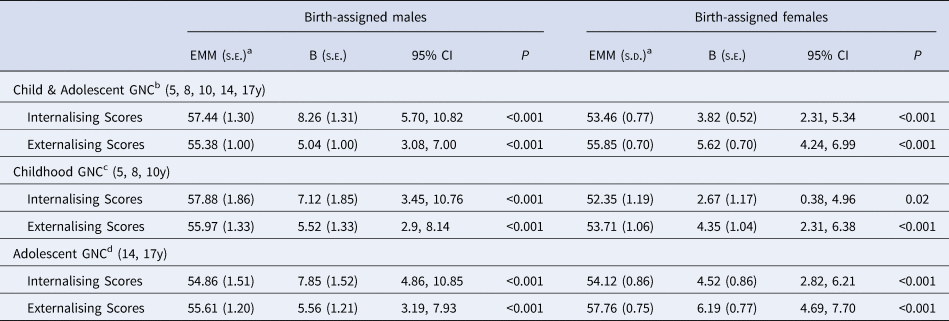
GEE linear regression models averaging the contribution of GNC (child and adolescent period, childhood period, and adolescent period) on Internalising and Externalising scores, including descriptive statistics, are summarised in Table 2. GNC was significantly associated with elevated Internalising and Externalising scores across all developmental periods.
Gender non-conformity and mental health outcomes at different points in development

Abbreviations: GEE, generalised estimating equations; GNC, gender non-conformity; EMM, estimated marginal means.
a T-scores <60 are within normal limits; T scores from 60–63 are in the borderline clinical range; T scores ⩾64 are in the clinical range.
b Refers to the overall averaged contribution of GNC (from the CBCL/YSR) on mental health outcomes in the ‘Child and Adolescent’ period (ages 5, 8, 10, 14 and 17 years).
c Refers to the overall averaged contribution of GNC (from the CBCL) on mental health outcomes in the ‘Childhood’ period (ages 5, 8, and 10 years).
d Refers to the overall averaged contribution of GNC (from the YSR) on mental health outcomes in the Adolescent’ period (ages 14 and 17 years).
Cross-sectional logistic regression analyses, using GNC to predict the odds of SI and DSH are reported in Figure 2, online Supplementary 1. Due to low frequency data in childhood, only adolescent data are reported. For birth-presumed males, GNC was significantly associated with DSH and SI at ages 14 and 17 years, where the odds of engaging in DSH were the most prominent at age 14 (aOR = 16.94, 95% CI 5.72–50.15, p < 0.001). For birth-presumed females, GNC was significantly associated with SI only, both at 14 and 17 years, with the odds ratio most prominent at age 17 (aOR = 2.82, 95% CI 1.61–4.92, p < 0.001).
GEE logistic regression models averaging the contribution of GNC on DSH and SI over the developmental periods of interest are summarised in Fig. 1. For birth-presumed females, there were insufficient data available on DSH in the childhood period to calculate a generalised estimate. In all other models, GNC was significantly associated with DSH and SI. For birth-presumed males, odds ratios were most elevated in the adolescent developmental period, both for DSH (aOR = 7.20, 95% CI 3.26–15.89) and SI (aOR = 6.45, 95% CI 3.26–12.75). For birth-presumed females, odds ratios for SI were most elevated in the childhood period (aOR = 3.37, 95% CI 1.21–9.40).
Gender non-conformity and odds of deliberate self harm and suicidal ideation at different points in development.
Birth-Presumed Males
Birth-Presumed Females
95% CIs are presented on a logarithmic scale.
Abbreviations: GNC, gender non-conformity; GEE, generalised estimating equations.
bRefers to the overall averaged contribution of GNC (from the CBCL/YSR) on mental health outcomes in the ‘Child and Adolescent’ period (ages 5, 8, 10, 14 and 17 years).
c Refers to the overall averaged contribution of GNC (from the CBCL) and mental health outcomes in the ‘Childhood’ period (ages 5, 8, and 10 years).
d Refers to the overall averaged contribution of GNC (from the YSR) on mental health outcomes in the Adolescent’ period (ages 14 and 17 years).

History of childhood or adolescent GNC and mental health in adulthood
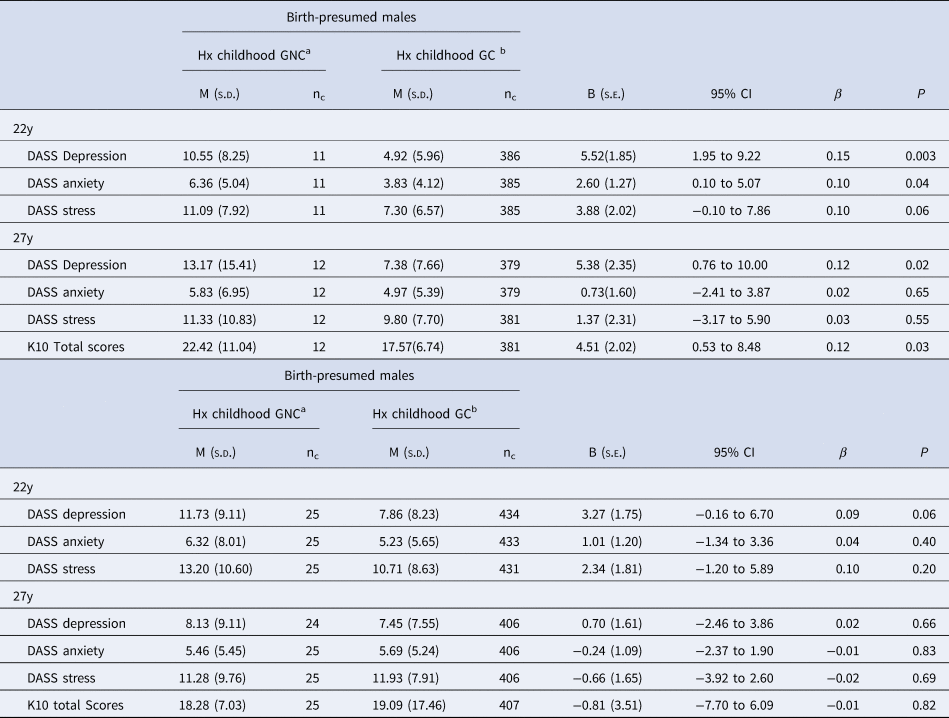
For birth-presumed males, linear regression analyses indicated that a history of childhood or adolescent GNC was significantly associated with higher DASS Depression and Anxiety scores at 22 years, and higher DASS Depression and K10 scores at 27 years (see Table 3). Logistic regression analyses exploring the association between childhood or adolescent GNC and SI at 22 years could not be undertaken, as the cell counts were too small.
History of childhood gender non-conformity and mental health outcomes in adulthood

Abbreviations: Hx, History, GNC, gender non-conformity.
a ‘Hx Childhood GNC’ was applicable when the parent had ever endorsed item 110 of the CBCL ‘Wishes to be of opposite sex’ in childhood (ages 5, 8, or 10 years).
b ‘Hx Childhood GC’ was applicable when the parent had never endorsed item 110 of the CBCL ‘Wishes to be of opposite sex’ at any time point.
cFinal sample sizes have been adjusted to account for covariates.
For birth-presumed females, the mental health scores of the GNC group were not significantly different to those of the group who had a childhood history of GC, at either 22 or 27 years. Logistic regression analyses indicated that childhood GNC was not associated with significantly higher odds of endorsing SI on the PHQ-9 at 22 years, aOR = 0.36, 95% CI 0.12–1.05, p = 0.06.
History of adolescent GNC and mental health in adulthood
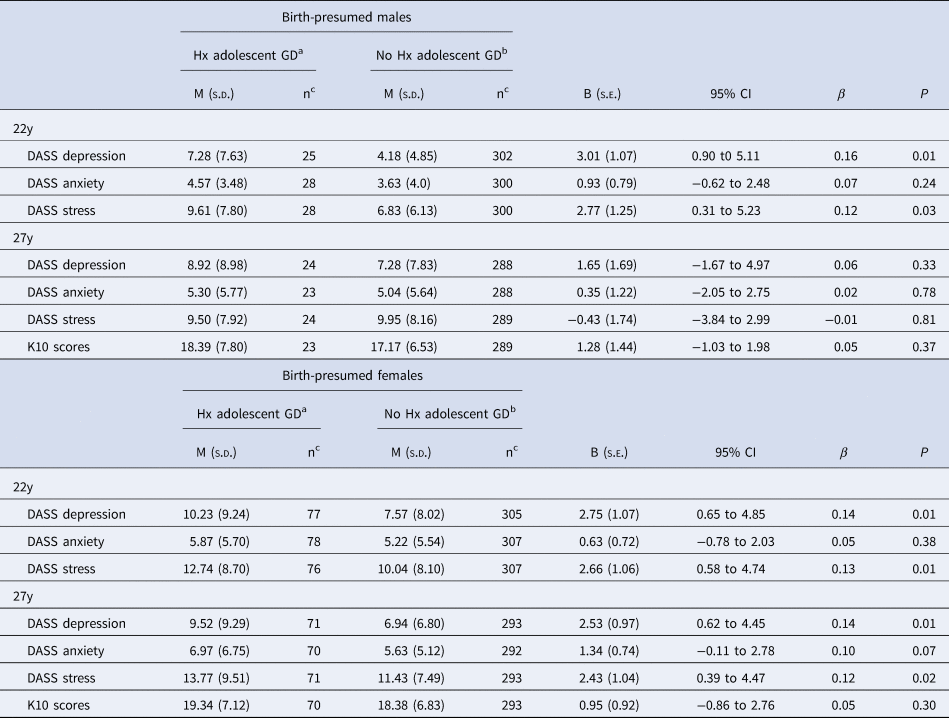
For birth-presumed males, linear regression analyses indicated that an adolescent history of GNC was significantly associated with higher DASS Depression and Stress scores at 22 years (see Table 4). No significant group differences were observed at 27 years. Adolescent GNC was associated with significantly higher odds of endorsing SI on the PHQ-9 at 22 years, aOR = 3.78, 95% CI 1.46–9.81, p = 0.006.
History of adolescent gender non-conformity and mental health outcomes in adulthood

Abbreviations: Hx, History, GNC, gender non-conformity.
a ‘Hx Adolescent GNC’ was applicable when the parent had ever endorsed item 110 of the CBCL ‘Wishes to be of opposite sex’ in childhood (ages 5, 8, or 10 years).
b ‘Hx Adolescent GC’ was applicable when the parent had never endorsed item 110 of the CBCL ‘Wishes to be of opposite sex’ at any time point.
c Final sample sizes have been adjusted to account for covariates.
For birth-presumed females, adolescent GNC was significantly associated with higher DASS Depression and Stress scores, both at 22 and 27 years. DASS Depression and Anxiety scores were also significantly elevated at 27 years. Logistic regression analyses exploring the association between adolescent GNC and SI on the PHQ-9 at 22 years were also significant, aOR = 2.17 (95% CI 1.07–4.38) p = 0.03.
Discussion
In this population-based birth cohort from Perth, Western Australia, GNC was endorsed by 2.12% parents of 5-year-olds (in 1995–1996), 1.88% parents of 8-year-olds, and 0.99% parents of 10-year-olds, as measured by CBCL item ‘wishes to be of opposite sex’. In childhood, these rates are comparable to those reported previously in non-clinical samples (Van Der Miesen et al., Reference Van Der Miesen, Nabbijohn, Santarossa and Vanderlaan2018). GNC was also endorsed by 5.20% of 14-year-olds (in 2004–2005) and 9.68% of 17-year-olds (in 2007–2008), as measured by YSR item ‘I wish I were of the opposite sex. At each time point in childhood and adolescence, rates of endorsement were higher for birth-presumed females than males, aligning with both clinical and community-based research demonstrating a birth-presumed female-biased gender ratio (De Graaf et al., Reference De Graaf, Cohen-Kettenis, Carmichael, De Vries, Dhondt, Laridaen and Steensma2018; Van Der Miesen et al., Reference Van Der Miesen, Nabbijohn, Santarossa and Vanderlaan2018).
To our knowledge, this study is the first to examine associations between GNC and mental health outcomes over multiple time points from childhood to adolescence and young adulthood, as reported by both parents and youth. It is also the longest study of mental health outcomes in this field to date, comprising seven waves of data, collected from age 5 to age 27 (1996–2018). We found that GNC was associated with emotional and behavioural difficulties, and psychological distress, across the child and adolescent period and into adulthood. Disparities between GNC and GC participants were apparent from age 5 years.
Amongst a community sample of GNC children from Canada (which also used item 110 to measure gender), Van Der Miesen et al. (Reference Van Der Miesen, Nabbijohn, Santarossa and Vanderlaan2018) found that mean CBCL internalising and externalising symptom scores fell within the clinical range, despite excluding children with a mental health diagnosis. Recent findings from the same dataset have also demonstrated an association between high levels of GNC (using the Gender Identity Questionnaire for Children) and SI (Macmullin et al., Reference Macmullin, Aitken, Nabbijohn and Vanderlaan2019). The authors concluded that the findings from their community sample were comparable to those which have previously been reported from similar studies conducted in gender clinic samples (Zucker et al., Reference Zucker, Wood and VanderLaan2014). The results from our study are partially consistent with these findings. In our cohort, birth-presumed male mean CBCL and YSR internalising and externalising scores for GNC youth fell within the clinical range at most time points, whereas birth-presumed female mean CBCL internalising and externalising scores fell within the normal range at all time points except for externalising scores at age 17; however, internalising and externalising scores were consistently significantly higher than those of GC youth at all time points except for internalising scores in 5 year old birth-presumed females. The present data add to the growing body of literature indicating that elevated emotional and behavioural difficulties, and psychological distress, are found in community samples of GNC children and adolescents (Macmullin et al., Reference Macmullin, Aitken, Nabbijohn and Vanderlaan2019; Spivey & Prinstein, Reference Spivey and Prinstein2018; Van Der Miesen et al., Reference Van Der Miesen, Nabbijohn, Santarossa and Vanderlaan2018). Given that a sizeable minority of adolescents from our cohort endorsed wishing to be the opposite sex, distress amongst GNC community samples is likely greater in scope than previously estimated.
Our results also indicate that the adolescent period constitutes an especially vulnerable time for birth-presumed GNC males, with very high rates of DSH and SI. Cross-sectionally, this association peaked at 14 years for this group, with reports of DSH approaching a 17-fold increase in comparison to GC adolescents, and nearly a 13.5-fold increase in SI. While general population trends indicate that SI rises rapidly, and peaks, in the adolescent period (Foley, Goldston, Costello, & Angold, Reference Foley, Goldston, Costello and Angold2006; Nock et al., Reference Nock, Green, Hwang, Mclaughlin, Sampson, Zaslavsky and Kessler2013), the present data suggest that the disparity in SI rates between GNC and GC groups is most prominent for birth-presumed males in early adolescence. Although significant GNC-GC differences were also evident amongst birth-presumed female groups, these remained relatively consistent over time. One possible reason for this pattern could be distress associated with secondary sexual development (for example, deepening voice, increased facial hair, laryngeal prominence), in the subset of GNC youth who experience gender dysphoria. There is also some evidence that GNC birth-presumed males are at particular risk of bullying victimisation and depressive symptoms (Roberts et al., Reference Roberts, Rosario, Slopen, Calzo and Austin2013), which is thought to be attributed, in part, to rigid conceptions and socially constructed expectations of masculinity. Experiences of victimisation (including homophobic and transphobic abuse) and other minority-related stressors might be more prevalent in early adolescence for this group, as it coincides with a point in development where increases in conformity to stereotypical expectations of masculinity have been noted (Rogers, Delay, & Martin, Reference Rogers, Delay and Martin2017). Collectively, these factors likely play an important role in widening mental health disparities amongst GC and GNC birth-presumed males.
As previous research suggests (Roberts et al., Reference Roberts, Rosario, Slopen, Calzo and Austin2013), we found that a history of GNC was associated with some mental health difficulties in adulthood. For example, childhood GNC (at age 5, 8, and/or 10 years) was associated with severe depressive symptoms at 22 and 27 years in birth-presumed males; adolescent GNC was associated with elevated depression and stress scores at 22 and 27 years in birth-presumed females. Several possible explanations for these findings are plausible. Notably, there is no evidence that risk for mental health difficulties is inherently attributable to being GNC, with gender variance increasingly recognised as a normal part of human variation. Rather, this pattern concords with the minority stress model (Meyer, Reference Meyer2003), where gender and sexual minorities’ exposure to chronic lifetime stressors, both external (e.g. violence, discrimination, societal non-acceptance) and internal (e.g. gender dysphoria including body-related distress, anticipated stigma, identity concealment) confers cumulative psychological stress, which contributes to distress (Chodzen et al., Reference Chodzen, Hidalgo, Chen and Garofalo2019; Diamond, Reference Diamond2020; Rood et al., Reference Rood, Reisner, Surace, Puckett, Maroney and Pantalone2016). While Roberts et al. (Reference Roberts, Rosario, Slopen, Calzo and Austin2013) reported that childhood GNC was a significant risk factor for depressive symptoms across adolescence and young adulthood, experiences of bullying victimisation and abuse accounted for much of the increased risk. In contrast, findings from cross-sectional studies indicate that social support, school safety and belonging, and the ability to use one's chosen name are important resilience-promoting factors for mental health amongst GNC and trans young people (Tankersley, Grafsky, Dike, & Jones, Reference Tankersley, Grafsky, Dike and Jones2021). Children who have parental support in exploring and affirming their gender also report depressive symptoms that are comparable to general population averages (Olson, Durwood, Demeules, & Mclaughlin, Reference Olson, Durwood, Demeules and Mclaughlin2016). Longitudinal investigations exploring prospective risk and protective factors amongst those with a history of GNC are needed to help shape long-term interventions for improving mental health outcomes, irrespective of gender identity in adulthood.
The present study has several limitations. Notably, a single item on the CBCL and YSR was used to measure GNC. While there is evidence that this item correlates with more nuanced measures of gender, such as the Gender Identity Questionnaire for Children (Van Der Miesen et al., Reference Van Der Miesen, Nabbijohn, Santarossa and Vanderlaan2018), it uses language (‘the opposite sex’),which is unlikely to describe the experience of individuals who identify between, outside and beyond a binary concept of male/female gender. A more nuanced measure of gender may have yielded different results. This limitation is inevitable for a longitudinal cohort of this kind, as sensitive questions exploring a gender spectrum were neither considered, nor available, when these data were collected decades ago. While item 110 has poor sensitivity (i.e. a high false-negative rate), it has reasonably good specificity (majority true positives, with a low false-positive rate) (Van Der Miesen et al., Reference Van Der Miesen, Nabbijohn, Santarossa and Vanderlaan2018), suggesting that our sample is unlikely to be comprised of participants who do not have some degree of gender variance, except where endorsed by error. In addition, as an item on a three-point Likert scale, it is important to recognise that individuals who endorsed this item ‘some of the time’ likely have very different experiences and mental health outcomes to individuals who endorsed this item ‘all of the time’. Although exploration of the mental health outcomes of these three subgroups would have been optimal, the sample sizes of those endorsing this item (either transiently or consistently) were not large enough to allow for subgroup analyses. The incorporation of more multifaceted and detailed measures of GNC and/or gender identity in future longitudinal cohort studies will be important in illuminating whether there are variations in mental health outcomes based upon explicit characteristics of GNC subgroups.
The study collected no self-report of gender identity in childhood or adolescence, so it cannot draw conclusions regarding development of gender identity over time. Currently, there is no consensus on best practice for analysing repeated measures of GNC over time, including how best to categorise participants who change their reports over time (Tabaac, Gordon, Reisner, Austin, & Charlton, Reference Tabaac, Gordon, Reisner, Austin and Charlton2019). Changing reports may reflect actual variations in gender, or measurement error. The study methodology aimed for the greatest possible sensitivity with the data available, by defining ‘GNC’ as a score of 1 or 2 on the item ‘wishing to be of the opposite sex’ at any one of the five data collection time points in either childhood or adolescence.
Mental health vulnerabilities are well-documented amongst children and adolescents referred to specialist gender clinics (Holt, Skagerberg, & Dunsford, Reference Holt, Skagerberg and Dunsford2016) and young trans community samples (Strauss et al., Reference Strauss, Cook, Winter, Watson, Toussaint and Lin2020). The findings from this study indicate that elevated emotional and behavioural difficulties, and psychological distress, are evident in an Australian community-based cohort of GNC children and adolescents followed into young adulthood. The inclusion of a broad range of time points at which data on mental health and gender were collected allowed longitudinal modelling of these associations over time, highlighting adolescence as a period in which GNC birth-presumed males were particularly at risk of DSH and SI. A history of GNC in childhood and/or adolescence was also found to predict poorer mental health outcomes in adulthood. Longitudinal investigations exploring prospective risk and protective factors amongst those with histories of GNC are needed to shape long-term intervention strategies for improving mental health outcomes across the lifespan.
Supplementary material
The supplementary material for this article can be found at https://doi.org/10.1017/S0033291723001721.
Financial support
SM was supported by an Australian Government Research Training Program (RTP) Scholarship, Perth Children's Hospital Fund PhD Top-up Scholarship, and the Raine Medical Foundation PhD Top-Up Scholarship. AL is funded by an NHMRC Investigator Grant (#2010063). YP is funded by a Perron People Grant. PS is funded by a Suicide Prevention Australia Fellowship.
Conflict of interest
The author(s) declare none”.
Ethical standards
The authors assert that all procedures contributing to this work comply with the ethical standards of the relevant national and institutional committees on human experimentation and with the Helsinki Declaration of 1975, as revised in 2008.”