Introduction
Severe health anxiety, or hypochondriasis, is fairly common (Faravelli et al. Reference Faravelli, Salvatori, Galassi, Aiazzi, Drei and Cabras1997), often chronic if untreated (Barsky et al. Reference Barsky, Fama, Bailey and Ahern1998), and associated with increased health-care utilization and functional disability (Barsky et al. Reference Barsky, Fama, Bailey and Ahern1998; Seivewright et al. Reference Seivewright, Salkovskis, Green, Mullan, Behr, Carlin, Young, Goldmeier and Tyrer2004; Fink et al. Reference Fink, Ornbol and Christensen2010). These aspects contribute to making severe health anxiety a costly disorder from a societal perspective. Cognitive behaviour therapy (CBT) has been shown to be effective in reducing health anxiety (Warwick et al. Reference Warwick, Clark, Cobb and Salkovskis1996; Seivewright et al. Reference Seivewright, Green, Salkovskis, Barrett, Nur and Tyrer2008). However, health economic evaluations are scarce. Investigating the cost-effectiveness of new treatments is pivotal because implementation of less cost-effective treatments may lead to comparably higher societal costs and that fewer persons can be offered treatment (Saha et al. Reference Saha, Hoerger, Pignone, Teutsch, Helfand and Mandelblatt2001).
We have found only one study where a randomized design has been used to investigate cost-effectiveness of CBT for severe health anxiety (Seivewright et al. Reference Seivewright, Green, Salkovskis, Barrett, Nur and Tyrer2008). In that study, participants receiving CBT reduced their direct medical costs (Seivewright et al. Reference Seivewright, Green, Salkovskis, Barrett, Nur and Tyrer2008). However, when including the costs of CBT, the total costs were higher in the CBT condition compared to the untreated control condition (Seivewright et al. Reference Seivewright, Green, Salkovskis, Barrett, Nur and Tyrer2008). In the past decade, Internet-based CBT (ICBT) has emerged as a promising means of increasing the availability of CBT (Proudfoot et al. Reference Proudfoot, Goldberg, Mann, Everitt, Marks and Gray2003; Andersson, Reference Andersson2009). One major advantage is that ICBT often requires less than 20% of the therapist time needed in conventional CBT (Hedman et al. Reference Hedman, Andersson, Ljótsson, Andersson, Rück, Mörtberg and Lindefors2011b), making it a potentially highly cost-effective treatment.
The aim of the present study was to prospectively evaluate the cost-effectiveness and long-term effectiveness of ICBT for severe health anxiety within the context of a previously conducted randomized controlled trial (RCT) (Hedman et al. Reference Hedman, Andersson, Andersson, Ljotsson, Ruck, Asmundson and Lindefors2011a). To our knowledge, these aspects of ICBT for severe health anxiety have not yet been studied. We hypothesized that ICBT, compared to an attention control condition, would generate improvements at no additional societal cost, thereby making the treatment cost-effective. We also expected that reductions in health anxiety would be maintained at a 1-year follow-up.
Method
Trial design and registration
Long-term follow-up
This was a follow-up study assessing health anxiety and secondary psychiatric symptoms 1 year after treatment completion. In the original RCT comparing ICBT (n = 40) to an attention control condition (n = 41), participants in the control condition were crossed over to ICBT immediately after post-treatment assessment (Hedman et al. Reference Hedman, Andersson, Andersson, Ljotsson, Ruck, Asmundson and Lindefors2011a). Thus, participants in both groups had received treatment at the 6-month follow-up. As the two groups were treated at different time points, they are reported separately (denoted ICBT and CC respectively).
Cost-effectiveness
This was also a prospective cost-effectiveness analysis study adopting a societal perspective, that is both direct and indirect costs were assessed. Cost-effectiveness analysis is a tool for estimating the costs of implementing a new treatment in clinical practice (Saha et al. Reference Saha, Hoerger, Pignone, Teutsch, Helfand and Mandelblatt2001). It is a combined measure of the incremental costs and gains of a new treatment compared to an alternative, such as a control condition. The outcome, the incremental cost-effectiveness ratio (ICER), gives an estimate of the cost for one additional unit of improvement when administering the new treatment compared to the alternative, in this study the control condition. Health economic data for the analysis were obtained from the RCT described previously (Hedman et al. Reference Hedman, Andersson, Andersson, Ljotsson, Ruck, Asmundson and Lindefors2011a).
Sample
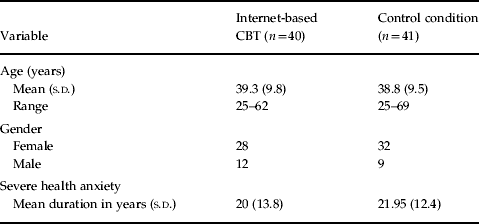
A description of the sample is presented in Table 1. Participants were recruited by self-referral and also by referral from psychiatrists and primary care physicians. The study was conducted at the Karolinska University Hospital, Stockholm, Sweden, and the study protocol was approved by the regional ethics review board and informed consent was obtained from all participants.
Characteristics of the sample
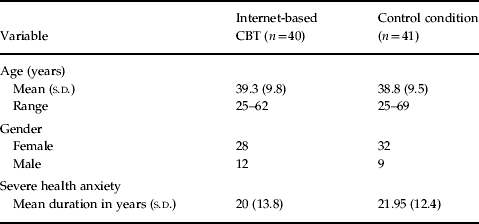
CBT, Cognitive behaviour therapy; s.d., standard deviation.
The main inclusion criteria were: participants had to (a) have a primary diagnosis of severe health anxiety according to DSM-IV (APA, 2000) as assessed using the Health Anxiety Interview (Taylor & Asmundson, Reference Taylor and Asmundson2004), (b) agree not to undergo any other psychological treatment for the duration of the study, (c) have a constant dosage 2 months prior to treatment if on prescribed medication for anxiety or depression and agree to keep dosage constant throughout the study, and (d) have no history of psychosis or bipolar disorder.
A clinical psychologist conducted a diagnostic assessment interview by telephone to establish whether the inclusion criteria were met. To ensure reliability in the diagnostic procedure, a psychiatrist was consulted in each case. Of the 117 applicants, 81 fulfilled all inclusion criteria and were randomized. A more detailed description of the participant flow through the trial is presented in the main outcome study (Hedman et al. Reference Hedman, Andersson, Andersson, Ljotsson, Ruck, Asmundson and Lindefors2011a).
Interventions
ICBT
The treatment was based on a CBT model for health anxiety, emphasizing the role of avoidance and safety behaviours as maintaining factors of health anxiety (Taylor & Asmundson, Reference Taylor and Asmundson2004; Furer et al. Reference Furer, Walker and Stein2007). A central feature of the treatment was a self-help text divided into 12 modules. Each module was devoted to a specific theme and included homework exercises. The modules reflected the content of conventional CBT for health anxiety (Taylor & Asmundson, Reference Taylor and Asmundson2004; Furer et al. Reference Furer, Walker and Stein2007). Participants gained gradual access to the modules through an Internet-based treatment platform. The duration of the ICBT was 12 weeks and throughout this period the participant had access to a therapist through a secure online contact system. Patient and therapist had no face-to-face or telephone contact during the treatment. On average, therapists spent 9 min/week with each patient.
Control condition
The control condition consisted of an online discussion forum where participants could send messages anonymously to each other over a period of 12 weeks. Participants were encouraged to discuss their health anxiety and helpful ways of coping with it, and to provide support to others randomized to the CC group.
Clinical assessments
Health anxiety measures
The primary continuous outcome measure was the Health Anxiety Inventory (HAI; Salkovskis et al. Reference Salkovskis, Rimes, Warwick and Clark2002). The Illness Attitude Scale (IAS; Speckens et al. Reference Speckens, Spinhoven, Sloekers, Bolk and van Hemert1996) and the Whiteley Index (WI; Pilowsky Reference Pilowsky1967) were used as secondary measures of health anxiety.
Depressive symptoms, general anxiety, anxiety sensitivity and quality of life
We used the Beck Anxiety Inventory (BAI; Beck et al. Reference Beck, Epstein, Brown and Steer1988) and the Anxiety Sensitivity Index (ASI; Reiss et al. Reference Reiss, Peterson, Gursky and McNally1986) to assess general anxiety and anxiety sensitivity respectively. The Montgomery–Åsberg Depression Rating Scale – Self-Report (MADRS-S; Svanborg & Åsberg, Reference Svanborg and Åsberg1994) was used to measure depressive symptoms and the Quality of Life Inventory (QOLI; Frisch et al. Reference Frisch, Cornell, Villanueva and Retzlaff1992) was used to assess quality of life. Finally, the EuroQol Questionnaire (EQ-5D) was used to assess quality of life from a health perspective (EuroQol Group, 1990). The EQ-5D is non-disease specific and measures five health domains: mobility, self-care, usual activities, pain/discomfort and anxiety/depression (Rabin & Charro, Reference Rabin and Charro2001).
Diagnostic instrument
To establish whether participants met diagnostic criteria for severe health anxiety the Health Anxiety Interview (Asmundson et al. Reference Asmundson, Taylor and Cox2001) was used.
Cost assessment
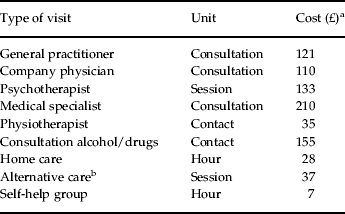
Table 2 displays cost tariffs for the most common health-care services used by the participants. Health economic cost data were obtained using the Trimbos and Institute of Medical Technology Assessment (iMTA) Cost Questionnaire on Costs Associated with Psychiatric Illness (TIC-P; Hakkaart-van Roijen & Donker, Reference Hakkaart-van Roijen and Donker2002). The TIC-P covers direct medical costs (e.g. general practitioner visits) and also indirect medical costs, that is costs of other health-related services not directly associated with health care (e.g. self-help groups). The TIC-P was also used to assess non-medical costs, which are costs pertaining to work and domestic productivity loss. The human capital approach was used, which means that monetary losses associated with work loss and work cutback were based on the average gross earning in Sweden for the duration of the sick leave (Drummond et al. Reference Drummond, Sculpher, Torrence, O'Brien and Stoddart2005). The domestic loss hourly tariff was estimated to be £8.54 (Smit et al. Reference Smit, Willemse, Koopmanschap, Onrust, Cuijpers and Beekman2006). Costs were converted from Swedish Kronor (SEK) into GBP (£) using the purchasing power parities of the Organization for Economic Cooperation and Development (OECD) for the reference year 2010 (OECD, 2006).
Cost tariffs for the most common types of health services
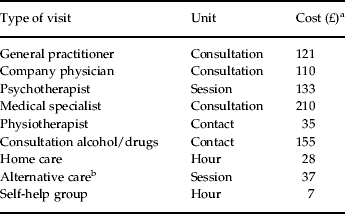
a Costs are in pounds (£) for 2010.
b Costs for alternative care vary. If unknown, the mean price of £37 per session was used.
The direct medical costs associated with ICBT were mainly represented by the costs of therapists. In this study, the tariff of visits to licensed clinical psychologists was used when estimating the cost of ICBT. The tariff was retrieved from an official health-care index providing the costs for psychiatric services offered within the publicly funded health-care system. The time the therapists spent on treating the participants was registered and multiplied by this tariff. We also estimated the costs of participant time using a tariff of £8.54/h, the same estimate as for domestic loss. The cost of the control condition was assumed to be £0 because of the low amount of therapist time required.
Procedure
Continuous outcome assessments were conducted before treatment (pre-treatment), immediately after treatment (post-treatment), 6 months after treatment (6-month follow-up) and 1 year after treatment completion (1-year follow-up). Diagnostic interviews were conducted by a clinical psychologist blind to treatment status and participants were randomized to ICBT or the attention control condition (CC) in a 1:1 ratio. After post-treatment, participants in the CC group were crossed over to treatment. A detailed presentation of the randomization procedure is presented in the main outcome study (Hedman et al. Reference Hedman, Andersson, Andersson, Ljotsson, Ruck, Asmundson and Lindefors2011a).
Statistical analysis
Statistical analyses were conducted using Stata IC/11.0 (Stata Corporation, USA) and SPSS 20.0 (IBM, USA).
Clinical assessment data
As for analyses of clinical data, we did not apply last observation carried forward (LOCF) to handle missing data as that might have exaggerated the degree to which gains were sustained. Instead we report the observed means and standard deviations and also estimated means and standard deviations, as suggested by Gueorguieva & Krystal (Reference Gueorguieva and Krystal2004). Estimated parameters were obtained using a mixed-effects model approach with a diagonal covariance structure. This method was also used for analysing improvements over time. This type of continuous assessment fits well onto the evidence supporting a dimensional view of health anxiety (Ferguson, Reference Ferguson2009). Because all participants had received ICBT at the 6-month and 1-year follow-ups, analyses at these assessment points entailed no between-group comparisons. However, as half of the sample served as controls in the first phase of the RCT, the two groups are reported separately. Cohen's d based on pooled standard deviations was used to calculate effect sizes.
Health economic data
ICERs were estimated using the formula: ICER = (ΔC1 – ΔC2)/(ΔE1 – ΔE2), where C1 – C2 is the difference in cost change between ICBT and the control condition at post-treatment and E1 – E2 refers to the difference in the average effectiveness of the two conditions (Drummond et al. Reference Drummond, Sculpher, Torrence, O'Brien and Stoddart2005). The cost change including all medical and non-medical costs of the participants in the ICBT condition was subtracted from the cost change of the participants in the control condition. This difference was then divided by the subtracted effects (in this case the effect measure was the proportion of participants meeting diagnostic criteria for severe health anxiety at post-treatment). This procedure was bootstrapped 5000 times, generating an estimated figure of the treatment group's incremental costs in relation to its incremental health benefit.
We also conducted a cost-utility analysis, which is the same as the cost-effectiveness analysis except that the cost of an additional quality-adjusted life year (QALY; Drummond et al. Reference Drummond, Sculpher, Torrence, O'Brien and Stoddart2005) is calculated instead of an additional case of improvement in terms of the target disorder. The measure used to assess quality of life was the EQ-5D and the analysis was performed applying the population-based index weights proposed by the EuroQol Group (Dolan, Reference Dolan1997). Thus, to calculate the cost-utility ICER, the net cost difference between the groups at post-treatment compared to baseline was divided by the net difference on the EQ-5D. As the cost data were non-normally distributed, Wilcoxon tests were used to analyse within-group cost changes and between-group analyses were conducted using bootstrap analyses within a quantile regression framework (1000 replications). Such analysis is considered to generate a reliable cost distribution estimate (Efron & Tibshirani, Reference Efron and Tibshirani1993). No between-group comparisons were made at the 6-month and 1-year follow-ups. All costs were converted to pounds (£) and expressed on an annual per capita basis.
The robustness of the results regarding health economic outcomes was tested in two different sensitivity analyses. In one analysis £130 was added, corresponding to a scenario of reduced production capacity of ICBT due to poorer treatment planning rendering longer average time spent in the system (Little, Reference Little1961). We also performed an analysis where £390 was added to the cost of ICBT, corresponding to the cost of ICBT during the first year of providing the service, thereby including developmental costs (e.g. writing the treatment programme, computer programming) and costs of establishing the treatment unit. As these were one-time costs, their impact on the cost of ICBT was expected to decrease rapidly with time.
Results
Attrition
There was no data loss at pre- or post-treatment assessments in any of the groups. In the ICBT group, there were no missing data at the 6-month follow-up. After being crossed over to treatment, 34 of 41 (83%) participants in the CC group provided data at the 6-month follow-up. At the 1-year follow-up 39 of 41 (95%) participants in the ICBT group and 36 of 41 (88%) in the CC group completed assessments.
Clinical assessments
Health anxiety
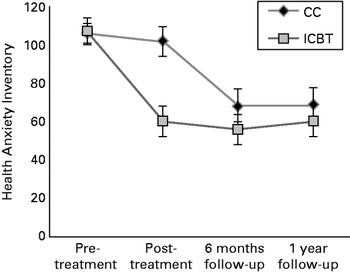
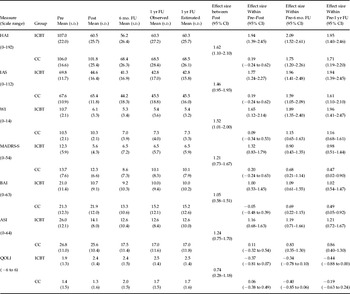
The observed and estimated means and standard deviations and the effect sizes of the continuous outcome measures are presented in Table 3. Figure 1 shows the course of improvement in the primary outcome measure HAI. Mixed-effects model analyses showed that participants in both groups were significantly improved at the 6-month and 1-year follow-ups compared to baseline on the HAI, IAS and WI (F = 13.2–87.2, df = 1,16–77, p < 0.01–0.001). In the ICBT group there were no significant effects of time from post-treatment to the 1-year follow-up on any of the health anxiety measures (F = 0.3–0.6, df = 2,75–116, p < 0.71–0.54), indicating the stability of improvements achieved at post-treatment. As expected and reported in the main outcome study (Hedman et al. Reference Hedman, Andersson, Andersson, Ljotsson, Ruck, Asmundson and Lindefors2011a), the CC group made no significant improvements from baseline to post-treatment (F = 0.7, df = 1,80, p < 0.39). However, between post-treatment and the 6-month follow-up, the participants in the CC group were significantly improved on all measures of health anxiety (F = 22.5–36.7, df = 1,73–76, p < 0.001). From the 6-month to the 1-year follow-up, participants in the CC group made no significant changes on measures of health anxiety (F = 0.0–0.1, df = 1,68, p < 0.99–0.77), also indicating stable treatment effects.
Course of improvement on the primary outcome measure, the Health Anxiety Inventory, including 95% confidence intervals. CC, Control condition; ICBT, Internet-based cognitive behaviour therapy. Note: the CC group received treatment after post-treatment assessment.

Means, standard deviations and effect sizes (Cohen's d) of primary and secondary outcome measures

HAI, Health Anxiety Inventory; IAS, Illness Attitude Scales; WI, Whiteley Index; MADRS-S, Montgomery Åsberg Depression Rating Scale – Self-Report; BAI, Beck Anxiety Inventory; ASI, Anxiety Sensitivity Index; QOLI, Quality of Life Inventory; ICBT, Internet-based cognitive behaviour therapy; CC, control condition; Pre, pre-treatment; Post, post-treatment; 6 mo. FU, 6-month follow-up; 1 yr FU, 1-year follow-up; s.d., standard deviation; CI, confidence interval.
The CC group received treatment after post-treatment.
Depressive symptoms, general anxiety, anxiety sensitivity and quality of life
Analyses using mixed models showed that both groups had improved significantly at the 6-month and 1-year follow-ups relative to baseline on the MADRS-S (F = 4.0–20.0, df = 1,71–77, p < 0.05–0.001), the BAI (F = 4.8–23.7, df = 1,74–77, p < 0.01–0.001) and the ASI (F = 12.6–33.0, df = 1,69–76, p < 0.001). None of the groups made significant improvements on the QOLI from baseline to the 6-month or the 1-year follow-up (F = 1.0–3.0, df = 1,70–76, p < 0.31–0.09). In the ICBT group, there were no significant effects of time on any of these four generic outcome measures from post-treatment to the 1-year follow-up (F = 0.1–0.5, df = 2,78–87, p < 0.99–0.62), indicating stability of post-treatment estimates. In the CC group, participants were significantly improved from post-treatment to the 6-month follow-up on the MADRS-S, BAI and ASI (F = 5.4–10.6, df = 1,73, p < 0.03–0.001) but not on the QOLI (F = 3.4, df = 1,73, p < 0.08). There was no effect of time from the 6-month to the 1-year follow-up on the MADRS-S, BAI, ASI or QOLI (F = 0.4–0.6, df = 1,66–68, p < 0.85–0.49) in the CC group, suggesting that the effects achieved after having received treatment were stable.
Cost-effectiveness
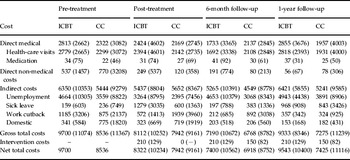
Table 4 presents per capita costs at each assessment point. At post-treatment, the ICER was −784/0.63 = −1244, favouring ICBT over the control condition. This means that each incremental improvement (no longer meeting diagnostic criteria for severe health anxiety) in ICBT relative to the control condition generated a societal earning of £1244. This was because the total net costs were slightly lower in the ICBT condition compared to the control condition whereas improvements in health anxiety were more likely to occur in the ICBT condition. Following treatment, 27 of 40 (67.5%) participants who had received ICBT no longer met diagnostic criteria for severe health anxiety; this was significantly more than the two out of 41 (4.9%) in the control condition who did not meet diagnostic criteria (χ2 = 34.55, df = 1, p < 0.001).
Costs across assessment points by type of expenditure, GBP (£)

ICBT, Internet-based cognitive behaviour therapy; CC, control condition.
CC participants received ICBT after post-treatment.
Values given as mean (standard deviation).
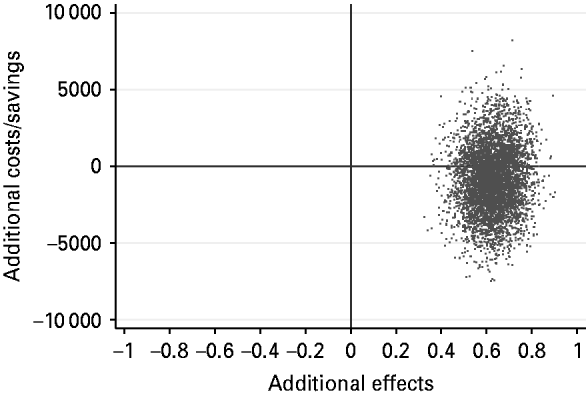
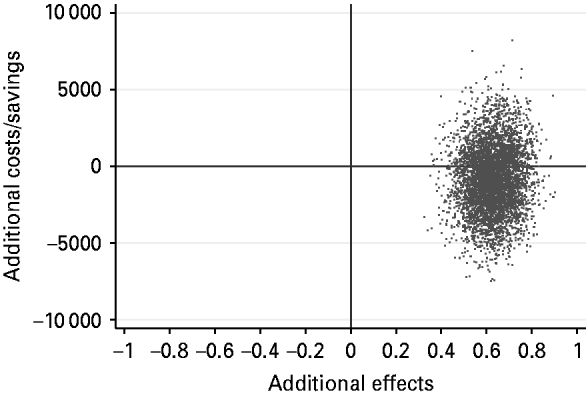
Figure 2 presents the scatter of simulated ICERs across the four quadrants of the ICER plane indicating the degree of uncertainty of the estimated parameter. From a cost-effectiveness perspective, the most favourable outcome is a concentration of scatter in the southeast quadrant indicating superior treatment effects and lower costs of the treatment (ICBT) compared to the control condition. If a majority of the simulated ICERs appeared in the northwest quadrant, ICBT would be associated with higher costs and lowered effectiveness compared to the control condition, thus making it unacceptable from a cost-effectiveness perspective. A majority of the simulated ICERs (64%) are located in the southeast quadrant compared to 36% in the northeast quadrant, indicating that ICBT is a cost-effective treatment.
Cost-effectiveness plane of 5000 bootstrap replicated incremental cost-effectiveness ratios comparing Internet-based cognitive behaviour therapy (ICBT) to control condition (CC), where effects refer to remission from severe health anxiety (no diagnosis). Scatter plots in the southeast quadrant indicate that ICBT produces more cases of remission at a lower cost than CC. Scatter plots in the northwest quadrant represent the opposite.
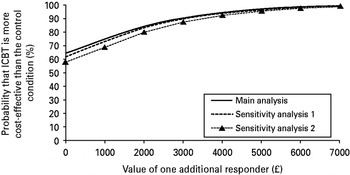
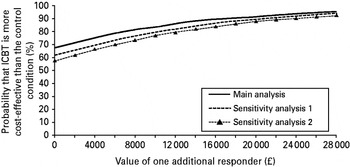
The same data were used to plot the acceptability curve in Fig. 3. The curve indicates that ICBT has a 64% probability of being cost-effective if society were willing to pay £0 for one additional improved patient with severe health anxiety (i.e. in remission). If society were willing to pay £5000 for one case of improvement, the probability of ICBT being cost-effective would increase to 96%.
Cost-effectiveness acceptability curve comparing Internet-based cognitive behaviour therapy (ICBT) to control condition, where additional responder refers to one additional case of remission of severe health anxiety. Sensitivity analyses 1 and 2 correspond to scenarios of low productivity (£130 added to the cost of ICBT) and the first year of implementation (£390 added to the cost of ICBT), respectively.

Cost-utility analysis
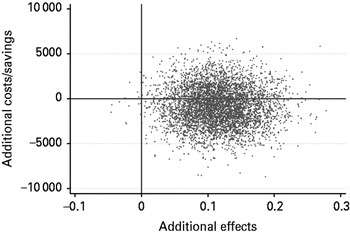
At post-treatment, the cost-utility ICER was −784/0.12 = −6533. This meant that one additional QALY generated a societal earning of £6533 when comparing ICBT to the control condition. Holding baseline values as covariates, there was a significant interaction effect of group and time, indicating a superior improvement on the EQ-5D of the ICBT group at post-treatment (F = 12.6, df = 1, 78, p < 0.001). The scatter of the simulated cost-utility ICERs is presented in the ICER plane in Fig. 4. A majority of the cost-utility ICERs are located in the southeast quadrant (64%) with nearly all remaining ICERs (35%) in the northeast quadrant, indicating that the most likely outcome is that participants receiving ICBT had lower net costs while gaining more QALYs.
Cost-effectiveness utility plane of 5000 bootstrap replicated incremental cost-effectiveness ratios comparing Internet-based cognitive behaviour therapy (ICBT) to control condition (CC), where effects represents quality-adjusted life years (QALYs) as assessed by the EQ-5D. Scatter plots in the southeast quadrant indicate that ICBT produces more QALYs at a lower cost than CC. Scatter plots in the northwest quadrant represent the opposite.

The same data were used to plot the acceptability curve in Fig. 5. The curve indicates that ICBT has a 67% probability of being cost-effective if society were to pay £0 for one gained QALY. If society were willing to pay £5000 for one additional QALY, the probability of ICBT being cost-effective would increase to 77%.
Cost-effectiveness utility acceptability curve comparing Internet-based cognitive behaviour therapy (ICBT) to control condition, where additional responder refers to one additional quality-adjusted life year. Sensitivity analyses 1 and 2 correspond to scenarios of low productivity (£130 added to the cost of ICBT) and the first year of implementation (£390 added to the cost of ICBT) respectively.

Wilcoxon tests showed that the ICBT group had significantly lower direct medical costs, driven by fewer health-care visits, at post-treatment and the 6-month follow-up compared to pre-treatment (Z = 2.0, 2.1, p < 0.05, 0.04). At the 1-year follow-up, the cost reductions no longer reached significance (Z = 0.7, p < 0.45). The CC group had no significant reductions in direct medical costs (Z = − 0.1 to 1.3, p < 0.0.95–0.2). In terms of indirect non-medical costs, the ICBT group made no significant changes (Z = 0.3–0.8, p < 0.74–0.44). The CC group had significantly lower indirect medical costs at the 1-year follow-up compared to pre-treatment (Z = 2.3, p < 0.03) but made no changes in this cost domain at post-treatment or at the 6-month follow-up compared to baseline (Z = − 1.3 to 1.6, p < 0.17–0.10). Holding baseline values as covariates, quantile regression analyses showed no between-group differences of costs at post-treatment (t = 0.0–0.8, p < 1.00–0.43).
Sensitivity analyses
Figures 3 and 5 display acceptability curves assuming additional costs of ICBT (£130 and £390) corresponding to (a) a scenario of low productivity and (b) a scenario assuming the cost of ICBT during the first year of delivering the service. The latter analyses included all one-time costs of development of ICBT and establishing the treatment in a psychiatric context. As shown in Figs 2 and 4, ICBT would remain more cost-effective than the control condition in both circumstances.
Discussion
Main findings
This is the first study, to our knowledge, to investigate the cost-effectiveness and long-term treatment effects of ICBT for severe health anxiety. The results show that ICBT can be a highly cost-effective treatment as each incremental case of improvement in ICBT relative to the control condition generated a societal cost reduction of £1244. This was because the intervention costs of ICBT were offset by a somewhat larger reduction of direct and indirect costs in the ICBT group compared to the control condition. In addition, an important finding of the present study was that the effects of ICBT on measures of health anxiety seem to be stable over at least 1 year after treatment completion. The effect sizes were large on the primary outcome measure (d = 1.75–1.95) at the 1-year follow-up compared to pre-treatment and the emerging picture of the course of improvement is that participants make substantial treatment gains immediately following treatment, and these are maintained at the 6-month and 1-year follow-ups.
Although severe health anxiety has been associated with high societal costs (Seivewright et al. Reference Seivewright, Salkovskis, Green, Mullan, Behr, Carlin, Young, Goldmeier and Tyrer2004; Fink et al. Reference Fink, Ornbol and Christensen2010), we have found only one prior study that has investigated the economic impact of CBT for the disorder. In that study, Seivewright et al. (Reference Seivewright, Salkovskis, Green, Mullan, Behr, Carlin, Young, Goldmeier and Tyrer2004) found that CBT resulted in lower direct medical costs and that the ICER was £33 per unit of reduction in the Short HAI (SHAI). This meant that the cost reduction was not completely offset by the cost of CBT (£427), but the sensitivity analysis showed that, if treatment costs were halved, CBT would have resulted in treatment gains to nearly no cost (ICER = £8). This is in line with data from the present study, in which the intervention cost could be reduced because of the limited amount of therapist time required. Notably, in this study the cost-effectiveness findings were robust as the sensitivity analyses showed that ICBT would remain cost-effective even when assuming higher intervention costs corresponding to scenarios of lower productivity. When interpreting ICERs, it is important to bear in mind that in most developed countries a treatment is not required to produce additional gains at no additional cost to be considered cost-effective. Instead, a treatment that can yield an additional QALY for £40 000 is typically regarded as cost-effective (National Board of Health and Welfare, 2011; King et al. Reference King, Tsevat, Lave and Roberts2005). Accordingly, studies using modelling methods in addition to the RCT design have concluded that conventional CBT for anxiety disorders is cost-effective although the cost of a QALY exceeds £10 000 (Issakidis et al. Reference Issakidis, Sanderson, Corry, Andrews and Lapsley2004; Katon et al. Reference Katon, Russo, Sherbourne, Stein, Craske, Fan and Roy-Byrne2006). From this perspective we view the findings of the present study as very encouraging because an additional QALY gained in ICBT was associated with a societal cost reduction.
As for treatment outcome at the 1-year follow-up regarding health anxiety, the results of the present study are in accordance with findings from studies investigating the effect of conventional CBT (Clark et al. Reference Clark, Salkovskis, Hackmann, Wells, Fennell, Ludgate, Ahmad, Richards and Gelder1998; Barsky & Ahern, Reference Barsky and Ahern2004; Seivewright et al. Reference Seivewright, Green, Salkovskis, Barrett, Nur and Tyrer2008). As expected with a treatment aimed specifically at health anxiety, the effect on depressive symptoms and general anxiety was significant but of moderate size. The non-significant effects of the QOLI can probably be explained by relatively high baseline values leaving less room for improvement, in combination with the fact that many of the items pertain to life domains that are only remotely affected by increased psychological well-being, for example satisfaction with housing, neighbourhood and community. As previous studies on anxiety disorders have shown that patients who relapse tend to do so fairly early, that is before the 1-year follow-up, we view the length of the follow-up period as an important strength of the present study (Yonkers et al. Reference Yonkers, Bruce, Dyck and Keller2003; Baldwin et al. Reference Baldwin, Anderson, Nutt, Bandelow, Bond, Davidson, den Boer, Fineberg, Knapp, Scott and Wittchen2005; Rickels et al. Reference Rickels, Etemad, Khalid-Khan, Lohoff, Rynn and Gallop2010).
Clinical implications
Considering the limited accessibility to CBT (Shapiro et al. Reference Shapiro, Cavanagh and Lomas2003; Cartreine et al. Reference Cartreine, Ahern and Locke2010), the results presented here provide further support for the use of Internet-based CBT as a possible means of providing effective psychological treatment for the many persons with severe health anxiety who currently lack access to CBT. From an economic societal health-care policy perspective, the findings strongly support the implementation of ICBT because health gains can be made while reducing the net costs of the disorder. Thus, there is no conflict between increased treatment accessibility and societal costs. The fact that the large effect sizes were maintained at the 1-year follow-up even though therapists spent less than 2 h in total for each treated participant is of clinical relevance as it demonstrates that improvements obtained in ICBT are as permanent as those in face-to-face CBT. This is in line with studies investigating ICBT for social anxiety disorder (Furmark et al. Reference Furmark, Carlbring, Hedman, Sonnenstein, Clevberger, Bohman, Eriksson, Hallen, Frykman, Holmstrom, Sparthan, Tillfors, Ihrfelt, Spak, Ekselius and Andersson2009; Hedman et al. Reference Hedman, Andersson, Ljótsson, Andersson, Rück, Mörtberg and Lindefors2011b).
Limitations
We consider the following limitations to be the most important. As participants in the CC group received treatment after the initial trial phase, no between-group comparisons could be made at the 1-year follow-up. However, the clear reduction of health anxiety in the CC group after but not before completion of the delayed treatment could be viewed as additional scientific support for the efficacy of ICBT. A second limitation is that questionnaires were used to collect the health economic data. The rationale for this was that primary care register data could be less reliable; for example, unless a there is a central system logging all health-care visits we are dependent on the patient's ability to remember all the health-care clinics they have visited so that data can be retrieved. In addition, it has been demonstrated that self-report measures can be as accurate as register data in health economic assessment (Patel et al. Reference Patel, Rendu, Moran, Leese, Mann and Knapp2005). A third limitation concerns the generalizability of estimates of health-care consumption to countries with other economic models for health care. This study was conducted in Sweden, where patients receive care within a system closely resembling the National Health Service (NHS) in the UK. As health-care consumption is substantially lower in subsidized health-care systems compared to those relying more on private financing, it is possible that patients with severe health anxiety in, for example, the USA might have even higher costs for health care (Reinhardt et al. Reference Reinhardt, Hussey and Anderson2004). However, estimates of cost-effectiveness (i.e. ICERs) would probably be largely the same because increased costs would be expected in the experimental treatment and also in the control treatment.
Despite these limitations, we view the results of the present study as important because they provide further empirical support for a new effective treatment for severe health anxiety that could play an important role in increasing accessibility to psychological treatment.
Acknowledgements
Trial registration: ClinicalTrials.gov (number NCT00 828152).
Declaration of Interest
The main funding organization (Stockholm County Council) is a public institution and had no role in the design and conduct of the study; in the collection, management, and analysis of the data; or in the preparation, review and approval of the manuscript. All authors report that they have no competing interests.