INTRODUCTION
Five of the seven species of sea turtles are considered to be ‘critically endangered’ or ‘endangered’ by the International Union for Conservation of Nature (IUCN, 2012). By-catch in longline fisheries is considered to be a critical global threat for sea turtles in general (Lewison et al., Reference Lewison, Crowder, Read and Freeman2004a), and in the Mediterranean in particular (Casale, Reference Casale2011). Sea turtles are long-lived animals with slow growth and late maturity. Thus, mature sea turtles show relatively high fecundity, and neonatal and immature individuals present high natural mortality (Crouse et al., Reference Crouse, Crowder and Caswell1987). In this context, the incidence of fisheries mortality on each size-class has a different effect on populations. For this reason, the most dangerous effects on sea turtle population conservation are due to the differential by-catch of juvenile or adult turtles.
The western Mediterranean Sea is an important fishing ground for the Spanish longline fishery, mainly targeting swordfish, Xiphias gladius, bluefin tuna, Thunnus thynnus, and albacore, T. alalunga. The Balearic Islands and surrounding fishing grounds are important feeding areas for thousands of juvenile and sub-adult loggerheads (Camiñas & de la Serna, Reference Camiñas, de la Serna, Llorente, Montori, Santos and Carretero1995) originating from nesting beaches in the Atlantic Ocean (Eckert et al., Reference Eckert, Moore, Dunn, van Buiten, Eckert and Halpin2008; Monzon-Arguello et al., Reference Monzon-Arguello, Rico, Naro-Maciel, Varo-Cruz, López, Marco and López-Jurado2010) and the eastern Mediterranean Sea (Carreras et al., Reference Carreras, Pont, Maffucci, Pascual, Barceló, Bentivegna, Cardona, Alegre, San Félix, Fernández and Aguilar2006, Reference Carreras, Pascual, Cardona, Marco, Bellido, Castillo, Tomás, Raga, Sanfélix, Fernández and Aguilar2011). Due to the spatial overlap in fishing activity and loggerhead distribution, Lewison et al. (Reference Lewison, Freeman and Crowder2004b) estimated that a minimum of 60,000 loggerhead sea turtles Caretta caretta were caught as by-catch in Mediterranean longline fisheries; more recently, Casale (Reference Casale2011) estimated that a minimum of 57,000 loggerhead sea turtles were caught as by-catch in Mediterranean longline fisheries.
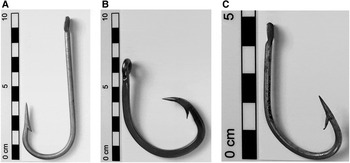
Technical differences in fisheries operations and gear configurations (e.g. hook and bait type) by Spanish Mediterranean longliners can determine by-catch frequency (Camiñas et al., Reference Camiñas, Báez, Valeiras and Real2006), and catch selectivity of size-classes (Wallace et al., Reference Wallace, Heppell, Lewison, Kelez and Crowder2008). The current classification of the Spanish longline fleet by the International Commission for the Conservation of Atlantic Tunas (ICCAT), recognizes four surface longline gears: LLALB (longline albacore), surface longline targeting albacore; LLAM (longline American), surface longliners using a hydraulically-operated monofilament longline reel and targeting swordfish; LLJAP (longline Japanese), surface longliners targeting bluefin tuna; and LLHB (longline home-base), traditional surface longliners targeting swordfish. Briefly, the principal differences in longline gears are related to hook type and hook size, bait type and operational depth (Table 1; Figure 1); for a detailed review see Camiñas et al. (Reference Camiñas, Báez, Valeiras and Real2006), Báez et al. (Reference Báez, Real and Camiñas2007a, Reference Báez, Real, Garcia-Soto, de la Serna, Macías and Camiñasb) and García-Barcelona et al. (Reference García-Barcelona, Ortiz de Urbina, de la Serna, Alot and Macías2010a, Reference García-Barcelona, Macías, Ortiz de Urbina, Alba, Real and Báezb). Of the three longline gear types described by Camiñas & Valeiras (Reference Camiñas, Valeiras, Laurent, Camiñas, Casale, Deflorio, De Metrio, Kapantagakis, Margaritoulis, Politou and Valeiras2001), longline gear targeting albacore caught smaller turtles relative to turtles caught using longline gear targeting bluefin tuna and swordfish.
Detail of the three different hooks used for the Spanish surface longline. Type A: used by surface longliners using a hydraulically-operated monofilament longline reel and targeting swordfish, and traditional surface longliners targeting swordfish; Type B: used by surface longliners targeting bluefin tuna; Type C: used by surface longline targeting albacore.

Main technical features of different gear types used in surface longline vessels. LLALB, surface longline targeting albacore; LLAM, surface longliners using a hydraulically-operated monofilament longline reel and targeting swordfish; LLJAP, surface longliners targeting bluefin tuna; LLHB, traditional surface longliners targeting swordfish.

*hydraulically-operated monofilament longline reel.
The longline fleet represents a group of companies, each with its own economic interests and in competition with each other. For this reason, the fishing fleet is continually making innovations and improving the economic profit of the fishery, and since Camiñas & Valeiras (Reference Camiñas, Valeiras, Laurent, Camiñas, Casale, Deflorio, De Metrio, Kapantagakis, Margaritoulis, Politou and Valeiras2001) published their study, the Spanish longline fleet has undergone further changes. In this context, we have currently observed four different surface longlines (gear types) in the Spanish longline fleet (Table 1).
The aim of the present study was to test the differences in by-catch per unit effort and body sizes of loggerhead sea turtles caught using different gear in the Mediterranean surface longline fishery. The ultimate goal of this study is to improve our knowledge about the possible effects of longline fisheries on loggerhead populations, and thus to improve fisheries management to reduce population impacts.
MATERIALS AND METHODS
The Spanish Institute of Oceanography (IEO) instituted an onboard observer programme on commercial longline vessels targeting highly migratory species, with the aim of obtaining direct information on catches and discards of target and by-catch species (e.g. catch and by-catch species, number of individuals, size, and other biological data). In the present study, we used data recorded from 1999 to 2011 in the above-mentioned programme (for more information on Spanish observer programme see Camiñas et al., Reference Camiñas, Báez, Valeiras and Real2006; Báez et al., Reference Báez, Real and Camiñas2007a, Reference Báez, Real, Garcia-Soto, de la Serna, Macías and Camiñasb, Reference Báez, Camiñas, Sagarminaga, Torreblanca and Realc, Reference Báez, Real, Macías, de la Serna, Bellido and Camiñas2010; García-Barcelona et al., Reference García-Barcelona, Ortiz de Urbina, de la Serna, Alot and Macías2010a, Reference García-Barcelona, Macías, Ortiz de Urbina, Alba, Real and Báezb).
In the period studied, the Spanish surface longline fleet consisted of approximately 90 vessels (annual average) that fished on a year-round basis. Vessel length ranged from 12 m to 27 and fishing trips were often of short duration (one day to six days). These fleets have been described in recent studies (Valeiras & Camiñas, Reference Valeiras and Camiñas2003; Camiñas et al., Reference Camiñas, Báez, Valeiras and Real2006; Báez et al., Reference Báez, Camiñas and Rueda2006, Reference Báez, Real and Camiñas2007a, Reference Báez, Real, Garcia-Soto, de la Serna, Macías and Camiñasb; García-Barcelona et al., Reference García-Barcelona, Ortiz de Urbina, de la Serna, Alot and Macías2010a, Reference García-Barcelona, Macías, Ortiz de Urbina, Alba, Real and Báezb); a detailed synopsis is provided in Table 1.
Using a pair of large callipers, the standard straight carapace length (SCL) measurements (measured from the anterior point at the midline of the nuchal scute to the posterior tip of the supra-caudal scute) were taken of 697 loggerhead turtles by-caught by surface longliners within the study period. We tested size differences between these by-caught loggerheads for each gear type, using univariate analysis of variance, after testing for normality with the one-sample Kolmogorov–Smirnov test (for example, see Sokal & Rohlf, Reference Sokal and Rohlf1995).
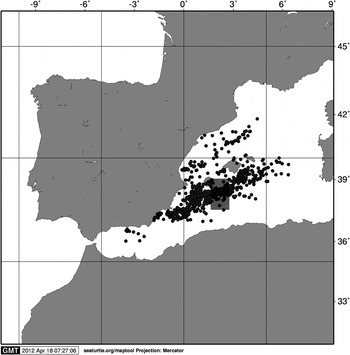
Wallace et al. (Reference Wallace, Heppell, Lewison, Kelez and Crowder2008) proposed that sea-turtle size selectivity in fishing gear may be explained by the differential geographical distribution of fishing fleets interacting with turtles originating from different nesting populations. To address this possible effect, we selected a geographical area (between 38°–39°N and 2°–3°E) to test for loggerhead size selectivity across fishing gears (Figure 2). In total, 95 of the 697 loggerheads considered in this study were caught in this geographical region (16, 50, and 29 turtles were caught by LLALB, LLJAP, and LLHB, respectively). We selected this specific area because previous studies have found that in the area of the Balearic Islands there is a mixture of individuals from both the Mediterranean and the Atlantic nesting beaches (Carreras et al., Reference Carreras, Pascual, Cardona, Marco, Bellido, Castillo, Tomás, Raga, Sanfélix, Fernández and Aguilar2011); in addition, a greater number of turtles were measured in this area versus other areas around the Balearic Islands.
The western Mediterranean Sea (study area), showing the observed set with positive loggerhead turtle by-catch of the Spanish longline fleet. We highlight the area between 38°–39°N and 2°–3°E that we selected as a specific geographical area. In this area we observed a sub-sample consisting of 95 specimens of the 697 total loggerheads in the study.

RESULTS AND DISCUSSION
We observed that LLALB and LLAM presented the highest sea-turtle by-catch rates, whereas LLHB presented the lowest (Table 2). The mean SCL for by-caught turtles across all fleets was 49 cm (N = 697) (Table 2). This result could be due to the dynamics of the fleet, given that LLALB, LLAM and LLJAP are used in spring and summer, whereas LLHB is used throughout the year.
The number of fishing operations observed for each gear type, the corresponding number of loggerhead by-caught per gear type, and minimum, maximum, mean and standard deviation straight carapace length measurements per gear type.
Key: Hooks, total observed hooks (in 1000s); Turtles, total by-catch turtles observed; BPUE, by-catch per unit effort per 1000 hooks; LLALB, surface longline targeting albacore; LLAM, surface longliners using a hydraulically-operated monofilament longline reel and targeting swordfish; LLJAP, surface longliners targeting bluefin tuna; LLHB, traditional surface longliners targeting swordfish.

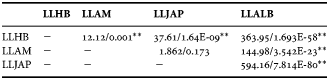
There were no significant differences in SCL between loggerheads taken in the LLJAP and LLAM fleets, whereas significant differences in SCL were found between turtles caught using LLHB and LLALB gear and when compared to other gear types (Table 3). Loggerheads caught using LLALB had the smallest mean SCL, whereas turtles caught using LLHB had a smaller mean SCL compared to LLJAP and LLAM (Table 3). This could be because smaller hooks tend to capture smaller loggerheads, whereas larger hooks (targeting swordfish) tend to select the larger animals, corresponding to Donoso & Dutton's (Reference Donoso and Dutton2010) findings.
Results of univariate analysis of variance, between turtle size (in Straight Carapace Length measurements) per each longline gear. The first number is the F statistic (F) and the second number is the p-value (p) (F/p). Key words: LLALB, surface longline targeting albacore; LLAM, surface longliners using a hydraulically-operated monofilament longline reel and targeting swordfish; LLJAP, surface longliners targeting bluefin tuna; LLHB, traditional surface longliners targeting swordfish.
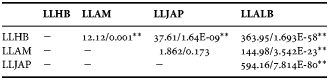
**, indicates P < 0.01.
When we tested for the possible effect of size as a function of geographical location using the sub-sample of 95 by-caught turtles within the same geographical area, we observed significant differences between LLHB (mean = 48 cm, N = 29), LLJAP (mean = 56 cm, N = 50), and LLALB (mean = 33 cm, N = 16), (F = 68.234, df = 2, P = 6.73*10−4). However, the only area studied was around the Balearic Islands and geographical effects could arise depending on which geographical area is selected for analysis. No data are available on the size of turtles by-caught in more distant areas of the Mediterranean Sea.
All the turtles caught were discarded (approximately 98% of by-catch turtles were released alive). However, the post-release mortality remains unknown. Recent studies have found a significant negative correlation between hook size and the likelihood of deep ingestion (Stokes et al., Reference Stokes, Hataway, Epperly, Shah, Bergmann, Watson and Higgins2011). Thus, small hooks, which are used by the LLALB, could be related to major post-release mortality due to internal injuries; the LLALB fleet has the highest loggerhead turtle capture rate in the western Mediterranean of approximately one loggerhead per 1000 hooks.
Revelles et al. (Reference Revelles, Camiñas, Cardona, Parga, Tomás, Aguilar, Alegre, Raga, Bertolero and Oliver2008) suggest the existence of a permeable barrier north of the Balearic Islands that divides the north-western and the southern Mediterranean basin affecting the distribution of loggerhead turtles. This barrier could have an impact on the distribution of both migrant turtles from the Atlantic and the eastern Mediterranean. According to García-Barcelona et al. (Reference García-Barcelona, Ortiz de Urbina, de la Serna, Alot and Macías2010), Spanish longliners have homogeneously distributed their fishing effort around the Balearic Islands. For these reasons, we believe that the Spanish longline fleet has an impact on both loggerhead nesting populations in a similar way.
An important finding of this paper is that differences in gear type used by Spanish Mediterranean surface longline fishery could have an effect on loggerhead by-catch frequency and size selectivity. Thus, it is of great importance to take into account the gear type (and its particular catch rates) when making inferences about the impact of longline fisheries on sea turtle populations.
Implications for surface longline fishery management
The demography of sea turtle populations is particularly sensitive to changes in the growth and mortality of older juveniles and adults (Crouse et al., Reference Crouse, Crowder and Caswell1987). For this reason, Pritchard (Reference Pritchard1980), in a classic paper, recommended increased efforts to reduce mortality in large juveniles and mature adults, particularly because these size/age-classes have increased potential reproductive value, i.e. older turtles have a greater probability of surviving to the next stage and nesting. Thus, disproportionate rates of fisheries-induced mortality on certain size/age-classes can differentially affect sea turtle populations, as each sea turtle age-class contributes differently to current and future reproductive activity (Wallace et al., Reference Wallace, Heppell, Lewison, Kelez and Crowder2008). In this context, fisheries management should not only be focusing on preserving large juvenile turtles and mature turtles, but also on reducing the total by-catch. Thus, it is important to strike a balance between total by-catch and by-catch by size-class.
We observed that LLHB had the lowest turtle by-catch per unit of effort (BPUE) and that turtle sizes were smaller on average to turtle sizes in LLJAP and LLAM. This contrasted with LLALB that had the smallest turtles on average, but the highest BPUE. Thus, we suggest the following recommendations: using LLHB versus other surface gear; and limiting fishing activity using surface longlines versus increasing fishing activity using semi-pelagic and bottom longline, for which turtle by-catch has not been reported due to their greater fishing depth (García-Barcelona et al., Reference García-Barcelona, Aranguren, Saber, de la Serna, Ortiz de Urbina, Báez and Macías2012).
It is of importance to continue the longline monitoring programme in order to test these recommendations and to improve the management of longline fisheries (technology, and fishing strategies), thus making the exploitation of large pelagic resources sustainable.
ACKNOWLEDGEMENTS
The onboard observer programme in commercial longline vessels was supported by different projects from the IEO based in Malaga, GPM-4 programmes (IEO) and PNDB (EU-IEO). We are grateful to the skippers and fishermen for providing the data from the boats. We also thank Andrew Paterson for style corrections and Leticia González-Alberquilla for her support in creating the map. The authors acknowledge use of the Maptool program which was used for analysis and the graphics presented in this paper. Maptool is a product of SEATURTLE.ORG (information available at www.seaturtle.org). We thank Dr Bryan Wallace for his useful comments.