Introduction
Household food insecurity (HFI) in Canada and other developed nations is recognized as a growing problem and threat to health by researchers, health professionals, advocates, and the general public (Tarasuk, Reference Tarasuk and Raphael2016). While certainly not as severe as in the developing world (Dreze and Sen, Reference Dreze and Sen1989; Lal et al., Reference Lal, Hansen and Uphoff2016), the inability of wealthy developed nations to adequately feed its citizens is striking (Riches, Reference Riches2016). As a signatory to numerous international covenants that recognize HFI as a violation of human rights, Canadian governments are obliged to address it, yet have failed to do so. One reason for this is that the growth of HFI has spawned numerous non-governmental means of managing the problem: such as food banks, feeding programs, and community gardens and kitchens (Riches and Tarasuk, Reference Riches, Tarasuk, Riches and Silvasti2014). Rather than reducing HFI, these efforts have served to depoliticize the issue, making its solution through public policy action even more difficult than is already the case (Riches, Reference Riches2016).
In addition, responding to a societal problem such as HFI is made difficult by the lack of consensus amongst researchers, advocates, and the public as to its causes and solutions. In this article we present – based on a careful analysis of the Canadian HFI literature – five competing discourses on HFI: nutrition and dietetics, charitable food distribution, community development, social determinants of health (SDH) and political economy. We argue most of these discourses obscure the structural sources of HFI and transform it from a societal problem to a personal and community one, making its solution more difficult. We call for placing HFI within a critical materialist political economy perspective whereby HFI is seen as resulting from the skewed distribution of economic and social resources produced by societal imbalances in power and influence. As such, the solution to HFI requires reducing these imbalances through citizen action that literally forces governments to enact public policies that reduce the inequitable distribution of economic and social resources, thereby reducing HFI.
Defining household food insecurity
HFI has been defined as the ‘inability to obtain sufficient, nutritious, personally acceptable food through normal food channels or the uncertainty that one will be able to do so’ (Davis and Tarasuk, Reference Davis and Tarasuk1994: 50). Marginal HFI is worrying about running out of food and/or limited food selection due to a lack of money. Moderate HFI is consuming food inadequate in either quality or quantity, while severe HFI is experiencing reduced food intake or disrupted eating (Tarasuk et al., Reference Tarasuk, Mitchell and Dachner2016). There is a distinction between household, community, and societal food insecurity. At the household level, food insecurity refers to households’ financial ability to access adequate foods (McIntyre and Anderson, Reference McIntyre, Anderson and Raphael2016), whereas at the community and societal levels food insecurity refers to aspects of the broader food system, including trade policies, agri-food industries and globalized food systems which impact local production and supply and distribution of foods (McIntyre and Rondeau, Reference McIntyre, Rondeau and Raphael2009). An additional concept, food sovereignty, is concerned with the ability of communities to manage their own food systems, i.e. land, water and seeds, as well as involvement in trade (Weiler et al., Reference Weiler, Hergesheimer, Brisbois, Wittman, Yassi and Spiegel2015). In this article, our focus is on HFI in Canada, yet we note how HFI discourses link to these broader concepts.
Household food insecurity in Canada
The 2012 Canadian Community Health Survey (CCHS) found that 12.6 per cent of Canadian households experienced food insecurity. Of this amount, 4.1 per cent experienced marginal HFI (approx. 543,700 households), 6.0 per cent experienced moderate HFI (approx. 786,100 households), and 2.6 per cent experienced severe HFI (approx. 336,700 households). In total, nearly 1.7 million households or 2.8 million individuals, and nearly 1.15 million children under the age of eighteen, experienced some form of HFI in Canada during 2012 (Tarasuk et al., Reference Tarasuk, Mitchell and Dachner2014b).
HFI is at even more alarming levels among Canada's indigenous populations. Provinces and territories with higher concentrations of First Nations and Inuit populations report higher rates of HFI (Nunavut, 45.2 per cent; Northwest Territories, 20.4 per cent; Yukon, 17.1 per cent) (Tarasuk et al., Reference Tarasuk, Dachner, Hamelin, Ostry, Williams, Bosckei, Poland and Raine2014a).
The Canadian government has recognized access to food as a basic human right by virtue of being a signatory to the Universal Declaration of Human Rights (United Nations, 1948), the International Covenant on Economic, Social and Cultural Rights (United Nations, 1966), the World Declaration and Plan of Action for Nutrition (World Health Organization, 1992) and the Declaration of World Food Security (Food and Agriculture Organization of the United Nations, 1996), all of which obligate governments to provide access to food. Yet, to date, little has been done by Canadian governments to achieve this. Instead, vast non-governmental networks that provide food to HFI Canadians have developed which rather than solving the problem have served to depoliticize it, making its solution even more difficult than is already the case (Riches and Tarasuk, Reference Riches, Tarasuk, Riches and Silvasti2014).
Causes of household food insecurity
HFI can best be understood within the context of growing social inequalities associated with the retrenchment of the Canadian welfare state since the 1970s (Riches, Reference Riches1986, Reference Riches1997, Reference Riches2018; Riches and Silvasti, Reference Riches and Silvasti2014). As early as Reference Riches1986, the striking growth of food banks in Canada was recognized as a result of the deteriorating state of the Canadian social safety net (Riches, Reference Riches1986). Since then the situation has worsened because of growing inequalities in income, wealth, employment and housing security among Canadians, a result of higher than rate-of-inflation rises in housing costs, increasing precarious employment, and drastic reductions in social spending by both federal and provincial governments (Banting and Myles, Reference Banting and Myles2013).
Not surprisingly, Canada has been the target of ongoing rebukes by the United Nations for its failure to address HFI. The most recent UN Rapporteur's Report on Hunger in Canada described how income gaps among lower, middle and higher income groups have widened in Canada to the point that a significant proportion of Canadians cannot afford food (De Schutter, Reference De Schutter2014). The situations for Canadians of indigenous descent and those receiving social assistance were identified as especially problematic.
Managing household food insecurity
Serious efforts to address the drivers of HFI in Canada are complicated by the development of a vast non-governmental industry acting to provide food to HFI Canadians (Riches and Tarasuk, Reference Riches, Tarasuk, Riches and Silvasti2014). These include the traditional charitable soup kitchen – long a feature of Canadian society – complemented by an explosive growth of food banks, associated community-based food drives, and children's feeding programs. In addition, community developers have spawned local community kitchens and community gardens, Good Food Box-type activities, and other local means of providing food as means of responding to HFI (Riches and Tarasuk, Reference Riches, Tarasuk, Riches and Silvasti2014).
While these responses to HFI are well-intentioned, they depoliticize HFI and give the false impression that effective responses to HFI are being taken (Wakefield et al., Reference Wakefield, Fleming, Klassen and Skinner2013). The emphasis placed upon non-governmental responses to HFI diverts attention from the societal structures and processes creating it, and the changes to these structures and processes necessary to reduce it. This makes its solution through state action more difficult (Riches, Reference Riches2018; Riches and Silvasti, Reference Riches and Silvasti2014) and explains in part why, despite the growth in knowledge about the extent of HFI, its adverse health effects, and the means by which it could be reduced, the HFI situation is worsening (PROOF, 2016).
In the following sections we show how increasing HFI in Canada generates differing societal discourses that explain in varying ways: a) HFI's presence in Canada; b) HFI's adverse health effects; and c) means of responding to HFI. The availability of differing discourses makes reaching a consensus on a preferred course of action difficult. Some of these discourses give the mistaken impression to many that HFI is being effectively dealt with, thereby relieving governments of the responsibility to act.Footnote 1
Paradigms and discourses
Political scientist Deborah Stone writes: ‘It's far easier to identify common problems of a group than to find a common solution’ (Stone, Reference Stone2002: 230). This is true in the case of HFI. The HFI literature is robust with regards to the extent and health implications of HFI but approaches to explaining and addressing it vary. These approaches to explaining and addressing HFI represent both differences in paradigms (Kuhn, Reference Kuhn1970) as well as discourses (Foucault, Reference Foucault1972).
Paradigmatic differences are usually differences in how a phenomenon is understood, with debates usually focused in the intellectual domain. Differences in understanding HFI are a result of intellectual and professional training, personal values and attitudes, as well as ideological dispositions (Kuhn, Reference Kuhn1970). Discourse differences subsume all of these but raise issues of power and coercion, as particular discourses may be favoured or disfavoured in terms of the receipt of societal respect, available research funding, and collegial reactions to HFI research and HFI-reduction activities (Foucault, Reference Foucault1972).
Discourses are especially important, as discourse language is not a neutral medium of communication. Rather discourses are centered on issues of power, coercion and legitimation (Lessa, Reference Lessa2005). In this way, discourse statements function to create social realities that, through power dynamics, exert influence over research and practice (Given, Reference Given2008). We see discourse theory as explaining why some discourses of HFI are in favour while others are not. As we will show later, few food security advocates make mention of the role that the political and economic power of the corporate and business sector play in the inequitable distribution of income that leads to HFI, instead preferring to view it as a personal or community problem. We also see the acceptance of some HFI discourses over others as responsible for the persistence and worsening of the problem over the last forty years, despite the explosion of research into its extent and adverse health effects.
Methodology
In this article, we identify five discourses on the sources and means of responding to HFI derived from an extensive narrative review of the last four decades of Canadian theoretical and empirical literature on HFI (Mendly-Zambo, Reference Mendly-Zambo2017).Footnote 2 The two authors jointly identified the key discourses found in the HFI literature by detecting the specific assumptions in the literature concerning the sources of HFI and the means provided of responding to it. This procedure had proven successful in previously published examinations of discourses found in the social determinants of health (Raphael, Reference Raphael2011) and obesity and health literatures (Medvedyuk et al., Reference Medvedyuk, Ali and Raphael2017). Consistent with tenets of the inductive approach to inquiry, we provide thick description of our findings, such that the validity of these HFI discourses and their usefulness for understanding the presence of HFI and its lack of amenability can be determined by readers (Lincoln and Guba, Reference Lincoln and Guba1985).
Findings: HFI discourses in Canada
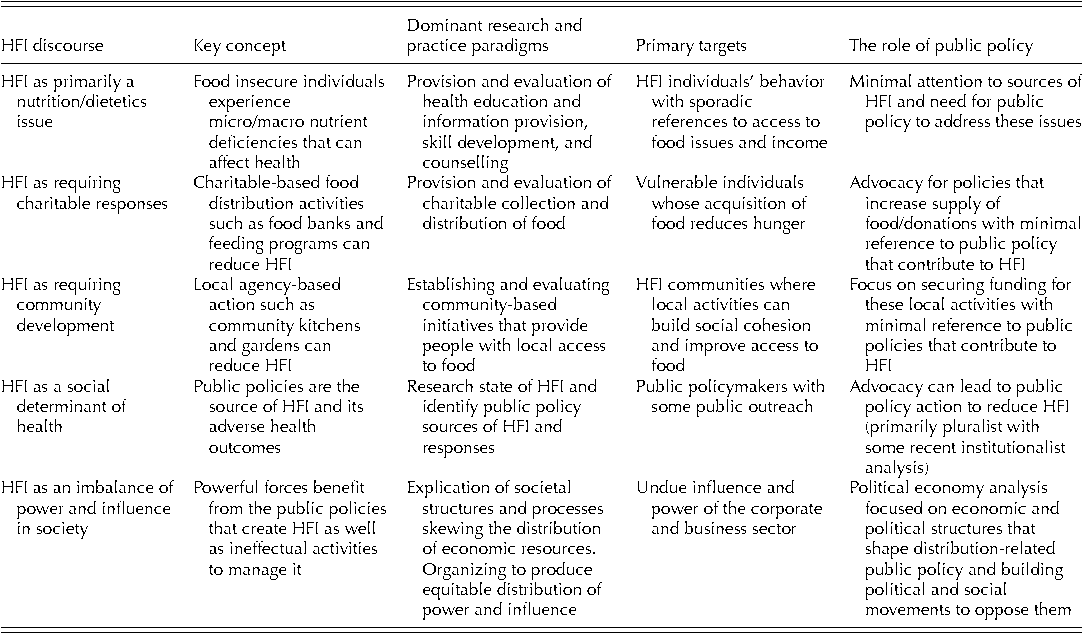
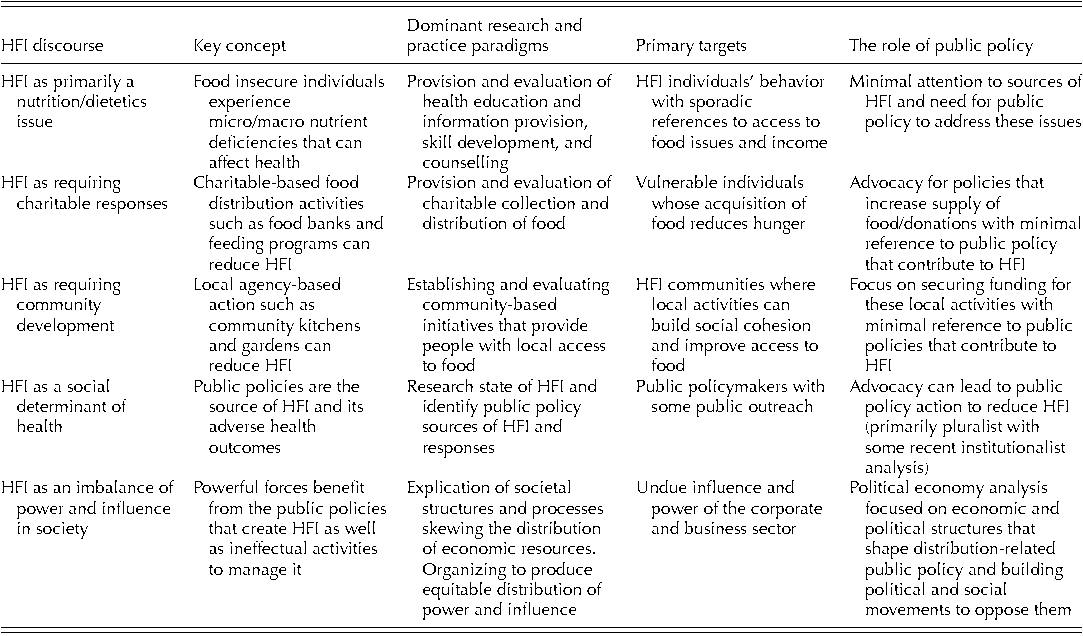
Table 1 presents details concerning these differing HFI discourses in Canada. These were identified based on our reading of their: a) key concept; b) dominant research and practice paradigms; c) primary targets; and d) the role attributed to public policy. The first three discourses, nutrition and dietetics, charitable food distribution, and community development, focus on immediate responses to the most visible consequences of HFI, hunger and malnutrition. These discourses have little to say about the public policy roots of HFI. The latter two, SDH and critical materialist political economy, focus on the broader factors responsible for HFI but offer differing means of promoting public policy action for reducing it.
Competing discourses/paradigms in the Household Food Insecurity (HFI) literature
Household food insecurity as a nutrition and dietetics issue
The nutrition and dietetics discourse focuses on food choice behaviours and health outcomes associated with HFI. Research and practice activities identify the nutritional deficiencies generated by HFI, and message around reducing these through the adoption of healthy eating habits. It is consistent with a healthy lifestyles approach, which assumes that diet-related issues are a primary contributor to ill health (Labonte, Reference Labonte1993; Nettleton, Reference Nettleton, Sidell, Jones, Katz and Peberdy1997; Scott-Samuel and Smith, Reference Scott-Samuel and Smith2015). In its usual form, it says little about the sources of HFI and means of reducing it. As such, it is an individualistic and depoliticized approach to HFI.
HFI is framed within the discourse of individual lifestyle behaviour and can be remedied with increased knowledge of cooking or bulk food purchasing techniques. In one example, Mello and colleagues examined the dietary behaviours of HFI individuals and concluded ‘Interventions to improve eating habits of low-income individuals should focus on education to improve knowledge, skills, and attitudes related to healthy eating and food preparation, as well as improving access and availability to healthy foods’ (Mello et al., Reference Mello, Gans, Risica, Kirtania, Strolla and Fournier2010: 1910).
In another example, Mercille and colleagues, observing that, in an Aboriginal population, ‘Severe household food insecurity was associated with significantly lower healthy food preparation. . .’ (p. 134) recommended behavioural interventions and the implementation of public policies to improve diet. Although it was acknowledged that ‘using only an educational approach to change behaviours cannot compensate for insufficient income. . .’ (p. 139) behaviour change was its dominant focus (Mercille et al., Reference Mercille, Receveur and Potvin2012).
Food literacy skills therefore are seen as an important component of health and food security (Thomas and Irwin, Reference Thomas and Irwin2011). A published scoping review based on a research project funded by Public Health Ontario provided these components of food literacy (Perry et al., Reference Perry, Thomas, Samra, Edmonstone, Davidson, Faulkner, Petermann, Manafò and Kirkpatrick2017: 2406):
Food and Nutrition Knowledge informs decisions about intake and distinguishing between ‘healthy’ and ‘unhealthy’ foods. Food Skills focuses on techniques of food purchasing, preparation, handling and storage. Self-Efficacy and Confidence represents one's capacity to perform successfully in specific situations. Ecologic refers to beyond self and the interaction of macro- and microsystems with food decisions and behaviours. Food Decisions reflects the application of knowledge, information and skills to make food choices.
It is noteworthy that this scoping review and other recent work by the Ontario Dieticians in Public Health (ODPH) explicitly note the broader societal factors (i.e. ecologic) such as poverty and social exclusion that make health literacy difficult to attain and the need to address them (Ontario Dieticians in Public Health, 2018). However, these broader recommendations are frequently ignored by governmental authorities when they are combined with the more familiar and concrete dietary behaviours components, a problem that cannot be blamed upon ODPH.
There are a number of problems with the nutrition and dietetics discourse. The primary one is its assumption that HFI individuals can make ‘healthy lifestyle choices’ in the face of the societal structures and processes that restrain such choices (Labonte and Penfold, Reference Labonte and Penfold1981; Lindbladh et al., Reference Lindbladh, Lyttkens, Hanson and Ostergren1998; Raphael, Reference Raphael2002). Without taking account of the economic factors leading to HFI, these efforts to promote healthy eating behaviours will have little effect. Research indicates that HFI individuals’ food choices are strongly shaped by their environments, such that consuming a healthy diet is made difficult by the inability to purchase such food (Raine, Reference Raine2005).
Second, while HFI certainly contributes to adverse health outcomes, HFI is embedded within the experiencing of a number of SDH – low income, precarious and insecure work and inadequate housing – which in combination lead to adverse health outcomes. Even if HFI individuals were able to change their dietary behaviours to achieve a better diet – and this is far from certain – their experiences of numerous other problematic SDH would continue to produce adverse health outcomes. In any event, programs aimed at changing individual behaviours of HFI-insecure individuals through nutrition education (Anderson, Reference Anderson2007), cooking skills (Wrieden et al., Reference Wrieden, Anderson, Longbottom, Valentine, Stead, Caraher, Lang, Gray and Dowler2007) and healthy eating (Bihan et al., Reference Bihan, Mejean, Castetbon, Faure, Ducros, Sedeaud, Galan, Le Clesiau, Peneau and Hercberg2012) programs show modest or short-term effects on behaviour, and improved health is not demonstrated (Pignone et al., Reference Pignone, Ammerman, Fernandez, Orleans, Pender, Woolf, Lohr and Sutton2003).
HFI is ‘medicalized’, a sociocultural process whereby a non-medical problem (e.g. lack of food) is defined and treated as a medical problem and a medical framework is adopted to understand and ‘treat’ the issue (Conrad, Reference Conrad1992). These supplementation programs or public health campaigns that emphasize personal behaviours have the effect of shifting responsibility for HFI and the means of responding to it away from governments onto the individual.
Indeed, it has been argued that the research fields of human nutrition and dietetics – referred to as ‘hegemonic nutrition’ – are conceived on universally equivalent and standardized concepts of normality that are easily decontextualized from the socio-spatial, political-economic and cultural locations in which normality is embedded (Hayes-Conroy, Reference Hayes-Conroy2016). Furthermore, it conforms to the ‘scientistic’ notion that facts are neutral and objective, enabling researchers to view nutrition in apolitical terms (Kimura et al., Reference Kimura, Biltekoff, Mudry and Hayes-Conroy2014).
Household food insecurity as requiring charitable responses
Charitable responses to HFI include soup kitchens, food banks and feeding programs (Poppendieck, Reference Poppendieck1999; Wakefield et al., Reference Wakefield, Fleming, Klassen and Skinner2013). Emergency food delivery dates back to the soup kitchens of the Great Depression (Wakefield et al., Reference Wakefield, Fleming, Klassen and Skinner2013). The first food banks in Canada opened in 1981 and were intended as short-term and emergency solutions to dire economic conditions, including recession and economic restructuring, as well as cuts to welfare programs (Husbands, Reference Husbands, Koc, MacRae, Mougeot and Welsh1999). In reality, they became institutionalized and have diverted attention from the causes and appropriate means of responding to HFI (Riches, Reference Riches1986, Reference Riches1997; Riches and Silvasti, Reference Riches and Silvasti2014). The number of HFI Canadians using food banks has expanded over time from 675,000 a month in 1996 to 862,000 a month in 2016 (Food Banks Canada, 2017).
Food bank usage is sometimes used as an indicator of population-level HFI rates. In reality however, food bank usage underestimates that prevalence. It is estimated that the number of food insecure Canadians is 4.6 times greater than the number of individuals that receive food from food banks (Loopstra and Tarasuk, Reference Loopstra and Tarasuk2015). Food bank use as an indicator of HFI underestimates the scope and magnitude of food insecurity, thereby reducing the need for public policy responses.
Food banks are no longer viewed as temporary solutions, but have become, along with food drives, an entrenched part of how HFI insecurity is managed; food banks create a public perception it is being addressed (Riches and Tarasuk, Reference Riches, Tarasuk, Riches and Silvasti2014). In addition, governments, rather than implementing public policy to reduce their use, in some cases contribute to their continuation (Tarasuk et al., Reference Tarasuk, Dachner, Hamelin, Ostry, Williams, Bosckei, Poland and Raine2014a). As one example, rather than develop an anti-poverty strategy, the British Columbia (BC) government contributed ten million dollars to Food Banks BC to expand refrigeration capacity (Government of British Columbia, 2017). Ontario is committing funds to expand the capacity of food banks to transport and store perishable foods (Paralovos, Reference Paralovos2017), and Ontario (Ontario Ministry of Finance, 2017), Nova Scotia (Smith, Reference Smith2016) and BC (Government of British Columbia, 2016) are implementing tax credits for farmers to receive rebates on food they donate to food banks.
Critics of the charitable responses approach argue that emergency food programs are unable to address HFI in their communities and heighten the problem by facilitating government-led welfare state retrenchment (Poppendieck, Reference Poppendieck1999; Livingstone, Reference Livingstone2013; Wakefield et al., Reference Wakefield, Fleming, Klassen and Skinner2013): ‘The rise of food banks in Canada is concrete evidence both of the breakdown of the social safety net and the commodification of social assistance’ (Riches, Reference Riches2002: 648). There is also evidence that food bank users experience stigma and feel shame (Tarasuk and Beaton, Reference Tarasuk and Beaton1999; Vahabi and Damba, Reference Vahabi and Damba2013).
Similar critiques are available in regard to children's breakfast/feeding programs (Hay, Reference Hay2000; Williams et al., Reference Williams, McIntyre and Dayle2003). The Canadian Education Association noted that these programs had become widespread in Canada as early as 1989 (Canadian Education Association, 1989). An ethnographic study of charitable school and community-based nutrition programs in Atlantic Canada found these food programs were ineffective in feeding hungry children and instead contributed to their alienation and stigmatization (Raine et al., Reference Raine, McIntyre and Dayle2003). Raine and colleagues argue these charitable programs assuage public concern and shift focus from the root political, economic, and social causes of causes of HFI: ‘This depoliticization legitimizes hunger as a matter of charity, not social justice’ (p. 155). The introduction of the term ‘feeding programs’ to replace ‘breakfast programs’ in the late 1990s was an attempt to remove the ‘wonderfulness’ of these efforts and replace it with a more critical social injustice edge (Hay, Reference Hay2000; Williams et al., Reference Williams, McIntyre and Dayle2003).
Such critical analyses are creating opposition to food banks and food drives in Canada. Recently, CBC Toronto's Sounds of the Season annual food drive was criticized for normalizing HFI and neglecting how poverty creates and perpetuates it. An open letter from the Ontario Dieticians in Public Health described the charity as ‘ineffective’ and ‘counterproductive’ and stated ‘it perpetuates the misconception that food insecurity is being taken care of by food banks’ (Ontario Dieticians in Public Health, 2016). Like the dietetics and nutrition discourse, the charity discourse shifts the burden of responsibility away from governments and in this case towards the willingness of Canadians to undertake charitable activities and donations (Livingstone, Reference Livingstone2013).
Household food insecurity as a community development issue
Another response to HFI is food-oriented community development programs. Efforts are made to increase the local food supply through community kitchens and gardens, health education, and local farmers’ markets. In addition to food provision, these efforts aim to improve social cohesion by fostering a sense of community (Scanlan, Reference Scanlan2009; Weiler et al., Reference Weiler, Hergesheimer, Brisbois, Wittman, Yassi and Spiegel2015).
An example of such a program is the Good Food Box run out of Toronto's FoodShare program. Based on the Sao Paulo Sacalo Markets program, it made its first deliveries in 1994 (Field, Reference Field2014). It is a collective buying program delivering fresh fruits and vegetables at a discounted cost to low-income individuals (Johnston, Reference Johnston2003). In 2015, the Good Food Box delivered over 30,000 boxes in the Greater Toronto Area (FoodShare, 2016). Good Food Box programs are now common all across Canada (Collins et al., Reference Collins, Power and Little2014).
Community food gardens and food kitchens are another response to increasing HFI and can improve access to food, physical activity, mental health, and social cohesion (Johnston, Reference Johnston2003; Wakefield et al., Reference Wakefield, Yeudall, Taron, Reynolds and Skinner2007). Similarly, community kitchen programs can improve diet and eating patterns (Engler-Stringer and Berenbaum, Reference Engler-Stringer and Berenbaum2006) thereby reducing HFI (Fano et al., Reference Fano, Tyminski and Flynn2004).
However, like food banks, community food programs have been criticized for being both ineffective and providing a false sense of dealing with HFI (Loopstra and Tarasuk, Reference Loopstra and Tarasuk2013). Collins and colleagues suggest: ‘We suspect that widespread support for the local-level food-based approach to HFI has impeded critical judgement of the true potential of these activities to reduce HFI’ (Collins et al., Reference Collins, Power and Little2014: e138).
These approaches fail to address the sources of HFI, which are rooted in the inequitable distribution of economic resources, which leads to poverty, and cannot guarantee a constant supply of nutritious food (Kirkpatrick and Tarasuk, Reference Kirkpatrick and Tarasuk2009). Most importantly, community programs, like charitable programs, ignore governmental failure to meet the basic human need for food and address HFI in Canada. Ultimately, like the nutrition and dietetics and the charitable HFI discourses, the community development discourse obscures the societal structures and processes that drive HFI and reduces pressure on governments to address it through public policy action.
Household food insecurity as a social determinant of health
HFI can be understood as a SDH. The framing of HFI as a SDH was first seen in Canada in the Ottawa Charter, in which food, along with shelter, education, peace and income, was identified a prerequisite of health (World Health Organization, 1986). In 1998 the European Office of the World Health Organization included food as a SDH in Social Determinants of Health: The Solid Facts (Wilkinson and Marmot, Reference Wilkinson and Marmot2003). In Canada, HFI was included in the 2003 conference on Social Determinants of Health across the Life-Span held at Toronto's York University and the two chapters on HFI that appeared in the 2004 conference-related volume Social Determinants of Health: Canadian Perspectives firmly established HFI as a SDH discourse (Raphael, Reference Raphael2004).
Since then, a voluminous literature has identified the health effects associated with HFI and the groups at risk for adverse health outcomes (McIntyre and Anderson, Reference McIntyre, Anderson and Raphael2016; Tarasuk et al., Reference Tarasuk, Mitchell and Dachner2016). Yet, while well established as a SDH, this recognition has done little to put it on the public policy agenda. In response, the HFI as a SDH research community has – in addition to continuing to document its prevalence and distribution across Canada and its adverse health effects – carried out advocacy to have policymakers recognize how public policy both creates HFI and can reduce it.
Proponents of HFI as a SDH place HFI within the context of Canadians lacking the economic resources necessary for purchasing food. Rather than focus on encouraging health education, charitable and community development activities, they enter the public policy realm by calling for:
1. Increasing income by raising minimum wages and social assistance rates;
2. Providing affordable housing which allows more of the family budget for food;
3. Improving women's job prospects, providing job supports and employment training;
4. Providing affordable child care; and
5. Improving monitoring programs (McIntyre and Rondeau, Reference McIntyre, Rondeau and Raphael2009).
As an example, PROOF, a major research and advocacy effort, has partners from several Canadian universities investigating household HFI in Canada with the goal of identifying effective public policy for reducing it (PROOF, 2016). Their reports are a rich source of data on HFI prevalence, its health consequences, and the public policies that drive it. It assumes these efforts will prompt governmental authorities to implement public policies to address HFI such as poverty reduction (Li et al., Reference Li, Dachner and Tarasuk2016b; Tarasuk et al., Reference Tarasuk, Mitchell and Dachner2016).
The HFI as a SDH discourse raises the issue of HFI to the public policy level. It accurately places HFI within the context of a declining welfare state whose policies create the lack of economic resources necessary to purchase food (McIntyre et al., Reference McIntyre, Patterson, Anderson and Mah2016b). Research efforts examining the impact of welfare state policies on food security outcomes include: increased social assistance and rental assistance programs (Li et al., Reference Li, Dachner and Tarasuk2016a), age limits for the Canada pension plan (Emery et al., Reference Emery, Fleisch and McIntyre2013), and the examination of food stamp programs in Canada (Power et al., Reference Power, Little and Collins2015).
The SDH discourse calls for increasing minimum wages and social assistance rates as well as reducing the costs of childcare and housing (McIntyre and Rondeau, Reference McIntyre, Rondeau and Raphael2009). SDH advocates have also given strong support for implementing a Basic Income, because it is thought that ‘the only way to eliminate household food insecurity in Canada is to ensure that every individual has access to an adequate income’ (McIntyre and Anderson, Reference McIntyre, Anderson and Raphael2016: 313); as the ‘Existing social assistance benefits are thousands of dollars below low income cut-offs and do not permit the purchase of a sufficient quality and quantity of nutritious food’ (Rideout et al., Reference Rideout, Riches, Ostry, Buckingham and MacRae2007: 570). It should be noted that the Ontario government has identified food security as a primary outcome for its Basic Income Pilot (Ontario, 2017).
Despite these efforts, evidence is lacking of systematic governmental activity – outside of a Basic Income Pilot Study in Ontario – to address HFI.Footnote 3 This may be because many advocates believe that arguments for public policies to address HFI will be objectively considered by governments and implemented if arguments are persuasive enough. This theory of public policymaking is known as pluralism (Brooks and Miljan, Reference Brooks, Miljan, Brooks and Miljan2003).
Pluralism holds that society consists of interest groups that vie for government attention to achieve their goals: in this case, addressing HFI (Bryant, Reference Bryant2016). It proposes that in democratic societies all groups have an equal opportunity to influence public policy in such a way that arguments are evaluated on their merit and decisions made that favour society as a whole. Working within these assumptions, governments are seen as part of the solution whereby researching and reporting on HFI and its adverse health impacts should spur government action (Bryant, Reference Bryant2015).
There are limitations to pluralism as a model of public policy change, in that it fails to consider the role political ideology and political power play in the policymaking process (Bryant, Reference Bryant2015). In response to such failures, some adherents of HFI as SDH are drawing upon institutionalist models of policy change to identify means of reducing HFI (McIntyre et al., Reference McIntyre, Lukic, Patterson, Anderson and Mah2016a; McIntyre et al., Reference McIntyre, Patterson, Anderson and Mah2016b). Institutionalist models argue that societal institutions structure public policymaking and policy change outcomes. The existing realm or framework within which policymakers operate defines the ideas, rules and types of problems that policy will address (Bryant, Reference Bryant2016).
To gain insights into these ideas and how these might be altered, adherents of HFI as SDH are carrying out detailed analyses of how policymakers frame the problem of HFI, and suggest advocates should take account of these frameworks for advancing their arguments (McIntyre et al., Reference McIntyre, Lukic, Patterson, Anderson and Mah2016a; McIntyre et al., Reference McIntyre, Patterson, Anderson and Mah2016b). Institutionalism as an approach also assumes – like pluralism – that governments act in the interests of the majority by seeking public policy solutions to maximize benefits and limit liabilities (Bryant and Raphael, Reference Bryant, Raphael, Carey, Landvogt and Barraket2015).
PROOF researchers have also carried out network analyses of food security policy actors to help identify policy entrepreneurs who can effect policy change (McIntyre et al., Reference McIntyre, Jessiman-Perreault, Mah and Godley2018). Their findings suggest these networks are limited in scope and share different emphases (income-based versus food-based) making collaboration difficult.
While it is too early to assess whether these efforts will be successful in reducing HFI, the sense of pessimism amongst food security advocates should be noted. Indeed, Silvasti and Riches (Reference Silvasti, Riches, Riches and Silvasti2014) comment in their recent edited volume: ‘The majority of authors express no hope for the possibility of progressive national politics and its capability to solve the hunger issue within the context of prevailing neoliberal economic policy’ (p. 204).
This suggests the value of a final HFI discourse that directs attention to how economic interests and accompanying political ideology play out in HFI-related public policymaking. This discourse is concerned with power and influence and sees the prevalence of HFI as a predictable result of neoliberal inspired public policy that benefits specific sectors of Canadian society at the expense of others. In this discourse HFI is a natural outgrowth of processes that skew governmental policymaking in the service of the few rather than the many.
Household food insecurity as a political economy issue
The political economy discourse views HFI in Canada as an outcome of economic, political, and social processes (Bryant, Reference Bryant2016). There are different streams of political economy inquiry (Coburn, Reference Coburn, Bryant, Raphael and Rioux2010). One stream is concerned with identifying how jurisdictions’ political and economic structures and processes shape the making of public policy. Riches’ extensive work tracking the rise of food insecurity and food banks in Canada with shifts in the structure of the Canadian welfare state since the 1970s is a good representative of this stream. HFI is seen as embedded within Canada's existence as a liberal welfare state that defers to the market economy as a mechanism for the distribution of economic resources (Bambra, Reference Bambra and Greve2013). These tendencies are exacerbated by the resurgence of neoliberalism since the 1980s, which has gone hand-in-hand with increases in HFI (Riches, Reference Riches2018).
Another stream of political economy inquiry – the critical materialist – is explicitly concerned with the imbalances of influence and power amongst societal sectors that shapes these political and economic structures and processes (Bryant, Reference Bryant2015). It moves beyond the other SDH discourse and the first political economy stream in identifying how the power and influence of specific societal sectors – usually the corporate and business sector – create the public policies that lead so many Canadians to lack the financial resources necessary to obtain food. In this latter case, the corporate and business sector is seen as benefiting from the public policies that create economic and social insecurity, including HFI.
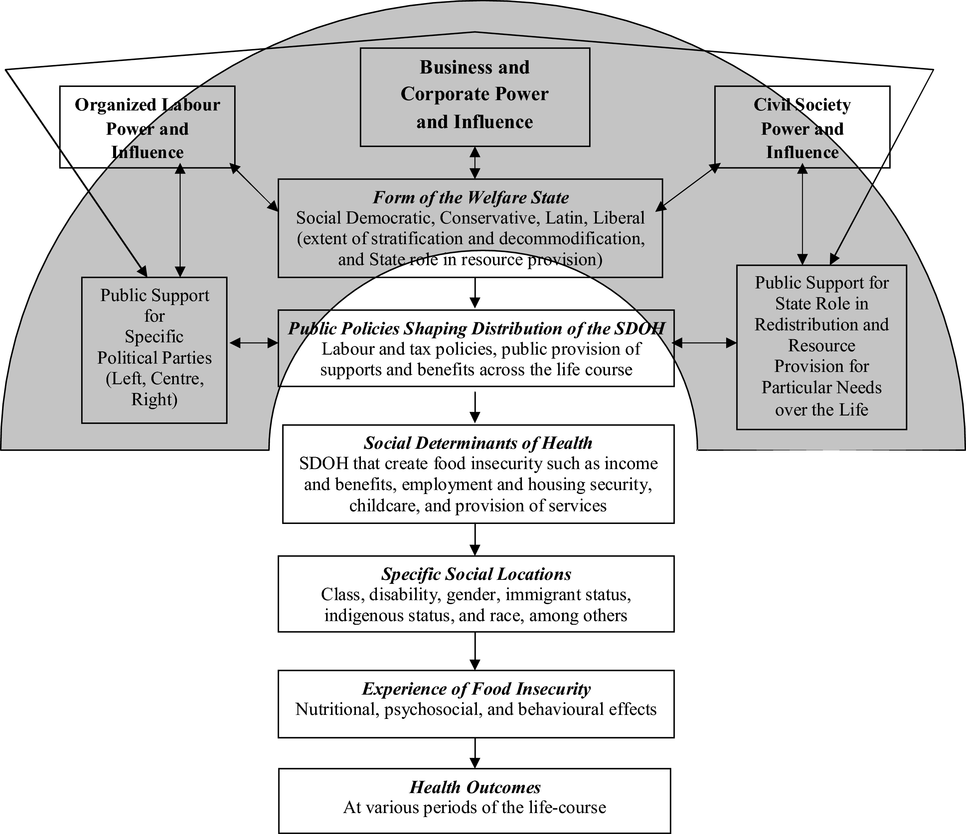
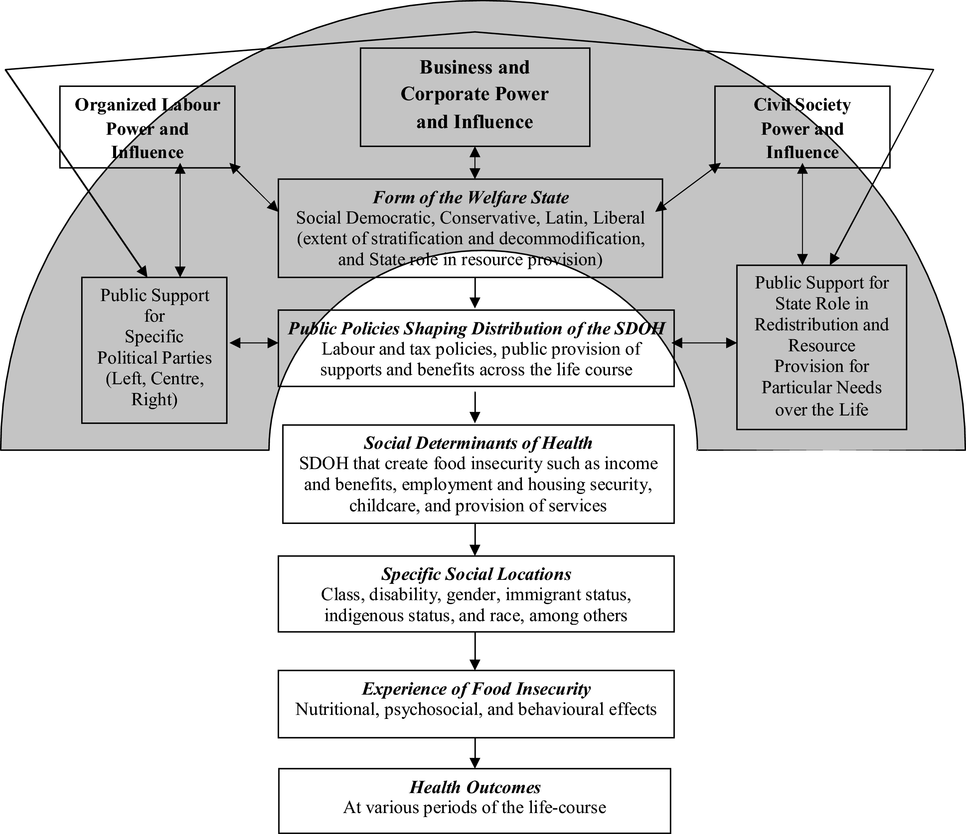
As shown in Figure 1, three key sectors influence the entire public policy process. The Business and Corporate Sector is centrally placed as it has the greatest potential in Canadian society to shape aspects of economic and political systems, public policymaking and the quality, and distribution of the SDH, including HFI.
Depiction of pathways by which the relative strengths of the business, labour, and civil society sectors act in concert with form of the welfare state and voter political activity and public support for a state role in distributing resources to produce public policy that shapes the experience of HFI across the life course.
Corporate and business influence shapes HFI in two separate but related ways (Raphael and Bryant, Reference Raphael and Bryant2015). The first is societal adherence to the view that the state should have little if any role in distributing economic and social resources. This belief is most commonly associated with the liberal welfare state and the rise of neoliberal ideology (Coburn, Reference Coburn, Bryant, Raphael and Rioux2010). As a result, governments become increasingly reluctant to provide any form of state support in a wide range of public policy areas that can affect HFI.
In Canada and other liberal nations this list would include universal childcare, employment security, support for post-secondary education and employment training, coverage of required pharmaceuticals, and home care for the elderly (Olsen, Reference Olsen2010). It is accompanied by a mantra of lowering taxes – which limits the ability to offer such supports even if these were desired by the public (Langille, Reference Langille and Raphael2016). This tendency is most easily captured in measures of public and social expenditures, on which liberal nations rank the lowest while the other three forms of welfare states rank higher (Organisation for Economic Cooperation and Development, 2017).
The second effect of the belief in a limited role for state involvement manifests in deregulation of economic activity. Legislation to require living wages, employment security and benefits, and more progressive taxation and other guarantees of receipt of economic and social resources are resisted (Pontusson, Reference Pontusson2005). Legislation to facilitate organizing the workplace falls by the wayside. Ceding control of resource allocation to the corporate and business sector increases the social inequalities that lead to HFI, a process that sees HFI as a ‘side-effect’ of profit making (Scambler, Reference Scambler2009).
The corporate and business sector also shapes the attitudes and values of the public through its creation of ideological discourse – the ways society members come to think about these issues (Grabb, Reference Grabb2007). These darkened boxes represent influences largely ignored in the other HFI discourses.
Within this discourse, it is recognized that the quality and inequitable distribution of the SDH that create HFI are a result of undue influence of those who create and benefit from the social inequalities that lead to HFI (Wright, Reference Wright and Wright1994; Navarro, Reference Navarro2009).
These same processes that weaken the influence of government on public policy are identified in the broader food systems and food insecurity literature as having adverse effects upon food security and food sovereignty (Lang and Heasman, Reference Lang and Heasman2015). Increasing corporate control of food systems is credited with skewing the production and distribution of food in a manner that serves the needs of profit making companies at the expense of equitable distribution of food security.
Nicola Livingstone identifies how the current HFI crisis in the UK is a result of wages being squeezed, itself a result of labour market restructuring combined with the real decline in the value of benefits (Livingstone, Reference Livingstone2015). In addition, food banks and feeding programs become a means of maintaining the economic system creating the problem. These efforts divert attention from HFI's true causes, i.e. the growing influence upon public policy of the corporate and business sector (Livingstone, Reference Livingstone2013).
This same corporate and business sector is working to maintain the perception that HFI is being adequately responded to (Riches, Reference Riches2018). The National Zero Waste Council (NZWC) is a self-proclaimed ‘leadership initiative’ to advance waste prevention in Canada that includes local governments, non-profits and importantly, grocery store chain Metro and the Retail Council of Canada. It has been calling for a federal tax incentive to encourage businesses to donate food to charitable organizations and has support to implement this tax incentive from twenty local governments including Montreal, Ottawa and Vancouver (National Zero Waste Council, 2016).
This tax incentive would burden the already overwhelmed food bank structure and not address the upstream drivers of food insecurity (Toronto Food Policy Council, 2016). Furthermore, it obscures the food industry's role in contributing to and perpetuating food insecurity in Canada through its low wages and lack of employment benefits, yet it allows the food industry to portray itself as engaging with the issue of HFI.
The critical materialist political economy analysis moves beyond pluralist and institutionalist analyses to argue that reducing HFI requires countering the power and influence of the corporate and business sector through broad political and social action. This places HFI within the broader question of how governing authorities meet the economic and social needs of a population. By linking the reduction of HFI with improving living and working conditions in general, it provides a direction for educating and mobilizing the general population around equity-related public policy and the impacts of its absence (Baum, Reference Baum2007).
Producing a more equitable distribution of resources can be achieved by increasing working class power through the growing of unionization rates and support of political parties of the left that contribute to stronger, more encompassing welfare states (Navarro and Shi, Reference Navarro, Shi and Navarro2002; Swank, Reference Swank2005; Brennan, Reference Brennan2012; Langille, Reference Langille and Raphael2016). Instituting proportional representation in the electoral process would facilitate governmental responses to HFI by involving political parties of the left in government on an ongoing basis (Alesina and Glaeser, Reference Alesina and Glaeser2004; Brady, Reference Brady2009).
Effective responses to HFI in the face of unresponsive governing authorities therefore may require moving beyond research and advocacy that limits itself to issues of food insecurity and hunger. It will require mobilizing the public to literally force governmental action to address issues of distribution and redistribution of economic and social resources. The political economy discourse makes explicit that the causes and means of responding to HFI are only part of a variety of political issues that will require building political and social movements to combat the power of the corporate and business sector. It questions many of the assumptions of public policy change current within the HFI as a SDH discourse.Footnote 4
Conclusion
We have identified five discourses that we believe are used to explain and suggest responses to HFI in Canada. These range from placing focus on the individual making healthier food choices to addressing the imbalance of power and influence in Canada and how it creates the inequitable distribution of the SDH that lead to HFI. We believe the critical materialist political economy discourse best explains the current HFI situation in Canada and suggests the most effective means of responding to it.
Tackling HFI therefore requires political action that moves well beyond naïve notions of democratic public policymaking assumed by pluralist and institutionalist frameworks of policy change. HFI researchers and advocates must not only advocate for governments to address issues of poverty, unemployment and housing insecurity, but must also recognize and respond to the powerful interest groups which have placed their interests over the interests of the most vulnerable in Canada.
This will require educating and mobilizing the Canadian public on the societal sources of HFI and other forms of economic and social insecurity. Placing HFI within these wider issues of economic and social security has the potential to build the political and social movements necessary for reducing HFI.