The role of argumentation in world politics has received fruitful attention recently, from both the strategicFootnote 1 and the deliberativeFootnote 2 sides of the debate. This comes as no surprise if one takes seriously the social nature of the international system. Language is, after all, a key element of social construction. This turn to arguments has generated impressive works on legitimacy as an international practice. While the study of the effects of international legitimacy on state behavior is not novel, it has only recently been complemented with empirical works focused on the construction of legitimacy.Footnote 3
How are military interventions legitimized? For better or for worse, international law has progressively acquired a privileged place in the discursive setting of world politics.Footnote 4 Public debates over international disputes have been gradually transformed into exchanges of legal claims and counterclaims. International politics has become legalized. But other discourses—such as those based on moral standards or political prudence—have not completely disappeared from the practice of diplomacy. If legalization is a continuum, world politics has become legalized but not fully. So how prevalent has international law really become in this respect? Many scholarly works stress how “especially powerful” legal argumentation has become vis-à-vis alternative forms of argumentation.Footnote 5 In this article I take a step further to argue that a military intervention's legal basis has become determinative of its legitimacy so that the legitimization of the use of force will fail unless it effectively invokes international law.
While focusing on the strategic employment of arguments, I rely on constructivist insights concerning the intersubjective constraints on argumentative success. A strategy of legitimation will fail if it invokes the wrong discourse. The strategic actor cannot make a particular discourse authoritative; for her, a discourse's authoritativeness is a given.Footnote 6 It is given by the shared understandings that constitute the historically contingent social setting in which legitimation takes place. This social setting bounds the range of valid claims and counterclaims; it provides the substrate for argumentative contestation over the legitimacy of the use of force. In this sense, this account of legitimation integrates rationalist and constructivist logics.Footnote 7
By analyzing the strategies used to legitimize NATO's military intervention in Yugoslavia in 1999, I test the proposition that the international legitimacy of the use of force has become legalized. Although the Kosovo case may be overstudied, its selection is justified because it is particularly powerful to corroborate my primary argument. Without a United Nations (UN) mandate, international law is an uneasy frame of reference for legitimizing a nondefensive, humanitarian military intervention—much less suitable than, for example, the legitimacy frame provided by moral standards of humanity. In this sense, NATO's primary strategy of legitimation should have been oriented toward constructing the intervention as moral rather than lawful. Consistent with this expectation, most of the literature on the Kosovo intervention endorses the view that it was “illegal but legitimate”Footnote 8 and construes its legitimacy on moral grounds. The use of force was ultimately legitimate, the typical argument goes, because the breach of international law was morally justified—it was necessary to break the law to uphold a moral imperative.Footnote 9 With this background, Kosovo emerges as a “crucial” case to test the proposition that international law has become determinative of the international legitimacy of the use of force.Footnote 10 Contrary to common knowledge, the case study shows that, even in this case, legitimacy was gained through, not despite, international law. That is, to the extent that the intervention was legitimate, this was primarily a result of the use of legal argumentation.Footnote 11
This article proceeds in two main sections. The first section provides the article's analytical framework. It delineates the conceptual boundaries of legitimacy and legitimation, and discusses the often oversimplified relationship between legitimacy and behavior. It then develops the “legalization thesis” and presents the observable hypothesis to be tested in the case study. The second section provides a qualitative analysis of the Kosovo case. The case study analyzes the strategies used by states to legitimize NATO's intervention, mostly, but not only, in the UN Security Council. This legitimation process is presented as a series of seven strategic moves that had the cumulative effect of shrinking the perceived gap between international law and NATO's actions.
Legitimacy and the Legalization of International Politics
This article is premised on the belief that a better understanding of legitimacy will contribute to a better understanding of political behavior. Here I will not restate or expand on what we already (claim to) know about the relationship between legitimacy and behavior.Footnote 12 Instead, I take for granted that, for some or all of the reasons offered by the extant scholarship, legitimacy considerations have some significant effect on international political behavior so that the further study of legitimacy and legitimation is worth pursuing.
Legitimacy, Authority, and Behavior
I understand an action to be legitimate when it is perceived as normatively valid by the relevant audience. Three elements stand out in this definition of legitimacy: perception, normative validity, and audience. It is in line with our predominant understanding of legitimacy in International Relations to posit it not as an objective quality inherent in behavior but, instead, as a status dependent on intersubjectively formed perceptions. An action is legitimate only if, and to the extent that, it is so perceived in a given social context.Footnote 13 In this sense, I approach the phenomenon of legitimacy from a descriptive, not a normative or prescriptive, perspective.Footnote 14
Why tie legitimacy to normative validity instead of acceptability or support? After all, it is often understood that “legitimacy implies a willingness to comply with rules or to accept a political order even if this goes against specific interests at specific times.”Footnote 15 Smuggled in this oft-held notion is a particular relationship between legitimacy as the perceived status of a given action, on one hand, and the perceiver's behavioral attitude towards that action, on the other. While these two may be causally linked, it is unwarranted to presume this causal relation. The legitimacy of an action may certainly pull the perceiver towards accepting it, but an action may be perceived as legitimate and still be opposed or rejected.Footnote 16 For instance, Germany agreed in 2011 that a UN-mandated intervention in Libya would be legitimate, and still considered it a bad idea because of “the danger of being drawn into a protracted military conflict that would affect the wider region.”Footnote 17 Similarly, a state may want to do things it deems illegitimate.Footnote 18 For instance, the United States reckoned in 2003 that the national security benefits of dismantling a hostile regime outweighed the legitimacy deficit of invading Iraq. In this sense, it is crucial to distinguish between an action's validity and its value or utility. Legitimacy refers to validity, so that an action is legitimate when it is perceived as normatively valid, that is, as conforming to the socially accepted “rules of the game.” By contrast, an action is acceptable or endorsable when it is perceived, in light of one's preferences, as worthy of support or approval. Just as norms can shape interests, an action's perceived validity may affect its perceived value, but the two concepts should not be conflated. Otherwise, we fall into the trap of presuming that legitimacy judgments trump all other motivations for action.Footnote 19 This presumption is unnecessary to understand the concept of legitimacy and leads to confusion between what legitimacy is and what it (presumably) does. My conceptualization of legitimacy contemplates the possibility that preferences (and thus behavior) may not be fully aligned with, and reducible to, the normative structure of the social order, and thus this conceptualization remains agnostic about how strong the behavioral pull of legitimacy in fact is.
If being legitimate is neither a necessary nor a sufficient condition for behavior, then what is legitimacy for? Why do states bother to legitimatize their actions? From an identity-based perspective, upholding the “rules of the game”—and being able to demonstrate it—is the appropriate thing to do for any actor that sees itself as part of “the game.” From a more consequentialist perspective, actors expect that the (il)legitimacy of an action will affect—though probably not determine—how others react to that action. This is because it can be significantly costly for others to publicly endorse, or even acquiesce to, a breach of the rules. Demonstrating that the action is legitimate will not necessarily mobilize others to support it but it is necessary for making a public request of support or acquiescence. Demonstrating that the action is illegitimate will not necessarily mobilize others against it, but it is sufficient for making a public request of condemnation and opposition.Footnote 20
Besides the conflation of legitimate and acceptable behavior, another commonly fuzzy conceptual link is that between an action's legitimacy and an actor's authority. When an actor is authoritative, her legitimacy claims about an action are regarded as true simply because she made them.Footnote 21 In this sense, an action's legitimacy can be derived from an actor's authority. For instance, when the International Committee of the Red Cross (ICRC) condemns certain Israeli warfare practices, it renders these practices illegitimate for those who see the ICRC as authoritative in matters of international humanitarian law. In the presence of an authoritative actor, the audience passively accepts that actor's legitimacy judgment by virtue of her authority. Legitimacy is thus constructed by delegation. In this respect, some audiences are more delegative (e.g., the press or the general public) than others (e.g., governments). When an action becomes legitimate through an authoritative endorsement, the interesting question is no longer how the action was legitimized but how the actor became authoritative—which is, to a significant extent, a different question. I focus on the construction of legitimacy in the absence of a controlling authoritative actor. In these cases, the audience's legitimacy judgments are not delegated to someone else, and therefore the (non-authoritative) agents of legitimation must persuade the audience about the normative validity of the action in question. Here legitimacy is not derived from an actor's authority but from the socially recognized authority of a discourse that sets the parameters of validity for that kind of action. An authoritative legitimacy discourse is a normative frame of reference that provides resources that actors can effectively use to (de-)legitimize behavior. A legitimacy discourse cannot authorize anything in and of itself. It is a tool for actors to use, manipulate, and extract a validation from. In this sense, behind a legitimate action there is always an act of legitimation.Footnote 22
From Legitimacy to Legitimation
I define legitimation as the process through which actors attempt to render an action legitimate by strategically manipulating a legitimacy discourse to generate arguments that demonstrate the correspondence between the action and the discourse invoked. While legitimation involves strategic manipulation, this does not imply that legitimation is necessarily deceitful or insincere; it implies only that the use of discursive resources is purposive. A strategy of legitimation typically also involves actions that will later be used to strengthen the persuasiveness of the arguments advanced. For instance, in the months preceding its military intervention in South Ossetia in 2008, Moscow strategically accelerated the issuance of Russian passports to most of the residents of South Ossetia, with the purpose of strengthening its framing of the subsequent use of force as the legitimate rescue of its nationals.Footnote 23 In this sense, legitimation is not just about arguing but also about behavior. In short, legitimation is an international practice of vying arguments about the validity of an action that result in the action in question being seen as legitimate.Footnote 24
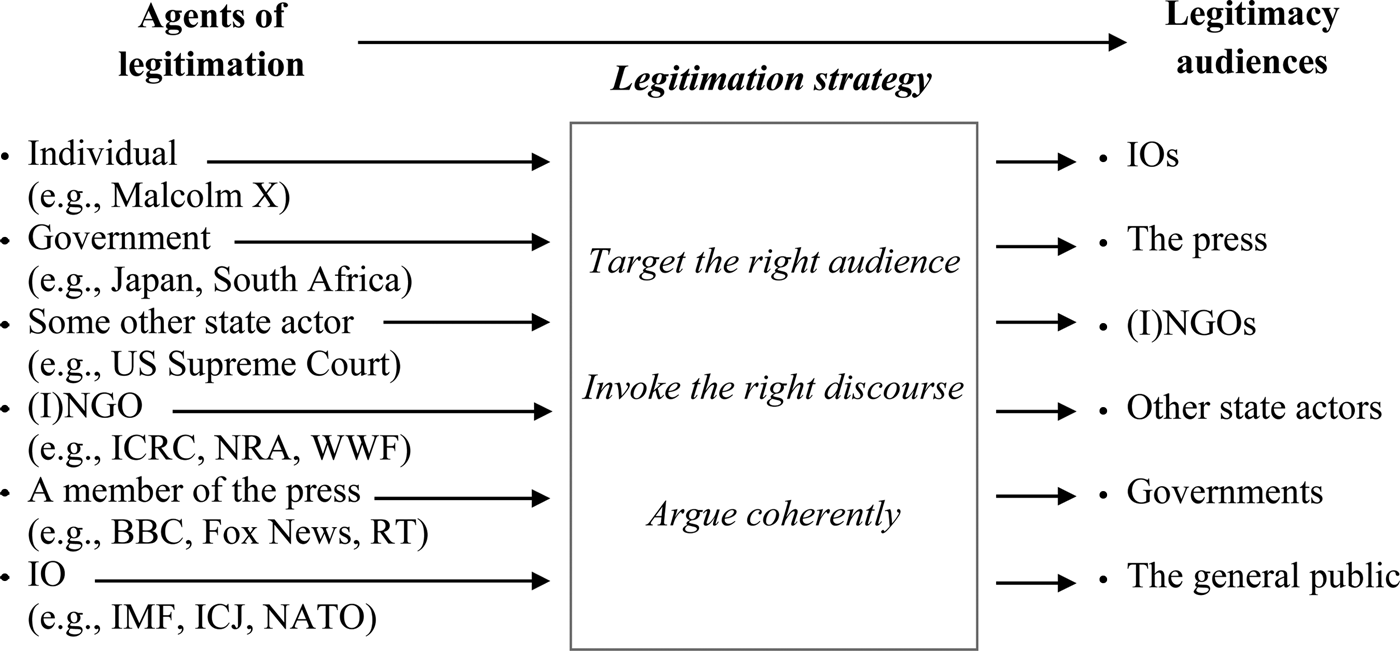
When engaging in this practice, states must pay attention to both the arguments' coherence and to the audience(s) these are addressed to and to the legitimacy discourse(s) they are built on. In effect, there are three factors that can undermine the success of a legitimation strategy: wrong audience orientation, wrong discourse invocation, and weak argumentation (Figure 1).Footnote 25 To succeed, the strategy of legitimation must be addressed to the relevant audience or “social constituency of legitimation.”Footnote 26 An audience's relevance depends on its reactions to the legitimacy status of the action in question—the more consequential its reactions, the more relevant the audience. In the case of military interventions, for instance, the international community of states is a key legitimacy audience. This is because the legitimacy-related reactions to a military intervention that are most consequential for the fate of that intervention are the reactions of fellow states.Footnote 27 The analysis that follows is circumscribed to the intergovernmental process of legitimation of the international use of force, thus excluding nongovernmental audiences. In other words, this study is exclusively focused on the diplomacy of international violence, and the legalization claims made here are subject to this scope limitation.
The international practice of legitimation

To be successful a strategy of legitimation must appeal to a legitimacy discourse that is recognized as authoritative by the relevant audience.Footnote 28 The right discourse orientation varies with the cultural context in which the practice of legitimation is performed, since the distribution of authoritativeness among legitimacy discourses is historically contingent. Socialization may facilitate the appeal to the right discourse by suggesting how both agent and audience share the same perception of the distribution of authoritativeness among discourses. Alternatively, even when the agent has not internalized those beliefs, she may still invoke the appropriate discourse by simply taking strategic notice of those beliefs internalized by the relevant audience. In short, both socialization and strategic calculation are plausible paths to invoking the right legitimacy discourse, and both are compatible with the theoretical framework used here.
Last but not least, a strategy of legitimation can fail when the arguments advanced are internally inconsistent or rest on factual premises that are rejected by the relevant audience. Arguments that are intrinsically weak fail to demonstrate the fit between the behavior and the discourse invoked. The audience's perception of the agent of legitimation as sincere, impartial, disinterested, or knowledgeable can make a difference in terms of her legitimacy arguments' persuasiveness. Briefly put, certain perceived characteristics of the agent, be they intrinsic or circumstantial, can make her more or less reliable in the eyes of the audience.Footnote 29 However, this reliability is more relevant for establishing the veracity of facts than the persuasiveness of legitimacy claims per se. To use a courtroom analogy, a witness's impartiality is important to establish facts, but the persuasiveness of the prosecuting or defense attorney's statements has nothing to do with their impartiality—which is assumed to be nil. Their success depends on the soundness of their arguments—that is, their invocation and interpretation of the right law, their reliance on established facts, and their skillful bridging of facts and norms.
In the context of the intergovernmental legitimation of the use of force, nobody expects the state using force (or its allies) or the target state (or its allies) to be impartial in their respective argumentations. And yet everyone is interested in what they have to say because the relative soundness of their competing arguments will ultimately determine the legitimacy of the use of force under debate. When does the agent's perceived reliability matter for the success of legitimation? When the legitimacy argument's persuasiveness depends on (1) factual information that has not been firmly established, for example, when the legitimacy of the use of force depends on the contested occurrence of a prior armed attack or (2) technical or theoretical knowledge that the audience lacks—for example, when the legitimacy of a military response to the detonation of chemical weapons depends on whether the detonation was accidental or intentional, which is to be inferred from the distribution of air toxicity in the area. In these cases, the perceived honesty and knowledgeability of the agent of legitimation can make a big difference in the eyes of the audience.Footnote 30 That said, in the intergovernmental legitimation of the use of force, arguments of this kind have become rare because of the institutionalization of external sources of factual information and expert knowledge that the audience can rely on, as well as states' development of their own sources of information and knowledge. As a result, states rarely need to rely on the sincerity of the agent of legitimation, and thus the agent's perceived reliability has typically only a marginal effect on the success of a legitimation strategy.
When conceiving the success or failure of legitimation in terms of the ability to persuade the relevant audience about a military intervention's legitimacy, it is important to keep in mind that the “community of states” is not a homogeneous group and that, for self-serving or other reasons, it is typically fragmented in terms of its members' expressed legitimacy judgments. But legitimacy should not evoke the idea of a consensus. Legitimation is successful to the extent that it corners opposing views into becoming aberrant within the relevant group.Footnote 31 In this sense, the success of a strategy of legitimation comes in degrees. Consequently, the action in question can turn out more or less legitimate. An action's legitimacy, as the output of the practice of legitimation, should be understood as a continuous, not a dichotomous, variable.
Legitimizing the Use of Force in a Legalized World
The normative structure of the international political system—what Mlada Bukovansky calls the “international political culture”—determines the relevant legitimacy discourses (for a given course of action) as well as the distribution of authoritativeness among them. This constitutes the legitimacy system for that kind of action, which is socially constructed and historically contingent. For instance, the legitimacy system pertaining to the use of military force is constituted by three legitimacy discourses:
1. Moral discourse. States may seek to legitimize the use of force by framing it as the enactment of a moral imperative, as when India tried to justify its military intervention in Pakistan in 1971 by underscoring Pakistan's “deliberate attempt to hold under colonial rule 75 million persons whom they have exploited for twenty-three years.”Footnote 32
2. Political discourse. The use of force can be validated by virtue of its political expediency or the desirability of its expected consequences, or simply by its compatibility with the political “rules of the game.” For example, the United States attempted to delegitimize India's intervention in Pakistan by stating that “the immediate cessation of hostilities and the withdrawal of forces are essential conditions for progress towards a political solution in East Pakistan.”Footnote 33
3. Legal discourse. The use of force can be legitimized by its compatibility with international law, as when Pakistan, in an attempt to delegitimize India's intervention, asked: “Since when is it permissible under the Charter of the United Nations for a Member State which is not attacked to enter the territory of another Member State in the name of self-defense?”Footnote 34
While multiple legitimacy discourses may co-exist in a legitimacy system, they are not always equally authoritative therein. For example, demonstrating an action's political expediency may carry more weight than establishing its moral basis. In this sense, legitimacy systems can be homogeneous or heterogeneous. In heterogeneous legitimacy systems authoritativeness is distributed among a few potentially competing legitimacy discourses. The arguments that were used most frequently in the United Nations Security Council (UNSC) to legitimize the US intervention in the Korean peninsula in 1950–1953 were that North Korea was destabilizing the region (political discourse) and that it violated core rules of the UN Charter (legal discourse); the most frequent delegitimizing argument was that the American intervention's purpose was to establish a system of exploitation and “enslavement” of the Korean people (moral discourse). This reflects a heterogeneous legitimacy system.
In contrast, in homogeneous legitimacy systems authoritativeness is disproportionately concentrated in a single legitimacy discourse. That discourse is said to be dominant and, consequently, the lack of correspondence between this discourse and the action in question cannot be compensated by appeals to an alternative legitimacy discourse. In other words, where one legitimacy discourse is dominant, embedding an action in that discourse is a necessary condition for the action to be perceived as legitimate. Here the competition between legitimation and delegitimation strategies is intradiscourse—all core arguments invoke the same (dominant) legitimacy discourse. By contrast, in a heterogeneous legitimacy system this competition is often interdiscourse—actors invoke competing legitimacy discourses, frequently challenging the relative authoritativeness of the discourse appealed to by competitors.
Legitimacy systems are not only associated with a specific kind of action, such as the use of force or the conclusion of a free trade agreement. They are also audience specific. The distribution of authoritativeness among legitimacy discourses may vary from audience to audience. For instance, when assessing the legitimacy of economic sanctions against human rights violators, international courts focus on the legal basis of those sanctions, while human rights organizations and the general public may be more sensitive to the moral imperative of stopping the humanitarian crisis. In this sense, while the present analysis is focused on the legitimacy system in which the intergovernmental legitimation of the use of force operates, other legitimacy systems pertaining to the use of force also exist, and these co-existing legitimacy systems can have different types and degrees of discursive homogeneity.Footnote 35
Building on the scholarly recognition that international law serves as a primary source of legitimacy in international relations,Footnote 36 I argue that the international use of force operates today in a homogeneous legitimacy system whose dominant discourse is international law. I call this the “legalization thesis,” according to which international law has relatively marginalized (though certainly not eliminated) alternative legitimacy discourses that used to be more authoritative in matters of international security in the past—namely, the use of force as moral imperative or political expediency.
The legalization of the international legitimacy of the use of force in no way downplays the political contestation over what constitutes legitimate conduct. Quite the contrary, political contestation remains intense and keeps the content of international law in constant flux. But legalization entails that this contestation has been engulfed by the legal discourse. Normatively valid behavior is cast in terms of lawful conduct. The dominant status of international law is given by naturalizing the authoritativeness of the legal discourse as a whole—even if its concrete constitutive rules remain the object of intense political competition.
The practice of legitimation under the discursive dominance of international law consists in the strategic manipulation of the law to advance claims and counterclaims about an action's lawfulness.Footnote 37 This underscores the malleability of international law and so it is fair to ask how this competition can ever result in a determinate level of legitimacy. How can legalized legitimacy contests have a “winner”? I argued earlier that the success of a legitimation strategy depends on three factors: audience orientation, discourse invocation, and argumentative strength. A legal argument is intrinsically weak if it fails to recognize and abide by the conventional parameters that distinguish a valid legal argument from an invalid one. These parameters constitute an interpretive community that governments (and especially their legal advisers) are members of, and imply that the discursive construction of lawfulness in international politics is a highly institutionalized business—a professional practice.Footnote 38 For example, a legal argument will be credited as valid only to the extent that it identifies the legal rules applicable to the case at hand by reference to the professionally recognized sources of international law, as listed in the Statute of the International Court of Justice (Art. 38).
Similarly, the interpretation of that law will be valid only to the extent that it is consistent with interpretations previously applied by recognized interpretive authorities, with opinions expressed at the time of negotiating the applicable treaty (travaux préparatoires), with other well-established legal norms, and so on. In this sense, the malleability of international law is limited and institutionally regulated. The precision of the applicable legal norms is another important constraint on the possibilities of successful manipulation. In addition, a legal argument will be intrinsically weak if it rests on factual premises that are not credible. In short, the practice of legitimation through international law has its own standards that determine the relative success and failure of different legitimation strategies.
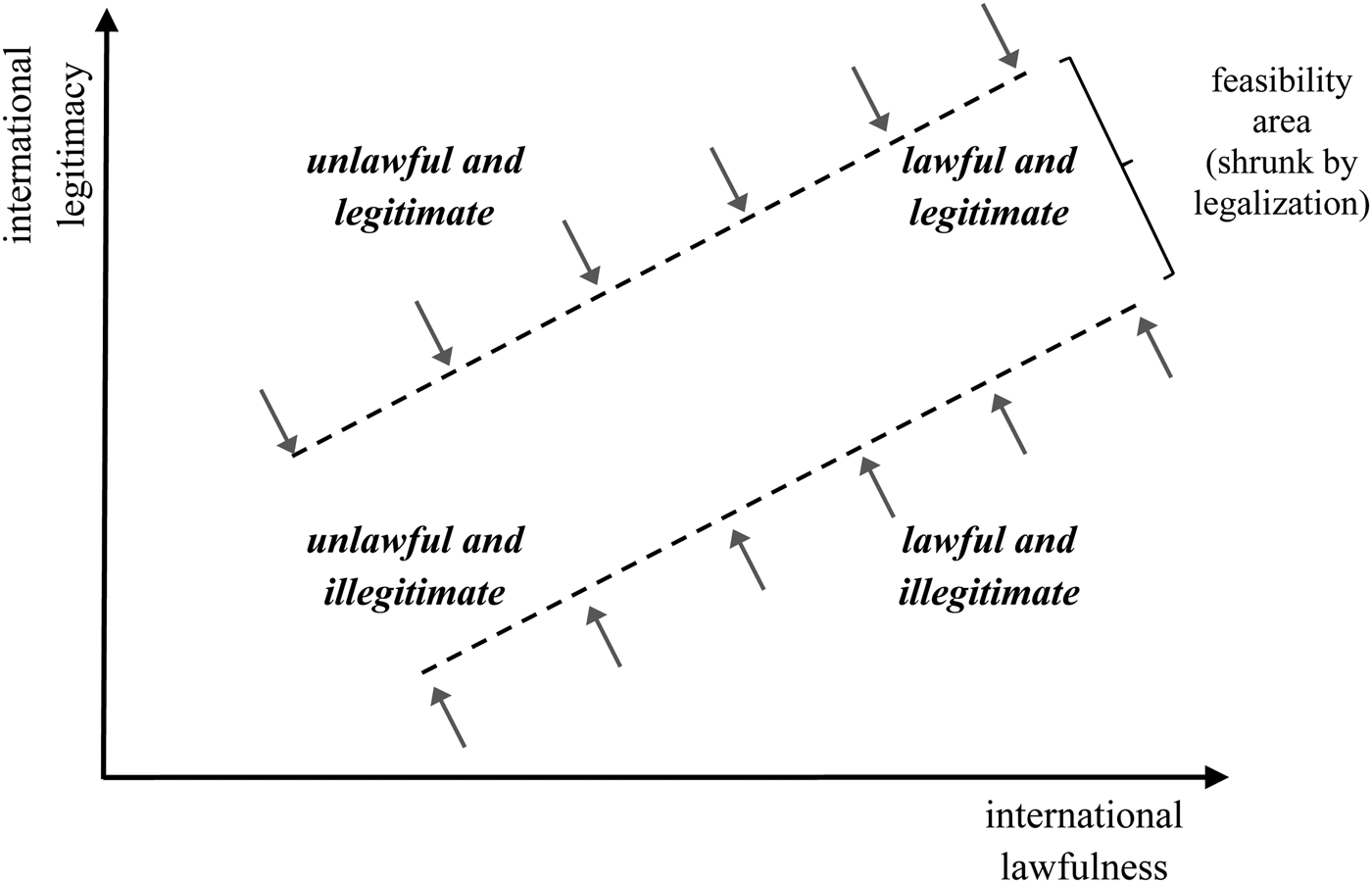
Although legitimacy and lawfulness are two different kinds of status, legalization entails that legitimacy is constituted by lawfulness.Footnote 39 As Figure 2 schematizes, the more legalized the legitimacy system—the more dominant the international legal discourse—the more an action's international legitimacy is confined by its lawfulness.
The legalization of the international legitimacy of the use of force

From a macro-analytical perspective, legitimacy's legalization in world politics has been presented as the result of a top-down process through which international law has progressively colonized the “constitutional structure” of international society. In this view, international law ceased to be just a set of rules and institutions that regulate behavior and became a discourse that constitutes the actors and actions that make up international politics.Footnote 40 According to Shirley Scott, the legitimizing power of international law resides in the idea of international law. This idea is made powerful by some of its intrinsic characteristics, especially the notion that international law is not only distinguishable from politics but also superior to it.Footnote 41 In this sense, international law is an expansive site of legitimation—a self-aggrandizing normative discourse that tends to encroach on alternative legitimacy discourses, rendering them complementary or subsidiary. “When an actor in world politics makes reference to international law … it is a justification ‘other than’ or ‘more than’ a mere political, economic, or moral, rationale.”Footnote 42 In short, the international practice of legitimation has become legalized because the international legal order is ideologically constructed not merely as an alternative to international society's political or moral orders, but as a normative structure superior to them.
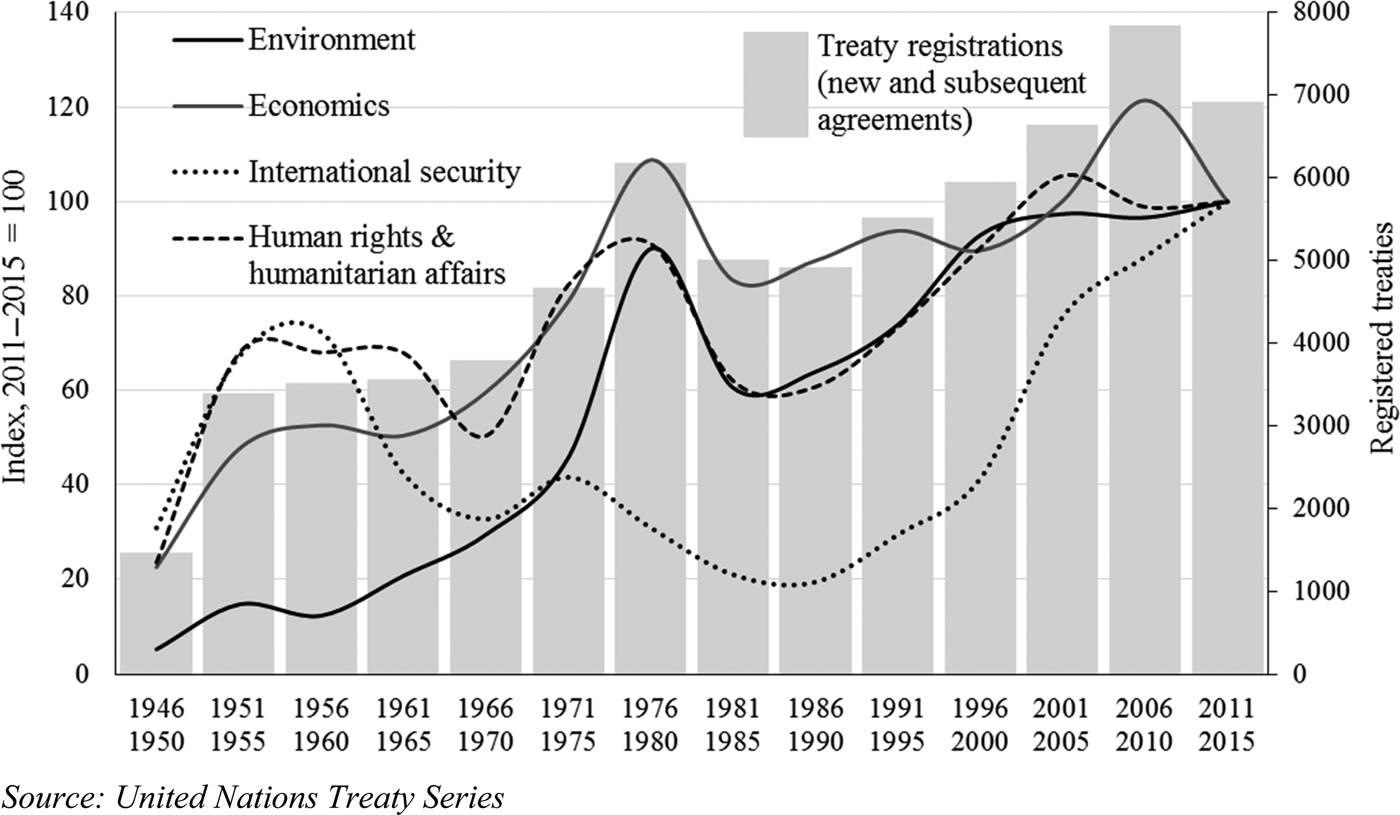
From a micro-analytical perspective, legitimacy's legalization is the result of the proliferation of legal agreements. Rationalists argue that states have increasingly chosen to cooperate through legalized international regimes because they are more efficient at solving commitment or collective action problems that undermine cooperation in most issue areas of international relations. Institutional path dependency and inter-regime synergies are also part of the story.Footnote 43 Naturally, as legal rules become constitutive of an international regime, international law becomes the dominant frame of reference in that regime's legitimacy debates. Figure 3 shows that this legal proliferation has occurred in all main issue areas (although at different rates), arguably leading to the legalization of world politics writ large. Constructivists contend that if legalized agreements are better at solving cooperation problems, this is mainly because of the international community's underlying “ideology” or political commitment to respect international law, whether that commitment is genuineFootnote 44 or rhetorical.Footnote 45 If so, where does this professed legalism come from? Cultural genealogies can be hard to establish, but the most promising explanations point to domestic politics. The legalization—and even judicialization—of domestic politics has generated a law-oriented practice of legitimation that progressively spilled over into international interactions.Footnote 46 This effect was reinforced by certain organizational transformations of the state—such as the empowerment of legal advisers in the foreign policy-making apparatus—that enhance the naturalization of law as the discursive substrate of legitimation strategies.Footnote 47 Briefly put, these accounts suggest that the legalization of legitimacy in world politics is the result of the internationalization of (legalized) domestic legitimacy.
Treaties registered at the United Nations (1946–2015), by issue area

Be that as it may, my legalization thesis confronts two alternatives: that the international legitimacy system in which the use of force operates is (1) heterogeneous, or (2) homogeneous but international law is not its dominant discourse. The legalization thesis generates one crucial observable hypothesis:
H1
If the action in question can be more effectively constructed as (il)legitimate by embedding it in a nonlegal discourse, and yet the agents of (de-)legitimation predominantly invoke the international legal discourse, then the legitimacy system is legalized. In this system, nonlegal strategies of (de-)legitimation should be rare and never successful. Footnote 48
When confirmed, this hypothesis corroborates legalization and disproves the two alternative theses. In effect, in a nonlegalized homogeneous legitimacy system, the agents of legitimation should appeal to the dominant discourse (which, by definition, is not international law); in a heterogeneous legitimacy system, (de-)legitimation attempts should rely only marginally (at best) on international law if the action can be more easily embedded in another authoritative legitimacy discourse.
This hypothesis can be tested best in a case where the action under legitimation does not “naturally” call for a legal framing—where the agents of legitimation would conveniently appeal to a nonlegal legitimacy discourse if they had the freedom to do so. This makes NATO's intervention in Kosovo a perfect testing ground for legalization. Indeed, the legal rules applicable in the Kosovo case imply that without a United Nations mandate, a nonlegal discourse provided a more “convenient” frame for a strategy of legitimation. It is most telling, therefore, that supporters of the intervention used international law as the main discursive frame of their legitimation strategy.Footnote 49
Legalization and the UN-ization of the Legitimation of the Use of Force
When governments engage in war, they take into account the reactions of multiple actors, including other states but also their own legislature, nongovernmental organizations, the media, and the general public. These audiences may be part of similar or different legitimacy systems, so that the successful legitimation of the use of force may require different strategies depending on who the addressee is. It would not be surprising to see governments use different arguments in different contexts to persuade different audiences.Footnote 50
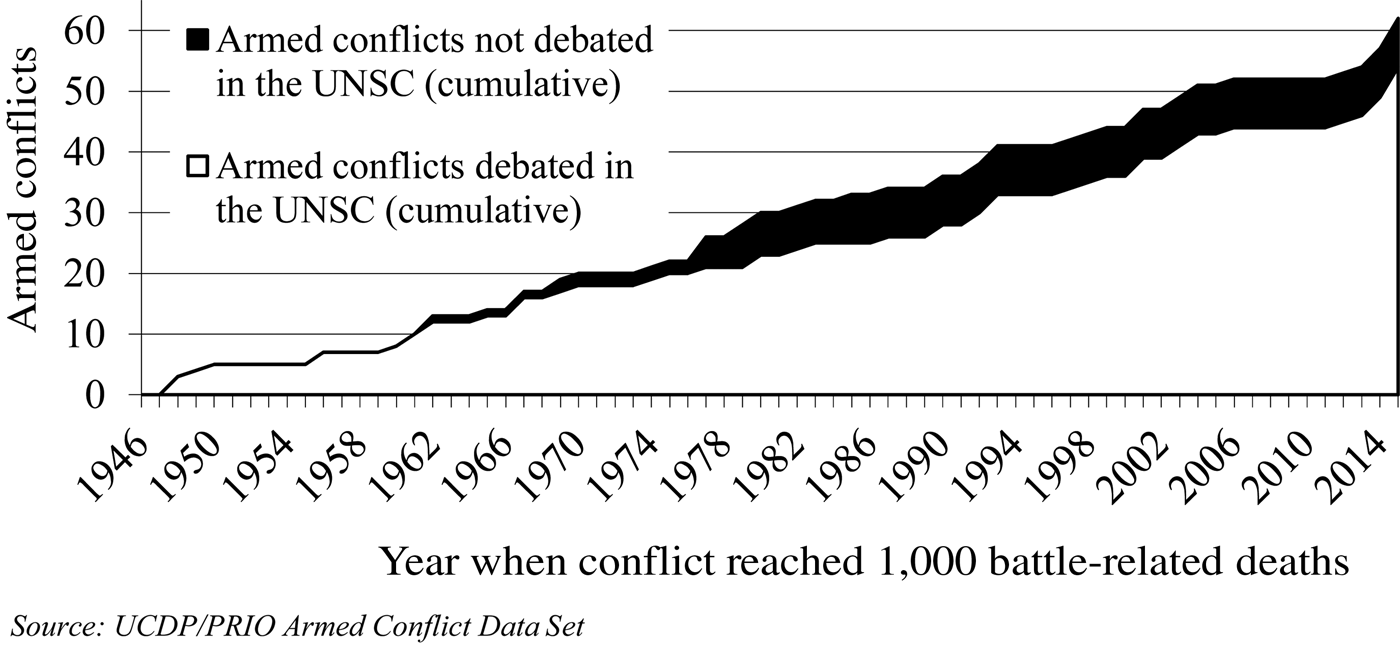
Thus embedded in multiple legitimacy systems, the legitimation of the use of force is not monopolized by state actors or particular institutional contexts. However, the intergovernmental legitimation of the use of force does have a privileged institutional venue—namely, the United Nations, and the UNSC in particular. Figure 4 shows the sixty-two interstate and internationalized armed conflicts that reached 1,000 battle-related deaths since 1946.Footnote 51 Of these, only eight (13%) were not debated in the UNSC—all eight of them occurring during the Cold War period. In this sense, a study of the intergovernmental legitimation of international violence is, for the most part, a study of legitimacy debates in the UNSC.
Intergovernmental legitimation of the use of force in the UN Security Council (1946–2015)

In this context, one might argue that if international law is the dominant language of the UN then the legalization of the intergovernmental legitimation of the use of force is nothing more than the UN-ization of this practice. In other words, legitimation has become legalized not because legitimacy has become dependent on legality—the argument goes—but simply because states have tended to debate the legitimacy of the use of force in the UNSC. Even if the “legalization thesis” applies, how can we tell this is not simply because of the institutional context in which legitimation occurs?
There are good reasons to reject the premise of this argument—that international law is the intrinsic language of the UN. While UNSC resolutions can be expected to be written in a juridical register—especially those resolutions that are legally binding and that therefore constitute a source of international law—this expectation need not apply to the diplomatic debates that take place in the UNSC. This is, after all, a political organ of the UN, and law is not the intrinsic language of political organs. In fact, international law was not the dominant discourse in earlier UNSC debates about the legitimacy of the use of force.
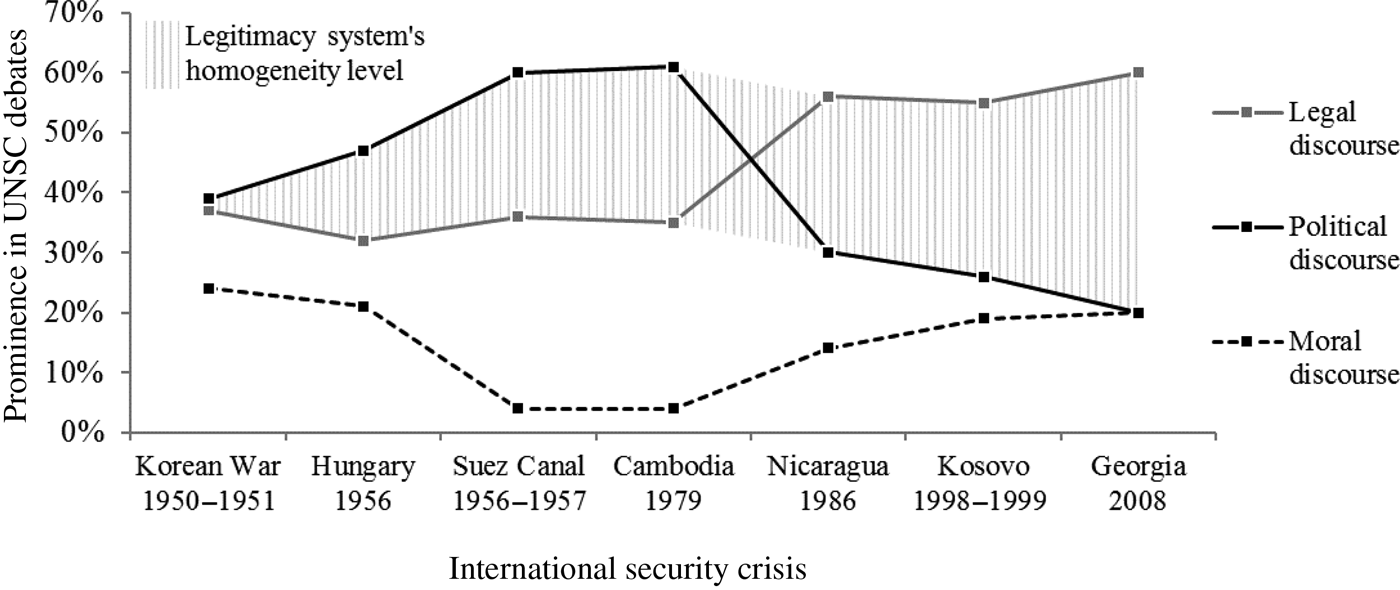
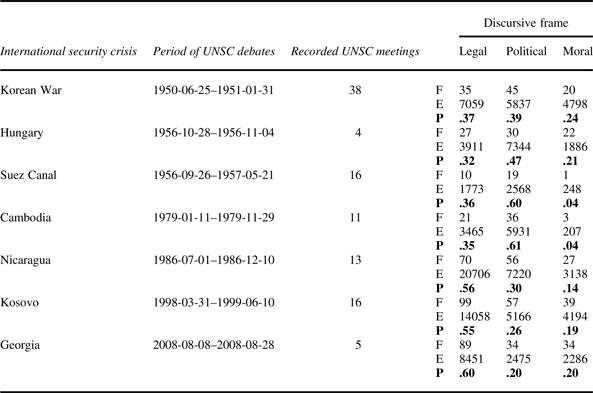
This is corroborated by preliminary quantitative data based on seven cases ranging from the early days of the UN until the present.Footnote 52 In each case, state representatives attempted to (de-)legitimize the use of force in the UNSC by invoking the three main legitimacy discourses that could (in-)validate a military intervention: the morality of the use of force, its political expediency, and its compatibility with international law. I measured the relative appeal to each discursive frame with three alternative quantitative measurements: the number of times each argument was made during discussions (frequency), the number of words used to develop each argument (extension), and a combination of each argument's relative frequency and relative extension (prominence). During much of the Cold War period, political arguments were significantly more prominent than legal ones. Table 1 and Figure 5 show that international law did not become predominant in UNSC debates about the use of force until the 1980s. These preliminary data—which need to be complemented with more qualitative analyses—not only demonstrate that UNSC debates are not inherently legal, but also suggest that the intergovernmental legitimation of the use of force has become increasingly homogeneous—measured as the distance between the most prominent discourse and its main competitor—and legalized.
The legitimation of the use of force in the UN Security Council

The legitimation of the use of force in the UN Security Council

Notes: F (Frequency) is the number of times arguments of a given type were made. E (Extension) is the number of words employed to develop the arguments made. P (Prominence) is a combination of a discursive frame's relative frequency and its relative extension, such that  ${\rm P}i = \left( {\displaystyle{{{\rm F}i} \over {{\rm F}l + {\rm F}p + {\rm F}m}} + \displaystyle{{{\rm E}i} \over {{\rm E}l + {\rm E}p + {\rm E}m}}} \right)/2$.
The Legitimation of the Kosovo Intervention
International Legal Expectations on the International Use of Force
At the heart of the present international legal system lies a general prohibition on the international use of force. The illegality of interstate war is enshrined in Article 2(4) of the UN Charter and is complemented by a commitment to the pacific settlement of disputes in articles 2(3) and 33. Besides self-defense, the Charter explicitly admits one exception to this general ban: measures authorized by the UN Security Council (UNSC).Footnote 53
The UNSC's capacity to authorize the nondefensive use of force is limited by a pre-existing condition: a threat to international peace and security (TIPS). It is precisely to maintain or restore international peace and security that the UNSC is entrusted with this capacity.Footnote 54 This factual limitation enabling UNSC involvement must be read in the light of the principle of nonintervention—codified in Article 2(7)—since its purpose is to prevent the UN from intervening in the internal affairs of its members. Recent UNSC practice has pushed the boundary between the applicability of Article 2(7) (internal affairs) and that of Chapter VII (TIPS) in favor of TIPS, partly because the Charter enshrines human rights but does not contemplate their international enforcement.Footnote 55
The nondefensive use of force is subject to this factual enabling condition—the existence of a TIPS—and also to the procedural constraints of the rules of UNSC decision making. The UNSC can authorize the use of force only if a majority—nine of its fifteen members—approves the motion and no permanent member opposes it.
Finally, I should mention the Uniting for Peace resolution (377), adopted by the UN General Assembly (UNGA) in 1950 with an almost unanimous vote. It codifies the notion that, because the UNSC is charged with the primary (but not exclusive) responsibility for the maintenance of international peace and security,Footnote 56 this responsibility may be taken up by the UNGA whenever the UNSC fails to do so. Although this right of the UNGA to recommend (let alone authorize) the collective use of force against a state is hard to harmonize with the Charter, Uniting for Peace is still a plausible mechanism to try to legitimize the use of force through international law. If admitted, this would constitute the last (and rather exceptional) way of legalizing nondefensive war via the UN.
Embedding Kosovo in the Discourse of International Law
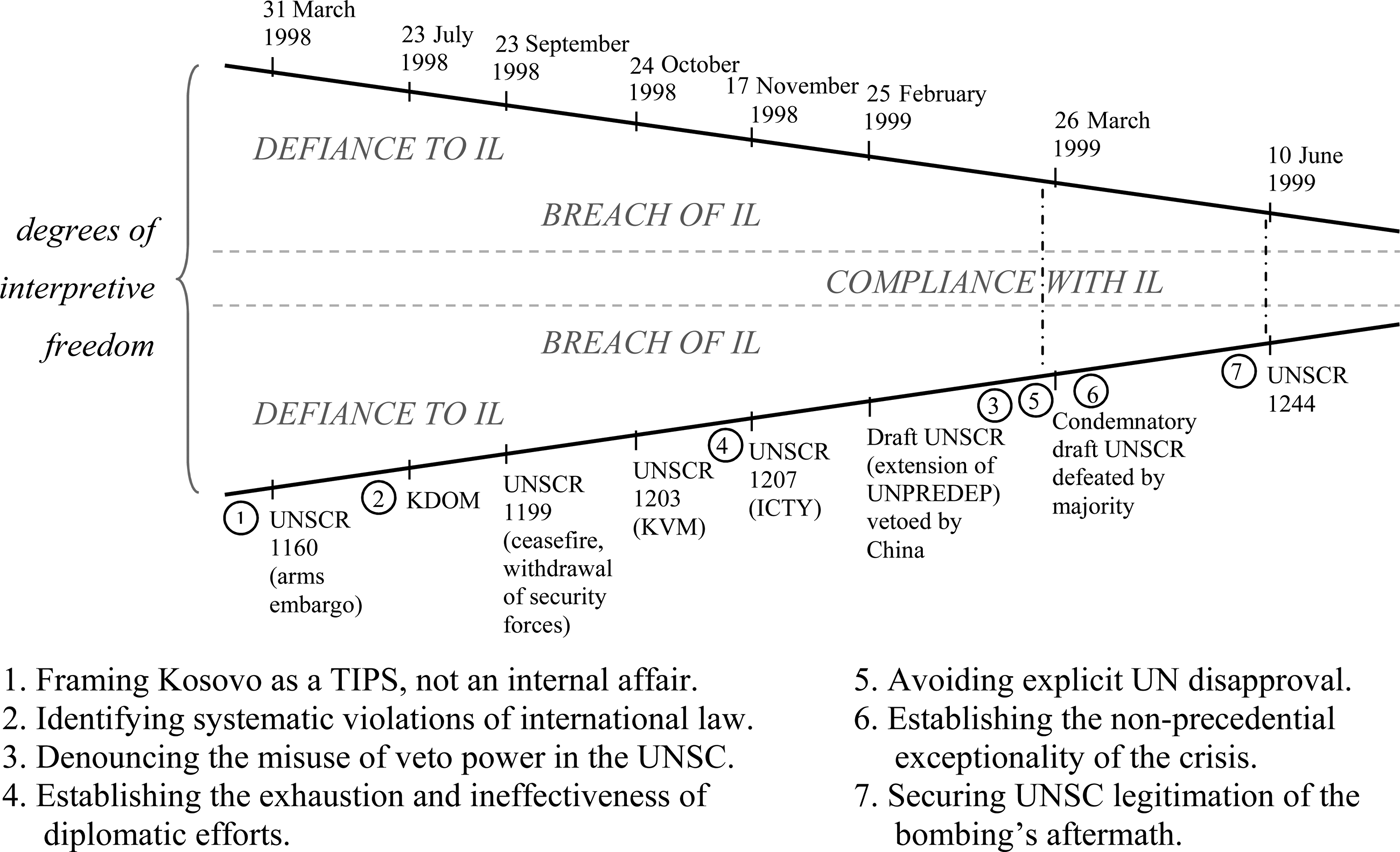
NATO's actions in 1998 and 1999 were consistent enough to construe and analyze them as part of a coherent strategy made up of seven strategic moves discursively embedded in international law.
1. Framing the situation in Kosovo as a threat to international peace and security, not an internal affair
If military force was to be employed in the context of the Kosovo crisis, it could only be a nondefensive use of force. Consequently, if deference to the UN Charter was to be conveyed, it was necessary to activate Chapter VII. In other words, a UNSC resolution had to be adopted that authoritatively stamped the situation in Kosovo as a TIPS—and thus not an internal affair of Yugoslavia.
UNSC Resolution 1160 of March 1998, supported by everyone but China (who abstained), marked the first success in making (implicitly) the situation in Kosovo a TIPS. This was first explicitly established by the UNSC six months later, by Resolution 1199. There, the UNSC classified the situation as a TIPS, legitimizing the subsequent imposition of a series of legal obligations under Chapter VII. The discussions in the UNSC pivoted around a more general question: Can the violation of human rights by a state, occurring exclusively on its territory and against its own people, implicate international peace and security and thus constitute a TIPS?
Several state representatives extensively argued that a widespread violation of fundamental human rights could certainly constitute a TIPS.Footnote 57 The question was settled once the UNSC treated the Kosovo crisis (resolution 1160) as a TIPS and explicitly classified it as such (resolutions 1199, 1203). This was a legally binding interpretation and a major strategic achievement by NATO, whose members did not hesitate to capitalize on it. On several occasions, when arguing in favor of the legitimacy of actions (to be) taken against Yugoslavia, they explicitly mentioned these enabling resolutions. For example, the representative of Slovenia in the UNSC stated that:
resolutions 1199 (1998) and 1203 (1998) … are applicable law in the case discussed today. The situation in Kosovo is defined by the Security Council as a threat to international peace and security in the region. This defines that situation as something other than a matter which is essentially within the domestic jurisdiction of a State. In other words, Article 2, paragraph 7, of the Charter clearly does not apply.Footnote 58
In contrast to this solid line of argumentation backed by authoritative institutional actions, some of the opponents of the Kosovo intervention tried to frame Kosovo as an internal affair—and thus not a TIPS. This framing was certainly not implausible, but it ultimately lost validity for failing to admit interpretive defeat once the UNSC established that Kosovo was a TIPS. While claiming that the situation was an internal affair, China refrained from using its veto and allowed the UNSC to activate Chapter VII. Similarly, Russia voted in favor of UNSC resolutions 1160 (March 1998) and 1199 (September 1998).
2. Pointing out systematic violations of international law (including UNSC resolutions)
Any military intervention in Yugoslavia without the authorization of the UNSC would inevitably have a vulnerable legal spot. The opponents of the intervention repeatedly invoked the UN Charter to establish the illegality of unauthorized military action. To undermine this reading of the intervention and weaken its delegitimizing effects, it was important for the intervention's supporters to establish that the military operation, instead of turning its back on the United Nations legal-institutional system, was meant to uphold the authority of the United Nations and international law. For this, a part of NATO's argumentative strategy was to point out Yugoslavia's systematic breaches of its legal obligations, such as its violations of human rights and international humanitarian law. In this respect, the representative of Costa Rica in the UNSC argued:
combating terrorism does not, as we see it, in any way justify human rights violations or the failure to respect international humanitarian law … If the authorities of the Federal Republic of Yugoslavia … continued to violate the fundamental rights of the population, we would be obligated to consider the imposition of additional measures in order to compel them to change their illegal policies that are contrary to the principles and obligations set forth in the Charter.Footnote 59
Arguments based on human rights violations are certainly part of the “moral talk” around Kosovo, and this can easily lead to miscategorizing moral arguments as legal ones, or vice versa. Different kinds of norms, such as moral standards and legal rules, are frequently interdependent in their emergence, interpretation, and application. For this reason, many legal arguments are not purely legal but instead have multiple, albeit convergent, discursive frames of reference. Human rights, for example, invoke morality when they are understood as “natural” rights. But when incorporated into international law, those same human rights may also be invoked as legal rights. In other words, human rights are part of both the moral and the legal normative orders of international society. Thus, an argument based on “human rights” will almost inevitably invoke both morality and legality. That said, the specific semantic field and context of the argument typically emphasize one discourse over the other. This is crucial to determine whether one is facing a moral argument with collateral legal overtones or, conversely, a legal argument with collateral moral overtones. Condemning causing human suffering per se, rather than as an indicator of contempt for fundamental rules of international law, makes more sense within a moral discourse than within a legal one. The extant literature offers multiple examples in which public justification for NATO's intervention was given in clear-cut moral form, especially when addressing the general public. In intergovernmental debates, however, human rights were more commonly invoked as obligations derived from international human rights law rather than from a moral standard. Human rights were more often coupled with the notion of legal obligation than with that of human suffering.
Supporters of the intervention also spotlighted breaches of other international legal obligations generated in the context of the Kosovo crisis, including those derived from legally binding UNSC resolutions. In Resolution 1199, the UNSC ordered Yugoslavia to maintain a ceasefire, improve the humanitarian situation, withdraw security forces used for civilian repression, collaborate with international monitors and humanitarian organizations, facilitate the safe return of refugees, comply with previously made commitments, and cooperate with the International Criminal Tribunal for the former Yugoslavia investigations.Footnote 60 UNSC Resolution 1203 obligated Yugoslavia to comply with agreements signed with the OSCE and NATO, through which it had undertaken to implement the obligations imposed by UNSC Resolution 1199.Footnote 61 In this context, the use of force was framed as the implementation and enforcement of those resolutions. For this, it was important to bring Yugoslavia's disregard for these UNSC mandates to public attention, as did, for example, US State Secretary Albright: “Acting under Chapter VII, the Security Council adopted three resolutions—1160, 1199 and 1203—imposing mandatory obligations on the FRY [Federal Republic of Yugoslavia]; and these obligations the FRY has flagrantly ignored. So NATO actions are being taken within this framework.”Footnote 62
All in all, the opponents of the Kosovo intervention had a strong case based on the UN Charter. Without a UNSC authorization, any nondefensive use of force stands on muddy legal grounds, and NATO's critics took good advantage of this to build a solid legal case against the military operation. However, the supporters of the intervention responded with legal accusations of their own: the very same international legal system, as well as the authority of the UNSC, had been continuously infringed by Yugoslavia for over a year, and failure to take effective action to force Yugoslavia back into compliance would become practically an act of acquiescence to such systematic defiance of the law.
3. Establishing the exhaustion of peaceful means
A legal expectation directly derived from the UN Charter is that disputes be solved peacefully and military force be used only as a last resort.Footnote 63 Demonstrating compliance with this rule requires more than legal talk. Some actions had to be effectively taken. In light of this, NATO crystallized diplomatic efforts, prior to the resort to force, in the form of a series of agreements through which Yugoslavia undertook to fully respect international humanitarian and human rights law in Kosovo. In October 1998, Richard Holbrooke, US especial envoy to the Balkans, negotiated an agreement with Slobodan Milošević through which Yugoslavia undertook to implement UNSC Resolution 1199.Footnote 64 The establishment of an OSCE air surveillance system to monitor compliance (KVM) was agreed on 15 October (with NATO) and 16 October (with OSCE), which was to replace the ground verification mission operating in the area by OSCE diplomats since July (KDOM).Footnote 65 The UNSC endorsed the agreements.Footnote 66
In January 1999, with the express support of the UNSC,Footnote 67 NATO attempted to negotiate an Interim Agreement with Yugoslavia. The agreement imposed that Yugoslavia followed a series of steps in relation to the situation in Kosovo.Footnote 68 This draft, which Milošević rejected, became the basis of the Rambouillet Agreement of 15 March 1999. The Rambouillet Agreement—the final attempt at working out a peaceful solution to the crisis—obligated Yugoslavia to concede substantial autonomy to Kosovo and allow a NATO-led international security force to guarantee the Kosovars' security.Footnote 69 The negotiations held for over two weeks in February 1999 failed to convince Yugoslavia to accept the NATO-led military presence in its territory, despite the explicit threat that only signing the agreement would stop NATO from resorting to military force.
Negotiations at Rambouillet were the strategic creation of a further pretext to start a more legitimized use of force.Footnote 70 As President Clinton's top national security advisor, Sandy Berger, later recalled, if Milošević “was playing a game with us at Rambouillet by building up his forces while pretending to negotiate seriously, so were we. We needed to demonstrate a real commitment to get a peaceful resolution in order to get the allies to go along with the use of significant force.”Footnote 71 This was confirmed by a close aide to the state secretary, according to whom the purpose of Rambouillet had always been clear: “To get the war started with the Europeans locked in.”Footnote 72
With this background of UN-endorsed diplomatic action, many argued repeatedly that the legal requirement of the peaceful settlement of disputes and the use of force as ultima ratio had been satisfied by March 1999.Footnote 73 In short, the exhaustion of peaceful means was demonstrated by highlighting a series of agreements undertaken by Yugoslavia and backed by the UNSC, and their systematic violation by Milosevic, also reported by the UN.
4. Construing the veto threat in the UNSC as legal-institutional sabotage
Exhausting peaceful means and spotting Yugoslavia's breaches of international legal obligations were not the only ways to portray the Kosovo intervention as compatible with the United Nations legal-institutional system. Another tactic used was to argue that the only reason the UNSC failed to authorize the use of force against Yugoslavia was the misuse of the veto by two permanent members. Why was the use of veto power in this case illegitimate? Because it expressed a minority view? Certainly not—after all, what is the point of a veto if it is supposed to be used only in agreement with the majority? Why then? Because the veto perpetuated a situation that (1) was contrary to international law, (2) had already been authoritatively established to be so by the UNSC, and (3) had withstood peaceful measures implemented to terminate it. In other words, a legal-institutional prerogative (i.e., the veto) was being used to undermine the very institutional framework of which it was a part. In this sense, failing to authorize the use of force was less compatible with the legal and institutional expectations, the argument goes, than was the use of force without such an authorization. Supporters of the intervention did not hesitate to denounce a series of misuses of the veto in this case and thus ultimately weaken the legal-institutional relevance of the (implicitly) vetoed authorization to enforce UNSC resolutions by military force. For example, Denmark stated at the UNGA:
The Security Council must do its utmost to live up to its primary responsibility for the maintenance of peace, security and humanitarian decency—a primary responsibility that all the Member States have vested in the Security Council in accordance with Article 24 of the Charter. The Council's permanent members should apply the veto only in matters of vital importance, taking into account their unique responsibility for the interests of the United Nations as a whole.Footnote 74
As we can see from the quoted statements, an important part of the argument about the subversive use of the veto in the Kosovo case had to do with the fact that the UNSC has a responsibility, not simply a right, to manage international peace and security.Footnote 75 In this context, vetoing the council's exercise of the responsibility conferred to it by the UN member states is failing to comply with the UN Charter, and thus, arguably, a violation of an international legal obligation owed by the permanent members to the other members.
In a nutshell, NATO attempted to conceptually corner the humanitarian intervention in Kosovo to present it as a legal dilemma—namely, that international law required that the international community both intervene (to uphold international human rights and humanitarian law) and refrain from intervening (to uphold the decision-making procedures required by the UN Charter). What is the legitimate thing to do, NATO rhetorically asked, in such an ambivalent legal context?Footnote 76 Their answer: respect for procedural rules should not prevail over respect for substantive rights and obligations under international law, especially when these are fundamental human rights. The point is reinforced by allegations that the procedural rules in question were being misused to advance national interests rather than the responsibilities of the UNSC laid out in the UN Charter.Footnote 77
5. Avoiding explicit UN disapproval
No authorization to use military force against Yugoslavia was formally requested at the UNSC. This was a strategic choice made for the sake of legitimacy. As the National Security Council (NSC) advised President Clinton on 15 July 1998, “under current circumstances, efforts to achieve a United Nations Security Council Resolution under Chapter VII would be counterproductive.”Footnote 78 The reason: with virtual certainty, China or Russia would have vetoed such an authorization. The impossibility of obtaining UNSC approval became evident in October 1998. An earlier draft of what later became UNSC Resolution 1203 contained an authorization to use military force, which China demanded to have removed from the draft or else it would veto it.Footnote 79 In effect, to make explicit the disapproval of the United Nations would have only weakened the legitimacy of the decision to employ military force in Kosovo.
It was only towards the end of 1998 that European NATO members, thanks to Washington's insistence, became sufficiently aware of the legitimacy costs of an explicit UNSC rejection to use force. In October, the NSC agreed that “because of Russia's position, the United States should discourage France and the UK from pursuing an additional UNSCR specifically authorizing force. If the two countries wish to ‘test’ Russian willingness to agree to such a resolution, we should encourage them to do so quickly and quietly.”Footnote 80 After that month there would be no more attempts to obtain a UNSC resolution authorizing the use of “all necessary means” to deal with the situation in Kosovo.
No authorization was sought at the UNGA, either. Securing a two-thirds majority in the plenary organ was far from certain and would have required, in any event, long and costly negotiations. This made the “Uniting for Peace” option rather unattractive. In effect, Professor Adam Roberts at the time suggested this option to the British government, but the Foreign Office thought it was too risky a move precisely because it was uncertain that the two-thirds majority would be achieved.Footnote 81
In short, the defeat in the UNSC of a resolution authorizing a military intervention was certain (due to the veto), and its defeat in the UNGA (where a two-thirds majority is required) was likely. It was more convenient for NATO to leave these defeats unexposed. These virtual defeats, however, should not be taken to necessarily refute that the bulk of the international community agreed to effectively put a stop to the humanitarian crisis in Kosovo.Footnote 82
The legitimacy costs that NATO avoided by not exposing a defeat in the UN were precisely those that the opponents of the Kosovo intervention ended up bearing. On 26 March 1999, immediately after Operation Allied Force started, Russia and Belarus introduced a draft resolution condemning the military action and demanding its cessation—hereinafter the “3/26 draft resolution.” This was yet another strategic mistake. The resolution was supported by only three affirmative votes (Russia, China, Belarus) and rejected by the remaining twelve. As the representative of Canada stressed during the discussion of the draft resolution in the UNSC, “there were no vetoes cast this morning. A veto is cast only when it overrides nine positive votes, and that was not the case this morning.”Footnote 83 While it is quite meaningless (in terms of legitimacy effects) that NATO members rejected the 3/26 draft resolution and that Russia and Belarus (allies of Yugoslavia) supported it, it is certainly meaningful that states regarded as neutral, like Argentina, Bahrain, Brazil, Gambia, and Malaysia, cast a negative vote on it.Footnote 84
Supporters and opponents of the Kosovo intervention wanted a UN authorization and condemnation, respectively, for the legitimacy effects of such legally binding resolutions. Both knew, however, that attaining this was impossible (in the UNSC) or improbable (in the UNGA). Accordingly, NATO did not formally seek an authorization, neither in the UNSC nor in the UNGA, because its anticipated rejection would have undermined the argument that the intervention was carried out to uphold the authority of the United Nations and international law and, by extension, it would have weakened the intervention's legitimacy. Some of the opponents of the intervention, on the other hand, introduced a condemnatory draft resolution in the UNSC that ended up exposing how isolated their position was. It is not clear why such a strategic mistake was made—especially since they knew, with certainty, that the draft resolution would not pass. Whatever the nature of this miscalculation, the point is that, once again, NATO succeeded in its legal-discursive defense of the Kosovo intervention by (1) avoiding an explicit UN disapproval of its actions, and (2) capitalizing on their opponents' strategic mistake.
6. Establishing the exceptionality of the crisis
A major concern at the time was the creation of a precedent for unilateral humanitarian interventions (UHI)—the international military enforcement of human rights not authorized by the UN. Such a precedent could build up to create a new right of states under international law. The precedential force of the Kosovo intervention clearly rendered it unattractive because many states rejected the creation of such a new right to use force unilaterally. This underbelly of the intervention in Kosovo was discursively exploited by those who opposed it, stating, for example, that it “has created a dangerous precedent of the revival of the policy of military diktat, and threatened the international law and order.”Footnote 85
To protect the intervention's legitimacy—by explicitly denying reliance on an invalid legal doctrine of UHI—and also make it more acceptable, its supporters strove to establish, in anticipation or reaction to the “precedent problem,” the exceptionality of the military campaign which would strip it of any precedential force. In the words of the German minister of foreign affairs, “NATO has not created a new legal instrument, nor did it intend to do so, which could serve as a general authorization for subsequent NATO interventions. NATO's decision must not become a precedent. We must not go the wrong way concerning the UN Security Council's monopoly on the authorization to use force.”Footnote 86 That the exceptionality of the recourse to military force in Kosovo was argued not as an exception to but an exception within the international legal order speaks to the importance of legal status as a vehicle of legitimation of state behavior in the diplomatic arena.
Insisting on the unprecedented character of the intervention had the purpose of not alienating support from the rest of the world, most of whom had reasons to be wary that such a right of UHI could be used against them in the future. In this sense, this strategic move is more about the acceptability than the legitimacy of the intervention, but legitimacy effects were not altogether absent. Arguing that, on the one hand, the humanitarian crisis in Kosovo was of such gravity that it triggered a humanitarian intervention contemplated by current international law, and that, on the other hand, the situation was so extraordinary that no practical legal implications would ensue, NATO once again worked within the legal discourse to enhance the legitimacy of the planned military campaign. And once again, this legal-discursive move was successful. Consider, for example, the developing world's reaction to the Kosovo intervention. In September 1999, the Group of Seventy-seven (G-77) formally condemned the practice of UHIs. The 132 signatories of the declaration “rejected the so-called right of humanitarian intervention, which had no basis in the UN Charter or in international law.”Footnote 87 Most interestingly, the list included six of the ten UNSC nonpermanent members that had rejected the 3/26 condemnatory draft resolution. Did it make sense to reject a general rule of UHI while condoning NATO's intervention against Yugoslavia? It did, insofar as the exceptionality of Operation Allied Force had been successfully established.
7. Securing UNSC legitimation of the outcome of NATO's military operations
The last strategic move toward legitimizing the intervention took place in June 1999, when the military campaign ended. The end of NATO's bombing came about with Milošević’s capitulation. Yugoslavia accepted, among other things, to withdraw from Kosovo and hand over the military control of the province to an international security force. NATO turned the agreement into a UNSC mandate with resolution 1244, approved unanimously (with China's abstention) on 10 June. This legally binding resolution did not constitute a retroactive authorization of NATO's use of force in Yugoslavia, but it did undermine criticism against the intervention by validating its aftermath.
The seven discursive tactics I presented make little sense unless the authority of international law—and the institutions and institutional procedures created by it—are taken for granted, especially since the arguments were all cast in particularly legalistic form. In effect, all these argumentative moves sought to demonstrate the Kosovo intervention's compatibility with international law. This is precisely what made them legal arguments.Footnote 88 Figure 6 illustrates how the sequential and cumulative effect of these legal-strategic moves made it harder for the international community to construe the Kosovo intervention as inconsistent with international law and, thus, illegitimate.
NATO's strategy of legitimation: Narrowing funnel of plausible legal interpretations of the Kosovo intervention

In short, while the strategies of (de-)legitimation of the Kosovo intervention relied on moral, political, and legal rationales, the discourse of international law was far more prominent than any of the other two discursive alternatives. Given the intervention's feeble legal basis, it is not surprising—and therefore not very revealing—that those opposed to the intervention appealed to international law to delegitimize it. What is particularly telling is that those seeking to legitimize the intervention also invoked international law predominantly, even when it was much easier to frame the use of force as a moral imperative. This is precisely the evidence that corroborates the legalization hypothesis outlined here. Consistent with the preliminary quantitative data (Figure 5), the legitimation of the Kosovo intervention reveals itself as an international practice operating in a homogeneous (legalized) legitimacy system. The use of nonlegal arguments in these intergovernmental discussions does not contradict this inference but instead proves, at best, that the legalization of the legitimacy system pertaining to the use of force is not complete.
Conclusion
The Kosovo intervention is treated in the literature as being legitimate despite its illegality, even though “amongst the practitioners, on both sides of the argument, the idea of the war as ‘illegal but legitimate’ was not, in any case, the operative framework.”Footnote 89 NATO members framed the military action and argued their legitimacy predominantly in legal terms, even though it was clear for all that making the intervention pass the strict legality threshold without a UNSC authorization to use “all necessary means” was very unlikely. If it was virtually impossible to demonstrate to their peers that bombing Yugoslavia was legal stricto sensu, why not turn away from the “legal talk” and embed the resort to military force in a more “convenient” discourse? The chances of persuading the international community that the intervention was “morally right” (rather than legal) were substantively higher. So why not legitimize the action exclusively on moral grounds? The reason is that the appeal to moral standards is simply not a sufficient legitimation strategy in a legalized legitimacy system like that pertaining to the international use of force today. To argue that bombing Yugoslavia was in conformity with moral imperatives would simply fail to legitimize the action, especially when others would not hesitate to argue that this action flouted international law (as they in fact did). Only in a legalized legitimacy system does it make sense that NATO's main legitimation strategy was to argue that the intervention was compatible with international law. This resonates with the conclusion that the House of Commons Foreign Affairs Committee reached: “We conclude that, faced with the threat of veto in the Security Council by Russia and China, the NATO allies did all that they could to make the military intervention in Kosovo as compliant with the tenets of international law as possible.”Footnote 90 The relative success of the legalized legitimation strategy—against all odds—is also reflected in the IICK report and academic commentaries,Footnote 91 in the lack of official protests from governments (with the uninteresting exception of Yugoslavia and its close allies), and in the explicit rejection of the condemnatory draft resolution introduced in the UNSC immediately after military operations began.
Almost two decades have passed since the intervention in Kosovo. What has happened to the legitimation of the use of force since then? At the turn of the century, counter-terrorism emerged as a key rationale for the international use of force, and much international support for the use of force has been gathered by invoking this newly shared transnational threat. However, tolerating a policy, or even actively supporting it, does not necessarily reveal its legitimacy. Does counter-terrorism provide alternative standards of validation for the use of force, or just newly powerful reasons to support certain military interventions? Counter-terrorism is not diplomatically invoked in defiance of international law, that is, as an exception to the international rule of law. On the contrary, the pressing threat of terrorism is invoked to reinterpret international law. The United States, for example, did not seek to create nonlegal standards of validation for the “War on Terror,” but to reinterpret the right of self-defense—an existing legal right—as triggered by anticipated, nonimminent terrorist attacks. Newly defined state interests call for new definitions of international legal rights and obligations. When the US drone warfare was criticized for violating international humanitarian law, the US response was that the deaths of innocent civilians were legitimate collateral damage within the terms of the proportionality principle; the US did not invoke counter-terrorism to argue that international law was legitimately breached. This speaks of the malleability of international law and reflects the political vying over the content of legal rules. It does not question but in fact confirms the discursive dominance of international law in the intergovernmental legitimation of the use of force.
In this article I provided evidence that corroborates the legalization thesis, to which the Kosovo intervention, despite what conventional knowledge holds, is no exception. States engaged in discussions over the legitimacy of the intervention for over a year. This suggests that states care about international legitimacy to some non-negligible extent. If that is the case not only in the context of the use of force but in world politics more generally, then legalization has important implications for a strategic theory of compliance with international law. In effect, as long as legitimacy can only be obtained through international law—as long as there are no alternative legitimacy discourses to effectively turn to—legitimacy-seeking states have an additional incentive to steer their behavior towards legally defensible conduct. Furthermore, if breaching international law has ineluctable legitimacy costs, this should also provide an additional incentive for states to create legal rules that are more functional to the realization of their interests—which would make, in turn, compliance with international law more likely.
International relations scholars have frequently studied legitimacy as a reservoir of morality in a world dominated by power politics. The legalization of international legitimacy may raise concerns that the allegedly moralizing effect of legitimacy may weaken, especially when procedural legal rules take prevalence over substantive ones. This was the IICK's main concern and admonition when it deemed the Kosovo intervention “illegal but legitimate”: procedural Security Council rules, which made the intervention illegal, were problematic because they clashed with the imperatives of other legal rules (i.e., international human rights and humanitarian law)—which, being enforced through the intervention, made it legitimate in the eyes of the commission.Footnote 92 In this sense, it is true that legalization may weaken the power of moral norms in international politics: states' moral drives can be offset by legal procedural rules. But this concern should not be taken too far, given that much of international law's content is a reflection of shared understandings of what is morally right. Where the substance of law and morality coincide, legalization may in fact strengthen the role of morals in world politics.
Legalization also has implications concerning the distribution of power in the international system. It is widely recognized that the contents of international law advantage some actors over others. Unlike other legitimacy discourses, the accessibility of international law is limited by its increasing volume and complexity. Its successful manipulation depends on the professional expertise of legal advisers, which entails that, insofar as this expertise is not evenly distributed among states, some states are structurally more advantaged than others in the practice of legitimation.Footnote 93 If the ability to effectively legitimize preferred policies constitutes a power resource in international relations,Footnote 94 and the technical capacity to manipulate the law correlates with material power, then legalization does not necessarily temper the effects of material power resources, as others have argued,Footnote 95 but reinforces them, adding a new dimension to the argument that international law empowers the already powerful. In short, legalization multiplies the effect of the material power that influences both the making of international law and its strategic use. While legalization enhances the constraining effect of international law on behavior for all, it does so disproportionately.