Introduction
Despite a dramatic decrease in the incidence of severe neurocognitive and functional impairment in HIV-infected people since the availability of highly active antiretroviral therapy (HAART), milder forms of HIV-associated neurocognitive disorders (HAND) remain commonly observed (McArthur, Reference McArthur2004). Recent studies in the HAART era suggest the continued occurrence of HAND in as many as half of HIV-infected individuals (Heaton et al., Reference Heaton, Clifford, Franklin, Woods, Ake, Vaida and Grant2010; Tozzi et al., Reference Tozzi, Balestra, Bellagamba, Corpolongo, Salvatori, Visco-Comandini and Narciso2007; Woods, Moore, Weber, & Grant, Reference Woods, Moore, Weber and Grant2009). These disorders are characterized by impairments in psychomotor functioning, information processing speed, attention, executive functioning, and working memory (Brew, Reference Brew2004; Heaton et al., Reference Heaton, Grant, Butters, White, Kirson and Atkinson1995; Sacktor et al., Reference Sacktor, McDermott, Marder, Schifitto, Selnes, McArthur and Epstein2002) and have been linked to frontal-subcortical brain disturbances, including cerebral metabolite abnormalities (Cohen, Harezlak, Gongvatana, et al., Reference Cohen, Harezlak, Gongvatana, Buchthal, Schifitto, Clark and Navia2010; Paul et al., Reference Paul, Yiannoutsos, Miller, Chang, Marra, Schifitto and Navia2007, Reference Paul, Ernst, Brickman, Yiannoutsos, Tate, Cohen and Navia2008) and white matter damage (Chen et al., Reference Chen, An, Zhu, Stone, Smith, Hall and Lin2009; Gongvatana et al., Reference Gongvatana, Schweinsburg, Taylor, Theilmann, Letendre, Alhassoon and Grant2009; Pomara, Crandall, Choi, Johnson, & Lim, Reference Pomara, Crandall, Choi, Johnson and Lim2001). Recent findings in HAART-treated cohorts suggest that increasing cortical involvement may also be present (Cohen, Harezlak, Schifitto, et al., Reference Cohen, Harezlak, Schifitto, Hana, Clark, Gongvatana and Navia2010; Thompson et al., Reference Thompson, Dutton, Hayashi, Toga, Lopez, Aizenstein and Becker2005). Although HAART has been associated with improvements in neurocognitive functioning (Cohen et al., Reference Cohen, Boland, Paul, Tashima, Schoenbaum, Celentano and Carpenter2001; Cysique et al., Reference Cysique, Vaida, Letendre, Gibson, Cherner, Woods and Ellis2009; Letendre et al., Reference Letendre, McCutchan, Childers, Woods, Lazzaretto, Heaton and Ellis2004; Robertson et al., Reference Robertson, Robertson, Ford, Watson, Fiscus, Harp and Hall2004), it is not clear whether these improvements are maintained with long-term treatment, which may be complicated by potential drug resistance and toxicity. Even among patients whose viral load is currently well-controlled, brain dysfunction may exist in association with disease history (e.g., nadir CD4, Cohen, Harezlak, Schifitto, et al., Reference Cohen, Harezlak, Schifitto, Hana, Clark, Gongvatana and Navia2010; Robertson et al., Reference Robertson, Smurzynski, Parsons, Wu, Bosch, Wu and Ellis2007).
In addition to the neurocognitive dysfunction attributable to HIV infection itself, comorbid conditions in HIV-infected individuals may significantly affect neurocognitive function in their own right. Because neurocognitive impairments persist despite effective control of HIV by HAART, there has been an increasing focus on these comorbidities as a source of impairment among HIV-infected people. Chiefly, substance use and hepatitis C infection are common comorbidities of HIV that are known to significantly affect brain function (Martin-Thormeyer & Paul, Reference Martin-Thormeyer and Paul2009). Substance abuse has been linked to neurocognitive dysfunction and reduced functional outcome both alone and in the context of HIV infection (Basso & Bornstein, Reference Basso and Bornstein2000; Cherner et al., Reference Cherner, Letendre, Heaton, Durelle, Marquie-Beck, Gragg and Grant2005; Nath, Maragos, Avison, Schmitt, & Berger, Reference Nath, Maragos, Avison, Schmitt and Berger2001; Rippeth et al., Reference Rippeth, Heaton, Carey, Marcotte, Moore, Gonzalez and Grant2004). Chronic substance users may exhibit neurocognitive effects similar to those of HIV, including frontal-subcortical damage and impairments in associated functions such as executive functioning, short-term memory, and attention (Ersche, Clark, London, Robbins, & Sahakian, Reference Ersche, Clark, London, Robbins and Sahakian2006; Fernandez-Serrano, Perez-Garcia, Schmidt Rio-Valle, & Verdejo-Garcia, Reference Fernandez-Serrano, Perez-Garcia, Schmidt Rio-Valle and Verdejo-Garcia2010; Lundqvist, Reference Lundqvist2005; O'Malley, Adamse, Heaton, & Gawin, Reference O'Malley, Adamse, Heaton and Gawin1992). Although the neurocognitive effects of substance use tend to diminish over time following cessation of use (Davis, Liddiard, & McMillan, Reference Davis, Liddiard and McMillan2002; Fein, Torres, Price, & Di Sclafani, Reference Fein, Torres, Price and Di Sclafani2006; van Gorp et al., Reference van Gorp, Wilkins, Hinkin, Moore, Hull, Horner and Plotkin1999), chronic heavy substance use can result in long-term cognitive impairments (Di Sclafani, Tolou-Shams, Price, & Fein, Reference Di Sclafani, Tolou-Shams, Price and Fein2002; Eldreth, Matochik, Cadet, & Bolla, Reference Eldreth, Matochik, Cadet and Bolla2004; Green, Saveanu, & Bornstein, Reference Green, Saveanu and Bornstein2004; Pascual-Leone, Dhuna, & Anderson, Reference Pascual-Leone, Dhuna and Anderson1991), which may have important consequences for HIV-infected individuals, even those who have long been abstinent.
Hepatitis C virus (HCV) infection, which affects an estimated 15% to 30% of people living with HIV in the United States (Sherman, Rouster, Chung, & Rajicic, Reference Sherman, Rouster, Chung and Rajicic2002), may also contribute to cognitive impairment in HIV-infected people. There is evidence that chronic HCV infection results in neurocognitive dysfunction, even in the absence of advanced liver disease, with deficits in many of the domains affected by HIV, including attention, executive function, and processing speed (Clifford, Evans, Yang, & Gulick, Reference Clifford, Evans, Yang and Gulick2005; Forton et al., Reference Forton, Allsop, Cox, Hamilton, Wesnes, Thomas and Taylor-Robinson2005, Reference Forton, Thomas, Murphy, Allsop, Foster, Main and Taylor-Robinson2002; Hilsabeck, Perry, & Hassanein, Reference Hilsabeck, Perry and Hassanein2002; Kramer et al., Reference Kramer, Bauer, Funk, Hofer, Jessner, Steindl-Munda and Ferenci2002). There is also emerging evidence suggesting that HIV/HCV coinfection is associated with poorer neurocognitive outcomes than infection with HIV alone (Cherner et al., Reference Cherner, Letendre, Heaton, Durelle, Marquie-Beck, Gragg and Grant2005; Hilsabeck, Castellon, & Hinkin, Reference Hilsabeck, Castellon and Hinkin2005; Ryan, Morgello, Isaacs, Naseer, & Gerits, Reference Ryan, Morgello, Isaacs, Naseer and Gerits2004).
The neurocognitive impact of HIV infection in the context of comorbid conditions, including HCV and substance use, in the HAART era is still not well understood. Increased understanding of the etiology of neurocognitive impairment in HIV-infected individuals is crucial for the prevention and treatment of brain dysfunction. Consequently, we examined the factors affecting cognitive functioning in a sample of HIV-infected and seronegative individuals with significant rates of HCV infection and lifetime substance use. We hypothesized that individuals with HIV/HCV coinfection and significant substance use history would demonstrate the greatest degree of cognitive impairment. We also hypothesized that greater HIV disease severity (i.e., lower CD4 counts, higher viral load, longer duration of infection) would be associated with poorer cognitive performance.
Method
Participants
One hundred eighty-seven participants, consisting of 115 HIV-infected (HIV+) and 72 HIV-seronegative (HIV-) individuals, were enrolled in the study. Participants were recruited from The Miriam Hospital Immunology Center as part of an NIH-sponsored study of HIV-associated brain dysfunction. The study was approved by the institutional review boards, and informed consent was obtained from each participant before enrollment. All participants underwent a neurological examination and thorough medical history assessment. HIV infection was documented by enzyme-linked immunosorbent assay (ELISA) and confirmed by Western blot. Active HCV infection was defined as positive anti-HCV by ELISA and positive qualitative HCV RNA by polymerase chain reaction. Participants were excluded for history of (1) head injury with loss of consciousness >10 minutes; (2) history of neurological conditions including dementia, seizure disorder, stroke, and opportunistic infection of the brain; (3) severe psychiatric illness that might impact brain function, for example, schizophrenia; and (4) current (6-month) substance dependence or positive urine toxicology screen for cocaine, opiates, or illicit stimulants or sedatives.
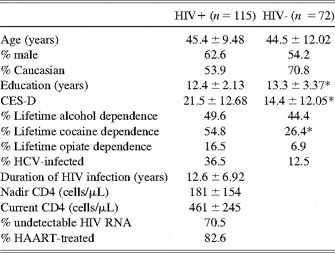
Demographic and clinical characteristics of the participant population are presented in Table 1. Mean duration of HIV infection was 12.6 years, and the majority (82.6%) of the HIV+ group was on stable HAART. Most HIV+ participants (70.5%) had undetectable plasma HIV RNA (<75 copies/mL). Despite an average nadir CD4 of 181 cells/μL, indicating a history of immunocompromise, participants were medically stable, with an average current CD4 count of 461 cells/μL. Fifty-one participants, including 42 HIV+ (36.5%) and 9 HIV- (12.5%) participants, had active HCV infection. HCV infection was significantly more common in the HIV+ group (χ2[1,N = 187] = 12.88; p < .001). No participants were receiving interferon or ribavirin at the time of testing.
Characteristics of HIV+ and HIV- participants

Note. Results are presented as mean ± standard deviation unless otherwise noted.
*p < .05.
CES-D = Center for Epidemiologic Studies Depression scale.
The Kreek-McHugh-Schluger-Kellogg Scale (KMSK scale, Kellogg et al., Reference Kellogg, McHugh, Bell, Schluger, Schluger, LaForge and Kreek2003) was used to assess lifetime alcohol and substance dependence. Using this classification system, respective rates of alcohol, cocaine, and opiate dependence were 49.6%, 54.8%, and 16.5% in the HIV+ group and 44.4%, 26.4%, and 6.9% in the HIV- group. Depression was assessed using the Center for Epidemiologic Studies Depression (CES-D) scale (Radloff, Reference Radloff1977). Mean CES-D scores for the HIV+ and HIV- groups were 21.5 and 14.4, respectively.
HIV+ participants had significantly fewer years of education (F[1,186] = 4.70; p = .031), higher rates of cocaine dependence (χ2[1,N = 187] = 14.50; p < .001), and higher degree of depression (F[1,182] = 14.04; p < .001). HCV-infected participants of either HIV status were more likely to be nonwhite (χ2[4,N = 187] = 10.28; p = .036) and had fewer years of education (F[1,186] = 13.90; p < .001) and higher rates of cocaine (χ2[1,N = 187] = 38.03; p < .001) and opiate (χ2[1,N = 187] = 37.38; p < .001) dependence. HIV/HCV-coinfected participants had longer duration of HIV infection (F[1,114] = 14.98; p < .001) than HIV-monoinfected participants.
Neurocognitive Assessment
Neurocognitive functioning was assessed in the following domains: speed of information processing, attention/working memory/executive functioning, learning, memory, verbal fluency, and psychomotor speed. The battery was comprised of the following tests chosen for their sensitivity to HAND: Hopkins Verbal Learning Test – Revised (HVLT-R; Benedict, Schretlen, Groninger, & Brandt, Reference Benedict, Schretlen, Groninger and Brandt1998; Brandt & Benedict, Reference Brandt and Benedict1991); Brief Visuospatial Memory Test – Revised (BVMT-R; Benedict, Reference Benedict1997); Controlled Oral Word Association Test (COWAT–FAS; Benton, Hamsher, & Sivan, Reference Benton, Hamsher and Sivan1994); category fluency (animals); Stroop Color and Word Test (Golden, Reference Golden1978); Trail Making Test, Parts A and B (Reitan, Reference Reitan1992); Grooved Pegboard Test (Kløve, Reference Kløve1963); and the Digit Symbol–Coding, Symbol Search, and Letter-Number Sequencing tests from the Wechsler Adult Intelligence Scale – Third Edition (WAIS-III; Wechsler, Reference Wechsler1997). Tests, grouped by domain, are listed in Tables 3 and 4. The present tests and domains are similar to those used in the Global Deficit Score (GDS), which has shown high validity in detecting HIV-associated neurocognitive impairment (Carey et al., Reference Carey, Woods, Gonzalez, Conover, Marcotte, Grant and Heaton2004; Heaton et al., Reference Heaton, Grant, Butters, White, Kirson and Atkinson1995).
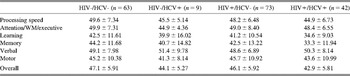
Demographically corrected t scores were calculated using established norms (Benedict et al., Reference Benedict, Schretlen, Groninger and Brandt1998; Benedict, Schretlen, Groninger, Dobraski, & Shpritz, Reference Benedict, Schretlen, Groninger, Dobraski and Shpritz1996; Heaton, Miller, Taylor, & Grant, Reference Heaton, Miller, Taylor and Grant2004). Domain composite scores were calculated by averaging the t scores of all tests in the domain. Overall composite scores were calculated by averaging the t scores of all tests in the battery. Means and standard deviations of domain and overall scores, grouped by HIV and HCV status, are presented in Table 2.
Neurocognitive performance by HIV and HCV status

Note. Results are presented as mean±standard deviation of demographically corrected t scores.
*p < .05.
WM = working memory.
Statistical Analysis
Statistical analysis was performed using SPSS software (IBM). Group differences in demographic, substance use, and clinical variables were assessed using analysis of variance or Pearson's χ2. All participants with a history of opiate dependence also had a history of cocaine dependence; consequently, cocaine and opiate histories were combined into one binary variable indicating history of either drug. Multiple linear regression analyses were performed with each cognitive test and composite score as the dependent variable. Two primary sets of analyses were performed. (1) The first set of analyses included all participants. HIV status, HCV status, lifetime alcohol dependence, and lifetime cocaine or opiate dependence served as predictors. The same analyses were performed with CES-D as an additional predictor. (2) The second set of analyses included HIV+ participants only. Current CD4 count, nadir CD4 count, HIV RNA level, duration of HIV infection, HCV status, lifetime alcohol dependence, and lifetime cocaine or opiate dependence were entered as predictors.
Results
Contributors to Neurocognitive Performance in the Whole Cohort
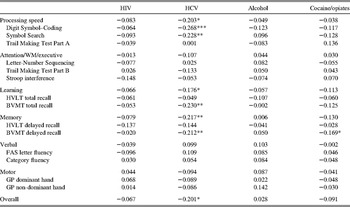
Neurocognitive performance in the whole cohort was assessed as a function of HIV serostatus, HCV infection, lifetime alcohol dependence, and lifetime cocaine/opiate dependence. Results are presented in Table 3. HCV infection was significantly associated with poorer performance on Digit Symbol–Coding (p < .001), Symbol Search (p = .004), BVMT total recall (p = .004), and BVMT delayed recall (p = .008), and composite scores for processing speed (p = .013), learning (p = .030), memory (p = .007), and overall performance (p = .014). Cocaine/opiate dependence was significantly associated with poorer BVMT delayed recall (p = .040). HIV serostatus and alcohol history were not significantly associated with neurocognitive performance.
Regression coefficients (β) for neurocognitive performance in the whole group as a function of HIV serostatus, HCV, and substance use history

Note. *p < .05, **p < .01, ***p < .001.
WM = working memory; HVLT = Hopkins Verbal Learning Test; BVMT = Brief Visuospatial Memory Test; GP = Grooved Pegboard.
To examine the contribution of depressive symptoms to neurocognitive performance, CES-D score was added as an additional predictor in the regression model described above. Higher degree of depression was associated with poorer processing speed (p < .001), attention/executive functioning (p = .010), motor functioning (p = .001), and overall performance (p < .001). Follow-up analyses showed significant associations between CES-D and overall performance in both the HIV- group (p = .014) and the HIV+ group (p = .004). The effects of HCV on neurocognitive performance remained regardless of whether CES-D was included in the model. When CES-D was included, substance use was no longer associated with poorer performance.
Contributors to Neurocognitive Performance in the HIV+ Group
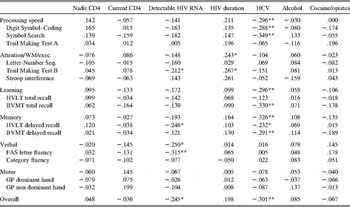
In secondary analyses of the HIV+ group alone, neurocognitive performance was assessed as a function of HIV disease measures, HCV infection, and substance use. Results are presented in Table 4. HCV infection was significantly associated with poorer performance on Digit Symbol–Coding (p = .007), Symbol Search (p = .001), BVMT total recall (p = .002), HVLT delayed recall (p = .038), and BVMT delayed recall (p = .007), and composite scores for processing speed (p = .008), learning (p = .007), memory (p = .003), and overall performance (p = .006). Detectable HIV RNA was significantly associated with poorer performance on Trail Making Test Part B (p = .039), HVLT delayed recall (p = .019), FAS Letter Fluency (p = .002), and composite scores for verbal fluency (p = .016) and overall performance (p = .016). Duration of HIV infection was significantly associated with Trail Making Test Part B (p = .014) and the attention/working memory/executive functioning domain score (p = .026). Surprisingly, longer duration of infection was associated with better performance on these measures. Current and nadir CD4 and history of substance dependence were not significantly associated with any cognitive measure in the HIV+ cohort.
Regression coefficients (β) for neurocognitive performance in the HIV+ group as a function of HIV clinical measures, HCV, and substance use history

Note. *p < .05, **p < .01.
WM = working memory; Exec. = executive functioning; Seq. = sequencing; HVLT = Hopkins Verbal Learning Test; BVMT = Brief Visuospatial Memory Test; GP = Grooved Pegboard.
Discussion
In this cohort of 115 HIV-infected (HIV+) and 72 seronegative (HIV-) individuals, we found significant associations between neurocognitive deficits and HIV viral load, hepatitis C virus (HCV) coinfection, and substance use history. HIV RNA and HCV coinfection were significant predictors of overall neurocognitive performance. Detectable HIV RNA was also associated with reduced executive functioning, verbal fluency, and memory, and HCV coinfection was associated with reduced processing speed, learning, and memory. Substance use was associated with reduced visuospatial memory. Depression also contributed to neurocognitive impairment in addition to the other clinical variables examined. Consistent with a recent report in a large national cohort (Heaton et al., Reference Heaton, Clifford, Franklin, Woods, Ake, Vaida and Grant2010), approximately half of our HIV+ cohort exhibited significant neurocognitive impairment (Carey et al., Reference Carey, Woods, Gonzalez, Conover, Marcotte, Grant and Heaton2004). The findings from this cohort of medically stable HIV-infected individuals support the persistence of neurocognitive dysfunction in the HAART era (Clifford, Reference Clifford2008; Harezlak et al., Reference Harezlak, Buchthal, Taylor, Schifitto, Zhong, Daar and Navia2011; Robertson et al., Reference Robertson, Smurzynski, Parsons, Wu, Bosch, Wu and Ellis2007; Tozzi et al., Reference Tozzi, Balestra, Bellagamba, Corpolongo, Salvatori, Visco-Comandini and Narciso2007), particularly in association with active HIV infection and HCV coinfection.
Detectable plasma HIV RNA level was a strong determinant of cognitive impairment, which emphasizes the importance of effective systemic virologic control in mitigating brain dysfunction. However, it is also possible that preexisting neurocognitive impairment contributes to poor treatment adherence and other health behaviors which may result in loss of virologic control. In contrast with viral load, other disease severity measures examined, including current and nadir CD4, were not significantly associated with impairment. The absence of significant associations between nadir CD4 and cognitive performance was somewhat unexpected given emerging evidence indicating an association between past immunocompromise and current neurocognitive function (Cohen, Harezlak, Schifitto, et al., Reference Cohen, Harezlak, Schifitto, Hana, Clark, Gongvatana and Navia2010; Tozzi et al., Reference Tozzi, Balestra, Lorenzini, Bellagamba, Galgani, Corpolongo and Narciso2005; Valcour et al., Reference Valcour, Yee, Williams, Shiramizu, Watters, Selnes and Sacktor2006); however, it has been suggested that effects of HIV disease markers may be difficult to examine in the context of comorbid conditions that may affect neurocognitive functioning (Heaton et al., Reference Heaton, Clifford, Franklin, Woods, Ake, Vaida and Grant2010). The relationship between longer duration of infection and better performance was surprising since we might expect neurocognitive functioning to worsen over the course of HIV infection in association with progressive neurodegeneration (Bornstein, Nasrallah, Para, Whitacre, & Fass, Reference Bornstein, Nasrallah, Para, Whitacre and Fass1994; Brew, Crowe, Landay, Cysique, & Guillemin, Reference Brew, Crowe, Landay, Cysique and Guillemin2009; Harezlak et al., Reference Harezlak, Buchthal, Taylor, Schifitto, Zhong, Daar and Navia2011; Valcour, Shikuma, Watters, & Sacktor, Reference Valcour, Shikuma, Watters and Sacktor2004). Instead, the results suggest that the relationship between duration of infection and brain dysfunction may not be straightforward (Cysique, Maruff, & Brew, Reference Cysique, Maruff and Brew2006; Ellis, Langford, & Masliah, Reference Ellis, Langford and Masliah2007; Moore et al., Reference Moore, Masliah, Rippeth, Gonzalez, Carey, Cherner and Grant2006; Robertson et al., Reference Robertson, Robertson, Ford, Watson, Fiscus, Harp and Hall2004; Tozzi et al., Reference Tozzi, Balestra, Bellagamba, Corpolongo, Salvatori, Visco-Comandini and Narciso2007) and should be examined in future studies. In sum, while the relationships between HIV clinical variables and neurocognitive impairment appear to be complex, the present findings indicate a continued relationship between HIV and neurocognitive functioning, particularly in association with active infection.
In analyses in the whole cohort of HIV-infected and seronegative individuals, the absence of an association between HIV serostatus and neurocognitive performance was noteworthy. However, it is perhaps unsurprising given the stable medical status of this mostly HAART-treated HIV+ cohort. HIV-associated neurocognitive dysfunction is less commonly observed among individuals with intact immune function and viral suppression (Chang et al., Reference Chang, Ernst, Witt, Ames, Gaiefsky and Miller2002; Childs et al., Reference Childs, Lyles, Selnes, Chen, Miller, Cohen and McArthur1999; Janssen et al., Reference Janssen, Saykin, Cannon, Campbell, Pinsky, Hessol and Kaplan1989; McArthur et al., Reference McArthur, McClernon, Cronin, Nance-Sproson, Saah, St Clair and Lanier1997; McCutchan et al., Reference McCutchan, Wu, Robertson, Koletar, Ellis, Cohn and Williams2007), which is emphasized by our HIV RNA finding. Additionally, several studies have observed structural brain changes only among individuals with advanced HIV disease (Gongvatana et al., Reference Gongvatana, Schweinsburg, Taylor, Theilmann, Letendre, Alhassoon and Grant2009; Hesselink, Tien, Spoto, Jernigan, & Grant, Reference Hesselink, Tien, Spoto, Jernigan and Grant1991; Jernigan et al., Reference Jernigan, Archibald, Hesselink, Atkinson, Velin, McCutchan and Grant1993). Therefore, HIV serostatus may have limited utility as a predictor of neurocognitive impairment in the context of effective virologic and immunologic control (Stern et al., Reference Stern, Arruda, Somerville, Cohen, Boland, Stein and Martin1998), and measures of disease severity may be more useful in this regard. In the present sample, although 52% of HIV+ participants exhibited neurocognitive impairment in comparison with 35% of the HIV- group, serostatus failed to significantly predict this difference.
The relatively high rate of neurocognitive impairment (35%) in the HIV-seronegative group may appear surprising. However, this may not be entirely unexpected considering that we directed recruitment efforts toward a seronegative comparison sample closely resembling the HIV-infected cohort, with the goal of minimizing potential confounding effects of demographics and other variables. Consequently, rates of comorbid factors, including HCV infection, substance use, and depression, were considerably higher in the HIV- group than in the general population (Compton, Thomas, Stinson, & Grant, Reference Compton, Thomas, Stinson and Grant2007; Grant, Reference Grant1996; Hasin, Stinson, Ogburn, & Grant, Reference Hasin, Stinson, Ogburn and Grant2007; Kim, Reference Kim2002; Radloff, Reference Radloff1977). In particular, 13% of the HIV-seronegative group had active HCV infection, in comparison with 1.6% of the United States population (Armstrong et al., Reference Armstrong, Wasley, Simard, McQuillan, Kuhnert and Alter2006), and 26% had lifetime non-alcohol substance dependence, in contrast with 2.6% of the general population (Hasin et al., Reference Hasin, Stinson, Ogburn and Grant2007). We found each of these factors to be significantly associated with neurocognitive impairment in the present cohort, indicating their contribution to cognitive dysfunction in the HIV- group as well as in the HIV+ group. In sum, the absence of significant associations between serostatus and neurocognitive functioning may be due to the nature of our HIV- cohort, which more naturalistically emulates HIV-infected people and thus should serve as a valid comparison sample for examining the effects of clinical factors on neurocognitive function.
The apparent effects of HCV coinfection on neurocognitive function in this cohort were particularly striking. HCV was among the strongest determinants of neurocognitive dysfunction in the sample, particularly in the domains of processing speed, learning, memory, and overall performance. These effects remained significant even after controlling for depression and substance use history. Our findings add to mounting evidence that HCV coinfection is associated with neurocognitive dysfunction in HIV-infected individuals (Cherner et al., Reference Cherner, Letendre, Heaton, Durelle, Marquie-Beck, Gragg and Grant2005; Clifford et al., Reference Clifford, Evans, Yang and Gulick2005; Hinkin, Castellon, Levine, Barclay, & Singer, Reference Hinkin, Castellon, Levine, Barclay and Singer2008; Morgello et al., Reference Morgello, Estanislao, Ryan, Gerits, Simpson, Verma and Sharp2005). Results from our group from the same cohort indicate that HCV coinfection is also among the strongest predictors of white matter integrity (Gongvatana et al., Reference Gongvatana, Cohen, Correia, Devlin, Miles, Clark and Tashima2011) and plasma inflammatory cytokine levels (Cohen et al., Reference Cohen, de la Monte, Gongvatana, Ombao, Gonzalez, Devlin and Tashima2011).
The robust effects of HCV may be partly explained by the current state of HCV management in HIV-infected people. Whereas HIV is often effectively controlled by modern antiretroviral treatment, as it was in the present cohort, treatment of HCV is less frequently initiated, completed, and successful in HIV/HCV-coinfected individuals (Carrat et al., Reference Carrat, Bani-Sadr, Pol, Rosenthal, Lunel-Fabiani, Benzekri and Perronne2004; Chung et al., Reference Chung, Andersen, Volberding, Robbins, Liu, Sherman and van der Horst2004). While HIV-related morbidity and mortality have declined (Crum et al., Reference Crum, Riffenburgh, Wegner, Agan, Tasker, Spooner and Wallace2006; Mocroft et al., Reference Mocroft, Ledergerber, Katlama, Kirk, Reiss, d'Arminio Monforte and Lundgren2003), HCV-related liver disease has emerged as a leading cause of morbidity and mortality among HIV-infected individuals (Bica et al., Reference Bica, McGovern, Dhar, Stone, McGowan, Scheib and Snydman2001; Monga et al., Reference Monga, Rodriguez-Barradas, Breaux, Khattak, Troisi, Velez and Yoffe2001; Palella et al., Reference Palella, Baker, Moorman, Chmiel, Wood, Brooks and Holmberg2006; Weber et al., Reference Weber, Sabin, Friis-Moller, Reiss, El-Sadr, Kirk and Lundgren2006). The present findings suggest that HCV infection poses a similar threat to neurocognitive functioning in the HAART era.
The relative contributions of HCV itself and resultant liver disease to brain dysfunction remain to be determined. Our HCV findings were observed in a sample with minimal prevalence of advanced liver disease, suggesting possible direct effects of the virus itself (Forton et al., Reference Forton, Allsop, Main, Foster, Thomas and Taylor-Robinson2001; Perry, Hilsabeck, & Hassanein, Reference Perry, Hilsabeck and Hassanein2008; Weissenborn et al., Reference Weissenborn, Krause, Bokemeyer, Hecker, Schuler, Ennen and Boker2004). Evidence suggesting penetration of the central nervous system by HCV has been observed (Laskus et al., Reference Laskus, Radkowski, Bednarska, Wilkinson, Adair, Nowicki and Rakela2002; Letendre et al., Reference Letendre, Paulino, Rockenstein, Adame, Crews, Cherner and Masliah2007; Wilkinson, Radkowski, & Laskus, Reference Wilkinson, Radkowski and Laskus2009), although direct links between neurocognitive functioning and HCV RNA have not been established (Clifford et al., Reference Clifford, Smurzynski, Park, Yeh, Zhao, Blair and Evans2009). Considering the links between liver disease and neurocognitive dysfunction (Bajaj, Wade, & Sanyal, Reference Bajaj, Wade and Sanyal2009; de la Monte, Longato, Tong, DeNucci, & Wands, Reference de la Monte, Longato, Tong, DeNucci and Wands2009; de la Monte et al., Reference de la Monte, Tong, Nguyen, Setshedi, Longato and Wands2010; McCrea, Cordoba, Vessey, Blei, & Randolph, Reference McCrea, Cordoba, Vessey, Blei and Randolph1996; Tarter et al., Reference Tarter, Hegedus, Van Thiel, Schade, Gavaler and Starzl1984), future research should account for markers of liver disease, including liver function tests and fibrosis stage, as well as quantitative HCV RNA to examine the relative contributions of the virus and secondary liver dysfunction to neurocognitive impairment. Additionally, it will be important to examine whether the neurocognitive effects of HCV infection are augmented by coinfection with HIV. Such analysis was not possible in the current study due to the breakdown of HIV/HCV sample sizes, which, while adequate for examining the main effects of each condition, prevents a valid examination of their statistical interaction. Future studies should include balanced HIV/HCV sample sizes to examine this interaction. However, whether the observed HCV associations are due to direct effects of HCV, secondary liver dysfunction, or interaction with HIV, the present findings suggest that successful treatment of HCV may result in improved neurocognitive outcomes for HIV/HCV-coinfected individuals.
The potential contribution of substance use to the present HCV findings also deserves mention. Substance use, especially of intravenous drugs, is among the most significant risk factors for HCV infection; this is reflected in the strong association between HCV and lifetime substance dependence in our sample. Thus, it is nearly impossible to completely disentangle the individual contributions of HCV and substance use to neurocognitive impairment. Nonetheless, regardless of the etiology, the results suggest that HCV coinfection presents increased risk for neurocognitive dysfunction in HIV-infected people, which has both research and clinical implications. The present findings underline the importance of considering this significant comorbid condition in the study and diagnosis of neurocognitive disorders in HIV-infected individuals.
A relatively weak association between lifetime substance use history and cognitive performance was found, which supports the idea that long-term neurocognitive effects of substance use diminish with prolonged abstinence (Davis et al., Reference Davis, Liddiard and McMillan2002; Fein et al., Reference Fein, Torres, Price and Di Sclafani2006; Pezawas et al., Reference Pezawas, Fischer, Diamant, Schneider, Schindler, Thurnher and Kasper1998). Current substance use, which was excluded from the current study, may be expected to have a greater impact on neurocognitive functioning than remote use. Additionally, examination of the degree of substance use (e.g., lifetime exposure, addiction severity, and length of abstinence) as opposed to the binary diagnosis used here may be more useful for studying the impact of substance use history in the context of HIV infection.
We did observe one significant association between substance use history and neurocognitive impairment in the present sample. Lifetime cocaine or opiate dependence was associated with poorer visuospatial memory, which supports previous similar findings (Fals-Stewart, Schafer, Lucente, Rustine, & Brown, Reference Fals-Stewart, Schafer, Lucente, Rustine and Brown1994; Gruber, Silveri, & Yurgelun-Todd, Reference Gruber, Silveri and Yurgelun-Todd2007), although it is unclear whether the present finding is attributable to cocaine, opiates, or both substances. Given the differing neurocognitive effects of cocaine and opiates (Basso & Bornstein, Reference Basso and Bornstein2000; Fernandez-Serrano, Perez-Garcia, & Verdejo-Garcia, Reference Fernandez-Serrano, Perez-Garcia and Verdejo-Garcia2011), future studies should include participants with both mono- and polysubstance use to characterize better the effects of these substances alone and in combination in the context of HIV infection.
It should be mentioned that HIV, HCV, and substance use are not the only contributors to neurocognitive functioning among people with HIV. While we excluded for severe psychiatric illness including major depression, moderate depression was present in the cohort and was strongly associated with neurocognitive performance. Educational or social factors, additional coinfections, and use of other substances may also have affected cognitive functioning in the present sample, particularly in HIV/HCV-coinfected participants. Additionally, with the emergence of HIV as a chronic condition, HIV-infected individuals increasingly face the neurocognitive effects of aging (Ances et al., Reference Ances, Vaida, Yeh, Liang, Buxton, Letendre and Ellis2010; Cherner et al., Reference Cherner, Ellis, Lazzaretto, Young, Mindt, Atkinson and Heaton2004; Stoff, Reference Stoff2004) and many of the same diseases as the general population, including cardiovascular disease, diabetes, and non–AIDS-defining cancers (Brown et al., Reference Brown, Cole, Li, Kingsley, Palella, Riddler and Dobs2005; Deeks & Phillips, Reference Deeks and Phillips2009; Obel et al., Reference Obel, Thomsen, Kronborg, Larsen, Hildebrandt, Sorensen and Gerstoft2007; Palella et al., Reference Palella, Baker, Moorman, Chmiel, Wood, Brooks and Holmberg2006; Phillips, Neaton, & Lundgren, Reference Phillips, Neaton and Lundgren2008; Powles et al., Reference Powles, Robinson, Stebbing, Shamash, Nelson, Gazzard and Bower2009). Future research should address the impact of these additional cofactors on neurocognitive functioning in the context of HIV.
In conclusion, the present findings support the persistence of brain dysfunction in HIV-infected individuals, particularly those with poor virologic control and comorbid conditions, especially HCV. HIV serostatus appears to have diminished utility as a predictor of neurocognitive impairment when HIV-infected individuals are medically stable, and the present findings therefore emphasize the importance of examining measures of disease severity in relation to neurocognitive function. Our findings also highlight the contribution of comorbid risk factors to neurocognitive functioning in HIV-infected individuals in the HAART era. While remote substance use appears to pose relatively minor neurocognitive risks, HCV coinfection is associated with poorer performance across neurocognitive domains. Future research should focus on longitudinal examination of HIV- and HCV-associated neurocognitive changes, and on relating these changes to neuroimaging and plasma/cerebrospinal fluid markers of brain dysfunction.
Acknowledgments
This work was supported by the National Institute of Health (Grant R01 MH074368) and the Lifespan/Tufts/Brown Center for AIDS Research (Grant P30 AI042853). This research has been facilitated by the infrastructure and resources provided by the Lifespan/Tufts/Brown Center for AIDS Research and The Miriam Hospital Immunology Center. The authors have declared that no conflicts of interest exist.