Implications
The screening bioassay that was used here can be used for efficient and economical screening of large numbers of plants for their potential to control lactic acidosis in vivo. We identified an Australian native plant, Eremophila glabra, which prevents simulated acidosis in an in vitro system as indicated by pH and d-lactate values. Its effects were similar to those of virginiamycin, an antibiotic currently used in ruminant feedstuffs to prevent acidosis. Based on the current findings and previous observations, E. glabra and Kennedia prorepens have a moderating effect on lactate production. The potential of these plants to prevent lactic acidosis needs to be determined using in vivo experiments.
Introduction
Lactic acidosis is a major rumen disorder and welfare issue that affects animal health and production in systems such as dairy and feedlot beef. Under normal conditions, lactate in the rumen is an intermediate product in carbohydrate fermentation that is converted to volatile fatty acids (VFA) by rumen microbes. However, introducing large amounts of readily fermentable carbohydrate in the diet of ruminants too quickly promotes the rapid growth of lactate-producing bacteria and the production of excessive lactate, which decreases ruminal pH and in its acute form (pH < 5.0) inhibits microbial fermentation (Hungate, Reference Hungate1966). A common control for this disorder is to feed sub-therapeutic doses of antibiotics such as virginiamycin (Godfrey et al., Reference Godfrey, Rowe, Thorniley, Boyce and Speijers1995; APVMA, 2003). Virginiamycin is effective at reducing lactic acid concentration probably because it inhibits the growth of lactate-producing bacteria (Nagaraja and Taylor, Reference Nagaraja and Taylor1987; Nagaraja et al., Reference Nagaraja, Taylor, Harmon and Boyer1987). However, fear of antimicrobial resistance in bacteria that can carryover to human pathogens has led to bans on feeding antibiotics to livestock (Wegener, Reference Wegener2003). Therefore, it is necessary to find alternatives that are safe for the consumer, but also maintain competitive levels of animal production.
Australian plants may be a suitable alternative to growth promoters for controlling acidosis because they are known to produce compounds with antimicrobial activity (Palo and Robbins, Reference Palo and Robbins1991; Bryant et al., Reference Bryant, Reichardt and Clausen1992; Min et al., Reference Min, Attwood, Reilly, Sun, Peters, Barry and McNabb2002). However, there is little information on their activity against rumen microbes. Methods have been developed such as those that Palombo and Semple (Reference Palombo and Semple2001) used to test the bioactive properties of plants and the methods that Nagaraja et al. (Reference Nagaraja, Taylor, Harmon and Boyer1987) used to test the effect of synthetic compounds on the ruminal processes involved with the onset of lactic acidosis. We adapted these methods to simulate the onset of rumen lactic acidosis in vitro (in batch cultures) and then used this bioassay to screen a range of Australian plants.
Material and methods
Experimental design
Two separate bioassays (screening bioassay and protection bioassay) were used to test the ability of test plants to prevent the development of acidotic conditions in batch culture. Acidotic conditions (control) were induced by adding fermentable carbohydrate to batch cultures and the effect was assessed by measuring pH and gas production (both assays), and changes in lactate and VFA accumulation (protection assay). A positive control was used in both assays where acidotic conditions were prevented by the addition of virginiamycin (AB). First, all plants were tested in the screening assay; then the two plants with the most promising effect were investigated in the second bioassay (protection bioassay). The protection bioassay was used to determine the ability of the plants to inhibit the production of lactic acid without inhibiting the production of VFA over an extended incubation (24 h).
Plants and plant extracts
A collection of plants (n = 95 comprising 79 species) and essential oils (n = 9), which were native or naturalised species of Australia were selected for screening. Species were selected that contained known or suspected antimicrobial components or with potential grazing value to farming systems of Southern Australia (Tables 2 and 3). Plants were only considered if they were available for ongoing testing and present in reasonable numbers in plant communities to enable ongoing collection and, potentially, their commercial development.
Fresh plant material was provided by the Department of Environment and Conservation (n = 45), the Future Farm Industries, Cooperative Research Centres for Plant-based Management of Dryland Salinity (n = 17) and private properties (n = 17) (Table 1). Essential oils were kindly donated by The Paperbark Company of Western Australia. Material was collected during 2004–05, identified botanically and voucher specimens were deposited. A record was made of plant locations and collection dates, but there was no account for changes in chemical composition of the plants caused by stage of growth, harvest time or climatic conditions. Plant parts were divided into leaf, stem and flower before weighing and storing in zip lock bags at −20°C. The material was then freeze-dried, reweighed and milled to coarse powder using a cyclone grinder (CYCLOTECH 1093 Sample Mill; Tecator, Hoganas, Sweden) fitted with a 4 mm screen followed by a 1 mm screen. The ground material was then stored at room temperature in sealed containers.
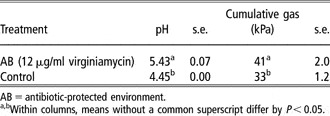
The effect of glucose (0.1 g/ml of rumen fluid) on pH and gas production during batch fermentations of rumen fluid with virginiamycin (AB, n = 3 with four replicates) or without (control, n = 3 with four replicates)

AB = antibiotic-protected environment.
a,bWithin columns, means without a common superscript differ by P < 0.05.
Rumen fluid
Fistulated wethers were used as a source of mixed rumen populations (rumen fluid) for all experiments. Two fistulated wethers were maintained in the animal house on a diet based on 250 g lupins, 50 g oaten grain and 25 g of minerals per day with oaten chaff provided ad libitum (the estimated starch content was 22 g/day). Rumen fluid (about 300 ml per sheep) was collected from two fistulated wethers, 2 to 3 h after feeding, into a pre-warmed thermos flask using a vacuum pump fitted with a 1-mm screening filter. The rumen fluid was transported immediately to the laboratory and placed in an anaerobic chamber (Coy anaerobic chamber; 80% N2 : 10% CO2 : 10% H2). The rumen fluid was pooled, stirred and the initial pH recorded.
Screening bioassay
The rumen fluid was not buffered in order to exaggerate differences in the pH between treatments. Adding buffer to the rumen fluid would mask or delay the drop in pH and make it difficult to detect subtle differences. The plant material was included at 0.1 g/10 ml rumen fluid (France et al., Reference France, Lopez, Dijkstra, Sanderson and Dhanoa1998; Rymer et al., Reference Rymer, Moss, Deaville and Givens1998), and 1 g of glucose was added as substrate to simulate carbohydrate overload (Nagaraja et al., Reference Nagaraja, Taylor, Harmon and Boyer1987). Oaten chaff was added at the same level as the test plant to represent fibrous portion of plant substrate (control). Oaten chaff was used as a negative control because it was the major substrate used in the feed rations of the sheep that provided the rumen fluid. A stock solution of virginiamycin was prepared using Eskalin500® (Phibro Animal Health Pty Ltd, Wentworthville NSW, Australia; containing 50% active virginiamycin) to a concentration of 1.2 mg of virginiamycin per ml of methanol. A final concentration of 12 μg/ml of virginiamycin was prepared by adding 100 μl of stock solution to 10 ml of rumen fluid. A methanol control was included in the bioassay and no effect was observed on the parameters being tested.
The treatments were prepared in triplicate in Bellco tubes (Medos Company Pty Ltd, Adelaide, South Australia) the day before the experiment and placed in the anaerobic chamber overnight to remove the oxygen. On the day, 10 ml of rumen fluid was anaerobically dispensed into each tube. Tubes were then sealed with a rubber stopper and crimped. The pressure in the gas phase of the tubes was adjusted to zero by inserting a 23G (23-gauge) needle through the stopper. The needle was removed and the tubes were shaken by hand to disperse the additives.
The tubes were then transferred to an orbital shaking incubator and incubated at 39°C with constant shaking at 50 rpm for 5 h. Rymer et al. (Reference Rymer, Moss, Deaville and Givens1998) and Pell and Schofield (Reference Pell and Schofield1993) found that shaking the samples slowly at 50 rpm reduced the variation in gas production between replicates. Treatments were removed from the shaking incubator after 2, 4 and 5 h of incubation and placed in a water bath maintained at 39°C for as long as it took to measure gas pressure in the headspace by inserting a 23G needle attached to a pressure transducer (Greisinger Electronic GmbH, Regenstauf, Germany) through the stopper. It was important to maintain the tubes at 39°C when taking pressure readings to prevent errors in the pressure readings due to changes in the temperature (Bettelheim and March, Reference Bettelheim and March1998).
After recording the cumulative gas pressure, a 23G needle was inserted through each Bellco stopper to release the pressure to prevent it from exceeding 50 kPa, because at higher pressures microbial growth becomes restricted and growth curves become non-linear (Pell et al., Reference Pell, Pitt, Doane and Schofield1998). After the final gas pressure reading, the stoppers were removed and the pH in the liquid phase was measured.
Protection bioassay
The method used was similar to the screening assay with the following amendments. The volume for the incubation reaction was increased to 50 ml to provide sufficient volume for samples to be taken for determining pH. The incubation period was increased from 5 to 24 h to allow repeated measures to be taken over an extended incubation period. The rumen fluid was buffered to pH 7.0 by adding McDougall’s solution (McDougall, Reference McDougall1948; Busquet et al., Reference Busquet, Calsamiglia, Ferret and Kamel2006). McDougall’s solution was not used in the screening bioassay because it would have masked pH changes over the short incubation period of 5 h. However, the solution was used in the protection assay to buffer the incubations over the extended period of 24 h during which time organic acids would accumulate and otherwise lower the pH to extreme levels.
d-Lactate and VFA were measured, in addition to pH and gas, to provide a more precise indication of the characteristics of microbial fermentation. Cumulative gas in the headspace and pH in the liquid fraction were recorded after 5, 10, 15 and 24 h of incubation. At each measuring stage, 1 ml of the liquid phase was removed by syringe and the pH was measured. At the end of the incubation period, 1 ml of the liquid phase was taken out, mixed with 5 μl of concentrated H2SO4 and stored at −20°C for lactate and VFA analysis.
A decrease in pH and an increase in d-lactate were used as indicators of the bacterial processes responsible for lactic acidosis, while gas and VFA production were used as indicators of microbial fermentation.
Volatile fatty acids were quantified by capillary gas chromatograph (GC), equipped with a split injector and flame ionisation detection, using internal standard calibration (GC Separation of VFA C2-C5 Supelco Bulletin 749D). d-Lactate was determined using the Boehringer Mannheim Lactic acid kit (Boehringer Mannheim, Castle Hill, NSW, Australia) (Product No. 1112821) in an assay based on the enzymatic oxidation of d(−)-lactate with a specific d-lactate dehydrogenase coupled to reduction of NAD and spectrophotometer measurement of NADH at 340 nm. A Roche Cobas Mira S autoanalyser (Roche Diagnostics, Perth, WA, Australia) was used for readings.
Statistical analysis
Values in the screening bioassay were adjusted to account for variation between days of the experiment using internal standards that were set by the oaten chaff controls. The means were compared using Oneway ANOVA in Genstat 7.2. When means differed by P < 0.05, a Tukey’s Pairwise Comparison was used to compare individual plant treatments against the controls.
Results
Screening bioassay
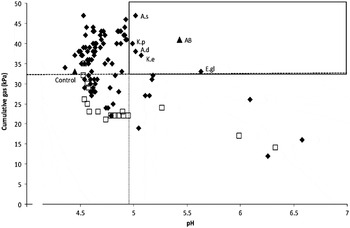
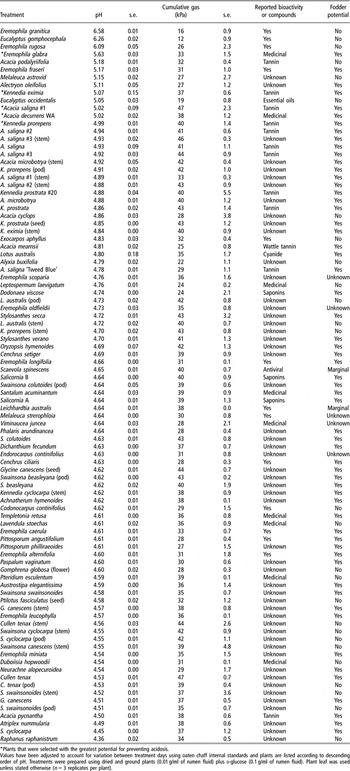
The AB treatment produced a higher pH and cumulative gas than the control (P < 0.05) (Table 1). Five plants produced significantly higher pH values than the control and a cumulative gas pressure above 33 kPa. These plants were considered as having a desirable effect on fermentation (Table 2 and Figure 1). These species included Eremophila glabra, Kennedia eximia, Acacia saligna, Acacia decurrens and Kennedia prorepens. Of these plants E. glabra produced pH values that were comparable to the AB treatment (5.63 and 5.43 respectively) but it also produced significantly less gas than the other four plant species and AB.
The relationship between cumulative gas and pH in an induced acidotic environment when rumen fluid was treated with ⧫, dried, ground Australian plant material or □, essential oil. E.gl = Eremophila glabra; K.p = Kennedia prorepens; K.e = Kennedia eximia; A.s = Acacia saligna; A.d = Acacia decurrens; ▴, Control = simulated acidosis and AB = antibiotic-protected environment. The horizontal axis is truncated and does not intersect with the vertical axis at zero. Each symbol represents the mean of a single plant tested in triplicate. Standard errors are given in Table 2 but not in this graph to avoid detracted from the focus of the graph and clarity of the points.

The effect of ground plant material on pH and gas production during batch fermentations of rumen fluid using glucose as the major substrate
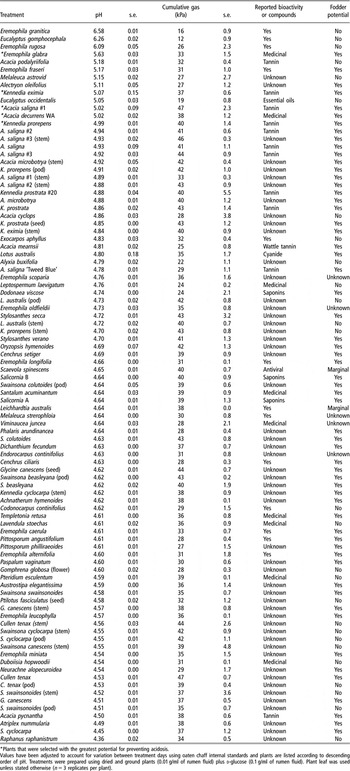
*Plants that were selected with the greatest potential for preventing acidosis.
Values have been adjusted to account for variation between treatment days using oaten chaff internal standards and plants are listed according to descending order of pH. Treatments were prepared using dried and ground plants (0.01 g/ml of rumen fluid) plus d-glucose (0.1 g/ml of rumen fluid). Plant leaf was used unless stated otherwise (n = 3 replicates per plant).
The mean starting pH was 6.35 and ranged from 6.06 to 6.71 (n = 6). The pH of all treatments declined over the 5-h incubation. Treatments that produced pH values higher than 5.98 after 5 h also produced the lowest cumulative gas (<20 kPa). The pH values from the plant treatments ranged from 6.26 to 4.36 and cumulative gas from 48 to 12 kPa (Table 2). The two plant treatments with the highest pH values, Eremophila granitica and Eucalyptus gomphocephala, also produced the least amount of gas.
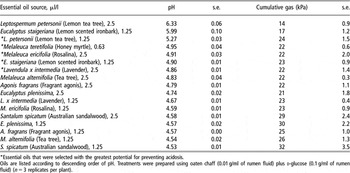
The pH values from the nine essential oil treatments ranged from 6.33 to 4.53 and cumulative gas from 40 to 14 kPa (Table 3 and Figure 1). The oils that prevented the greatest decline in pH values included Leptospermum petersonii, Melaleuca teretifolia, Melaleuca ericifolia, Eucalyptus staigeriana and Lavendula x intermedia. However, these oils produced cumulative gas values lower than 30 kPa.
The effect of essential oils on pH and gas production during batch fermentations of rumen fluid using glucose as the major substrate

*Essential oils that were selected with the greatest potential for preventing acidosis.
Oils are listed according to descending order of pH. Treatments were prepared using oaten chaff (0.01 g/ml of rumen fluid) plus d-glucose (0.1 g/ml of rumen fluid) (n = 3 replicates per plant).
Protection bioassay
The two most promising candidates, E. glabra and K. prorepens were selected for testing in the protection bioassay.
pH
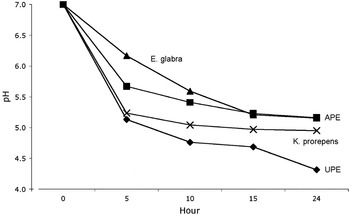
The pH declined in all treatment groups over the 24-h incubation period, with the control consistently producing the lowest pH values (Figure 2). The pH declined sharply in the control up to 10 h and continued to decline but at a slower rate to a final pH of 4.31. During the incubation there was a sharp decline for K. prorepens and the control (below pH 6.00), while E. glabra maintained pH at 6.17. However, over the next 5 h, the pH of E. glabra dropped more rapidly, reaching pH 5.59, while K. prorepens maintained a relatively constant pH at 5.04. Relative to the other treatments, K. prorepens maintained consistent pH values of 5.23 declining to just 4.95 after 24 h. After 24 h of incubation, both plant treatments maintained pH values that were higher than the control (P < 0.05), but only the E. glabra treatment maintained the pH at a similar level to the AB treatment (Table 4 and Figure 2).
The pH of rumen culture fluid over a 24-h incubation period in an in vitro acidosis assay (▪, antibiotic-protected environment, ▴, Eremophila glabra,  , Kennedia prorepens and ⧫, Control). Symbols represent means, n = 3.

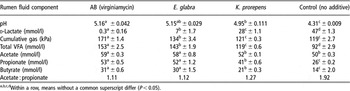
The extent of control in vitro of acidosis (pH and d-lactate) and fermentation (gas and volatile fatty acids (VFA)) indicators by the addition of dried and ground Eremophila glabra and Kennedia prorepens compared to an antibiotic-protected (AB) environment and an unprotected environment after a 24-h incubation (mean, ±s.e., n = 3)

a,b,c,dWithin a row, means without a common superscript differ (P < 0.05).
d-Lactate
The concentration of d-lactate varied from 0.3 (AB) to 47 mmol/l (control), with the control producing more d-lactate than all other treatments (P < 0.05) (Table 4). After 24 h of incubation, both AB and the E. glabra treatments had a d-lactate concentration that was lower than the control and K. prorepens (P < 0.05).
Cumulative gas
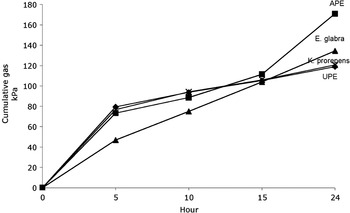
Cumulative gas in the E. glabra treatment was significantly higher than the control but lower than AB after 24 h of incubation (Table 4). There was a lag phase in the first 5 h of gas production in the E. glabra treatment (Figure 3). The cumulative gas in the AB treatment increased more rapidly than other treatments between 15 and 24 h (112 to 171 kPa). After 24 h of incubation, the AB treatment produced more gas than the other treatments (P < 0.05). More gas was produced from the E. glabra treatment than K. prorepens and the control (P < 0.05).
The cumulative gas production by rumen culture fluid over a 24-h incubation period in an in vitro acidosis assay (▪, antibiotic-protected environment, ▴, Eremophila glabra,  , Kennedia prorepens and ⧫, Control). Symbols represent means, n = 3.

Volatile fatty acids
Total VFA in the E. glabra treatment were significantly higher than the control but lower than AB after 24 h of incubation (Table 4). The total VFA concentrations at the end of incubation were the highest in the AB treatment, followed by E. glabra, K. prorepens and the control (P < 0.05). Total VFA, propionate and butyrate were lower in the control than all other treatments (P < 0.05). There was a reduction in the acetate : propionate ratio in the AB, E. glabra and K. prorepens treatments of 35%, 29% and 33%, respectively, compared with the control.
Discussion
An in vitro bioassay was used to allow testing for the bioactivity of plants against the development of an acidotic environment in batch cultures. Ninety-five plants and nine essential oils were tested in the bioassay. The five plants that produced significantly higher pH values than the control and a cumulative gas pressure above 33 kPa were considered as having a desirable effect on fermentation and the potential to prevent acidosis in vivo. Cumulative gas pressure that was significantly lower than the controls indicated microbial inhibition that was broad spectrum and restrictive on fermentation.
The treatment containing virginiamycin was the most effective in the prevention of simulated acidosis although, plants were identified that may have similar effects on bacterial processes in the rumen. One species, E. glabra, produced a similar level of protection against an acidotic environment as virginiamycin, although it also had a moderate inhibitory effect on total fermentation. Four species, K. prorepens, K. eximia, A. saligna and A. decurrens prevented a decline in the pH of rumen fluid without inhibiting gas production, relative to the acidotic control.
The five species identified in the screening assay were of most interest because of their potential to protect against acidosis. These species were important for two reasons; first, the plants enabled high gas production with a moderate decline in pH and this indicated normal fermentation and production of VFA. Although VFA are weaker acids than lactate and have less influence on declining pH in the rumen, they have a pKa of 4.80 and cause the pH to drop before their absorption through the rumen wall. Second, the plants that maintained a high pH without inhibiting gas production when incubated with glucose substrate were likely to have specifically inhibited bacteria that convert glucose to lactic acid.
Plants with broad-spectrum activity were identified by a severe inhibition of gas production and pH values that remained higher than batch cultures with normal fermentation. Many of the essential oils showed broad-spectrum antimicrobial activity and no oils produced similar fermentation characteristics to virginiamycin. The majority of plants tested showed little bioactivity in the acidosis bioassay, and this is indicated by gas and pH levels equal to or below the acidotic control.
The control was an effective model for simulating lactic acidosis. The low pH value and high concentration of d-lactate in the control was indicative of acute acidosis. As a consequence of the low pH, normal fermentation was inhibited and this was indicated by a decline in gas and total VFA production. The pH in the acidotic control was lower than 4.80 and can be explained by excessively high levels of lactic acid. Lactate is a stronger acid (pKa 3.1) than the VFA that are produced in the rumen (pKa 4.80). The VFA begin to have maximum buffering effect at pH 4.80, which inhibits any further decline in pH (Owens et al., Reference Owens, Secrist, Hill and Gill1998). Therefore, only high concentrations of lactate can decrease the pH below 4.80. The buffering effect was evident between 10 and 15 h as a reduction in the otherwise rapid pH decline in the acidotic control. The low production of propionate and butyrate in the acidotic control was probably the result of the inhibition of succinate producers and lactate-users resulting from the low pH.
The bioassay that was used here was suitable for use in screening plants for their protection against ruminant acidosis. The AB treatment and the control allowed us to simulate acidosis using a glucose challenge in batch cultures and then to inhibit the decline in pH by adding virginiamycin.
In the protection bioassay E. glabra and K. prorepens offered protection against acute acidotic conditions in vitro as indicated by higher pH values and lower d-lactate concentrations compared to the acidotic control. Eremophila glabra, in particular, provided a level of protection that was comparable to virginimycin, while K. prorepens was less effective and also inhibited normal fermentation.
Acidosis develops when large dietary increases of ruminally fermentable carbohydrate cause an imbalance in microbial populations in the rumen (Nocek, Reference Nocek1997). The imbalance is characterised by the rapid increase in populations of Streptococcus bovis and Lactobacilli spp. that use freely available carbohydrate and produce lactic acid as a byproduct. The overproduction of lactic acid causes the pH to drop and there is a consequent decrease in lactate-users such as Maleleuca elsdenii and Selenomonas ruminantium resulting in microbes that synthesise lactic acid outnumbering those that use it (Klieve et al., Reference Klieve, Heck, Prance and Shu1999).
d-Lactate was present at normal physiological levels in the E. glabra treatment, and the moderating effect on lactate production may have been due to the inhibition of rumen microbes responsible for acidosis. The inhibition was probably due to the effects of antimicrobial compounds contained in the plant. This is supported by pure culture work (Hutton, Reference Hutton2008) where E. glabra selectively inhibited the lactate-producing bacteria S. bovis and Lactobacillus spp., but not on the lactate-user M. elsdenii. In the present study, the high butyrate concentrations found in E. glabra and AB treatments relative to the acidotic control further indicates the moderating effect on lactate production. Melaleuca elsdenii ferment lactic acid to butyrate and the presence of butyrate at the expense of lactate indicates a balanced microbial environment (Schwartz and Gilchrist, Reference Schwartz and Gilchrist1975).
Eremophila (Family Myoporaceae) species are hardy perennial shrubs that grow throughout arid and semi-arid Australia with the main centre of diversity in Western Australia. In general, they are tolerant of drought, fire, frost, salinity and grazing. The glabra species is a rangeland shrub plant that was selected for screening in this study based on the ethnobotanical records that indicate its use in Australian Aboriginal medicine (Palombo and Semple, Reference Palombo and Semple2001).
This work supports the findings of Nagaraja et al. (Reference Nagaraja, Taylor, Harmon and Boyer1987) and Coe et al. (Reference Coe, Nagaraja, Sun, Wallace, Towne, Kemp and Hutcheson1999) that the antibiotic virginiamycin is effective at inhibiting lactic acidosis by preventing the accumulation of lactate in the rumen. Lactate levels in a normal balanced microbial system do not accumulate above 5 mmol/l but levels exceeding 40 mmol/l indicate severe acidosis (Owens et al., Reference Owens, Secrist, Hill and Gill1998). The study here supports these observations because the concentration of d-lactate in the acidotic control was indicative of acute acidosis while virginiamycin prevented lactate from accumulating.
It should be considered that virginiamycin consists of purified compounds that have been extensively tested and refined for a specific mode of action. Eremophila glabra, on the other hand, was introduced as ground plant material at a single concentration. It is possible that the efficacy of E. glabra could be improved by extracting and testing the active compounds of the plant.
After 24 h of incubation, the K. prorepens treatment demonstrated limited protection against simulated acidosis. The higher pH and lower d-lactate compared to the acidotic control indicated some microbial inhibition of lactate-producing bacteria. In pure culture work (Hutton, Reference Hutton2008), K. prorepens inhibited various strains of Lactobacilli spp., but not S. bovis or the lactate-user M. elsdenii. It appears that this may also have occurred in this experiment because of the high butyrate concentration observed in the K. prorepens treatment relative to the acidotic control.
Virginiamycin, E. glabra and K. prorepens elevated the levels of propionate at the expense of acetate. The E. glabra, K. prorepens and AB treatments resulted in acetate to propionate ratios that were more than 25% lower than the acidotic control, which is considered significant and favourable for animal production (Nagaraja et al., Reference Nagaraja, Taylor, Harmon and Boyer1987). In-feed antibiotics also select for microbial communities that produce more propionate at the expense of acetate (Dennis et al., Reference Dennis, Nagaraja and Bartley1981). Propionate is the main gluconeogenic substrate for ruminants. Increased concentrations of propionate in the rumen have a protein sparing effect because less amino acids are used for gluconeogenesis (Van Nevel and Demeyer, Reference Van Nevel and Demeyer1988). Acetate, on the other hand, is a precursor for the formation of methane by methanogenic archaea (Wolin and Miller, Reference Wolin and Miller1988). In general, compounds that inhibit methane production generally enhance propionate production, and it is possible that these plants, when introduced into the rumen, would also inhibit methane production.
d-Lactate accumulation was measured rather than l-lactate because d-lactate is metabolised more slowly than l-lactate by microbes and in tissue. This results in the accumulation of d-lactate in the rumen and in the bloodstream and so d-lactate is considered more toxic during acidosis. (Godfrey et al., Reference Godfrey, Rowe, Thorniley, Boyce and Speijers1995; Nocek, Reference Nocek1997; Owens et al., Reference Owens, Secrist, Hill and Gill1998).
The in vitro gas production technique used here is a simple yet sensitive procedure that is used to measure the rate and extent of degradation of ruminant feeds indirectly (Theodorou et al., Reference Theodorou, Williams, Dhanoa, McAllan and France1994). In traditional pasture species, there is a high correlation between gas production values in vitro and the extent of digestion by microbial fermentation in vivo (Rymer et al., Reference Rymer, Moss, Deaville and Givens1998). However, the correlation may not be as high when digesting bioactive plants. A decline in gas and VFA production can be caused by the inhibition of microbial species and/or low digestibility of the substrate, but the gas production technique does not allow us to distinguish between the two. To determine the level of bioactivity it would be necessary to examine the effect of these plants as ethanolic extracts.
Acknowledgements
Support for this project was obtained from an Australian Postgraduate Association award. The authors gratefully acknowledge the assistance of the Future Farm Industries CRC, the Department of Environment and Conservation, The Paperbark Company and the Department of Agriculture and Food Western Australia.