Introduction
Advanced capitalist countries have responded to the recent economic crisis and its associated aftershocks by embarking upon one or another deliberate strategy of crisis management. By crisis management, I mean the variable policy responses that governments formulate as they endeavour to cope with the consequences of crises. Welfare state architectures play a critical role in the operation of crisis management, although their precise contributions have varied considerably across space and over time (Starke et al., Reference Starke, Kaasch and van Hooren2013). Contemporary crisis management has similarly manifested itself in an uneven fashion across the landscape of advanced capitalist countries (Farnsworth and Irving, Reference Farnsworth and Irving2011/2013; Greve, Reference Greve2014; Starke et al., Reference Starke, Kaasch and van Hooren2014). Cross-national differences have therefore been observed not only in the degree to which countries were exposed to the crisis, but also in the policy responses with which they have attempted to confront its consequences.
The present study is concerned with explaining the observed cross-national variation in contemporary crisis management, with specific attention to labour market policy responses. It employs Qualitative Comparative Analysis (QCA) to investigate patterns of recommodification in recent labour market reforms across a sample of eighteen advanced welfare states. The countries included in the analysis are: Australia, Austria, Belgium, Canada, Denmark, Finland, France, Germany, Greece, Ireland, Italy, the Netherlands, New Zealand, Norway, Portugal, Spain, Sweden, and the United Kingdom. The central research question is as follows: How can we explain patterns of welfare state recommodification in the labour market policy trajectories of advanced welfare states during the aftermath of the recent economic crisis? At its core, the study explores the range of institutional, political and economic factors that are predicted to have shaped and constrained the observed diversity of contemporary crisis management.
Explaining welfare state change during hard times
The existing literature offers a number of theoretical frameworks with which to attempt to explain the direction of welfare state change during hard times (cf. Castles, Reference Castles2004; Starke, Reference Starke2006). According to a first theoretical framework, the welfare state is first and foremost a mechanism of social compensation that is presumed to expand (or contract) whenever and wherever there is greater (or lesser) need for it (Glatzer and Rueschemeyer, Reference Glatzer and Rueschemeyer2005). Advocates of this neo-functionalist social compensation hypothesis suggest that socio-economic challenges generate functional demands for an expansion of the welfare state (Vis et al., Reference Vis, van Kersbergen and Hylands2011). However, to the extent that all welfare states are not created equal, advocates of this hypothesis argue that the relationship between economic crises and welfare state change is moderated by the scope and generosity of existing social policy arrangements (Ramesh, Reference Ramesh2009). The functional demand for social compensation is predicted to be greatest in weaker welfare states that lack adequate compensatory mechanisms with which to buffer the consequences of crises. Recommodification is therefore said to be more likely to occur in stronger welfare states, where the functional demand for expansion may be less significant or less apparent.
A second theoretical framework has approached the question of welfare state change through the lens of partisan politics (Allan and Scruggs, Reference Allan and Scruggs2004; Korpi and Palme, Reference Korpi and Palme2003). According to this second approach, the policy objectives of political parties differ systematically according to the perceived interests of their respective constituents. According to this partisan politics hypothesis, left-leaning and right-leaning parties are expected to display different political preferences when faced with similar socio-economic circumstances. While it is true that economic crises affect large portions of the population, they tend to affect the traditional constituencies of left-leaning and right-leaning parties differently (Cusack et al., Reference Cusack, Iversen, Rehm, Beramendi and Anderson2008). Thus, it is reasonable to expect that the strategies of crisis management they formulate will differ. In particular, advocates of this second hypothesis predict that recommodification is more likely to occur when right-leaning parties are in power than when left-leaning parties are in power.
A revised formulation of the traditional partisan politics hypothesis suggests that the salience of partisanship is contingent upon the institutional context in which crises unfold (Starke et al., Reference Starke, Kaasch and van Hooren2014). According to this third constrained partisanship hypothesis, the relevance of partisan politics during a period of economic crisis may depend on the strength of existing welfare state measures. Partisan differences are said to play a more decisive role in shaping the direction of social policy change in weaker welfare states, where the inadequacy of existing compensatory mechanisms generates a demand for state intervention. By contrast, partisan effects on the direction of social policy change are said to be muted in stronger welfare states, due to the adequacy of compensatory mechanisms that depoliticize the practice of crisis management. Thus, whether or not a partisan effect on crisis management occurs is predicted to depend on the scope and generosity of existing social policy arrangements.
A fourth theoretical framework has emphasised the role of institutions in shaping the path-dependent contours of cross-national welfare state change. Institutionalist scholars have brought attention to the fact that, when faced with a common challenge, welfare states will embark upon different, and often divergent, trajectories of reform (Ebbinghaus and Manow, Reference Ebbinghaus and Manow2001; Esping-Andersen, Reference Esping-Andersen1990/Reference Esping-Andersen1996; Hall and Soskice, Reference Hall and Soskice2001). Proponents of this path dependence hypothesis suggest that welfare states differ systematically in their logic of operation and, consequently, in their responses to a similar set of circumstances. Thus, countries are expected to fall back on their established habits and exhibit regime-specific patterns of adjustment whose contents correspond neatly to the logic of pre-existing institutional configurations (Chung and Thewissen, Reference Chung and Thewissen2011; Iversen, Reference Iversen, Hancké, Rhodes and Thatcher2007; Lallement, Reference Lallement2011). More specifically, liberal welfare states are expected to rely on a strategy of recommodification, while conservative and social democratic welfare states are expected to preserve or even reinforce established levels of social protection.
A final fiscal crisis hypothesis suggests that severe economic shocks have the capacity to undermine the established principles of the welfare state, revive concerns about its long-term viability, and provide the necessary political and economic conditions for radical welfare state retrenchment (Taylor-Gooby, Reference Taylor-Gooby2013; Vis, Reference Vis2009). Economic crises are said to generate significant problem pressures, including rising levels of unemployment and declining levels of fiscal maneuverability, which have the potential to fundamentally alter the structural constraints that governments believe themselves to be facing (Dukelow and Considine, Reference Dukelow and Considine2014). When and where these pressures are particularly severe, they are said to generate perceptions of a fiscal crisis of the welfare state (Hay and Wincott, Reference Hay and Wincott2013; Streeck, Reference Streeck2011; cf. O'Connor, Reference O'Connor1973). The expectation is that governments will confront such an emergency by embarking upon an agenda of fiscal consolidation (Bieling, Reference Bieling2012). Recommodification is therefore said to be more likely to occur in countries that experience particularly acute fiscal problem pressures.
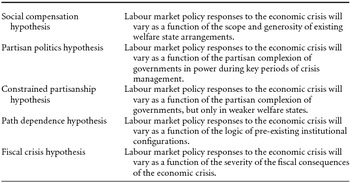
In summary, a number of theoretical frameworks exist with which to attempt to explain cross-national patterns of welfare state recommodification in the aftermath of economic crises (Table 1). By and large, these frameworks and their corresponding hypotheses tend to highlight one or another determinant of welfare state change to the exclusion of all others. Nevertheless, the complexity of contemporary crisis management is likely to render each of them less than universal. A central goal of this paper is to use available methodological tools to confront the observed complexity of crisis management with the aim of generating a more comprehensive account of its consequences for welfare state change.
Overview of hypotheses

Among the methodological tools available to comparative social scientists, QCA represents a powerful instrument for the analysis of causal complexity across a medium-sized sample of cases (Rihoux and Ragin, Reference Rihoux and Ragin2009). QCA draws on the strengths of both variable-oriented and case-oriented strategies to embody a unique sensitivity to both theoretical generality and empirical complexity. As a formal technique of analysis, QCA is a configurational comparative method that employs the logic of Boolean algebra and set theory to implement principles of comparison across cases. According to the procedure of QCA, each case is represented configurationally as a combination of causally relevant conditions whose variable presence or absence is said to contribute either to the presence or the absence of an outcome of interest, such as welfare state recommodification. Cases and their corresponding configurations of causally relevant conditions are systematically compared in order to uncover patterns of similarity and difference between them. Through the application of logical comparisons, the method simplifies complex data structures with the overall aim of establishing the necessary and sufficient conditions for the presence and absence of an outcome of interest (Rihoux and Ragin, Reference Rihoux and Ragin2009).
Operationalisation and calibration
Outcome of interest
The aim of the present study is to explain cross-national patterns of welfare state recommodification in the labour market policy trajectories of advanced capitalist countries in the aftermath of the recent economic crisis.Footnote 1 The notion of commodification was introduced by Marx (Reference Marx and Bottomore1963/1844) to describe the condition of labour power under capitalism; namely, as a commodity whose sale in the labour market becomes the sole mechanism of securing the means of subsistence (Room, Reference Room2000). By contrast, decommodification refers to the reconfiguration of state–market relations associated with the emergence and consolidation of modern welfare states (Esping-Andersen, Reference Esping-Andersen1990). According to Esping-Andersen (Reference Esping-Andersen1990), decommodification occurs when a person can maintain an adequate standard of living without having to rely on the sale of their labour power. Decommodification is therefore used as a term to describe the process whereby social welfare – and, by extension, the means of subsistence – is rendered as a matter of right, rather than as a matter of one's performance in the labour market. In direct contrast to decommodification, recommodification describes the process whereby state–market relations are reconfigured in such a way as to imply a greater reliance on, or heightened exposure to, the labour market as a prerequisite for securing the means of subsistence (Holden, Reference Holden2003; Seeleib-Kaiser, Reference Seeleib-Kaiser2008). In other words, one's ability to subsist depends to a greater extent upon one's participation in the labour market. Thus, while the process of decommodification aims to protect citizens from the market, the process of recommodification aims precisely at orienting them towards it.
Borrowing from recent studies on welfare state retrenchment (Gray, Reference Gray2004; Kildal, Reference Kildal2001), recommodification is operationalised in the present study along three dimensions of labour market policy change.Footnote 2 The first dimension of recommodification accounts for labour market policy change that reinforces the obligation to work as a condition of unemployment protection. The reinforcement of work-related obligations implies a process of recommodification because it strengthens the emphasis on labour market participation as a prerequisite for subsistence (Clasen and Clegg, Reference Clasen, Clegg, Clasen and Siegel2007; Dingeldey, Reference Dingeldey2007; King, Reference King1995). In the analysis, work-related obligations are said to have been reinforced when (i) mandatory participation in job search activities as a condition for the receipt of unemployment benefits is introduced or intensified; (ii) mandatory participation in active labour market policy schemes as a condition for the receipt of unemployment benefits is introduced or intensified; (iii) the definition of what constitutes a suitable job offer is tightened; or (iv) punitive sanctions resulting from the failure to comply with benefit conditionalities are introduced or intensified.
The second dimension of recommodification accounts for labour market policy change that reduces the generosity of unemployment protection. By reducing the generosity of unemployment protection, governments restrict alternatives to labour market participation for securing the means of subsistence (Pierson, Reference Pierson2001; van Vliet, Reference van Vliet2010). In the analysis, the generosity of unemployment protection is said to have been reduced when (i) the level of unemployment benefits is reduced; (ii) the maximum duration of unemployment benefits is reduced; (iii) access to unemployment benefits is reduced through the tightening of qualifying conditions or the lengthening of the waiting period before benefits can be claimed.
The third dimension of recommodification accounts for labour market policy change that reduces the strictness of employment protection. The analysis focuses on changes to the regulatory architectures that govern the parameters of lawful and unlawful dismissals. This final dimension is included to account for the variable intensity of recommodification experienced by those engaged in paid employment (Gray, Reference Gray2004). Notably, employment protection is largely neglected in existing indices of decommodification (e.g. Esping-Andersen, Reference Esping-Andersen1990; Scruggs and Allan, Reference Scruggs and Allan2006). Nevertheless, labour market regulations are centrally linked to the experience of commodification and are therefore crucial elements in its reconfiguration vis-à-vis state–market relations (Papadopoulos, Reference Papadopoulos2005). In the analysis, employment protection is said to have been reduced when (i) the parameters of lawful dismissal are relaxed; or (ii) the punitive consequences associated with the use of unlawful dismissal are relaxed.
A comprehensive review of labour market reforms enacted between January 2008 and June 2013 was conducted. Data on labour market reforms were derived from three comparative databases (European Commission 2013a, b; International Labour Organization/World Bank, 2013). Temporary labour market reforms were excluded from the analysis on the basis that the aim of the study is to generate insight into the substantive impact of the economic crisis on the long-term trajectory of welfare states.Footnote 3
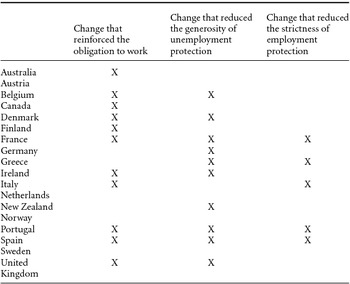
Table 2 provides an overview of labour market reforms enacted between January 2008 and June 2013. A more detailed outline of the reforms is provided in Appendix A. The data reveal that fourteen of the eighteen countries included in the analysis enacted at least one measure of recommodification.

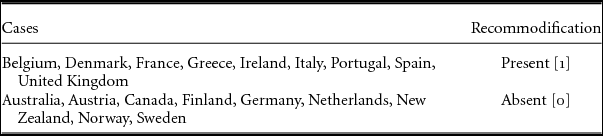
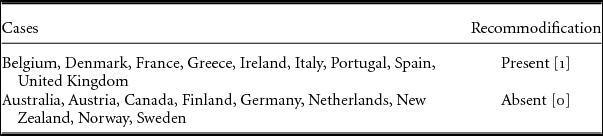
In order to derive membership scores, the outcome of interest is calibrated such that each case is described as belonging either to the subset of cases displaying the presence of the outcome [1] or to the subset of cases displaying the absence of the outcome [0]. For the purpose of the present analysis, a distinction is made between cases that display strong evidence of recommodification and those that display limited or no evidence of recommodification. Strong evidence of recommodification is said to have been observed when a case tests positively for more than one of the dimensions of recommodification. These cases are assigned a score of [1] for the outcome and are formally operated in the QCA as the subset of cases that display the presence of recommodification. By contrast, cases that test either positively for only one of the dimensions of recommodification or negatively for all three of them are said to offer limited or no evidence of recommodification. These cases are assigned a score of [0] for the outcome and are formally operated in the QCA as the subset of cases that display the absence of recommodification. The results of this calibration are summarized in Table 3. They indicate that nine cases enacted measures of recommodification along two or three of the dimensions in the analysis.
Calibration results for the outcome of interest
Causally relevant conditions
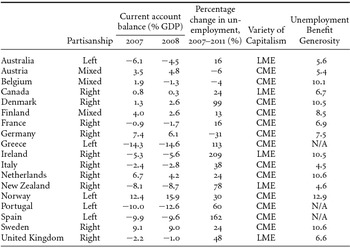
A total of five causally relevant conditions are included in the QCA reflecting the range of political, institutional and economic variables highlighted by existing theories of welfare state change. The raw data corresponding to these causally relevant conditions are summarized in Table 4. In order to attribute membership scores to all of the cases, thresholds are derived for each of the causally relevant conditions according to which the raw data can be calibrated. Whether or not a case meets a defined threshold determines whether it is assigned membership in the subset of cases displaying the presence of the condition [1] or in the subset of cases displaying the absence of the condition [0]. This process of calibration is informed by theoretical and substantive criteria (Rihoux and De Meur, Reference Rihoux, De Meur, Rihoux and Ragin2009).
Raw representation of the causally relevant conditions

Sources: Partisanship (Armingeon et al., Reference Armingeon, Weisstanner, Engler, Potolidis and Gerber2012); Current account balances (OECD, 2013); Unemployment rates (OECD, 2013); Variety of capitalism (Hall and Gingerich, Reference Hall and Gingerich2009; Schmidt, Reference Schmidt2009); Unemployment benefit generosity (Scruggs, Reference Scruggs2004).
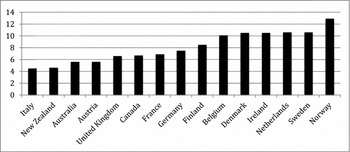
The first causally relevant condition [GEN] accounts for the strength of existing welfare state measures and, in particular, the generosity of unemployment benefit systems. Data on the generosity of unemployment benefits were derived from the Comparative Welfare Entitlements Dataset (Scruggs, Reference Scruggs2004). Figure 1 lists the generosity scores for the eighteen countries. Case-based knowledge suggests that a qualitative distinction can be made between the national unemployment benefit systems of Finland and Germany. While the former is characterised by a relatively generous and inclusive system of unemployment benefits, the latter is characterised by an increasingly exclusive system of unemployment benefits whose generosity has experienced considerable decline over the last decade (Bleses and Seeleib-Kaiser, Reference Bleses and Seeleib-Kaiser2004; Clasen, Reference Clasen2011; Picot, Reference Picot2012). The calibration threshold is therefore placed between Finland (8.5) and Germany (7.5). A score of [1] is assigned to countries with unemployment benefit generosity scores greater than 8. A score of [0] is assigned to countries with unemployment benefit generosity scores less than 8. Prior studies have indicated that Greece, Portugal and Spain are characterised by rudimentary and fragmented unemployment benefit systems (Ferrera, Reference Ferrera1996; Picot, Reference Picot2012; Saint-Arnaud and Bernard, Reference Saint-Arnaud and Bernard2003). Accordingly, they are assigned a score of [0] for this condition.
Unemployment benefit generosity scores

The second causally relevant condition [RIGHT] accounts for the partisan composition of government. A score of [1] is assigned to countries where right-leaning parties dominated during the period in which crisis-response legislation was enacted. A score of [0] is assigned to countries in which left-leaning parties, centrist-parties or government coalitions involving parties of different partisan tendencies dominated during the period in which crisis-response legislation was enacted.
The third causally relevant condition [LME] accounts for systematic differences in the institutional configurations of political economies. In the present study, a distinction is made between liberal and non-liberal market economies (Hall and Gingerich, Reference Hall and Gingerich2009). Drawing on recent scholarship integrating welfare state and production typologies (Schröder, Reference Schröder2009), I include both conservative and social democratic welfare states among the non-liberal market economies whose policy responses are expected to preserve or reinforce the generosity and scope of existing welfare state measures (Chung and Thewissen, Reference Chung and Thewissen2011; Lallement, Reference Lallement2011). A score of [1] is assigned to liberal market economies. A score of [0] is assigned to non-liberal market economies.
The fourth causally relevant condition [DEF] accounts for the strength of national current account balances as a proportion of GDP. The existing literature suggests that current account balances provide an accurate indication of a country's fiscal strength and maneuverability (Claessens et al., Reference Claessens, Dell'Ariccia, Igan and Laeven2010). Data on current account balances in 2007 and 2008 were derived from the OECD (2013). Current account balances were collected for these two years, because empirical research has demonstrated that the fiscal maneuverability of the state is significantly greater when a country enters periods of crisis management without structural deficits (Armingeon, Reference Armingeon2012). A score of [1] is assigned to countries that reported current account deficits in both 2007 and 2008. A score of [0] is assigned to countries that reported a current account surplus in both 2007 and 2008.
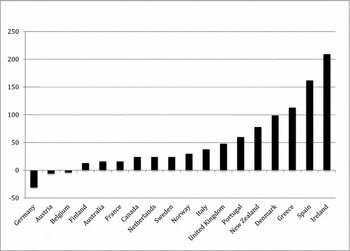
The fifth causally relevant condition [UNEMP] accounts for changes in national levels of unemployment over the course of the economic crisis. Data on unemployment rates were derived from the OECD (2013). Figure 2 shows the percentage change in levels of unemployment between 2007 and 2011 for the 18 countries. Case-based knowledge suggests that Portugal has experienced a qualitatively different jobs crisis from the United Kingdom (Clasen et al., Reference Clasen, Clegg and Kvist2012; Leschke and Watt, Reference Leschke and Watt2010; Rodrigues and Reis, Reference Rodrigues and Reis2012; Zartaloudis, Reference Zartaloudis2014). Accordingly, the calibration threshold is placed between Portugal (60 per cent) and the United Kingdom (48 per cent). A score of [1] is assigned to countries that experienced more than a 50 per cent increase in unemployment between 2007 and 2011. A score of [0] was assigned to countries that experienced less than a 50 per cent increase in unemployment.
Change in unemployment, 2007–2011 (%)

Analysis
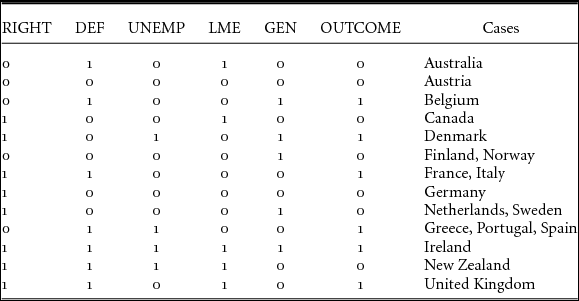
Having calibrated the outcome and the causally relevant conditions, it is possible to generate a truth table providing a configurational representation of the cases and their corresponding membership scores. This truth table is depicted in Table 5. The truth table is the fundamental unit of analysis in QCA (Rihoux and De Meur, Reference Rihoux, De Meur, Rihoux and Ragin2009). It lists all of the observed combinations of causally relevant conditions, the cases that correspond to them and the outcomes with which they are associated.
Truth table for the presence and absence of recommodification
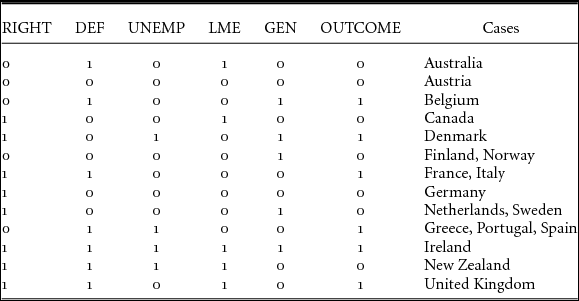
Analysis of the truth table proceeds through a process of logical minimisation. Logical minimisation refers to the systematic application of Boolean logic through the use of paired comparisons that follow a simple rule: ‘If two Boolean expressions differ in only one causal condition, yet produce the same outcome, then the causal condition that distinguishes the two expressions can be considered irrelevant and can be removed to create a simpler, combined expression’ (Ragin, Reference Ragin1987: 93). These paired comparisons allow for the complexity of the truth table to be reduced until final solutions, whose constituent elements reveal minimally relevant causal solutions for the presence and the absence of the outcome of interest. The notation and operators involved in the application of Boolean logic are listed in Table 6.
Boolean notation and operators

Depending on the strategy of logical minimisation employed, a single truth table can generate several Boolean solutions of varying complexity (Rihoux and De Meur, Reference Rihoux, De Meur, Rihoux and Ragin2009). Solutions vary in their complexity depending on whether or not they include logical remainders in the process of minimisation. Logical remainders refers to combinations of causally relevant conditions that are not associated with actually existing cases. In order to generate parsimonious solution terms, the present study includes logical remainders in the process of paired comparison. The analysis therefore relies on a number of simplifying assumptions (Ragin and Sonnett, Reference Ragin, Sonnett, Kropp and Minkenberg2005). These are simplifying, because they allow for a grater number of paired comparisons and, by extension, facilitate the derivation of more parsimonious solution terms. However, they are assumptions to the extent that they rely on counterfactual cases that are not observed in the empirical world. Parameters for the use of simplifying assumptions are established on the basis of both technical and theoretical criteria (Ragin and Sonnett, Reference Ragin, Sonnett, Kropp and Minkenberg2005). Following Emmenegger (Reference Emmenegger2011), I rely only on simplifying assumptions that correspond to the theoretical predictions of the hypotheses being tested. Simplifying assumptions that do not correspond to those theoretical predictions are excluded from the process of minimisation. A list of simplifying assumptions incorporated into the analysis can be found in Appendices B and C.
Truth table analysis for the presence of recommodification
Truth table analysis proceeds in a two-fold manner, beginning with the analysis of necessary conditions and ending with the analysis of sufficient conditions. The analysis of necessary conditions is concerned with determining whether any condition (or combination of conditions) is necessary for an outcome to occur and relies on two measures: consistency and coverage (Ragin, Reference Ragin2008). Consistency refers to the degree to which a given subset relation is approximated by the data. It is measured as the proportion of cases displaying a given condition among the subset of cases displaying the outcome of interest. Coverage refers to the empirical relevance of a subset relation that has already been determined to be consistent. It is measured as the proportion of cases displaying the outcome of interest among the subset of cases displaying a given condition (or combination of conditions).
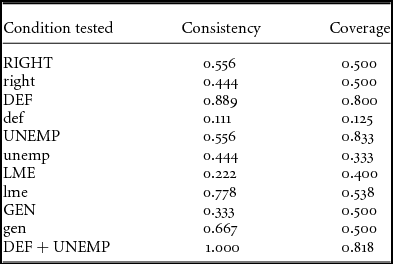
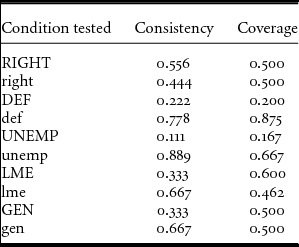
Table 7 summarizes the consistency and coverage scores of the causally relevant conditions for the presence of recommodification. The analysis of necessary conditions is conducted using a consistency threshold of 0.900 (Schneider and Wagemann, Reference Schneider and Wagemann2007). Only conditions whose consistency scores fall above this threshold are said to be necessary. A test for necessity reveals that none of the individual conditions is individually necessary for recommodification to occur.
Analysis of necessary conditions for the presence of recommodification
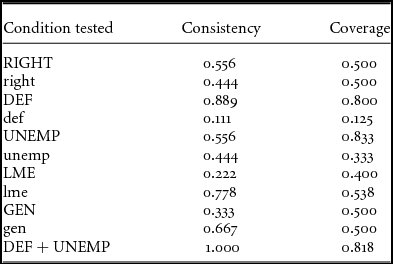
A test for necessity can also be performed for combinations of conditions. However, such a test is plausible only where there are theoretical arguments to justify it (Schneider and Wagemann, Reference Schneider and Wagemann2007). While the fiscal crisis hypothesis outlined above holds that a fiscal crisis is necessary for the presence of recommodification, there are two causally relevant conditions that individually constitute sufficient conditions for the presence of fiscal crisis: [DEF], the presence of current account deficits in 2007 and 2008, or [UNEMP], the presence of a greater than 50 per cent increase in unemployment levels. Accordingly, the combination of conditions [DEF + UNEMP] is included in the analysis of necessary conditions. The consistency score for this configuration is 1.000, indicating that the presence of fiscal crisis is a necessary condition for the presence of recommodification. With a coverage score of 0.818, this combination of conditions is confirmed to be non-trivial.
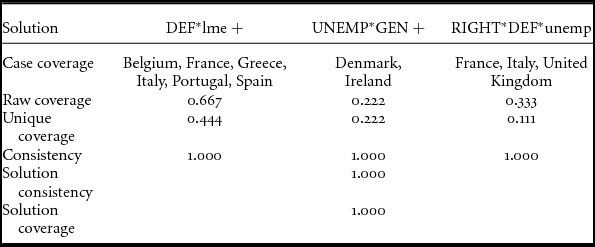
The analysis of sufficient conditions is concerned with determining the combinations of conditions that are sufficient for an outcome to occur. The analysis of sufficiency is conducted through the logical reduction of the truth table using the process of paired comparison described in the previous section. Table 8 summarizes the results of the parsimonious analysis of sufficient conditions. The solution suggests that there are three causal paths that lead to the presence of recommodification. Each causal path is composed of a unique combination of conditions. However, each combination of conditions is individually sufficient to ensure the presence of recommodification. The empirical relevance of a solution term is assessed by way of its coverage score (Rihoux and De Meur, Reference Rihoux, De Meur, Rihoux and Ragin2009). Both raw and unique coverage scores are listed in Table 8. The first solution term [DEF*lme] combines current account deficits with non-liberal market arrangements. The second solution term [UNEMP*GEN] combines a significant increase in unemployment with a strong unemployment benefit system. The third and final solution term [RIGHT*DEF*unemp] combines a right-leaning government with current account deficits and the absence of a significant increase in unemployment.
Parsimonious analysis of sufficient conditions for the presence of recommodification

The results of the truth table analysis for the presence of recommodification confirm that the presence of fiscal crisis – a condition that is sufficiently though not necessarily met by the presence of either [DEF] or [UNEMP] – is a necessary but insufficient condition for the presence of recommodification. The presence of fiscal crisis is necessary because [DEF] or [UNEMP] appears in all three of the solution terms. Its presence is insufficient, however, insofar as these conditions must combine with other causally relevant conditions in order to generate the causal recipes that give rise to the presence of recommodification.
Truth table analysis for the absence of recommodification
Table 9 lists the consistency and coverage scores of the causally relevant conditions for the absence of recommodification. All of the causally relevant conditions report consistency scores below the threshold of 0.900. Accordingly, no single condition appears to be individually necessary for the absence of recommodification.
Analysis of necessary conditions for the absence of recommodification

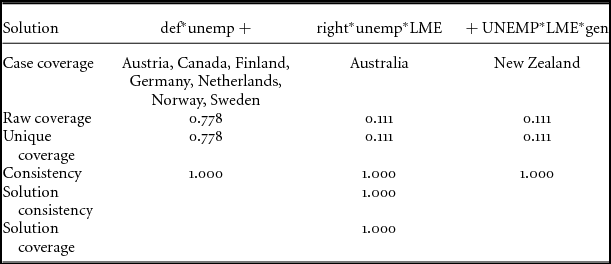
Table 10 depicts the results of the parsimonious analysis of sufficient conditions for the absence of recommodification. The parsimonious solution indicates that there are three causal paths that lead to the absence of recommodification. Each of the paths consists of a unique combination of conditions. The first solution term [def*unemp] combines current account surpluses with the absence of a significant increase in unemployment. The second solution term [right*unemp*LME] combines a right-leaning government with the absence of a significant increase in unemployment and liberal market arrangements. The third and final solution term [UNEMP*LME*gen] combines a significant increase in unemployment with liberal market arrangements and a weak unemployment benefit system.
Parsimonious analysis of sufficient conditions for the absence of recommodification

It is noteworthy that the second and third terms in the solution each account for only a single case. This is reflected in their relatively low coverage scores of 0.111. Empirically speaking, these solution terms are trivial. This is not to suggest that these cases are theoretically irrelevant. On the contrary, the analysis of atypical or anomalous cases can often generate crucial insights into the causal mechanisms underlying empirical phenomena. Nevertheless, their overall explanatory relevance to broader patterns of recommodification appears to be limited, when compared to the first term. Empirically speaking, only the first of the three solution terms [def*unemp] is highly relevant, covering seven of the nine cases that display the absence of recommodification. Notably, the combination [def*unemp] represents the absence of fiscal crisis. In other words, the results of the analysis of sufficient conditions demonstrate that the absence of fiscal crisis is a sufficient condition for the absence of recommodification.Footnote 4
Discussion
The empirical regularities unmasked by the above QCA suggest that there is a need to revisit extant theories of welfare state change and, in particular, the causal leverage they provide during periods of crisis management.
The social compensation hypothesis predicts that governments will respond to economic crises by expanding the breadth and depth of the welfare state (Glatzer and Rueschemeyer, Reference Glatzer and Rueschemeyer2005). However, advocates of this perspective argue that the functional demand for welfare state expansion will be greatest in countries that lack adequate compensatory mechanisms (Ramesh, Reference Ramesh2009). They therefore expect crisis responses to vary cross-nationally as a function of existing social policy arrangements. The results of the QCA call this hypothesis into question. Contrary to the predictions of the social compensation hypothesis, patterns of recommodification appear to have unfolded irrespective of the scope and generosity of national unemployment benefit systems. Moreover, recommodifying policy reforms have been enacted even where the functional demand for welfare state expansion has been the greatest. For example, such reforms are apparent even in the rudimentary welfare states of Greece, Portugal and the United Kingdom, all of which have suffered significant crisis consequences (Taylor-Gooby and Stoker, Reference Taylor-Gooby and Stoker2011; Zartaloudis, Reference Zartaloudis2014). Governments in these countries have responded to the recent economic crisis by reducing established levels of social protection.
A second strand of literature has highlighted the role of institutional path dependence in shaping cross-national welfare state change. Advocates of the path dependence hypothesis argue that welfare states differ systematically in their logic of operation and, on this basis, predict that they will formulate different strategies of adjustment in response to a common set of pressures (Esping-Andersen, Reference Esping-Andersen1996; Hall and Soskice, Reference Hall and Soskice2001). During periods of economic crisis, welfare states are therefore expected to fall back on their institutional habits and exhibit regime-specific patterns of change (Chung and Thewissen, Reference Chung and Thewissen2011; Iversen, Reference Iversen, Hancké, Rhodes and Thatcher2007; Lallement, Reference Lallement2011). This paper has provided little evidence of any such pattern of correspondence between pre-existing institutional configurations and crisis responses. In the aftermath of the recent economic crisis, the labour market policy trajectories of advanced welfare states appear to have deviated from the predictions of the path dependence literature in some important ways. Countries with similar institutional arrangements, such as Sweden and Denmark, have enacted very different crisis responses. Despite both being social democratic welfare states, the latter has responded to the crisis by reducing, rather than maintaining or expanding, established levels of social protection. Furthermore, countries whose institutional arrangements share little in common, such as Ireland and Belgium, have nevertheless exhibited similar trajectories of crisis management. Although they belong to different (i.e., liberal and conservative) welfare regime types, both countries have reduced the generosity of their unemployment benefit systems while simultaneously reinforcing work-related obligations. More generally, the results of the QCA indicate that the presence of recommodification has not been confined to liberal welfare states, and the absence of recommodification has not been confined to their conservative and social democratic counterparts. These findings indicate that the ex post diversity of cross-national crisis management cannot be explained strictly or even primarily in terms of the ex ante diversity of cross-national institutional configurations. These findings are consistent with those reported in a number of recent comparative analyses (Bermeo and Pontusson, Reference Bermeo and Pontusson2012; Clasen et al., Reference Clasen, Clegg and Kvist2012; Heyes et al., Reference Heyes, Lewis and Clark2012; Pontusson and Raess, Reference Pontusson and Raess2012).
A third strand of literature has highlighted the role of partisan politics and has argued that strategies of crisis management differ systematically between Left and Right parties, with the latter being more likely to opt for a market-oriented crisis reaction (Cusack et al., Reference Cusack, Iversen, Rehm, Beramendi and Anderson2008; Starke et al., Reference Starke, Kaasch and van Hooren2014). However, the results of the QCA suggest that partisan politics provide little causal leverage for explaining cross-national differences in labour market policy responses to the recent economic crisis. Moreover, the evidence presented suggests that the causal relevance of partisan politics is severely limited even after accounting for the generosity of existing welfare state measures. Though the partisan complexion of ruling parties appears to play a role in a small sub-set of cases (i.e., Australia and the United Kingdom), neither the traditional partisan politics hypothesis nor the revised constrained partisanship hypothesis appears to offer anything more than a piecemeal explanation for contemporary patterns of crisis management. Echoing the conclusions of recent comparative analyses (Bermeo and Pontusson, Reference Bermeo and Pontusson2012; Pontusson and Raess, Reference Pontusson and Raess2012; Rueda, Reference Rueda2012), the present study therefore provides evidence that the economic crisis has encouraged a political convergence between parties of varying ideological tendencies.
In summary, the political and institutional variables most commonly cited to explain welfare state change do not appear to provide compelling explanations for contemporary patterns of recommodification across advanced capitalist countries. On the contrary, the results of the present study suggest that economic conditions in general and fiscal conditions in particular have played the most decisive role in shaping and constraining labour market policy responses to the recent economic crisis. More specifically, the analysis has revealed that the presence of fiscal crisis has operated as a necessary (but insufficient) condition for the presence of recommodification, while the absence of fiscal crisis has operated as a sufficient (but unnecessary) condition for the absence of recommodification. These results suggest that, where the fiscal consequences of the economic crisis have expressed themselves most acutely, the established principles of the welfare state have been undermined and governments have been presented with the necessary conditions for the recommodification of labour market policies. They also suggest that, where the consequences of the crisis have manifested themselves less severely, the absence of an immediate sense of fiscal crisis has provided governments with the sufficient conditions to resist pressures for the recommodification of labour market policies. That patterns of reform have unfolded in this manner brings critical attention to the fiscal stability of the state as a powerful determinant of contemporary welfare state change.
While the recent economic crisis has generated a functional demand for greater social protection, the governments of advanced capitalist countries have largely proven incapable or unwilling to meet it. If we are correct in assuming that democratic governments are inclined to provide relief against the experience of socio-economic insecurity, the question remains why electoral concerns have not encouraged governments to compensate for the crisis by expanding the scope and generosity of the welfare state (Pontusson and Raess, Reference Pontusson and Raess2012). While it is certainly the case that welfare state retrenchment is more popular in some national contexts than in others, by and large public attitudes towards the welfare state remain favourable (Brooks and Manza, Reference Brooks and Manza2007; Svallfors, Reference Svallfors2012). The evidence provided by the present study suggests that fiscal conditions may provide a more meaningful explanation for this democratic deficit. In particular, the findings intimate that the fiscal scope for an expansion of the welfare state was sorely lacking across the landscape of advanced capitalist countries. These empirical developments raise important theoretical questions regarding the propensity of the capitalist state to sacrifice social welfare in order to promote economic recovery (Bieling, Reference Bieling2012; Heyes, Reference Heyes2013). They demand, in other words, a scholarly return to the problematic relationship between capitalism and the welfare state (Streeck, Reference Streeck2011; cf. Gough, Reference Gough1979; O'Connor, Reference O'Connor1973; Offe, Reference Offe1984).
Conclusion
The present study has attempted to make sense of differences in labour market policy responses to the Great Recession. The results of the study indicate that theories of welfare state change that award theoretical centrality to political and institutional variables do not provide compelling explanations for this observed cross-national diversity. Rather, contemporary patterns of recommodification in the labour market policy trajectories of advanced welfare states appear to be explained principally in terms of the variable fiscal capacity of the state. These results lend support to the broader claim that the fiscal crisis of the state –whether real or imagined – has returned as a core political concern across the landscape of advanced capitalist countries (Gough, Reference Gough, Farnsworth and Irving2011; Streeck, Reference Streeck2011; Taylor-Gooby, Reference Taylor-Gooby2013). The long-term political consequences of this crisis are as yet unclear.
Acknowledgments
The author would like to thank Martin Seeleib-Kaiser, Bastian Betthaeuser and Emanuele Ferragina for their helpful comments. A previous version of this article was presented at the annual conference of the UK Social Policy Association in 2013.
Appendix A: Detailed overview of labour market reforms, 2008–2013

Appendix B: Simplifying assumptions for the presence of recommodification
(1) right*def*UNEMP*lme*STAB
(2) right*def*UNEMP*LME*STAB
(3) right*DEF*unemp*lme*stab
(4) right* DEF*UNEMP*lme*STAB
(5) right*DEF*UNEMP*LME*STAB
(6) RIGHT*def*UNEMP*LME*STAB
(7) RIGHT*DEF*unemp*lme*STAB
(8) RIGHT*DEF*unemp*LME*STAB
(9) RIGHT*DEF*UNEMP*lme*stab
(10) RIGHT*DEF*UNEMP*lme*STAB
Appendix C: Simplifying assumptions for the absence of recommodification
(1) right*def*unemp*LME*stab
(2) right*def*unemp*LME*STAB
(3) right*def*UNEMP*LME*stab
(4) right*DEF*unemp*LME*STAB
(5) right*DEF*UNEMP*LME*stab
(6) RIGHT*def*unemp*LME*STAB
(7) RIGHT*def*UNEMP*LME*stab