I consider that the field of environment and development economics (EDE) began with the publication of The Control of Resources by Partha Dasgupta (Reference Dasgupta1982). Although he did not confine his focus to developing countries, Dasgupta (Reference Dasgupta1982: 10) suggested that managing environmental resources was much broader than conventional resource stock depletion or pollution control:
To sum up: environmental discussions need to be conducted in the face of a clear recognition that, (a) these resource are often common property, (b) resolutions of environmental problems usually involve changes in the allocation of property rights, (c) resource use may well be irreversible (e.g. it may lead to their exhaustion when in fact this could have been avoided), (d) resource stocks often affect welfare directly, (e) the environmental impact of certain types of activity are cumulative and only become noticeable at some time in the future, and (f) the environmental impact of certain types of activity are uncertain. It is no wonder that environmental problems are formidable to analyse, let alone solve.
This perspective on environmental issues was extremely helpful when I began analyzing specific natural systems in developing countries – such as upper watersheds, tropical forests and coastal and marine systems. Sound management of these systems required a broader concept of natural resource scarcity, which I defined as ecological scarcity, or the ‘increasing relative scarcity of essential natural services and ecological functions’ as natural systems are exploited for human use and economic activity (Barbier, Reference Barbier1989: 96–97). Today we define these myriad ecological contributions to human wellbeing as ecosystem services, i.e., ‘the benefits that people obtain from ecosystems’ (MEA, 2005).
Over 30 years since Dasgupta (Reference Dasgupta1982), the field of EDE has made great strides in analyzing complex environmental relationships – including ecosystems services – that are relevant to development. Many such analyses have been published in the past 20 years in this journal. However, despite this significant achievement, our rapidly advancing field faces several challenges.
First, the ‘development’ in EDE should not be forgotten. There are four stylized facts of natural resource use that affect economy-wide development and poverty alleviation in developing countries: the majority of these countries are highly dependent on primary product exports; such ‘resource dependency’ has not always led to improved economic performance; development in low- and middle-income economies is associated with increased land conversion and water use; and a significant share of the population in developing countries is concentrated on marginal agricultural lands and ecologically fragile environments (Barbier, Reference Barbier2005). In recent years the ‘resource curse’ literature has made much progress in analyzing the first two stylized facts (van der Ploeg, Reference van der Ploeg2011); however, the last two facts are equally important to understanding the complex environment– development relationships in low- and middle-income economies and deserve more attention (Barbier, Reference Barbier2010).
Second, environmental issues related to development are not solely about the resource problems of developing countries. Fossil fuel energy and raw material use, environmental degradation and pollution are occurring on such an unprecedented scale that the resulting consequences in terms of global warming, ecological scarcity and energy insecurity are generating worldwide impacts, especially in terms of the decline of major global ecosystems and their services (MEA, 2005). As a result, the world economy may be on the verge of a new era, the Age of Ecological Scarcity (Barbier, Reference Barbier2011). The world's poor and the low-income economies are especially vulnerable to the growing environmental risks. But in this new era, environment–development relationships are relevant to all peoples and economies, both rich and poor.
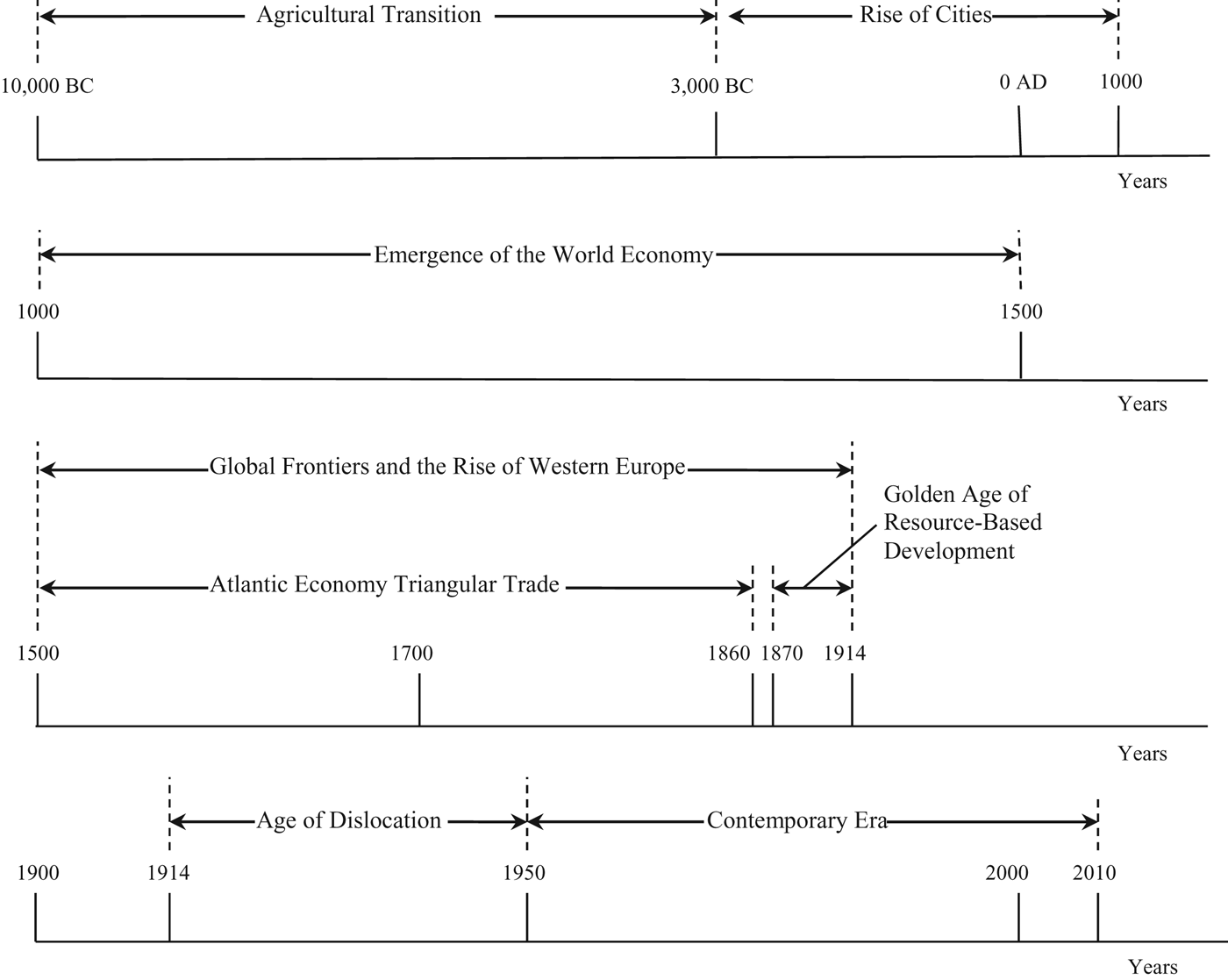
Third, our focus should not be just on contemporary environment and development problems. As David and Wright (Reference David and Wright1997: 204) have noted, ‘resource development is a neglected topic in economic history’. Unfortunately, EDE has largely ignored this topic too. Yet, over the past 12,000 years, there are eight historical epochs where economic development has been shaped by natural resource use (Barbier, Reference Barbier2011): the Agricultural Transition (10,000–3000 BC), the Rise of Cities (3000 BC–AD 1000), the Emergence of the World Economy (1000–1500), Global Frontiers and the Rise of Western Europe (1500–1914), the Atlantic Economy Triangular Trade (1500– 1860), the Golden Age of Resource-Based Development (1870–1914), the Age of Dislocation (1914–1950) and, finally, the Contemporary Era (1950 to present). As human history has progressed, these periods have evolved much faster (see figure 1). However, in all historical eras, economic development has been influenced by specific patterns of natural resource use and scarcity. In addition, the discovery, use and development of land and natural resources often coincided with the emergence of new regional or global economic powers. If we are to understand the economic implications of the environment–development relationships in the emerging Age of Ecological Scarcity, then we should examine more closely how natural resource exploitation has influenced economic development in past historical periods.
Key historical eras of resource-based development