In 1911 malt factory owner Ignatz Briess of Olmütz/Olomouc wrote a memoir to explain the nature of Jewish life in small town Moravia before the Revolution of 1848 to his children and grandchildren. He related that he had attended a German-Jewish Trivialschule, a German-language elementary school run by the Jewish community for Jewish children, in his home town of Prerau/Přerov in the late 1830s and early 1840s. At the school, the children had two to three hours of German subjects every morning; and at the end of every year, the state school inspector, a local priest, examined them on their studies. At the same time, Briess learned Hebrew, Bible, and Talmud in the cheder, the traditional Jewish school, for seven more hours every day. The cheder, he remarked, was just like those in Halbasien, that is, Galicia, or Eastern Europe.Footnote 2 Despite his reference to Karl Emil Franzos's negative evaluation of Galician Jewish life,Footnote 3 Briess described the chaotic conditions in the cheder positively and with considerable warmth. His father, a grain dealer and manager of a noble estate who had studied at the famous Pressburg yeshiva in Hungary and who read Goethe, Schiller, Shakespeare, Spinoza, Mendelssohn, and Kant in his spare time, made sure that his son received a thorough Jewish education.Footnote 4 The memoir, a nostalgic evocation of a vanished world, describes a Jewish community that was deeply pious, enmeshed in the world of Jewish religious tradition yet also influenced by secular, German-language culture, much of it expressed in Jewish terms. At his bar mitzvah in 1846, Briess gave a droschoh (a traditional learned discourse) for which the traditional rabbi helped him prepare, and a “German sermon,” on which he worked with his Trivialschule teacher.Footnote 5
Briess's experiences were probably typical of many Moravian Jews of his generation. He grew up in a traditional Jewish world, but he had learned German at the German-Jewish school run by the Jewish community, a school that in his day taught only secular subjects, not Jewish ones. These schools first opened when Austrian Emperor Joseph II, in his Edict of Toleration of 1781/82, ordered Jews in the Habsburg monarchy to learn German and to obtain secular education, either by attending Christian schools or by creating their own German-Jewish schools. Jews in Galicia and Hungary largely resisted Joseph's efforts to modernize and Germanize them, but rabbis in Bohemia and Moravia supported the new schools because in those provinces Jewish subjects would not form part of the curriculum. There was thus no chance that the Maskilim, the Jewish enlighteners whom the government usually hired for Jewish schools, would teach Judaism in a heretical way, and the German-Jewish schools, which provided useful instruction, were safe. Within a generation or two, the Jews of Bohemia and Moravia had become German-speakers, abandoning Western Yiddish for German, although of course many of them, especially those who lived in a Czech-speaking milieu, also knew Czech.Footnote 6 It is significant, however, that these Jews learned German language within a Jewish space. Indeed, for many Jews, German became and remained a Jewish language.
This article explores the role and significance of the German-Jewish schools of Moravia between 1848 and 1938 in order to understand the significance of the persistent attachment of Jews in this Habsburg, later Czechoslovak, provinceFootnote 7 to German language and culture. Unlike nearby Bohemia, where many Jews for political, practical, or ideological reasons increasingly identified with Czech language, culture, and political aspirations in the late nineteenth and early twentieth centuries, the Jews of Moravia remained loyal to German language and culture. Indeed, over three-quarters of all Jews in the province indicated on the census that German was their language of daily speech. In 1900, there were 44,255 Jews in Moravia, and 77.4 percent of them indicated German Umgangssprache. Ten years later, 77.7 percent of 41,158 Moravian Jews declared that German was their language of daily speech. By contrast, in Bohemia, two-thirds of Jews had declared German Umgangssprache on the 1890 census, but ten years later, in 1900, only 45 percent indicated German, and the majority, 55 percent, declared that Czech was their language of daily speech.Footnote 8 Czech nationalist activists deeply resented the Jews for their German loyalties in a province that they considered to be “Czech territory.” After all, according to the 1900 census, 71 percent of the Moravian population indicated Czech as their language of daily speech, only 28 percent German, and 6 percent Polish.Footnote 9 Because the nationalist activists regarded the language statistics as an accurate measure of the strength of their respective nations, language choice became one of the main battlegrounds in the nationality conflicts in Habsburg Austria. Umgangssprache was a problematic measure of national identity, ignoring as it did widespread bi-lingualism, national “in-between-ness,” and national indifference, but the nationalist activists nevertheless used it in their overheated political rhetoric to claim national rights and national territory.Footnote 10
The choices made by Moravian Jews in the late nineteenth and early twentieth centuries provide one more indication of the complexity and fluidity of ethnic and national allegiance in Habsburg Austria. The Jewish preference for German language and German schools did not mean that Jews had adopted a German national identity, even if Czech nationalists regarded Jews as agents of Germanization and equated Jewish language preference with anti-Czech and pro-Habsburg attitudes. The German-Jewish schools were not “outposts of Germanism in all-Czech areas” as some have claimed.Footnote 11 To be sure, the German-Jewish schools did inculcate loyalty to Habsburg Austria, but they ignored German nationalism and unlike most German schools taught Czech language to their students. Moreover, the Jews who ran these schools felt comfortable in their Czech-language milieu, even as they assumed that Jews spoke German. For them, German was the language they spoke, even a Jewish language. That is not to say that the Jews were simply the quintessential “in-between” group. They counted themselves part of the community of German-speakers, and the schools, located in an overwhelmingly Czech-speaking environment, publicly announced that Jews belonged to the German-speaking world. At the same time, since these schools were both German and Jewish, Moravian Jews demonstrated that there were self-imposed limits to Jewish participation in the German community. Moravian Jews were well integrated into German cultural institutions and German politics in the late Habsburg Monarchy, but at the same time they formed a separate German-Jewish group. The German-Jewish elementary schools were one of the markers of self-conscious Jewish separateness within the larger German world in the province.Footnote 12
Not all Jews attended German-Jewish schools, even if virtually all Jews in late Habsburg Moravia attended German-language elementary and secondary schools. No Jewish schools existed in most of the larger cities of Moravia, from which Jews had been excluded before 1848, including Brünn/Brno, Olmütz/Olomouc, Znaim/Znojmo, and Iglau/Jihlava. In those majority German-speaking cities, Jews attended local German public schools. The Jewish schools in Moravia were virtually all schools run by the so-called “political Jewish communities,” which administered their own public schools. Most of these political Jewish communities were located in market towns in largely Czech-speaking central and southern Moravia, although some were on the German-speaking Lower Austrian border. None were located in the regions of dense German concentration in northern Moravia, where few Jews lived. These German-language schools for Jews in largely Czech-speaking areas, attended by the vast majority of Jews in their towns, announced to everyone that Jews spoke German and as German-speaking Jews remained distinct from their Czech-speaking neighbors. The absence of large numbers of other German-speakers in the region also meant that German and Jewish could easily be viewed as coterminous categories both by the Jews and everyone else. It is therefore not surprising that Czech nationalists could view the schools as unnecessary outposts of Germandom in what they regarded as Czech territory.
The German-Jewish schools had originally been created by Jewish communities in the late eighteenth century, when the authorities allowed the Jews to live only in fifty-two towns in Moravia. Although Joseph II had deprived the Jewish communities of their traditional rights of self-government—that is, the right to live according to Jewish law—Habsburg authorities nevertheless allowed them to continue to exist as juridical entities, and they continued to be marked-off, visibly distinct sections of the cities in which they were located. After the Revolution of 1848 and the end of restrictions on freedom of movement in the 1850s, Jews were free to leave these fifty-two towns and settle anywhere. As a result, the Jewish communities of commercial and industrial cities like Brünn/Brno and Mährisch Ostrau/Moravská Ostrava grew rapidly, and the number of Jews in the old Jewish communities dwindled. Prosperous Jews left the confines of what had been called the “Jewish towns” and moved to other sections of the city in which they were located (or elsewhere), while poor Gentiles moved into former Jewish residences. In 1849, Habsburg authorities had tried to amalgamate the “Jewish towns” into the cities in which they were located, but intense opposition from those cities led the authorities in 1850 to maintain a separate legal status for the urban space previously inhabited by the Jewish community in twenty-seven of the towns to which Jews had earlier been restricted. These areas were called politische Israelitengemeinden, political Jewish communities, and they formed separate juridical entities within the towns in which they were located, being treated as separate towns for the purposes of elections and providing their own town services to their inhabitants, including police protection, tax collection, and public elementary schools, which were Jewish schools.Footnote 13
Before 1890, these political Jewish communities also provided Jewish religious services to their Jewish inhabitants in their role as Jewish religious communities for Jews in their vicinities. In that year, the Austrian authorities deemed that only Israelitische Kultusgemeinden, Jewish religious communities, should provide religious services. Such religious communities already existed in cities with new Jewish settlement and in former Jewish towns that were not political communities. Now only Israelitische Kultusgemeinden (IKGs) provided religious services to all Jews, including those in political Jewish communities, thus depriving political Jewish communities of their religious function and creating separate institutions for that purpose.Footnote 14 In Prossnitz/Prostějov, for example, the Israelitische Kultusgemeinde ran synagogues, hired rabbis, provided for kosher food, and managed the cemetery for all Jews, those in the political Jewish community and those in the larger city, while the political Jewish community provided town services to everyone within its borders and ran a German-Jewish public school for its own inhabitants, as well as any Jews in the city who wanted to attend. Because these schools became the public schools of the political Jewish communities, they continued to exist into the twentieth century.
Most studies ignore the fact that Jewish schools persisted in Moravia until the end of the Habsburg Monarchy. They take the decline of the German-Jewish schools in Bohemia as paradigmatic for the Bohemian Lands in general. In Bohemia, the old network of German-Jewish schools, which were private confessional schools, had largely disappeared by the 1890s. They fell victim to urbanization and to pressure from the Czech national movement and from the Czech-Jewish movement, which wanted the Jews to Czechify and worried that German-Jewish schools exacerbated Czech nationalist anti-Semitism. Moreover, there were no political Jewish communities in Bohemia.Footnote 15 In Moravia, however, these schools continued to exist, and most political Jewish communities administered German-Jewish schools until the end of the monarchy.Footnote 16 Their status as public schools of the political Jewish communities made them impervious both to Czech nationalist and to Czech-Jewish pressure, which was weaker in Moravia than in Bohemia. As a result, these schools played an important role in Jewish life, announcing the existence of a separate German-Jewish group, until closed by the Czechoslovak government in 1919/20, after it dissolved the old “political Jewish communities.”Footnote 17
This article will focus on the German-Jewish elementary schools run by three political Jewish communities in late Habsburg Moravia: Prossnitz/Prostějov, Prerau/Přerov, and Leipnik/Lipník. I chose these three schools as a sample because they were all typical German-Jewish schools located in overwhelmingly Czech-speaking central Moravia, but they were not exactly the same. The cities in which they were located differed in size, economic significance, linguistic composition, and the degree to which Czech nationalism played an important role in local politics. Moreover, the Jewish communities varied in size and degree of Jewish religious traditionalism. In addition, these schools were large enough to have generated significant records, and, more importantly, these records still exist and are easily accessible in the archives of the Jewish Museum of Prague.Footnote 18 To be sure, this study would have benefitted from an analysis of the German-Jewish school of Nikolsburg/Mikulov, the largest political Jewish community, located in a German-speaking region near the Lower Austrian border, but its records from the second half of the nineteenth century are no longer extant. Records also no longer exist for other interesting communities, including Trebitsch/Třebíč, a large political Jewish community that ran both a German- and Czech-language Jewish school, and Holleschau/Holešov, a town that experienced Czech nationalist violence against Jews.Footnote 19 Nevertheless, the fact that schools in the three somewhat different communities under analysis here resembled each other allows me to conclude that these schools were representative of all the German-Jewish schools.
Prossnitz/Prostějov was a textile- and clothing-manufacturing center in central Moravia, with a relatively large Jewish community, many of whose richer members dominated the clothing industry.Footnote 20 In 1900 the city contained 24,054 people, of whom 987, or 4.1 percent, were Jews. In addition, the juridically separate Prossnitz/Prostějov politische Israelitengemeinde contained 1,412 people, of whom 566 (40 percent) were Jews. The Jews, most of whom probably used German as their primary language, lived in a city that was almost entirely Czech-speaking. In 1900, 94.8 percent of the residents of Prossnitz/Prosějov city indicated Czech as their language of daily speech on the census, and about half of the residents of the political Jewish community did so as well. Since the city and the political Jewish community contained 1,660 German-speakers and 1,553 Jews, it stands to reason that most of the city's German-speakers were Jews. The city was located in an overwhelmingly Czech-speaking administrative district (Bezirkshauptmannschaft), 97 percent of whose population listed Czech language, and only 3 percent German. Jews, who formed 2 percent of the district population, virtually all of whom (1,553 out of 1,565) lived in the city, may have accounted for the overwhelming majority of German-speakers in the district, since there were only 1,838 of them, although of course some Jews may have indicated a Czech language preference on the census.Footnote 21 The city was not especially attractive. Antoinette Kahler, the daughter of a prosperous wool textile manufacturer in Brünn/Brno, condescendingly described Prossnitz/Prostějov, where her sister had moved after her marriage to a clothing factory owner, as having a “filthy, hostile, foreign-language atmosphere.” Not only was it muddy and ugly, but it also contained a large, poorly paid Czech-speaking proletariat for whom anti-capitalist sentiment mixed with national hatred, she remembered.Footnote 22 Indeed, Czech nationalism, based on artisan resentment of “German” merchants and factory owners, played an important role in the city from the 1860s onward.Footnote 23
Prerau/Přerov and Leipnik/Lipník were smaller, less economically dynamic towns in central Moravia with fewer Jews. In 1900, 16,727 people lived in the city of Prerau/Přerov, including 404 Jews (2.4 percent), and 278 lived in Prerau's political Jewish community, including 118 Jews (42.4 percent). Prerau/Přerov, a city on the intersection of several rail lines, was overwhelmingly Czech-speaking. In 1900, 95.6 percent of the city indicated Czech Umgangssprache on the census, and 53.2 percent of the inhabitants of the political Jewish community did so as well. The city was located in an almost totally Czech-speaking district, 99 percent of whose population indicated Czech as their language of daily speech on the 1900 census. There were 941 Jews in the district, 55 percent in the city, and almost all of the rest in two former “Jewish towns” that had not become political Jewish communities, Kojetein/Kojetín (198 Jews) and Tobitschau/Tovačov (133). Since there were only 893 people in the entire district who indicated German Umgangssprache on the census, it stands to reason that most of the German-speakers in the area were Jews in these three towns, although of course some Jews may have indicated a preference for Czech.Footnote 24
Leipnik/Lipník was a small town, and its population was more linguistically mixed than the other two cities. In 1900, the municipality contained only 5,881 people, including 240 Jews (2.4 percent), and Leipnik/Lipník's political Jewish community contained 1,005 people, of whom 294 were Jews (29.3 percent). Even if all Jews indicated German language on the census, they were not the only German-speakers in town. The city of Leipnik/Lipník was 78.3 percent Czech-speaking and 19.6 percent German-speaking, according to the 1900 census, and in its political Jewish community Czech-speakers accounted for 53.3 percent of the population and German-speakers 45.6 percent.Footnote 25 Leipnik/Lipník was not a district capital like Prossnitz/Prostějov or Prerau/Přerov, but it was the largest city in the court district of Leipnik, located in the administrative district of Mährisch Weisskirchen, which was linguistically mixed. According to the 1900 census, 76.8 percent of the residents of that district indicated Czech as their language of daily speech, and 22.9 percent indicated German. Jews did not form the majority of German-speakers in this district, which had 12,794 German-speakers and only 1,050 Jews, most of whom (apart from those in Leipnik/Lipník) lived in the city of Mährisch Weisskirchen/Hranice (305) and in its political Jewish community (157).Footnote 26
In order to understand more fully the significance of German-Jewish schools in Moravia, this article will also analyze one other kind of Jewish school, a private Jewish school with public-school accreditation, run by the Jewish religious community in Mährisch Ostrau/Moravská Ostrava, a coal mining and steel manufacturing city in northeastern Moravia, on the Silesian (today Polish) border, called by one memorist, “the Moravian Pittsburgh.” It was, Joseph Wechsberg recalled, like an aggressive border town or an American city, containing “smart wheeler-dealers, elegant coffeehouses, attractive whores, admired embezzlers,” and much coal dust. It was also a “buoyant, mirth-loving, alive city,” filled with shops, cabarets, and theaters.Footnote 27 This city of 30,016 people in 1900 boasted 3,272 Jews, who formed 10.9 percent of the total population. No linguistic group formed a majority in this city. On the 1900 census, 42.4 percent of the population listed Czech as their language of daily speech, 33.4 percent German, and 20.8 percent Polish. Even if all the Jews listed German language on the census, which they probably did not, they only accounted for a third of all German-speakers in the city. Mährisch Ostrau/Moravská Ostrava was located in a linguistically mixed Bezirkshauptmannschaft, 55 percent of whose population indicated Czech Umgangssprache, 29 percent German, and 16 percent Polish.Footnote 28 Indeed, Wechsberg loved the linguistic mix of the town. He recalled in his memoirs: “Linguistically my home town was a complex place. The Czechs spoke Czech, the Poles spoke Polish, the Germans spoke German, the Jews spoke Czech at the tax-collector's office or in court and German among themselves…. Some people used Wasserpolakisch with their servants. ‘Watered-down Polish’ was bowdlerized German that sounded like Czech…. It was the pure expression of linguistic tolerance.” He and his friends–Chacharen (rascals) in the local dialect—used it in their written messages, he noted, as did nightclub comedians when they needed a laugh.Footnote 29
The Jewish school in Mährisch Ostrau/Moravská Ostrava was large, and from the 1860s onward, it provided elementary education for a significant number of the Jews in the city and its suburbs, including Wechsberg. Unlike the German public schools of the political Jewish communities, which the Czechoslovak government either closed or folded into the local school systems in 1919/20, this private school continued to be a German-Jewish school until 1936, when it switched its language of instruction to Czech. By that time, the city had incorporated many of its largely Czech-speaking suburbs and now contained 125,304 people, of whom 6,865 (5.5 percent) were Jewish. According to the 1930 census, which counted “nationality,” not language of daily speech, 79 percent of the Czechoslovak citizens in the city indicated Czechoslovak nationality, 18.6 percent German, and 1.9 percent Jewish nationality, approximately one-third of all Jews.Footnote 30 Jewish attendance at this school illuminates the extent to which Jews chose to announce that German-speaking Jews formed a separate group on the urban scene in both Habsburg Austria and in Czechoslovakia. I chose to study the Jewish school in Mährisch Ostrau/Moravská Ostrava rather than the Zionist schools established after World War I in Brünn/Brno,Footnote 31 not only because the latter's records no longer exist, but also because the former school existed in the two different political contexts and thus can help us understand the role of German-Jewish schools more fully.
Prossnitz/Prostějov
The German public elementary school in the pre-World War I Prossnitz/Prostějov political Jewish community clearly functioned to provide the Jewish children of the political Jewish community, as well as the city of Prossnitz/Prostějov, with a German-Jewish education, but one that also unself-consciously acknowledged the Czech-language environment of the region. Already by 1865, the curriculum of the four-grade elementary school, now called a Hauptschule, Footnote 32 included not only German reading and writing, arithmetic, nature, “love of fatherland,” penmanship, singing, and drawing, the standard curriculum of an Austrian elementary school with German language of instruction, but also three hours a week of Czech language from second grade on, taught by the regular classroom teachers. These teachers also provided instruction in Jewish subjects two hours every day, including Hebrew language, Bible, and “religion,” and they received extra pay for the extra work. In addition, students in the upper grades learned Talmud, taught by the school's head teacher and paid for by the Jewish religious community. Obviously, by the 1860s, rabbinic opposition to using the German-Jewish schools to teach Jewish subjects, first articulated when Joseph II ordered the establishment of such schools in the late eighteenth century, and still true in the 1830s when Briess attended school, had withered away. The school, which united the old German-Jewish school with a Talmud Torah school, established in 1838 to provide a relatively modern Jewish education, provided a Jewish education that emphasized Bible stories, Jewish religious tenets, as well as Hebrew language and familiarity with the daily, Sabbath, and holiday prayers, rather than intensive text study of the Torah with rabbinic commentary, which had been the traditional cheder curriculum. Some elements of tradition remained. Girls were “completely free” from Hebrew language instruction, except for learning prayers, and they also received training in needlework.Footnote 33
At this point, before the sweeping changes introduced by the Liberals in 1869, the school was a private Jewish confessional school. Financial responsibility for the school was divided between the political Jewish community and the Jewish religious community of Prossnitz/Prostějov, with the latter charging tuition (or else releasing impoverished students from the obligation to pay), paying teachers’ salaries, and covering instructional expenses, and the former paying for heating, cleaning, and repairs.Footnote 34 The authorities did not allow classes on Sunday, which the school might have liked in order to make up the time lost on Saturday when there were no classes, so the school added extra hours during the week for some students.Footnote 35
The status of the school changed after the Liberals came to power in 1867. Liberal legislation permanently took control over education from the Catholic Church, and, in the case of the German-Jewish schools, from the “religious” Jewish community. Thus, what had been a confessional school became a four-class public elementary school of the political Jewish community in 1869, under the supervision of the local, regional, and central school boards, which regularly monitored curriculum, teacher and student behavior, and attendance.Footnote 36 These boards only concerned themselves with the standard curriculum of German-language schools: German reading and writing, arithmetic, geometry, drawing, penmanship, natural history, history, singing, religion, and needlework for girls.Footnote 37 The Jewish political community ran this elementary school, and it remained a German-Jewish school, although it was no longer called by that label. Instruction in Hebrew and Bible continued, but this instruction was considered “private instruction” or “non-obligatory instruction,” offered after regular hours, and parents had to request it and pay a fee. The Israelitische Kultusgemeinde paid the expenses of such instruction and supervised it, as it did the two weekly hours of “religious instruction” for Jewish children in all public schools, including the public school of the political Jewish community. Hebrew instruction, which now began in the second half of the first grade for girls as well as boys, was generally the task of the classroom teachers, as was Czech-language instruction in grades three and four. Both languages were technically nonobligatory, but all students studied them.Footnote 38 The financial arrangements were different than before 1867. Now teachers’ salaries were directly paid by the government, and most of the other costs were paid by the political Jewish community, with the Jewish religious community providing a regular subsidy and free prayer books, Hebrew primers and readers, Bibles, and books of biblical history to poor children.Footnote 39 Until the collapse of the Habsburg monarchy in 1918, therefore, the political Jewish community ran a German public elementary school, which provided Czech-language instruction, and the Jewish religious community helped pay for the Jewish curriculum.
The school may have been classified as an ordinary public school, but everyone regarded it as a German-Jewish school. Certainly its teachers and the men who ran both the political and the religious Jewish community of Prossnitz/Prosějov continued to regard it as a Jewish school. In July of 1878, for example, the head teacher, Bernhard Weiner, wrote to the board of the political community seeking approval for a decision of the teachers to take the school children to the synagogue on all Saturdays and Jewish holidays “to participate in religious services in the Temple.”Footnote 40 In 1893, the school celebrated the end of the school year on 29 July with a religious service in the synagogue.Footnote 41 In the early twentieth century, Zionists lauded the schools of the political Jewish communities as German-Jewish schools that inculcated “love of [the Jewish] people, love of the old homeland [the Land of Israel], and Jewish national self-consciousness.”Footnote 42 Zionists exaggerated. These schools concerned themselves with Jewish religion, not nationalism. At the same time they provided their students with Jewish education and a Jewish social context, or, in the words of historian Michael Miller, a sense of “Jewish territory.”Footnote 43 Thus, Jews associated German language with Jewish space.
The school provided a richer Jewish studies curriculum than was possible in the two hours a week of religious instruction in the regular public schools. The Hebrew-language curriculum of 1888 stipulated two hours of Hebrew per week. Instruction used a Hebrew primer and translation of blessings in grades one and two, moving in grades three and four to reading and translating from the prayer book and working on Hebrew language skills in a reader, Limudei Sha'ashuim, prepared by the Moravian-Silesian Israelite Teachers’ Association.Footnote 44 In 1893, obviously not satisfied with this fairly meager curriculum, the teachers approved a fuller curriculum that in the first grade included learning Hebrew vocabulary to prepare for higher level studies, moving on in grades two, three, and four to reading and translation from a Hebrew reader and from the prayer book, beginning with the daily prayers, and continuing with the Sabbath liturgy.Footnote 45 What is noteworthy is that girls received the same instruction in Hebrew as the boys, which was not the case in the minimal Jewish religious instruction in the regular public schools.Footnote 46 There boys obtained some rudimentary ability to read Hebrew, but not girls. Obviously, parents who wanted a better Jewish education for their daughters sent them to the Jewish school. In addition to the enriched Jewish studies curriculum, students at the Jewish school received the standard public school two-hours of Jewish religious instruction a week, which included the tenets of Judaism, Bible and biblical history, and Jewish ethics.Footnote 47
Jews in Prossnitz/Prostějov sent their children to this German-Jewish school for many reasons. It provided a German-language education in an overwhelmingly Czech-speaking city to Jews who preferred German instruction.Footnote 48 Moreover, since the city was a center of Czech nationalist agitation, many Jews might have sought to escape anti-Czech attitudes in the local German school. Most importantly, Jews enrolled their children in this school because it was Jewish. Whether they lived in the political Jewish community or in Prossnitz/Prostějov city, many Jews preferred to send their children to the Jewish school.
Contrary to the assumptions made by scholars, all of the students in this school were Jewish, at least before the turn of the century. Despite the fact that the Jewish population within the boundaries of the political Jewish community was dwindling, and the number of (mostly poor) Catholic residents had grown, until around 1900 the school, like virtually all such schools, contained only Jewish students.Footnote 49 In a letter of 1896 to the Jewish religious community, the political Jewish community noted that since it had become a public school in 1869, there were “only students of Jewish religion” at the school of the political community.Footnote 50 Similarly, in an 1898 printed appeal to Jews in Prossnitz/Prostějov for funds to build a new schoolhouse to replace one that no longer met hygienic standards, the signatories—the mayor and the chair of the school board of the political Jewish community, the chair of the Jewish religious community, and the head teacher of the school—noted that “the children of the Christian population [of the political Jewish community] attend, almost without exception, the schools in the city,” while many Jewish families in the city “send their children to our school, the school in the Israelitengemeinde.” The school was not a confessional school, they noted, but rather a school attended “in fact by all local Jewish children,” whether they lived in the Jewish political community or in the city.Footnote 51
This impression is absolutely borne out by the registration records of the elementary school of the Prossnitz/Prostějov political Jewish community. In the 1864/65 school year, 227 students attended the school, including 151 boys and 76 girls, all Jews. Their fathers practiced traditional Jewish occupations in commerce, trading (or peddling) in agricultural products or textiles, while some of them were artisans or innkeepers.Footnote 52 Ten years later, the school contained 205 students, including 102 boys and 103 girls, all of them Jewish. Their fathers (and sometimes mothers) practiced similar occupations as ten years earlier. The only children with professional parents were the children of the local rabbi.Footnote 53 It is interesting that when the school was a confessional school, fewer girls than boys attended, but once the school became a regular public school with mandatory attendance, equal numbers of boys and girls attended. In 1884/85, the school contained 205 students, 109 boys, and 96 girls, all Jews.Footnote 54
By the mid 1880s, the Prossnitz/Prostějov political Jewish community contained many Catholic children, but all of them attended schools in Prossnitz/Prostějov city, whereas some of the Jewish children in the city attended the German elementary school run by the political Jewish community, thus making it the “Jewish” school. In the school year 1885–86, there were 262 children resident in the Israelitengemeinde required by Austrian law to attend public school. Of those eligible for elementary school, 123 were Jews and 105 Catholics. All of the Catholic children and eight of the Jewish children attended an elementary school in Prossnitz/Prostějov city, not the public school of the political Jewish community. That school contained 193 children, most of the Jewish children in the Israelitengemeinde plus 76 Jewish children from Prossnitz/Prostějov city who transferred in.Footnote 55 Similarly in 1890/91, 256 school-age children lived in the Israelitengemeinde, 123 Jews and 133 Catholics. Only 79 of the total went to their local elementary school. The others transferred to schools in Prossnitz/Prostějov city, while 65 children from the city attended school in the political Jewish community.Footnote 56 Thus, an interesting transfer took place in Prossnitz/Prostějov. Wherever they lived, Jews (although not all Jews) attended the “Jewish” school in the Israelitengemeinde, and non-Jews who lived in the Israelitengemeinde eschewed the Jewish school and attended school in Prossnitz/Prostějov city. Not all Jews attended the “Jewish” school, but all non-Jews avoided it, presumably because it seemed “Jewish.” Jews who lived in the Israelitengemeinde and attended other schools virtually all attended German schools. Interestingly, and in contrast to the Czech nationalist narrative, most of the Catholics who transferred out went to German-language schools in the city. Thus in 1890–91, of the 128 Catholics who transferred out of the Israelitengemeinde school to schools in Prossnitz/Prostějov city, 87 attended German schools and only 41 attended Czech ones.Footnote 57 At the same time, the majority of all Jewish school-age children in the entire Prossnitz district attended the Jewish school in the political Jewish community.Footnote 58
With the passage of time, the number of Jewish children living in the political Jewish community declined steadily. In 1894–95, there were 216 school-age children, of whom 88 were Jewish and 132 Catholic. Virtually all of the Catholics (130) attended school in Prossnitz/Prostějov city, 40 of them in Czech elementary schools and 90 in German ones. Yet the school of the Israelitengemeinde contained 139 children, 52 from its boundaries and 87 who came from Prossnitz/Prostějov city.Footnote 59 According to the registration lists from that year, the school contained 84 boys and 62 girls (148 altogether), all of whom were Jewish.Footnote 60 Interestingly, the school was not a place just for poor Jews. Indeed, the 1894/95 students came from a somewhat more prosperous background than had been true ten years earlier. Although most of the fathers were merchants at various income levels and some were artisans, there were now a noticeable number of factory owners, high level white-collar employees, many of them in the textile or clothing factories of the city, and even professionals, especially doctors. Ten years later, in 1904–05, the Prossnitz Israelitengemeinde contained 207 school-age children, including 68 Jews and 139 Catholics. Virtually all the Catholics transferred to schools in Prossnitz/Prostějov city, including 73 to Czech-language elementary schools and 61 to German-language ones (plus several to higher-level schools), thus finally tipping the scales in favor of Czech-language education, the result either of growing Czech national identity or Czech nationalist pressure. The elementary school of the Israelitengemeinde contained 135 students, only 50 students from within its borders, plus 85 who transferred in from Prossnitz/Prostějov city.Footnote 61 In that year, the school did contain eight Catholic children.Footnote 62 The school now contained 70 percent of all the Jewish school-age children in the Prossnitz district.Footnote 63
In the last decade before World War I, this pattern persisted, with the only change the increased number of Catholic children who transferred to Czech-language (rather than German-language) schools in Prossnitz/Prostějov city. The new popularity of Czech education might reflect growing Czech national sentiment, or the fact that the Lex Perek, the school provision of the Moravian Compromise of 1905, allowed the newly created separate Czech- and German-language school boards to “reclaim” children for their “nations.” As a result of the Lex Perek, the Czech school boards plucked children whom they considered “Czech” from German schools. Fear of reclamations and the need to “prove” German nationality in order to attend German schools might have convinced many parents to send their children to Czech-language schools.Footnote 64 In the 1910–11 school year, 188 children of school age lived in the Prossnitz/Prostějov Israelitengemeinde, 55 of them Jewish and 133 Catholic. Virtually all the Catholics transferred to elementary schools in Prossnitz/Prostějov city, 97 of them to Czech-language schools and only 7 to German-language schools. The “Jewish” school now had 157 students, of whom 68 came from the territory of the Israelitengemeinde and 89 from Prossnitz/Prostějov city.Footnote 65
In the first year of World War I, 1914/15, the elementary school in the Israelitengemeinde grew because of the presence of many Galician Jewish refugees in the area. Most Catholic children, however, continued to transfer to Czech-language elementary schools in Prossnitz/Prostějov city. In that year, the political Jewish community contained 211 school-age children. Of these, 140 transferred to elementary schools in the city, 9 Jewish children to German schools and 131 Catholics, of whom 123 went to Czech-language schools and only 9 to German ones. The Volksschule of the political Jewish community contained 166 students, of whom only 57 lived in the Israelitengemeinde and 109 transferred in from Prossnitz/Prostějov city, but now 25 percent or 42 children—22 boys and 20 girls—were Catholic. By the end of that school year, the student body, now containing 177 students, contained 55 Jewish refugees from Galicia and Bukovina, 31 percent of the total.Footnote 66 Only in the last year of its existence (1919/20) did the Prossnitz/Prostějov political Jewish community's school contain a substantial number of Catholic students. In that year, the Israelitengemeinde contained 196 school-age children, of whom 144 (73.5 percent) were Catholic. Most of the Catholics (94 percent) transferred to the Czech-language elementary school in Prossnitz/Prostějov city, leaving 53 children in the Israelitengemeinde school, of whom 28 were Jewish and 23 Catholic.Footnote 67
The teachers at the German school of the political Jewish community were also Jewish. Jewish faculty made the school highly unusual in Habsburg Austria where de facto discrimination meant that very few Jews attended teacher training institutions or became public school teachers.Footnote 68 In the 1890s, Bernhard Weiner, Eduard Blitz, Moritz Mahler, and Emanuel Metzel served as teachers in the school, where they had been on the faculty for decades.Footnote 69 Only in the early twentieth century did non-Jews join the faculty. In 1903, the school hired Josef Nawratil to replace the retired Moritz Mahler.Footnote 70 Since he could not provide Jewish religious and Hebrew instruction to the students in his class, as had been the norm, another teacher provided that instruction, while Navratil taught gymnastics to all grades, and singing or Czech in some grades. Catholic children received Catholic religious instruction from a church-appointed special teacher, who, beginning in 1911, came to the school two mornings a week.Footnote 71 In 1910, the school hired a second non-Jewish teacher, Ludmila Smejkal, who likewise did not teach the Jewish subjects.Footnote 72
The Prossnitz/Prostějov German-Jewish school was devoted to German language and culture, but such devotion mostly entailed concern for Enlightenment and liberal ideals and Austrian state and dynastic patriotism, not German nationalism. Indeed, none of the school records show any glorification of things German. German was simply the language of instruction, a utilitarian language, even a Jewish language. The teachers’ library, which contained over 500 volumes, clearly reflected these attitudes. Between the late 1860s and the early twentieth century, this library for elementary school teachers included works by Kant, Schleiermacher, Plato, Descartes, Hegel, Spinoza, Locke, Rousseau, and Leibniz, as well as works on pedagogy, German literature, science, nutrition, health, history, and geography, along with pedagogical journals. It also contained German school books, as well as a large number of books on Judaism, Hebrew language, Bible, and Jewish history. All of the books were in German. The small number of history books included biographies of Austrian Emperor Joseph II, obtained in the 1870s, before German nationalists used him as a German icon, and thus only signifying Jewish admiration for the emperor who had lifted many anti-Jewish restrictions.Footnote 73 School records reveal only one German festival, the 7 May 1905 celebration of German poet Friedrich Schiller, which provided an opportunity to celebrate the values of the German Enlightenment.Footnote 74
To be sure, the school was a German school, and it often used the facilities of the Deutsches Haus, the center of German cultural life. Before the new schoolhouse was built, the school used the gymnasium at the Deutsches Haus for physical education classes.Footnote 75 The school also used the Deutsches Haus for some school festivities, including a fund-raiser and celebration in June 1912.Footnote 76 Yet the school considered itself more Jewish than German. In 1901, the Prossnitz/Prostějov school board suggested merging its German elementary school with the school of the Israelitengemeinde. Not only did the local Jewish nationalist organization, the Jüdischer Volksverein, protest, urging the representative of the Jewish religious community on the school board to oppose the measure, but it also suggested that the other German school focus less on national issues and more on “cultural and educational (bildungsfreundlich), that is practical, concerns” (presumably like the Jewish school).Footnote 77 The school continued to exist, probably because the Israelitengemeinde convinced the local school board that it was necessary and that the numbers warranted it. After the creation of separate German and Czech school boards in Moravia following the Moravian Compromise of 1905, the Jewish school became part of the German school system in the province, although relations with the German school board for the Olmütz/Olomouc region were a bit strained, probably because the school did not conform to the board's bureaucratic expectations of a proper German school. In November 1909, the district school board expressed discomfort with the fact that the Jewish school offered Hebrew-language instruction, even if such instruction was nonobligatory. The local bureaucrats allowed Hebrew instruction, since permission had already been granted by higher authorities, but they insisted that such instruction take place only if parents really wanted it and entrance to middle school was not contingent on grades in Hebrew.Footnote 78 Despite strains, teachers attended district and provincial (German) public school teachers’ conferences,Footnote 79 and the German school board for the Olmütz/Olomouc region provided ordinary bureaucratic oversight.Footnote 80
The Prossnitz/Prostějov German-Jewish school was far more Austrian than German. It celebrated Kaiser Francis Joseph's name day (4 October) every year.Footnote 81 It also warmly celebrated the 60th jubilee of his reign in 1908, with a solemn ceremony on 2 December, during which two children from the lower grades walked around with a picture of the kaiser, and two children from the upper grades with the official memorial volume, 60 Jahre auf dem Kaiserthrone. The head teacher made a speech, and students declaimed readings about the kaiser, including one entitled, “The Kaiser is a Dear Man.” Finally, one girl in each class presented gifts for the emperor, someone placed a wreath on the bust of the kaiser, and everyone sang the usual patriotic concluding hymns.Footnote 82 Virtually every school celebration included prayers for the kaiser and poems and songs like “Mein Österreich,” “Österreicher bin ich,” and the Volkshymne.Footnote 83 While all elementary schools in Cisleithanian Austria emphasized Austrian patriotism and loyalty to the emperor, they also encouraged students to identify with their own linguistic group and nation.Footnote 84 The Jewish schools, however, emphasized Austrian loyalties and paid little attention to German nationalist concerns.
The best example of how the school mixed Austrian patriotism and Enlightenment values in a Jewish key was the program for the dedication of the new schoolhouse in 1904. As early as 1898, the political Jewish community wanted to build a new schoolhouse since hygienic conditions in the old one were not good. Because most inhabitants of the Israelitengemeinde were poor, it appealed to Jews in Prossnitz/Prostějov city, as well as Prossnitz Jews who had migrated elsewhere, to contribute funds, an effort that would honor Francis Joseph's 50th jubilee, a testimony to Jewish love of the emperor, as well as “the continuing power of our old Jewish traditions.”Footnote 85 The dedication of the new schoolhouse, held on 17 September 1904, included the singing of Mendelssohn's “The Honor of God” by the German Singing Club, speeches by the mayor of the Israelitengemeinde and by Head Teacher Bernhard Weiner, as well as several songs sung by all in attendance, including the Kaiser Franz Joseph Lied and the Volkshymne.Footnote 86 Weiner's speech, printed as a pamphlet, emphasized the school's goal to work for human brotherhood and enlightenment, morality, and compassion, as well as for the moral, physical, and intellectual development of each child. Weiner criticized those who wanted to politicize education and infuse it with nationalism. By contrast, the school of the Prossnitz/Prostějov Israelitengemeinde concerned itself above all with ethical education and love of Fatherland. Turning to the children, he told them to pursue enlightenment and understanding, so that they could be virtuous human beings, practicing brotherly love, free from prejudice and hate. They would also become good citizens, “counted among the most trustworthy supporters of our Fatherland, our beloved Austria, so richly blessed in all the gifts of nature by God.” Weiner concluded by wishing Francis Joseph long life for the benefit of “all his peoples and the whole Fatherland.”Footnote 87
German Enlightenment culture and Austrian state patriotism allowed the school to be positive toward Czech language and culture. As we have seen, the school had taught Czech language since the 1860s,Footnote 88 which was not common for German elementary schools in the Bohemian Lands. Indeed, unlike the situation in most German schools, which rarely offered Czech-language instruction, all students studied Czech, presumably because they understood the benefits of learning that language and did not harbor any nationalist-inspired hostility to it.Footnote 89 Moreover, the mayor of the Prossnitz Israelitengemeinde for many years, Albert Trieschel, a member of the German Club in the Moravian Diet from 1879 to 1885, devoted himself to Czech-language education in Prossnitz/Prostějov city, serving for twenty-four years as a member of the district school board, helping to establish Czech-language schools.Footnote 90 It is hard to tell, however, how those who ran the school greeted the establishment of Czechoslovakia in October 1918. They duly noted the creation of the Republic but did not comment on it.Footnote 91
Shortly thereafter, in 1919, Czechoslovakia, run as it was by triumphant Czech nationalists, eliminated the political Jewish communities, which they had long regarded as troublesome bastions of German influence in local politics. At the same time, the German public schools run by those Israelitengemeinden were either eliminated or folded into local German schools. In the fall of 1919, the Czechoslovak authorities combined the German schools in Prossnitz/Prostějov city with the one in the former political Jewish community into one school. The head teacher of the “Jewish” school, Josef Nawratil, its first non-Jewish teacher, protested in vain. The Jewish religious community protested as well, upset that the authorities had taken over the Jewish school building, which was their property. Prossnitz/Prostějov Jews had no choice but to give up the Jewish school, but they retained the building, which they later leased to the city.Footnote 92 In interwar Moravia, separate “Jewish” public schools no longer existed.
Prerau/Přerov and Leipnik/Lipník
The records of the public school in the political Jewish community in Prerau/Přerov are not as extensive as those for Prossnitz/Prostějov, yet that school, too, was a German-language public school for Jewish children that taught Jewish subjects as well as the Czech language.Footnote 93 Prerau/Přerov's school was much smaller than the school in Prossnitz/Prostějov, reflecting a smaller and shrinking Jewish population. In 1882 the school went from two classes to three, returning to two classes in 1885, but becoming a one-class school in 1890/91,Footnote 94 with all four elementary school grades in one classroom. The political Jewish community paid for most expenditures of the school, while the Israelitische Kultusgemeinde provided regular subventions to cover Hebrew-language instruction, often obtaining this money from the Moravian Jewish Landesmassafond, a special fund created in the eighteenth century from Jewish taxes that served in the nineteenth century to help subsidize poor Jewish communities and their schools.Footnote 95 Here as elsewhere the district school board took 12 percent (later 15 percent) of the political Jewish community's tax revenues to help pay teachers’ salaries.Footnote 96
Virtually all the students in the Prerau/Přerov school were Jewish until the early years of the twentieth century. In 1888 the school contained 100 children, of whom 99 were Jewish and one was Protestant. In 1905, there were 3 Catholic children in the school, who received Catholic religious instruction in the elementary school in Prerau/Přerau city.Footnote 97 Just as in Prossnitz/Prostějov, most of the children in the school did not live within the borders of the Israelitengemeinde but transferred in from what local authorities called the Christengemeinde. In the 1887/88 school year, the school contained 100 students: only 17 from the Israelitengemeinde, 5 from a nearby small town, and 78 from Prerau/Přerov city.Footnote 98 That number represented virtually all the Jewish children in town, and most of those in the entire district.Footnote 99
The political Jewish community regarded the school as Jewish space. Indeed, in the late 1870s and early 1880s, the Austrian authorities, horrified on aesthetic, sanitary, and pedagogical grounds, regularly admonished the Israelitengemeinde for allowing kosher slaughter in the schoolhouse garden and ordered it to stop the practice.Footnote 100 In late 1882, the authorities threatened a 50 florin fine if the Jewish political community did not abandon the practice within eight days. After all, to slaughter animals in the vicinity of a school was “totally forbidden.”Footnote 101 The frequency of the admonition reflected the fact that the political Jewish community ignored the authorities until they could no longer do so. Finally, in an obvious compromise in June 1883, the Bezirkshauptmann ordered the Jewish political community not to conduct kosher slaughter in the school garden between the hours of 7 a.m. and 5 p.m., permitting it at other times only behind a wooden partition and following sanitary guidelines.Footnote 102 The absence of further correspondence suggests that the political community complied. Indeed, in late 1884, the Jewish religious community was looking for another location for kosher slaughter in combination with a dwelling for the kosher slaughterer.Footnote 103 In any case, the school functioned as a Jewish school, and children attended Sabbath services together under the supervision of their teachers.Footnote 104
The school was also a German school. In 1881, the newly created German School Association, which supported German schools in mixed linguistic areas, offered the school a subvention of 600 florins.Footnote 105 This subvention did not continue. Already in 1884, the political community asked the IKG to provide a 150 florin subvention to cover a teacher's salary because the Deutscher Schulverein, which had previously donated this amount, was no longer doing so.Footnote 106 Support from the German School Association ended primarily because the Jewish school was a public school, and the Deutscher Schulverein reserved its funds for schools in areas where there were insufficient German-speaking children for a public school. While not anti-Semitic, the association was nevertheless skittish about supporting Jewish schools and only did so if they inculcated German nationalism and were the only available German school for Christian children in an area.Footnote 107 Most Jewish schools, located in overwhelmingly Czech-speaking towns whose residents avoided attending a Jewish school, did not qualify for support. Jewish schools were German public schools, bureaucratically integrated into the German school system. Thus, here as everywhere the Israelitengemeinde sent delegates to the regional German school board and received instructions from it.Footnote 108 A circular letter from the German district school board of the Olmütz region in 1913 makes the bureaucratic inclusion clear. It was addressed “To all German communities of the political district Olmütz-Land [the region of Olmütz not including the city] and to the boards of the Israelitengemeinden in Prerau, Prossnitz, und Holleschau.” It is telling that political Jewish communities are included but mentioned separately.Footnote 109
Jews in Prerau/Přerov did not regard the school as any ordinary German school. It was a Jewish school, and despite shrinking enrollment (due to a shrinking Jewish population in the city), they successfully parried all attempts to close the school or fold it into the other German school in town. So, too, did the residents of the “Christian community” of Prerau/Přerov. In early 1888, some people in the city, which at that time only had Czech-language public schools, requested a German public school for their children, one that could be merged with an already existing private German school established by the Nordbahn railroad eighteen years earlier for the offspring of its employees. Austrian law allowed for a public school in the “minority” language if at least 40 children attended. Virtually all the 200 children expected to attend the projected school were Catholic. The Bezirkshauptmann, the local representative of the central government, invited the political Jewish community to several meetings to discuss whether it was necessary to maintain the German school in the Israelitengemeinde if a German public school was created in town. After all, the two schools could be combined and money saved.Footnote 110 At a meeting in February, the Israelitengemeinde voiced its opposition “in principle” to closing its own school, but, diplomatically indicated that it might be willing to unite its school with a German one in town.Footnote 111 Despite the opposition from the political Jewish community, which worried that it could not afford to expand its school to accommodate other students, and the city of Prerau/Přerov, which strongly objected to joining with the Israelitengemeinde in a unified school district, in November 1888 the authorities decided to unite the schools, forming one German public school for both jurisdictions.Footnote 112
Negotiations about uniting the schools dragged on for several years, presumably because the political Jewish community wanted to keep its German-Jewish school, and the authorities changed their minds several times.Footnote 113 In late 1893, the district school board once again made inquiries about closing the Israelitengemeinde's school and assigning the children to schools in the “Christian community” of Prerau/Přerov.Footnote 114 Finally, in April 1894, the authorities decided that since all the interested parties had unanimously rejected the idea, they would not unite the schools.Footnote 115 Nevertheless, in 1896, the district school board informed the Jewish political community that shrinking enrollments necessitated closing the school and sending the children to schools in Prerau/Přerov city. Indeed, between 1891/92 and 1894/95, the school had shrunk from 38 to 32 children, and in the 1895/96 school year, there were only 21 children in the school, well below the 40 required by Austrian law for a school in the minority language. Moreover, many of the students did not even live within the borders of the political Jewish community itself. In 1895/96, only 11 children came from the Israelitengemeinde, and 13 came from Prerau/Přerov city.Footnote 116 The district school board did not want a school for only 11 children. Despite this decision, the school continued to exist. The available evidence does not clarify why the school did not close. Was it that the Jews wanted their own school, no matter how small, and had a legal right to it because of the odd juridical status of the political Jewish community? Did the local Czechs or Germans not want to create a unified school district with the Jews? Or were the legal problems of uniting the two juridical entities too complicated? Whatever the reason, the “Jewish” school continued to exist, a reminder to everyone that the Jews were a separate group, at least until the Czechoslovak authorities closed the school in the fall of 1919.Footnote 117
In Leipnik/Lipník the situation was virtually the same. The German elementary school of the political Jewish community was small and shrinking. Yet, the men who ran the community wanted to maintain the school. Despite the fact that Leipnik/Lipník contained fewer Jews than Prerau/Přerov, its school contained more children, possibly because the Jews in Leipnik/Lipník were more religious. After all, this particular Jewish community was known as “conservative.”Footnote 118 In 1871/72 the school contained 112 students, 52 boys and 60 girls. In the 1886/87, the school contained 92 students, 48 boys and 44 girls.Footnote 119 Arnold Hindls, later an engineer in Brünn/Brno, recalled in his memoirs that all the Jews in his hometown attended the Leipnik/Lipník Jewish elementary school.Footnote 120 Indeed, about half of all Jewish school-age children in the district of Mährisch Weisskirchen (in which Leipnik/Lipník was located) attended the Jewish school in Leipnik/Lípnik, and presumably many of the rest went to the Jewish school run by the political Jewish community of Mährisch Weisskirchen/Hranice.Footnote 121 Declining Jewish population, however, meant that by 1915 and 1916, the school had shrunk to 30 students.Footnote 122
This school offered many more hours of Hebrew language, prayers, and Bible instruction than the other schools, between six and seven hours a week in all grades. Most of this instruction took place after regular school hours, in the late afternoon, and on Sunday morning, and in the younger grades on Saturday morning.Footnote 123 Like all the other schools run by political Jewish communities, the Leipnik/Lipník school was bureaucratically integrated into the German school system, and the Israelitengemeinde, as well as the Jewish religious community, regularly sent representatives to the district school board in Mährisch Weisskirchen.Footnote 124 It also received regular requests to contribute to various charities to benefit German children, to which it donated token amounts.Footnote 125 While German was the language of instruction, the school also taught Czech.Footnote 126 Local Czechs probably complained that some of the children in the school did not belong there, but the political Jewish community chose not to contest the issue, presumably because they did not want to antagonize their Czech neighbors and because they regarded their school as not so much German as Jewish.Footnote 127
Until forced to close by the Czechoslovak government, the political Jewish community wanted to retain a German-Jewish school and successfully opposed any merger with other German schools. In the late 1860s/early 1870s, at the time of the conversion of the hitherto private Jewish school into a public one, the Jewish community thought that the transformation was “desirable,” but it also stressed the importance of Hebrew and Bible for Jewish children. Such study, it insisted was not separatist but rather served to teach general morality. Moreover, it argued, Jews in the political Jewish community could not attend the public school in Leipnik/Lipník town. That school used Czech as the language of instruction, and after all, while the Jews taught Czech in their school, German was their mother tongue and their preferred language of instruction. Special arrangements would be made (as elsewhere) to remunerate the teachers for the extra hours of Hebrew instruction they would provide.Footnote 128 In 1886, the city of Leipnik/Lipník proposed that the city and the Israelitengemeinde unite their elementary schools. Members of the political Jewish community, fearing that Jewish instruction would suffer, nervously agreed to study the issue. A few days later they voted to oppose such unification, although they expressed interest in the creation of a German-language secondary school in Leipnik/Lipník.Footnote 129 The school ceased to exist only in 1920, when the Czechoslovak government closed it, along with the political Jewish community.Footnote 130 The school building became the property of the Jewish religious community of Leipnik/Lipník, which sold it to the city for 90,000 crowns in 1929 for use as a poor house.Footnote 131
Mährisch Ostrau/Moravská Ostrava
The schools of the political Jewish communities, as well as the Israelitengemeinden themselves, ceased to exist after World War I, but, since it was not the public school of a political Jewish community, the Jewish school in Mährisch Ostrau/Moravská Ostrava continued to flourish in the 1920s and 1930s. In this economically dynamic city in eastern Moravia, the Jewish religious community operated a large private Jewish school with German as the language of instruction, that usually contained more than 200 students in four (later five) classes. The school, established in 1863 and formalized in 1871, obtained full accreditation in 1884, enabling its graduates to secure the same educational privileges and status as those who attended public elementary school. According to head teacher Ferdinand Kraus, the school had been created because Jewish parents in the newly established Jewish community of the 1860s and 1870s sought intensive Hebrew instruction, as well as a German-language education, for their children. At that time the only German school in the city was just for girls.Footnote 132 Free to offer a very rich Jewish studies curriculum because it was not a public school, but a private school with public school accreditation, the Jewish school in Mährisch Ostrau/Moravská Ostrava educated a large percentage of the Jewish children in the city and its suburbs, providing them with a modern German-language and Jewish education that emphasized Habsburg Austrian patriotism before November 1918 and Czechoslovak patriotism in the interwar period. Czechoslovak loyalty, combined after 1933 with fears of Nazism, accelerated the process of transforming this German-language school into a Czech-language school by 1936. The history of this school thus provides interesting insight into the political and linguistic choices of Moravian Jewry in the twentieth century.
From its inception until the end of the Habsburg monarchy, the school offered the standard curriculum of a German-language public elementary school, and it also offered regular instruction in the Czech language. In addition, it offered eight to ten hours of Hebrew, Bible, and Jewish religious instruction each week to boys and girls alike, although in the upper grades, girls had less intensive Hebrew instruction than the boys.Footnote 133 In order to accommodate the extra instruction, the school day was longer than in a typical public school. In the winter semester of 1911, for example, students attended school from 8 a.m. to 4 p.m. on Mondays, Tuesdays, Thursdays, and Fridays, and from 8 a.m. to noon on Wednesdays and Sundays. Since this was a Jewish school, there was no school on Saturday.Footnote 134 The Hebrew curriculum was intensive. Students at the Jewish school memorized much of the daily, Sabbath, and holiday prayers and blessings, and the boys especially also learned formal Hebrew grammar and translated prayers and biblical passages. All students were expected to understand important Jewish prayers. In addition, boys in grade two translated Genesis 28: 10–22 (Jacob's dream of the ladder to heaven) and Genesis 44: 18–34 (Joseph's brothers asking him for grain in Egypt). In grade 3, they translated Exodus 20: 1–18 (the Ten Commandments), and many verses from the legal sections of Exodus. In the fourth grade, they translated several legal sections in Leviticus and Deuteronomy.Footnote 135
Joseph Wechsberg, who attended the Jewish elementary school in Mährisch Ostrau/Moravská Ostrava from 1913 to 1917, recalled in his memoirs how his middle-class parents sent him to the school because “they felt it was their duty.” After all, “Czech parents would send their children to the Czech school, German parents theirs to the German school, and Jewish parents theirs to the Jewish school. Why not?”Footnote 136 Wechsberg ascribed this pattern to the liberal-mindedness of the city, but it is more likely that it resulted from some sense of separation between the groups—or, in the case of the Jews, to show that they were not Germans despite their German language preference. There is no way to tell from the school registration records why Jewish parents chose a Jewish school for their children, but presumably the major reason was to provide a reasonably good Jewish and German education. To be sure, by the late nineteenth century, there were other German schools in the city, but many parents preferred the Jewish school, possibly because in it their children could get a German education without the German nationalism that infused many German schools. Many of the students in the school came from the suburbs of Mährisch Ostrau/Moravská Ostrava, especially from Witkowitz/Vítkovice (the center of the coal mines, including the Rothschild- and Gutmann-owned Witkowitz Coal and Steel Works), and from Polnisch Ostrau/Polská Ostrava and other suburbs in nearby Silesia. The school was also attractive to recent migrants from nearby Galicia. Given the relatively high rate of religious traditionalism in Galicia, many of the Galician families might have preferred a Jewish school that offered a rich Jewish studies curriculum. Galician piety, of course, was not the only reason for the popularity of the school.
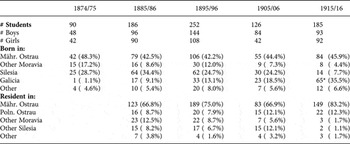
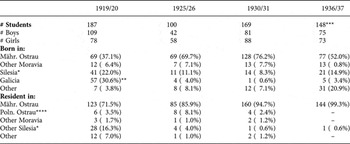
School registration records from this Jewish elementary school provide a wealth of detail about the children who attended, including the place in which they were born, their fathers’ occupations, and their current residence. A careful analysis of these records in five sample years—1874/75, 1885/86, 1895/96, 1905/06, and 1915/16—reveals many interesting patterns (See Table 1).Footnote 137 The school experienced steady growth from 1874/75, when it only contained 90 students, 48 boys and 42 girls, to the late nineteenth century, when it contained 252 students, 144 boys and 108 girls. In most years the male/female ratio was roughly equal. For inexplicable reasons, the school suffered a decline in the early twentieth century. Although in 1900, the school contained 281 students,Footnote 138 by 1905/06 enrollment had fallen to only 126. At that point, some members of the Israelitische Kultusgemeinde wanted to close the school, probably for financial reasons, because declining enrollment made the school too costly. At a meeting on 9 July, the IKG voted 12–11 to close the school. Within a few weeks, probably in response to strong protest by Jews in the city, the IKG changed its mind, and attendance recovered in the following years.Footnote 139 In his history of the school, head teacher Ferdinand Kraus attributed the declining enrollment to the fact that by the early twentieth century there were other German elementary schools in town to which parents, especially more “assimilated” ones, could send their children.Footnote 140 The very quick recovery of the school indicates that such an explanation does not provide the whole picture. It is likely that economic problems led to lower enrollment since subventions provided by the Society for the Jewish Elementary School, formed at the time of the enrollment crisis, enabled the school to continue.Footnote 141
Place of Birth and Residence of Students in Jewish Elementary School, Mährisch Ostrau/Moravská Ostrava, 1874/75–1915/16.

*Includes 2 children born in Bukovina.
The place of birth of students casts much light on the growth of the Jewish community of Mährisch Ostrau/Moravská Ostrau, which was composed of Jews who had migrated there for the economic opportunities it offered. As Table 1 shows, between 1874 and 1915, only about 45 percent of the children were born in the city, a sign of the immigrant composition of this new Jewish community. In the 1870s, 46 percent of the children were born elsewhere in Moravia or Silesia, many of them in the city's suburbs, but that percentage declined somewhat over the years to 37 percent in 1895/96 and only 12 percent in 1915/16. With the passage of time, an ever greater percentage of children in the school had been born in nearby Galicia. In 1874, only one student was born in Galicia, in Oświęcim/Auschwitz, fairly close by. With the passage of time, the percentage of Galician-born students grew significantly, reaching almost 20 percent in the early twentieth century. During World War I, the percentage of Galician-born students was much higher, over a third, but that figure was inflated by the presence of Galician Jewish refugees in the city who had fled westward in very large numbers.
The school attracted not only Jews who lived in Mährisch Ostrau/Moravská Ostrava, but also students who lived in its suburbs, especially Polnisch Ostrau/Polská Ostrava in Silesia (Table 1). They may have attended this Jewish school to obtain a better Jewish education than was available in the suburbs, or because they wanted a German education, one not offered in the largely Czech- and Polish-speaking suburbs of the city. The Jewish school, after all, offered Jewish parents the opportunity for a German-language education for their children. In 1874/75 residential information is only available for about half of the students. In that year, two-thirds of them lived in Mährisch Ostrau/Moravská Ostrava, and most of the rest either in the Moravian or Silesian suburbs.Footnote 142 In the ensuing decades, most of the students lived in the city, yet a sizable number of children came in from the suburbs, especially from Polnisch Ostrau/Polská Ostrava.
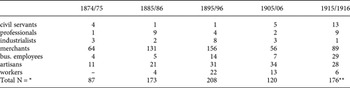
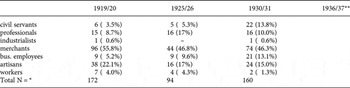
The school by no means attracted only poor students. To be sure, some students received financial aid, but they were not the majority. In the school year 1885/86, for example, when 186 students attended the school, 37 children received a release from paying full tuition (20 percent), and 35 paid half tuition (19 percent).Footnote 143 Moreover, a study of the occupations of the fathers of the students reveals that rich and poor alike sent their children to the Jewish school, although probably the very richest Jews in Mährisch Ostrau/Moravská Ostrava, those who owned factories, and the town's Jewish professionals, eschewed the Jewish school, and the very poor also did not attend, presumably because they could not afford to do so (See Table 2). The occupational profile of the students’ fathers is a typical one for Jews in the Bohemian Lands and in Galicia in the late nineteenth century. The majority—even the overwhelming majority—of fathers (and occasionally mothers, whose occupations were noted if there were no fathers) were merchants of one sort or another, ranging from peddlers to large-scale merchants and even, in the case of Joseph Wechsberg's family, bankers. In 1874/75 four-fifths of the students had fathers engaged in trade and commerce, many of them (27 out of 64) as innkeepers or tavern keepers, long a traditional Jewish occupation in Moravia as in nearby Galicia. In the late nineteenth century, three-quarters of the fathers of children in the Jewish school were merchants, with 32 percent of the merchants being tavern keepers in 1885 and 22 percent in 1895. The percentage of merchants declined in the twentieth century, although even then about half of all fathers of children in the school were merchants. The decline in the number of merchants, along with the concomitant decline of the percentage of tavern keepers (to 11–12 percent of all in commerce) reflected the economic modernization of the Jews in the city, as new occupations as “business employees,” that is salespeople, bookkeepers, clerks, and managers in commercial or industrial enterprises, began to attract significant numbers of Jews. Thus, while few Jews worked as business employees in the late nineteenth century, by 1915, 16.5 percent of the fathers did so.Footnote 144 Only a small number of the children had fathers who were civil servants, professionals, or industrialists.
Professions of Parents of Students in Jewish Elementary School, Mährisch Ostrau/Moravská Ostrava, 1874/75–1915/16.

*Ns (number of cases) are slightly different than in Table 1 because information on parents’ occupation is not available for all children.
**Total number includes 1 farmer from Galicia.
Large numbers of the fathers of children in the school were artisans, mostly tailors, butchers, shoemakers, jewelers, plasterers, turners, and house painters. In general, very few of the fathers of children in the school were wage laborers, probably because they could not afford to send their children to a private Jewish school. The laborers worked as drivers or conductors, not as industrial workers. Most of the fathers who were laborers were born in the city and its suburbs, although the Galician-born accounted for a disproportionate number of the workers. None of the fathers of Jewish children in the school worked in steel mills or coal mines, probably because few Jews worked in those locations.
The Galician-born children in the school were not necessarily poor, although they were not the richest children in the school. Most children who were born in Galicia had fathers who worked as merchants, although it is not clear how prosperous they were. A growing percentage of the Galician-born had fathers who were business employees, and many were artisans. A disproportionate number of workers—mostly drivers, conductors, and servants—among the fathers of children born in Galicia does attest to the fact that many Galician Jews were poor. Surprisingly, however, none of the Galician-born children in 1915/16, when Galician refugees swelled their ranks, had parents who were workers, largely because the Jewish refugee population included rich and poor alike.
The Jewish elementary school in Mährisch Ostrau/Moravská Ostrava was bureaucratically integrated into the local and regional German school boards, which supervised the school, inspected it regularly to make sure that instruction met state guidelines,Footnote 145 approved curricula (apart from Hebrew language),Footnote 146 arranged for pedagogical conferences, and provided endless instructions on such matters as which books to buy from publishers in Vienna and how to obtain books for poor children. Each year the board gave the school an allotment for such books.Footnote 147 For its part, the Israelitische Kultusgemeinde of Mährisch Ostrau/Moravská Ostrava sent a representative to the district school board.Footnote 148 The board also gave regular instructions about patriotic celebrations.Footnote 149
As in the schools run by the political Jewish communities, the Jewish school in Mährisch Ostrau/Moravská Ostrava emphasized Habsburg and Austrian loyalty more than German nationalist zeal. Such patriotism was especially prominent during the war, when the girls in the school knitted many kilos of socks and scarves for soldiers at the front, and the children made contributions to the Austrian Red Cross and bought Austrian war bonds.Footnote 150 While the school also contributed to local German charities, the amounts were generally smaller.Footnote 151 Teachers and students tended to be more generous with Jewish causes than German ones.Footnote 152
The Jewish elementary school in Mährisch Ostrau/Moravská Ostrava continued to flourish in interwar Czechoslovakia. As a German-language school, it was bureaucratically integrated in the local and regional German school boards, which had some difficulties understanding the school's concern for Hebrew language. Since Czech was now the “state language,” the school wanted to provide sufficient Czech-language instruction to its students, and it increased the numbers of hours of Czech-language instruction. After the Nazis came to power in Germany in 1933, this goal accelerated, and by 1936, the language of instruction in all subjects except German was Czech. Jews who attended the school in the interwar period remember it and its teachers fondly.Footnote 153
The curriculum of the Jewish school remained more or less the same in the interwar period, although in contrast to most German schools, all four grades received mandatory Czech-language instruction,Footnote 154 and the number of hours devoted to Czech increased markedly over the years. In June 1928, the Israelitische Kultusgemeinde instructed the Jewish school to increase Czech-language instruction in every grade.Footnote 155 The 1928/29 curriculum reveals that the Czech language now accounted for a substantial number of hours each week. Although there were only two hours of Czech-language instruction in the first grade, in grades 2–4 children received 11–15 hours of Czech a week, three to four hours of which were devoted to language. The remaining Czech hours were allocated to civics and natural history, as well as to the nonacademic subjects: music, art, physical education, and handicrafts for boys. What most probably considered the “important” subjects continued to be taught in German: German reading and writing, arithmetic, religion, and Hebrew, as well as needlework for girls, and the majority of school hours remained in German. By that time, the school had a fifth grade, in which almost all classes were taught in Czech.Footnote 156 That grade had been established in 1927 as a fully Czech grade with the exception of German language, needlework, and Jewish studies classes, the latter being exempted because of the difficulties of obtaining teachers who could teach Hebrew in Czech, and possibly also because school officials considered Jewish studies to be “German.”Footnote 157
In order to accommodate German, Czech, and Jewish studies, students had a long school week as they had before World War I, with classes on Sunday morning but not Saturday, the Jewish Sabbath.Footnote 158 The Jewish Studies curriculum was less extensive than before the war. Students still read, memorized, and translated important prayers in the daily and Sabbath liturgy, and learned biblical history, but they had fewer hours of Jewish subjects, and there is no evidence that boys still studied the Bible in its Hebrew original.Footnote 159 Religious instruction was no longer mandatory in Czechoslovakia, but all students in the Jewish school received it.Footnote 160 In the 1928/29 curriculum, it would appear that students had two hours of religion and one hour of Hebrew a week in grades two through four, but only one hour of religion in grade one.Footnote 161 It is possible that students had more Hebrew hours, which the school did not report to the authorities, who did not understand the need for so much Hebrew in a German school. The continued popularity of the school despite the reduced Jewish studies curriculum attests to the continuing desire of local Jews to have their children attend a Jewish school.
The students of the school in the interwar period differed somewhat from the students in the late nineteenth century (See Tables 3 and 4).Footnote 162 In the first school year after World War I, there were still many Galician and Bukovinian refugees in the school population, but, because Czechoslovakia forced the refugees to leave, in the 1920s and 1930s virtually none of the children had been born in Galicia. Moreover, no Jews from that area, now located in Poland, migrated to Mährisch Ostrau/Moravská Ostrava in the interwar period. At that time, about three-quarters of the students had been born in the city, a sign that the Jewish community contained fewer immigrants than before the war. The most significant change in the place of origin of the student body was the rising number of children who had been born in Slovakia. Virtually no children in the school had come from that region when it was part of the Hungarian half of the monarchy before the war. In interwar Czechoslovakia, many Jews from Slovakia and Sub-Carpathian Ruthenia migrated to the Bohemian Lands seeking economic opportunity. Thus, in 1936/37, 18 children came from the eastern part of Czechoslovakia, 58 percent of all the children counted in the category “other.” The overwhelming majority of Jews in Slovakia and Sub-Carpathian Ruthenia were deeply pious, so they might have preferred to send their children to a Jewish school. They did not do so, however, until 1936/37, probably because they saw no reason to send their children to a German-language school. Indeed, in both 1925/26 and 1930/31 school years, only two children had been born in Slovakia. Slovakian Jews who had modernized before 1918 had done so through the vehicle of the Magyar language and many also knew German. In interwar Czechoslovakia, where these were not favored languages, Slovakian Jews understood that it was a good idea to learn Czechoslovak, the state language.Footnote 163 Once the Jewish school adopted Czech as its language of instruction in 1936, Slovakian parents sent their children to the school. Indeed, it is possible that one of the reasons the school switched to Czech in 1936 was to attract Slovakian-born children.
Place of Birth and Residence of Students in Jewish Elementary School, Mährisch Ostrau/Moravská Ostrava, 1919/26–1936/37.

*In Czechoslovakia, Silesia and Moravia were joined into one province. I have separated out Silesia here for the sake of comparability with Tables 1 and 2.
**Includes 3 students born in Bukovina.
***Class lists for the fourth grade in 1936/37 were missing from the archives. Assuming the fourth grade contained about 40 students, the real number of students that year was approximately 188.
****Now called Schlesische Ostrau/Slezská Ostrava.
Occupations of Parents of Students in Jewish Elementary School, Mährisch Ostrau/Moravská Ostrava, 1919/20–1936/37.

*Ns (number of cases) are slightly different than in Table 3 because information on father's occupation is not available for all children.
**Occupations unavailable to me because indicated in Czech.
The number of children at the school born in or resident in the Moravian or Silesian suburbs diminished markedly from the prewar period. Such decline might indicate a more prosperous student body, or the fact that most Jews in the suburbs had already migrated to the city, or simply that the city had incorporated many of the suburbs. In 1919/20 there were still many children who commuted from the suburbs, but that was because of the large number of Galician refugees, many of whom lived there. In all subsequent years, the number of suburban children was tiny. It is possible that in the Czechoslovak Republic, Jews in the Czech-speaking suburbs felt it was the better part of wisdom to send their children to Czech-language public schools so their children could master the “state language.”
That the student body was more prosperous in the interwar period can be seen from the occupations of students’ parents (almost all fathers), presented in Table 4. In this period the number of fathers who were professionals—doctors, lawyers, engineers, teachers, rabbis—increased markedly, as did the number of civil servants. While the number of industrialists among the fathers remained minuscule, the percentage of merchants declined from the prewar period. In the late nineteenth century, three-quarters of the fathers had been merchants, but already in the years before World War I, only about half of the fathers were merchants. In the interwar period, the percentage of parents who were merchants of any sort was just under half, and the number of traditional tavern keepers had declined significantly, reflecting the continuing economic modernization of the Jews. This economic modernization is also reflected in the number of fathers who worked as “business employees,” a rise from 5 percent to 13 percent between 1919/20 and 1930/31. Especially significant is the fact that many of these business employees were bank directors and held other upper-management positions, not merely working as salespeople, bookkeepers, or clerks. Finally, the very significant decline in the number of parents who were workers, both compared to the prewar period and during the interwar period, as well as the more modest decline in the percentage of parents who were artisans, reflects the increased prosperity of the student body. This prosperity means that the Jewish school was not a place that the Jewish community used to educate the Jewish poor. Rather, the German-Jewish school in Mährisch Ostrau/Moravská Ostrava was an institution that provided Jews in the city a space in which they could assert a German-Jewish—and after 1936 Czech-Jewish—identity, part of and separate from the larger German (and later Czech) world.
The Jewish elementary school in Mährisch Ostrau/Moravská Ostrava was integrated into the German school system until 1936. The local German school board, based in Neutitschein/Nový Jičin, supervised and inspected the school, approving its curricula,Footnote 164 and served as a conduit for all notices from the Ministry of Education and National Culture in Prague. From these notices, it is easy to see how Czechoslovakia sought to make loyal citizens out of its German-speaking subjects, urging them to celebrate Masaryk's birthday and the anniversaries of Czechoslovak independence, and to foster Czechoslovak democracy.Footnote 165 The government also sought to ensure that German schools used only newly approved school books, ones that no longer assumed that the Bohemian Lands were part of Habsburg Austria and that viewed German identity in local terms.Footnote 166 After 1933, as Czechoslovakia became ever more anxious about its German-speaking inhabitants, admonitions to the schools about Czechoslovak loyalty increased noticeably.Footnote 167 The authorities also insisted that all schools use school books published in Czechoslovakia,Footnote 168 a point that caused problems for the Jewish school since few Jewish textbooks were published in the new state. Nevertheless, the state made it its business to approve books for Jewish religion and Hebrew instruction, approving prayer books and Hebrew primers prepared by teachers in the school and by a local rabbi, Reuben Färber, the father of one its teachers, Grete Färber Gross.Footnote 169
To be sure, the Jewish school did experience some difficulties with the German school board, mostly due to lack of understanding, but the problems were usually easily resolved. For example, at some point the board required the school to hold classes on Saturday and close on Sunday, like all the other German schools. In February 1929, the school complained to the IKG about this issue, as well as the fact that they had to take Easter vacation during Easter, not Passover, and had to remain open on the High Holidays. The school director asked the Jewish community to appeal to the Ministry of Education and National Culture, if necessary through the Jewish National Council in Prague, to require the German school board to follow the laws of the democratic Czechoslovak republic and respect the needs of a Jewish school.Footnote 170 The appeal worked. On 30 March 1929, the school board notified the Jewish school that the Ministry of Education would allow the school to substitute four days of Passover for the regular Easter vacation.Footnote 171 Lesson plans for the following years show classes on Sunday but not on Saturday.Footnote 172 The German school board also worried that the school offered more Hebrew and Jewish religious instruction than Czechoslovak law allowed. It regularly reminded the school that there was no legal basis for Hebrew-language instruction in the first grade and asked the school to revise the lesson plans accordingly.Footnote 173 In 1927, it asked the Jewish school about the legal basis for offering one hour of religion and three hours of Hebrew in the third grade, and it asked the school to revise the lesson plans to conform with the rules.Footnote 174
One interesting measure of the school's continuing preference for German language was the books in its library. In 1921, all 379 books in the teachers’ library and all 99 books in the students’ library were in German.Footnote 175 In 1928, by which time the school devoted many hours a week to Czech-language instruction, the teachers’ library had 12 books in Czech and 373 in German, and all of the books for the children were in German. In 1933, on the eve of the decisive turn to Czech-language instruction, the teachers’ library had 397 books, of which only 29 were in Czech and the rest in German. Many of the Czech books dealt with Czechoslovakia, its political leaders, and its Jews. Needless to say, by that time the school had de-accessioned its books that dealt with the Habsburg monarchy and its leaders.Footnote 176
Alongside its integration into the German school system and its emphasis on Czech-language instruction, the school served as a Jewish school, providing a Jewish religious education and separating a substantial number of Jewish children from other German-speaking children in Mährisch Ostrau/Moravská Ostrava and its suburbs. Local Jews regarded the school building as Jewish space, and Jewish organizations regularly used the school for their activities. For example, the Beth Hamidrasch Verein, a society devoted to studying Jewish holy texts, met at the school.Footnote 177 So too did the Blau-Weiss Wanderbund, a Zionist youth group. In addition, the Mirjamverein used the school for its kindergarten, as did a Jewish vocational school, organized by the IKG for boys and girls offering instruction in German, Czech, and modern Hebrew, which the Zionist organization took over in 1924.Footnote 178
More importantly, all of the teachers in the school were Jews, in terms both of the nationality they indicated on the census and of their religious affiliation, at least until the increased number of Czech-language hours of instruction made it impractical to hire only Jewish teachers.Footnote 179 In the 1920s, the school hired non-Jewish Czechs to teach the nonacademic material that increasingly was taught in Czech, but these teachers did not remain long in the school. In 1921, the school had four regular teachers, Ferdinand Kraus, Schulem Salter, Greta Färber, and Käte Hirsch, plus Leopold Löwinger for (Jewish) religion and Irene Janote for Czech-language instruction. Only Janote, German by nationality, was Catholic.Footnote 180 Over the next few years, the school hired various Czechs to teach Czech, but none of them lasted very long.Footnote 181 In 1927, the school needed to hire two Czech-language teachers, and they hoped to find Jewish teachers to fill those positions.Footnote 182 This was not an easy task because teacher training schools had almost no Jewish students. One applicant for the position, a Jewish graduate of a Czech-language Gymnasium, did not have teacher certification, but he argued that because of the dearth of Czech-language Jewish teachers, the school authorities might let him teach for a year and then take the certification exam, just as they had done in the Zionist school in Brünn/Brno.Footnote 183 The following year, the school had six teachers, two of whom were non-Jews.Footnote 184 Over the course of the next few years, long-time head teacher Ferdinand Kraus retired, several non-Jewish teachers had come and gone, and the faculty remained almost all Jewish.Footnote 185 In 1938/39, all of the teachers were Jewish, but the faculty contained none of the teachers of the early 1930s, all of whom left when the school switched to Czech-language of instruction.Footnote 186
In the early years of the Czechoslovak Republic, the number of children in the Mährisch Ostrau/Moravská Ostrava Jewish school declined. In 1920/21 the school only had 151 students, and by 1924/25, only 77, although there was some modest growth thereafter, so that by the 1927/28 school year, 123 students attended the school.Footnote 187 The IKG was upset that school attendance was so low and asked all parents who did not re-register their children in fall 1928 why they had not done so. Most of the parents who responded gave ordinary reasons: They lived too far away, they had moved elsewhere, or no one was available to walk their children to school because the mother worked or had younger children and no maid.Footnote 188 One parent, an attorney, noted in his response that he was pleased that the Jewish school offered as many hours of Czech as it did, but he felt compelled to send his child to a Czech-language public school so that the child could truly master the “state language.” At home, he noted, they spoke only German, and even the servants were German, so that the child heard no Czech there. He himself had an “imperfect knowledge of the state language,” which he regarded as a major failing, and his wife knew no Czech at all.Footnote 189 His letter may reflect a common attitude, because the school grew in the late 1920s and early 1930s, very likely because of increased hours of Czech-language instruction, which many Jewish parents desired, including those who were not comfortable in Czech but recognized its importance for their children in the new state. As a result, in 1928/29 the school had 172 students and in 1929/30, 181.Footnote 190 Attendance at the Jewish school grew even more after the Nazi rise to power in Germany in 1933, probably because many Jews now felt uncomfortable in the German public schools, or simply because the Jewish school offered some haven from Czech-German tensions. In the 1933/34 school year, the school had 224 students, and at the end of 1934/35, 230 students.Footnote 191 It is unclear what role Zionism played in attracting students to the school. The school was not officially Zionist, but Zionists, including the president of the Zionist Central Committee of Czechoslovakia, which was headquartered in Mährisch Ostrau/Moravská Ostrava, sent their children to it.Footnote 192 Ruth Elias noted in her memoirs that her father, a Zionist, sent her to the Jewish school even though it was four kilometers from their home in the suburbs.Footnote 193
Once the Nazis came to power in Germany in 1933, the Jewish school in Mährisch Ostrau/Moravská Ostrava decided to begin the process of switching the language of instruction at the school from German to Czech. Fearful of pro-Nazi sympathies among the German-speakers of Bohemia and Moravia, and loyal to Czechoslovakia, Jews consciously decided to switch from German to Czech. Making the switch at school had to be done gradually, both because of the teachers, most of whom were more comfortable teaching in German, and the students, most of whom came from German-speaking homes. In the 1933/34 school year, German remained the language of instruction for first grade, but grades two and three were “utraquist,” that is, both languages were the language of instruction, and Czech was the language of instruction for fourth and fifth grade.Footnote 194 The school urged its teachers to get certification as Czech-language teachers as quickly as possible.Footnote 195 The process of Czechification accelerated in 1935 and 1936, after the resounding success of the radical German nationalist, anti-Semitic Sudeten German Party among German-speakers in the Czechoslovak elections of 19 May 1935.Footnote 196 In that month, the IKG decided to make Czech the language of instruction for the third grade beginning in 1936, and for the whole school beginning in 1938. At the same time, the Czechoslovak government put some pressure on the Jewish community to Czechify the school completely. At a meeting of IKG representative Dr. Leon Kornblüh with Moravian provincial school officials on 28 May 1935, the school inspector asked “why the school has not yet Czechified.” Knornblüh, assuming that the teachers had to be Jewish, explained the difficulties of finding teachers who could teach in Czech and the problems that Jewish graduates of Czech high schools faced gaining acceptance into teacher training schools.Footnote 197 Kornblüh viewed his exchange with the provincial school authorities in very positive terms. He concluded his memorandum: “Throughout [the meeting] I had the impression of complete understanding and great goodwill of the provincial school authorities.” One gets the impression, however, that he thought the Ministry of Education in Prague was somewhat less understanding of the needs of the Jewish school.Footnote 198
As a result of Jewish concern and government pressure, the Israelitische Kultusgemeinde decided to make Czech the language of instruction in the entire school ahead of schedule, beginning in the 1936/37 school year, and it received permission to do so from the Ministry of Education and National Culture on 16 January 1936. The Moravian provincial school board reminded the school that its teachers had to be qualified as Czech-language teachers and it had to keep its records in Czech. Tellingly, the school translated the letter from the authorities into German for the leaders of the IKG.Footnote 199 Changing the language of instruction to Czech was a political act, not the result of the gradual linguistic Czechification of the Jews.
One of the results of the linguistic shift was that the school had to hire virtually all new teachers, all of whom were Jews fluent in Czech and qualified to teach in Czech.Footnote 200 Perhaps the ease with which the school hired qualified Czech-language Jewish teachers in 1936 reveals that earlier protests about the difficulties of doing so were simply cover for wanting to keep the school German (and to retain beloved teachers as long as possible). The school also took a Zionist turn. Earlier, its Hebrew-language curriculum had been focused entirely on prayer. Beginning in 1933, the school began to teach modern Hebrew, the Zionist anthem Hatikvah, and Land of Israel studies.Footnote 201 Teaching modern Hebrew put the school into conflict with the Ministry for Education and National Culture, which required that all schoolbooks had to be published in Czechoslovakia. Since there were no modern Hebrew textbooks published in Czechoslovakia, the IKG petitioned the authorities to use a text published in Warsaw. The IKG emphasized that the book was entirely in Hebrew and therefore, by implication, did not serve as a vehicle for German-language instruction.Footnote 202 The authorities did not approve the book. At his meeting with the Moravian provincial school board in May 1935, Kornblüh complained, but the provincial authorities only promised to study the matter. On the other hand, when Kornblüh indicated that the school wanted to increase the number of hours of Hebrew instruction each week, the provincial authorities recommended that the school make Hebrew “non-obligatory,” so that they, rather than the national authorities, could approve the increase.Footnote 203
Conclusion
The four Jewish schools studied here provide compelling evidence that many Jews in Moravia wanted a separate Jewish education in the German language for their children. Even in Czechoslovakia, a state to which they were loyal, Jews preferred German-language education, switching to Czech only when faced with the threat of Nazism in the mid 1930s. To be sure, most Jews were undoubtedly bilingual. They needed to be so to conduct their businesses in a largely Czech-speaking region. Nevertheless, they remained attached to German language. Such attachment never meant that they saw themselves as members of a German nation. Indeed, the German-Jewish schools are an indication that Jews regarded themselves primarily as German-speaking Jews, even regarding the German as simply part of the cultural patrimony of Habsburg, later Czechoslovakian Jews. As long as they lasted, the German-Jewish schools provided a Jewish space in which Jews could demonstrate and inculcate their Jewish, German, and state loyalties.
Jews also expressed their intertwined loyalties in their choice of secondary schools. Those Moravian Jews who provided a secondary school education for their children in the late Habsburg monarchy and in Czechoslovakia almost all chose German-language schools. In the late nineteenth century, well over 90 percent of all Jewish boys in secondary school in Moravia attended German-language institutions, where they formed about one-quarter of all students in such schools despite the fact that Jews were a tiny percentage of the population.Footnote 204 In the cities under discussion here, Jews avoided the Czech-language secondary schools and attended German ones, where they formed between a quarter and two-fifths of all students.Footnote 205 Even in Czechoslovakia, despite the clear benefits of Czech education and the sharp decline in the number of German schools in Czech-speaking regions, the majority of Jews who attended middle school attended German institutions. By 1930, 56 percent of all Jews in secondary school still attended German-language schools.Footnote 206
Yet, in Czechoslovakia Jews did not identify primarily as Germans. For many Moravian Jews, the opportunity the Czechoslovak Republic gave them to register on the census as members of the Jewish nation, rather than as Germans or Czechoslovaks by nationality, allowed them a comfortable way to demonstrate that they were not Germans, not members of a nationality group that Czech nationalists regarded with suspicion. Thus, in the census of 1921, 48.5 percent of all Jews in Moravia registered as members of the Jewish nation, and in 1930, 51.7 percent (Moravia and Silesia now combined) did so.Footnote 207 In the cities and towns that had once contained political Jewish communities, fully 65 percent of all Jews declared Jewish nationality, compared to about one-third in the larger cities. In 1921, 39.4 percent of the Jews in Prossnitz/Prostějov, 61.5 percent in Prerau/Přerov, and fully 93.9 percent in Leipnik/Lipník professed membership in the Jewish nation.Footnote 208 Even if they preferred to speak German, they were not German, but rather German-speaking Jews and loyal citizens of Czechoslovakia.
It may very well be that Jews in Moravia, especially in smaller cities and towns in Czech-speaking central and southern Moravia that had once had political Jewish communities, chose the Jewish nationality simply because they considered themselves Jews—Jews who spoke German. The role of the German-Jewish schools in fostering this sense of separate Jewish identity must not be overlooked. After all, as long as they functioned, these schools created a Jewish space in which Jews spoke German. The schools reminded Jews and Gentiles alike that although Jews spoke German, they did not regard themselves as members of a German nation. The schools were not bastions of German nationalism or outposts of Germandom in a Czech-speaking landscape. The schools were Jewish spaces that taught both German and Czech and inculcated Habsburg or Czechoslovak state loyalty. They announced that while Jews in some ways formed part of a German community in a largely Czech-speaking world, they were a separate group within it. Moreover, while these schools did not inculcate Czech identity, they were always positive to Czech language and comfortable in the Czech milieu. Even if Czech nationalists resented the schools, the Jews loved them because they so well expressed the complicated nature of Moravian Jewish identity. They reminded Jews that they were German-speaking Jews, and their loyalties were to each other and to the state in which they lived.