Introduction
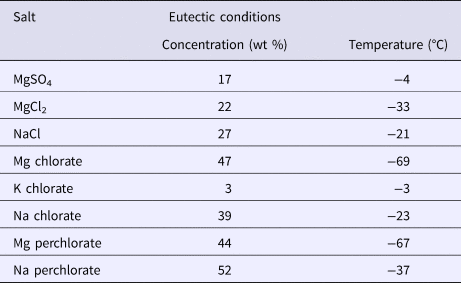
For water to remain liquid at the frigid temperatures near the Martian surface, it must contain high concentrations of solutes. Salts, sugars, and ammonia can depress the freezing point of water dramatically (Table 1). For instance, sodium and magnesium chlorates depress the freezing point of water to −23 and −69°C, respectively (Hanley et al., Reference Hanley, Chevrier, Berget and Adams2012). Oxyanions of chlorine have been detected in Mars soils, reaching 0.6% near the Phoenix lander and likely exist as separate hygroscopic phases (Hecht et al., Reference Hecht, Kounaves, Quinn, West, Young, Ming, Catling, Clark, Boynton, Hoffman, DeFlores, Gospodinova, Kapit and Smith2009; Kounaves et al., Reference Kounaves, Hecht, Kapit, Gospodinova, DeFlores, Quinn, Boynton, Clark, Catling, Hredzak, Ming, Moore, Shusterman, Stroble, West and Young2010; Ming et al., Reference Ming, Archer, Glavin, Eigenbrode, Franz, Sutter, Brunner, Stern, Freissinet, McAdam, Mahaffy, Cabane, Coll, Campbell, Atreya, Niles, Bell, Bish, Brinckerhoff, Buch, Conrad, Des Marais, Ehlmann, Fairén, Farley, Flesch, Francois, Gellert, Grant, Grotzinger, Gupta, Herkenhoff, Hurowitz, Leshin, Lewis, McLennan, Miller, Moersch, Morris, Navarro-González, Pavlov, Perrett, Pradler, Squyres, Summons, Steele, Stolper, Sumner, Szopa, Teinturier, Trainer, Treiman, Vaniman, Vasavada, Webster, Wray and Yingst2014; Clark and Kounaves, Reference Clark and Kounaves2016). Ammonia at high concentrations can depress the freezing point of water to −100°C and may be relevant to the oceans of Ceres and Pluto (Nimmo and Pappalardo, Reference Nimmo and Pappalardo2016). Even NaCl can lower the freezing point of water to −21°C, while MgSO4 reduces it to a modest −4°C (Toner et al., Reference Toner, Catling and Light2014). Extremely salty and cold waters created by permafrost melt or deliquescence may be the only wet habitats for microbes near Mars’ surface (Chevrier and Altheide, Reference Chevrier and Altheide2008; Davila et al., Reference Davila, Duport, Melchiorri, Jänchen, Valea, de los Rios, Fairén, Möhlmann, McKay, Ascaso and Wierzchos2010; Hanley et al., Reference Hanley, Chevrier, Berget and Adams2012; Rummel et al., Reference Rummel, Beaty, Jones, Bakermans, Barlow, Boston, Chevrier, Clark, de Vera, Gough, Hallsworth, Head, Hipkin, Kieft, McEwen, Mellon, Mikucki, Nicholson, Omelon, Peterson, Roden, Sherwood Lollar, Tanaka, Viola and Wray2014; Clark and Kounaves, Reference Clark and Kounaves2016; Rivera-Valentin et al., Reference Rivera-Valentin, Gough, Chevrier, Primm, Martinez and Tolbert2018).
Chemical compositions of saturated salt solutions at their eutectic temperatures

The eutectic point for a solution is the combination of the highest salt concentration and the lowest temperature at which the solution remains free of ice and free of precipitate. Adding more salt leads to precipitation, while lowering the temperature leads to ice formation. Liquid water on Mars may be found at times as saturated or eutectic solutions from permafrost melt or deliquescence. For instance, it has been hypothesized that saturated ferrous sulphate brines might be the longest-lived liquids near the surface (Chevrier and Altheide, Reference Chevrier and Altheide2008). The eutectic concentrations of relevant brines are typically high, above 20 wt% salt (Table 1). The eutectic conditions for (per)chlorate salts are typically at concentrations of ~40 wt% or more. Eutectic brines could form on Mars by deliquescence when these hygroscopic salts absorb atmospheric moisture (humidity). Sufficient moisture is present at the Curiosity landing site to support this process with certain perchlorate salts (Chevrier et al., Reference Chevrier, Hanley and Altheide2009; Hu et al., Reference Hu, Bloom, Gao, Miller and Yung2016). Modelling suggests that permafrost melt would create saturated salt solutions in pore spaces given the high salt concentrations in Mars regolith (Crisler et al., Reference Crisler, Newville, Chen, Clark and Schneegurt2012). The current work demonstrates bacterial growth in extremely high salt concentrations, including the eutectic conditions for MgSO4 and K chlorate, the first demonstration of microbial growth in a brine that has a reasonable likelihood of being present on Mars at certain times.
Growth of salinotolerant (exhibit growth at high salt concentrations) microbes has been demonstrated in the presence of high concentrations of solutes, including saturated NaCl and MgSO4 solutions (Crisler et al., Reference Crisler, Newville, Chen, Clark and Schneegurt2012; Schneegurt, Reference Schneegurt and Vreeland2012; Fox-Powell and Cockell, Reference Fox-Powell and Cockell2018). We have examined culture collections captured from these natural environments rich in salts: Great Salt Plains of Oklahoma (GSP; saturated with NaCl) and Hot Lake, WA (HL) and Basque Lake, BC (BLE) (both saturated with MgSO4) (Caton et al., Reference Caton, Witte, Ngyuen, Buchheim, Buchheim and Schneegurt2004; Crisler et al., Reference Crisler, Newville, Chen, Clark and Schneegurt2012, Reference Crisler, Chen, Clark and Schneegurt2018; Kilmer et al., Reference Kilmer, Eberl, Cunderla, Chen, Clark and Schneegurt2014). Halotolerance (exhibits growth at high NaCl concentrations) and epsotolerance (exhibits growth at high MgSO4 concentrations) appear to be widespread in both types of environments, those rich in monovalent ions and those rich in divalent ions. Water activities are low in both environments and ionic strength is particularly high for epsomic lakes rich in sulphates. Low water activity is associated with the inhibition of microbial growth, whether the solute be salts or sugars, due to specific solute effects, which involve interplay of several physicochemical parameters (Grant, Reference Grant2004; Schneegurt, Reference Schneegurt and Vreeland2012). Salinotolerant and sucretolerant (exhibit growth at high sugar concentrations) microbes are readily found in common soils and thus are not found only in extreme environments (Echigo et al., Reference Echigo, Hino, Fukushima, Mizuki, Kamekura and Usami2005; Al Soudi et al., Reference Al Soudi, Farhat, Chen, Clark and Schneegurt2017; Fredsgaard et al., Reference Fredsgaard, Moore, Chen, Clark and Schneegurt2017). We have recovered remarkably tolerant microbes from spacecraft assembly facilities (SAFs) as well, suggesting that microbes contaminating spacecraft may be able to grow under the extreme chemical conditions expected at certain times near the surface of Mars (Eberl and Schneegurt, Reference Eberl and Schneegurt2015; Wilks et al., Reference Wilks, Chen, Clark and Schneegurt2017).
While high salinities appear to be widely tolerated, microbial growth at low temperatures seems to be more restricted (Clarke et al., Reference Clarke, Morris, Fonseca, Murray, Acton and Price2013; Bakermans, Reference Bakermans and Margesin2017). Although microbial metabolism is generally slowed at low temperatures, methanogenesis has been detected in permafrost at temperatures as low as −16.5°C (Rivkina et al., Reference Rivkina, Friedmann, McKay and Gilichinsky2000, Reference Rivkina, Shcherbakova, Laurinavichius, Petrovskaya, Krivushin, Kraev, Pecheritsina and Gilichinsky2007). Record microbial growth is limited to about −20°C, higher than the freezing points of many eutectic brines relevant to Mars and the ocean worlds. The suggestion is that the high salt concentrations of eutectic brines may be less inhibitory to growth than their low temperatures on frigid celestial bodies. We have reported growth of bacteria at >27% Na chlorate and survival at the eutectic concentration (Al Soudi et al., Reference Al Soudi, Farhat, Chen, Clark and Schneegurt2017; Schneegurt et al., Reference Schneegurt, Wilks, Zayed, Joad, Mahdi, Zbeeb, Chen and Clark2018). However, growth at the Na chlorate eutectic temperature of −23°C has yet to be demonstrated for salinotolerant bacteria.
The current study examines microbial responses to two eutectic solutions that appear suitable for growth and that are potentially found at times on Mars. We have previously demonstrated strong bacterial growth in the presence of 50% (w/v; 2M) MgSO4, which is higher than the eutectic concentration for MgSO4 of 43% (w/v) (Crisler et al., Reference Crisler, Newville, Chen, Clark and Schneegurt2012, Reference Crisler, Chen, Clark and Schneegurt2018; Kilmer et al., Reference Kilmer, Eberl, Cunderla, Chen, Clark and Schneegurt2014). While the eutectic temperature for MgSO4 is −3.9°C, we had previously reported growth of salinotolerant bacteria in 10% NaCl at 4–7°C (Caton et al., Reference Caton, Witte, Ngyuen, Buchheim, Buchheim and Schneegurt2004; Litzner et al., Reference Litzner, Caton and Schneegurt2006; Crisler et al., Reference Crisler, Newville, Chen, Clark and Schneegurt2012, Reference Crisler, Chen, Clark and Schneegurt2018). The second eutectic solution we have examined is that of K chlorate, which is unusual among the (per)chlorate salts in that its eutectic concentration of ~3% is low and its eutectic temperature is moderate, near −3°C (Hanley et al., Reference Hanley, Chevrier, Berget and Adams2012). In the current report, we demonstrate the growth of psychrotolerant isolates from saline soils at each of these eutectics. This is the first demonstration that terrestrial microbes can grow in the densest brines potentially present at times near the surface of Mars or near the oceans of icy worlds.
Materials and methods
Site description and sample collection
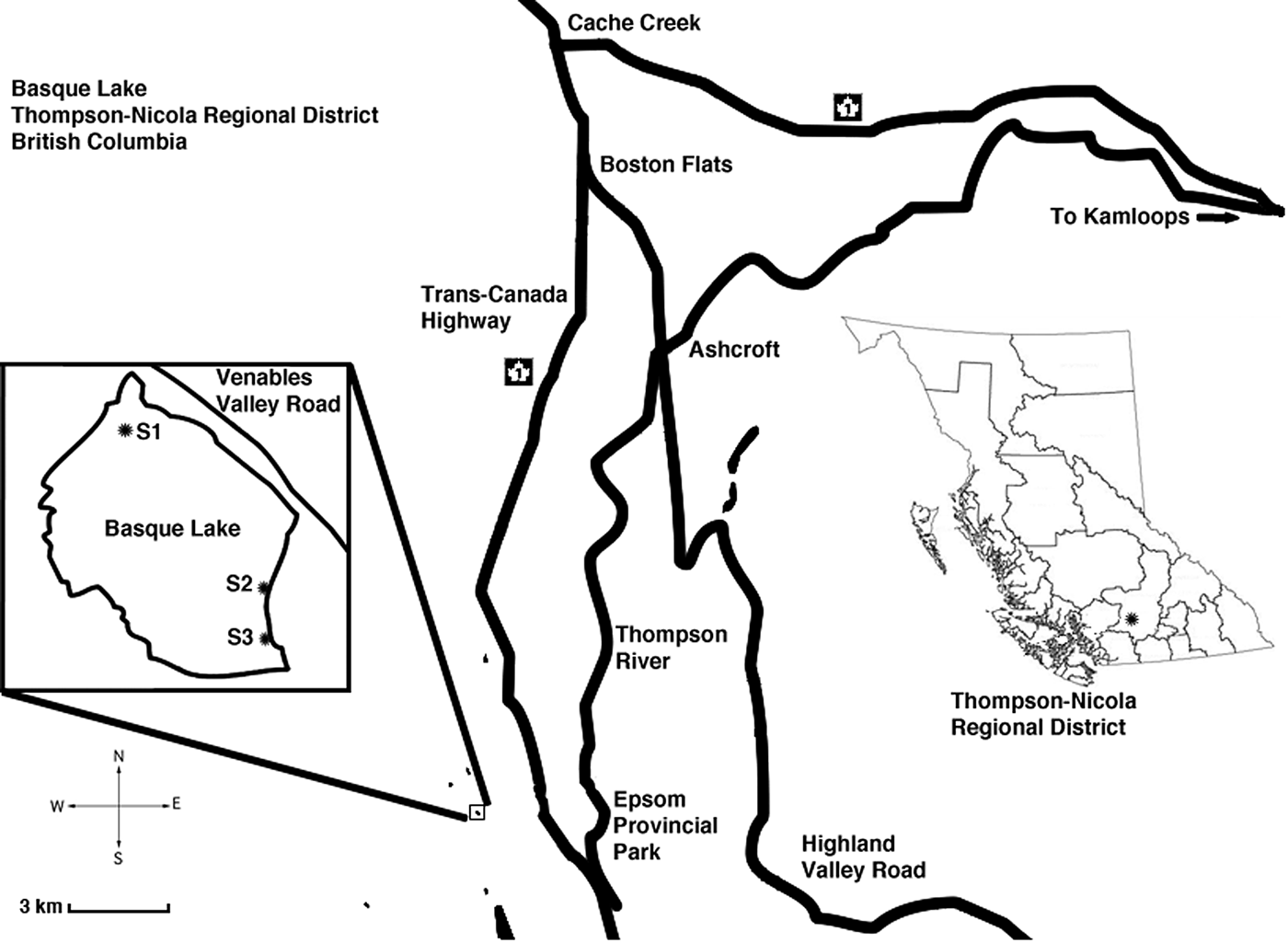
Water and lake margin soils (~100 g from top 4 cm) were collected using sterile tools and containers from Basque Lake, BC at three locations: S1 (50°36′02.5″N, 121°21′32.2′W), S2 (50°35′59.8″N, 121°21′27.6″W) and S3 (50°35′58.9″N, 121°21′27.2″W) (Fig. 1). Aliquots for live culture work were held and transported fresh at ambient temperature. The soils were predominantly grey or black fine clays and silts, often with a strong sulfidic odour, and were saturated with salts.
Contextual map of Basque Lake showing sampling sites.

Organisms and enrichment of microbial isolates
Salinotolerant bacterial isolates were obtained previously from the Great Salt Plains of Oklahoma, an environment rich in NaCl (Caton et al., Reference Caton, Witte, Ngyuen, Buchheim, Buchheim and Schneegurt2004; Litzner et al., Reference Litzner, Caton and Schneegurt2006). Two previous studies of epsomic lakes, Hot Lake, WA and Basque Lake, BC, provided bacteria tolerant to 2M (50%) MgSO4 (Kilmer et al., Reference Kilmer, Eberl, Cunderla, Chen, Clark and Schneegurt2014; Crisler et al., Reference Crisler, Chen, Clark and Schneegurt2018). Finally isolates from an existing collection of epsotolerant bacteria from the SAFs at NASA Jet Propulsion Laboratory (JPL) were included in the current study (Eberl and Schneegurt, Reference Eberl and Schneegurt2015; Wilks et al., Reference Wilks, Chen, Clark and Schneegurt2017). Additional psychrotolerant, salinotolerant isolates were obtained from Basque Lake for the current study. Enrichment cultures were started with fresh samples of Basque Lake soils in SP medium supplemented with 50% MgSO4. Seven isolates were obtained that grew well at salt saturation for the growth temperature, namely, 67 and 56% (w/v) MgSO4 at 25 and 4°C, respectively, and in some cases, under eutectic conditions with 43% (w/v) MgSO4 at −4°C.
Cultures were maintained on SP medium (Caton et al., Reference Caton, Witte, Ngyuen, Buchheim, Buchheim and Schneegurt2004), a nutrient-rich medium containing per litre: NaCl, 1 g; KCl, 2.0 g; MgSO4·7H2O, 1.0 g; CaCl2·2H2O, 0.36 g; NaHCO3, 0.06 g; NaBr, 0.23 g; FeCl3·6H2O, 1.0 mg; trace minerals, 0.5 ml; Bacto tryptone, 5.0 g; yeast extract, 10.0 g; glucose, 1.0 g; final pH 7.0. This was prepared with various concentrations of MgSO4, K chlorate or NaCl. Throughout this work, MgSO4 is used to represent epsomite, MgSO4 • 7 H2O.
Measurement of growth in saturated and eutectic media
Bacterial growth was tested in SP medium (Caton et al., Reference Caton, Witte, Ngyuen, Buchheim, Buchheim and Schneegurt2004), supplemented with high concentrations of MgSO4, K chlorate or NaCl. Note that SP medium supplemented with salts at the eutectic concentration formed brines that were near-eutectic for a single salt, but by definition were not true eutectic solutions since nutritive media components were added to support microbial growth. Cultures were maintained in saturated MgSO4 media at 4°C before growth experiments under eutectic conditions. The temperatures of the incubators were monitored with traceable wire thermometers. There were no temperature anomalies during the course of these experiments. Culture flasks and tubes were partially buried in sand to damp the effects of temperature changes due to thermostat cycling (~2°C range) or opening the incubator for sampling. Cultures were kept in a moist box when incubations were above 0°C. Growth was measured by turbidity as optical density at 600 nm using a Thermo Scientific (Thermo Fisher Scientific, Waltham, MA, USA) Genesys 10S UV-Vis spectrophotometer. An OD of 0.1 was chosen as the threshold for positive growth. Growth also was measured by standard plate count, with serial dilution and spread plating, to enumerate colony-forming units. Plating was typically on SP medium supplemented with 10% NaCl, since agar with high concentrations of MgSO4 did not gel. While culture turbidity is the product of live cells, dead cells, and any materials that scatter or absorb light, the standard plate count reflects only live cells capable of forming a colony on agar. Not all replicate subcultures were successful under the most extreme conditions.
Characterization of bacterial isolates
Characterization of the bacterial isolates followed protocols described previously (Caton et al., Reference Caton, Witte, Ngyuen, Buchheim, Buchheim and Schneegurt2004; Litzner et al., Reference Litzner, Caton and Schneegurt2006). SP medium composition was modified with different concentrations of NaCl or MgSO4 to measure salinity tolerances in liquid shake-tubes. A threshold of 0.1 OD units was chosen for positive growth. All isolates were Gram-stained using the Protocol Gram-staining kit (Thermo Fisher Diagnostics, Waltham, MA, USA) following the manufacturer's instructions. The addition of 3% hydrogen peroxide solution to confluent plates or smears of culture on slides was used to detect catalase. Oxidase testing was performed using the BBL DrySlide system (BD, Franklin Lakes, NJ, USA) according to the manufacturer's instructions. Amylase was determined after a 5-day incubation on Starch agar (BD Difco, Franklin Lakes, NJ, USA), followed by flooding of plates with 25% stabilized Gram's iodine solution. Nitrate reduction tests were done as previously described (Caton et al., Reference Caton, Witte, Ngyuen, Buchheim, Buchheim and Schneegurt2004). Production of acid and gas from carbohydrates was tested using 0.5% (w/v) glucose, lactose or sucrose in culture tubes containing inverted Durham tubes, using a 10% NaCl solution supplemented with Bacto tryptone (10 g l−1) and phenol red (0.018 g l–1; pH 7.3).
Crude DNA extracts from each isolate were prepared using a freeze–thaw technique as described in Caton et al. (Reference Caton, Witte, Ngyuen, Buchheim, Buchheim and Schneegurt2004). Genomic DNA in the supernatant was the target of PCR amplification of nearly complete 16S rRNA gene fragments using universal bacterial primers (EUBPA: 5′–AGAGTTTGATCCTGGCTCAG–3′ and EUBPH: 5′–AAGGAGGTGATCCAGCCGCA–3′) (Edwards et al., Reference Edwards, Rogall, Blöcker, Emde and Böttger1989). PCR was performed in a thermal cycler (Eppendorf Mastercycler; Hamburg, Germany) as 25-µl reactions containing 0.2 µM of each primer, 1 U of ExTaq DNA polymerase and associated master mix (Takara, Kusatsu, Japan), and 5 µl of cell extract. DNA was denatured at 95°C for 2 min, followed by 40 cycles of 95°C for 1 min, 50°C for 1 min and 72°C for 1 min, with a final 5 min extension at 72°C. PCR amplicons were single-pass sequenced by a commercial vendor (Eurofins Genomics, Louisville, KY, USA) using the EUBPA primer. Initial sequences were trimmed to remove remaining vector regions. All sequences appear in GenBank with accession numbers MH286503 to MH286509 and MH503928 to MH503933, for BLE and JPL sequences, respectively. Sequences were aligned using SILVA and maximum likelihood analysis was used to build trees in MEGA v7.0 (Kumar et al., Reference Kumar, Stecher and Tamura2016). Known contextual 16S rRNA gene sequences from type organisms were identified in GenBank using BLAST.
Results
Isolation and characterization of psychrotolerant bacterial isolates
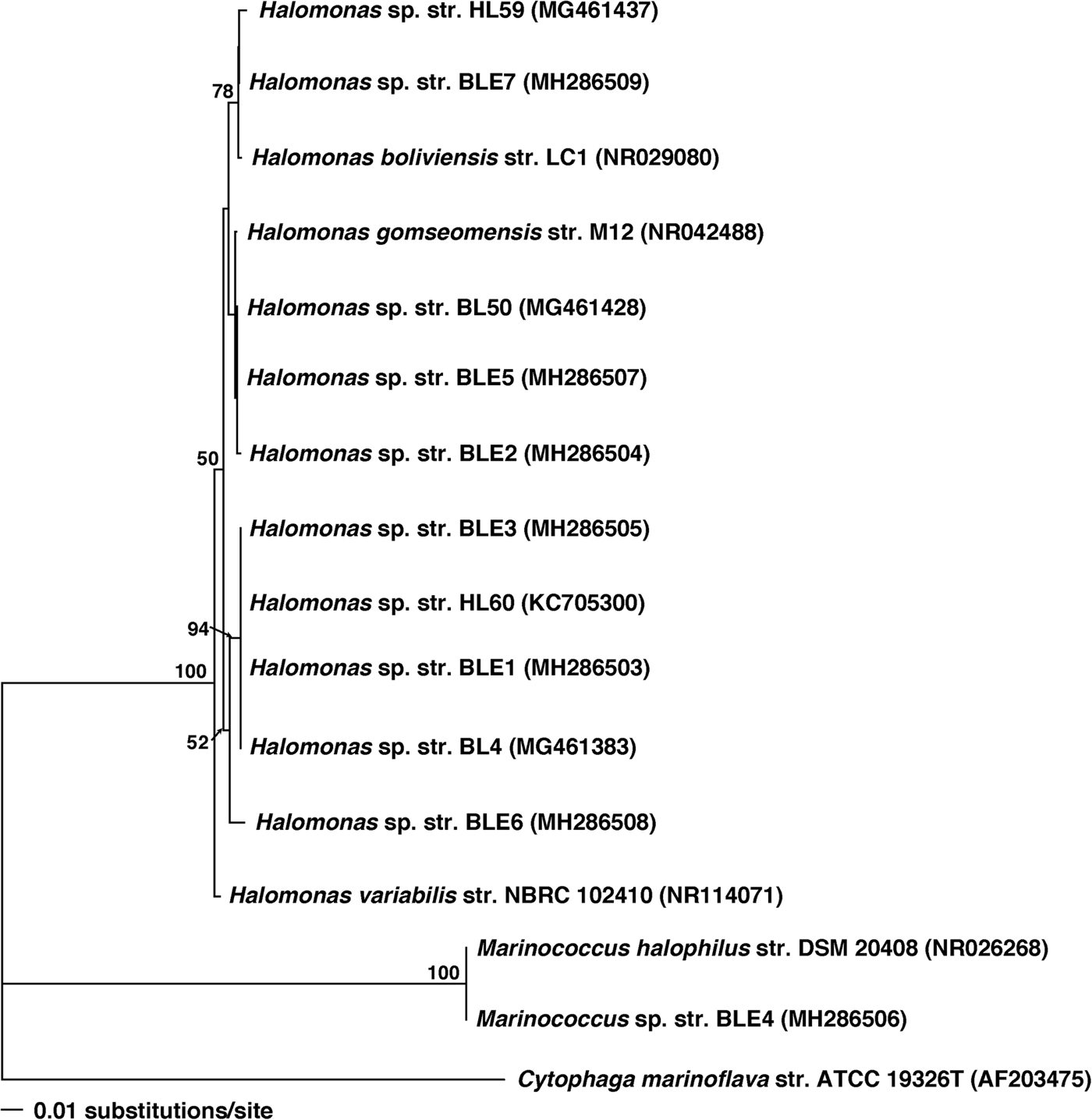
Basque Lake, Hot Lake and Spotted Lake have been recognized as Mars analogues due to their high divalent ion concentrations and low water activities (Kilmer et al., Reference Kilmer, Eberl, Cunderla, Chen, Clark and Schneegurt2014; Pontefract et al., Reference Pontefract, Zhu, Walker, Hepburn, Lui, Zuber, Ruvkun and Carr2017; Crisler et al., Reference Crisler, Chen, Clark and Schneegurt2018). Our current bacterial collections include more than 150 isolates from epsomic lakes, but these organisms were not selected for psychrotolerance. Seven new isolates were obtained from enrichments at 4°C in SP medium supplemented with 50% MgSO4. Designated as BLE isolates, the bacteria were identified by phylogenetic analysis of 16S rRNA gene sequences (Fig. 2). Six BLE isolates were Gram-negative Halomonas and BLE4 was a Gram-positive Marinococcus. The isolates were closely related to those obtained earlier in this laboratory from HL and the GSP.
Phylogenetic tree for psychrotolerant BLE bacterial isolates from Basque Lake based on 16S rRNA gene sequences, with GenBank accession numbers.

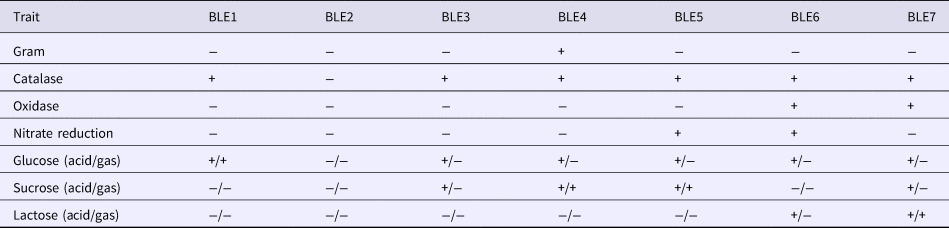
Biochemical, morphological and physiological characteristics of the BLE isolates are consistent with known related organisms (Table 2). Isolates were all catalase-positive, except Halomonas sp. str. BLE2, while only Halomonas sp. str. BLE 6 and 7 also were oxidase-positive. Anaerobic nitrate respiration was observed for Halomonas sp. str. BLE 5 and 6. Carbohydrate metabolism was limited, as reflected by the absence of amylase activity, as observed previously with microbes from hypersaline environments (Caton et al., Reference Caton, Witte, Ngyuen, Buchheim, Buchheim and Schneegurt2004; Kilmer et al., Reference Kilmer, Eberl, Cunderla, Chen, Clark and Schneegurt2014; Crisler et al., Reference Crisler, Chen, Clark and Schneegurt2018). It is possible that four of the isolates (Halomonas sp. str. BLE 1–3, 5) are slightly salinophilic (requiring high salt for growth), showing no growth in 0.1% NaCl, but growing at 1% NaCl. All of the isolates grew at 20% NaCl and at 50% MgSO4. All of the isolates grew at temperatures from 4 to 37°C. None grew at 50°C and only Halomonas sp. str. BLE2 did not grow at −4°C, near the eutectic temperature for MgSO4 and K chlorate.
Phenetic characteristics of psychrotolerant, salinotolerant bacterial isolates from Basque Lake

All isolates were negative for citrate, indole, H2S, motility and phenylalanine deaminase.
Screening of salinotolerant bacterial collections
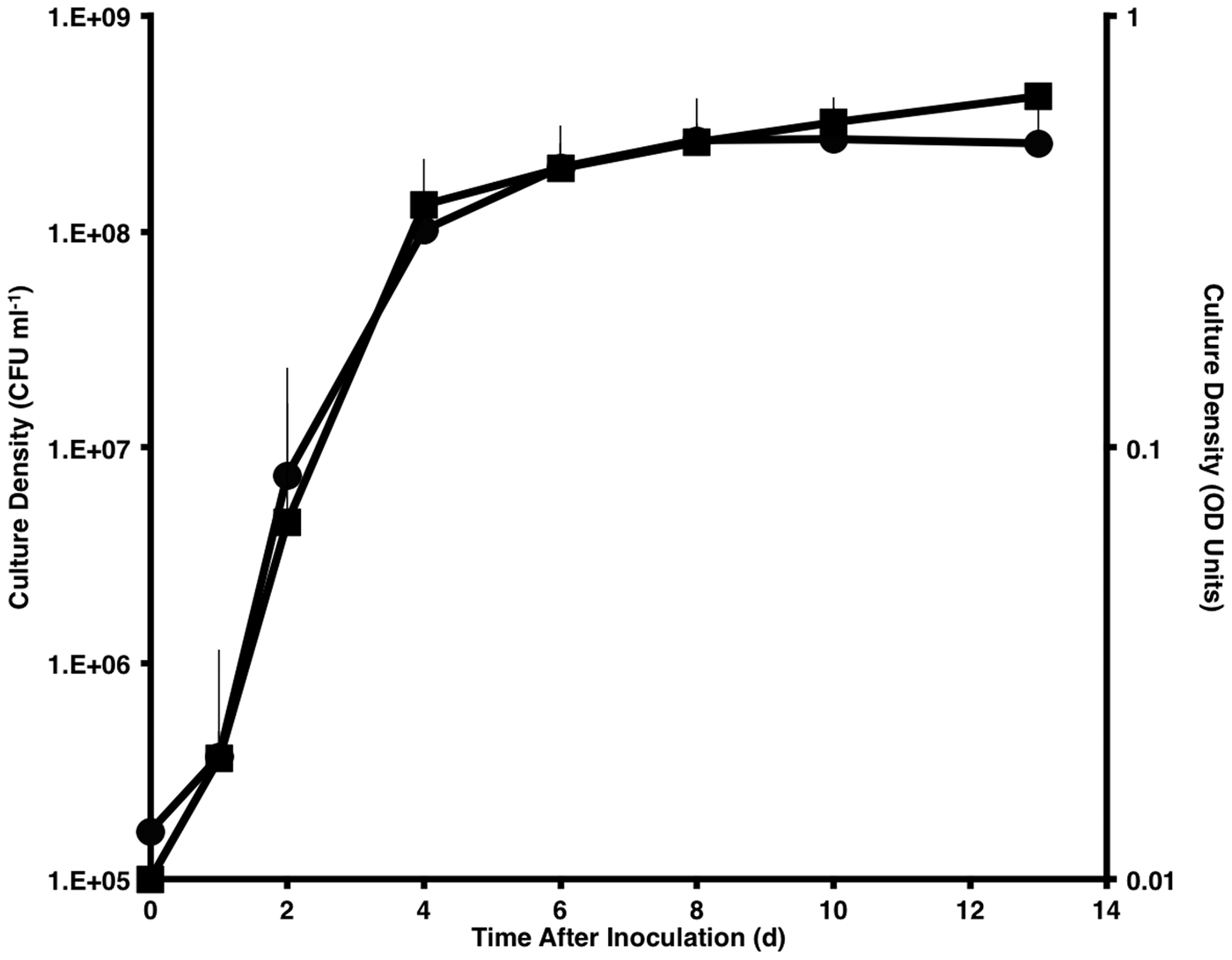
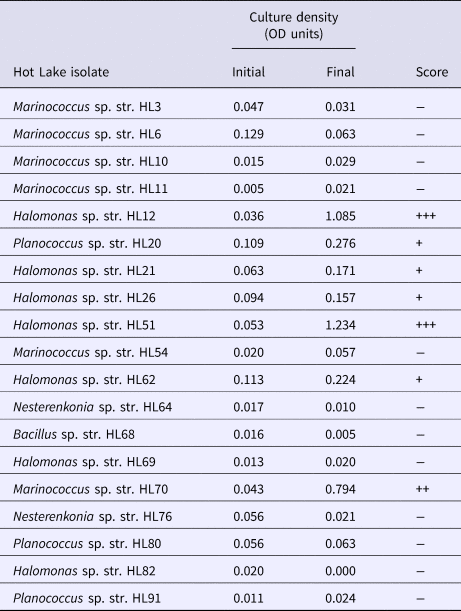
Previous studies of salinotolerant bacteria from the GSP and HL allowed for the selection of organisms with the highest likelihood of growing under extremely salty and sub-zero eutectic conditions (Table 3). A survey of HL bacteria found that only three of 19 salinotolerant isolates (Halomonas sp. str. HL 12 and 51 and Marinococcus sp. str. HL70) grew well in saturated (67%) MgSO4 medium at 25°C, with four isolates (Halomonas sp. str. HL 21, 26, and 62 and Planococcus sp. str. HL20) showing slight growth. Representative growth curves by turbidity and plate count are shown for HL12, a particularly tolerant Halomonas isolate (Fig. 3). Growth is relatively rapid under these extreme salt conditions, with stationary phase reached ~4 day after inoculation. Several of the BLE isolates were positive for growth in saturated MgSO4 medium at 25°C, including Halomonas sp. str. BLE 3 and 7 and Marinococcus sp. str. BLE4. Isolates obtained from enrichments of SAF swabs in 50% MgSO4 (Bacillus sp. str. JPL10 and Staphylococcus sp. str. JPL27) also exhibited growth in saturated MgSO4 medium at 25°C. Doubling times ranged from 9.6 to 46.7 h and maximum culture densities were above 1 OD, similar to those of low-salt cultures. When isolates were grown at 4°C in saturated (56%) MgSO4, doubling times increased substantially, being 300–700 h (12–29 days). Several BLE isolates (Halomonas sp. str. BLE 1, 3, 5 and 7) and a HL isolate (Nesterenkonia sp. str. HL76) grew under these conditions.
Growth of Halomonas sp. str. HL12 as shake-tubes in SP medium with saturated MgSO4 (67%, w/v) at 25°C. Circles, standard plate count on SP medium supplemented with 10% NaCl; squares, turbidity at 600 nm.

Growth of selected Hot Lake bacterial isolates in saturated (67%) MgSO4 at 25°C

Cultures were grown as shake-tubes in SP medium supplemented with salt. The threshold for positive growth was 0.1 OD and qualitative scores reflect the relative robustness of growth.
Growth under eutectic conditions
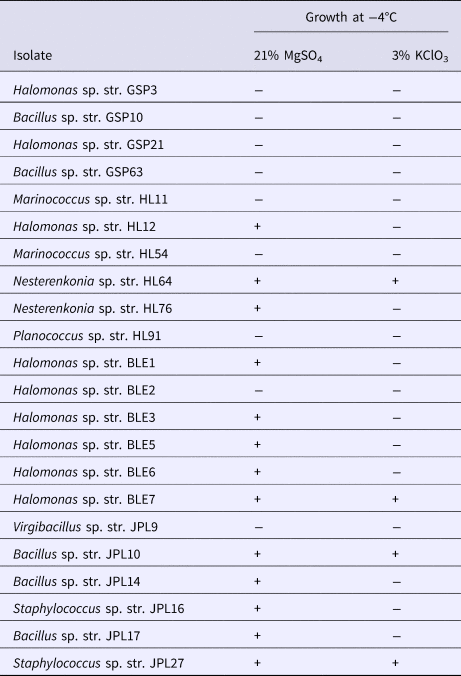
As cultures were transferred into environments that are closer to eutectic conditions for MgSO4, growth was slowed or stopped (Table 4). At −4°C (its eutectic temperature) and 21% MgSO4 (half of its eutectic concentration), several isolates grew, including Bacillus sp. str. JPL17; Halomonas sp. str. BLE 1, 3, 5 and 6 and HL 12; Nesterenkonia sp. str. HL 64 and 76; and Staphylococcus sp. str. JPL16.
Growth of selected bacterial isolates from the Great Salt Plains, Hot Lake, Basque Lake and JPL SAFs at −4°C with high salts

Cultures were grown as shake-tubes in SP medium supplemented with salt. The threshold for positive growth was 0.1 OD. Note that the K chlorate trials were at eutectic conditions.
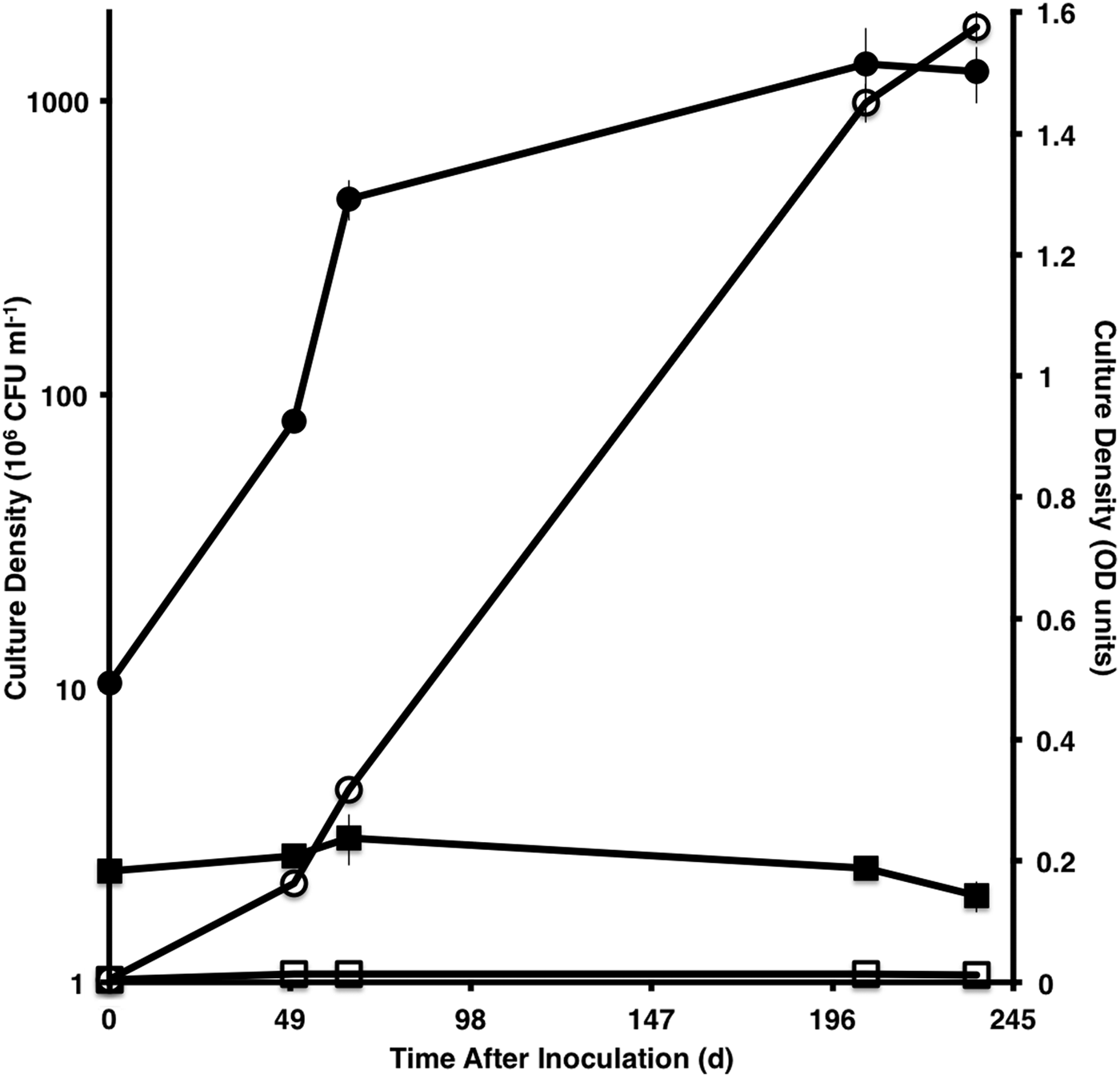
Growth of Halomonas sp. str. BLE 1, 3, 6 and 7 and Nesterenkonia sp. str. HL76 was observed under the eutectic conditions for MgSO4. A representative growth curve is presented for Halomonas sp. str. BLE7, which grew best, and compared with that of Marinococcus sp. str. BLE4, which did not grow at this eutectic (Fig. 4). Note that growth is substantially slowed next to that observed for saturated MgSO4 at 25°C. In saturated MgSO4 at 25°C, stationary phase was reached in about 4 days. However, under eutectic conditions, it took >50 days and perhaps as long as 200 days for Halomonas sp. str. BLE7 cultures to reach their maximum cell density. Cells held under these conditions for months appeared somewhat smaller than is typical and formed mucoidy flocs. The characteristic orange coloration of Nesterenkonia sp. str. HL76 was maintained even in cultures incubated under eutectic conditions for more than 2 years.
Bacterial growth at the MgSO4 eutectic in static liquid cultures of SP medium supplemented with 43% (w/v) MgSO4 at −4°C. Closed, standard plate counts on SP medium supplemented with 10% NaCl; open, turbidity at 600 nm; circles, Halomonas sp. str. BLE7; squares, Marinococcus sp. str. BLE4.

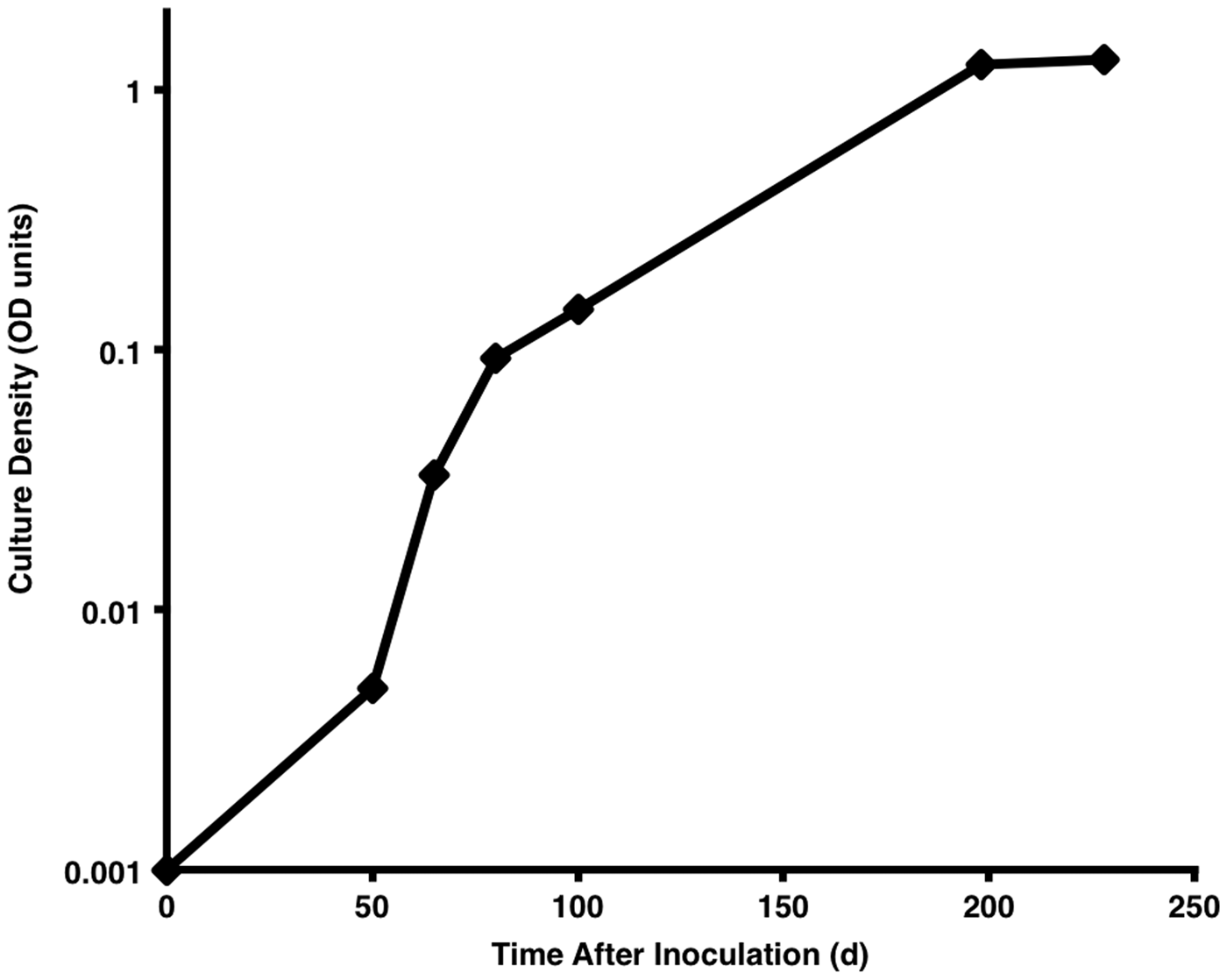
The eutectic state of K chlorate is at approximately the same temperature as the MgSO4 eutectic, but at a much lower salt concentration (3% for K chlorate and 43% for MgSO4). Several isolates showed substantial growth under the eutectic conditions for K chlorate including Bacillus sp. str. JPL10, Halomonas sp. str. BLE7, Nesterenkonia sp. str. HL64 and Staphylococcus sp. str. JPL27. Representative data for BLE7 cultured at the K chlorate eutectic point (only one of three replicates grew) demonstrates that growth was slowed, as observed for eutectic MgSO4 (Fig. 5). Stationary phase was reached after 100 days and perhaps not until near 200 days after inoculation. Our previous study reported that growth of salinotolerant isolates in K chlorate up to 1M (10%) at room temperature was much more rapid, reaching stationary phase in less than a week (Al Soudi et al., Reference Al Soudi, Farhat, Chen, Clark and Schneegurt2017).
Bacterial growth of Halomonas sp. str. BLE7 at the K chlorate eutectic as a static liquid culture in SP medium supplemented with 3% K chlorate at −4°C.

Discussion
Natural brines on Earth are usually dominated by chloride salts. While chlorides are present in Martian soils, often sulphates are found in higher abundance, reaching 30% by weight (Vaniman et al., Reference Vaniman, Bish, Chipera, Fialips, Carey and Feldman2004; Gendrin et al., Reference Gendrin, Mangold, Bibring and Langevin2005). Dry conditions near Mars’ surface allow the preservation of (per)chlorate salts that are rare on Earth, being found in the driest soils of the Atacama Desert (Kounaves et al., Reference Kounaves, Hecht, Kapit, Gospodinova, DeFlores, Quinn, Boynton, Clark, Catling, Hredzak, Ming, Moore, Shusterman, Stroble, West and Young2010; Jackson et al., Reference Jackson, Böhlke, Andraski, Fahlquist, Bexfield, Eckardt, Gates, Davila, McKay, Rao and Sevanthi2015). Several of the salts that are most relevant to soils on Mars are hygroscopic enough to form saturated brines through deliquescence. When present, cold liquid brines on Mars, rich in divalent ions and oxidants, may be most limiting for growth when near their eutectic points. Epsomic lakes of southern British Columbia and the Qaidam Basin, China, have divalent ion concentrations similar to potential Martian brines (Hammer, Reference Hammer1978, Reference Hammer1986; Haynes and Hammer, Reference Haynes and Hammer1978; Kezao and Bowler, Reference Kezao and Bowler1986; Last and Slezak, Reference Last and Slezak1988; Last and Ginn, Reference Last and Ginn2005). How microbes from analogue sites, such as Hot and Basque Lakes, respond to the chemical conditions on Mars informs our understanding of habitable regions, forward planetary protection and exobiology.
Temperatures at the surface of Mars typically average below −33°C, but can reach over −3°C in summer (Mellon et al., Reference Mellon, Feldman and Prettyman2004). Maximum daily temperatures do not fall below −68°C. Saturated solutions of some (per)chlorate and sulphate salts would remain liquid under these conditions and could be maintained globally (Chevrier and Altheide, Reference Chevrier and Altheide2008). Heavy brines not only have greatly depressed freezing points; evaporation of water also is slowed, with less potential to boil at low ambient atmospheric pressures. Brines below the surface of Mars would evaporate even more slowly and are not as affected by diurnal temperature changes at the surface. The high concentrations and low eutectic temperatures of most (per)chlorate salts seem non-permissive for microbial growth. Cells might freeze or vitrify even within liquid brines (Fonseca et al., Reference Fonseca, Meneghei, Cenard, Passot and Morris2016). The high concentrations of Fe in the sulphate brines that might be the most persistent on Mars (Chevrier and Altheide, Reference Chevrier and Altheide2008) also may prove to be non-permissive for microbial growth, given the high reactivity and hence high toxicity of Fe.
Copious growth has been demonstrated in saturated (67%) MgSO4 media at 25°C for bacteria isolated from Basque Lake (Crisler et al., Reference Crisler, Chen, Clark and Schneegurt2018). We report here (and elsewhere) growth at very high MgSO4 concentrations for bacteria isolated from the Great Salt Plains, Hot Lake and JPL SAFs (Crisler et al., Reference Crisler, Newville, Chen, Clark and Schneegurt2012). The isolates studied in the current report do not appear to be unique and growth at high MgSO4 concentrations is remarkably widespread, heightening planetary protection concerns. For the first time, we demonstrate that bacteria can grow in a brine that may be present at times on Mars. There has been speculation that MgSO4 brines are not suitable for life (Tosca et al., Reference Tosca, Knoll and McLennan2008), but we have observed strong microbial growth at high MgSO4 concentrations (Crisler et al., Reference Crisler, Newville, Chen, Clark and Schneegurt2012, Reference Crisler, Chen, Clark and Schneegurt2018; Kilmer et al., Reference Kilmer, Eberl, Cunderla, Chen, Clark and Schneegurt2014). We now report that copious bacterial growth is possible in eutectic solutions of MgSO4 that may arise from permafrost melt or deliquescence at certain times. Similar eutectic brines may exist on ocean worlds such as Europa, suggesting that bacteria may be able to grow in these environments too. While K is not a major cation on Mars, it is possible that K chlorate salts could be present and create brines. We demonstrate here for the first time that bacteria can grow in eutectic K chlorate solutions.
Suitable conditions for microbial growth may well be intermittent near the surface of Mars. There could be long periods of desiccation punctuated by the formation of heavy brines through deliquescence or permafrost melt when conditions are somewhat warmer than today. Microbes may need to remain cryptobiotic, in a dormant form, for years, perhaps centuries, before revivification. Studies on the survival of microbes under non-permissive growth conditions relevant to Mars would address this possibility, with concomitant measurement of metabolic state and DNA repair. It has been suggested that tolerance to high salt involves many of the same mechanisms leading to tolerance to other extreme environmental conditions and that DNA repair mechanisms are key to survival (Wilson et al., Reference Wilson, Caton, Buchheim, Buchheim, Schneegurt and Miller2004). If microbes existed on Mars during a wetter period of its history, these may well have been deposited with the salts present today and remained viable, reviving when intermittent brines form in their vicinity.
Acknowledgements
The authors thank Timothy Eberl for isolating and characterizing JPL SAF microbial isolates and appreciate the technical support of Mark Sutton and Roshni Venagadasamy. We are grateful that Jim Britton (British Columbia Ministry of Energy and Mines) collected and documented Basque Lake samples and that Fadi Aramouni (Kansas State University) performed water activity measurements. Preliminary accounts of this work have been presented previously (Wilks et al., Reference Wilks, Chen, Clark and Schneegurt2017; Schneegurt et al., Reference Schneegurt, Wilks, Zayed, Joad, Mahdi, Zbeeb, Chen and Clark2018). This work was supported by awards from National Aeronautics and Space Administration (NASA), Research Opportunities in Space and Earth Science (ROSES), Planetary Protection Research (09-PPR09-0004 and 14-PPR14-2-0002). Additional student support was from Kansas Institutional Development Award (IDeA) Networks of Biomedical Research Excellence (KINBRE) of the National Institute of General Medical Sciences (NIGMS) of the National Institutes of Health (NIH) (P20 GM103418).