Implications
Decades of selection for increasing prolificacy caused additional management challenges for pig producers. Besides naturally occurring early postnatal losses of common newborns, low birth weight (L-BtW) piglets from hyperprolific sows are even more prone to perish in the lactation period as their lower viability hampers their capacity to ingest enough sow milk. This study aimed at investigating nutritional strategies in combination with artificial rearing for improving viability, growth and muscle development of L-BtW piglets. A very high survival rate was observed in this experiment, which emphasizes the potential benefits of frequent monitoring of L-BtW piglets housed in rescue decks. However, overall growth performance obtained with milk replacer supplemented with either L-carnitine (CAR) or L-arginine (ARG) could not be improved.
Introduction
Selection for large litter size in sows decreased average piglet birth weight (BtW) of the litter (Foxcroft et al., Reference Foxcroft, Dixon, Dyck, Novak, Harding and Almeida2009). However, low birth weight (L-BtW) is associated with greater mortality rate, reduced early postnatal growth and lower weaning weight (Quiniou et al., Reference Quiniou, Dagorn and Gaudré2002). Strong evidence suggests that prenatal myofiber hyperplasia and postnatal muscle maturation is impaired in these piglets (Lefaucheur et al., Reference Lefaucheur, Ecolan, Barzic, Marion and Le Dividich2003; Bérard et al., Reference Bérard, Kalbe, Lösel, Tuchscherer and Rehfeldt2010). As underprivileged pigs from large litters tend to receive less milk, early weaning combined with provision of milk replacer might be a way to improve survival rate and weaning weight (Zijlstra et al., Reference Zijlstra, Whang, Easter and Odle1996). Recently, regulatory roles of amino acids in muscle protein synthesis in young pigs (Davis et al., Reference Davis, Suryawan, Orellana, Fiorotto and Burrin2010), and optimizing milk replacer with supplements have gained interest (De Vos et al., Reference De Vos, Che, Huygelen, Willemen, Michiels, Van Cruchten and Van Ginneken2014). For instance, supplementing milk replacer with ARG increased plasma ARG level and the activity of the mammalian target of rapamycin (mTOR) in the muscle of piglets. This coincided with stimulated muscle protein synthesis and greater weight gain found by Kim and Wu (Reference Kim and Wu2004) and Yao et al. (Reference Yao, Yin, Chu, Liu, Deng, Li, Huang, Zhang, Tan, Wang and Wu2008). In addition, Lösel et al. (Reference Lösel, Kalbe and Rehfeldt2009) reported that a daily dose of CAR stimulated myofiber hyperplasia and elevated expression of the gene encoding for the embryonic isoform of myosin heavy chain in suckling piglets. However, these studies were not performed with L-BtW piglets specifically selected from large litters, which are known to suffer from intra-uterine growth retardation resulting in impaired muscle development (Bérard et al., Reference Bérard, Kalbe, Lösel, Tuchscherer and Rehfeldt2010). Likely, L-BtW piglets will increase in number, thus, novel nutritional approaches improving their survival and postnatal growth are required (Douglas et al. Reference Douglas, Edwards and Kyriazakis2014). Thus, it was hypothesized that supplementing milk replacer with either ARG or CAR to early weaned L-BtW piglets from large litters would promote growth and muscle development.
Material and methods
The Swiss Cantonal Committee for Animal Care and Use approved all procedures involving animals used in this study (2012_39_FR). Piglets were controlled at every feeding event for health condition and in case of diarrhea they were treated with either Borgal (Virbac group, Carros, France) or Colivet (Prodivet pharmaceuticals, Hagbenden, Belgium), or both in severe cases.
Animals, treatments and experimental conditions
For the experiment, a total of 30 piglets (14 females and 16 castrates) originating from 19 litters of hyperprolific Swiss Large White sows were used. One to two piglets were selected per litter. The intention was to have number and BtW of selected piglets balanced between dietary treatments, sex, litters and series. Slight deviations happened due to unforeseen events such as selected piglets dying before artificial rearing on day 7 of age. Males were castrated before initiation of the experimental period at ~day 4 of age. It has been suggested that >15 total born pigs per litter is the threshold for uterine capacity. Exceeding this capacity results in a decrease not only of the average litter weight but also of the individual BtW (Foxcroft et al., Reference Foxcroft, Dixon, Dyck, Novak, Harding and Almeida2009). Thus, to be selected for the experiment, piglets had to originate from large litters (average±SD: 17.6±2.5 piglets born) and weigh <1.2 kg at birth, which was more than 200 g lower than the average BtW of the piglets born from this specific sow herd. At day 7 of age, piglets were weaned, blocked by sex and BtW and randomly allocated within block in pairs to one of three dietary treatments: Control (CON), CAR and ARG. Except for treatment CON, where four females and six castrates were used, sex was balanced within treatment. If possible one castrate and one female was selected per litter. The experimental period lasted from days 7 to 28 of age during which the piglets stayed in customized rescue decks (0.49×1.1 m, semi-slatted floor) adapted to fulfill the Swiss legal space requirements. The offspring included in this experiment originated from sows with an average parity of 3.3, 3.0 and 2.8 for the CON, CAR and ARG group, respectively.
Diet, feeding regime and digestibility trial
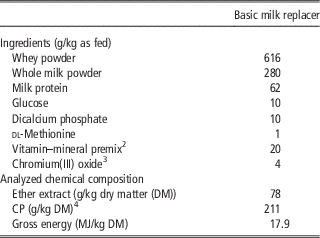
Piglets of the CON group were offered an unsupplemented milk replacer (Table 1). Those in the CAR and ARG treatments were offered the same milk replacer plus daily either 0.40 g CAR/piglet (Carniking; Lohmann Animal Health, Cuxhaven, Germany) or 1.54% ARG (on the basis of milk replacer powder; Evonik Degussa GmbH, Hanau, Germany). Supplement quantities were based on dosage level eliciting postnatal hyperplasia as observed by Lösel et al. (Reference Lösel, Kalbe and Rehfeldt2009) and based on the estimated ARG requirements of 1.08 g/kg BW for suckling piglets (Kim and Wu, Reference Kim and Wu2004) and the digestible ARG content of the milk replacer of 6.0 g/kg dry matter (DM). To make diets isonitrogenous, 5.11% of L-alanine (on the basis of milk replacer powder; Evonik Degussa GmbH) were added to the CAR treatment. Piglets were weighed daily between 0600 and 0700 h and the amount of diet was adjusted to BW considering estimated daily intake of 60 g DM/kg BW (Kim and Wu., Reference Kim and Wu2004). Each morning, the daily amount of milk powder with added CAR or ARG was mixed with tap water at a ratio of 1:4, heated to room temperature before serving, and stored at 5°C between feedings. Piglets were offered daily the experimental diets in six rations from 0700 to 2200 h every 3 h. This procedure ensured that the daily doses of CAR or ARG were also offered in six portions. They had ad libitum access to water.
Ingredients and analyzed chemical composition of the experimental dietsFootnote 1

1 In the arginine and carnitine group, milk replacer was supplemented with 1.54% l-arginine to a final concentration of 1.08 g l-arginine/kg BW and 0.40 g l-carnitine/piglet+5.11% l-alanine/kg BW per day, respectively.
2 Supplied per kg diet: 20 mg Cu; 100 mg Fe; 50 mg Mn; 275 mg Zn; 0.75 mg I; 0.75 mg Se; 20 000 IU vitamin A; 2000 IU vitamin D3; 100 mg choline; 10 mg vitamin B1; 15 mg vitamin B2; 75 mg vitamin B3; 75 mg vitamin B5; 15 mg vitamin B6; 0.005 mg vitamin B8; 2.5 mg vitamin B9; 0.1 mg vitamin B12; 325 mg vitamin E; 5 mg vitamin K3.
3 Supplemented from days 21 to 28 of the experimental period.
4 Analyzed amino acid composition of the milk replacer, g/kg dry matter: aspartic acid: 18.0; alanine: 8.0; arginine: 6.0; cysteine: 2.8; glutamic acid: 40.9; glycine: 4.2; histidine: 5.2; isoleucine: 12.0; leucine: 20.5; lysine: 18.5; methionine: 5.7; phenylalanine: 9.2; proline: 18.1; serine: 10.8; threonine: 10.7; tryptophan: 3.1; tyrosine: 8.6; valine: 13.1.
To determine apparent total tract (ATT)-energy and -nitrogen digestibility, chromium oxide (Cr2O3) (Sigma-Aldrich Chemie GmbH, Buchs SG, Switzerland), was mixed into the milk replacers at 0.4% (Table 1) as inspired by the study of Lin et al. (Reference Lin, Mahan, Wu and Kim2009), and feces samples were collected daily from each pen from days 21 to 28 and stored at −20°C until analysis. Before analysis, the eight feces samples (>100 g in total of all samples) from each pen were pooled, dried at 60°C for 48 h and ground to pass a 1 mm sieve. Three batches of milk replacer were used and samples were collected from each batch for later analysis.
Blood, muscle tissue and organ sampling
On day 28 of age, piglets were anaesthetized with an isoflurane-oxygen mixture (4% vol/vol) and euthanized by exsanguination. Blood samples were collected at exsanguination in 9 ml vacutainers (Vacuette; Greiner Bio-One GmbH, Kremsmuenster, Austria) and centrifuged at 1000×g for 15 min at 20°C. Serum was transferred to 2 ml microtubes (Treff AG, Degersheim, Switzerland) and stored at −20°C until further analysis. Immediately after exsanguination, the whole right Semitendinosus muscle (STM) was excised and weighed, and its length and circumference was measured. The circumference was used to assess the entire cross-sectional area of the STM. The STM was then dissected into the dark (STMd) and light (STMl) portion. A sample from each portion was removed from the middle of the muscle, snap frozen in 2-methylbutane cooled in liquid nitrogen and subsequently stored at −80oC until histochemical and enzyme activity analysis was performed. In addition, ~150 mg of the STMd was removed and stored in RNAlater storage solution (Qiagen, Hilden, Germany) at −20oC until RNA extraction. In addition, heart, lungs, liver, kidneys, spleen, brain and adrenal glands were collected and weighed. The left carcass side was weighed and cooled at 3°C, then cut into smaller pieces by knife, homogenized in a primary step with a meat mincer (R 2 version ‘A’; Robot Coupe SNC, Montceau en Bourgogne Cedex, France), lyophilized (Delta 1-24 LSC; Christ, Osterode am Harz, Germany), cooled with liquid nitrogen and homogenized using a Grindomix GM 200 (Retsch, Haan, Germany). As an indicator of a lasting brain-sparing-effect, which is indicative of intra-uterine growth retardation (Town et al., Reference Town, Putman, Turchinsky, Dixon and Foxcroft2004), the brain-to-STM and brain-to-liver ratio was calculated.
Analysis of diet, feces and carcasses
Dry matter content of milk replacer, feces and carcasses was determined by drying samples at 105°C for 160 min and subsequently analyzed for total ash content by a thermogravimetric analyzer (Leco TGA-601, Leco Corporation, St. Joseph, MI, USA). Gross energy content of the samples was analyzed with a bomb calorimeter (AC600 Semi-Automatic Calorimeter; Leco Corporation). Nitrogen content in diet and feces were analyzed with the Dumas method (Association of Official Analytical Chemists (AOAC), 2012) using the automated CNS elemental analyzer (TruMac Series; Leco Corporation). Nitrogen concentration in the carcasses was determined by the Kjeldahl (Kjeltec 2400/2460) method (AOAC, 2012). Crude protein concentration was calculated as 6.25×nitrogen. Ether extract concentration of milk replacer and carcasses was analyzed by acid hydrolysis (10% HCl solution; Hydrotherm HT6; C. Gerhard, Königswinter, Germany) followed by a petroleum ether extraction (Speed Extractor 916; Büchi Labortechnik AG, Flawil, Switzerland). Amino acid composition of the milk replacer was analyzed by HPLC using the 2695 Alliance Separation Module (Waters Corporation, Milford, MA, USA) coupled to the Alliance Column Heater (Waters Corporation) and the 2475 Multi-Lambda Fluorescence Detector (Waters Corporation). The Cr2O3 concentration in milk replacer and feces was determined by inductively coupled plasma optical emission spectrometry (ICP-OES), using an Optima 2000 DV ICP-OES (PerkinElmer, Waltham, MA, USA) after samples had been dry-ashed at 550°C for 4 h and mineralized at 340°C for 15 min with 4 ml of 4.5% KBrO4 and 3 ml of 80% H3PO4.
Blood serum analysis
Blood serum samples were analyzed for concentrations of glucose (Art. no. 1447513; Roche, Basel, Switzerland), urea (Art. no. 61974; BioMérieux, Marcy l’Etoile, France) and non-esterified fatty acids (NEFA; Art. no. FA 115; Randox, Crumlin, UK) according to manufactures’ protocols using a photometric autoanalyzer (BT 1500; Biotecnica Instruments, Roma, Italy). The acute phase proteins haptoglobin and C-reactive protein (CRP) were measured in 50 μl serum samples with the pig ELISA kit ab15496 and ab156477 (Abcam plc, Cambridge, UK), respectively. The concentration of free CAR was determined in deproteinized serum samples using the CAR assay kit abcam ab83392 (Abcam plc).
Histochemical analysis of the semitendinosus muscle
The areas of type I and type II myofibers and the total number of myofibers (TNF) were determined in the STM by applying histochemical procedures as described previously by Bérard et al. (Reference Bérard, Kalbe, Lösel, Tuchscherer and Rehfeldt2010). In brief, 10 μm thick cross-sections of the STMd and STMl were prepared with a cryotome (Shandon cryotome; Shandon Inc., Pittsburgh, PA, USA), mounted on glass microscopic slides (Menzel-Gläser Superfrost Plus; Gerhard Menzel GmbH, Braunschweig, Germany) and stained for the determination of myofibrillar ATPase activity after acid preincubation at pH 4.37. In both portions of the STM, type I myofibers stained dark and type II myofibers stained light. Cross-sectional area and numbers of type I and type II myofibers in both muscle portions were determined. The TNF was estimated by counting the total number of type I and type II fibers in a defined area of 0.14 mm2, and extrapolating these numbers to the total muscle area based on the STM circumference measured at slaughter. From the 30 muscle samples five (two CON, two CAR and one ARG) could not be adequately stained due to freezing damage.
Enzyme activity analysis in the semitendinosus muscle
To characterize the citric acid cycle activity, lipid oxidation and glycolytic capacity, enzyme activities of citrate synthase (CS; EC 4.1.3.7), β-hydroxyacyl-CoA dehydrogenase (HAD; EC 1.1.1.35) and lactate dehydrogenase (LDH; EC 1.1.1.27), respectively, were measured in the STMd and STMl. At first, protein was extracted from 50 to 100 μg of muscle samples stored at −80°C after lysis in 500 μl of CelLytic MT buffer (Sigma-Aldrich Chemie GmbH). The extracts were treated with Complete TM Inhibitor Cocktail Tablets (F. Hoffmann-La Roche Ltd, Rotkreuz, Switzerland), homogenized for 40 s and centrifuged at 12 000×g for 10 min at 4°C. The supernatant was stored at −80°C until further analysis. Protein concentration of the supernatant was determined with the Pierce Coomassie Plus (Bradford) Assay Kit (Thermo Scientific, Wilmington, DE, USA). The incubation solution for the determination of the HAD activity contained 97 mM potassium phosphate, 0.1 mM β-NAD, 0.09 mM S-acetoacetyl-CoA and muscle supernatant. The HAD activity was determined at 340 nm with a spectrophotometer (Biochrom WPA Biowave II; Biochrom Ltd, Cambridge, UK) as the change in light absorbance for 3 min at 37°C. The LDH and CS activities were determined with the LDH and CS BioVision Activity Colorimetric Assay Kits (Biovision Incorporated, CA, USA) according to manufacturer’s protocol. Activities of LDH and CS were measured at 450 nm for 10 min and at 412 nm for 30 min, respectively. Samples were standardized per milligram protein and activity expressed as substrate degradation in μmol/min.
Gene expression analysis in the dark portion of the semitendinosus muscle
Total RNA was extracted from STMd stored in RNAlater using the Sigma GenElute mammalian Total RNA MiniPrep Kit (Sigma-Aldrich Chemie GmbH). Before column purification, tissues were treated with proteinase K in order to assure a complete lysis, and a deoxyribonuclease I-digestion step during RNA purification was included to avoid contaminations with genomic DNA. All RNA extraction steps were performed according to the manufacturer’s protocol. The concentration of RNA was assessed using the NanoDrop spectrophotometer (NanoDrop 2000c UV-Vis Spectrophotometer; Thermo Scientific). The RNA quality was assessed by capillary electrophoresis using a fragment analyzer (Advanced Analytical Technologies Inc, Ankeny, IA, USA), and by measuring the absorbance ratio at 260/280 nm which was 1.82 to 2.29. The complementary DNA (cDNA) reverse transcription was performed using the ImProm-II Reverse Transcription System (Promega, Dübendorf ZH, Switzerland) with 1 μl of an oligo(dT) primer in a final volume of 20 μl and otherwise in accordance with manufacturer’s protocol (Technical Manual – ImProm-II Reverse Transcription System). The reverse transcription reaction was performed under the following conditions: 5 min at 25°C, 60 min at 42°C and 15 min at 72°C. Following reverse transcription, the cDNA was used to assess gene expression by quantitative PCR (qPCR). The qPCR primers were designed using the Primer-BLAST at the NCBI website (http://www.ncbi.nlm.nih.gov/tools/primer-blast) and subsequently purchased from Microsynth AG (Balgach, Switzerland). The sequences of the primers are listed in the Supplementary Table S1. Except for the primer of protein kinase, AMP-activated, α 2 catalytic subunit, which was chosen from the study of Lin et al. (Reference Lin, Flisikowski, Schwarzenbacher, Scharfe, Severitt, Blöcker and Fries2010), primers for myogenesis and proteasome related genes were based on the studies of Rehfeldt et al. (Reference Rehfeldt, Lefaucheur, Block, Stabenow, Pfuhl, Otten, Metges and Kalbe2012) and Keller et al. (Reference Keller, Ringseis, Koc, Lukas, Kluge and Eder2012), respectively. All reactions were carried out in duplicate with an Eco Real-Time PCR System (Illumina, San Diego, CA, USA) in a reaction volume of 20 μl. The expression of the genes was assessed with SYBR green technology with the following reaction mix: 10 μl of Kapa SYBR® Fast Universal 2× qPCR Master Mix (Kapa Biosystems, Wilmington, MA, USA), 7.2 μl of nuclease-free water and 0.8 μl of a water-diluted mix containing 5 μM forward and reverse primer and 2 μl of cDNA (~1 ng) were added as a template. The thermal profile was as follows: 5 min of activation at 95°C, followed by 40 cycles of a two-step PCR with 10 s denaturation at 95°C and 30 s combined annealing and extension at 51°C to 67°C depending on the primer pair used (Supplementary Table S1). Gene expression was calculated as the relative expression of target genes in relation to two reference genes, TATA binding protein (Erkens et al., Reference Erkens, Van Poucke, Vandesompele, Goossens, Van Zeveren and Peelman2006) and ribosomal protein L4 (Nygard et al., Reference Nygard, Jørgensen, Cirera and Fredholm2007), using the ΔΔC t -method corrected for amplification efficiency (Hellemans et al., Reference Hellemans, Mortier, De Paepe, Speleman and Vandesompele2007). Observed relative expressions were normalized to a reference sample. Reference genes for the STM were determined using the geNorm algorithm (Vandesompele et al., Reference Vandesompele, De Preter, Pattyn, Poppe, Van Roy, De Paepe and Speleman2002), and proved to have a stable expression in all the animals used in this study (data not shown).
Statistical analysis
All data were tested for normality of residuals using the Univariate procedure of SAS (version 9.2; SAS Institute Inc., Cary, NC, USA). Initially BtW and BW at day 7 were analyzed as response variables to test whether they would need to be included as covariables for the growth performance data. This was not the case because neither of them were significant. The weekly determined BW (days 7, 14, 21 and 28) and average daily gain (ADG) (weeks 1, 2 and 3 corresponding to days 7 to 14, 14 to 21 and 21 to 28, respectively) were analyzed with the MIXED procedure, the repeated statement and the first-order autoregressive covariance structure. Dietary treatment (CON, ARG, CAR), sex (barrows, gilts), day or week and the two- and three-way interactions were included as fixed effects, dam nested within farrowing series as random effect and animal was the experimental unit. A similar model was applied for the data on average daily feed intake (ADFI) and gain-to-feed ratio (G:F). However, because ADFI, G:F, ATT-energy and -nitrogen digestibility were determined per pen, for these data sex was omitted and in the final model dietary treatment, week and the two-way interaction were used as fixed effects, farrowing series as random effect and pen was the experimental unit. Data on organ weights, carcass nutrient and energy content, blood serum metabolites, muscle histology, enzyme activity and gene expression were analyzed with the MIXED procedure using dietary treatment (CON, ARG, CAR), sex, dietary treatment×sex interaction as fixed, dam nested within farrowing series as random effect and animal was the experimental unit. The P-value for differences of the LS-means (PDIFF) option with the Tukey adjustment was used to evaluate differences among treatment groups. Differences were considered significant at P<0.05 and as tendencies at P<0.10.
Results
Performance and apparent total tract-energy and -protein digestibility
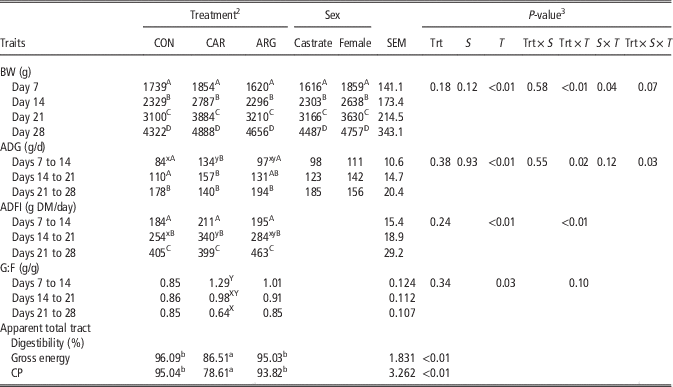
Birth weight (CON: 1.049 kg; CAR: 1.028 kg; ARG: 1.036 kg; P=0.942; SEM=0.0430) and ADG from birth to day 7 (CON: 106 g/d; CAR: 133 g/d; ARG: 106 g/d; P=0.464; SEM=19.0) did not differ between treatments. Within treatments, BW and ADFI increased (P<0.05) weekly (Table 2). As evidenced by the treatment×time interaction (P<0.05) a more steady temporal BW development of CAR compared with CON and ARG piglets was observed. This difference was reflected in the fact that in the 1st experimental week piglets of the CAR tended (P<0.10) to grow faster compared with those of the CON, but not ARG group. Within experimental groups, ADG was greater from days 21 to 28 compared with the period from days 7 to 14 in CON and ARG but not CAR piglets (treatment×time interaction; P<0.05). This coincided with the lower (P<0.01) ATT-energy and -protein digestibility of the CAR piglets (Table 2). From days 14 to 21, ADFI tended to be greater (treatment×time interaction; P<0.05) in CAR compared with CON, but not ARG piglets. In accordance with the growth performance and feed intake data, CAR but not CON and ARG piglets, tended to more feed efficient from days 7 to 14 than from days 21 to 28 (treatment×time interaction; P<0.10).
Effect of supplementing the milk replacer fed to early weaned low birth weight pigs born from hyperprolific sows with either l-carnitine or l-arginine on growth performance and apparent total tract-energy and -protein digestibilityFootnote 1

ADG=average daily gain; ADFI=average daily feed intake; DM=dry matter; G:F=gain-to-feed ratio.
a,b Within a row for the main factor treatment, least squares means without a common superscript differ (P<0.05).
x,y Within a row for the main factor treatment, least squares means without a common superscript differ (P<0.10).
A,B,C,D Within a column for the main factor treatment, least squares means without a common superscripts differ (P<0.05).
X,Y Within a column for the main factor treatment, least squares means without a common superscripts differ (P<0.10).
1 Results are presented as least squares means and pooled SEM of the main factors treatment and sex.
2 CON=control (unsupplemented); CAR=0.40 g l-carnitine/piglet+5.11% l-alanine/kg BW per day; ARG=1.08 g l-arginine/kg BW per day.
3 Probability values for the effects of the dietary treatment (Trt), sex (S), time (T), and Trt×S, Trt×T, S×T and Trt×S×T interactions.
Within sex, weekly assessed BW tended to increase faster in female pigs compared with castrates (sex×time interaction; P<0.10). A treatment×sex×time interaction (P<0.07) for BW and ADG was observed. However, the Tukey post hoc multiple comparison test did not indicate any significant differences between these three main factors.
Muscle morphometric measurements, organ weights and carcass traits
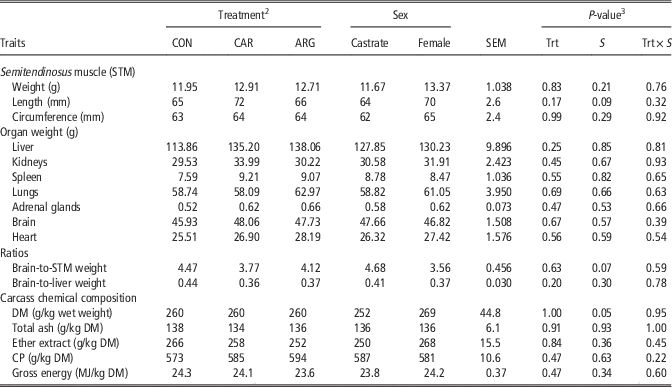
The supplements had no effect on muscle and organ weights (Table 3). The STM tended (P<0.10) to be shorter in castrates compared with female piglets, which corroborates with the numerically lower weight and smaller circumference of the STM. The brain-to-STM weight ratio tended (P<0.10) to be greater in castrates than female piglets. The concentrations of ash, fat, CP and energy of the whole carcass did not differ between dietary treatments (Table 4). Apart from a greater (P<0.05) DM content of carcasses from females compared with castrates, nutrient and energy content of the carcasses did not differ.
Weight of the organs and Semitendinosus muscle as well as carcass chemical composition at 28 days of age of early weaned low birth weight pigs born from hyperprolific sows fed a milk replacer supplemented with either l-carnitine or l-arginineFootnote 1

DM, dry matter.
1 Results are presented as least squares means and pooled SEM of the main factors treatment and sex.
2 CON=control (unsupplemented); CAR=0.40 g l-carnitine/piglet+5.11% l-alanine/kg BW per day; ARG=1.08 g l-arginine/kg BW per day.
3 Probability values for the effects of the dietary treatment (Trt), sex (S) and Trt×S interactions.
Effect of supplementing the milk replacer fed to early weaned low birth weight pigs born from hyperprolific sows with either l-carnitine or l-arginine on concentrations of blood serum metabolitesFootnote 1

a,b Within a row, treatment means without a common superscript differ (P<0.05).
x,y Within a row, treatment means without a common superscript differ (P<0.10).
1 Results are presented as least squares means and pooled SEM of the main factors treatment and sex.
2 CON=control (unsupplemented); CAR=0.40 g l-carnitine/piglet + 5.11% l-alanine/kg BW per day; ARG=1.08 g l-arginine/kg BW per day.
3 Probability values for the effects of the dietary treatment (Trt), sex (S) and Trt×S interactions.
Blood serum metabolites
Serum glucose concentration measured on day 28 of age tended (P<0.10) to be greater in CAR than ARG piglets with intermediate values for CON piglets (Table 4). Furthermore, greater serum glucose levels were determined in CAR females and CON castrates compared with CAR castrates and CON females, respectively, whereas no sex differences were found in the ARG group (treatment×sex interaction; P=0.06). The NEFA concentration tended (P<0.10) to be greater in ARG than in CON and CAR piglets. Serum urea concentration was greatest (P<0.05) in CAR and lowest in CON piglets with intermediate values for ARG piglets and tended (P<0.10) to be lower in castrates than female pigs. The concentration of free CAR in serum was greater (P<0.05) in CAR compared with CON piglets.
Regarding acute phase proteins, only three animals (one and two from CAR and ARG, respectively) displayed CRP concentrations (min. 1.7 to max. 3.5 ng/ml) above the detection limit of the assay (2.2 ng/ml). The haptoglobin levels above detection limits of the assay (3.1 ng/ml) were measured in six, seven and four animals of the CON, CAR and ARG group, respectively, and ranged for these piglets from 0.03 to 0.79 μg/ml. Therefore, no statistical analysis was performed.
Myofiber-related traits and enzyme activity in Semitendinosus muscle
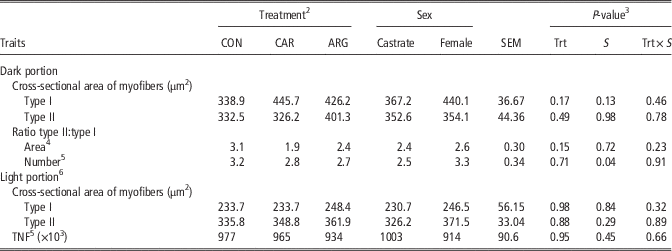
Type I and type II myofiber area of the STM were not affected by the dietary treatments and sex, except for a greater (P<0.05) ratio of type II:type I myofiber number in the STMd of females compared with castrates (Table 5).
Effect of supplementing the milk replacer fed to early weaned low birth weight pigs born from hyperprolific sows with either l-carnitine or l-arginine on myofiber-related traits in the dark and light portion of the Semitendinosus muscleFootnote 1

TNF=total number of myofibers in the Semitendinosus muscle.
1 Results are presented as least squares means and pooled SEM of the main factors treatment and sex.
2 CON=control (unsupplemented); CAR=0.40 g l-carnitine/piglet+5.11% l-alanine/kg BW per day; ARG=1.08 g l-arginine/kg BW per day.
3 Probability values for the effects of the dietary treatment (Trt), sex (S) and Trt×S interactions.
4 Area ratio is expressed as the summed area of type II fibers relative to the summed area of type I fibers in a defined area of 0.14 mm2 of the Semitendinosus muscle dissected into the dark (STMd).
5 Number ratio is expressed as the total number of type II fibers relative to the total number of type I fibers in a defined area of 0.14 mm2 of STMd.
6 As only a few type I fibers are present in the light portion of STM, type II:type I area and number ratios of this portion is not reported.
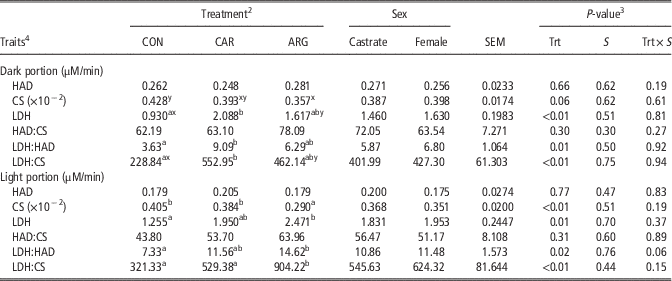
With respect to HAD activity no treatment effect was found (Table 6). The CS activity, an indicator of overall muscle oxidative capacity, was greater (P<0.05) in the STMl and tended (P<0.10) to be greater in the STMd, respectively, of CON than ARG piglets with intermediate values for the CAR group. With respect to the glycolytic capacity, the STMd of CAR and ARG piglets, respectively, expressed greater (P<0.05) and tended (P<0.10) to express greater LDH activity compared with CON piglets. In the STMl, LDH activity was greater (P<0.05) in ARG than CON piglets. No differences were observed between castrates and female pigs in the activity of the enzymes investigated in the STM.
Effect of supplementing the milk replacer fed to early weaned low birth weight pigs born from hyperprolific sows with either l-carnitine or l-arginine on metabolic enzyme activities in the dark and light portion of the Semitendinosus muscle characterizing citric acid cycle activity (CS=citrate synthase), lipid oxidation (HAD=β-hydroxyacyl-CoA dehydrogenase) and glycolytic capacity (LDH=lactate dehydrogenase)Footnote 1

a,b,c Within a row, treatment means without a common superscript differ (P<0.05).
x,y Within a row, treatment means without a common superscript differ (P<0.10).
1 Results are presented as least squares means and pooled SEM of the main factors treatment and sex.
2 CON=control (unsupplemented); CAR=0.40 g l-carnitine/piglet+5.11% l-alanine/kg BW per day; ARG=1.08 g l-arginine/kg BW per day.
3 Probability values for the effects of the dietary treatment (Trt), sex (S) and Trt×S interactions.
4 Samples were standardized per milligram protein and activity expressed as μM of substrate degraded per min. The HAD:CS, LDH:HAD and LDH:CS ratios characterize the portion of lipid oxidation to total oxidative capacity, the portion of glycolytic capacity to lipid oxidation capacity and the portion of glycolytic capacity to total oxidative capacity, respectively.
The HAD:CS ratio as an indicator of the relative importance of lipid oxidation over overall muscle oxidation capacity was not altered by the dietary supplements (Table 6). On the contrary, in the STMd CON piglets had lower (P<0.05) LDH:HAD and LDH:CS ratio compared with CAR piglets, and also tended to have lower (P<0.10) LDH:CS ratio compared with ARG piglets. Furthermore, in the STMl the LDH:HAD ratio was lower (P<0.05) in CON compared with ARG piglets, and the LDH:CS ratio was lower (P<0.05) in CON and CAR compared with ARG piglets. None of the aforementioned ratios were affected by sex.
Gene expression in Semitendinosus muscle
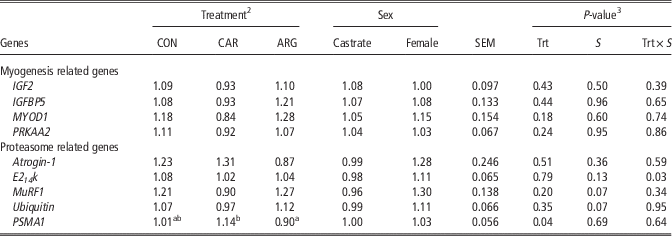
The mRNA expression level of the proteasome subunit alpha type 1 (PSMA1) in the STMd was greater (P<0.05) in CAR than ARG piglets with intermediate values in CON piglets (Table 7). The expression of the other genes related to myogenesis and proteasome were not altered by the dietary treatments. Compared with castrates, female piglets tended (P<0.10) to show greater tripartite motif-containing 63 (MuRF1) and Ubiquitin B (Ubiquitin) expression levels, whereas the expression levels of the other genes were not affected by sex. In addition, mRNA expression level of ubiquitin-conjugating enzyme E2B (E214k) was greater in females compared with males of the CON (1.29 v. 0.88) and CAR (1.09 v. 0.94) group, but was lower in ARG females compared with ARG castrates (0.95 v. 1.13; treatment×sex interaction, P<0.05).
Effect of supplementing the milk replacer fed to early weaned low birth weight pigs born from hyperprolific sows with either l-carnitine or l-arginine on the relative expression of myogenesis and proteasome related genes in the dark portion of the Semitendinosus muscleFootnote 1

IGFBP5=IGF binding protein 5; MYOD1=Myogenic differentiation-1; PRKAA2=Protein kinase, AMP-activated, α 2 catalytic subunit; Atrogin-1 (FBXO32)=F-box protein 32; E214k=Ubiquitin-conjugating enzyme E2B; MuRF1 (TRIM63)=Tripartite motif-containing 63; UBB (Ubiquitin)=Ubiquitin B; PSMA1=Proteasome (prosome, macropain) subunit, α type, 1. Reference genes used: RPL4 (LOC100038029)=Ribosomal protein L4; TBP=TATA box binding protein.
The cycle threshold (C t ) value for RPL4 and TBP did not (P<0.05) differ between dietary treatments and sex.
1 Results are presented as least squares means and pooled SEM of the main factors treatment and sex.
2 CON=control (unsupplemented); CAR=0.40 g l-carnitine/piglet + 5.11 l-arginine/kg BW per day; ARG=1.08 g l-arginine/kg BW per day.
3 Probability values for the effects of the dietary treatment (Trt), sex (S) and Trt×S interactions.
Discussion
Due to selection for high prolific sows in the commercial pig production, average piglet BtW has decreased and within-litter variation of BtW has increased (Wolf et al., Reference Wolf, Žáková and Groeneveld2008). This in turn resulted in a greater proportion of piglets subjected to intra-uterine growth retardation (Pardo et al., Reference Pardo, Bérard, Kreuzer and Bee2013b), accompanied not only by low BtW but also by impaired muscle maturity at birth (Lefaucheur, Reference Lefaucheur2001). Compared with their heavier littermates, these piglets display lower early-life survival rates (Paredes et al., Reference Paredes, Jansman, Verstegen, Awati, Buist, den Hartog, Van hees, Quiniou, Hendriks and Gerrits2012). Hence, novel approaches to rear and feed the increasing number of L-BtW piglets are needed in order to improve their viability and performance, especially in the early postnatal period. In view of the claimed suboptimal concentration of ARG in mature sow milk compared with the requirement of the young piglet, Yao et al. (Reference Yao, Yin, Chu, Liu, Deng, Li, Huang, Zhang, Tan, Wang and Wu2008) studied the effect of ARG supplementation on growth and muscle protein synthesis of artificially reared piglets. Their results were promising as they showed that ARG supplementation increased mTOR signaling activity in the muscle, which correlates with stimulated muscle protein synthesis and greater weight gain. This is however in contrast to a more recent effort, which in fact revealed detrimental effect of ARG supplementation on growth of especially L-BtW piglets (Getty et al., Reference Getty, Almeida, Barrata and Dilger2015). In another study, Lösel et al. (Reference Lösel, Kalbe and Rehfeldt2009) reported increased muscle development of pre-weaned L-BtW piglets supplemented with a daily oral dose of CAR. The latter result even suggested that postnatal hyperplasia occurred, which would be beneficial especially for L-BtW pigs known to have lower myofiber number at birth (Wigmore and Stickland, Reference Wigmore and Stickland1983). However, in the aforementioned studies the piglets used were not specifically selected from hyperprolific sows and, thus, it is not clear whether or not they suffered from intra-uterine growth retardation. In light of this, it seemed relevant to examine whether the two dietary supplements had a similar potential to improve the development of L-BtW piglets from hyperprolific sows. The major finding of the present study is that, despite the lack of clear effects of the dietary supplements on growth and myofiber hyperplasia and hypertrophy, metabolism of the muscle appeared to be more like that of mature muscles in CAR and ARG compared with CON piglets as supported by the greater relative importance of the glycolytic capacity in the STM. This observation could prove to be beneficial for piglets in their later grower and finisher phase.
Growth performance and carcass development
Comparing the two supplements with respect to daily gain, CAR appeared to promote growth in the first 2 experimental weeks. However, in the last week CAR piglets grew slowest which coincided with the lower ATT-energy and -protein digestibility found in this period. Although the average number of antibiotic treatments necessary to overcome diarrhea problems between groups was similar within the 28 day, an accumulation of this problem was observed in the last week in the CAR treatment, which may explain the impaired growth and the lower ATT-energy and -protein digestibility. Despite these challenges, all piglets adapted to the artificial rearing strategy, as supported by the significant increase in BW and ADFI throughout the experimental period.
Blood serum metabolites
As by experimental design, free CAR serum concentration was greater in pigs from the CAR compared with the CON group. Serum ARG levels were not measured as the concentration returns to the baseline level 6 h after supplementation (Wu G., personal communication). Serum NEFA concentration was found to be greatest in ARG, indicating greater mobilization of fatty acids from adipose tissue compared with CON and CAR. Although expected to increase after the 10-h fasting period before slaughter and regardless of dietary treatment, the values were 50% lower than those reported by Lösel et al. (Reference Lösel, Kalbe and Rehfeldt2009). Serum urea was lowest in CON animals and was greater in CAR compared with ARG piglets even though the diets of the latter two groups were isonitrogenous, whereas the former observation was in contrast to what was observed by Kim and Wu (Reference Kim and Wu2004). However, in that experiment compared with the present study, high BtW and not low BtW piglets were used. The increased serum urea level, an indicator for excess dietary protein used for gluconeogenesis in the liver rather than for body protein synthesis, coincides with the tendency to greater glucose level of CAR compared with ARG. This might be a response to an increased energy demand due to the reduced ATT-energy and -protein digestibility. With regard to both supplements it was unexpected that no greater impact on the serum metabolites was observed, as CAR is known to affect serum NEFA concentration and ARG play a major role in the nitric oxide among other pathways involved in metabolism of energy substrates (Rincker et al., Reference Rincker, Carter, Real, Nelsen, Tokach, Goodband, Dritz, Senne, Fent, Pettey and Owen2003; Jobgen et al., Reference Jobgen, Fried, Fu, Meininger and Wu2006). To better understand the systemic effect of the supplements, it is for future studies advisable to sample blood at birth and more frequently during the experimental period (e.g. weekly) to monitor the metabolite profile over time. In contradiction to the occurrence of diarrhea, the acute phase proteins haptoglobin and CRP were either undetectable or very low in concentration compared with observations in healthy piglets from previous studies (0.83 mg/ml and 22 μg/ml, respectively; Pomorska-Mol et al., Reference Pomorska-Mol, Markowska-Daniel, Kwit, Stepniewska and Pejsak2013), suggesting that no acute inflammation was present in the animals at the time of slaughter.
Myofiber properties in Semitendinosus muscle
Impaired myofiber hyperplasia is generally considered to be a major cause for poor postnatal growth efficiency of L-BtW piglets compared with their heavier littermates (Madsen and Bee, Reference Madsen and Bee2015). Carnitine is of particular interest in this matter as it has been shown to promote myofiber hyperplasia early postnatal in L-BtW piglets (Lösel et al., Reference Lösel, Kalbe and Rehfeldt2009). The increase in myofiber number together with the greater DNA concentration and DNA:protein ratio suggested an intensified myogenic proliferation. In the present study, we could not confirm these effects as there was no increase in myofiber size or TNF in the CAR and ARG compared with the CON treatment. This is also supported by the lack of difference in myofiber area together with the lack of difference in muscle circumference between dietary treatments. However, regardless of dietary treatment, TNF of the STM was ~27% greater on day 28 of age compared with the TNF of the STM determined by Pardo et al. (Reference Pardo, Mueller, Bérard, Kreuzer and Bee2013a) in newborn L-BtW piglets originating from the same sow herd. This suggests that a third wave of hyperplasia occurred as was hypothesized by Bérard et al. (Reference Bérard, Pardo, Bethaz, Kreuzer and Bee2011).
Enzymatic activity and gene expression in Semitendinosus muscle
The most pronounced effect of the supplementation was found on the level of enzymatic activity. Especially in the STMl the CS activity was lower in ARG piglets. This indicates that ARG may be capable of increasing the rate to which the muscle matures, as the activity of mitochondrial enzymes decreases with age (Rooyackers et al., Reference Rooyackers, Adey, Ades and Nair1996). Consistent with this observation, a tendency to a decrease in CS activity was also observed in STMd, which, compared with the STMl, has more mitochondria. On the contrary, LDH activity was greater in CAR and tended to be greater in ARG compared with CON in the STMd, and was greater in ARG compared with CON in the STMl. In fatty acid β-oxidation, HAD and CAR play a crucial role as a catalyst (Wakil et al., Reference Wakil, Green, Mil and Mahler1954) and as a transporter of long chain fatty acids across the inner mitochondrial membrane (Roe and Ding, Reference Roe and Ding2001), respectively. Unexpectedly, in the present study CAR supplementation only numerically increased HAD activity in the STMl.
The enzyme activity ratios LDH:CS and LDH:HAD can be used as markers for muscle maturity as they reflect the relative importance of glycolytic compared with oxidative metabolism in muscle according to Lefaucheur et al. (Reference Lefaucheur, Ecolan, Barzic, Marion and Le Dividich2003). Thus, a shift towards a greater glycolytic metabolism points towards a greater muscle maturity (Picard et al., Reference Picard, Lefaucheur, Berri and Duclos2002). In the present study, the greater LDH:HAD and LDH:CS ratios in STMd were observed in CAR as well as in ARG and CAR piglets, respectively. Furthermore, in STMl ARG piglets displayed greater ratio of LDH:CS compared with both CON and CAR piglets and of LDH:HAD compared with CON piglets. These observations indicate that CAR and ARG supplementation promoted a shift towards a greater glycolytic metabolism.
Only numerical differences in expression levels of selected myogenesis related genes between ARG and CON and CAR groups was observed. Although PSMA1 was found to be significantly lower expressed in ARG compared with CAR, expression level was not different from the CON group. This gene is involved in the ubiquitin proteasome system which is upregulated during protein breakdown in muscle tissue (Mitch and Goldberg, Reference Mitch and Goldberg1996). In broiler hens, the expression level of PSMA1 has been shown to be unaffected by protein and energy intake (Ekmay et al., Reference Ekmay, Salas, England, Cerrate and Coon2013). In contrast to the result of the present study PSMA1 was influenced by CAR supplementation by lowering PSMA1 expression compared with unsupplemented piglets (Keller et al., Reference Keller, Ringseis, Koc, Lukas, Kluge and Eder2012). On the contrary, in the CAR group other proteasome related genes like E2 14 k, MuRF1 and Ubiquitin were all found to display lowest level of expression, which is comparable with expression levels observed by Keller et al. (Reference Keller, Ringseis, Koc, Lukas, Kluge and Eder2012). Together with no difference in expression levels of the myogenesis related genes, this indicates that no overall greater protein accretion is occurring in the STMd.
Only few traits showed an interaction between treatment and sex. These cases indicate different impact of supplementation in the individual sexes. Among these traits, it appears that supplementation had a different but overall greater impact on females than castrates as indicated by numerically greater carcass DM, blood glucose concentration and LDH:HAD ratio. However, these interactions were too scarce and too small to be considered relevant for a sex dependent supplementation scheme.
In conclusion, piglets supplemented with CAR showed minor improvements with greater numerical periodic growth performance. A certain indication for an altered expression of a gene related to protein synthesis was observed in pigs fed ARG supplemented milk replacer, whereas both, CAR and ARG supplements appeared to promote muscle maturation. Whether this has a long-term effect resulting in improved growth rate in the starter, grower and finisher period needs further studies.
Acknowledgments
The authors would like to thank Guy Maikoff and his staff for their excellent work in the piggery, and the staff of the laboratory for their valuable support. This study is part of ECO-FCE and has received funding from the European Union’s Seventh Framework Program for Research, Technological Development and Demonstration.
Supplementary Material
To view supplementary material for this article, please visit https://doi.org/10.1017/S175173111700132X