Introduction
There is a growing interest in the nascent field of ‘nutritional psychiatry’ and the potential for nutritional interventions to help improve mental health problems (Jacka, Reference Jacka2017). In particular, there is increasing attention to the question of whether nutritional supplementation may reduce conduct problems in children, and also antisocial/aggressive behavior in adults. This attention has been partly stimulated by correlational findings from longitudinal studies showing that poor nutrition is associated with antisocial behavior. Poor nutritional status in 1795 3-year olds from Mauritius reflecting deficiencies in protein, iron, and zinc has been shown to predispose to aggressive and antisocial behavior at ages 8, 11, and 17 years (Liu et al. Reference Liu2004). Poor nutrition during pregnancy reflecting reduced micronutrients (potentially folate) has been found to predispose to antisocial personality disorder in adulthood in the Netherlands (Neugebauer et al. Reference Neugebauer, Hoek and Susser1999), documenting that poor nutrition even prior to birth has long-lasting effects. These studies that extend into late adolescence and adulthood provide the premise that poor nutritional status may be a risk factor for antisocial behavior.
There has in parallel been growing interest in the specific relationship between the nutrient omega-3 (ω-3) and aggression in children, and violence in adulthood. Fish consumption has been negatively associated with cross-country homicide rates (Hibbeln, Reference Hibbeln2001). Although homicide is an extreme form of violence, and while cross-country differences do not speak to individual difference within countries, one recent meta-analysis of 13 correlational studies found that increased aggression in children and adults is associated with reduced blood ω-3 levels, although the effect size was small (Gajos & Beaver, Reference Gajos and Beaver2016). As such, there is growing support for a small but significant association between reduced ω-3 and increased aggression.
The ω-3/aggression correlation raises the question of whether this association is causal. Animal research has documented that depriving rats of ω-3 results in increased aggression (DeMar et al. Reference DeMar2006). In humans, this question can be addressed using randomized controlled trials (RCTs). In one intervention, Mauritian children at 3–5 years were randomly selected for a nutritional intervention that included 2.5 extra portions of fish per week, combined with cognitive stimulation and exercise, and then matched to a control group. The intervention not only matured brain functioning by 1.1 years at age 11 years (Raine et al. Reference Raine2001), but also reduced criminal offending by 34% at age 23 years (Raine et al. Reference Raine2001, Reference Raine2003; Raine, Reference Raine2013). In adults, RCTs have shown that ω-3, multivitamin, and mineral supplementation reduced aggressive offending in both young adult English prisoners (Gesch et al. Reference Gesch2002) and also in Dutch young adult offenders (Zaalberg et al. Reference Zaalberg2010). These findings, taken together, suggest that ω-3 supplementation could be helpful in reducing externalizing behaviors, albeit at a relatively modest level.
Three broad questions remain unanswered. The first concerns the form of aggression that ω-3 can attenuate. An important distinction in the literature on aggression lies between reactive aggression, which is impulsive, emotional, and ‘hot-blooded’, and proactive aggression, which is planned, regulated, and ‘cold-blooded’ (Scarpa et al. Reference Scarpa, Haden and Tanaka2010). To the extent that ω-3 has been shown to reduce impulsive behavior, one might anticipate that ω-3 supplementation may be more efficacious for reactive, impulsive aggression. Only two ω-3 RCT intervention studies appear to have addressed this question. The first RCT from Mauritius documented significant reductions in both forms of aggression (Raine et al. Reference Raine2015). The second RCT from the USA documented significant reductions in reactive but not proactive aggression (Raine et al. Reference Raine2016). The ω-3 supplementation may therefore be expected to be somewhat more effective for reactive than proactive aggression, although efficacy for proactive aggression cannot be ruled out.
Second, to our knowledge, only two prior RCTs on antisocial/aggressive/externalizing behavior have followed up participants to assess if any treatment effects are sustained after supplementation ends (Raine et al. Reference Raine2015, Reference Raine2016), and neither were on a clinic-referred sample. From a clinical standpoint, an important question concerns whether ω-3 supplementation effects, if they have any efficacy, can to be sustained over time.
The third issue concerns whether ω-3 supplementation could reduce aggressive and antisocial behavior when used as an adjunct to more traditional psychological interventions, including cognitive–behavioral therapy (CBT) and social skills training. Surprisingly only one study has addressed this issue (Raine et al. Reference Raine2016). Children drawn from the community in the USA were randomized into CBT alone, ω-3 alone (3 months’ treatment duration), combined ω-3 + CBT, and treatment-as-usual controls. The combined treatment group showed significant reductions in externalizing behavior 3 months’ post-treatment, although this reduction was not sustained 9 months’ post-treatment. It remains to be seen therefore whether ω-3 supplementation combined with a psychosocial intervention could more effectively reduce externalizing behavior problems, and whether such effects could carry over from a community-based sample to a clinical sample receiving standard clinical treatment.
The current study aimed to address these three questions in an RCT of clinic-referred children, with reactive aggression as the primary outcome. In doing so, it attempted to improve on the methodological rigor of many prior studies by using a relatively robust experimental design, repeated assessments over time, combining different treatment regimens, using a longer treatment duration, and employing longer term follow-up of treatment efficacy within a clinical context.
Methods
Trial design
This consisted of a randomized, double-blind, stratified, placebo-controlled, 2 × 2 factorial trial of children attending a child guidance clinic. Children were randomized to four study groups: ω-3 only (n = 67), social skills + placebo capsules only (n = 66), ω-3 + social skills (n = 75), and treatment-as-usual + placebo capsules controls (n = 74). All groups received treatment-as-usual (see below). The trial design remained unchanged throughout the study.
Participants
Eligibility criteria
Participants consisted of 282 children from an outpatient psychiatric clinic (the Child Guidance Clinic, Singapore). All had been given a primary diagnosis of an externalizing behavior disorder (oppositional defiant disorder (ODD); conduct disorder (CD); attention-deficit hyperactivity disorder (ADHD)) using the Computerized Diagnostic Interview Schedule for Children (C-DISC)). Diagnoses were made by a clinician and validated through the C-DISC structured interview by a trained research assistant. Other inclusion criteria consisted of an IQ score above 70, no prior serious head injury, no history of epilepsy (obtained from the parent by a clinician), aged 7–16 years, willing to participate in an RCT, residing in the community, and no seafood allergy. Participants were selected from a larger baseline sample of 846 clinic-referred children. Participants received an allowance of $30 for travel and refreshments. Written informed consent was obtained from the caregiver, while assent was obtained from the child. Ethical approval was obtained from both institutional and hospital group review boards (CRC 240/2008; DSRB A/08/410). The authors assert that all procedures contributing to this work comply with the ethical standards of the relevant national and institutional committees on human experimentation and with the Helsinki Declaration of 1975, as revised in 2008.
Study setting
Data collection and social skills training took place in clinical interview rooms at the Child Guidance Clinic. The study was registered in ClinicalTrials.gov under the identifier NCT00819429.
Nutritional and social skills interventions
The ω-3 supplementation
The ω-3 daily supplements consisted of four white-colored, soft, gelatin, oval, 500 mg capsules. Each capsule contained primarily marine fish oil concentrate (fatty acid profile: 151 mg EPA, 102.8 mg DHA, 29.8 mg oleic acid, 26.6 mg DPA, 119.3 mg other fatty acids, and 29.4 mg minor components) and 5.6 mg vitamin E. Each capsule contained 102.8 mg of DHA, 26.6 mg of DPA, and 151 mg of EPA, for a total daily dosage of 1.12 g of ω-3 (411.2 mg DHA, 106.4 mg DPA, and 604 mg of EPA). This dose is higher than the dose (300 mg DHA and 200 mg of EPA) we had previously used in our prior study of impulsive aggressive behavior (Raine et al. Reference Raine2015).
Placebo capsules were matched for color, size, and texture, and were filled primarily with high oleic sunflower oil (fatty acid profile: 74.4% oleic acid; 11.7% linoleic acid; ⩽5% other fatty acids including α-linolenic acid, stearidonic acid, EPA, DPA n-3, DHA, and 0.2% minor components) and 5.7 mg vitamin E. They also contained marine fish oil to provide a fish odor and taste, but at trace levels that were not expected to have significant physiological effects (total daily dosage of 27.6 mg ω-3, consisting of 9.2 mg DHA, 16.4 mg EPA, and 2 mg DPA n-3). Both ω-3 and placebo capsules were purchased from Efamol Limited (Surrey, UK), with capsules prepared in unlabeled, unit-dose blister packs.
Social skills training
This comprised a manualized training protocol of 12 weekly 1-h sessions, supplemented with weekly homework tasks (Ooi et al. Reference Ooi, Ang and Lim-Ashworth2015). An earlier version of this program documented significantly lower levels of aggression and parental stress at post-treatment and at 3-month follow-up in clinic-referred children with disruptive behavior disorders in Singapore, compared with a treatment-as-usual control group (Ooi et al. Reference Ooi2007). This specific program was selected for use as few if any other skills programs have been developed in Singapore showing treatment efficacy.
Four booster sessions were scheduled at 3-week intervals after the initial treatment period of 12 weeks, for a total duration of 24 weeks. Throughout 12 sessions, children were taught empathy, prosocial skills, and a variety of positive coping techniques for problem-solving, emotional regulation, conflict resolution, and anger management using practical strategies, materials, activities, role-play, and games. The program was tailored and appropriately modified for children aged 9–12 years and for adolescents aged 13–16. The therapist was a psychologist at the Child Guidance Clinic with expertise and training in the social skills intervention and the protocol.
Treatment duration and administration
Treatment duration for both ω-3 and social skills interventions was 6 months. All treatment groups received treatment-as-usual by clinicians once a month which included, in addition to psychotropic medication, parent management training in which parents were taught behavior and parenting techniques, as well as referral to parent support groups. For only the ω-3 + social skills group, ω-3 supplementation began 3 months prior to the first skills session following the rationale that any initial neural enhancement from ω-3 could potentially facilitate receptivity to skills training. In this group, ω-3 supplementation began as baseline (month 0) and social skills began at month 3. No changes were made to trial outcomes after treatment commenced. The nutritional supplements were administered by the parents to their children at any suitable time.
Outcome measures, IQ, and medication status
All parent-reported and child-reported outcome measures were administered in English at 0 months (pre-treatment baseline), 3, 6 months (end of treatment), 9 months (3 months’ post-treatment), and 12 months (6 months’ post-treatment). Reactive aggression was a priori delineated as the primary outcome of this study, while all other measures are secondary outcomes.
Reactive-Proactive Aggression Questionnaire (RPQ). Children completed the self-report RPQ, yielding scales of reactive, proactive, and total aggression (Raine et al. Reference Raine2006). Reliability and validity have been extensively documented (Baker et al. Reference Baker2008; Fossati et al. Reference Fossati2009).
Child Behavior Checklist (CBCL) and Youth Self Report (YSR). The CBCL (parent report) and the YSR (child report) are extensively used psychometric instruments with high reliability/validity in many countries (Achenbach & Rescorla, Reference Achenbach and Rescorla2001), yielding subscale scores for rule-breaking and aggression.
The Antisocial Process Screening Device (APSD). The APSD assesses parent- and child-reported psychopathic-like traits (Frick et al. Reference Frick, Bodin and Barry2000), yielding three subscales assessing callous-unemotional traits, narcissism, and impulsivity.
Conduct and Oppositional Defiant Disorder Scales (CODDS). This 23-item parent- and child-report measure is modeled on Diagnostic and Statistical Manual of Mental Disorders, Fifth Edition (DSM 5) and assesses the eight ODD criteria and the 15 CD criteria (Raine et al. Reference Raine2016). Each item is assessed on a three-point scale (never, sometimes, often), with items summated to yield CD and ODD scores.
Aggression Questionnaire (AQ). The AQ is a 29-item self-report questionnaire that yields four subscales measuring anger, hostility, verbal aggression, and physical aggression (Buss & Perry, Reference Buss and Perry1992). Acceptable reliability and validity have been established (Buss & Perry, Reference Buss and Perry1992).
Conner's Parent Rating Scale – Revised Short Form (CPRS-SF). This 27-item scale measures parent reports of their child's ADHD and oppositional behavior, and provides subscales of inattention, hyperactivity, ADHD, thought problems, and oppositional behavior (Conners, Reference Conners1997). Reliability and validity are provided in Conners (Reference Conners1997).
To both provide more robust indices of antisocial behavior and to help reduce type 1 error, all child- and parent-report scales were separately factor analyzed to produce overarching measures of antisocial behavior using principal component analysis (see online Supplementary material for full details).
Medication status. Whether or not participants were receiving psychotropic medications (stimulants, depressants, antipsychotics) was assessed by a clinician.
IQ. Estimated full-scale IQ was assessed using the Wechsler Intelligence Scale for Children – Fourth Edition (WISC-IV; Wechsler, Reference Wechsler2003). Vocabulary, matrix reasoning, digit span, and coding subtests were chosen to represent the four main cognitive domains (verbal, non-verbal, working memory, and processing speed) based on having the maximal correlation with their respective total domain scores.
Sample size
Based on prior findings for externalizing behavior by the first author (Raine et al. Reference Raine2015), a small-to-medium effect size was anticipated. The final total sample size of 282 would have a power of 0.80 to detect a small effect size of f = 0.144, α = 0.05, critical F (12 831) = 1.76.
Randomization and allocation
Participants were randomized into the four treatment groups by a statistician outside of the study team. Restricted randomization to group was conducted using a computer-generated randomization list of random numbers generated by SPSS. The randomization sequence was stratified by age (7–12 and 13–16 years) and diagnosis (ODD/CD only; ADHD and ODD/CD; ADHD only), with a 1:1 allocation and a block size of 10. Following randomization, blister packs were labeled with participants’ study identifiers.
Adherence to protocol and adverse events
Adherence to the treatment regimen was assessed by assays of fasting serum ω-6 and ω-3 fats from venous blood drawn by a nurse at both baseline and 6 months (end of treatment). Samples were assayed blinded for treatment condition at the Section of Nutritional Neurosciences, National Institute of Alcohol Abuse and Alcoholism (see Lin et al. (Reference Lin2012) for full methodological details). At the end of treatment (6 months), participants were administered an eight-item adverse events checklist.
Blinding
In this double-blind trial, all persons involved in data collection or outcome reporting, including participants and their parents, were blind to ω-3 group allocation. Participants were not blinded to social skills allocation. Allocation concealment was maintained by having the ω-3 intervention allocation conducted separately by the project coordinator who was kept independent of participants and the investigators, and with all research assistants who assessed externalizing behavior blind to group membership. Details of each participant's group allocation were kept in a locked facility by the study administrator who was not involved in data collection.
Statistical methods
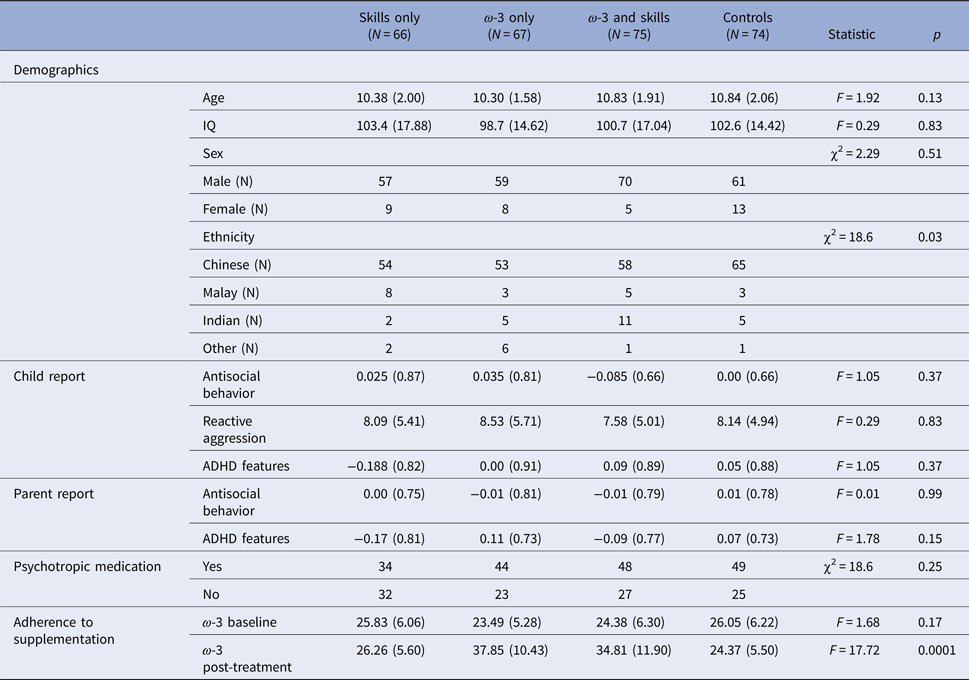
An intention-to-treat (ITT) design using all randomly assigned participants without any exclusion was employed for all data analyses as it is viewed as the method of choice for RCT analyses (Abraha & Montedori, Reference Abraha and Montedori2010) and provides an unbiased estimate of the effect of treatment on outcome (Moher, Reference Moher2010). Linear mixed-effects modeling (Molenberghs & Verbeke, Reference Molenberghs and Verbeke2005) was utilized to deal with missing data. In compliance with CONSORT guidelines (Moher, Reference Moher2010), the analytic plan focused on testing group × time interactions. Intervention group and group × time interaction terms were entered as fixed effects, with outcome measures modeled using maximum likelihood estimation with a first-order autoregressive covariance structure and with homogeneous variances to account for the correlation between time points. The random intercept was included to account for individual differences. Age, gender, and ethnicity were entered as baseline covariates as they can result in smaller standard errors for treatment effects and increased power (Kahan et al. Reference Kahan2014), and furthermore groups differed on ethnicity despite randomization (see Table 1). Analyses were designated a priori to focus on change from baseline. All tests are two-tailed.
Demographic, baseline externalizing behavior, medication status, and ω-3 blood-level adherence data (% of ω-3 as a function of all highly unsaturated fatty acids in plasma) together with statistical comparisons for intervention groups

To assess robustness of any significant findings emerging from the ITT design that used mixed-effects models, sensitivity analyses were run using an ITT design utilizing last observation carried forward (White et al. Reference White, Horton and Pocock2011) and analyzed using repeated measures multivariate analysis of variance using the same covariates as in ITT analyses. A check on robustness was also run consisting of an ITT design using a random-effect regression with ω-3 as a yes/no term, social skills as a yes/no term, a ω-3 × social skills interaction term, and again including the same covariates. In the primary analyses, Hochberg's procedure (Hochberg, Reference Hochberg1988) was used to control for family-wise error on the six group × time interactions (four for child reports and two for parent reports), with both unadjusted and adjusted p values reported under results below. Figures are based on estimated marginal means.
Results
Participant flow
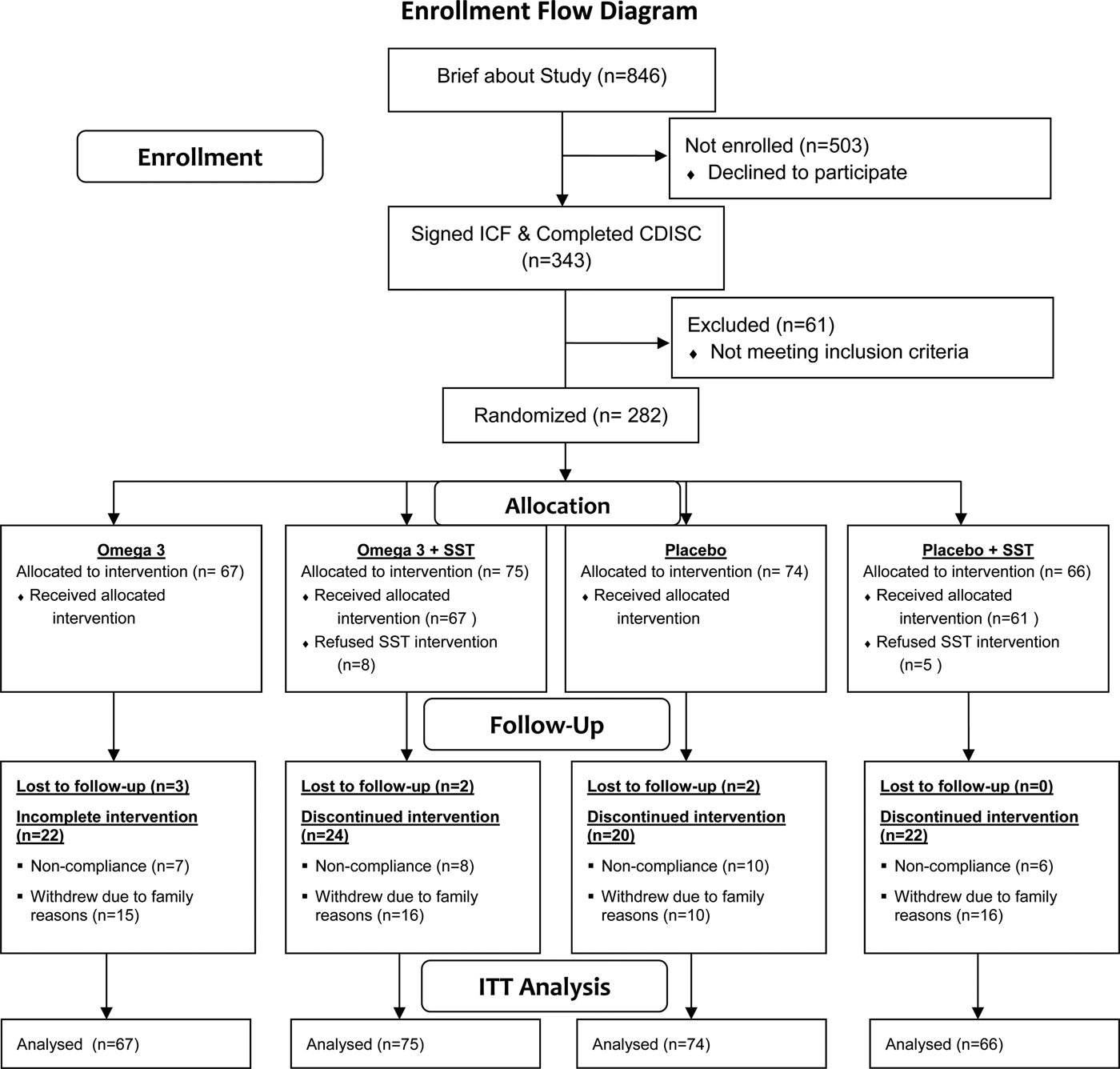
Full details on participant flow, including enrollment, group allocation, and follow-up, are given in Fig. 1.
CONSORT flow diagram on enrollment, group allocation, follow-up, and intention-to-treat analyses.

Demographics and adherence to protocol
Demographics
No significant group differences were observed at baseline on age, gender, medication status, and IQ, but groups differed on ethnicity (see Table 1), which was controlled for as a covariate.
Adherence to protocol
Adherence to the protocol was assessed from blood samples using ω-3 fatty acid levels expressed as a percentage of all highly unsaturated fatty acids in plasma (see Table 1). Baseline levels were compared with post-treatment levels. A significant group × time interaction was observed, F(3105) = 28.44, p < 0.0001. As predicted, groups differed post-treatment (p < 0.0001), but not at baseline (p = 0.17). Both groups taking ω-3 showed a significant increase in ω-3 levels from 0 to 6 months (ω-3 only: t = 8.3, p < 0.0001, d = 1.70; combined ω-3 + social skills: t = 5.6, p < 0.0001, d = 1.03). In contrast, those not assigned to ω-3 showed no ω-3 change across time (p > 0.21).
Participant flow and attrition
No participant loss was observed on baseline assessment after randomization. Full details of subject flow and attritions are provided in Fig. 1. There was no evidence of selective attrition after baseline assessments, with drop-outs equally occurring across all four groups (χ2 = 0.95, df = 3, p = 0.81).
Factor analyses of secondary outcome measures
Parent and child measures of externalizing behavior were factor analyzed separately for both ‘antisocial behavior’ and ‘ADHD features’ to both provide overarching indicators of these different but related constructs, and to reduce type I error. Full details are provided in the online Supplementary material. Analyses produced overarching measures of both parent- and child-reported antisocial behavior and ADHD for each of the five time points.
Child reports: treatment effects
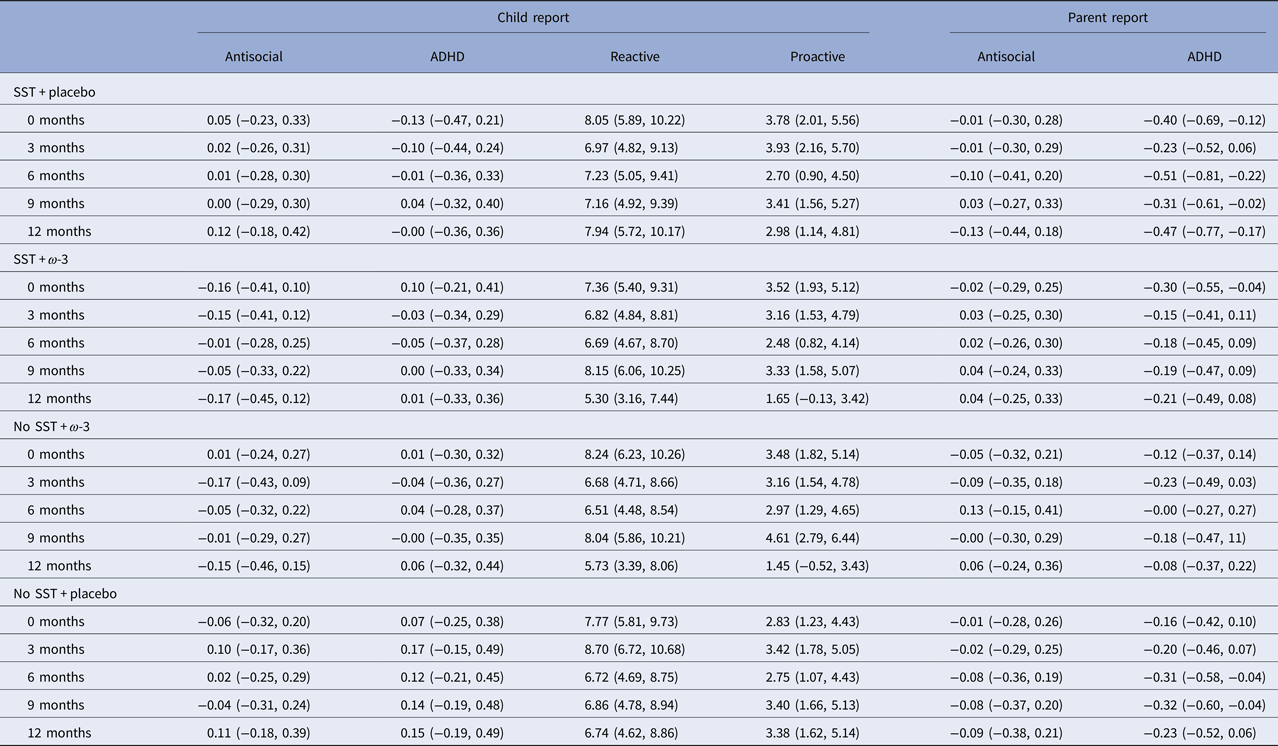
Unadjusted means from mixed-effects analyses for child-reported and parent-reported measures at all five time points are detailed in Table 2. Analyses below are based on the estimated marginal means.
Unadjusted means with 95% confidence intervals (in parentheses) from mixed-effects models on child behavior outcomes in the four intervention groups for the four assessment periods

Reactive aggression (primary outcome)
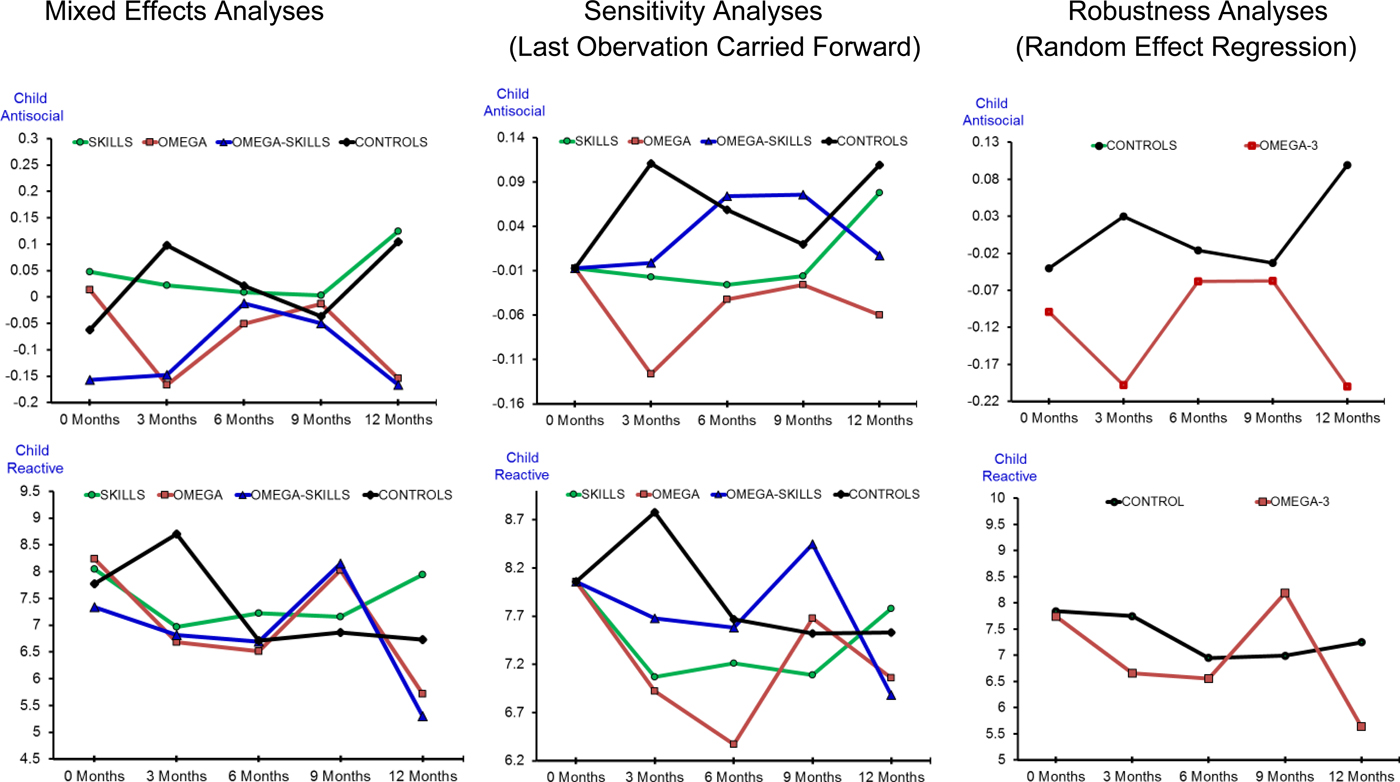
A significant group × time interaction was observed for reactive aggression (F(12, 624) = 2.59, p = 0.002, Hochberg's p = 0.008) and is illustrated in Fig. 2. Univariate tests were significant for the ω-3-only group (F(4, 625) = 3.78, p = 0.005), the ω-3 + social skills group (F(4, 617) = 4.52, p = 0.001), and the controls (F(4, 615) = 2.68, p = 0.031).
Illustration of group × time interactions for child self-report antisocial behavior (upper) and reactive aggression (lower) scores, with declining scores after 0 months indicating improved behavior. Left-hand figures are from mixed-effects modeling. Middle figures are from sensitivity analyses (repeated measures analysis of variance with last observation carried forward) controlling for baseline values. Right-hand figures are from the robustness check using a random-effect regression with ω-3 as a yes/no term.

For the ω-3-only group, reactive aggression was significantly reduced compared with baseline at both 3 months (p = 0.018, CI = 0.26 to 2.86, d = 0.19) and at 6 months (p = 0.042, CI = 0.06 to 3.41, d = 0.21). There was also a significant long-term decline from 0 to 12 months (p = 0.028, CI = 0.28 to 4.76, d = 0.29). No other baseline–post-treatment effects were significant (p > 0.13).
For the ω-3 + social skills group, relative to baseline, there was a significant long-term drop in reactive aggression at 12 months (p = 0.041, CI = 0.09 to 4.02, d = 0.24). No other baseline–post-treatment comparisons were significant (p > 0.11).
For controls, no baseline–post-treatment comparisons were significant (p > 0.13).
Antisocial behavior (secondary outcome)
A borderline group × time interaction was observed (F(12, 680) = 2.07, p = 0.017, Hochberg's p = 0.0166) and is illustrated in Fig. 2. Univariate tests were significant for the ω-3-only group (F(4672) = 2.49, p = 0.042) but not for other groups (p > 0.058). Breaking down the time effect for the ω-3-only group, pairwise comparisons indicated a significant reduction in antisocial behavior 3 months into treatment compared with baseline (p = 0.011, CI = 0.041 to 0.320, d = 0.17) but no further significant reduction (p > 0.13).
Attention-deficit hyperactivity (secondary outcome). The group × time interaction was non-significant, F(12 611) = 0.41, p = 0.96.
Proactive aggression (secondary outcome). The group × time interaction was non-significant, F(12 619) = 1.09, p = 0.36.
Parent secondary reports – treatment effects
Antisocial behavior. The group × time interaction was non-significant (p = 0.25).
Attention-deficit hyperactivity. The group × time interaction was significant, F(12 700) = 2.52, p = 0.003, Hochberg's p = 0.008. Findings are illustrated in the online Supplementary material. Univariate tests were significant only for the ω-3-only group (F(4685) = 2.53, p = 0.039) and the social skills-only group (F(4681) = 3.89, p = 0.004). However, for both groups, there were no significant effects with respect to baseline–post-treatment scores.
Sensitivity analysis and robustness check
Analyses were repeated using last observation carried forward to assess robustness of prior significant findings. The significant group × time interactions were replicated for reactive aggression (F = 2.05, df = 12, 678, p < 0.018, η 2 = 0.035), child antisocial behavior (F = 1.80, df = 12, 747, p = .044, η 2 = 0.028), and parent-reported ADHD (F = 2.05, df = 12, 738, p < 0.018, η 2 = 0.032). Results are illustrated in Fig. 2, and show close similarity to the same pattern of findings shown by mixed-effects models.
Analyses were also repeated using a mixed-effects design testing ω-3 supplementation (yes/no), social skills (yes/no), and the supplementation × skills interaction. The prior effect of ω-3 supplementation on reactive aggression was substantiated by a ω-3 × time interaction (F = 3.67, df = 4, 187, p = 0.007). Similarly, the prior effect for child antisocial behavior was also substantiated by a ω-3 × time interaction (F = 3.62, df = 4, 194, p = 0.007). The effect for parent-reported ADHD was also observed for a ω-3 × time interaction (F = 3.32, df = 4, 215, p = 0.012). The social skills × time interaction for parent-reported ADHD was also significant (F = 2.72, df = 4, 215, p = 0.031), but did not survive multiple comparison correction. Results for the significant effects for ω-3 are illustrated in Fig. 2.
Adverse events
No major adverse events were reported. From the entire sample, only four minor adverse events were reported. These consisted of a nose bleed, chest pains, skin rash, and body odor. No participant withdrew due to these minor events.
Discussion
This study tested whether ω-3, both alone and in conjunction with social skills training, can reduce childhood reactive aggression as the primary outcome, and antisocial behavior and ADHD as the two secondary outcomes. The ω-3 supplementation alone produced declines in reactive aggression at 3 months compared with baseline (18.9% reduction), and also at 6 months (21.0% reduction). In addition to the effects for reactive aggression, borderline effects (p = 0.017) were observed for ω-3 supplementation alone in reducing child-reported antisocial behavior in the short term, with this group × time interaction effect also being observed in both sensitivity analyses. Findings were observed over and above the standard care of medication and parent training given to all groups, and ω-3 placebo control. While effects were limited to child reports, interaction effects were replicated in the two different sets of analyses. Findings provide limited support for the longer term efficacy in reducing reactive aggression in clinic-referred children with externalizing disorders, and tentatively provide some cross-cultural generalizability of ω-3 in reducing antisocial/aggressive behavior.
The first aim of this study was to assess whether any effects of ω-3 would be more effective for reactive aggression than for proactive aggression. This hypothesis received some limited support. The ω-3-only group showed a significant reduction in child-reported reactive aggression 3 and 6 months after treatment commenced, but not proactive aggression. This replicates one prior RCT which distinguished these forms of aggression and showed that ω-3 reduced an aggressive-reactive form of child-reported antisocial behavior also at 3 months, but not a callous-proactive form (Raine et al. Reference Raine2016). The only other study to distinguish reactive and proactive aggression however found significant reductions in both forms of child-reported aggression (Raine et al. Reference Raine2015). There are reasons to believe that ω-3 supplementation could help remediate more impulsive, emotional forms of aggression. One brain imaging RCT has shown that ω-3 supplementation of children upregulates the dorsolateral prefrontal cortex (McNamara et al. Reference McNamara2010), and reactive (but not proactive) aggression has been associated with poorer prefrontal functioning (Raine et al. Reference Raine1998). Although we identified reactive aggression as the primary outcome measure in our study design, and while this hypothesis was confirmed in the current study and one of the two prior studies, it requires further evaluation in future studies.
The second study aim was to ascertain whether combining ω-3 supplementation with a psychosocial intervention could be particularly effective in reducing externalizing behavior. This synergistic prediction was not unsupported. While the ω-3 + social skills group did show a long-term reduction in reactive aggression compared with controls at 12 months compared with baseline (6 months after treatment termination), this effect was also shown by the ω-3-only group and as such the combined group is not showing the predicted potentiating treatment effect. The only other prior study on antisocial/aggressive behavior to test this synergistic hypothesis observed only mixed support for combining ω-3 with CBT (Raine et al. Reference Raine2016). The lack of support for the synergistic, combined treatment hypothesis is likely due to the null findings of the social skills-only group to show a treatment effect. Future studies using a more successful intervention approach could well reach a different conclusion.
The third study aim concerns assessing long-term, post-treatment effects which have been neglected for antisocial and aggressive behavior outcomes. While some support was found for end-of-treatment efficacy for reactive aggression, results on long-term effects are questionable. The ω-3 group showed a significant 30.0% reduction in reactive aggression at 12 months (6 months after treatment was terminated) compared with baseline, as opposed to a non-significant 13.3% reduction in treatment-as-usual controls. However, because no effect was found at 9 months, it is unclear what mechanism could account for the further decline at 12 months. A long-term effect for reactive aggression (baseline to 12 months) was also observed for the ω-3 + social skills group (28.0% reduction), which suggest that a sleeper effect could be in operation for ω-3 supplementation, given that one prior study of child-reported reactive aggression showed a significant 6 months post-treatment effect after ω-3 supplementation was terminated (Raine et al. Reference Raine2015). Nevertheless, we cannot claim a clearly interpretable long-term effect of ω-3 in the current study. Given the shorter term reductions in reactive aggression at 3 and 6 months however, the current study does nevertheless give added support for the notion that more impulsive, emotional aggression could be a target for treatment with ω-3, at least in the short term.
Limitations should be recognized. First, while some effects were observed for child-reported antisocial behavior, null effects were observed for parent reports. We similarly observed significant child- but not parent-report effects in one of our prior RCTs (Raine et al. Reference Raine2015). While contrasting results as a function of reporter are relatively common in the field (De Los Reyes et al. Reference De Los Reyes2013), they underline the need for replication and generalization. Second, attrition was observed in this study, and while mixed-effects modeling utilized the full sample using an ITT design, this does not substitute for the absence of attrition. Third, Singapore has its unique cultural context within which aggression and its treatment are embedded, and findings require replication in a Western sample. Fourth, no clear effects were observed for ADHD measures, and consequently any significant findings on externalizing behavior in this study are restricted to antisocial and aggressive behavior. Fifth, effect sizes were not large, ranging from small to medium, although this is consistent with meta-analytic findings (Gajos & Beaver, Reference Gajos and Beaver2016).
These limitations should be viewed in the context of several putative strengths of the study. The randomized, stratified, double-blind, placebo-controlled, factorial design is relatively rigorous. The crossing of intervention types (ω-3, social skills) is uncommon in ω-3 studies on any clinical outcome. The sample size for each treatment group (on average 71) is larger than the median sample size (22) we have calculated for prior ω-3 studies. Treatment duration of 6 months is also longer than the median of 3 months for prior studies, while the five assessments points are more than the median of 2 for prior studies. Importantly, we included a 6-month post-treatment follow-up in contrast to all other studies on antisocial/aggressive behavior conducted outside of our research group. The focus on symptomatic, clinic-referred children extends studies on asymptomatic community child populations (Raine et al. Reference Raine2015), although different weights need to be assigned to child v. adult studies of significant antisocial behavior (Gesch et al. Reference Gesch2002; Zaalberg et al. Reference Zaalberg2010). Finally, from a methodological standpoint, we have previously documented in this study that children and parents could not distinguish between the active ω-3 capsule and the placebo capsule, confirming blinding of our design which has not been documented in any prior study in this area (Liu et al. Reference Liu2015).
Conclusions
In conclusion, some support is found for considering ω-3 as a supplement to standard interventions for clinic-referred children with reactive aggression. Much more limited support was found for the efficacy of ω-3 for antisocial behavior. Future studies could evaluate whether combining ω-3 with vitamin and mineral supplementation could amplify treatment effects, given the argument for more broad-based dietary interventions (Jacka, Reference Jacka2017). The potential clinical implication is that if ω-3 can provide added value to standard medical and psychological interventions for reducing child behavior problems, there could be value in considering this nutritional supplement as adjunctive treatment given its minimal side effects and other health benefits already documented for ω-3. Nevertheless, further replication from methodologically strong studies is critically required to steer a balanced path that neither dogmatizes nor oversimplifies the message on nutrition and behavior (Sonuga-Barke, Reference Sonuga-Barke2015).
Key points
• There is growing interest in ω-3 supplementation as a potential treatment for children behavior problems, with reactive aggression as a particular target of opportunity.
• Few if any prior studies have followed up participants after treatment is terminated, leaving open the question of whether longer term effects can be demonstrated.
• This RCT showed that 3 months of ω-3 supplementation produced both short-term (3 and 6 months), and less conclusively short-term post-treatment reductions in overall antisocial behavior. Sensitivity analyses replicated significant interaction effects.
• The ω-3 was more effective in reducing reactive (impulsive) aggression than proactive (planned) aggression in this study.
• The ω-3 supplementation could be considered as an adjunct to more traditional clinical approaches in treating childhood aggression, although further replication from methodologically strong studies is required.
Supplementary material
The supplementary material for this article can be found at https://doi.org/10.1017/S0033291718000983
Acknowledgements
This research was funded by a grant from the National Medical Research Council of Singapore (NMRC 1170/2008). The Intramural Program of the National Institute on Alcohol Abuse and Alcoholism provided additional support. The authors gratefully acknowledge the many research assistants at the Institute of Mental Health, Singapore who assisted in data collection and management.
Declaration of interest
None