INTRODUCTION
Coral reefs are one of the most biologically diverse habitats in the world (Spalding et al., Reference Spalding, Ravilious and Green2001). Coral reefs in the Iranian coastal area have a surface area of about 1050 hectares and they are found around 16 islands from the north-west to the south-east and also some limited areas around Nay Band Bay (Shokri et al., Reference Shokri, Fatemi and Crosby2005). Typical reef along much of the Iranian coasts are fringing reefs although some patches of reef are found in some of the more sheltered areas in Nay Band Bay in the northern Persian Gulf and in Chahbahar Bay in the Oman Sea (Shokri et al., Reference Shokri, Fatemi and Crosby2005). The highest coral cover was found around Khark and Kharku islands in the far north of the Persian Gulf, and Larak Island in the south (Shokri et al., Reference Shokri, Fatemi and Crosby2005). Coral reefs are found encircling Iranian islands (Sharabati, Reference Sharabati1981) with fringing reef being the dominant reef structure along the coastlines (Sheppard & Salm, Reference Sheppard and Salm1988; Sheppard & Sheppard, Reference Sheppard and Sheppard1991). Staghorn coral (Acropora sp.) is the dominant genus around islands in the Persian Gulf (Sheppard & Sheppard, Reference Sheppard and Sheppard1991). Knowledge of coral reef distribution in the Iranian waters of the Persian Gulf is very limited.
An early study by Rosen (Reference Rosen1971) recorded only 15 genera of hard corals in the northern part of the Persian Gulf and Saudi Arabia. Harrington (Reference Harrington1976) reported the presence of corals at the Sheedvar Island. Harger (Reference Harger1984) noted 19 coral species at Hormuz Island. Rezai (Reference Rezai and Jahangard1994, Reference Rezai1996) examined the corals around different islands and identified 35 species of hard corals around Larak, Farur, Banifarur, Tonb-e-Kuchak, Tonb-e-Bozorg, Hendourabi and Kish islands. Rezai (Reference Rezai and Jahangard1994, Reference Rezai1996) reported the presence of soft coral (Sacrophyton sp.) and hard coral (Seratopora sp.) for the first time around Larak Island. Sadeghi (Reference Sadeghi1997) surveyed hard corals around Kish Island and identified 19 species. Acroporidae were found to be the most diverse family, while Faviidae and Poritidae occurred most frequently. Agariciidae and Dendrophyllidae occurred rarely. Fatemi & Shokri (Reference Fatemi and Shokri2001) identified 27 species of hard corals belonging to nine families and 20 genera from Nay Band Bay, Kish and Farur islands. They found that Faviidae with six genera and eight species was the most diverse family. Poritidae was the most abundant family in all areas with two genera and four species. The islands north-west of Kish Island and Qeshm Island (the largest one in the Persian Gulf) are the continuation of sedimentary layer outcrops from the Zagros Mountain Range on the mainland. The other islands have been uplifted by a salt dome intrusion from the sea bottom (a unique tectonic feature of the Bandar Abbas area). The eastern islands in the Strait of Hormuz are greatly influenced by the less saline and nutrient-rich oceanic waters from the Indian Ocean, while the inner islands tolerate a more saline and less fertile condition prevailing in nearly the entire region (Shokri et al., Reference Shokri, Fatemi and Crosby2005). Coral reefs around these islands are of two types: (a) patchy reefs exist in suitable shallow waters and protected areas along the shoreline, such as Bandar Taheri Port and Nayband Bay in Bushehr Province; and (b) fringing reefs which are found around all remaining islands (Fatemi & Shokri, Reference Fatemi and Shokri2001).
Given the paucity of information on the species inventory of hard corals in Larak Island, the present study was undertaken to explore the species diversity of hard corals in this area. We describe three new records of hard coral species from Larak Island.
MATERIALS AND METHODS
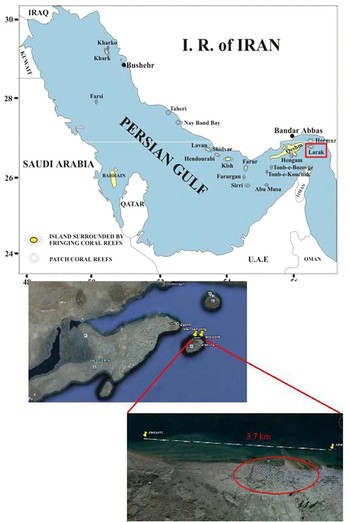
The survey of coral reefs around Larak Island was conducted by using the Manta Tow Technique (Hill & Wilkinson, Reference Hill and Wilkinson2004). A diver equipped with snorkel and fins was towed around the island over the depths of 2–5 m at an approximate distance of 200–250 m from the shore. The geographical positions of starting and ending points were 26°53′21.86″N 56°21′45.37″E and 26°53′14.25″N 56°23′59.69″E, respectively (Figure 1). The diver was towed at a speed of 3–5 km per hour. The pattern of coral distribution around the island was recorded. The coral specimens were collected from two sites where corals were abundant. The specimens were carried to the boat and preserved in 70% ethanol. The coral specimens were bleached using hydroperoxide. The specimens were photographed showing the whole specimen and the corallite structures. Identification was done using Veron (Reference Veron2000) and communication with Professor Charles Sheppard at the Department of Biological Sciences, University of Warwick, UK. The coral specimens are deposited at the Department of Marine Biology, University of Hormozgan, Iran.
Coral reef distribution in the northern Persian Gulf and location of Larak Island (Shokri et al., Reference Shokri, Fatemi and Crosby2005).

RESULTS
Three species of hard corals including Echinopora gemmacea (Faviidae), Leptoria irregularis (Faviidae) and Montipora incrassata (Acroporidae) were new records from the area.
Taxonomic reference: Chevalier (1975), Veron, Pichon & Wijsman-Best (1977)
MATERIAL EXAMINED
HCS1-33, HCS2-64, two specimens, Larak Island, coll. F. Shojae.
DIAGNOSIS CHARACTERS
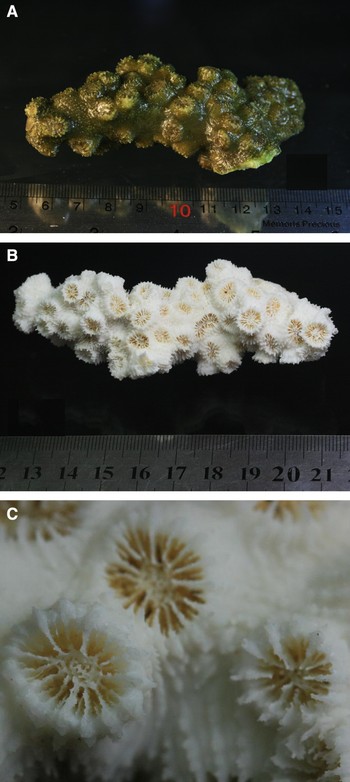
Colonies are laminar and bifacial, sometimes forming contoured branches. Corallites are 3.5–4.5 mm in diameter. This species usually grows as encrusting plates and thick leaves, or more rarely may have a branching growth form. Where its growth is prolific, it may completely overgrow dead reef surfaces and live corals, resembling a relatively smooth, almost plastic-like brown surface that covers and follows the contours of tens of square metres of reef. Columellae are large, and paliform lobes are not well developed. Primary septa may be thick and are always exert. Its calyces are up to 7 mm in diameter, protrude prominently from the coral surface, are moderately spiny, and are closely spaced together. Usually grey, sometimes pale cream to dark brown or green (Veron, Reference Veron2000).
HABITAT
Abundant in 2–5 m depths at shallow protected reef.
DISTRIBUTION
Reported from southern Persian Gulf, Gulf of Aden, Red Sea, eastern Africa, Madagascar, Seychelles, Mauritius, Chagos Archipelago, Maldives, Pakistan and central Indian coast, southern India, Sri Lanka, Myanmar, Thailand, South-east Asia, Vietnam, South China Sea, southern Japan, Papua New Guinea, south-western to eastern Australia, Solomon Islands, Vanuatu, New Caledonia, Micronesia, Marshall Islands, Fiji, Samoa, and Cook Islands (DeVantier et al., Reference DeVantier, Hodgson, Huang, Johan, Licuanan, Obura, Sheppard, Syahrir and Turak2008a).
REMARKS
Columella are large, and paliform lobes are not well developed. Primary septa may be thick and are always exert (Figure 2).
Echinopora gemmacea (Lamarck, 1816). (A) Natural specimen; (B) bleached specimen; (C) corallites.

MATERIAL EXAMINED
HCS2- 20, 36, 50, 83,101, five specimens, Larak Island, coll. F. Shojae.
DIAGNOSIS CHARACTERS
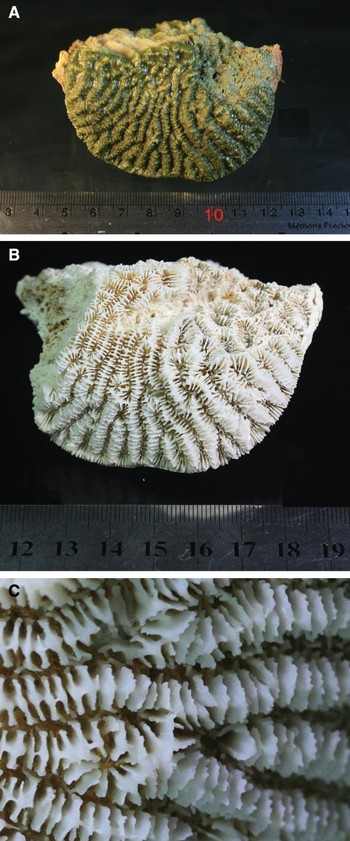
The species appears similar to brain coral in live specimens except that the polyp valleys are usually narrower and are very uniform in their structure colonies are submassive or laminar, up to 1.5 m across. Valleys are 3–4 mm wide, usually perpendicular to colony margins, becoming sinuous toward the colony centre. The valley walls form many extensive straight sections or many meander greatly. Septa are irregular, with strong teeth. Collumellae do not form centres and are not laminar. Tentacles are extended only at night. Pale blue-grey to translucent white (Veron, Reference Veron2000).
HABITAT
Abundant in 2–5 metre depths at upper reef slope.
DISTRIBUTION
Reported from the Gulf of Aden and Indian Ocean (Veron, Reference Veron2000), north-east Somalia, Tanzania, Seychelles, Chagos Archipelago, South-east Asia, Vietnam, southern Japan, Papua New Guinea, eastern Australia, Fiji, and Phoenix Islands (DeVantier et al., Reference DeVantier, Hodgson, Huang, Johan, Licuanan, Obura, Sheppard, Syahrir and Turak2008b).
REMARKS
Septa are irregular, with strong teeth. Collumellae do not from centres and are not laminar (Figure 3).
Leptoria irregularis (Veron, 1990). (A) Natural specimen; (B) bleached specimen; (C) corallites.

Taxonomic reference: Veron & Wallace (1984)
MATERIAL EXAMINED
HCS1- 40, 62, HCS2-114, three specimens, Larak Island, coll. F. Shojae.
DIAGNOSTIC CHARACTERS
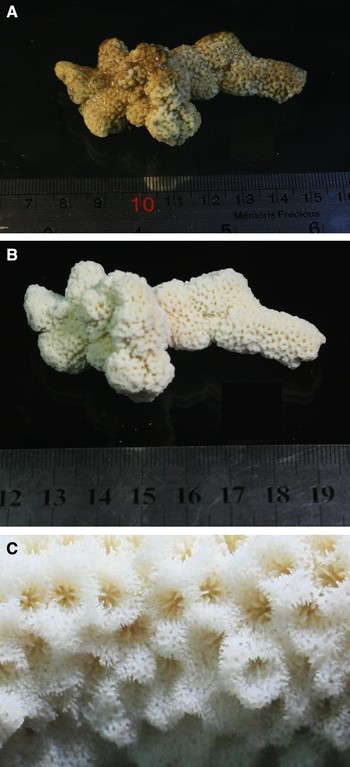
Colonies are thick plates with or without contorted nodular columns or branches. Corallites are immersed or exerted, cup-shaped, tubular, or nariform (where openings on the sides of tuberculae give them the shape of a Roman nose, as with corallites of nariform Acropora), corallite walls and the coenosteum are porous. Tuberculae may also be fused into smooth ridges. Collumella are absent. Tentacles are usually extended only at night. Mottled or uniform purple or brown (Veron, Reference Veron2000).
HABITAT
Abundant in 2–5 m depths, mostly upper reef slope.
DISTRIBUTION
Reported from Indo-Pacific (Veron, Reference Veron2000), Rodrigues, Thailand, Vietnam, South-east Asia, Japan, Papua New Guinea, Australia, Solomon Islands, Vanuatu, New Caledonia, Palau, Micronesia, Marshall Islands, Fiji, American Samoa, Line Islands, Hawaii, Johnston Atoll, and Pitcairn (DeVantier et al., Reference DeVantier, Hodgson, Huang, Johan, Licuanan, Obura, Sheppard, Syahrir and Turak2008c).
REMARKS
Corallite walls and the coenosteum are porous. Collumella are absent (Figure 4).
The species Montipora incrassata (Dana, 1846). (A) Natural specimen; (B) bleached specimen; (C) corallites.

DISCUSSION
Three hard coral species including Echinopora gemmacea Lamarck, 1816, Leptoria irregularis Veron, 1990 (Faviidae) and Montipora incrassata (Dana, 1846) (Acroporidae) were reported for the first time from the north-east of Larak Island in the Strait of Hurmoz, northern Persian Gulf. The review of previous studies revealed that these species were new reports from Larak Island situated in the northern Persian Gulf. Of these species only Echinopora gemmacea was earlier reported from the Oman Sea (Coles, Reference Coles1996). No evidence of Leptoria irregularis and Montipora incrassata has been reported from the southern Persian Gulf and the Oman Sea. Hard coral biodiversity in the Persian Gulf is similar to the one found in the Indo-Pacific, with most species occurring in a wide geographical area (Riegl, Reference Riegl1999). The closest area to the Persian Gulf in terms of coral biodiversity in the Indo-Pacific is the Red Sea (Sheppard & Sheppard, Reference Sheppard and Sheppard1991).
Echinopora gemmacea is a very common species and is listed as a species of ‘least concern’ in the IUCN Red List of Threatened Species (DeVantier et al., Reference DeVantier, Hodgson, Huang, Johan, Licuanan, Obura, Sheppard, Syahrir and Turak2008a). This species is reported from the southern Persian Gulf, Gulf of Aden, Red Sea, eastern Africa, Madagascar, Seychelles, Mauritius, Chagos Archipelago, Maldives, Pakistan and central Indian coast, southern India, Sri Lanka, Myanmar, Thailand, South-east Asia, Vietnam, South China Sea, southern Japan, Papua New Guinea, south-western to eastern Australia, Solomon Islands, Vanuatu, New Caledonia, Micronesia, Marshall Islands, Fiji, Samoa, and Cook Islands (DeVantier et al., Reference DeVantier, Hodgson, Huang, Johan, Licuanan, Obura, Sheppard, Syahrir and Turak2008a). The specimens collected in the present study were entirely in branching growth form. A part of inconsistency in the growth forms for Echinopora gemmacea off Larak Island and Oman may be due to the variation in environmental conditions.
Leptoria irregularis is very uncommon and listed as a ‘vulnerable’ species in the IUCN Red List of Threatened Species (DeVantier et al., Reference DeVantier, Hodgson, Huang, Johan, Licuanan, Obura, Sheppard, Syahrir and Turak2008b). This species is distributed from the Gulf of Aden and the Indian Ocean (Veron, Reference Veron2000), to north-east Somalia, Tanzania, Seychelles, Chagos Archipelago, South-east Asia, Vietnam, southern Japan, Papua New Guinea, eastern Australia, Fiji, and Phoenix Islands (DeVantier et al., Reference DeVantier, Hodgson, Huang, Johan, Licuanan, Obura, Sheppard, Syahrir and Turak2008b). No earlier evidence of this species is reported from southern Persian Gulf and the Oman Sea. Few specimens of Leptoria irregularis in the present study were collected from 2–5 m depths at the upper reef slope.
Montipora incrassata is an uncommon species and listed as ‘near threatened’ in the IUCN Red List of Threatened Species (DeVantier et al., Reference DeVantier, Hodgson, Huang, Johan, Licuanan, Obura, Sheppard, Syahrir and Turak2008c). This is reported from the Indo-Pacific (Veron, Reference Veron2000), Rodrigues, Thailand, Vietnam, South-east Asia, Japan, Papua New Guinea, Australia, Solomon Islands, Vanuatu, New Caledonia, Palau, Micronesia, Marshall Islands, Fiji, American Samoa, Line Islands, Hawaii, Johnston Atoll, and Pitcairn (DeVantier et al., Reference DeVantier, Hodgson, Huang, Johan, Licuanan, Obura, Sheppard, Syahrir and Turak2008c). No evidence of this species is reported from the southern Persian Gulf and the Oman Sea.
The findings in the present study are based on a single sampling occasion within a limited area. Further sampling in the present study area and other Iranian islands should be a research priority since this may lead to identification of new coral species in the area.
ACKNOWLEDGEMENTS
We would like to express our appreciation to Mrs Lale Daraei management of GEF/SGP in Iran, Mr Abdullah Salehi and Mr Mohammad Dakhte management of Geopark Institute of Qeshm Island who assisted us in field sampling. We are also greatly honoured and thankful to Professor Charles Sheppard at the Department of Biological Sciences, University of Warwick for assistance in the identification of the specimens.