Women have made significant political inroads in established democracies. Female politicians make up a growing proportion of parties' parliamentary delegations and are gaining access to high-profile executive positions. Politicians likewise make clear overtures toward women on the campaign trail, and most party policy statements explicitly reference women. Indeed, within these states, it is increasingly difficult for mainstream parties to present all-male candidate slates or to exclude women from their election platforms.
Though politics in advanced industrialized states is becoming more “feminized,” whether—and to what extent—this has occurred among right-leaning parties remains unclear. Women's numeric (descriptive) and policy (substantive) representation has traditionally been the purview of left parties (Caul Reference Caul2001; Lovenduski and Norris Reference Lovenduski and Norris1993), with right parties falling behind on both fronts. Yet scholars are now highlighting right-leaning parties' efforts to advance women's representation (Celis and Childs Reference Celis and Childs2012; Wiliarty Reference Wiliarty2010; Xydias Reference Xydias2013). In fact, there is mounting skepticism about the predictive power of party ideology on this front (Celis and Childs Reference Celis and Childs2014).
Despite the fact that some right parties are making gains on their leftist counterparts, it is clear neither that these findings are indicative of a broader trend nor that these gains are sufficient to close the gap with left-leaning organizations. This raises an important question for women and politics and party politics scholars alike: does the conventional wisdom about right parties' laggard status with respect to women's descriptive and substantive representation still hold? Even if some right parties are making progress, moreover, these trends may not hold across all party types. While existing research tends to focus on right parties as a unified entity, there are important differences among conservatives, Christian democrats, and nationalists. This prompts a second question: do all right parties behave alike with respect to women's descriptive and substantive representation?
To answer these two questions, I offer a wide-ranging study of women's representation within and across right parties in parliamentary democracies. I first highlight the centrality of political parties to women's representation and theorize the relationship between gender and party ideology, focusing special attention on conservative and Christian democratic parties. I then draw on a data set that includes information on women's presence in the parliamentary delegations of 72 organizations from 12 states between 1980 and 2013 to examine patterns in women's descriptive representation across and within party families. Moving next to women's substantive representation, I use a second data set to explore women's inclusion on the election platforms of 56 parties between 1980 and 2008. Extending this analysis, the final empirical section examines the influence of women's presence on women's policy representation across party families.
Together, the results both support and subvert our traditional understanding of women's representation in right parties. On the one hand, despite gains in women's descriptive representation over time, conservative and Christian democratic parties have not kept pace with left-leaning organizations. This is related to quota implementation and the influence of female leaders, though the effect of these mechanisms varies across the two center-right party types. Conservatives, in particular, remain immune to quota diffusion. Christian democrats, in contrast, are as likely as other parties to adopt quotas, but these policies do not result in the election of significantly more women.
With respect to substantive representation, on the other hand, parties' willingness to discuss women in their policy statements does not fall strictly along left-right lines. Christian democrats, in particular, include as many gendered references on their platforms as social democrats. The content of this representation, however, differs among parties in ways that conform to their broader ideological stances, with right parties placing greater emphasis on women's traditional roles. Finally, though the proportion of seats held by female legislators is a good predictor of women's substantive representation for Christian democrats, this does not hold for all party families (including conservatives and social democrats). Taken as a whole, these findings reveal the ways in which ideological differences—both between the left and right and among right parties—continue to shape women's representation in advanced parliamentary democracies.
POLITICAL PARTIES, IDEOLOGY, AND WOMEN'S REPRESENTATION
Political parties are the central political actors in established democracies, determining both who comes into elected office and which policies reach the legislative agenda. Parties control the recruitment of candidates, for example, dictating how many (and which) women stand for office. Once elected, parliamentarians influence policy primarily by acting within the party group to create support for their cause (Mattson Reference Mattson and Döring1995). Parties, in turn, work to implement their electoral programs, and winning parties' policy platforms typically serve as the basis for the legislative agenda (Thomson et al. Reference Thomson, Royed, Naurin, Artés, Costello, Ennser-Jedenastik, Ferguson, Kostadinova, Moury and Pétry2017). Government agenda control and high levels of party cohesion together ensure that governing parties' bills are typically adopted, whereas legislation introduced by individual legislators mostly fails.
As parties determine both candidate selection and policy formation, any account of women's descriptive or substantive representation must consider their influence. Indeed, many studies examine women's representation within one or a small number of parties (Childs and Webb Reference Childs and Webb2012; Murray Reference Murray2010; Wiliarty Reference Wiliarty2010), and research on (female) legislators' behavior always accounts for partisanship. At the same time—and in contrast to the many studies of women's representation at the national level—little cross-national work examines party-level trends in women's descriptive representation (but see Caul Reference Caul2001; Kittilson Reference Kittilson2006; Kunovich and Paxton Reference Kunovich and Paxton2005), and virtually no research considers parties' efforts to substantively represent women over place and time.
Though few works assess women's representation within parties across states, existing scholarship highlights several factors that likely influence women's inclusion in parties' parliamentary delegations and on their policy platforms. Among these features, researchers return time and again to the role played by party ideology. In established democracies, the traditional left-right divide was structured by class, religious, and urban-rural cleavages (Lipset and Rokkan Reference Lipset and Rokkan1967). Beginning in the 1970s, a new set of divisions emerged with respect to postmaterialist issues such as environmental protection and acceptance of alternative lifestyles (Inglehart Reference Inglehart1997). While the meanings of “left” and “right” vary across time and place, leftist ideology typically advances the interests of working-class citizens, and it is often linked to secularism and a cosmopolitan world outlook. A right-leaning orientation is traditionally associated with upper-class voters. It is often more concerned with preserving traditions and frequently prioritizes nationalism and/or religion.
Despite political developments, the notions of left and right remain the “major organizing principles” of—and the “foundation for contemporary patterns of political competition” in—established democracies (Mair and Smith Reference Mair and Smith1990, 175). With respect to women's political representation, many studies emphasize the left-right distinction. Left parties have long traditions of publicly embracing gender-egalitarian ideologies and historical ties with progressive women's movements (Beckwith Reference Beckwith2000). These parties have also been more open to selecting female candidates and cabinet ministers (Caul Reference Caul2001). Progressive opinions on gender issues likewise often correspond to left party membership (Tremblay and Pelletier Reference Tremblay and Pelletier2000), and these organizations have been more likely to integrate feminist demands into their policy programs (Young Reference Young2000).
Just as left parties have been more receptive to women's representation, right parties in established democracies have traditionally been viewed as failing on this front. Preferences for traditional gender roles are strongly related to political conservatism (Cassese and Holman Reference Cassese and Holman2017). Unsurprisingly, in addition to nominating fewer female candidates, these parties have been more apt to advance nonfeminist and antifeminist claims (Lovenduski and Norris Reference Lovenduski and Norris1993; Wängnerud Reference Wängnerud2000). They are also less committed to feminist policy change and less supportive of the activities of women's policy agencies (Banaszak, Beckwith, and Rucht Reference Banaszak, Beckwith, Rucht, Banaszak, Beckwith and Rucht2003; Lovenduski Reference Lovenduski2005). Though right-leaning female voters may hold more moderate views than their male counterparts (Barnes and Cassese Reference Barnes and Cassese2017), they also express higher levels of sexism and racism—and show lower levels of support for fair pay policies—than women on the left (Cassese, Barnes and Branton Reference Cassese, Barnes and Branton2015).
In contrast to these established patterns, a growing body of work suggests that rightist ideology may no longer be as important a predictor of women's representation. Kittilson (Reference Kittilson2006), for example, does not find ideology to be a significant determinant of women's presence in the parliamentary caucus. Celis and Childs (Reference Celis and Childs2014) similarly note that right parties are now electing more women. These parties are also actively participating in gendered debates and reforms (Kantola and Saari Reference Kantola, Saari, Celis and Childs2014; Wiliarty Reference Wiliarty2010), often in an effort to modernize and broaden their appeal (Campbell and Childs Reference Campbell, Childs, Seldon and Finn2015; Childs and Webb Reference Childs and Webb2012; Kittilson Reference Kittilson2006). Indeed, a number of case studies point to right parties' policy claims on behalf of women (Bryson and Heppell Reference Bryson and Heppell2010; Curtin Reference Jennifer, Celis and Childs2014; Xydias Reference Xydias2013).
Clearly, left parties no longer maintain a “monopoly on the substantive representation of women” (Murray and Sénac Reference Murray, Sénac, Celis and Childs2014, 246). Yet whether (and to what extent) parties on the right remain behind with respect to women's descriptive and substantive representation remains unknown. Existing work, moreover, has not identified which kinds of right parties are making inroads and which are failing to do so. The following section considers the diversity among right party families in order to shed light on this variation.
NUANCING THE LEFT-RIGHT DISTINCTION
Beyond the left-right binary, there is heterogeneity among right (and left) parties. It is especially useful to consider “party families”—sets of parties that share a resemblance based on their common origins, transnational links, and similar ideologies and policy aims (Mair and Mudde Reference Mair and Mudde1998). Breaking apart the category of “right parties” to consider these distinct families reveals two important features for women's representation in established democracies. First, while one party group dominates the center-left (social democrats), the center-right is divided between two party families: Christian democrats and conservatives. Second, center-right parties are distinct from their far-right counterparts.
Christian democrats and conservatives are rarely found in the same system; countries with well-established conservative parties tend to have no/weak Christian democratic parties (and vice versa). Yet these two families are not perfect substitutes. Christian democrats are the dominant right party in Austria, Belgium, Germany, and the Netherlands, among other states. These parties emerged in response to secular, left-leaning social democrats, and they often retain traditional values on issues such as euthanasia, gay marriage, and abortion. Stemming in part from their historical religious links, these parties are especially interested in policies related to education and family. They are also more inclined to advance centrist programs and to defend (and promote) the welfare state (Gallagher, Laver, and Mair Reference Gallagher, Laver and Mair2011; Kubicek Reference Kubicek2012). Indeed, Christian Democrats oversaw the development and expansion of strong welfare states in both Austria and Germany.
Conservative parties, in contrast, lack formal links to organized religion. These parties also tend to be more staunchly antisocialist and less committed to the welfare state than their Christian democratic counterparts. Though class-based voting has dissipated, conservatives traditionally received most of their support from the upper and middle classes, as well as the rural population. Beyond the economic dimension, conservatives are the “guarantors of the existing order” (Ball Reference Ball2013, 25). They stress the importance of law and order and national defense and uphold traditional values. In this way, they combine economic liberalism with social interventionism (Gallagher, Laver, and Mair Reference Gallagher, Laver and Mair2011; Kubicek Reference Kubicek2012). Conservatives are the dominant right parties in states including Australia, Canada, Denmark, Ireland, Norway, Spain, Sweden, and the United Kingdom.
Christian democratic and conservative parties dominate right-leaning politics. In recent years, a number of countries have also observed the growth of far-right parties. These parties, which are characterized by the promotion of populist and xenophobic political appeals, have grown in response to fears over immigration, globalization, and the growth of the European Union (Mudde Reference Mudde2007). In some states, they remain protest parties. In others, including Austria, Denmark, and Sweden, they have gained traction, particularly among young, working-class, and male voters (Arzheimer and Carter Reference Arzheimer and Carter2006). Because these parties are still peripheral competitors in most states, the primary focus of this article is the two center-right party families. At the same time, in the results section, I offer preliminary insights about women's presence in far-right organizations.
There is, of course, variation within party families across place and time. There are significant differences, for example, between Anglo and Scandinavian conservatives' commitment to neoliberal welfare state reform (Arter Reference Arter and Broughton1999). In recent decades, Christian democrats have, to varying degrees, softened their stance on moral issues as their electorates have secularized (Van Hecke and Gerard Reference Van Hecke and Gerard2004). At the same time, party family has long been meaningful for women's representation. The distinction between social democratic and new left parties is widely acknowledged (Caul Reference Caul2001). Though they have received less attention in the gender and politics literature, right parties also differ in important ways.
Conservatives' and Christian democrats' distinct ideological commitments to liberalism, individualism, and the welfare state likely have ramifications for women's descriptive representation (including their openness to gender quotas) and substantive representation (such as their support for the social safety net on which many women rely). Indeed, since the advent of women's suffrage, these two party families have had distinct relationships with female voters. Morgan-Collins (Reference Morgan-Collins2016) shows that women's suffrage helped Christian democrats, as female voters were especially attracted to these parties' economic and social policies. Women have historically been important members of the Christian democratic coalition (Conway Reference Conway, Kselman and Buttigieg2003, 56–57). Conservative parties, in contrast, did not attract female supporters at the same rates. Yet whether—and to what extent—these differences carry into the modern era remains unknown. A comprehensive assessment of women's representation on the political right thus demands not only a broad reaching analysis that spans time and space but also one that accounts for the nuances among party families.
WOMEN'S DESCRIPTIVE REPRESENTATION
My study of right parties begins with an assessment of women's descriptive representation in parties' parliamentary delegations. I examine patterns in women's presence in office in 72 organizations in 12 democracies between 1980 and 2013.Footnote 1 Following Kittilson (Reference Kittilson2011) and others, party family is identified using the Comparative Manifestos Project (CMP) (Volkens et al. Reference Volkens, Lacewell, Lehmann, Regel, Schultze and Werner2011). The CMP defines party family as a “tentative grouping of political parties and alliances” and classifies parties by “membership in international organizations, such as international party groups and factions in the European Parliament” (Volkens Reference Volkens2002, 158) (see the online appendix for more information). Like Adams et al. (Reference Adams, Clark, Ezrow and Glasgow2004), I identify Christian democrats, conservatives, and nationalists as right-wing parties.Footnote 2 I compare these three party families with left-leaning and centrist organizations including green, socialist/communist, social democratic, liberal, and agrarian parties.
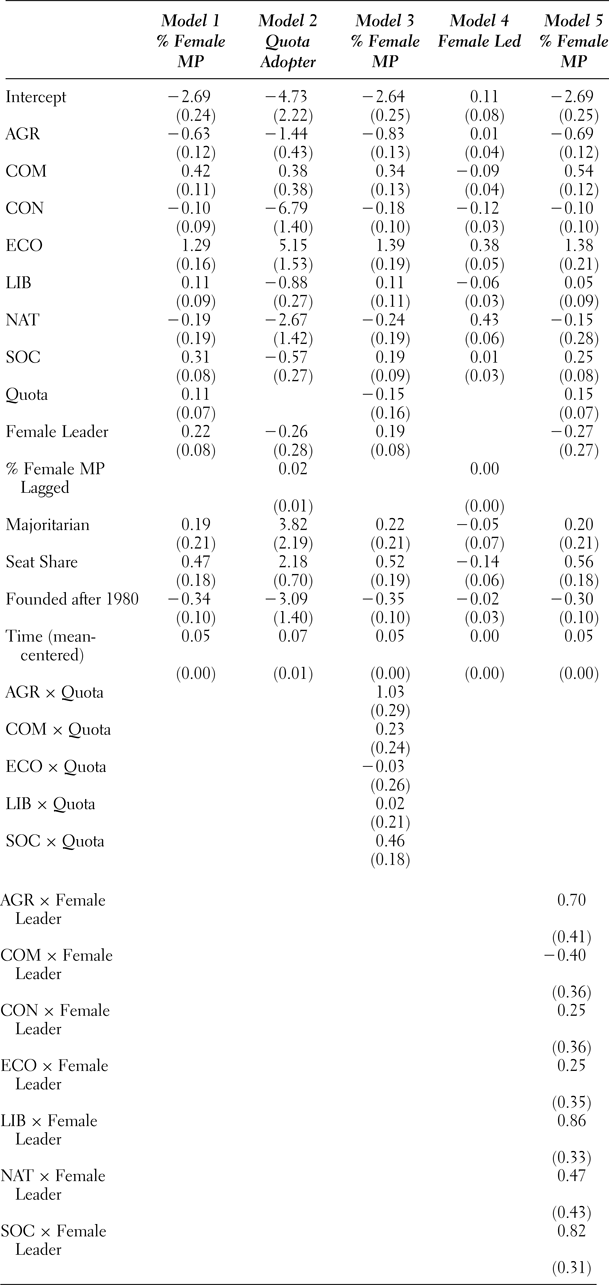
Model 1 is a linear model with a logistic transformation of the outcome variable that predicts the proportion of seats in the parliamentary caucus held by women. The results demonstrate that party family is a significant predictor of women's presence even after controlling for quota policies, female leaders, electoral system, party size and founding date, the passage of time, and country-level fixed effects (see the online appendix for more information on all models).
Logistic regression models related to women's descriptive representation (with country-level fixed effects)

Notes: The outcome variable in Models 1, 3, and 5 is the logistic transformation of the percentage of seats in the parliamentary delegation held by women. The outcome variable in Model 2 is a dichotomous measure of the presence of a quota policy and in Model 4 of a female leader. For party families, the baseline category is Christian democratic organizations. AGR = agrarian parties; COM = socialist/communist parties; CON = conservative parties; ECO = ecological parties; LIB = liberal parties; NAT = nationalist parties; SOC = social democratic parties. Standard errors are presented in parentheses. See the online appendix for more information.
Conservative and Christian democratic parties have significantly fewer female members of parliament (MPs) on average than leftist parties (greens, communists, and social democrats). While there are examples of center-right parties with comparatively high levels of descriptive representation—such as New Zealand's National Party, the Dutch Christian Democrats, and the center-right Nordic parties—on average these organizations still perform more poorly than those on the left. It is especially interesting to compare the two center-right parties with their center-left counterpart. In 1985, women's average representation level was nearly identical across the three party types: women made up 13% of legislators in Christian democratic parties and 14% of conservative and social democratic representatives. Despite the increased attention to women's descriptive representation in recent decades, the gap between party groups has grown over time. In 2013, the mean percentage of seats held by women across all parliamentary parties was 28%. Christian democratic and conservative parties both fell below this average, with mean levels of women's representation at 23% and 24% of their parliamentary caucuses, respectively. In social democratic parties, on the other hand, the mean percentage of seats held by women was 37% (see the online appendix for plots).
Despite the claim that right parties are catching up to their left counterparts, the gap between the two is increasing as women's representation in center-left parties grows at a faster pace than in center-right organizations. Additionally, though there are only four nationalist parties in the sample, it is worth noting that these organizations perform especially poorly with respect to women's representation, lagging behind even center-right organizations. This is the case even though three of these parties are Scandinavian. Clearly, in established democracies, the variation in women's parliamentary representation is attributable both to the positive strides made by left parties and to the slower rate of growth among parties on the right.
Explaining Women's Underrepresentation in Right Parties
Clearly, right parties fall short with respect to women's descriptive representation. What factors explain the differences in women's presence in elected office across party families? This is a particularly pressing question in established democracies, where the pool of women with the desire and capacity to compete for political office is sizable and voter discrimination is low. The large supply of female aspirants, coupled with voters' demand for (or at least acceptance of) female candidates, suggests that the issue resides with the party elite. In particular, there are two demand-side factors that likely explain women's underrepresentation in right parties: first, differences in the use of voluntary gender quotas as a formal mechanism to ensure the selection of female candidates; second, the presence of women in the party leadership as an informal mechanism to bolster support for women's inclusion in the parliamentary delegation.
Quota Policies
Globally, the presence of a gender quota is among the strongest predictors of women's representation (Paxton and Hughes Reference Paxton and Hughes2015), and the majority of national parliaments with more than 30% women have some form of quota provision. Though the evidence is more mixed with respect to voluntary quotas (Paxton and Hughes Reference Paxton and Hughes2015), the adoption of policies mandating the selection of female candidates is often associated with greater descriptive representation at the party level (Kittilson Reference Kittilson2006). Indeed, party-based tactics not only have the “potential to be very successful,” but are “perhaps the most effective” strategies for bolstering women's presence among candidates and elected officials (Krook and Norris Reference Krook and Norris2014, 10).
To determine whether quotas account for differences in women's presence in parliament across party families, I estimated two additional regression models (Models 2 and 3). Extending the data from O'Brien (Reference O'Brien2015) with information from Krook (Reference Krook2009) and the Global Database of Quotas for Women, Model 2 is a binary logistic regression analysis that predicts the presence of a voluntary quota policy. Model 3 considers quotas' influence on women's descriptive representation.
Looking first at quota adoption across party families, a striking trend emerges: of the 14 conservative parties included in this analysis, none has implemented gender quotas for national-level elections. The nearest approximation was the Swedish Moderate Party's decision to allocate two of the top four posts on its 2009 European Parliament candidate list to women (a strategy it abandoned in the 2014 election). As party family perfectly predicts the outcome variable, I use Firth's penalized likelihood approach to fit the logistic regression analysis modeling the presence of a quota policy. As expected, the results suggest that conservative (as well as nationalist) parties are significantly less likely than others to adopt these electoral affirmative action strategies. Yet this reluctance does not extend to all right parties. In fact, while Christian democrats are less likely to adopt quotas than greens, they are more likely to do so than communist and liberal organizations. Indeed, parties including the Austrian People's Party and German Christian Democratic Union (CDU) both implement some form of positive discrimination policy.
Just as receptiveness toward quotas varies across party families, the consequences of these policies are also distinct. As Model 3 demonstrates, when controlling for a myriad of other factors, social democratic and agrarian parties with voluntary quota policies have significantly more female MPs than those that do not. Among Christian democrats, however, there is no significant difference between quota adopters and nonadopters. That is, when controlling for other factors, those Christian democratic parties that implement positive discrimination policies do not elect more women than their nonquota counterparts.
Taken together, these results suggest that ideological objections—particularly a commitment to individualism and “merit” (Dahlerup Reference Dahlerup2007)—make conservatives immune to the otherwise widespread diffusion of voluntary quotas. When these parties do attempt to increase women's representation, they are likely to focus on alternative approaches, such as capacity building programs (Krook and Norris Reference Krook and Norris2014). Consider, for example, the Swedish Moderate Party. Though Sweden has been a leader in women's representation, the conservatives viewed any type of quota as untenable because it “leads to the suspicion that a candidate [was] promoted, even if he would not sustain an independent assessment of his competence and merits” (Conservative Party Board Statement 1993, quoted in Freidenvall Reference Freidenvall2003). The party instead placed responsibility squarely on individual women, arguing that they needed to become more “assertive” and “competent” (Freidenvall Reference Freidenvall2003).
This aversion to quotas is less pervasive among Christian democrats. Yet enthusiasm for the policies seems limited, as quotas do not markedly increase women's descriptive representation. Indeed, referencing the German CDU, Davidson-Schmich (Reference Davidson-Schmich2006) notes that although the “rank and file party members were generally unenthusiastic about quotas,” the party leadership pushed for a “women's quorum” in an effort to appeal to younger women voters. Importantly, while classified as voluntary gender quotas (Krook Reference Krook2009), the policies adopted by Christian democrats are often weaker than those advanced by center-left parties. As Wiliarty (Reference Wiliarty2010, 185) notes, “both the German and Austrian parties have quota-like mechanisms, though neither has a hard-core quota.” Thus, while Christian democrats are not averse to electoral affirmative action per se, these policies are weaker than would be ideal.
Female Party Leaders
Though formal mechanisms such as gender quotas are important predictors of women's election, informal mechanisms also shape women's access to power. In particular, the presence or absence of female party leaders may affect women's descriptive representation in established democracies. Party leaders are “the central political figures” in these states (Cross and Blais Reference Cross and Blais2012, 1), and they wield significant influence over their copartisans' career paths (Bille Reference Bille2001). Female party leaders in particular likely have both direct and indirect effects on women's selection as candidates. Female-led parties elect more female parliamentarians and are more apt to adopt quota policies for women (Cheng and Tavits Reference Cheng and Tavits2011; Kittilson Reference Kittilson2006). Female leaders may thus directly bolster the number of women competing for legislative office. Female leaders can also improve citizens' beliefs about women's capacity to govern (Beaman et al. Reference Beaman, Chattopadhyay, Duflo, Pande and Topalova2009), and the very presence of a woman in this post indicates that women have cracked the highest glass ceiling within the party. Women's inclusion in this position thus likely indirectly enhances parties' demand for—or at least acceptance of—female MPs.
In order to establish whether women's presence as party leaders helps to explain differences in women's descriptive representation across party families, I conducted two additional analyses. The first (Model 4) is a binary logistic regression model predicting the probability that a party is female led in any given year. The second (Model 5) considers female leaders' effects on the proportion of women in the parliamentary caucus. While ideology does not predict the selection of the first female party leader (O'Brien Reference O'Brien2015), the number of years that a party has been female led is influenced by party family. As shown in Model 4, between 1980 and 2013 conservative parties had significantly fewer female-led years than all other party types (the only exception, interestingly, being communist parties). Despite the presence of female conservative leaders in Britain, Canada, Denmark, and New Zealand, when controlling for other factors, these parties were still more likely than others to be male led.
While conservatives perform especially poorly with respect to female leadership, this trend does not hold among Christian democrats and nationalist parties. Christian democrats are no worse than social democrats on this front and even outpaced both communist and liberal organizations. This is likely attributable to the long tenures of some female Christian democratic leaders, including Angela Merkel as head of the German CDU. The results are even more surprising for nationalist parties. While there are only four such organizations in the data set, all have been female led. To ascertain whether this relationship holds more broadly, I conducted an additional analysis using information from 464 party-election years in 30 OECD countries. The findings suggest no difference between nationalists and center-left or center-right parties with respect to women's leadership (see the online appendix for details).
Though Christian democratic parties are as likely to be female led as their center-left counterparts, as with quota policies, the effects of female leadership differ across party groups. As shown in Model 5, social democratic and liberal parties with female leaders have significantly more women in their parliamentary delegations than those with men at the helm. In contrast, female-led Christian democratic, conservative, and nationalist organizations have as many (or as few) female MPs as their male-led counterparts.Footnote 3 The presence of a female leader does not lead to “letting down the ladder” effects in right parties. This result may be surprising, particularly with respect to Christian democratic parties, given that the most high-profile example of a female leader (Angela Merkel) has been said to have “brought significant numbers of women to power with her” (Wiliarty Reference Wiliarty2010, 183). Yet it is consistent with work on a similar set of countries by O'Brien et al. (Reference O'Brien, Mendez, Peterson and Shin2015), which shows that female leaders from right parties do not appoint more women to their cabinets than their male counterparts and are actually outperformed by male left party leaders on this front.
The absence of a link between female leaders and parliamentarians in center-right parties can likely be attributed to the fact that these organizations are reluctant to select female leaders who will disrupt the status quo vis-à-vis women's numeric representation. Looking across 10 European countries, for example, Celis and Erzeel (Reference Celis and Erzeel2015) find that women on the right are less likely to speak on behalf of women than their male counterparts. Female leaders within these parties may also feel less able to advocate on behalf of female aspirants. Indeed, Jiménez (Reference Jiménez2009, 257) demonstrates reluctance among some right women to work on gender topics due to the perception that a “defense of women's problems is damaging.” Clearly, the variable consequences of women's party leadership across party families is an important area for future study, particularly as women's presence in these positions grows.
WOMEN'S SUBSTANTIVE REPRESENTATION
Descriptive representation is only one facet of women's representation. Just as significant are parties' efforts to provide women with substantive—or policy—representation by including women on their policy agendas. As with women's presence in elected office, moreover, there are strong reasons to expect that both the quantity and content of women's policy representation vary across party families. Right party politicians, for example, have been shown to be both less feminist (Tremblay and Pelletier Reference Tremblay and Pelletier2000) and less concerned with gender equality (Wängnerud Reference Wängnerud2000). Nonleft parties are also less likely to support legislation “liberalizing divorce, extending abortion rights, criminalizing violence against women, expanding employment opportunities, providing women's healthcare innovations, and advancing social welfare issues” (Beckwith and Cowell-Meyers Reference Beckwith and Cowell-Meyers2007, 557). Right-party references to women are more likely to fall under what Celis and Childs (Reference Celis and Childs2014, 11) define as Type II claims: those that “address women's concerns and perspectives in ways distinct from traditionally understood feminism.”
Women's party-level policy representation can be studied using the policy statements parties draft prior to elections, which outline the legislative priorities they hope to enact once in office. These statements communicate parties' major policy ideas, allowing voters to compare competing programs. Importantly, while these platforms are campaign documents designed to sway the electorate, parties in advanced industrialized democracies work to implement their manifestos. Single-party executives have especially high rates of pledge fulfillment, though coalition and minority governments also perform surprisingly well on this front (Thomson et al. Reference Thomson, Royed, Naurin, Artés, Costello, Ennser-Jedenastik, Ferguson, Kostadinova, Moury and Pétry2017). Inclusion on the manifesto thus simultaneously indicates the party's commitment to women and also represents an important step in the policy-making process. Indeed, a growing number of case studies examine claims related to women on parties' election manifestos (Campbell and Lovenduski Reference Campbell and Lovenduski2005; Childs, Webb, and Marthaler Reference Childs, Webb and Marthaler2010; Murray and Sénac Reference Murray, Sénac, Celis and Childs2014; Xydias Reference Xydias2013), and quantitative cross-national work explores women's influence on manifesto content more generally (Greene and Lühiste Reference Greene and Lühiste2017; Greene and O'Brien Reference Greene and O'Brien2016; Kittilson Reference Kittilson2011).
To assess parties' efforts with respect to women's policy representation, I built a data set composed of the manifestos of 56 parties in 12 countries between 1980 and 2008.Footnote 4 Each manifesto was translated into English and searched for instances of attention to women. The text analysis was based on a dictionary containing almost 100 words signaling feminine issue framing (see online appendix). This dictionary was drafted from close readings of out-of-sample party platforms. It was then expanded based on the Beijing Declaration and Platform for Action, a comprehensive agenda for women's empowerment authored after the Fourth World Conference on Women in 1995. Using this approach, I was able to generate a count of the number of references to women on parties' platforms. In the following subsections, I focus on conservative and Christian democratic parties' efforts to represent women on their agendas. As nationalist parties rarely participate in government, they are excluded from these analyses.
The Extent of Women's Substantive Representation
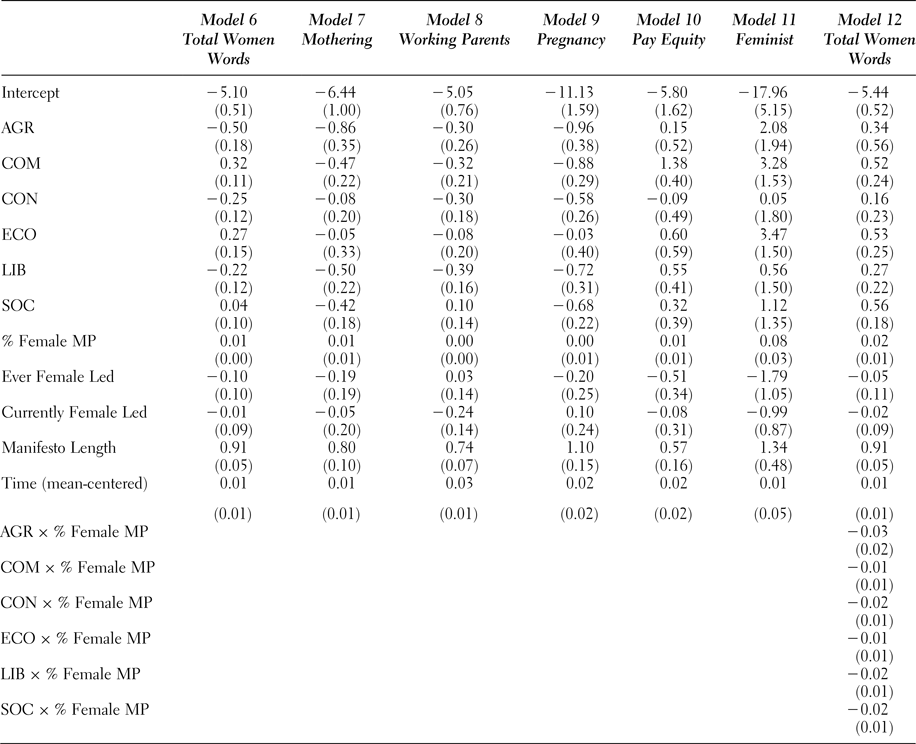
Model 6 presents the results from a quasi-Poisson regression that models the count of words for women on parties' manifestos, controlling for factors including the presence of female legislators and party leaders, the passage of time, the length of the platform, and country-level fixed effects. Unsurprisingly, green and communist parties perform significantly better than conservative (as well as liberal and agrarian) parties. Yet the model also yields unexpected findings. Christian democrats, in particular, exceed the expectations laid out for right-leaning organizations. They outpace conservative parties and are no different from social democrats on this front. Social democratic parties, in contrast, do not perform as well as might be anticipated. While they include significantly more references to women on their platforms than their conservative (and agrarian) counterparts, they are outmatched by green parties and indistinguishable from other groups (see online appendix for plots of women's policy representation by party family).
This cross-national analysis provides some confirmation for the claims made in case study research: right-leaning parties are increasingly shaping the political discourse around gender in their states (Kantola and Saari Reference Kantola, Saari, Celis and Childs2014; Murray and Sénac Reference Murray, Sénac, Celis and Childs2014; Wiliarty Reference Wiliarty2010). At the same time, among parties on the right (and also on the left), ideological differences between party families shape the extent of women's policy representation. The comparatively high numbers of references to women among Christian democrats are consistent with the parties' historical foundations. In particular, these parties traditionally supported families with substantial tax, wage, and benefit systems. While their policies were not feminist—indeed, they incentivized women to remain outside of paid employment—they did appeal to women, who were key Christian democratic supporters (Morgan-Collins Reference Morgan-Collins2016).
The Content of Women's Substantive Representation
Just as parties' willingness to discuss women on their platforms differs across party families, the content of this representation may also vary based on party ideology. Right-leaning organizations are thought to be more likely to address women's traditional gender roles, particularly those related to mothering, as well as the complementarity of the sexes and the need for equality of opportunity and equal treatment (Bryson and Heppell Reference Bryson and Heppell2010; Childs and Webb Reference Childs and Webb2012; Murray and Sénac Reference Murray, Sénac, Celis and Childs2014; Piccio Reference Piccio, Celis and Childs2014; Wiliarty Reference Wiliarty2010; Xydias Reference Xydias2013). Right parties are also expected to make more nonfeminist or even antifeminist gendered claims (Curtin Reference Jennifer, Celis and Childs2014). In addition to this left-right divide, there is reason to expect important differences among right-leaning parties. As Verloo (Reference Verloo2015) points out, an emphasis on the “polity dimension” of conservatism may lead conservatives, for instance, to focus on equal employment opportunities for men and women. A stronger commitment to the “moral dimension” may make Christian democrats more likely to valorize women's role in the family and to focus on balancing work and familial obligations.
Despite these expectations concerning the content of women's policy representation, no study to date has systematically analyzed whether—and to what extent—different party families make different claims on behalf of women over place and time (but see Celis and Erzeel Reference Celis and Erzeel2015 for related work on legislators' behavior). Table 2 presents the results from the first cross-national study of the content of women's policy representation on parties' policy statements. Models 7–10 once again use quasi-Poisson regression analyses to predict the count of words for women on parties' manifestos. In each instance, however, I focus on subsets of dictionary terms that capture distinct beliefs about women's role in the private and public spheres.
Quasi-poisson and binomial logistic regression models of women's substantive representation (with country-level fixed effects)

Notes: Models 6–10 and 12 are quasi-Poisson models. The outcome variable in Models 6 and 12 is the total count of words related to women on parties' election manifestos. The outcome variables in Models 7–10 are subsets of words related to different claims for women. Model 11 is a binomial logistic regression model estimated using Firth's penalized likelihood approach. The outcome variable is a binary variable that indicates whether the word was used at least once on the party's manifesto. For party families, the baseline category is Christian democratic organizations. AGR = agrarian parties; COM = socialist/communist parties; CON = conservative parties; ECO = ecological parties; LIB = liberal parties; NAT = nationalist parties; SOC = social democratic parties. Standard errors are presented in parentheses. See the online appendix for more information.
Model 7 includes words related to women's traditional roles as mothers and housewives (see online appendix for complete list of terms for Models 7–11). The results show that Christian democrats are significantly more likely to include these references on their manifestos than communist, social democratic, agrarian, and liberal parties. There is no distinction between Christian democratic and conservative parties on this front, however. Different patterns emerge if we consider women's role as mothers but focus on terms related to working mothers and women's capacity to balance family and paid employment. Model 8 looks at terms such as “child care,” “flextime,” and “parental leave.” Here, Christian democrats and social democrats perform similarly to one another and outpace other parties. Conservatives, on the other hand, fall behind both their center-left and center-right counterparts. Center-right parties in general, and conservative parties in particular, are thus especially likely to discuss women in ways that reflect conventional gender norms.
Clearly, Christian democrats are especially concerned with women as mothers both inside and outside of the home. Indeed, the results from Model 9 suggest that they are more likely than almost any other party family to discuss issues related to pregnancy on their platforms. This finding is consistent with work that points both to these parties' historical interest in maintaining women's traditional domestic roles (Piccio Reference Piccio, Celis and Childs2014), as well as their more recent successes in advancing policies aimed at balancing work and family life (Wiliarty Reference Wiliarty2010). Conservatives, in contrast, are willing to reference women's position in the private sphere, but they seem to shy away from issues such as day care and parental leave. This is not surprising, given that these policies demand large public expenditures. Campbell and Childs (Reference Campbell, Childs, Seldon and Finn2015) highlight the tension between the British Conservatives' child care commitments and their austerity politics. Kantola and Saari (Reference Kantola, Saari, Celis and Childs2014) likewise note that concerns over costs constrain conservative parties' efforts with respect to gender equality.
Just as there are policy areas in which right parties (particularly Christian democrats) outpace others, there are also arenas that remain out of bounds for these party families. Consider, for example, overtly feminist issues such as lesbianism, feminism, and sexism. The data suggest that center-right parties simply do not use these terms. Lesbians, for example, are never referenced by parties on the right. Feminism, moreover, is only explicitly addressed by green and communist organizations. Table 2 presents the results from a logistic regression analysis using Firth's penalized likelihood approach that models the presence of at least one of these terms on the manifesto (Model 11). Christian democrats and conservatives—as well as liberals and social democrats—are each significantly less likely to address these issues than communist and green parties.Footnote 5 Clearly, neither right parties nor center-left organizations are likely to address these more “radical” versions of women's representation on their agendas. Only far-left organizations aim to fundamentally transform the social systems that reinforce and promote gender-based discrimination.
WOMEN'S DESCRIPTIVE AND SUBSTANTIVE REPRESENTATION
Looking across place and time, both women's descriptive and substantive representation appear to be shaped by party family. Center-right parties elect fewer female parliamentarians than social democrats, and conservatives (though not Christian democrats) use fewer words related to women in their policy statements. Though the previous sections consider these forms of representation separately, a large body of literature suggests that the two are fundamentally linked. The final empirical analysis connects these two pieces of the puzzle and examines the relationship between numeric and policy representation across party families.
Parties' efforts to include women on their policy statements may be shaped by women's presence (or absence) from their parliamentary delegations. Increasing the percentage of seats held by female MPs both diversifies parties' platforms and pushes them leftward (Greene and O'Brien Reference Greene and O'Brien2016). This is partly because female parliamentarians are more likely to prioritize women's equality and family issues (Esaiasson Reference Esaiasson, Esaiasson and Heidar2000; Wängnerud Reference Wängnerud, Ballington and Karam2005). Likewise, in a number of institutions and across a variety of legislative activities, female legislators aim to represent women's interests (Barnes Reference Barnes2016; Tremblay Reference Tremblay1998; Xydias Reference Xydias2007). Unsurprisingly, the proportion of legislative seats held by women is often correlated with female-friendly policy outcomes (Bratton and Ray Reference Bratton and Ray2002; Kittilson Reference Kittilson2008).
While descriptive and substantive representation are often linked, women's presence alone does not guarantee attention to women on the policy agenda. To the contrary, this relationship is context dependent (Beckwith and Cowell-Meyers Reference Beckwith and Cowell-Meyers2007). In strong party systems like those studied here, it is especially difficult for female politicians to represent a distinct set of perspectives (Lovenduski Reference Lovenduski2005; Lovenduski and Norris Reference Lovenduski and Norris2003). Rather, the party leadership is responsible for policy decisions, and rank-and-file legislators follow the party line (Celis Reference Celis2008; Studlar and McAllister Reference Studlar and McAllister2002). The extent to which women's descriptive representation shapes policy representation thus likely varies both from party to party and among party types. That is, the ideological and organizational features of different party families create environments that make women's descriptive representation a stronger or weaker predictor of attention to women on the policy platform.
Extending Model 6, Model 12 reports the results of a second quasi-Poisson regression analysis of the count of words for women on parties' manifestos. This model, however, includes an interaction term between party family and the proportion of seats held by female MPs. This interaction effect shows how variation in women's presence affects the total references to women across different party types. The results are striking and differ from traditional expectations on this front. Controlling for a myriad of other factors, the proportion of seats held by women significantly affects the number of women-related terms on Christian democratic (as well as green and communist) parties' platforms. Parties with more female MPs use significantly more gynocentric words than those with fewer women. This effect size is largest, moreover, for Christian democratic parties: holding all other variables constant, moving from the first to the third quartile of female MPs (from 10% to 37%) increases the predicted count of the number of words for women by 12.
While women's descriptive and substantive representation are highly correlated in Christian democratic parties, this relationship does not hold for other major party families. Conservatives lag behind their counterparts, irrespective of women's presence in (or absence from) elected office. Among social democrats, women's policy representation appears to be well established at comparatively high levels and does not vary based on the proportion of seats held by female MPs.
The difference between Christian democratic and conservative parties is particularly striking. The link between descriptive and substantive representation within Christian democratic organizations may reflect the party family's unique ideological commitments and distinct history with female voters. It may also be a function of party structure. Christian democratic organizations are typically corporatist catchall parties. Consequently, “policies on women's issues are largely the product of internal interest group politics” (Wiliarty Reference Wiliarty2010, 47). In Germany, for example, the CDU's women's policies depend on the “success of the party's women's auxiliary organization in mobilizing and forming alliances” (47). Strong intraparty women's organizations may jointly promote women's descriptive and substantive representation, thus explaining the correlation between the two. A strong women's group may also empower female legislators to act on behalf of women.
In contrast to Christian democrats, conservative parties have more hierarchical internal organizations and lack voluntary quota policies. These two structural features likely depress the descriptive representation-substantive representation link. When power is concentrated among the party leadership, it is difficult for members of the parliamentary party to shape the policy agenda. In the absence of quota generated “mandate effects” (Franceschet and Piscopo Reference Franceschet and Piscopo2008), moreover, female legislators may not feel an obligation to act on behalf of women. Even if they would like to do so, conservative parties' neoliberal ideological views may make it harder to successfully advocate for female-friendly policies (particularly those that demand a strong welfare state).
CONCLUSIONS
In recent years, right-leaning parties have increasingly dominated the governments of advanced industrialized democracies. Case study analyses suggest, moreover, that these organizations are making significant inroads with respect to women's descriptive and substantive representation. Despite the importance of these parties' efforts to represent women (or their failure to do so), few studies consider the overarching trends in right parties' election of female candidates, and no study to date has considered women's representation on these parties' policy agendas over place and time. To address this gap in the literature, I examined the relationship between party family and women's descriptive and substantive representation across a large set of parties in advanced parliamentary democracies from 1980 onwards.
Though variation exists among parties from the same family, broad trends do emerge. Beginning with descriptive representation, parties on the right fall behind their leftist counterparts. The factors predicting women's presence in the parliamentary delegation, moreover, behave differently not only between left and right parties, but also among right parties. With respect to substantive representation, further differences emerge. While conservatives are less likely to reference women on their policy statements than other parties, Christian democrats perform as well as social democrats on this front. The content of this representation also varies by party type. Right parties generally (and Christian democrats in particular) focus on women in the context of family life, while more transformative issues—such as lesbianism and feminism—remain untouchable. Finally, the link between descriptive and substantive representation differs across party families. Women's presence in elected office is a significant predictor of women's policy representation in Christian democratic parties, while conservative (and social democratic) agendas are less malleable.
Taken together, this wide-reaching study offers key lessons for women and politics scholars and party politics researchers alike. To begin with, it is clear that party ideology continues to influence women's representation. Looking across place and time, it is a significant predictor of women's presence in elected office and inclusion on the policy agenda, and even shapes the relationship between the two. Though parties on the right have made gains in recent years, their efforts (particularly with respect to descriptive representation) have in many cases been insufficient to offset the advances made by left-leaning organizations.
At the same time, a simple left-right division is clearly too coarse for fully understanding women's representation in established democracies. Like the distinctions between new and old left organizations, there are also crucial differences among parties of the right. Conservatives and Christian democrats, in particular, differ markedly with respect to the causes of women's underrepresentation in their parliamentary delegations, their claims on behalf of women on their policy agendas, and even the effects of women's presence on women's policy representation.
Grouping these different types of organizations under the umbrella of “right parties” may obfuscate the causes and consequences of women's underrepresentation in politics. Alternatively, accounting for the differences among party families may help address this problem. Advocates should aim to improve quota implementation among Christian democratic parties, for example. Those working with conservatives, on the other hand, may wish to take a two-pronged approach that advocates for quota adoption while also pursuing alternative strategies, including strengthening women's sections, promoting recruitment and capacity building initiatives, and advocating for additional campaign funding for female candidates. These measures may be a good first step toward bolstering women's presence in office (Krook and Norris Reference Krook and Norris2014).
In revealing trends in women's representation across party families over time and place, this paper also raises important questions that cannot be answered using a large-N, cross-national approach. I offer preliminary explanations concerning the weak link between female leaders and parliamentarians in right parties, as well as the distinctions between conservatives and Christian democrats with respect to women's presence and policy representation. Though these accounts are informed by existing research, more work is clearly required to fully understand these relationships. Indeed, the distinctions among party families provide a rich vein for future research. Likewise, this study provides some interesting preliminary findings concerning women's descriptive representation in nationalist parties. These results suggest that we cannot draw conclusions about these organizations based on knowledge of center-right parties. Instead, as far-right organizations become more prominent, we will need more quantitative and qualitative work on this party family.
Finally, this article provides insights for women's representation in right parties beyond advanced parliamentary democracies. Work on Latin America and Eastern Europe offers mixed results with respect to right parties and women's representation. While some studies show that right-leaning organizations lag behind, others find the left-right distinction to be less meaningful (Hinojosa Reference Hinojosa2009; Rashkova and Zankina Reference Rashkova and Zankina2017). Despite the different regional focus, this paper may help explain these mixed results. Rather than taking the left-right divide as given, scholars must consider the ideology that underlies these labels. Clearly, there is significant variation in the extent to which rightist ideologies embrace—or reject—female citizens' demands. Rather than assuming that party ideology is irrelevant, scholars should instead focus on the meanings assigned to the rightist label within and across states.
SUPPLEMENTARY MATERIAL
To view supplementary material for this article, please visit https://doi.org/10.1017/S1743923X17000514