Brugada syndrome is an inherited condition, associated with risk of ventricular fibrillation and sudden cardiac death in an apparently structurally normal heart. Diagnosis is based on a typical electrocardiographic pattern showing a coved ST-segment elevation in the right pre-cordial leads (V1 to V2) positioned in the second, third, or fourth intercostal space, and occurring either spontaneously or after provocative drug tests. Reference Brugada, Campuzano, Arbelo, Sarquella-Brugada and Brugada1,Reference Krahn, Behr, Hamilton, Probst, Laksman and Han2
Brugada syndrome shows sex- and age-related penetrance, and incomplete penetrance and variable expressivity are characteristic of this condition. Reference Brugada, Campuzano, Arbelo, Sarquella-Brugada and Brugada1 It is more prevalent in men and symptoms typically first occur during adulthood, with a mean age of sudden cardiac death presentation of 42 ± 15 years. Reference Milman, Andorin and Gourraud3 Although the first description in 1992 included three children in a series of eight patients with Brugada syndrome, Reference Brugada and Brugada4 subsequent studies revealed a low prevalence of Brugada in the paediatric population and data in this age group remain scarce. Reference Oe, Takagi and Tanaka5,Reference Behere and Weindling6 In addition to the lower prevalence, there seem to be other clinical differences when compared to adults, such as a more attenuated gender difference. Reference Milman, Andorin and Gourraud3
The aim of this study was to describe the clinical features, management, and long-term follow-up of children with personal or family history of Brugada syndrome, in a tertiary paediatric referral centre.
Materials and method
Study population
This was a single centre retrospective study of patients with history of Brugada followed up in a tertiary paediatric cardiology centre from 2009 to 2021. Clinical and demographical data were collected and analysed according to the phenotype (typical electrocardiographic pattern according to definition Reference Brugada, Campuzano, Arbelo, Sarquella-Brugada and Brugada1,Reference Brugada and Brugada4 ): positive phenotype (with variable genotype) or negative phenotype (with positive genotype).
Patients with family history of Brugada syndrome and no phenotype and no/uncertain genotype (negative or unknown genetic test) were evaluated separately (family members).
Patients who received a diagnosis of Brugada syndrome as first in their family were defined as “index case.”
The local ethics review board approved this study and written informed consent was waived due to the study’s retrospective nature. The study was conducted following the declaration of Helsinki.
Clinical assessment and follow-up
Clinical assessment of these patients included personal and family history and clinical observation; cardiac evaluation with a 12-lead electrocardiogram with pre-cordial leads V1 and V2 positioned in the second, third, or fourth intercostal space at each visit, transthoracic echocardiogram, and a 24-hour Holter monitoring annually; exercise testing on a treadmill was performed in all cooperative children (mainly aged > 7 years) according to the modified Bruce protocol using 3-minute stages with an incremental workload. Provocative tests with ajmaline or flecainide are not usually performed in our centre and the electrophysiology study is carried out only in selected cases. The follow-up was scheduled every 6 months for symptomatic patients or those with rhythm/conduction disturbances or every 12 months for asymptomatic patients.
All patients were also referred for genetic consultation in the same centre. Genetic testing was conducted according to guidelines and was approved by local ethics committees for research or regular clinical purposes. Informed written consent was obtained either from the parents or the patient (if above age 18). Genomic DNA was extracted from peripheral blood leukocytes using standard protocols. In patients already with an identified mutation in the family, the genetic test was performed using the polymerase chain reaction technique with targeted Sanger sequencing. When the index case was the child or if the parents had no previous genetic study performed, the genetic screening included the most common genes (SCN5A, SCN10A, CACNA1C, and CACNB2) using a next-generation sequencing technique (Ion semiconductor sequencing technology). Children with family history of Brugada syndrome, whose parents had a negative or uncertain genetic study, did not undergo a genetic test, and screening and follow-up were exclusively clinical and electrocardiographic.
Statistical analysis
Statistical analysis was performed using the IBM® SPSS Statistics, version 23. We used the Kolmogorov–Smirnov test to assess the normality of continuous variables All of them had normal distribution and, then, were presented as mean and standard deviation. Categorical variables were presented by absolute numbers and percentages.
Results
A total of 81 patients were followed up in our tertiary paediatric cardiology referral centre from 2009 to 2021, 30 patients with positive phenotype or negative phenotype/positive genotype and 51 patients with family history of Brugada syndrome.
Characterisation of children with positive phenotype or negative phenotype/positive genotype
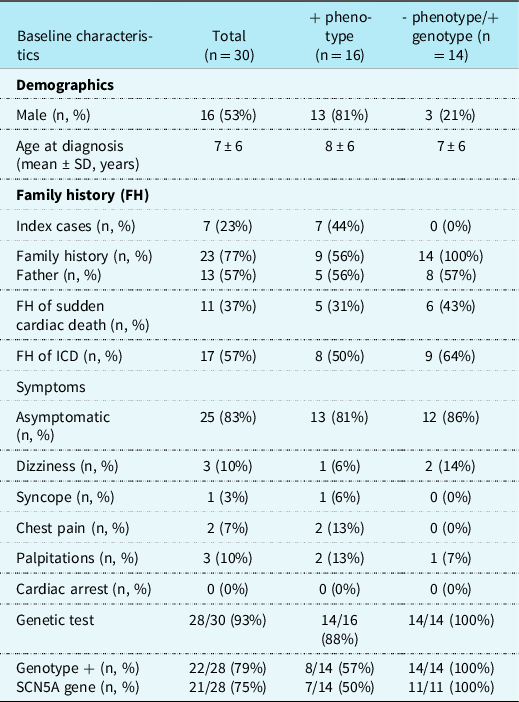
Thirty patients were included, belonging to 25 different families; 16 patients had a positive phenotype and 14 patients had a negative phenotype/positive genotype. Table 1 lists the baseline clinical characteristics according to the phenotype.
Baseline characteristics of patients with a positive phenotype for Brugada Syndrome and patients with negative phenotype/positive genotype. FH, family history, ICD, implantable cardioverter defibrillator.

The mean age at diagnosis was 7 ± 6 years (2 months to 18 years) and 16 patients (53%) were male. Most patients had a positive family history of Brugada syndrome (n = 23, 77%), mainly from the paternal side (n = 13, 57%), and 7 patients (23%) were index cases. One patient had previous medical history of epilepsy and another patient had Addison’s disease. Most patients were asymptomatic (n = 25, 83%). The majority of the patients performed a genetic test (n = 28, 93%), mostly during family screening, which was positive in 79% (n = 22).
Sixteen patients had a positive phenotype, predominantly male (n = 13, 81%) and with a mean age at diagnosis of 8 ± 6 years. Most of the patients presented a spontaneous type 1 ECG pattern (n = 14, 88%) and two patients presented a fever-induced pattern. The majority of the patients had family history of Brugada syndrome (n = 9, 56%) and almost one-third had positive family history for sudden cardiac death (31%); 44% (n = 7) were index cases. A genetic test was performed in 14 patients (88%) and was positive in 57% (n = 8). The most frequent gene involved was the SCN5A gene (n = 7); one patient presented a mutation in the CACNA1C gene (Supplementary Table S1).
Fourteen patients had a negative phenotype/positive genotype, presenting a positive familial genetic screening (Supplementary Table S2), but with no identified phenotypic expression. Contrary to patients with a positive phenotype, these patients were mostly female (n = 11, 79%). They all had family history of Brugada syndrome, mainly from the paternal side (57%); 43% (n = 6) mentioned sudden cardiac death family history and 64% had family history of implantable cardioverter defibrillator implantation. No provocative test with ajmaline or flecainide was performed in the study population.
Follow-up of children with positive phenotype or negative phenotype/positive genotype
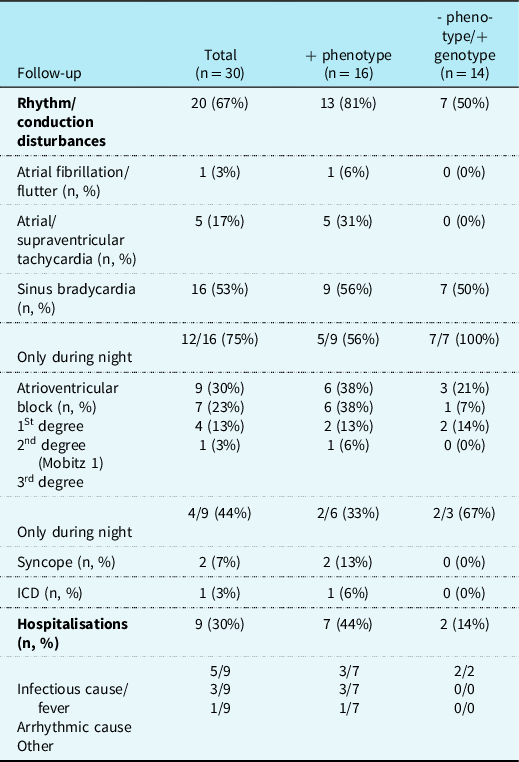
Although most patients were asymptomatic, the prevalence of rhythm or conduction disturbances during follow-up (mean time of 7 ± 3 years) was not infrequent, particularly in patients with a positive phenotype (n = 13, 81%) (Table 2). Five patients from this group had documented supraventricular tachyarrhythmias and one patient had symptomatic episodes of atrial fibrillation and atrial flutter requiring electrophysiology study and catheter ablation, which was performed by the age of 12. No ventricular arrhythmias were induced during the programmed ventricular stimulation. This patient also presented significant conduction disturbances including complete atrioventricular block.
Follow-up of children with positive phenotype or negative phenotype/positive genotype including rhythm/conduction disturbances and hospitalisations. ICD, implantable cardioverter defibrillator.

Two patients had syncope episodes. In one case, the episode was considered vasovagal and the patient was maintained under close follow-up; in the other case, the syncope was presumed to be due to ventricular arrhythmias and it was decided to implant a subcutaneous implantable cardioverter defibrillator. During the 2-year follow-up after device implantation, no arrhythmic events were documented.
In patients with negative phenotype/positive genotype only sinus bradycardia and first- and second-degree atrioventricular block were reported, mainly during sleep.
Nine patients (30%) were hospitalised during follow-up, three due to an arrhythmic event (one patient with atrial flutter and complete atrioventricular block, one with supraventricular tachyarrhythmia, and the other with syncope presumed to be due to ventricular arrhythmias), all patients with a positive phenotype. Overall, no sudden cardiac death events were reported during follow-up.
Characterization and follow-up of children with family history of Brugada syndrome
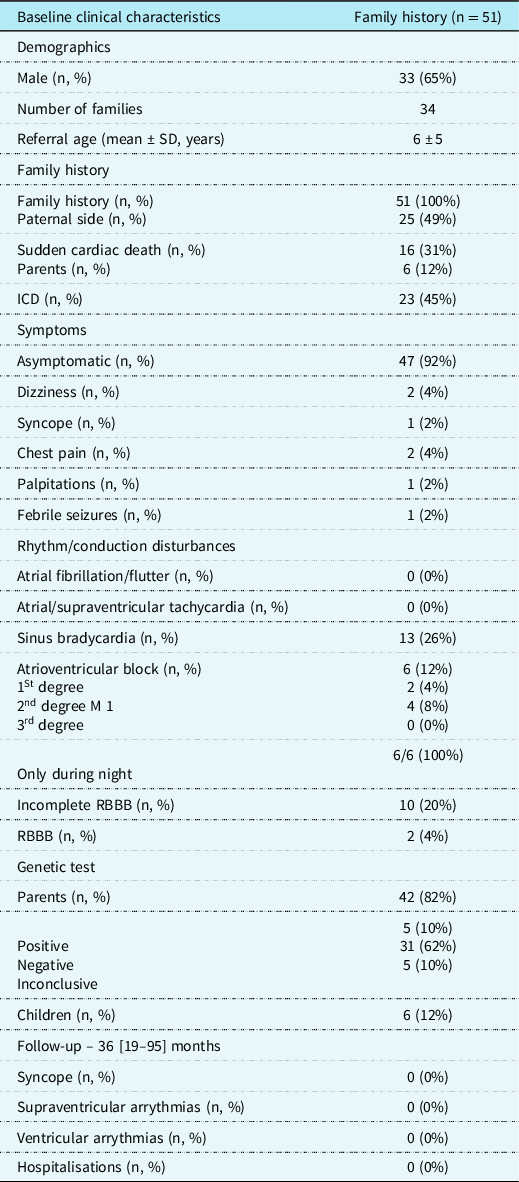
A total of 51 patients from 34 families presented no phenotype and no/uncertain genotype and were followed-up due to family history of Brugada syndrome. Table 3 lists the baseline clinical characteristics. Most patients were male (n = 33, 65%) and the mean referral age was 6 ± 5 years. Almost one-third of the patients had family history of sudden cardiac death (n = 16, 31%), of which 38% was of a parent. A genetic test was carried out on the parents in 82% of the cases (n = 42) and on the children in 12% (n = 6). The majority of the patients were asymptomatic (n = 47, 92%). One of the patients had previous history of loss of consciousness and seizures during fever, and as such, the event was not considered arrhythmic. Despite that, the child maintained close follow-up.
Characterization and follow-up of children with family history of Brugada syndrome. ICD, implantable cardioverter defibrillator; RBBB, right bundle branch block.

In this group, only conduction disturbances were reported, mainly sinus bradycardia during sleep and incomplete right bundle branch block. Overall, no taquiarrhythmias or hospitalisations were reported during follow-up.
Discussion
In our study of children with Brugada history (positive phenotype or negative phenotype/positive genotype), the documentation of rhythm and conduction disturbances was not infrequent, particularly in patients with a positive phenotype. Despite the significant family history, patients with a negative phenotype/positive genotype presented no clinically relevant events during follow-up.
As the presence of Brugada syndrome and the known risk of sudden cardiac death in a young patient can have devastating familial and social implications, the management of these patients represents a major challenge.
Age and gender
The lower prevalence of Brugada syndrome in the paediatric patients Reference Oe, Takagi and Tanaka5 and the absence of male predominance compared to the adult population might be explained by hormonal influences, although the exact physiological mechanism is still poorly understood. Reference Brugada, Campuzano, Arbelo, Sarquella-Brugada and Brugada1,Reference Milman, Andorin and Gourraud3 Testosterone appears to have an influence, explaining the higher proportion of male cases in adults, which is not so prominent in the paediatric population. Reference Probst, Denjoy and Meregalli7
In our study, we also found only a slight male predominance (53% of the patients with positive phenotype or negative phenotype/positive genotype and 65% of the patients with family history of Brugada syndrome). However, analysing the patients according to the phenotype, we found a significant male pre-dominance (81%) in those with a positive phenotype and female pre-dominance (79%) in those with negative phenotype/positive genotype. Interestingly, previous studies including paediatric patients with severe forms of the disease, namely arrhythmic events or implantable cardioverter defibrillator implantation, also revealed a significant male pre-dominance (71 to 100%). Reference Gonzalez Corcia, Sieira and Sarkozy8–Reference Gonzalez Corcia, Sieira and Pappaert10
Clinical presentation
Asymptomatic patients with a family history of Brugada syndrome are usually the most common form of presentation in paediatric patients. Reference Behere and Weindling6 However, the initial manifestation of Brugada syndrome in children can include sinus node dysfunction, atrial arrhythmias including atrial fibrillation or atrial flutter, ventricular arrhythmias, syncope, and sudden cardiac death. Reference Michowitz, Milman and Andorin9,Reference Gonzalez Corcia, de Asmundis, Chierchia and Brugada11
In our study, although most of the patients were asymptomatic (83% of the patients with positive phenotype or negative phenotype/positive genotype and 92% of the patients with family history of Brugada syndrome), the prevalence of rhythm or conduction disturbances was not infrequent, mainly in patients with a positive phenotype. In this group, two patients in particular presented a more complicated course, one requiring an electrophysiological study and catheter ablation for atrial flutter and the other an implantable cardioverter defibrillator. Previous studies have shown that patients with this type of presentation, including syncope, atrial tachycardia and conduction abnormalities, are at higher risk of life-threatening events, and close follow-up is therefore essential. Reference Gonzalez Corcia, Sieira and Pappaert12
One patient followed up due to family history of Brugada syndrome had previous history of loss of consciousness and seizures during fever. Benign febrile seizures are a common phenomenon during the first 6 years of life; atypical febrile seizures have been reported to be associated with sodium channel mutations and Brugada syndrome. Reference Skinner, Chung and Nel13 Electrocardiographic screening should be considered in cases of atypical febrile seizures with suspicion of arrhythmia or a positive family history of Brugada syndrome. Reference Gonzalez Corcia, de Asmundis, Chierchia and Brugada11
Diagnosis
In case of non-diagnostic electrocardiogram, sodium channel blockers such as flecainide, procainamide, and ajmaline have been used to unmask the Brugada pattern. Reference Krahn, Behr, Hamilton, Probst, Laksman and Han2 A consensus on the age to start these tests in children and the safety of the different drugs is not yet well established. It appears to be safe if performed by an experienced team; Reference Gonzalez Corcia, de Asmundis, Chierchia and Brugada11 however, it should be noted that the result may change over time and that repeating ajmaline test after the onset of puberty can unmask the Brugada pattern in patients with negative result before puberty. Reference Behere and Weindling6 Due to a possible higher risk of adverse events with sodium channel blockers provocation in children, Krahn et al do not recommend its routine use for screening purposes until the age of 15. Reference Krahn, Behr, Hamilton, Probst, Laksman and Han2
Genetics
Genetic testing is recommended in patients with a type 1 electrocardiographic pattern in order to allow for family screening. Reference Krahn, Behr, Hamilton, Probst, Laksman and Han2 In spite of several genes identified, SCN5A has attracted the most attention and is responsible for nearly 30% of all cases in which a gene variant is implicated. Reference Brugada, Campuzano, Arbelo, Sarquella-Brugada and Brugada1
In our study, a mutation was found in 57% of the phenotype positive patients (79% of the total population), mainly in the SCN5A gene, which was also the most frequently studied. This higher prevalence is in accordance with previous studies in children (58–77%) Reference Probst, Denjoy and Meregalli7,Reference Michowitz, Milman and Andorin9,Reference Andorin, Behr and Denjoy14 and can result from a bias related to screening of families with known mutations.
It is common sense to assume that genotype-positive children are at higher risk of developing Brugada syndorme, but there is still no data regarding risk stratification of these patients at present. In our negative phenotype/positive genotype patients, despite the significant family history, no clinically relevant events were reported. Nevertheless, these patients should be closely followed up to identify any possible electrocardiographic or clinical manifestations.
Risk stratification
As sudden cardiac death in a young patient has devastating implications, the management of children with Brugada represents a major challenge regarding the best prognostic stratification and therapeutic strategy. As in adults, risk stratification remains challenging and controversial.
The most consistently reported predictors of life-threatening arrhythmias are clinical presentation with sudden cardiac death or syncope and spontaneous type I electrocardiogram. Reference Gonzalez Corcia, Sieira and Sarkozy8,Reference Gonzalez Corcia, Sieira and Pappaert10,Reference Gonzalez Corcia, Sieira and Pappaert12,Reference Andorin, Behr and Denjoy14 Other variables significantly associated with events include sinus node dysfunction and/or atrial tachycardia and conduction abnormalities. Reference Gonzalez Corcia, Sieira and Sarkozy8,Reference Gonzalez Corcia, Sieira and Pappaert12
In our study, particularly in the patients with a positive phenotype, we found a significant proportion of patients with rhythm and/or conduction abnormalities, who are therefore followed up more regularly considering the higher risk of events.
Asymptomatic patients identified by family screening, notwithstanding their genetic status or family history of sudden cardiac death, are considered low risk. Reference Gonzalez Corcia, Sieira and Sarkozy8 In our centre, no clinically significant events were reported in patients with negative phenotype/positive genotype or patients followed-up only due to family history. Despite the importance of ruling-out future onset of electrocardiographic or symptomatic manifestations, especially during febrile episodes, a less strict follow-up is usually carried out.
Treatment
In all patients with a diagnosis of Brugada syndrome, lifestyle changes are recommended including avoiding drugs that may induce ST-segment elevation in the right pre-cordial leads, excessive alcohol intake, large meals, and avoidance of sports practice that increase core temperature > 39°C. Reference Priori, Blomström-Lundqvist and Mazzanti15,Reference Pelliccia, Sharma and Gati16
In paediatric patients, fever is the most important precipitating factor for arrhythmic events Reference Probst, Denjoy and Meregalli7,Reference Michowitz, Milman and Andorin9,Reference Andorin, Behr and Denjoy14 and prompt treatment with antipyretic drugs is therefore essential. Reference Priori, Blomström-Lundqvist and Mazzanti15 Hospitalisation during febrile illnesses should also be considered, not only due to the increased arrhythmic risk, but also because of the possibility of establishing an electrocardiographic diagnosis. Reference Behere and Weindling6
The management of negative phenotype/positive genotype patients is controversial. Shashank et al recommend regular screening with electrocardiogram with high pre-cordial leads and the adoption of the above-mentioned preventive measures. Reference Behere and Weindling6
Implantable cardioverter defibrillator placement remains the only therapy with proven efficacy in the management of ventricular arrhythmias and prevention of sudden cardiac death in patients with Brugada syndrome and is the treatment of choice for symptomatic adults. Reference Krahn, Behr, Hamilton, Probst, Laksman and Han2,Reference Priori, Blomström-Lundqvist and Mazzanti15 The indication for implantable cardioverter defibrillator in children remains a difficult decision, not only due to the limited and, at times, conflicting data, but also considering the psychological stress, impact on quality of life and the increased risk of complications which include inappropriate shocks, lead fractures, and the need for reoperation. Reference Gonzalez Corcia, Sieira and Pappaert10,Reference Andorin, Behr and Denjoy14
In paediatric patients, implantable cardioverter defibrillator implantation is indicated in patients with a diagnosis of Brugada syndrome who are survivors of sudden cardiac death or have documented spontaneous sustained ventricular tachycardia (class of recommendation I, level of evidence B - NR evidence from non-randomised studies, observational studies, or registry studies). Implantable cardioverter defibrillator is considered reasonable for patients with Brugada syndrome with a spontaneous type I Brugada ECG pattern and recent syncope presumed to be due to ventricular arrhythmias (IIA, B – NR). Reference Shah, Silka and Silva17
Implantable cardioverter defibrillator implantation should be a shared decision between the patient, family, and the physician considering specific paediatric characteristics (age, size of the patient, need for an epicardial device) and individualised according to clinical presentation, family history, genetic data, and the family’s specific preferences. Reference Shah, Silka and Silva17
This study has the limitations inherent to its retrospective design and small sample size. Only a descriptive statistical analysis was performed considering the intrinsically very different groups characteristics, and as such no statistical methods for bias elimination was applied. Only 1–4 genes were evaluated in the present analysis, excluding the possibility of mutations in other Brugada syndrome-related genes. The high prevalence of positive genetic results can be explained by the bias related to screening of families with known mutations.
To conclude, this study reports a unique single-centre experience with long-term follow-up in a paediatric cohort of patients with a history of Brugada. In our study, although the majority of the patients were asymptomatic, the documentation of rhythm and conduction disturbances was not negligible, especially in patients with a positive phenotype. In spite of the significant family history of sudden cardiac death and implantable cardioverter defibrillator, patients with negative phenotype/positive genotype and patients only with family history of Brugada syndrome had no significant events reported during follow-up. Nevertheless, the management of these patients is not clear cut, and a personalised therapeutic strategy with close follow-up is essential. Decision-making in children with Brugada is challenging and should be individualised according to the specific clinical presentation, patient characteristics, family history, genetic data, and patient’s and family’s preferences.
Supplementary material
For supplementary material accompanying this paper visit https://doi.org/10.1017/S1047951122003894
Acknowledgements
None.
Financial support
This research received no specific grant from any funding agency, commercial, or not-for-profit sectors.
Conflicts of interest
None.