INTRODUCTION
Several papers exist that describe current dispersal, dynamics and status of non-indigenous decapods on a global scale (Yamada, Reference Yamada2001; Carlton & Cohen, Reference Carlton and Cohen2003; Dittel & Epifanio, Reference Dittel and Epifanio2009; Galil et al., Reference Galil, Clark and Carlton2011; Galil, Reference Galil2012; Epifanio, Reference Epifanio2013). General information on many non-indigenous species is contained in online databases such as AquaNIS (www.corpi.ku.lt/aquanis) or CIESM online atlas of exotic species (http://www.ciesm.org/online/atlas/intro.htm). In these studies, however, there is limited information about the seas around East Europe and North Asia, which are largely within the jurisdiction of Russia and several adjacent countries. The main reason for this is that a significant amount of existing information is contained in Russian literature which is not readily accessible. Due to the high variety of marine basins around Russia (13 out of 20 of non-tropical Eurasian seas; see Zalogin & Kosarev, Reference Zalogin and Kosarev1999) it is an important representative area for the analysis of marine alien species in temperate and cold waters of the northern hemisphere. In this paper, we review existing information on alien marine and brackish water decapod species in the eastern Baltic, Sea of Azov, Black, Caspian Seas, the Eurasian Arctic seas, the western Bering Sea, Sea of Okhotsk and the Sea of Japan and their watersheds. Some data on the land-locked Aral Sea and its successor salt lakes is also provided. The present study aims to assess current status of alien decapod species, review the scope of existing biological data, forecast future developments of introductions/invasions, and to identify common or unique (if any) dispersal patterns of alien decapods in these basins.
MATERIALS AND METHODS
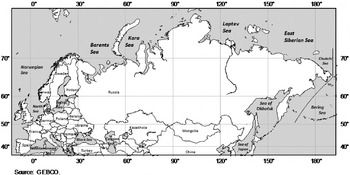
A database of information sources of findings, distribution and biological data of non-indigenous decapod species in the seas adjacent to the Russian Federation, as a proxy for marine waters of East Europe and North Asia (Figure 1), has been compiled. The Baltic Sea was only considered in its eastern and central parts, including Russian and neighbouring countries’ waters: Estonia, Finland, Latvia, Lithuania and Poland. These sources are divided into three categories: scientific publications (both peer reviewed publications and ‘grey’ literature), museum collections and media communications. Scientific publications consist of about 400 titles, of which 43% are published in Russian. About 70% of Russian papers and abstracts were published in ‘grey’ literature. These were either records of particular species (often discussed later in subsequent papers published in reviewed journals, i.e. Shakirova et al., Reference Shakirova, Panov and Clark2007; Berezina & Petryashov, Reference Berezina and Petryashov2012, or thesis, i.e. Anosov, Reference Anosov2016), or papers on the Kamchatka and snow crabs that have originated from fishery research; mostly done by the Russian Federal Institute of Fishery and Oceanography (VNIRO) and N.M. Knipovich Polar Institute of Fishery and Oceanography (PINRO). As for the museum collections, these mainly refer to the Zoological Museum of the Moscow University (ZMMU), the Zoological Institute of the Russian Academy of Sciences (ZIN RAS), the Museum Naturalis, Leiden and the Natural History Museum (NHM), London (the latter two only refer to Rhithropanopeus harrisii (Gould, 1841)). Generally, media communications cannot be used as a proof of the occurrence of an alien species. However, they can be taken into account in cases when they are consistent with scientifically based publications and collections and are used for planning future research and monitoring. These references have been categorized as follows: history of introduction and invasion (including first and subsequent records); genetic structure and origin of alien populations; distribution pattern, habitats and habits; larval biology; size composition, population characteristics and dynamics; symbionts, parasites and pathogens; position in the ecosystem and impact; possible vectors of introduction and forecast of potential future spread. For most common alien crab species, information is presented along all (if available) or part of these categories. For the sake of brevity, references of species records are given to the most comprehensive paper that contains references to previous records.
The seas around and inside East Europe and North Asia. 1: White Sea; 2: Sea of Azov; 3: Aral Sea (before splitting into the Big and Smaller Aral salt lakes).

The database will be available from the authors’ pages of researchgate.net upon publication of the present paper.
RESULTS
Overall situation
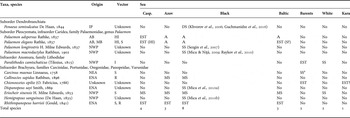
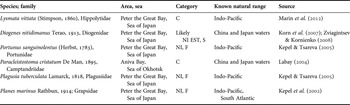
The total number of non-indigenous decapod species recorded from the seas around Russia (Figure 1) amounts to 13 (Table 1). Unambiguous alien decapod species have not been identified with certainty in most of the Siberian Shelf (except the Kara Sea) and the North-West Pacific seas and their watersheds (except for the Chinese mitten crab in the Amur River, see below). However some cryptogenic species and species dispersed with flotsam are known from the southern area of Russia's Pacific: Peter the Great Bay and the Aniva Bay (Table 2). Non-indigenous decapod species have mostly been recorded in the Atlantic Basin, while the greatest number (8) was found in the Black Sea (Table 1).
Non-indigenous Decapoda species in the seas of East Europe and North Asia, their areas of origin, vectors and occurrence in particular seas. Origin: AB, Аzov-Black sea basin; ENA, East North America; IP, Indo-Pacific; NEA, North-east Atlantic; NWP, North-west Pacific; MB, Mediterranean basin. Vector: I, intentional introduction (acclimatization); HI, hitchhiker with intentional introduction of other species; R, range expansion from neighbouring populations; S, Shipping industry. Status in the sea: No, species is not recorded; А, autochthonous species; SS, non-indigenous species, single sighting; DS, non-indigenous species, double sightings, status unknown; MS, non-indigenous species, multiple sightings, status unknown; EST, Established non-indigenous species. Compiled from literature data, collections materials and results of field studies performed by authors (see text).

References within table are for single and double sightings of species not treated in special sections of the text.
a Catalogue of collections of Zoological Institute of Russian Academy of Sciences, St. Petersburg.
Cryptogenic and non-indigenous Decapoda species recorded in the south of the Russian Far East region (Sea of Japan and southern Sea of Okhotsk). C, cryptogenic species; NI, non-indigenous species; EST, established species; S, species dispersing with shipping vector; F, species dispersing with flotsam.

Based on Table 1, established and potentially capable of establishment decapod species in the seas around East Europe can be tentatively classified by contemporary geographic pattern of introduction. This classification is used merely to facilitate the description of a complex situation.
GLOBAL INVADERS
Species are regarded as global invaders when their introduction, through any vector, leads to their occurrence in several seas of at least two oceans (extension of the term coined by Yamada (Reference Yamada2001)). In East Europe, this group is represented by the Chinese mitten crab (Eriocheir sinensis), Harris mud crab (Rhithropanopeus harrisii) and blue crab (Callinectes sapidus). A single record of the green crab (Carcinus maenas) in the Barents Sea, Asian shore crab (Hemigrapsus sanguineus), Say mud crab (Dyspanopeus sayi) (Micu et al., Reference Micu, Niţă and Todorova2010a, Reference Micu, Niţă and Todorovab), and two invasive prawns (Palaemon macrodactylus and Palaemon longirostris) (Sezgin et al., Reference Sezgin, Aydemir, Ateş, Katağan and Özcan2007; Micu & Niţă, Reference Micu and Niţă2009; Raykov et al., Reference Raykov, Lepage and Pérez-Domínguez2010) in the Black Sea, can also be referred to this category.
The blue crab has been regularly observed in the Azov and Black Seas since the 1960s (Anosov, Reference Anosov2016; AquaNIS database, 2016). This crab was probably introduced from the Mediterranean Sea, where several localities with established independent local populations of this crab already exist (Brockerhoff & McLay, Reference Brockerhoff, McLay, Galil, Clark and Carlton2011). The increase in number and geographic distribution of findings of ovigerous females suggest a possibility of the formation of a reproducing population of the blue crab in the Azov/Black Sea basin (Anosov, Reference Anosov2016).
The green crab is a historically earliest recorded global marine invader (Yamada, Reference Yamada2001; Carlton & Cohen, Reference Carlton and Cohen2003). It is native to the western, but not to the eastern, European seas. In Russia it has been observed only once in 1877, on Kildin Island (~69°19′N 34°16′E) in the Barents Sea (catalogue of Zoological Institute of Russian Academy of Sciences). This is several hundred miles east of its known findings in Norway (Christiansen, Reference Christiansen1969). It is possible that the crab has been transported in hull fouling of wooden ships that travelled between Russia and Norway at that time, due to fishing and trade industry (Popov & Davydov, Reference Popov and Davydov1999).
Eriocheir sinensis and Rhithropanopeus harrisii are reviewed in the case studies section below.
‘REGIONAL’ ALIENS
This is a working title for alien species within the North-East Atlantic seas (and their derivatives such as the Caspian Sea), which are native to European marine waters. Widely distributed palaemonid shrimps, Palaemon elegans and P. adspersus, are commonly found in coastal areas of the North-Eastern Atlantic seas (d'Udekem d'Acoz, Reference d'Udekem d'Acoz1999). These species have been unintentionally introduced to the Caspian Sea from the Sea of Azov or the Black Sea. The exact time of introduction is not known, but could have happened with the intentional introduction of the mullet fish from the Black Sea between 1931 and 1934 (Shorygin & Karpevich, Reference Shorygin and Karpevich1948). Yet from 1936–1939 they have been recorded on the west coast of the Central Caspian (Behning, Reference Behning1936; Filippov, Reference Filippov2005).
Today rockpool prawn, Palaemon elegans, is still common in the Caspian Sea (Karpinsky, Reference Karpinsky2002; Filippov, Reference Filippov2005), although little is known about its status and distribution. Rockpool prawn reached the Aral Sea in the 1950s (first recorded in 1956), through a similar vector, as a hitchhiker with intentionally introduced mugil fish from the Caspian Sea (Khusainova, Reference Khusainova1958). In the early 1990s, P. elegans was abundant and occurred throughout the Aral Sea (Filippov, Reference Filippov2005). Drastic decrease in the area of the Aral Sea, increase in its salinity and the division of the previously land-locked sea into two saline lakes, the Big Aral and the Smaller Aral, led to the extinction of P. elegans in the Big Aral by 1997 (Aladin et al., Reference Aladin, Plotnikov, Letolle, Nihoul, Zavialov and Micklin2004). In the years 2014–2015, the second author undertook expeditions to the Smaller Aral (which has maintained lower salinity, currently 11.1‰), and has found P. elegans to be common on soft bottom substrates with macrophytes (Izhitskiy et al., Reference Izhitskiy, Zavialov, Sapozhnikov, Kirillin, Grossart, Kalinina, Zalota, Goncharenko and Kurbaniazov2016; Ph. Sapozhnikov, personal communication).
Since the late 1990s to early 2000s P. elegans expanded its range in the Baltic Sea, which resulted in it becoming a common species in the Vistula lagoon, Gulf of Riga and Gulf of Finland (Grabowski, Reference Grabowski2006; Burukovsky, Reference Burukovsky2012; Katajisto et al., Reference Katajisto, Kotta, Lehtiniemi, Malavin and Panov2013; AquaNIS database, 2016). Genetic analysis has shown that this invasion is not due to the expansion of the local population from the western Baltic, but it is facilitated by introductions from the Mediterranean or the Black Seas (Reuschel et al., Reference Reuschel, Cuesta and Schubart2010).
ARCTIC INVADERS
This group of decapod invaders consists of two species and is unique to Russian and contiguous waters: intentionally introduced lithodid Kamchatka crab (Paralithodes camtschaticus) and unintentionally introduced brachyuran snow crab (Chionoecetes opilio). These species (discussed in the case studies section below) have initially been introduced to the Barents Sea and have now spread beyond its borders.
OTHER CATEGORIES
Besides the groups of alien species mentioned above there has been a repeated sighting of the green tiger prawn (Peneus semisculcatus) (Khvorov et al., Reference Khvorov, Boltachev, Reshetnikov and Pashkov2006; Guchmanidze et al., Reference Guchmanidze, Statkevich and Boltachev2016), a representative of the widely known Lessepsian migrant group from the Red Sea, which enters the Mediterranean Sea through the Suez Canal (Por, Reference Por1978; Galil, Reference Galil2012).
There have been several records of warm water species known to travel with flotsam in the Peter the Great Bay, Sea of Japan. These include: Planes marinus (Kepel et al., Reference Kepel, Spiridonov and Tsareva2002), Portunus sanguinolentus and Plagusia tuberculata (Kepel & Tsareva, Reference Kepel and Tsareva2005). Some temperate or warm water West Pacific species have been sighted in the Russian Far East, from localities distant to their known ranges, which are located further south, in East Asian waters. Presently they can be categorized as cryptogenic species (Table 2). From this group, the hermit crab Diogenes nitidimanus is of particular interest. It could indeed be an alien species introduced via shipping vector and have an established population in the Peter the Great Bay (Korn et al., Reference Korn, Kornienko and Zvyagintsev2007; Zviagintsev & Kornienko, Reference Zviagntsev and Kornienko2008).
Case studies
CHINESE MITTEN CRAB (ERIOCHEIR SINENSIS) – A WAY TO ESTABLISHMENT?
The Chinese mitten crab, E. sinensis, originates from the coastal area of northern China (Panning, Reference Panning1939). Its life history, similar to other species of the Varunidae, involves catadromous migration (Panning, Reference Panning1939; Herborg et al., Reference Herborg, Rushton, Clare and Bentley2003, Reference Herborg, Rudnick, Yang, Lodge and MacIsaac2007a). The reproduction of these crabs occurs in coastal waters at salinity no less than 15‰ (Anger, Reference Anger1991); the juveniles then migrate from estuaries further up the river.
History of introductions in Central/East Europe and non-European Russia
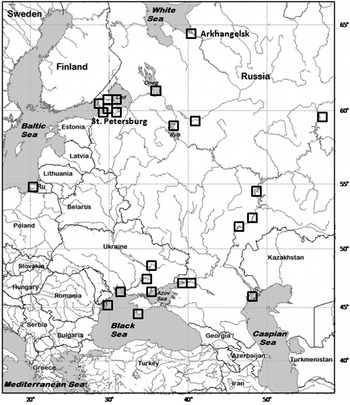
Chinese mitten crabs were first found in European waters in the North Sea, in Germany (Panning, Reference Panning1939; Herborg et al., Reference Herborg, Rushton, Clare and Bentley2003). Currently it is one of the most widespread alien species in European Russian waters and neighbouring countries (Figure 2). It is found in most of the European basins except the Barents Sea. In the Gulf of Finland, the first specimens were recorded in 1933, but since then the species was seldom observed (Herborg et al., Reference Herborg, Rushton, Clare and Bentley2003; Ojaveer et al., Reference Ojaveer, Gollasch, Jaanus, Kotta, Laine, Minde, Normant and Panov2007). This crab was found in the estuary of river Neva in the 1980s (Berezina & Petryashov, Reference Berezina and Petryashov2012), that coincided with the beginning of its regular findings on the coast of Poland, particularly near Gdansk, in the neighbouring Vistula lagoon (Grabowski et al., Reference Grabowski, Jazdzewski and Konopacka2005 and earlier references therein), on the shores of Kaliningrad region (reported here) and in Lithuania (Bacevičius & Gasiūnaitė, Reference Bacevičius and Gasiūnaitė2008), Latvia, Estonia and Finland (Ojaveer et al., Reference Ojaveer, Gollasch, Jaanus, Kotta, Laine, Minde, Normant and Panov2007).
Records of Chinese mitten crab (Eriocheir sinensis) in the watersheds and coastal marine waters of Russia and Ukraine. Simplified mapping of the data presented by Kamentseva (Reference Kamentseva2002), Panov (Reference Panov2006), Ojaveer et al. (Reference Ojaveer, Gollasch, Jaanus, Kotta, Laine, Minde, Normant and Panov2007), Shakirova et al. (Reference Shakirova, Panov and Clark2007), Berezina & Petryashov (Reference Berezina and Petryashov2012) and Son et al. (Reference Son, Novitsky and Diadichko2013).

From the 1990s and early 2000s reports of this species have become more common in the Neva estuary, Ladoga and Onega lakes that are also interconnected with the Baltic Sea (Panov, Reference Panov2006). In 1998, E. sinensis has been found in the delta of the Northern Dvina River in the White Sea basin (Berezina & Petryashov, Reference Berezina and Petryashov2012 and earlier references therein).
In the Black Sea, mitten crabs have been recorded since 1998, and from the 2000s they have been commonly sighted on the Ukrainian coast in the north-western part of the Danube River, and in Crimean Sevastopol. Two records (2002–2003) are known from the Dnieper River: in the Dnieper and the Kakhovka Reservoirs. At a similar time (1998), it has also been found in the Molochnyi liman of the Sea of Azov (Son et al., Reference Son, Novitsky and Diadichko2013 and earlier references therein; Anosov, Reference Anosov2016). Nearly simultaneously E. sinensis was reported from the mouths of the rivers Don and Manych (Kamentseva, Reference Kamentseva2002).
In the Caspian Sea basin E. sinensis is known from the Volga River, possibly since the 1970s (Shakirova et al., Reference Shakirova, Panov and Clark2007 and earlier references therein). From 1995 until 2007 this crab was regularly sighted mainly in reservoirs and in the delta of the Volga River (Shakirova et al., Reference Shakirova, Panov and Clark2007, and earlier references therein) (Figure 2) and in a river on the Iranian coast (Robbins et al., Reference Robbins, Sakari, Baluchi and Clark2006).
Since the early 2000s Chinese mitten crabs are sometimes found in the Amur River and its side streams near Khabarovsk (Novomodnyi, Reference Novomodnyi2014). Novomodnyi (Reference Novomodnyi2014 and personal communication) suggests that the observed crabs are escapees from nearby Chinese markets in the Amur Basin.
Genetic structure and origin of alien populations
The European populations of the Chinese mitten crab generally show reduced genetic diversity compared with the samples from the native distribution range. Only one sample of E. sinensis that originated from the vicinity of the studied region (Maelaren, Sweden), has been examined for microsatellite loci (Herborg et al., Reference Herborg, Weetman, van Oosterhaut and Hänfling2007b). It showed a remarkable similarity to the mitten crab populations in the estuaries of the rivers Elbe and Weser in the North Sea. This supports the hypothesis of the recruitment of the central Baltic populations of E. sinensis from the North Sea (Herborg et al., Reference Herborg, Weetman, van Oosterhaut and Hänfling2007b; Ojaveer et al., Reference Ojaveer, Gollasch, Jaanus, Kotta, Laine, Minde, Normant and Panov2007).
Contemporary distribution pattern, habitats and habit
Records in the eastern Baltic indicate a geographic pattern of occurrence, i.e. greater abundance of E. sinensis in the Gulf of Riga and the eastern Baltic compared with the Bothnian Bay (Ojaveer et al., Reference Ojaveer, Gollasch, Jaanus, Kotta, Laine, Minde, Normant and Panov2007). There is also a seasonal pattern of recording of this crab by fishermen in the Gulf of Finland and Latvian waters (Ojaveer et al., Reference Ojaveer, Gollasch, Jaanus, Kotta, Laine, Minde, Normant and Panov2007) that may indicate migratory activity.
The Chinese mitten crab widely occurs throughout watersheds and estuarine areas of the Black and the Caspian basins, but little specific information on habitats is present in the literature for these regions. The species is known for its burrowing habit in tidal estuaries (Panning, Reference Panning1939; Dittel & Epifanio, Reference Dittel and Epifanio2009), but no observations on burrows of mitten crabs has been published for the studied region, which is generally a non-tidal environment.
Size and population characteristics
There is limited information on the biology of the Chinese mitten crab in Central and East Europe. Most of the records in the eastern and central Baltic (Normant et al., Reference Normant, Chrobak and Skora2002; Ojaveer et al., Reference Ojaveer, Gollasch, Jaanus, Kotta, Laine, Minde, Normant and Panov2007) and in the White Sea basin (collection of ZIN RAS) consist of large specimens, including ovigerous females (Normant et al., Reference Normant, Chrobak and Skora2002). The specimens found inland are also large; one sighting of an ovigerous female was reported from the inland reservoir of Rybinsk of the Volga River (Shakirova et al., Reference Shakirova, Panov and Clark2007). Larvae have not been recorded from the central or eastern Baltic (Ojaveer et al., Reference Ojaveer, Gollasch, Jaanus, Kotta, Laine, Minde, Normant and Panov2007); accordingly there are no published records of larvae in the southern seas of East Europe.
Symbionts, parasites and pathogens
No information on parasites and diseases of E. sinensis in Russia and neighbouring countries is available in the literature. Numerous nematodes, bivalves, crustaceans, oligochaetes and gastropods were found in the mittens of crabs’ claws in brackish waters. In fresh water the epibiota in the mittens of these crabs consisted of chironomids and water mites (Normant et al., Reference Normant, Korthals and Szaniawska2007).
Position in the ecosystem and impact
In the Baltic (Odra/Oder estuary) mitten crabs have been shown to feed on aquatic plants, copepods and chironomids along with detritus, and they have been found to be able to significantly reduce phyto- and zoobenthic biomass in mesocosm experiments (Czerniejewski et al., Reference Czerniejewski, Rybszyk and Wawrzyniak2010). The ability of crabs to carry numerous epibiotic organisms in their mittens may facilitate dispersal of indigenous and non-indigenous species between different watersheds (Normant et al., Reference Normant, Korthals and Szaniawska2007). While the Chinese mitten crab is known for its significant impact on the estuarine and riverine habitats in West Europe and North America, due to burrowing activity (Panning, Reference Panning1939; Dittel & Epifanio, Reference Dittel and Epifanio2009), there is no such information in the literature for East Europe.
Possible vectors and potential for spread
Chinese mitten crabs in the central and eastern Baltic most likely constitute a pseudopopulation, supplied by migration of crabs from the North Sea or the western Baltic (Ojaveer et al., Reference Ojaveer, Gollasch, Jaanus, Kotta, Laine, Minde, Normant and Panov2007). Otto & Brandis (Reference Otto and Brandis2011) also presented evidence of possible reproduction of E. sinensis in the Kiel Fjord in the western Baltic. Few papers (Shakirova et al., Reference Shakirova, Panov and Clark2007; Berezina & Petryashov, Reference Berezina and Petryashov2012) discuss the possible mechanism of introduction of E. sinensis into the watersheds of East Europe. Berezina & Petryashov (Reference Berezina and Petryashov2012) suggest that a possible vector of introduction could be with ballast water release in the estuary region of the Bay of Finland and the White Sea. Shakirova et al. (Reference Shakirova, Panov and Clark2007: 171) proposed that ‘mature mitten crabs are being transported through the calm European waterways as hull fouling on slow moving vessels such as barges’ and point to several indications of such a vector. The specimens found in the Ladoga and Onega Lakes could thus originate from the Gulf of Finland and enter these big lakes via migration and shipping vectors (Panov, Reference Panov2006; Berezina & Petryashov, Reference Berezina and Petryashov2012). The canal system also makes the entry of crabs from the Baltic to the White Sea basin possible (Northern Dvina watershed). The Baltic–Volga canal is probably the main route of E. sinensis entry into the Volga Basin (Shakirova et al., Reference Shakirova, Panov and Clark2007; Berezina & Petryashov, Reference Berezina and Petryashov2012). The occurrence of the Chinese mitten crab in the north-western part of the Black Sea could be due to the migration of this crab via canals from the North Sea watershed through the Rhine–Main–Danube Canal to the Danube River (Paunovic et al., Reference Paunovic, Cakic, Hegedis, Kolarevic and Lenhardt2004).
There is an alternative vector of introduction to the Northern Dvina and the Sea of Azov, via ballast waters from tankers, which were common in the 1990s due to oil export from the Arkhangelsk port and a transit via Rostov-on-Don. Similar circumstances could have resulted in the appearance of the Chinese mitten crab in the southern Caspian Sea. Released juveniles could survive in the estuaries for several years and move up rivers as they increase in size, where they have been found by local fishermen.
There are no reports of reproducing populations of E. sinensis in the eastern Baltic, White, Black, Azov or Caspian Seas at the present time. Shakirova et al. (Reference Shakirova, Panov and Clark2007) suggested that if a substantial number of ovigerous crabs were transported and released into a suitable environment, then this could speed up the establishment of populations in the Black and Caspian Seas.
HARRIS MUD CRAB (RHITHROPANOPEUS HARRISII) – A BRIEF HISTORY
The other widely distributed, and in contrast to E. sinensis, widely established crab in the East Europe seas is the Harris mud crab. It is a global invader that originates from the East Coast of USA and the oldest non-indigenous decapod species in Europe. Known since 1874, it was recorded from the Zuiderzee lagoon, Province of North Holland in the Netherlands (Buitendijk & Holthuis, Reference Buitendijk and Holthuis1949). The first collected specimens are still available for study in the Museum Naturalis in Leiden. In East Europe this species was observed for the first time in 1937 in the Dnieper and Bug estuary of the north-western Black Sea (USSR, now Ukraine) (Makarov, Reference Makarov1939). This material is also still available for study in ZIN RAS. It is of interest to note that its arrival in the Black Sea coincided with a series of first findings in the North Sea outside its initial area of introduction (Buitendijk & Holthuis, Reference Buitendijk and Holthuis1949).
History of invasion in Central/East Europe
The introduction of the Harris mud crab to the southern and eastern Baltic is relatively well documented, but mostly by researchers from the countries neighbouring to Russia: Poland, Estonia and Finland. The species was first recorded in the Kiel Canal system in 1936 (Neubaur, Reference Neubaur1936). In 1951 it was found both in Russian and Polish parts of the Vistula Bay (Reznichenko, Reference Reznichenko1967 and earlier references herein), and in 1953 in Dead Vistula, an abandoned terminal part of the channel of the Vistula River (Turoboyski, Reference Turoboyski1973 and earlier references therein). Populations of the Vistula Lagoon and Dead Vistula have been maintained since that time, although the latter showed a decline and a recovery (Grabowski et al., Reference Grabowski, Jazdzewski and Konopacka2005). Although Dead Vistula has a direct connection to the Gulf of Gdansk, R. harrisii was recorded there significantly later, in the early 1960s, and an abundant population only became established during the early 2000s (Hegele-Drywa et al., Reference Hegele-Drywa, Normant, Szwarc and Podłuska2014). The area between the Hela Peninsula (Mierzeja Helska) in Poland and the Sambian (Semland) Peninsula (Kaliningrad Area of Russia) remained the easternmost known area in the Baltic populated by R. harrisii until 2000, when two specimens were found in the Klaipeda Port area in Lithuania (Bacevičius & Gasiūnaitė, Reference Bacevičius and Gasiūnaitė2008). In 2009 the species was found, and by 2011 apparently became established, in the skerries area of the Finnish Archipelago Sea in the eastern Baltic (Fowler et al., Reference Fowler, Forsström, von Numers and Vesakoski2013). At the same time in 2011 there were indications of establishing mud crab population in the Estonian waters: Pärnu Bay, the north-eastern part of the Gulf of Riga (Kotta & Ojaveer, Reference Kotta and Ojaveer2012).
In the north-western Black Sea, the initial dispersal of the species could not be well documented because it probably occurred during World War II. In the late 1940s to early 1950s it was found in the entire Dnieper–Bug and the Berezan limans, and around 1954–1957, the Harris mud crab was reported from the open waters near Odessa (Reznichenko, Reference Reznichenko1967). Simultaneously it was found throughout the Romanian and Bulgarian coasts (Ziemiankowski, Reference Ziemiankowski1951; Reznichenko, Reference Reznichenko1967). In 1969–1985 R. harrisii occurred along the entire continental coast of the north-western Black Sea, in the then Ukrainian Republic of USSR: from the Karkinitsky Bay in the very north-west of the Crimean Peninsula to the Danube Delta, both in limans and relatively open waters (Reznichenko, Reference Reznichenko1967; Makarov, Reference Makarov2004).
Along the Crimean coast of the Black Sea it has only been reported from Sevastopol Bay (Shalovenkov, Reference Shalovenkov2005: Mordvinova & Lozovsky, Reference Mordvinova and Lozovsky2009). In the Sea of Azov the Harris mud crab was first observed in the Taganrog Bay in 1948 (Mordukhai-Boltovskoi, Reference Mordukhai-Boltovskoi1952). However taking into account the duration of World War II (1941–1945) a difference of 11 years between the finding time of the species in the north-western Black Sea and in the Sea of Azov has to be taken with caution (Zalota et al., Reference Zalota, Spiridonov and Kolyuchkina2016a). By the 1950s Harris mud crab became a common species throughout the Sea of Azov (Reznichenko, Reference Reznichenko1967).
In the eastern and southern Black Sea, first populations of R. harrisii have been discovered in the estuaries of the Vulan and Shapsukho Rivers and the Bugaz Liman (Krasnodar area of Russia) in 2012–2013 (Zalota et al., Reference Zalota, Spiridonov and Kolyuchkina2016a) and in the estuary of the river Tuapse in 2016 (G.A. Kolyuchkina and U.V. Simakova, personal communication). It is however unknown when this species was introduced and established in these particular localities.
After the construction of the Don–Volga Canal connecting the Azov and Caspian basins (built in 1952), R. harrisii was found in the northern Caspian Sea in 1958 (Nebolsina, Reference Nebolsina1959). By early 1960s it became widespread and abundant at shallow depths throughout the entire Caspian Sea (Reznichenko, Reference Reznichenko1967). In 1963 R. harrisii was recorded in the coastal lagoon of the Gorgan Bay in the south-eastern corner of the Caspian Sea near the Iranian town Bandar-e Gaz (NHM collection).
From the Sea of Azov, Harris mud crab was unintentionally introduced to another land-locked Aral Sea in the 1970s (first recorded 1976). It was probably transported with species intended to improve food resources for fish in the Aral (Filippov, Reference Filippov2005). However, it was restricted to the southern part of the sea (Andreev & Andreeva, Reference Andreev and Andreeva1988). Harris mud crab was still recorded in the 1980s when the sea underwent a strong regression, increased salinity (about 30 g l−1) and separation into the Large and the Small Aral salt lakes (Andreev et al., Reference Andreev, Andreeva, Filippov and Aladin1992; Aladin et al., Reference Aladin, Plotnikov, Letolle, Nihoul, Zavialov and Micklin2004). Desiccation of the Large Aral continued and apparently R. harrisi has not survived the phase of increasing salinity up to 57 g l−1. The Small Aral is maintaining lower salinity (now 8–11 g l−1) owing to the Syr-Daria River discharge (Izhitskiy et al., Reference Izhitskiy, Zavialov, Sapozhnikov, Kirillin, Grossart, Kalinina, Zalota, Goncharenko and Kurbaniazov2016). It seems that the Harris mud crab had failed to reach the Small Aral before its separation in 1989 (Andreev et al., Reference Andreev, Andreeva, Filippov and Aladin1992). In the expeditions of IO RAS in 2014 (Izhitskiy et al., Reference Izhitskiy, Zavialov, Sapozhnikov, Kirillin, Grossart, Kalinina, Zalota, Goncharenko and Kurbaniazov2016) and 2015 the coastal areas of the Small Aral near village of Akbasty (46°16.5′N 60°54.7′E) was surveyed specifically for R. harrisii, however there have been no sightings.
Genetic structure and origin of alien populations
European populations of R. harrisii are genetically heterogeneous (Projecto-Garcia et al., Reference Projecto-Garcia, Cabral and Schubart2010; Hegele-Drywa et al., Reference Hegele-Drywa, Thiercelin, Schubart and Normant-Saremba2015; Simakova et al., Reference Simakova, Zalota and Spiridonov2017). Populations from the North Sea and some other European waters are more similar in their haplotypes constitution to the New Jersey population, although haplotype A, which is most common in European populations, has not been found in its native populations (Projecto-Garcia et al., Reference Projecto-Garcia, Cabral and Schubart2010). The establishment and dispersion of European populations have been largely determined by the founder effect; nevertheless the inflow of genetic information to the established populations has been substantial. In addition, the possibility of several introduction events should not be excluded (Projecto-Garcia et al., Reference Projecto-Garcia, Cabral and Schubart2010; Hegele-Drywa et al., Reference Hegele-Drywa, Thiercelin, Schubart and Normant-Saremba2015). Rhithropanopeus harrisii in the Black, Azov and Caspian Seas is characterized by low genetic diversity, two unique haplotypes, and most probably originated from some unknown European population (Simakova et al., Reference Simakova, Zalota and Spiridonov2017). The Caspian population is directly related to the Sea of Azov population and probably had multiple episodes of introduction through the Volga-Don canal (Simakova et al., Reference Simakova, Zalota and Spiridonov2017).
Contemporary distribution pattern, habitats and habit
In the north-western Black Sea (from the Danube delta to the isthmus of the Crimean Peninsula: Figure 3) R. harrisii shows a semi-continuous distribution along the coast in: limans, lagoons and estuaries, offshore banks and marine ports (Reznichenko, Reference Reznichenko1967; Makarov, Reference Makarov2004; Vinogradov et al., Reference Vinogradov, Bogatova and Sinegub2012). In the Sea of Azov, the Harris mud crab distribution pattern appears to be nearly continuous over the entire basin, including the northern part of Kerch Strait and the Taman Bay (Figure 3). There, this species occurs practically everywhere at various depth (0–10 m) and habitats, with the exception of oxygen depleted mud habitats in the deepest (10 m and deeper) area (Mordukhai-Boltovskoi, Reference Mordukhai-Boltovskoi1952; Reznichenko, Reference Reznichenko1967; Makarevich et al., Reference Makarevich, Lyubin and Larionov2000; Sergeeva & Burkatsky, Reference Sergeeva and Burkatsky2002; Ivanov & Sinegub, Reference Ivanov and Sinegub2008; Nabozhenko et al., Reference Nabozhenko, Shokhin, Bulysheva, Matishov and Boltachev2010; Zalota et al., Reference Zalota, Spiridonov and Kolyuchkina2016a). In some areas, i.e. the entrance to the Taganrog Bay, according to the data of a grab survey, R. harrisii has even been recognized as a dominant species in the community (Makarevich et al., Reference Makarevich, Lyubin and Larionov2000). The information on the distribution in the Caspian Sea is fragmented (Figure 3), but there are several indications of significant continuity of its population over vast coastal shallow areas (Reznichenko, Reference Reznichenko1967; Yablonskaya, Reference Yablonskaya1985; Malinovskaja et al., Reference Malinovskaja, Filippov, Osadchikh and Aladin1998; Karpinsky, Reference Karpinsky2002; collection of ZMMU).
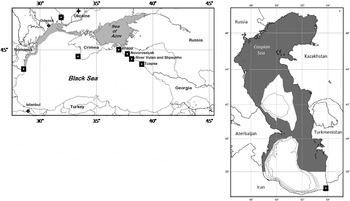
Distribution of Harris mud crab (Rhithropanopeus harrisii) in the Black Sea – Caspian region. Shadowed areas indicate basins with more or less continuous distribution of the species (shortage of data for the Iranian waters). Quadrates indicate localized records. For sources see text.

In contrast to this, the distribution pattern in the eastern Black Sea is different and is dominated by localized discontinuous populations associated with river estuaries and probably harbours (Zalota et al., Reference Zalota, Spiridonov and Kolyuchkina2016a; Figure 3). Localized discontinuous populations of R. harrisii are also presently characteristic for the Baltic (Kotta & Ojaveer, Reference Kotta and Ojaveer2012; Fowler et al., Reference Fowler, Forsström, von Numers and Vesakoski2013; Hegele-Drywa et al., Reference Hegele-Drywa, Thiercelin, Schubart and Normant-Saremba2015; Figure 4).
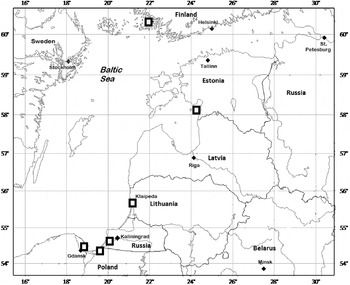
Distribution of Harris mud crab (Rhithropanopeus harrisii) in the central and eastern Baltic Sea. For sources see text. Quadrates indicate the areas of occurrence of Harris mud crab.

Within the areas of its distribution Harris mud crabs shows a highly opportunistic habitat choice. In the Azov and Black Seas the populated habitats include practically all existing types of substrate from muddy sediments to sand with shell debris and stones, in the seagrass meadows and between roots of reed, or without aquatic vegetation at all (Zalota et al., Reference Zalota, Spiridonov and Kolyuchkina2016a). In the Baltic, they live on: various plant debris; mud and sand with shell; and among Fucus macroalgae on hard bottom (Turoboyski, Reference Turoboyski1973; Fowler et al., Reference Fowler, Forsström, von Numers and Vesakoski2013), which has been its preferred habitat during the experiments performed by Nurkse et al. (Reference Nurkse, Kotta, Orav-Kotta, Pärnoja and Kuprijanov2015). However, the presence of various kinds of shelters appears to be the key factor (Petersen, Reference Petersen2006; Zalota et al., Reference Zalota, Spiridonov and Kolyuchkina2016a), while the patterns of shelter use and hiding habits vary significantly between different sizes and sex groups and localities (Zalota et al., Reference Zalota, Spiridonov and Kolyuchkina2016a).
Few studies have been undertaken on the distribution of its larvae. In the tidal environment (typical for the native area of distribution along the south-eastern coast of North America) larvae of R. harrisii can maintain their distribution in estuarine areas by a complex mechanism of hatching synchronization with the tidal cycle and vertical migration superimposed on differences in velocity and directions of tidal flow (Forward, Reference Forward2009 and references therein). The Baltic, Black, Azov and Caspian Seas are non-tidal basins (Zalogin & Kosarev, Reference Zalogin and Kosarev1999). Field surveys indicate that in the Black Sea, Harris mud crab larvae have restricted distribution in limans, inlets and harbours (Makarov, Reference Makarov2004; Selifonova, Reference Selifonova2012). In the Sea of Azov they occur over the entire area (Makarov, Reference Makarov2004).
Size and population characteristics
Rhithropanopeus harrisii attains greater maximum size (20–26 mm carapace width) in the Baltic, Black and Azov Seas than in its native distribution range; i.e. Chesapeake Bay, Louisiana where males larger than 18 mm, and females larger than 16 mm have not been reported (Fowler et al., Reference Fowler, Forsström, von Numers and Vesakoski2013; Zalota et al., Reference Zalota, Spiridonov and Kolyuchkina2016a). This agrees with a general pattern revealed for most studied marine invasive species, the majority of which become significantly larger in the introduced range compared with the native range with little evidence for any decrease in size following the invasion (Grosholz & Ruiz, Reference Grosholz and Ruiz2003).
Size and age composition, reproductive traits and dynamics of the introduced populations of Harris mud crab have not been much studied. During the laboratory studies of the Baltic Sea specimens, moulting ceased at temperatures below 14°C (Turoboyski, Reference Turoboyski1973). Thus, the individual growth should be seasonal. Two or three size groups (except newly settled juveniles) are usually present in populations of the Dead Vistula, the Azov and Black Seas, which may correspond to year classes; some females reproduce in the 2nd year of their life and most of females in the 3rd year, depending on the temperature (Turoboyski, Reference Turoboyski1973; Zalota et al., Reference Zalota, Spiridonov and Kolyuchkina2016a). Laboratory experiments have shown that they could potentially reproduce within 2 months after hatching (Morgan et al., Reference Morgan, Goy and Costlow1983). Some populations, such as the one in the Dead Vistula, show high pulses of abundance: from being extremely abundant in the 1950–60s to nearly collapsed condition in the 1970–80s and back up in the 2000s (Grabowski et al., Reference Grabowski, Jazdzewski and Konopacka2005). There are also indications of significant changes of this species abundance and biomass in the northern Caspian Sea in the 1960–1980s (Yablonskaya, Reference Yablonskaya1985; Malinovskaja et al., Reference Malinovskaja, Filippov, Osadchikh and Aladin1998; Karpinsky, Reference Karpinsky2002).
Symbionts, parasites and pathogens
The distribution range of native populations of R. harrisii is constrained by the presence of the rhizocephalan parasite Loxothylaxus panopaei whose larvae develop well at 10–15 psu but survive poorly in salinities below 10 psu (Reisser & Forward, Reference Reisser and Forward1991). No indication of this parasite has been found in the Baltic (Fowler et al., Reference Fowler, Forsström, von Numers and Vesakoski2013) nor in the Azov and Black Seas (authors’ data). In the Black Sea Harris mud crab appears to have a specific parasitic gregarine species Cephaloidophora rhithropanopei Belofastova, Reference Belofastova1996 which has not been recorded in other Black Sea crab species (Belofastova & Lozovsky, Reference Belofastova and Lozovsky2008; Mordvinova & Lozovsky, Reference Mordvinova and Lozovsky2009). No other parasite species, including trematode cercaria and native rhizocephalans (common for indigenous decapod species), have been found in R. harrisii (Mordvinova & Lozovsky, Reference Mordvinova and Lozovsky2009).
Position in the ecosystem and impact
Not many publications have dealt with the ecosystem relationships of R. harrisii in spite of its long history as an alien species in Europe. Gut content analyses in the Vistula (Baltic Sea) and the Taman (Sea of Azov) Bays suggest an opportunistic feeding mode with importance of plant detritus and plant remains in the stomach content and indication of common consumption of benthic invertebrates such as polychaetes, crustaceans and molluscs (Czerniejewski & Rybczyk, Reference Czerniejewski and Rybczyk2008; Hegele-Drywa & Normant, Reference Hegele-Drywa and Normant2009; Kolesnichenko, Reference Kolesnichenko2014; Kolesnichenko et al., Reference Kolesnichenko, Burukovsky and Marin2014). However, a stable isotopes analysis of the Taman Bay specimens indicates that Harris mud crab is using mainly animal food, that originates from all main primary producers’ chains, i.e. phytoplankton, benthic algae and seagrass (Zalota et al., Reference Zalota, Spiridonov and Tiunov2013, Reference Zalota, Kolyuchkina, Tiunov, Birjukova and Spiridonov2017). Similar results were obtained, at least for adult crabs, in the Finnish Archipelago Sea (Aarnio et al., Reference Aarnio, Törnroos, Björklund and Bonsdorff2015). In the newly colonized area of the Bay of Finland predatory behaviour of R. harrisii has been shown, but the realized predation pressure in the field is lower than could be expected from laboratory experiments (Forsström et al., Reference Forsström, Fowler, Manninen and Vesakoski2015).
Upon establishing, these crabs became an important component of the diet of some fishes in the north-western Black Sea, the Azov and Caspian Seas (Reznichenko, Reference Reznichenko1967; Yablonskaya, Reference Yablonskaya1985; Karpinsky, Reference Karpinsky2002).
In the Sea of Azov, an indigenous brachyuran species, Brachynotus sexdentatus (Risso, 1824) was common and relatively abundant prior to the introduction of R. harrisii (Vorobyev, Reference Vorobyev1949). Presently this species is not reported in the Sea of Azov where its characteristic habitats are populated by Harris mud crab (Makarevich et al., Reference Makarevich, Lyubin and Larionov2000; Sergeeva & Burkatsky, Reference Sergeeva and Burkatsky2002; Ivanov & Sinegub, Reference Ivanov and Sinegub2008; Zalota et al., Reference Zalota, Spiridonov and Kolyuchkina2016a). However, it is not known if the decline of B. sexdentatus in the Sea of Azov has been related to competitive/predatory pressure from R. harrisii or other factors.
Possible vectors and potential for future spread
Surprisingly, not much is known about the vectors of introduction of Harris mud crab. Initial introduction took place either owing to the transportation on ship hull fouling (Buitendijk & Holthuis, Reference Buitendijk and Holthuis1949) or with American oyster export (Projecto-Garcia et al., Reference Projecto-Garcia, Cabral and Schubart2010). Further spread in European seas was most probably associated with shipping, including traffic via canal systems, such as the Kiel Canal, which connects the North and the Baltic Seas and the Don–Volga Canal, which connects the Azov and the Caspian basins (Reznichenko, Reference Reznichenko1967). In the latter case, it is assumed that R. harrisii is capable of surviving in ship fouling submerged in fresh water and can tolerate such conditions for up to 10 days of the journey. Adaptations of osmotic regulation (Normant & Gibowicz, Reference Normant and Gibowicz2008), established populations in the Texas freshwater lakes (Boyle et al., Reference Boyle, Keith and Pfau2010) and nearly freshwater conditions of the Panama Canal (Roche & Torchin, Reference Roche and Torchin2007) along with a recent report of R. harrisii in the Dnieper reservoir (Son et al., Reference Son, Novitsky and Diadichko2013) indicate that it might well be the case. However, it is also possible that multiple vectors have been involved in the transportation of mud crabs from the Sea of Azov to the Caspian Sea: the shipping via the Don–Volga Canal that commenced in 1952 and unintentional transfer with the clam Abra segmentum (Récluz, 1843). This was introduced to the Caspian Sea from the Sea of Azov as an additional food resource for commercial fish in 1947–1948 (Karpevich, Reference Karpevich1975).
In recent decades, transportation of several invasive crabs in ship fouling was apparently complemented with ballast water (Carlton & Cohen, Reference Carlton and Cohen2003). In this respect an ovigerous female of R. harrisii was found in the ballast water (Briski et al., Reference Briski, Chabooli, Bailey and McIsaac2012).
The present review demonstrates the contrast between the spread of the Harris mud crab in the Black–Caspian Seas region and the Baltic. There was a rapid dispersal in the former region with the formation of practically continuous areas of distribution along the coast of the north-western Black Sea, the entire Sea of Azov and the Caspian coastal area that took about 20 years from the presumed time of its arrival in the region. Colonization of the Baltic has been proceeding about three times slower and resulted in a quite patchy distribution. These differences may result from multiple vectors of spread in the first region: various forms of shipping and dispersal of larvae throughout the extensive shallow basins with wind-driven circulation and unintended artificial introductions (Zalota et al., Reference Zalota, Spiridonov and Kolyuchkina2016a; Simakova et al., Reference Simakova, Zalota and Spiridonov2017). In the Baltic, shipping appears to be the main vector, because larval dispersal may be effective only within continuous shallow areas with local water circulation which are limited in this basin.
Consequently an establishment of new Harris mud crab populations via shipping may be expected in protected shallow areas of the western Gulf of Finland, where salinity is still suitable for the species.
In the Black Sea–Caspian region Harris mud crab reached its physical limits of marine dispersion. Transportation with ship fouling most likely provides a continuous supply of crabs to such water bodies as Tsimlyanskoe Reservoir in the Don River, which has mineralized water with tendency to increase in the last decades (Nikanorov & Khoruzhaya, Reference Nikanorov and Khoruzhaya2014). It is unknown whether limited genetic diversity in the regional population is sufficient to provide the basis for adaptation and an establishment of freshwater populations (similarly to the Panama Canal and Texas reservoirs), but special studies that focus on this possibility are worth considering.
KAMCHATKA (RED) KING CRAB (PARALITHODES CAMTSCHATICUS)
The Kamchatka crab was introduced in the Barents Sea as a result of a specially designed and effectively implemented programme to increase fishery productivity in 1961–1969. The introduction was sourced with just settled juveniles and a limited number of ovigerous females from the Peter the Great Bay, Sea of Japan, and to lesser extent, from the Sea of Okhotsk off West Kamchatka. The first ovigerous female was caught in 1974 (Orlov & Ivanov, Reference Orlov and Ivanov1978; Kuzmin & Gudimova, Reference Kuzmin and Gudimova2002; Orlov, Reference Orlov2004; Türkay & Spiridonov, Reference Türkay and Spiridonov2004).
History of introductions in East Europe
The initial introduction area was the so-called Western Murmansk Coast between the entrance of the Kola Bay and Rybachiy Peninsula (Orlov & Ivanov, Reference Orlov and Ivanov1978; Kuzmin & Gudimova, Reference Kuzmin and Gudimova2002). The expansion of the population is relatively well documented (see Kuzmin & Gudimova, Reference Kuzmin and Gudimova2002; Berenboim, Reference Berenboim and Berenboim2003; Sundet, Reference Sundet and Stevens2014). It seemed to be explosive, since in the early 1990s the king crabs became abundant in the area of introduction, in 1996–97 its abundance increased by an order of magnitude, and from 1998 they spread further east along the Kola Peninsula coast of the Barents Sea and west, to Varanger Fjord (shared by Russia and Norway), Tana, Lakse and finally Porsanger Fjord and some smaller fjords in northern Norway (Kuzmin & Gudimova, Reference Kuzmin and Gudimova2002; Berenboim, Reference Berenboim and Berenboim2003; Sundet, Reference Sundet and Stevens2014). By 2000 in the Russian Barents Sea P. camtschaticus occupied the entire shelf zone of the Kola Peninsula up to the area of Kolguev Island and Gusinaya Banks (Kuzmin & Gudimova, Reference Kuzmin and Gudimova2002; Berenboim, Reference Berenboim and Berenboim2003), which is under direct influence of Atlantic waters (Boitsov, Reference Boitsov and Berenboim2003; Figure 5). A detailed trawl survey in 2011 did not indicate further spread of the king crab to the eastern Barents Sea or to the north (Zimina et al., Reference Zimina, Lyubin, Jørgensen, Zakharov and Lyubina2015).
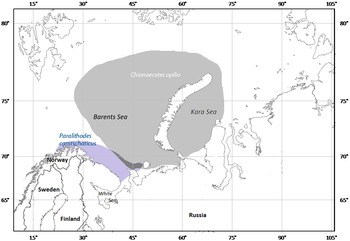
Roughly schematic limits of regular occurrence of the Kamchatka and snow crabs in the area of introduction. Based on the data presented by Jørgensen & Spiridonov (Reference Jørgensen and Spiridonov2013), Sokolov (Reference Sokolov2014), Sundet (Reference Sundet and Stevens2014), Spiridonov et al. (Reference Spiridonov, Zalota, Vedenin and Flint2015) and Zimina et al. (Reference Zimina, Lyubin, Jørgensen, Zakharov and Lyubina2015).

Genetic structure of alien populations
The gene of cytochrome oxidase (COI) and five nuclear microsatellite loci of king crab populations have been studied at four localities in the Barents Sea and two donor populations from the Western Kamchatka and Primorye. No decrease in the genetic diversity of the introduced populations has been detected (Zelenina et al., Reference Zelenina, Miuge, Volkov and Sokolov2008)
Contemporary distribution pattern, habitats and habit
Being the result of an intentional introduction, P. camtschaticus in the Barents Sea makes a unique case of nearly continuous monitoring and assessment of a non-indigenous decapod population from the termination of the latent phase of establishment, using fishing gears (Kuzmin & Gudimova, Reference Kuzmin and Gudimova2002; Berenboim, Reference Berenboim and Berenboim2003; Sokolov & Miljutin, Reference Sokolov and Miljutin2008; Sundet, Reference Sundet and Stevens2014; Bakanev et al., Reference Bakanev, Dvoretsky, Pavlov, Pinchukov, Zacharov and Zolotarev2016).
Larval settlement of Kamchatka crab in the Barents Sea occurs mainly on red and brown algae in the coastal zone; subsequently, fingerlings are found on algae or algal offal. Yearlings inhabit rocky substrates with a developed microrelief that provides shelter from predators (Pereladov, Reference Pereladov and Sokolov2003). Immature individuals (older than 1 year) concentrate mainly on solid substrates offshore, frequently in kelp fronds (Matyushkin, Reference Matyushkin and Berenboim2003b; Pereladov, Reference Pereladov and Sokolov2003; Sokolov & Miljutin, Reference Sokolov and Miljutin2008; V. Spiridonov, personal communication); and far from the coast, on scallop settlements in Voronka, White Sea (Zolotarev, Reference Zolotarev2010). The preferred habitats of adult crabs in the Barents Sea are mainly silty-sandy grounds with rich infauna, but during the period of inhabiting coastal zones, they can also be found in other various biotopes, including vertical rock walls (Pereladov, Reference Pereladov and Sokolov2003).
The Kamchatka crab is a migratory species (Vinogradov, Reference Vinogradov1945). Adult crabs undergo seasonal migrations (male and females often separately). They mate and breed in the coastal waters in spring. In autumn they migrate back from the coast to depths greater than 100 m. In the Barents Sea a significant change in the migration pattern has been observed: the extent of migrations is much lower than in the Pacific (Talberg, Reference Talberg2005), with a portion of males remaining at depth throughout the year (Matyushkin, Reference Matyushkin and Berenboim2003a). In some fjords of the Barents Sea, partially isolated by sills (for instance the western arm of Ura Guba Fjord) both males and females maintain a relatively settled mode of life, reproduce at depth, and spend a greater part of the year at a temperature of 2.0–2.5°C (Matyushkin, Reference Matyushkin and Berenboim2003a). In general, distribution and migration patterns in the area of introduction are an adapted version of the pattern which exists in its native areas (Talberg, Reference Talberg2005; Sundet, Reference Sundet and Stevens2014). In a relatively well-studied area of Varanger Fjord, king crab distribution and migration is most similar to Alaskan populations, but adult crabs seem to move to the shore for hatching, spawning and mating earlier than in Alaska, in late winter or early spring (Pereladov, Reference Pereladov and Sokolov2003; Talberg, Reference Talberg2005; Sundet, Reference Sundet and Stevens2014).
Size and population characteristics
Several studies deal with the differences in size characteristics and growth of the king crab in the native and introduced populations. Pinchukov & Berenboim (Reference Pinchukov, Berenboim and Berenboim2003) reported that males attain commercial size (150 mm carapace breadth) at about the same age (10 years) in the Barents Sea as in the Russian Far East. However, size of female maturity is somewhat greater than in the native range (Hjelset et al., Reference Hjelset, Sundet and Nilsen2009). On the West Kamchatka shelf the growth of females to carapace breadth larger than 120 mm has not been recorded, which might be the result of either negligible growth increment per moult, non-annual moulting in large specimens or both (Buyanovsky, Reference Buyanovsky2004). Contrary to this, in the Barents Sea, both size composition data and tagging experiments indicated continuous growth of females up to carapace breadth of at least 160 mm (Pinchukov, Reference Pinchukov2015). The maximum size attained by males in the West Kamchatka shelf population (one of the largest in the North Pacific) in the 1990s did not exceed 200 mm, however this population was under strong pressure from fishery, including illegal catch (Slizkin & Safonov, Reference Slizkin and Safonov2000; Buyanovsky, Reference Buyanovsky2004). In the Barents Sea males over 200 mm have been a usual component of commercial catches (Dolgov et al., Reference Dolgov, Matyushkin and Sennikov2006). The maximum longevity of Kamchatka crabs is about 20 years, both in the West Kamchatka shelf (Buyanovsky, Reference Buyanovsky2004) and in the Barents Sea (Pinchukov & Berenboim, Reference Pinchukov, Berenboim and Berenboim2003; Pinchukov, Reference Pinchukov2015). Even though no standard characteristics of size and growth are consistently reported in literature to be able to perform a fully conclusive comparison, king crabs in the Barents Sea appear to be effectively growing to larger sizes than in many native areas.
Population characteristics, such as abundance, relative composition of different age groups and fecundity have been varying strongly over the last two decades with regard to area, years, possibly food supply and fishery pressure (Sokolov & Miljutin, Reference Sokolov and Miljutin2008; Bakanev, Reference Bakanev2009; Hjelset et al., Reference Hjelset, Nilsen and Sundet2012; Sundet, Reference Sundet and Stevens2014).
Symbionts, parasites and pathogens
Symbionts and pathogens of Kamchatka crabs in the Barents Sea have been studied from relatively early stages of introduction (Bakay, Reference Bakay and Berenboim2003; Dvoretsky & Dvoretsky, Reference Dvoretsky and Dvoretsky2012). Overall, 16 common parasitic species and 31 non-parasitic symbiotic species have been found in P. camtschaticus from the Sea of Okhotsk within its native distribution. In the Barents Sea, king crabs are hosting 12 and 15 species of these groups respectively; both in the native distribution range and in the area of introduction crabs suffer from the ‘shell disease’ caused by several bacterial taxa (Matishov et al., Reference Matishov, Karmanova, Dvoretsky and Utevsky2014). Thus the parasitic/symbiotic community based on the Kamchatka crabs appears yet to be well established in the Barents Sea.
Position in the ecosystem and impact
The impact of king crabs was first of all considered in the context of their feeding habit as a generalist and opportunistic predator with a wide food spectrum, which includes more than 170 species of invertebrates as well as seaweed, detritus and carrion. However, bivalves and echinoderms are often preferred, while crustaceans appear to play a minor role in their diet (review in Jørgensen & Spiridonov, Reference Jørgensen and Spiridonov2013). Crabs show selective feeding on epifauna and less selective feeding on infauna. Experiments have shown that crabs are destroying more epibenthic animals than they eat (review in Jørgensen & Spiridonov, Reference Jørgensen and Spiridonov2013).
A limited number of case studies elucidate on the impact of Kamchatka crabs from foraging on benthic communities and habitats (review in Britayev et al., Reference Britayev, Rzhavsky, Pavlova and Dvoretskij2010; Jørgensen & Spiridonov, Reference Jørgensen and Spiridonov2013; Hjelset, Reference Hjelset2014). In several cases a measurable effect associated with the removal of large echinoderms or bivalves can be inferred in fjords or inlets where juvenile crabs are present round the year and migration activity of adults may be restricted (Britayev et al., Reference Britayev, Rzhavsky, Pavlova and Dvoretskij2010; Jørgensen & Spiridonov, Reference Jørgensen and Spiridonov2013; Pereladov et al., Reference Pereladov, Spiridonov Vassily, Anosov, Bobkov, Britayev, Deart, Labutin, Simakova and Spiridonov Victor2013; Hjelset, Reference Hjelset2014 and references herein). There are also indications of significant predation pressure of king crabs on broods of some fish spawning in the coastal zone (Mikkelsen & Pedersen, Reference Mikkelsen and Pedersen2012; Hjelset, Reference Hjelset2014).
Commercial fishery of king crabs in the Barents Sea commenced in 2004. While in Russia the fishery is primarily managed with the aim to protect the stock, in Norway fishery itself is considered as a management tool for regulating dispersal and impact of this non-indigenous species.
Vectors and potential for future spread
The mechanisms of expansion of king crabs from the area of their initial release have been studied and discussed. Tagging experiments revealed cases of directional movement of adult crabs to the west following the increase in temperature and salinity (Berenboim, Reference Berenboim and Berenboim2003; Sundet et al., Reference Sundet, Nilsen and Hjelset2009; Pinchukov, Reference Pinchukov2009). Dispersal of crabs to the west and east could proceed via different mechanisms: an invasion to the Varanger Fjord and to the fjords of Finmark might be proceeding as a cumulative effect of directional migration of adult crabs and transfer of larvae by local currents (Berenboim, Reference Berenboim and Berenboim2003; Starikov et al., Reference Starikov, Spiridonov, Naumov and Zuev2015). Dispersal to the east is most likely caused by transport of larvae with prevailing currents of eastern direction (Pinchukov, Reference Pinchukov2009).
Several records in Norway, to the west of Porsanger Fjord, may originate either from migratory behaviour of adults or from releases by fishermen (Sundet, Reference Sundet and Stevens2014). Thus it is possible that new populations will be established in particular Norwegian fjords.
During the second half of the 2000s, Kamchatka crab juveniles have been regularly recorded, and indications of the species’ ongoing reproduction has been observed in the northern part of the White Sea – i.e. in the Voronka (Zolotarev, Reference Zolotarev2010). This part of the White Sea has similar oceanographic characteristics to the Barents Sea (Berger & Naumov, Reference Berger, Naumov, Berger and Dahle2001). In 2013, an ovigerous female was caught in the Kandalaksha Bay of the White Sea, which could have been due to intentional transfer by humans (Starikov et al., Reference Starikov, Spiridonov, Naumov and Zuev2015). However, another Kamchatka crab female has been recorded in the same place in 2016 (A.D. Naumov, Kartesh White Sea Biological station, personal communication). The spread and successful establishment of this species in the inner part of the White Sea is unlikely, whether it is done through natural spread or intentional transportation. This will most likely be restricted due to low salinity of the near shore waters, where reproduction occurs, and below zero temperatures of the whole water column in winter, which is unacceptable for adults during the winter time (Starikov et al., Reference Starikov, Spiridonov, Naumov and Zuev2015).
SNOW CRAB (CHIONOECETES OPILIO) –AN ONGOING INVASION
Native distribution of snow crabs spans from the northern part of the Pacific Ocean through the Bering Strait over to British Colombia and the northern part of the Sea of Japan, Chukchi Sea, and the East Siberian Sea; as well as in the north-western Atlantic from the tip of the north-western USA to the Davis Strait (Squires, Reference Squires1990). Although there is one record from the boundary of the East Siberian and the Laptev Seas (Sokolov et al., Reference Sokolov, Petryashov, Vassilenko, Vasilenko and Petryashov2009) the species was never reported from the Western Eurasian Arctic and North-East Atlantic until 1996.
History of introductions in East Europe
In 1996 the snow crab was found in the central part of the Barents Sea (Kuzmin et al., Reference Kuzmin, Akhtarin and Menis1998), which seems to be the result of human mediated introduction. Based on the size of the crab caught in 2004, it is presumed that the introduction could have occurred in the mid 1980s (Pavlov, Reference Pavlov2006).
Due to the research of the Polar Research Institute of Marine Fisheries and Oceanography (PINRO) the growth and dispersal of the population has been well documented (Kuzmin et al., Reference Kuzmin, Akhtarin and Menis1998; Jørgensen & Spiridonov, Reference Jørgensen and Spiridonov2013; Bakanev et al., Reference Bakanev, Dvoretsky, Pavlov, Pinchukov, Zacharov and Zolotarev2016). In less than 15 years since the first record, this species has spread to the east of the Barents Sea and became a common and abundant species in an area with cold transformed Barents Sea water (Pavlov & Sundet, Reference Pavlov, Sundet and Jakobsen2011; Sokolov, Reference Sokolov2014; Zimina et al., Reference Zimina, Lyubin, Jørgensen, Zakharov and Lyubina2015) (Figure 5).
It is worth noting that the range expansion of the alien population in the Barents Sea has been determined by the transfer of larvae with currents (Pavlov, Reference Pavlov2006; Pavlov & Sundet, Reference Pavlov, Sundet and Jakobsen2011; Sokolov, Reference Sokolov2014). Tagging (Goryanina, Reference Goryanina2015) has shown that adults often walk long distances (up to 102 km in 87 days), although overall movement and the resulting speed are usually much lower, especially for crabs caught more than a year after tagging. Overall, the resulting dominant direction of such movements has not been determined (Goryanina, Reference Goryanina2015).
By 2007–2008 C. opilio had been observed at the northern tip of Novaya Zemlya and at Karskie Vorota Strait, which is the boundary between the Barents and the Kara Seas. Nevertheless, research expeditions of PINRO and the Institute of Oceanology of the Russian Academy of Sciences (IO RAS) in 2007 have failed to find any specimens in the western part of the Kara Sea (Spiridonov et al., Reference Spiridonov, Zalota, Vedenin and Flint2015).
In 2011–2012 adults, immature specimens and larvae were found for the first time in the north- and south-eastern parts of the Kara Sea (Zimina, Reference Zimina2014; Spiridonov et al., Reference Spiridonov, Zalota, Vedenin and Flint2015). In 2013 the snow crab was observed in 20% of trawling samples of PINRO in the western part of the sea (Sokolov, Reference Sokolov2014). One year later, in the vicinity of St Anna Trough, near the eastern coast of Novaya Zemlya and near Yamal Peninsula the frequency of findings was 60% and 75% in the western part of the sea (Figure 5). Juveniles have also been collected in the eastern bays of Novaya Zemlya in 2014–2016; their distribution and size composition suggested that they are the result of both local recruitment and possible transport of larvae from the Barents Sea (Spiridonov et al., Reference Spiridonov, Zalota, Vedenin and Flint2015; Zalota et al., Reference Zalota, Spiridonov and Vedenin2016b).
Genetic structure and origin of alien population
Only preliminary results are available for the genetic structure of the snow crab population in the Barents Sea. The analysis of 14 microsatellites indicates that the non-indigenous population of the snow crab is more similar to the cluster of samples combining the Bering Sea and the Canadian east coast specimens than to the populations from Greenland (Dahle et al., Reference Dahle, Agnalt, Farestveit, Sevigny, Parent and Hjelset2014).
Contemporary distribution pattern, habitats and habit
During the 2000s the western and southern borders of the snow crab distribution area in the Barents Sea were well determined by the 2°С isotherm (Jørgensen & Spiridonov, Reference Jørgensen and Spiridonov2013). However this species (up until 2016) has not been reported from the northern and north-western part of the Barents Sea (such as Spitsbergen and Franz Josef Land Archipelagos) where the temperature does not exceed this limit. Currently the snow crab occurs mainly in the eastern part of the Barents Sea within the depth range of 40–360 m, temperature range from −1.0 to +3.0°С and salinity 33.4–35.0 (Zimina et al., Reference Zimina, Lyubin, Jørgensen, Zakharov and Lyubina2015). Current (2011–2015) maximum abundance zone of snow crab is located to the north-west of Admiralty Peninsula in North Island of Novaya Zemlya Archipelago and south of it along the western coast (Bakanev et al., Reference Bakanev, Dvoretsky, Pavlov, Pinchukov, Zacharov and Zolotarev2016).
In the Kara Sea the snow crab inhabits muddy sediments of the western shelf and troughs within the depth range 50–450 m where temperature and salinity range from −1.45 to +0.4°С, and from 33.9 to 34.9‰ respectively (Spiridonov et al., Reference Spiridonov, Zalota, Vedenin and Flint2015).
Size and population characteristics
Chionoecetes opilio does not reach its maximum size in the introduced area. The maximum carapace width of male adults registered in the Barents Sea is 166 mm, whereas in its native range, near Sakhalin Island, it can reach 178 mm (Pavlov, Reference Pavlov2006). During the first half of the 2010s the maximum size of 50% of males during their terminal moult was 82 mm (Bakanev & Pavlov, Reference Bakanev and Pavlov2015). In contrast to this, crabs from the Chukchi Sea do not exceed the Barents Sea specimens in size having maximum carapace width of only 95 mm (see Chuchukalo et al., Reference Chuchukalo, Nadtochy, Fedotov and Bezrukov2011).
During the short period that the Barents Sea population has been observed, it underwent substantial changes in size-age group structure; in particular, since 2010 the recruitment has been obtained through ongoing multiple generations, which lead to a much younger population by 2015 (Bakanev & Pavlov, Reference Bakanev and Pavlov2015).
Position in the ecosystem and impact
The diet of snow crabs in the Barents Sea has been studied since the early 2000s and has shown characteristic features that differentiate it from the Kamchatka crabs. Major portions (by weight) of the diet are (decreasingly): crustaceans, polychaetes, molluscs and echinoderms as well as fishes (Pavlov & Pinchukov, Reference Pavlov and Pinchukov2015). In its native range of the Chukchi Sea crabs predominantly feed on similar food items, but molluscs constitute a greater proportion and there are recorded incidents of cannibalism (Chuchukalo et al., Reference Chuchukalo, Nadtochy, Fedotov and Bezrukov2011).
It is hard to estimate the impact of the new incomer on the Barents Sea community at the present time, due to the small time lapse since the invasion. Although there is a potential for good future understanding of such impacts, since the dispersal of the snow crab has coincided with the beginning of regular joint Russian–Norwegian ‘ecosystem’ research events with the help of standardized trawling tools (Jørgensen et al., Reference Jørgensen, Lyubin, Skjoldal, Ingvaldsen, Anisimova and Manushin2015; Zimina et al., Reference Zimina, Lyubin, Jørgensen, Zakharov and Lyubina2015).
Commercial fishery of the snow crab commenced in 2014 in the international enclave of the Barents Sea. Exploitation in the Russian exclusive economic zone of the Barents Sea started in 2016.
Possible vectors and potential for future spread
Possible origin and vector of introduction of snow crabs to the Barents Sea are speculative, but most likely larvae have been transported in ballast waters from the North-west Atlantic (Pavlov, Reference Pavlov2006; Pavlov & Sundet, Reference Pavlov, Sundet and Jakobsen2011; Sokolov, Reference Sokolov2014). This vector might have been associated with floating factories and tankers serving the Soviet fishing fleet which operated in the 1970s and 1980s on both sides of the North Atlantic.
The area of mass occurrence of C. opilio in the Kara Sea coincides with the distribution of waters that originate from the Barents Sea (Spiridonov et al., Reference Spiridonov, Zalota, Vedenin and Flint2015). Consequently, the introduction of these crabs has occurred in the second half of the 2000s from the north- and south-eastern borders of the Barents Sea as a result of the expansion of the Barents Sea population. It is possible that the migration took place via both larvae transportation and adult migration. Further eastward expansion of this species seems to be possible along the salinity gradient of the Siberian Seas (Sokolov, Reference Sokolov2014; Spiridonov et al., Reference Spiridonov, Zalota, Vedenin and Flint2015). It is most likely that it will be subject to the ice coverage regimes in summer that affect larval development as well as food supply in these seas (Spiridonov et al., Reference Spiridonov, Zalota, Vedenin and Flint2015).
DISCUSSION
Contrasts in occurrence of alien decapod species around Northern Eurasia
The general distribution of alien species in the seas around Northern Eurasia is highly uneven. There is a striking difference between the North-west Pacific and the Arctic Seas east of the Kara Sea on one hand, and the seas of the North-east Atlantic on the other. The number of non-indigenous (excluding cryptogenic) decapod species in the North Sea amounts to six, in the Celtic–Biscay shelf to eight (AquaNIS database, 2016), in the Black Sea there are eight non-indigenous species (this study). In the Mediterranean the number of recorded non-indigenous decapod species amounts to 65 (CIESM Atlas, 2016) owing to the Lessepsian migration (Galil, Reference Galil2012). In the North-west Pacific practically no alien decapod species have been recorded for the Russian seas with certainty, except possibly Diogenes nitidimanus and warm water species that are occasionally brought with flotsam (present assessment, Table 2). Furthermore, only three alien decapod species are known for Japan (Doi et al., Reference Doi, Watanabe, Carlton, Galil, Clark and Carlton2011). However, it may well be that the invasions in Japan, Korea and the southern part of the Russian Far East are still largely in the hidden stages or upcoming. In the case of the Russian part of the Sea of Japan it is difficult to distinguish between cryptogenic species, those that may naturally expand their range from the southern part of the sea and those being brought via shipping vectors from Japan, China or South Korea (Ivin et al., Reference Ivin, Zvyagintsev and Kashin2014).
The absence of records of non-indigenous decapods in the entire area from the Sea of Okhotsk to the Laptev Sea may be a reflection of either limited contemporary sampling effort or of a real absence of non-indigenous decapods. Indeed, nowadays in the Sea of Okhotsk and in the western Bering Sea few studies are done in the coastal areas, and particularly, in the vicinity of harbours. The Arctic Russian Seas have been relatively intensively surveyed recently, which resulted in the finding of the snow crabs in the Kara, East Siberian and Chukchi Seas (see respective case studies above) and some apparent natural North Pacific migrants in the Chukchi Sea (Sirenko & Vassilenko, Reference Sirenko, Vassilenko and Sirenko2008). Generally shipping is considered as the main vector of human-induced spread of non-indigenous species in the subarctic North Pacific and the Arctic. However, intensity of shipping in the North-west Pacific and in the Arctic is low compared to the lower latitude Pacific (WBGU, 2013), thus the second explanation appears to be more plausible. Furthermore, non-indigenous species in cold waters could be recruited only from a limited number of Arctic–Boreal species, which are not physiologically constrained to live in cold and icy waters.
Physiological constraints of successful introductions in the Decapoda
The Arctic–Subarctic fauna of Decapoda is dominated by few taxa of the family level, which constitute the majority of species. This may be related to physiological constraints, in particular the ability to regulate magnesium concentration in the haemolymph. High magnesium concentration in the haemolymph and low temperature may work in concert to lower neuromuscular transmission and rates of activity (Frederich et al., Reference Frederich, Sartoris, Arntz and Pörtner2000). Caridean shrimps, such as pandalids and crangonids, are cold compensated for this ion regulation (Sartoris & Pörtner, Reference Sartoris and Pörtner1997; Wittmann et al., Reference Wittmann, Held, Sartoris and Pörtner2010). These families along with Hippolytidae sensu lato constitute the majority of Arctic and subarctic decapod species (Squires, Reference Squires1990; Sokolov et al., Reference Sokolov, Petryashov, Vassilenko, Vasilenko and Petryashov2009; Spiridonov et al., Reference Spiridonov, Petryashov, Marin and Sirenko2013). Many species of these caridean families have either circumpolar or amphiboreal distribution and none of them are known as introduced species.
King crabs (Lithodidae), which have the centre of diversity in the North Pacific, avoid waters with negative temperatures at a global scale (Hall & Thatje, Reference Hall and Thatje2009). Thus Kamchatka crab would never have a chance to reach the Barents Sea via the Arctic shelf in the climate similar to present conditions, without human help.
Brachyuran crabs are the most successful invaders among decapods (Brockerhoff & McLay, Reference Brockerhoff, McLay, Galil, Clark and Carlton2011). However, they generally have poor ability to regulate magnesium concentration in haemolymph at low temperatures (Wittmann et al., Reference Wittmann, Held, Sartoris and Pörtner2010), and due to this, the majority of them are unable to invade the Arctic and subarctic seas. The only brachyuran crab genera that live in the real Arctic shelf waters (but not in the Laptev Sea and the Canadian Arctic Archipelago area) are Chionoecetes and Hyas (Oregonidae). While Hyas spp. have been naturally present in all Arctic seas neighbouring to the Atlantic and the Pacific oceans, the snow crab has been absent in the western Eurasian Arctic until the late 20th century (Squires, Reference Squires1990; Sokolov et al., Reference Sokolov, Petryashov, Vassilenko, Vasilenko and Petryashov2009). Therefore, it was probably one of the few Brachyura candidate species that is not physiologically constrained for introduction into Arctic waters and could potentially be introduced to the eastern Barents and the Kara Seas. Consequently this possibility has been realized.
The realized scenarios for the snow and the king crabs’ invasions make the situation in the European Arctic seas and the Kara Sea unique with regard to alien decapods and alien species in general (which are indeed rare in the Arctic waters). The western and especially south-western Barents Sea, which is strongly influenced by warm Atlantic waters (Zalogin & Kosarev, Reference Zalogin and Kosarev1999), is more similar to the North-east Atlantic seas. There, environmental conditions set fewer physiological constraints for non-indigenous crab species, especially if warming is progressing. In particular, there is a recognized risk of the arrival of the West Atlantic rock crab (Cancer irroratus), which has recently colonized several fjords of Iceland, most likely via ballast water vector (Gíslason et al., Reference Gíslason, Haldórsson, Pálsson, Palsson, Davðsdóttir and Svavarsson2014). The physical conditions in fjords of the western Barents Sea and adjacent parts of the Norwegian Sea may be suitable for this species.
The composition of non-indigenous decapods in temperate seas of East Europe (the central and eastern Baltic, Black, Azov and Caspian Seas) is quite distinct. Similar to the Arctic seas, these basins are in certain aspects extreme habitats for marine decapods. It is the decreased salinity of these basins (Zalogin & Kosarev, Reference Zalogin and Kosarev1999) that may have some restricting effect on the number of potential marine decapod invaders, many of which prefer marine conditions for reproduction. Thus, global invaders such as varunids Hemigrapsus sanguineus and Eriocheir sinensis have not yet been established there, even though they are abundant in the western European seas.
Ecological constraints and facilitations of invasions
Ecological constraints for successful introduction and invasion are related to a complex relationship of non-indigenous species, at different stages of their life history, to biotic and abiotic environment properties. For example, in a relatively well-studied case of the green crab invasion (C. maenas) along the West Coast of North America, the distribution of adult crabs is restricted to particular intertidal habitats, most likely due to interactions with native crabs (Hunt & Yamada, Reference Hunt and Yamada2003), while the dispersal of larvae is dependent on matching the time of release to seasonal pattern of water circulation (Yamada & Kosro, Reference Yamada and Kosro2010). The effect of interactions with local crabs is also evident in the invasion history of another global invader, H. sanguineus (Epifanio, Reference Epifanio2013).
Different patterns of distribution of Harris mud crab in the north-eastern Black Sea (association with estuaries and limans) and in the Sea of Azov (occupation of practically the entire sea) is of significant interest with respect to ecological constraints and facilitation of invasions. In the Black Sea its distribution in shallow areas outside estuaries and limans is probably constrained by poor ability of larvae to control their dispersal to areas not suitable for settlement in the non-tidal environment, and by the presence of various predatory native crabs (usually absent in the estuaries; see Zalota et al., Reference Zalota, Spiridonov and Kolyuchkina2016a). In the Sea of Azov, in most cases, wind-driven currents transport mud crab larvae to areas suitable for settlement. Furthermore, there was a large native population of Brachynotus sexdentatus, which no longer exists. Although we do not know with certainty whether the native crab has been displaced by the invader or the decline of B. sexdentatus is due to other causes, the absence or low diversity of native crab species may affect the rapidity of invasions of non-indigenous crabs. In the Sea of Azov (about 38,000 km2), R. harrisii occupied the entire sea very fast, within two decades. The colonization of the entire shallow part of the Caspian Sea (area exceeding 80,000 km2, and no native crab species existed) was also extremely rapid. It took about 10 (if counted from the construction of the Don–Volga canal in 1952) or about 15 years (if R. harrisii was transferred with Abra in 1947–48). This approximates to 3–6 generation spans (if normal lifespan of this species of about 3–4 years is accepted).
The Kamchatka and the snow crab also exhibited rapid expansion in the area where few native crab species occur. The first species occupied most of the appropriate shelf habitats within ~25 years, or within only about two generation spans, for such a long-living and late maturing species. If the introduction of the snow crab occurred around the mid-1980s (Pavlov, Reference Pavlov2006) the colonization of a large area of the central and eastern Barents Sea took ~25 years. Life expectancy and generation spans in snow crabs are not accurately estimated, due to the presence of terminal moult (Pavlov, Reference Pavlov2006), but in any case, this would result in not more than three generation spans. In the Kara Sea it took not more than 10 years for snow crabs to colonize the western part of the sea. This is however not surprising, if the high propagule pressure from the Barents Sea is taken into account.
These crab invasions are remarkable and appear to have few analogies among other decapods. The analogies are known in other groups, such as the rapid occupation of the entire Black Sea upper shelf by a predatory whelk Rapana venosa (Valenciennes, 1846) (Chikina & Kucheruk, Reference Chikina and Kucheruk2005; Ivanov & Sinegub, Reference Ivanov and Sinegub2008; Leppäkoski et al., Reference Leppäkoski, Shiganova, Alexandrov, Rilov and Crooks2009; Pereladov, Reference Pereladov2013).
Genetic diversity of introduced populations
Little can be said about the relationships between genetic diversity of founders of non-indigenous populations and the development of the invasion in the cases described in this paper. Two case studies of decapods in Russian waters, those of P. camtschaticus (Zelenina et al., Reference Zelenina, Miuge, Volkov and Sokolov2008) and R. harrisii (Simakova et al., Reference Simakova, Zalota and Spiridonov2017) indicate that successful invasion may take place both in the absence of a bottleneck effect (as in Kamchatka king crab in the Barents Sea) and on the basis of impoverished genetic diversity of the founder population (as in Harris mud crab in the Black, Azov and the Caspian Seas). The studies on genetic structure of introduced decapod populations and population genetic aspects of their invasions in the Baltic, Barents, Kara Seas and the Black Sea–Caspian region are still in infancy, and are thus a promising field of research.
Size increase of crabs in established non-indigenous populations
Case studies of non-indigenous decapod populations in the seas around Russia provide at least one clear example supporting the Grosholz & Ruiz (Reference Grosholz and Ruiz2003) rule of the increase of maximum size of marine invertebrates in areas of introduction, irrespective of the geographic latitude. With regard to the Harris mud crab a similar increase takes place independently of the latitude in the Baltic (55°–60°N) and in the Azov–Black Sea basin (about 44°–46°N), on the basis of different genetic structures (haplotype composition) of populations. There is also some evidence of an increasing maximum size and faster growth in the Kamchatka king crab in the Barents Sea compared with the populations in its native distribution range. However, for this commercial species, the mortality due to fishing of larger specimens may seriously obscure the results for accurate comparison. This also applies to the snow crab. To reveal its size changes in the Barents and the Kara Sea one needs to analyse datasets from non-exploited populations and populations at different levels of exploitation from its native range and area of introduction.
Parasites and pathogens load
Size increase and a general success of non-indigenous marine invertebrates in the areas of introduction are frequently explained inter alia by the decrease of parasite and pathogenic load in the new distribution range (Grosholz & Ruiz, Reference Grosholz and Ruiz2003; Torchin et al., Reference Torchin, Lafferty, Dobson, Mckenzie and Kuris2003). The present case studies provide however two opposite examples: few recorded parasites in Harris mud crab in the Black Sea and a parasitic and pathogen load of the Kamchatka crab in the Barents Sea comparable to the native range. These results may be biased due to the greater amount of research interest for P. camtschaticus since it is a valuable commercial species.
Impact of non-indigenous decapods
Introduced crabs may have a significant impact on benthic communities and habitats (Dittel & Epifanio, Reference Dittel and Epifanio2009; Brockerhoff & McLay, Reference Brockerhoff, McLay, Galil, Clark and Carlton2011). Detecting and monitoring impact of introduced species in nature is a complex task. The populations of the Harris mud crab that live in the north-western Black Sea, Sea of Azov, the Caspian Sea and the Vistula Bay have been established for more than half a century. Several studies reviewed in the present paper indicated that after an initial increase of these populations they underwent pronounced pulsations. Furthermore, the marine habitats and ecosystems which host the introduced species are experiencing changes themselves. The factors of change are powerful. In the Barents Sea, these are pulsation of input of Atlantic waters and intensity of fishery, which have been shown to impact benthic communities (Denisenko, Reference Denisenko2013). In the Baltic, eutrophication is considered to be the main driving force of change, besides a number of other anthropogenic factors, including the presence of numerous alien species (HELCOM, 2016). In the Black Sea and the Sea of Azov, eutrophication caused dramatic consequences in both pelagic and benthic ecosystems, which were strengthened by the impact of such invasive species as a ctenophore Mnemiopsis leidyi A. Agassiz, 1865 and a predatory gastropod rapana, R. venosa (Chikina & Kucheruk, Reference Chikina and Kucheruk2005; Leppäkoski et al., Reference Leppäkoski, Shiganova, Alexandrov, Rilov and Crooks2009). The Caspian Sea ecosystem was strongly impacted by sea level changes in the 20th century and massive intentional and spontaneous introductions of non-indigenous species (Karpinsky, Reference Karpinsky2002; Filippov, Reference Filippov2005). With such background, specific effects of invasions of decapod species may be detected only for restricted areas, such as bays or fjords, where comprehensive baseline data for pre-introduction time is available and the impact of other factors can be taken into account. Such case studies are limited for the Kamchatka crab (Britayev et al., Reference Britayev, Rzhavsky, Pavlova and Dvoretskij2010), not yet reviewed for other species and need to be assessed on the comparable basis, i.e. using a biopollution index suggested by Olenin et al. (Reference Olenin, Minchin and Daunys2007). For the ongoing invasions (Harris mud crab in the eastern Baltic, snow crab in the Kara Sea) obtaining baseline data now, at relatively early stage of invasion is of critical importance.
CONCLUDING REMARKS
The present study highlights the importance of decapods as invasive species. Furthermore it points to specific characteristics of marine invasions in the seas around East Europe and North Asia (largely around Russia). These are: an apparent absence on non-indigenous decapod species in a huge realm of the north-western Pacific Subarctic and the Eastern Eurasian Arctic (Chukchi, East Siberian and Laptev Seas); the presence of a unique group of Arctic–Subarctic invaders in the Western Eurasian Arctic (Barents, White and the Kara Seas); and interesting cases of alien crab invasions in the absence of or a very low number of indigenous crab species. Understanding patterns of invasions of decapod species makes it possible to forecast future spread for particular species. Rapid ongoing invasion of commercially valued species such as the snow crab raises an issue of fishery as a management tool, which can be considered, as a method to restrict massive dispersal of invasive species to marine protected areas of the Spitsbergen/Svalbard and Franz Josef Land archipelagoes.
ACKNOWLEDGEMENTS
We thank Sergei E. Anosov, Mikhail V. Pereladov (VNIRO), Galina A. Kolyuchkina, Philipp V. Sapozhnikov, Uliana V. Simakova (IO RAS), Victor V. Petryashov (ZIN RAS), Olga L. Zimina (Murmansk Marine Biological Institute, Kola Science Centre of RAS), Paul F. Clark (NHM) for long time research cooperation, sources research and working with collections. We are also grateful to the two reviewers of the present paper for constructive criticism and suggestions.
FINANCIAL SUPPORT
This study was supported by the Russian Foundation for Basic Research (RFBR) grants 13-04-01127 and 15-29-02507.