Weedy rice is a weed that is found around arable areas suitable for growing rice (Sun et al. Reference Sun, Qian and Ma2013). In general terms, weedy rice consists of unwanted plants of the Oryza genus with a distinctly red or rough pericarp that compete with cultivated rice (Chauhan Reference Chauhan2013; Delouche et al. Reference Delouche and Labrada2007), which results in increased production costs and reduced profits because of yield reduction and lower rice values at harvest (Baki et al. Reference Baki, Chin and Mortimer2000). Infestations of weedy rice have been widely reported (Azmi and Abdullah Reference Azmi and Abdullah1998; Chin Reference Chin2001), and weedy rice has become a damaging weed and major threat globally, especially in direct-seeded rice systems (Ferrero Reference Ferrero2003; Ziska et al. Reference Ziska, Gealy and Burgos2015).
The control of weedy rice is a formidable and long-term endeavor because weedy rice and cultivated rice have extremely similar morphological features and physiological properties (Andres et al. Reference Andres, Fogliatto, Ferrero and Vidotto2015; Baek and Chung Reference Baek, Chung and Chung2012). At present, PRE herbicide treatments are most frequently used to control weedy rice. Because of the identical responses of cultivated and weedy rice (Sales et al. Reference Sales, Burgos and Shivrain2011), it is generally difficult to control weedy rice in crops with POST herbicides (Burgos et al. Reference Burgos, Norsworthy, Scott and Smith2008). Fenoxaprop-P-ethyl, a member of the aryloxy–phenoxy–propionic acid herbicide group, is applied POST to disrupt the biosynthesis of aliphatic acid in grasses by inhibiting acetyl CoA carboxylase (ACCase) (Pornprom et al. Reference Pornprom, Mahatamnuchoke and Usui2006). It is widely used to control grassy weeds in several crops, such as wheat (Triticum aestivum L.), cotton (Gossypium hirsutum L.), potato (Solanum tuberosum L.), beets (Beta vulgaris L.), and barley (Hordeum vulgare L.) (McMullan Reference McMullan2006; Nisha and Chopra Reference Nisha and Chopra2005). Fenoxaprop-P-ethyl can be used in rice (Guo et al. Reference Guo, Huang and Xu2008; Reddy et al. Reference Reddy, Reddy and Devi2000; Saini and Angiras Reference Saini and Angiras2002; Singh et al. Reference Singh, Singh and Singh2004) against annual and perennial grasses (Lucini and Molinari Reference Lucini and Molinari2010) such as Chinese sprangletop [Leptochloa chinensis (L.) Nees] and weedy rice, which are difficult to control, although it readily causes phytotoxicity in sensitive crops. Isoxadifen-ethyl, when used as an herbicide safener in corn (Zea mays L.) (Schulte and Köcher Reference Schulte and Köcher2009) and rice (Buehring et al. Reference Buehring, Talbert and Baldwin2006), can decrease the injury level to rice plants caused by fenoxaprop-P-ethyl (Lucini and Molinari Reference Lucini and Molinari2010, Reference Lucini and Molinari2011). However, in the case of rice and weedy rice, it is difficult to apply isoxadifen-ethyl at the same time in a manner that can safen cultivated rice but not weedy rice, since they are extremely similar (Sheng et al. Reference Sheng, Vila-Aiub and Busi2015). Thus, it may be practical for the safener to be applied directly to rice seeds before crop seeding to safen rice against POST herbicides that would be lethal to both cultivated rice and weedy rice. This could enable selective weedy rice control without damaging cultivated rice (Busi et al. Reference Busi, Nguyen, Chauhan, Vidotto, Tabacchi and Powles2016). However, in earlier research, seed treatments with isoxadifen-ethyl did not increase the resistance of cultivated rice to fenoxaprop-P-ethyl, a factor that can result in serious herbicide-based damage in rice fields.
The purpose of this study was to improve the seed treatment–based activity of isoxadifen-ethyl by modifying its structure and generating a series of isoxadifen-ethyl derivatives. To determine the isoxadifen-ethyl derivatives with high seed treatment–related bioactivity, the novel compounds were synthesized by hydrolyzing the isoxadifen-ethyl–containing ester structure to carboxylic acid through a strong acid, conducting acyl chlorination through thionyl chloride (SOCl2), and finally combining the product with an amine, amino acid (Hamada and Dobashi Reference Hamada and Dobashi2002), or 2-methoxy-5- nitrophenol sodium salt. The biological activities of the compounds were tested.
Materials and Methods
Materials and Instruments
Weedy rice seeds were collected at maturity in August 2015 from several fields in Xinyang, Henan Province, China. Seeds of rice variety ‘Mianyou 838’ were used as the test crop in the experiment. Isoxadifen-ethyl and fenoxaprop-P-ethyl were provided by Henan Yuanjian Chemistry Company (Zhengzhou, China). The other chemicals and reagents were of pure or analytical grade and were purchased from Sigma Chemical Company (Shanghai, China). The 1H nuclear magnetic resonance (1H NMR) spectra were recorded on a Bruker AVANCE III HD 600-MHz pulse Fourier-transform NMR spectrometer (Bruker, Beijing, China) in a deuterated dimethyl sulfoxide (DMSO-d6) or deuterated chloroform (CDCl3) solution with tetramethylsilane as an internal standard. The mass spectrometry (MS) spectra were recorded using liquid chromatography–mass spectrometry (Agilent 6470 LC/MS). All melting points were determined with a Cole Parmer melting-point apparatus and were uncorrected.
Synthesis of the Isoxadifen-Ethyl Derivatives
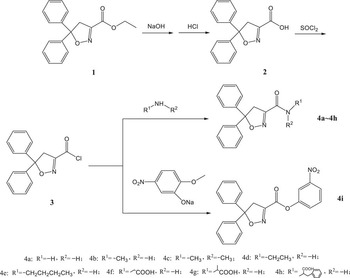
The synthesis route is described in Figure 1.
The steps in synthesizing compounds 4a to 4i.

The Hydrolysis Reaction of Isoxadifen-Ethyl
Freshly prepared 1 M NaOH solution (60 ml) was heated to 60 C in a water bath. Then, 8.85 g isoxadifen-ethyl was slowly added to the solution; the reaction was complete when the reaction mixture was clear. The reaction mixture was diluted with 200 ml of water after the solution dropped to room temperature, acidified with 1 M HCl (pH 2–3), and left to stand for 60 min. The reaction mixture was then filtered, and the filter cake was washed with water and vacuum-dried to produce the hydrolysate of isoxadifen-ethyl (Compound 2), a white solid.
The Acyl Chlorination Reaction of Isoxadifen-Ethyl Hydrolysate
Compound 2 (2.67 g, 10 mmol) was dissolved in 30 ml of dichloromethane (DCM), and then 2 ml of SOCl2 was slowly added to the solution, and 3 drops of dimethylformamide (DMF) were added to catalyze the reaction. The mixture was heated to reflux at 50 C, and the reaction was monitored by thin-layer chromatography (v[petroleum ether]:v[ethyl acetate]=4:1). At the end of the reaction period, Compound 4 was obtained after the solvents and unreacted SOCl2 were removed under pressure. The solid was not treated further before being used in the next reaction.
The Synthesis of Target Compound 4a
Compound 3 (10 mmol) was dissolved in 10 ml of DCM and then added dropwise to 10 ml of a 25% concentrated ammonia solution. The reaction was stirred for 1 h in an ice-water bath. The reaction mixture was filtered, and the filter cake was washed with water and then recrystallized with ethanol. Compound 4a, a white acicular crystal, was obtained.
The Synthesis of Target Compounds 4b to 4e
Compound 3 (10 mmol) was dissolved in 10 ml of DCM and then added dropwise to a 10-ml DCM solution containing 50 mmol methylamine or a homologue. The reaction was stirred 2 h in an ice-water bath. Then, it was diluted with 20 ml of water, and the reaction mixture was extracted three times with DCM. The combined organic layers were dried on MgSO4 and then filtered. The solvent was removed under reduced pressure. Finally, after the white residue was washed with water and recrystallized with ethanol, Compounds 4b to 4e were obtained.
The Synthesis of Target Compounds 4f to 4h
Amino acids (10 mmol) were added to a 20-ml 0.5 M NaOH solution, and stirred until they were completely dissolved. Then, 10 mmol of Compound 3 was dissolved in 10 ml of acetone and slowly added to the amino acid solution. During the reaction period, 2 M NaOH solution was slowly added to the reaction mixture to maintain the reaction at pH 8–10. After the acetone solution was added, the mixture continued to undergo reaction for an additional 3 h at room temperature. During the reaction mixture’s acidification with 1 M HCl (pH 1), a large amount of white solid was precipitated. This was then filtered, and the filter cake was thoroughly washed with water. Compounds 4f to 4h were obtained after the solid was dried in a vacuum and recrystallized with ethanol.
The Synthesis of Target Compound 4i
The 2-methoxy-5-nitrophenol sodium salt (10 mmol) was dissolved in 30 ml of distilled water by stirring. Then, 10 mmol of Compound 3 was dissolved in 10 ml of acetone and then added to the solution. During the reaction period, 2 M NaOH solution was slowly added to the reaction mixture to maintain the reaction at pH 8–10. After the acetone solution was added, the mixture continued to undergo reaction for an additional 3 h at room temperature. Then, the reaction mixture was filtered, and the filter cake was washed with water. The filter cake was dried in a vacuum and recrystallized with acetonitrile to obtain Compound 4i.
Effects of Fenoxaprop-P-Ethyl on Weedy and Cultivated Rice
Dose–response experiments were conducted in plastic pots. The cultivated and weedy rice seeds were soaked in deionized water for 12 h and then germinated for 24 h at 28 C. After germination, the seeds were sown directly into plastic pots. Afterward, the pots were placed in a growth chamber at 30 C/28 C (day/night), with 80% relative humidity and a 12-h/12-h light cycle. After 6 d, the cultivated and weedy rice seedlings were sprayed with a series of concentrations of fenoxaprop-P-ethyl. The control was treated with water. The plant heights and fresh weights were measured 7 d later. The effective concentrations of herbicide causing 50% inhibition in plant height and fresh weight (IC50) values were calculated using the probit regression analysis (Equation 1).
Bioassays of Isoxadifen-Ethyl Derivatives
Moderate isoxadifen-ethyl derivatives were dissolved in DMF and emulsified with Tween 80, and then added to a basal agar medium containing 0.3% agar, with or without 2 μM fenoxaprop-P-ethyl at concentrations of 0 (herbicide control), 50, and 100 μM. Then, the media containing different concentrations of herbicide were poured in individual plastic cups (20 ml medium cup−1). Isoxadifen-ethyl was used as the safener control. The rice seed germination conditions were as previously published by Deng and Hatzios (Reference Deng and Hatzios2002). Rice seeds were sterilized with 0.1% HClO for 15 min, washed three times, soaked for 24 h with deionized water, and allowed to germinate for 24 h at 28 C. Then, the treated rice seeds were added to the plastic cups (10 seeds cup−1) containing 20 ml of prepared agar medium. Afterward, the cups were placed in a growth chamber at 30 C/28 C (day/night), with 80% relative humidity, and a 12-h/12-h light cycle. After 5 d, the plant heights and fresh weights were determined, and the recovery rate was calculated (Zhao et al. Reference Zhao, Ying and Shuang2014).
 $$\eqalignno{&{\rm Recovery}\,{\rm rate}\left( \,\%\, \right)=\cr&{{{\rm Treated}\,{\rm with}\,{\rm compounds}\,{\rm and}\,{\rm herbicide}{\,\minus\,}{\rm treated}\,{\rm with}\,{\rm herbicide}} \over {{\rm Control}{\,\minus\,}{\rm reated}\,{\rm with}\,{\rm herbicide}}}$$
Protecting Rice from Fenoxaprop-P-Ethyl–associated Injury Using Isoxadifen-Ethyl Derivative Seed Treatments
Moderate isoxadifen-ethyl derivatives were dissolved in DMF and emulsified with Tween 80, and then diluted into an 800 μM solution with distilled water. Rice seeds were soaked in the prepared solution for 24 h. The control was soaked with water. After being soaked, the seeds were germinated for 24 h at 28 C and then sown directly into pots. The pots were then placed in a growth chamber at 30 C/28 C (day/night), with 80% relative humidity and a 12-h/12-h light cycle. After 6 d, the rice seedlings were sprayed with 400 or 800 μM fenoxaprop-P-ethyl. After 7 d, the plant heights and fresh weights were determined, and the recovery rate was calculated.
Statistical Analysis
The experimental design was a randomized complete block with four replications. An analysis of the dose–response data was performed using the following probit model (Equation 1) with the (SPSS v. 20.0) software. IC50 values were computed as follows:
 $$Y=KX{\plus}B$$
where Y indicates the probit, B indicates the intercept, K indicates the regression coefficient, and X indicates the log10(dose) value (Yang et al. Reference Yang, Dong and Li2007). Grouped means and Duncan multiple range tests were performed to test for significant differences at a 95% confidence level (P < 0.05).
Results and Discussion
Synthesis and Analytical Spectral Data
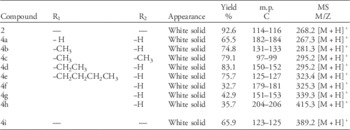
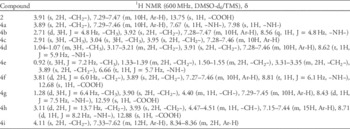
The physical and chemical data, and the 1H NMR data, for the compounds are shown in Tables 1 and 2, respectively. The synthesis routes of the intermediates and title compounds are illustrated in Figure 1. Through hydrolysis and chlorination, the inactive compound, isoxadifen-ethyl, was converted into the active acid chloride structure. Then, the acid chloride, as the intermediate, was spliced with other groups, including amines, amino acids, and 2-methoxy-5-nitrophenol, to obtain a series of isoxadifen-ethyl derivatives.
The physical and chemical data for the compounds.Footnote a

a Abbreviations: m.p., melting point; MS, mass spectrometry.
1H nuclear magnetic resonance (1H NMR) data for the compounds.Footnote a

a Abbreviations: DMSO-d6, deuterated dimethyl sulfoxide.
Effects of Fenoxaprop-P-Ethyl on Weedy and Cultivated Rice
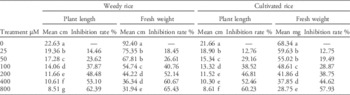
To determine the effects of fenoxaprop-P-ethyl on weedy and cultivated rice, a range of concentrations of fenoxaprop-P-ethyl was tested for its ability to control weedy rice. Fenoxaprop-P-ethyl caused reduced growth of both weedy and cultivated rice (Table 3). The weedy rice was more sensitive to fenoxaprop-P-ethyl than cultivated rice, especially as indicated by decreased fresh weights. After SPSS software analysis, the IC50 herbicide concentrations affecting weedy rice heights and fresh weights were 294 μM and 218 μM, respectively, while the concentrations were 309 μM and 483 μM, respectively, for cultivated rice. Thus, fenoxaprop-P-ethyl effectively controlled weedy rice but also resulted in herbicide phytotoxicity in cultivated rice.
Effects of fenoxaprop-P-ethyl on weedy and cultivated rice.Footnote a

a Values sharing the same letters differ nonsignificantly (P>0.05).
Safening Activities of Isoxadifen-Ethyl Derivatives
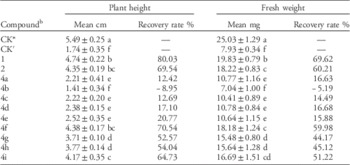
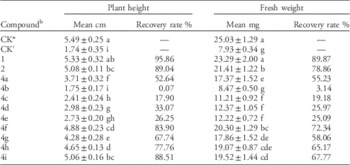
A range of isoxadifen-ethyl derivative concentrations were tested for their ability to decrease the injury in rice plants caused by fenoxaprop-P-ethyl. The herbicide caused a significant decrease in the growth of rice, but reduced effects were observed after the introduction of some of the derivatives (Tables 4 and 5). The highest recovery rate for the cultivated rice’s growth level was recorded for isoxadifen-ethyl at 100 μM. For the plants heights and fresh weights, there were generally no significant differences between the 100 μM isoxadifen-ethyl treatment and the control. Compared with isoxadifen-ethyl, Compounds 2, 4f, 4g, 4h, and 4i showed similar recovery effects, with greatly significant improvement in plants height and fresh weights for the herbicide control at all three doses. At the 100 μM dose, no significant differences in plants height were observed between Compounds 2, 4i, and isoxadifen-ethyl. Additionally, Compounds 4a, 4b, 4c, 4d, and 4e presented the poorest recovery effect as determined by recovery height among the derivatives, and even caused injury to rice seedlings.
The biological activity of each compound at 50 μM.Footnote a

a Values shown are mean±SD. Values sharing the same letters differ nonsignificantly (P>0.05). The values represent the average of four replicates.
b Abbreviations: CK*, blank control; CK′, herbicide control; 1, isoxadifen-ethyl; 2, hydrolysates of isoxadifen-ethyl; 4a–4i, isoxadifen-ethyl derivatives.
The biological activity of each compound at 100 μM.Footnote a

a Values shown are mean±SD. Values sharing the same letters differ nonsignificantly (P>0.05). The values represent the average of four replicates.
b Abbreviations: CK*, blank control; CK′, herbicide control; 1, isoxadifen-ethyl; 2, hydrolysates of isoxadifen-ethyl; 4a–4i, isoxadifen-ethyl derivatives.
Protecting Rice from Fenoxaprop-P-Ethyl–associated Injury by Isoxadifen-Ethyl Derivative Seed Treatments
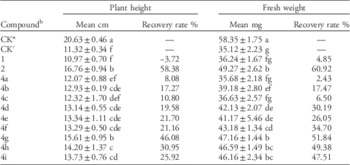
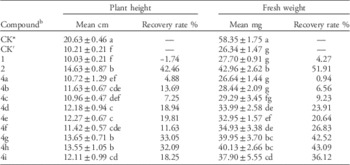
The isoxadifen-ethyl seed treatment did not decrease the amount of injury to cultivated rice caused by fenoxaprop-P-ethyl compared with the herbicide control (Tables 6 and 7). Among the derivatives, Compounds 2, 4g, and 4h presented the greatest protective activity for cultivated rice, as indicated by the 58.38%, 46.08%, and 30.95% plant height recovery rates, respectively, and 60.92%, 51.84%, and 49.38% plant weight recovery rates, respectively, at the herbicide dose of 400 µM. In addition, there were significant differences between treatments with these compounds and isoxadifen-ethyl. However, Compounds 4a, 4b, and 4c had the lowest performances, with no significant differences being observed in plant heights and fresh weights, except for Compound 4b, compared with the herbicide control. Additionally, Compounds 4d, 4e, and 4f presented some recovery effect, but their recovery rates were less than 30% at the herbicide dose of 800 µM.
The ability of each compound to prevent damage caused by fenoxaprop-P-ethyl (400 μM).Footnote a

a Values shown are mean±SD. Values sharing the same letters differ nonsignificantly (P>0.05). The values represent the average of four replicates.
b Abbreviations: CK*, blank control; CK′, herbicide control; 1, isoxadifen-ethyl; 2, hydrolysates of isoxadifen-ethyl; 4a–4i, isoxadifen-ethyl derivatives.
The ability of each compound to prevent damage caused by fenoxaprop-P-ethyl (800 μM).Footnote a

a Values shown are mean±SD. Values sharing the same letters differ nonsignificantly (P>0.05). Values represent the averages of four replicates.
b Abbreviations: CK*, blank control; CK′, herbicide control; 1, isoxadifen-ethyl; 2, hydrolysates of isoxadifen-ethyl; 4a–4i, isoxadifen-ethyl derivatives.
In this experiment, isoxadifen-ethyl could not relieve the phytotoxicity caused by fenoxaprop-P-ethyl in cultivated rice when it was used directly as a seed treatment, nor could the compounds of isoxadifen-ethyl combined with amines. However, the hydrolysates of isoxadifen-ethyl and the compounds of isoxadifen-ethyl combined with alanine or phenylalanine presented good activity as seed treatments, decreasing the herbicide damage significantly compared with isoxadifen-ethyl. We hypothesize that the increased activity levels of these compounds are the result of their absorption due to their structural changes.
In conclusion, because of the similarities in morphological features and physiological properties between weedy and cultivated rice, it has been difficult to find a POST herbicide that can kill the former but not the latter (Andres et al. Reference Andres, Fogliatto, Ferrero and Vidotto2015). It was also shown that fenoxaprop-P-ethyl had a great effect on the control of weedy rice but caused serious phytotoxicity to cultivated rice in the experiment. The use of a safener seed treatment is a viable alternative. However, isoxadifen-ethyl, a widely used safener that prevents damage caused by fenoxaprop-P-ethyl in rice (Lucini and Molinari Reference Lucini and Molinari2010), showed no activity as a seed treatment. To initiate the activity of isoxadifen-ethyl as a seed treatment, a series of isoxadifen-ethyl derivatives were synthesized and characterized. Some of the novel compounds had good activity as seed treatments against the herbicide’s phytotoxicity, indicating that the control method for weedy rice of treating cultivated rice seeds with safeners and applying POST herbicides in fields is practical. This may be a convenient and effective method to control weedy rice.
Cultivation and promotion of herbicide-resistant crops significantly increased the efficiency of weed control and brought a new weed control strategy. In recently years, Hinga and colleagues have developed methods and compositions to produce rice resistant to ACCase inhibitors (Hinga et al. Reference Hinga, Griffin and Moon2016a, Reference Hinga, Moon and Channarayappa2016b). The mutant rice also provides a convenient and effective method to control grass weeds, especially weedy rice, with ACCase-inhibiting herbicides such as fenoxaprop-P-ethyl. But the mutant rice may expose agroecosystems to uncontrollable risks. First, the herbicide-resistant rice will become a superweed with serious herbicide resistance in successive crops (Chèvre et al. Reference Chèvre, Eber and Baranger1997). Second, the mutant rice could lead to gene flow problems, with the herbicide-resistant gene possibly transferring from crops to weeds (Chèvre et al. Reference Chèvre, Eber and Darmency2000), generating herbicide-resistant weeds. So, owing to the outcrossing between herbicide-resistant rice and weedy rice (Sankula et al. Reference Sankula, Braverman and Oard1998), there is risk of weedy rice becoming herbicide resistant leading to failure of ACCase-inhibiting herbicides. These problems do not arise with weedy rice control using herbicides and safeners.
Acknowledgments
This study was supported by the Special Fund for Agro-Scientific Research in the Public Interest (201203098) and the Special Fund for Independent Innovation of the Henan Academy of Agricultural Sciences (2017ZC41). The authors would like to acknowledge Hongdan Hao, Huihui Sun, and Lanlan Sun for technical assistance. We also thank two anonymous reviewers and an associate editor whose thoughtful comments greatly strengthened this article.