Young patients suffering from rhythm disorders present with recurrent symptoms of palpitations, dizziness, syncope, and anxiety which have a repercussion on their quality of life. The anticipation of potential episodes causes anxiety in the patients and their families, resulting in reduced ability to carry out daily activities and socialise with peers.Reference Johnson and Francis1
During the last decade, significant advances in the medical care backed up by technology support have dramatically improved the outcomes of ablations in the paediatric population.Reference Hafez, Abu-Elkheir, Shokier, Al-Marsafawy, Abo-Haded and El-Maaty2 At present, catheter ablation therapy offers a safe and instant cure for arrhythmias.Reference Kubus, Vit and Gebauer3,Reference Chun and Van Hare4
In the light of the current expertise and advancement in the field, we decided to evaluate the quality of life in young patients with supraventricular arrhythmias before and after a percutaneous ablation procedure. Previous studies have evaluated retrospectively the impact of ablations in adults and selected types of arrhythmias in children.Reference Bubien, Knotts-Dolson, Plumb and Kay5-Reference Goldberg, Bathina, Mickelsen, Nawman, West and Kusumoto7 This is the first large prospective study of the subjective experience of children with supraventricular arrhythmias before and after an ablation therapy.
Quality of life assessment
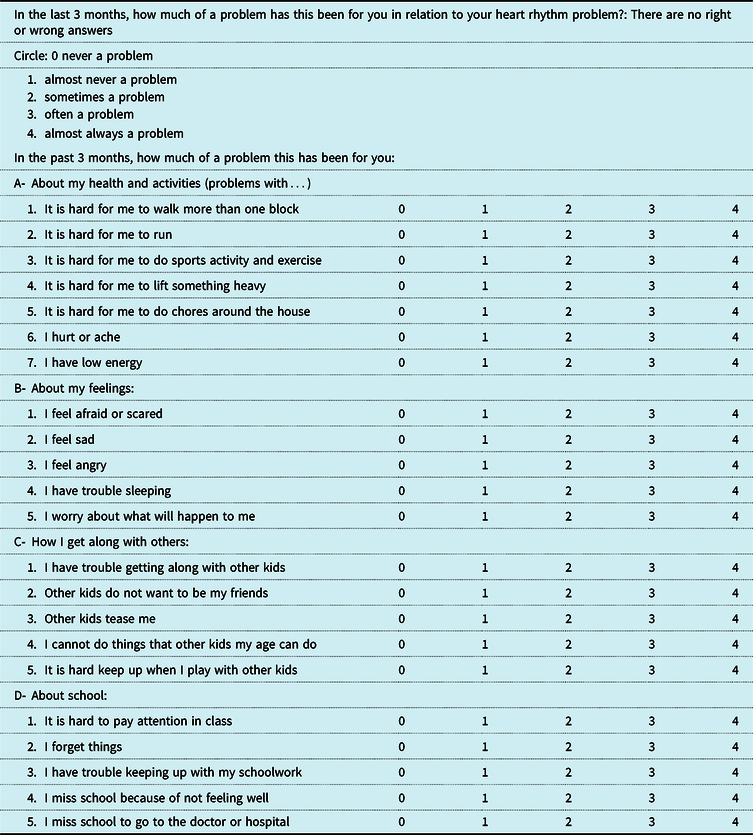
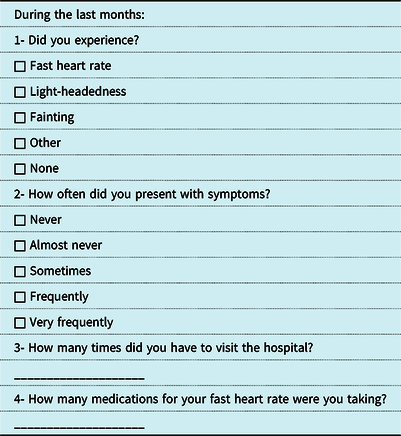
Quality of life is a broad general term that encompasses non-health-related aspects of life based on the patient’s perception of the impact of an illness and its treatment. The assessment of a group of subjective measures evaluates the patient’s situation before and after a treatment.Reference Varni, Seid and Kurtin8,Reference Varni, Seid and Kurtin9 This study uses PedsQL™ 4.0 Generic Core Scales, a validated questionnaire for child self-report which integrates both generic core scales and disease-specific modules, designed to measure the core dimensions of health as well as social and school functioning.Reference Varni, Burwinkle, Seid and Skarr10,Reference Varni and Seid11 This simple questionnaire takes 5 minutes and encompasses four aspects such as physical functioning (seven items), emotional functioning (five items), social functioning (five items), and school functioning (five items). Each question ranges in a scale of five scores indicating increasing levels of disturbance in everyday life. Table 1 shows a copy of the PedsQL™ child report questionnaire. Additional questions were added to evaluate specific areas for arrhythmia symptoms and treatment, including a self-sense of health status, frequency of the symptoms of prolonged palpitations (>15 minutes), number of hospital visits, and number of medications used to treat the arrhythmia (Table 2). The addendum to the quality of life questionnaire has not been validated by previous studies.
A copy of the PedsQL™ child report questionnaire

Additional questions added to evaluate specific areas for arrhythmia symptoms and treatment

Material and methods
Patient population
The present study has been approved by the Institutional Ethics Committee and has been performed in accordance with the ethical standards as laid down in the 1964 Declaration of Helsinki and its later amendments or comparable ethical standards.
A cohort of children was prospectively recruited in the paediatric cardiology department at Cliniques Universitaires St Luc in Belgium during a period of 6 years from 2013 to 2018. Inclusion criteria were aged from 8 to 18 years old, presence of a structural normal heart, previous diagnosis of sustained supraventricular arrhythmias, and underwent a first-attempt successful electrophysiology ablation for termination of the substrate. An ablation was considered successful when the clinical arrhythmia could be initially induced, and an effective ablation resulted in an endpoint of non-inducibility of the tachycardia and/or absence of the initial arrhythmia substrate. Exclusion criteria were CHD of any type, severe co-morbid conditions, presence of pre-excitation, impossibility to eliminate the arrhythmia substrate during the procedure, and evidence of recurrence of the arrhythmia within the initial follow-up time of 6 months. The underlying motivation to exclude patients with pre-excitation was the aim to have a more homogenous population. The pre-excitation involves a risk of sudden death related to sport participation, which represents a different category in terms of quality of life assessment.
All the patients underwent a pre-ablation screening including at least one 12-lead electrocardiogram, a transthoracic echocardiogram to rule out structural heart disease and to evaluate heart function, a pre-anaesthetic evaluation, and confirmation of the clinical arrhythmia in at least one non-invasive electrocardiographic recording (electrocardiogram, Holter monitoring, loop recorder, or other).
As part of the protocol, a doctor explained the study and obtained verbal and written parental informed consent and child assent. The pre-ablation questionnaires were completed within 7 days before the procedure of ablation. The post-ablation questionnaires were mailed to the patient’s address 6 months after the ablation procedure. Non-responders to the first survey received a telephone reminder in an effort to increase the response rate. The questionnaires were self-administered but frequently required parental assistance in the case of children below 10 years of age. Patients were requested to reflect on the prior 3 months of their life before the ablation (baseline) and in the period starting after 3 months of the ablation to complete the questionnaires. The 3 months immediately after the ablation procedure were excluded, as the quality of life within this initial period does not reflect the longer-term situation, as many patients continue to refer palpitations and many children do not start a normal life including sport practice immediately after the ablation.
Statistical analysis
Data were analysed using SPSS version 25 (IBM SPSS Statistics, IBM Corp., Armonk, New York, United States of America). Matched paired t-tests were used to compare changes in continuous quality of life subscale and symptom scores from before to after the ablation procedure. Wilcoxon-matched pair tests were used to compare differences for the ordinal scores of arrhythmia episode frequency and duration. The non-parametric McNemar chi-square test was used to compare changes in symptom proportions. Two-way ANOVA analyses were used to explore changes in symptom scores by gender, age, and type of arrhythmia. Statistical significance was set at <0.05.
Results
Baseline study population
A cohort of 88 patients aged 8–18 years old who underwent a successful ablation during the period from 2013 to 2018 was included in this prospective study. The cohort consisted of 52 males (59%), with a mean age at onset of the arrhythmias of 8.7 ± 3.7 years and a mean age at ablation of 12.5 ± 3.3 years.
Forty-two patients (48%) had a retrograde-only accessory pathway mediating the tachycardia, 38 (43%) had atrio-ventricular nodal re-entrant tachycardia, 7 (8%) had ectopic atrial tachycardia, and 1 (1%) had atrial flutter.
Seventy-four (88%) patients received at least one anti-arrhythmic treatment at any time before the ablation. Sixty-one patients (70%) were treated with an anti-arrhythmic medication immediately prior to the ablation.
There was a mean of two visits to the emergency department for symptoms of tachycardia during the 12 months prior to ablation (range of 0–12; median of three visits).
The main reason that motivated the ablation was first patient’s choice in 47 (53%), adverse effect and/or wish to stop anti-arrhythmic medication in 21 (24%), drug refractory arrhythmia in 15 (17%), and cardiac dysfunction in 5 (6%).
There were no severe complications during the ablation procedures. One patient presented with a small pericardial effusion following a challenging trans-septal procedure that resolved spontaneously within 3 days.
Post-ablation follow-up
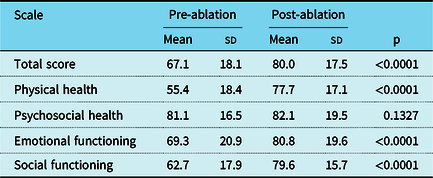
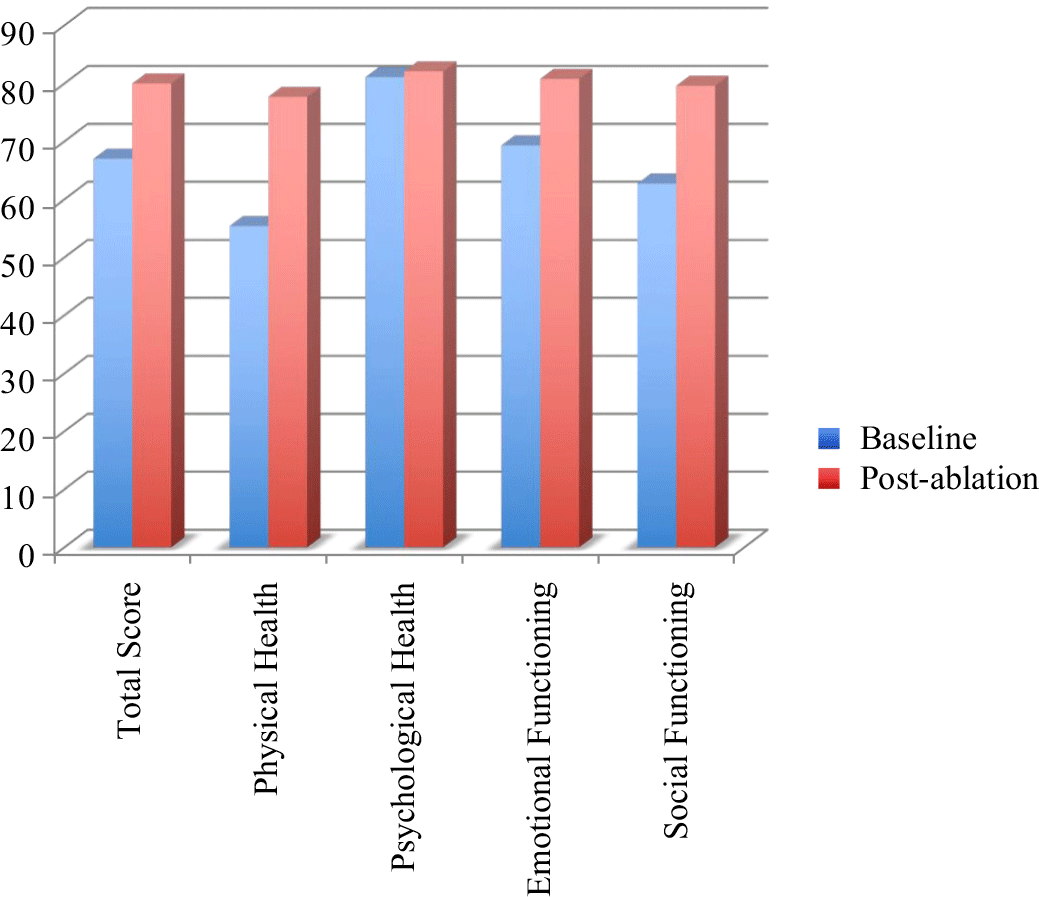
Table 3 presents the results of the baseline and the post-ablation mean PedsQL scores. Comparing the baseline situation to the post-ablation evaluation, patients reported significant improvement in the scores for physical health, emotional and social functioning, as well as in the total scores (Fig 1).
Comparison of the baseline and post-ablation mean PedsQL scores

Graphic on baseline and post-ablation quality of life scores.

Evaluation performed in separated age groups, from <12-year-old (n = 36) and from 13 to 18 (n = 52), showed no significant difference in the specific areas or global scores. Equivalent results were obtained when the population was analysed by sex.
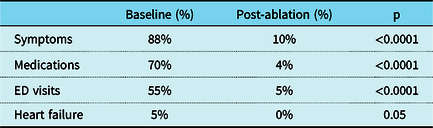
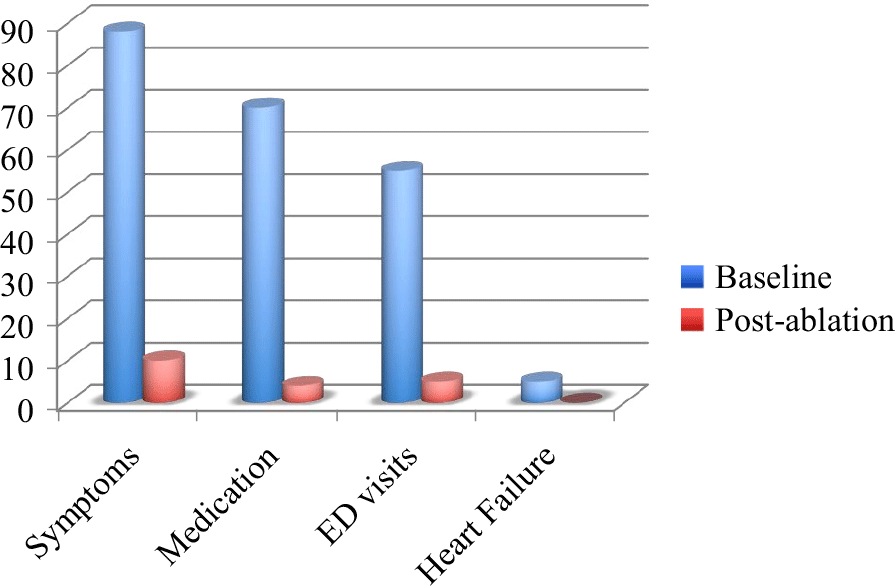
Table 4 and Figure 2 show the arrhythmia-specific scores for children at baseline and post-ablation. Seventy-seven patients (88%) presented with symptoms at baseline, including palpitations in 85 (96%), light-headedness in 32 (36%), and loss of consciousness in 5 (5%). Following ablation, nine (10%) patients presented with persistence of significant symptoms, six (6%) with light-headedness, and three (3%) with persistent palpitations. No arrhythmia could be identified in association with these ongoing symptoms despite a complete screening including electrocardiograms, Holter monitors, and mobile phone-assisted applications.
The arrhythmia-specific scores for children at baseline and post-ablation

ED = emergency department.
Graphic on baseline and post-ablation arrhythmia-specific parameters.

Moreover, treatment with a beta-blocker had to be continued after the procedure in four (4%) patients due to the symptoms of vasovagal origin without further evidence of arrhythmia.
Discussion
It has long been apparent that young patients suffering from rhythm abnormalities are limited in their daily lives, thus presenting also repercussion in their quality of life.Reference Wood, Stewart and Drew13-Reference Varni, Limbers and Burwinkle17 Our study substantiates this and demonstrates that the successful treatment of heart arrhythmias by means of an ablation results in a significant improvement in the quality of self-reported life scores in young patients. This study is innovative as it prospectively evaluates responses given by the patients according to their own experiences, using a well-validated paediatric score system.
The present study unveils that recurrent arrhythmias have a negative impact in the quality of life during the first years of life, as they affect school attendance, reducing the possibility to participate in activities with peers and resulting in a sense of “lack of health”.
Moreover, anti-arrhythmic medications have potential side effects that affect quality of life parameters. One clear example are beta-blockers, the first-line anti-arrhythmic drugs, which frequently result in mood change, weakness, fatigue, and depression.
In this study, the comparison of pre- and post-ablation conditions has shown a significant improvement in the individual as well as in the global score after the procedure. We acknowledge that the presence of post-procedure symptoms is lower than previously reported in the international literature, which may be partially explained by the exclusion of minor symptoms and by the 3-month exclusion following the ablation. We decided to exclude this initial period as patients present with unspecific symptoms and complaints, many of which are anxiety-related and eventually settle and disappear in the long-term.
The impact the elimination of the arrhythmia substrate has on the physical, emotional, and social lives of young patients is unequivocal. The results of the present study make a research-based contribution to the field of arrhythmia management and may help patients, families, and physicians at the time of making therapeutic decisions in young individuals.
Limitations
This is a prospective study without a matched control group, which limits the strength of the conclusions. Due to ethical reasons, our study did not evaluate the placebo effect of a purely diagnostic electrophysiology study without ablation in a blind control group. Thus, the importance of the placebo effect could not be measured and could be underestimated.
We acknowledge the possibility of recruitment of a control group consisting of those patients who either refused the ablation procedure or preferred medical treatment and/or vagal manoeuvres to control their arrhythmias. According to our experience, these are rather infrequent patients nowadays. Thus, it would take a long time to build a representative cohort. This is an initiative we considered for a next future study.
Finally, we would like to share a rather critical perspective on the results of our study. In spite of the fact that the objectively measurable parameters such as symptoms, medications, and emergency department visits (depicted in Fig 2) are dramatically decreased after an ablation, subjective parameters including emotional and psychosocial functioning (depicted in Fig 1) show only a modest improvement. On the one hand, this may lead to the conclusion that arrhythmias are not highly incapacitating. On the other hand, an argument could be made that the benefits of ablations may have been overestimated. In any case, our experience is that a successful arrhythmia does restore the sense of normality in a child’s life. The questions that are still to solve are if we are satisfying ourselves as much as our patients, and if there is not more to learn about quality of life in these population.
Acknowledgements
None.
Financial support
This research received no specific grant from any funding agency, commercial, or not-for-profit sectors.
Conflict of interest
None.
Ethical standards
The authors assert that all procedures contributing to this work comply with the ethical standards of the relevant national guidelines on human experimentation and with the Helsinki Declaration of 1975, as revised in 2008, and have been approved by the Institutional Committees of Cliniques Universitaires St Luc.