- CCP
-
colloidal calcium phosphate
- GDL
-
glucono-δ-lactone
- G′
-
storage modulus
- G″
-
loss modulus
- MC
-
micellar casein
- SMP
-
skim milk powder
Yogurt is an acidified coagulated milk product widely consumed worldwide. Yogurt's texture is a determinant feature that affects product quality and acceptability. One of the greatest approaches to enhance yogurts textural attributes (mainly consistency and viscosity) consists of increasing the solid content (more particularly the protein content) of the milk base. Indeed, according to Damin et al. (Reference Damin, Alcântara, Nunes and Oliveira2009) the increase in protein levels is the key factor influencing texture since protein enrichment enhances casein micelle aggregate and chain development. The increase in protein content could be achieved by either milk concentration (evaporation of water under vacuum, ultra-filtration or reverse osmosis) or by the addition of miscellaneous dairy powders (skim milk powder (SMP), milk protein concentrates, whey proteins, micellar casein (MC) and caseinates) (Kristo et al. Reference Kristo, Biliarderis and Tzanetakis2003; Soukoulis et al. Reference Soukoulis, Panagiotidis, Koureli and Tzia2007; Damin et al. Reference Damin, Alcântara, Nunes and Oliveira2009; Peng et al. Reference Peng, Serra, Horne and Lucey2009). The fortification of milk by the addition of SMP is a common practice (Sodini & Béal, Reference Sodini and Béal2003; Soukoulis et al. Reference Soukoulis, Panagiotidis, Koureli and Tzia2007; Peng et al. Reference Peng, Serra, Horne and Lucey2009) in industrial yogurt manufacture (Schkoda, Reference Schkoda2002). Nevertheless, the use of high proteins ingredients (Isleten & Karagul-Yuceer, Reference Isleten and Karagul-Yuceer2008) such as, whey proteins and caseins fractions has gained interest because of their functional and nutritional properties (González-Martínez et al. Reference González-Martínez, Becerra, Cháfer, Albors, Carot and Chiralt2002). These added dairy ingredients should be completely dispersed and rehydrated in milk in order to avoid some subsequent defects such as lumps formation (Sodini & Béal, Reference Sodini and Béal2003).
The use of casein based ingredients in yogurt production has been extensively studied and several studies have reported that this type of fortification resulted in firmer (Soukoulis et al. Reference Soukoulis, Panagiotidis, Koureli and Tzia2007; Peng et al. Reference Peng, Serra, Horne and Lucey2009), more elastic and viscous products (Damin et al. Reference Damin, Alcântara, Nunes and Oliveira2009) that undergo less syneresis (Sodini & Béal, Reference Sodini and Béal2003; Soukoulis et al. Reference Soukoulis, Panagiotidis, Koureli and Tzia2007) when compared with yogurts fortified with SMP or whey proteins. On the other hand, numerous authors have reported that casein proteins and especially native casein present a poor aptitude to rehydrate and dissolve into water (Gaiani et al. Reference Gaiani, Scher, Schuck, Hardy, Desobry and Banon2006) and other ionic media. Indeed, in a recent study, Hussain et al. (Reference Hussain, Gaiani, Aberkane and Scher2011), demonstrated that micellar casein rehydration at 24°C into a salt media (NaCl and CaCl2) at a concentration up to 3%, was not completed even after 500 min.
From a rheological viewpoint, yoghurt gel is formed by aggregation of casein micelles (in unheated milk) into chains, strands and clusters throughout milk acidification (Gastaldi et al. Reference Gastaldi, Lagaude, Marchesseau and Torodo De la Fuente1997). Moreover, casein aggregation and subsequent gel formation correspond to an increased viscosity and gel modulus. Gel point could thus be determined by considering rheological properties of the gel (Horne, Reference Horne1999). Elastic (or storage) modulus (G′) and viscous (or loss) modulus (G″) as well as phase angle are rheological measures that define the gel properties. The storage modulus reflects the measure of energy stored per cycle, the solid-like behaviour. The viscous modulus reflects the energy dissipated per cycle and the viscous-like behaviour. Finally, the ratio of the viscous to the storage modulus defines the tangent of the phase angle (Horne, Reference Horne1999).
The objective of this study was to investigate a potential effect of casein powder age and rehydration condition (referred to as the length of rehydration) on some rheological properties (gel time and storage modulus) of acid gels. In this study, glucono-δ-lactone (GDL) was used as the acidifying agent in order to eliminate external variables associated with starter bacteria like variable activity and variation of culture type used (Lucey & Singh, Reference Lucey and Singh1998).
Materials and Methods
Materials
SMP was supplied by Lactalis (Lactalis Ingredients, Bourgbarré, France). MC powders (Promilk 872B) were both procured from International Dairy Ingredient (IDI, Arras, France). There were obtained through milk microfiltration and presented an important fraction (more than 83·5%) of native micellar casein. The ‘aged’ and the ‘fresh’ casein powders were stored at 20°C for their entire storage period (one year for the aged powder and less than 2 months for the fresh one). GDL and sodium azide were both provided by Merck (Merck & Co, Inc., Whitehouse Station, NJ, USA).
Milk base preparation and acidification
SMP was rehydrated in distilled water to the concentration of 10% w/w in glass bottles. Sodium azide (0·02 g/100 g) was added in order to prevent bacterial growth. Samples were covered with an aluminium foil to prevent evaporation then stored at 4°C under low mechanical agitation for 15 h before use. The aged or fresh MC powder was then added under mechanical agitation (300 rpm) at 20°C, at a 2% level to reach a final solid content of 12% w/w. There were left to rehydrate for various duration (5 or 180, 300, 480, 900 or 1440 min) before acidification with 1·5% GDL at 42°C.
Powder chemical characterisation
Protein and lactose content of the dairy powders were determined by Kjeldahl and Potterat-Eschmann methods respectively. Fat content was determined with a Rös–Gottlieb extraction and ashes were measured after a dry ashing procedure in a muffle furnace of 550°C (AFNOR standards). Moisture content was determined via a drying oven at 103°C as described by AFNOR standards.
Rheological properties and pH determination
Rheological properties (viscous and elastic components as well as the final value of the storage modulus and the phase angle) were measured at 42°C with a Kinexus rotational rheometer (Malvern Instruments, Orsay, France). The rheometer was equipped with a cup and bob geometry consisting of coaxial cylinders. After addition of GDL, the mixture was stirred for 2 min and then 17·25 ml of the acidified mix were transferred into the cup. Samples were oscillated at a constant frequency of 1 Hz with an applied shear strain of 0·1%. Gelation time was defined as the time when the phase angle transits 45° and when subsequent phase angles of less than 45° are recorded thus emphasizing elasticity behaviour dominance. The final G′ value corresponds to the final value of storage modulus measured after 2000s of onset of gelation.
The pH values concomitant with the onset of gelation were monitored using an analytical radiometer (SAS, Villeurbanne, France) equipped with a miniaturised combined pH electrode. The combined electrode consists of a sensitive glass membrane of 1·5 mm. It was standardised by means of two buffers (pH 7·0 and 4·0), rinsed with sterilised water and placed on the surface of the rheometer cup.
Particle size during rehydration
Experiments were carried out in vessels under mechanical agitation (by a stirrer) at 300 rpm. The temperature was held at 20°C via a double wall jacket vessel. Particle dispersion was achieved through a peristaltic pump (Watson-Marlow pumps, La Queue les Yvelines, France) and monitored via an inline process. Analyses were performed using a Qicpic equipment (Sympatec GmbH, Germany) with a dispersion module (Lixell, Sympatec) particularly appropriate for powders in suspension (Gaiani et al. Reference Gaiani, Boyanova, Hussain, Murrieta, Burgain, Karam and Scher2011). For each measure, 0·5 g MC powder was dispersed in 100 ml milk base preparation. Concurrently, regular images and video of the particles under rehydration were incessantly recorded during 24 h. Data were first collected every 15 s for the first 1 h, then every min for 3 h, every 15 min for 6 h and finally every hour for the remaining 14 h. Windox 5.4.10 software (Sympatec GmbH, Germany) was used in this study to determine the particle size distributions in milk media.
Casein powder solubility in milk base preparation
The powder solubility in milk was estimated according to the International Dairy Federation Method (IDF, 1988) with slight modifications. MC powder (2 g) was added to 100 ml milk to allow powder solubilisation. After 5 or 180, 300, 480, 900 or 1440 min of powder rehydration at 20°C, the dispersion was centrifuged at 266 g for 20 min. The supernatant was then removed and samples were left overnight in the drying oven at 103°C before weighing the remaining sediment. Finally, the insolubility index was calculated on the difference between the quantity of powder added (2 g) and the quantity of the remaining sediment.
Statistical analyses and data treatments
For all experiments, the results are the averages of three experiments. Statistical analyses were performed using Sigma Stat 3.1 (Systat Software, Inc., Chicago, IL, USA).
Results and Discussion
Powder characterisation
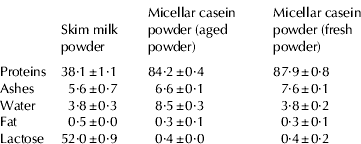
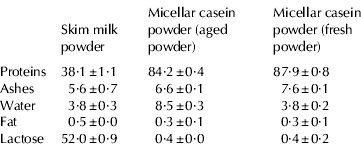
The powders composition is presented in Table 1. SMP composition was consistent with that reported in literature (Peng et al. Reference Peng, Serra, Horne and Lucey2009). MC powder compositions were comparable except for water content and in agreement with others (Gaiani et al. Reference Gaiani, Schuck, Scher, Desobry and Banon2007a; Hussain et al. Reference Hussain, Gaiani, Aberkane and Scher2011). Aged MC powder had a greater moisture content that could be explained by acquired humidity during storage. In addition, this powder is well known for water uptake during storage (Mimouni et al. Reference Mimouni, Deeth, Whittaker, Gidley and Bhandari2010). Nevertheless, the composition of the aged powder was determined (when this powder was still fresh) and found similar to the fresh powder (data not shown).
Chemical composition (g/100 g) of the powders used: skim milk powder, fresh and old micellar casein powders (mean of three independent analyses with standard deviation)
Rehydration profile of MC powders in milk base
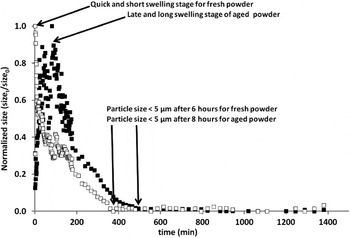
Figure 1 illustrates the rehydration profiles of MC powders in milk. These profiles were obtained by following the evolution of particle size (d 50 in μm) during rehydration. Since both powders had an initial different size, the results were normalised taking into account their initial size. Indeed, the initial particle size for fresh and aged MC powders were about 20 and 40 μm, respectively. The same profiles were observed for each powder. Our results are in agreements with others (Gaiani et al. Reference Gaiani, Banon, Scher, Schuck and Hardy2005, Reference Gaiani, Scher, Ehrhardt, Linder, Schuck, Desobry and Banon2007), insofar as they show similar rehydration profiles. These authors depicted four phases in rehydration: the wetting, swelling, dispersing and finally the dissolution phase.
Fresh and aged micellar casein (respectively white and black squares) rehydration profiles obtained with the Qicpic equipment in milk at 20°C (mean of triplicates independent analyses).

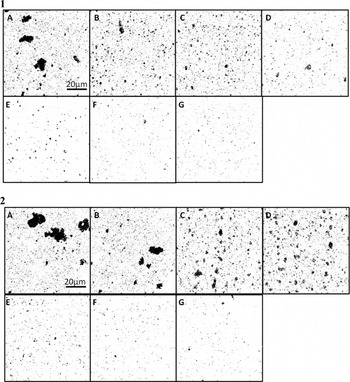
In Fig. 1, a quick particle size increase was first observed from the initial particle size to 30 and 80 μm for fresh and aged powder respectively. A similar behaviour was already noticed in water and was related to the particle swelling (Gaiani et al. Reference Gaiani, Scher, Schuck, Hardy, Desobry and Banon2006). The particle size increase was rapid for the fresh powder (around 10–15 min) and significantly longer for the aged powder (around 100–120 min). The observed extended length of aged casein micelle swelling phase could be attributed to the deterioration of the rehydration properties over time (Gaiani et al. Reference Gaiani, Banon, Scher, Schuck and Hardy2005). Indeed, Mimouni et al. (Reference Mimouni, Deeth, Whittaker, Gidley and Bhandari2009) showed the progressive loss of milk powder rehydration properties during storage in the dry form, especially in the case of high protein containing powders. Finally, a slow decrease of the particle size was observed for each powder. A particle size under 2–5 μm was obtained after 360 min (6 h) for the fresh powder and 480 min (8 h) for the aged powder (Fig. 1). The normalised particle size at zero was in fact related to a particle size under 2–5 μm. Indeed, only the beginning of the rehydration was investigated as the Qicpic apparatus could not measure particles under 2–3 μm. So, 6 and 8 h were the times needed to reach this size correlated to the detection limits of the apparatus and not to the end of the dispersion phase. The dispersion stage was already observed for MC powders rehydrated in water (Gaiani et al. Reference Gaiani, Scher, Schuck, Hardy, Desobry and Banon2006) and in salt media (Hussain et al. Reference Hussain, Gaiani, Aberkane and Scher2011). Mimouni et al. (Reference Mimouni, Deeth, Whittaker, Gidley and Bhandari2009) also observed this phenomenon for milk protein concentrate powders. These authors also depicted the very slow dispersion of this powder. In conclusion, differences were observed between the two powders. Logically, the fresh powder presented faster swelling and dispersions properties in comparison with the aged powder. All these results were concordant with the in situ microscopy observations presented in Fig. 2.
Example of in situ microscopy images obtained during fresh (1) and aged (2) micellar casein powder rehydration in milk media (A: few seconds, B: 5 min, C: 180 min, D: 300 min, E: 480 min, F: 900 min and G: 1440 min).

For the first time, an in situ determination of the particles size during rehydration into an opaque environment (milk) was measured without any dilution and in different medias from those studied by several authors (water or ionic environment) (Gaiani et al. Reference Gaiani, Scher, Schuck, Hardy, Desobry and Banon2006; Mimouni et al. Reference Mimouni, Deeth, Whittaker, Gidley and Bhandari2009). These results were made possible by the use of the Qicpic apparatus equipped with a very thin window allowing the determination of the size in this kind of media.
Influence of casein rehydration state on gel formation and pH
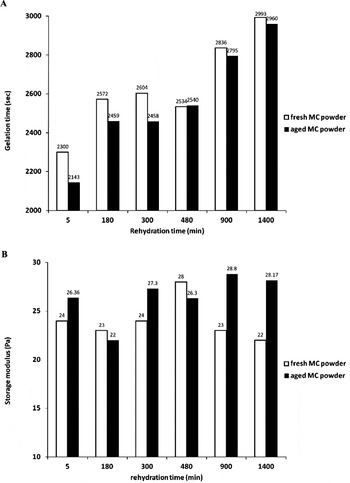
Average gelation times observed for various rehydration times for both fresh and aged MC powders are reported in Fig. 3a. The rehydration state of MC powder was found to significantly (p< 0·05) affect the onset of gelation. The onset of gelation was about 2100 s (for the aged powder) and 2300 s (for the fresh powder) after 5 min of rehydration. This time increased proportionally to the rehydration length (Fig. 3) reaching 3000 s for both powders after 1440 min of rehydration. The onset of gelation for aged and fresh powders was found comparable within the same rehydration time despite a distinct rehydration profile (Fig. 1). The pH associated to the onset of gelation was also determined. There was no significant difference in the values for samples at different rehydration time. The gelation pH value was 5·3 (±0·04) after 5 or 180, 300, 480, 900 or 1440 min of rehydration.
Onset of gelation determination (a) and storage modulus (b) at the end of acidification after variable rehydration time for fresh and aged micellar casein powder (values are means of triplicates independent analyses).

Relationships between powder rehydration stage and gel formation delay
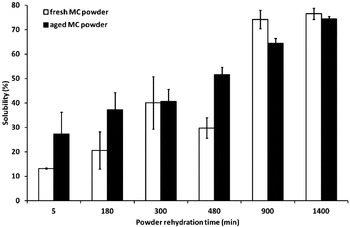
A number of explanations can be drawn from these results. First, the extended onset of gelation could be partially due to the decrease in GDL/protein ratio. In fact, in our study GDL concentration remains constant (1·5%) whereas the soluble casein fraction (reported in Fig. 4) increases with the rehydration length (although this increase is minimal). Braga et al. (Reference Braga, Menossi and Cunha2006) have shown that a high GDL/protein ratio reduces the gelation time. In fact, in our study, the powder solubility increased from about 17% (average of the solubility of the two powders) after 5 min rehydration to about 70% after 15 and 24 h rehydration. Indeed, these results show that even after 8 h of rehydration, MC powders continue to disperse into milk before complete dissolution. This result was also observed by the Qicpic apparatus. The latter, however, (due to sensitivity limitations) could just depict the beginning of the dispersion phase.
Micellar casein powder solubility in milk base at variable rehydration times in minutes (mean of three independent analyses with standard deviation).

The higher soluble casein fraction could be also correlated to the delayed gel point. Indeed, Glantz et al. (Reference Glantz, Devold, Vegarud, Mansson, Stalhammar and Paulsson2009) have reported a positive correlation between low protein content and short gelation time. Finally, the increased gel point could be explained by a more important buffering of extra soluble casein exhibited in the vicinity of pH 5 (Peng et al. Reference Peng, Serra, Horne and Lucey2009).
Concerning the obtained pH-range (of 5·3), it differs from the pH-value reported by Sodini & Béal (Reference Sodini and Béal2003). In fact, these authors have reported a higher pH of gelation (at pH range near 5·5) when the milk basic was heated. This disparity in pH-range may be attributable to the presence of denatured whey proteins that interact with themselves in a heated system. Indeed, it is well-known that in unheated milk (like our system) gelation is governed by casein aggregation. In heated milk, denatured whey protein forms complexes with themselves and with κ-casein and precipitate at higher pH values (Donato et al. Reference Donato, Alexander and Dalgleish2007; Fox & Brodkorb, Reference Fox and Brodkorb2008) before true casein precipitation and coagulation.
Moreover, our pH values could correspond to the dissolution of the inorganic micellar calcium phosphate (which is usually fully soluble at pH near 5·2) (Heertje, Reference Heertje1985; Donato et al. Reference Donato, Alexander and Dalgleish2007).
Storage modulus at the end of acidification after different rehydration times
The values of storage modulus at the end of acidification after several rehydration times for both powders (aged and fresh) are represented in Fig. 3b. The storage modulus was about 24 Pa after 5, 180 and 300 min rehydration and about 28 Pa after 480 min rehydration for the fresh micellar casein powder. It was around 26 Pa after 5, 180 and 300 min rehydration and around 28 Pa after 900 min rehydration for the aged casein powder. The storage modulus slightly increased parallel to the rehydration length (except for the fresh MC powder after 900 min). This is mainly due to the increased soluble casein concentration. Indeed, Gastaldi et al. (Reference Gastaldi, Lagaude, Marchesseau and Torodo De la Fuente1997) stated that higher solids content are correlated to increases in elasticity and firmness. Moreover, these authors reported that increases in caseins particles are responsible of higher values of storage modulus due to an increase of bonds and interactions. However, in our study the increase in caseins particles was not statistically significant. We can speculate that the increase in casein concentration (maximum 2%) was negligible to impact significantly the storage modulus. On the other hand, Donato et al. (Reference Donato, Alexander and Dalgleish2007) reported that the storage modulus measurement depends on all particles present in the suspension (even the non soluble fraction of micellar casein) and that even after aggregation particles continue to rearrange. This could be a potential explication of the insignificant increase in the storage modulus.
Conclusion
This study highlights the impact of rehydration state of micellar casein into the milk base on some rheological properties of yogurt. Indeed, gelation time was increased proportionally to the rehydration duration whereas storage modulus seems unaltered by rehydration conditions. Furthermore, this study used, for the first time, interesting equipment combining a dispersion module and a camera allowing tracking of the rehydration of dairy powders into a complex and opaque environment such as milk. Other rheological properties will be correlated with rehydration state of miscellaneous dairy ingredients in further studies.
The authors thank the financial support of Philippe Jabre Association.