Introduction
Single ventricle CHD is a complex, lifelong condition that demands continuous care from infancy through adulthood. Reference Dalén, Odermarsky, Liuba, Johansson Ramgren, Synnergren and Sunnegårdh1,Reference Pundi, Johnson and Dearani2 Advances in perioperative management and long-term follow-up have improved survival rates, allowing many individuals with single ventricle CHD to reach adulthood. Reference Miller, Sorabella and Padilla3 While survival remains the primary outcome measure, there is a growing emphasis on optimising health-related quality of life. Reference Miller, Sorabella and Padilla3 Individuals with single ventricle CHD encounter numerous medical and psychosocial challenges throughout their lives. Reference Well, Lamari-Fisher and Taylor4 However, the broader impact of these on individuals with single ventricle CHD and their families remains largely unexplored. Reference Hoyos, Well and Van Diest5
Mery et al. created a detailed map of the journey of individuals with single ventricle CHD to better understand the lived experiences of patients and their families. Reference Mery, Well and Taylor6 The study also identified gaps in care, defined as obstacles that may impede the achievement of health outcomes that matter most to a unique population; in this case, patients and their families. Reference Teisberg, Wallace and O’Hara7,Reference Ulack, Suarez, Brown, Ring, Wallace and Teisberg8 Identifying these gaps in care is a first step in redesigning and transforming healthcare through a value-based approach. Reference Mery, Well and Taylor6 Care delivery improvement decisions have traditionally been determined by clinical teams and administrators. However, involving patients in prioritising interventions can strengthen patient-provider relationships, reduce costs, benefit clinician experience, and ultimately enhance value-based care. Reference Miller and Reihlen9,Reference Krist, Tong, Aycock and Longo10 Building on Mery et al.’s work, this study aims to assess how individuals affected by single ventricle CHD rate the importance of each gap in care based on the importance for them and their families.
Methods
The original study identified 27 gaps in care. Details on the methodology used for the original study can be found in Mery et al.’s publication. Reference Mery, Well and Taylor6 These gaps in care were categorised into five main themes: Communication, Transitions across Life Stages, Patient and Family Support, Structural Deficiencies, and Education. They were originally phrased and grouped for a target audience of clinicians to understand where the single ventricle CHD care journey was being affected. To make them more approachable to families, they were rephrased and adjusted to be more accessible and understandable to a broader range of literacy levels.
Survey creation
A total of 22 rephrased and regrouped gaps in care were presented in a survey on Qualtrics XM©. Eligible participants included parents, ≥18 years of age, of children with a diagnosis of single ventricle CHD and individuals≥18 years of age with a diagnosis of single ventricle CHD who spoke English or Spanish. Parents who had only received a prenatal diagnosis of single ventricle CHD and participants who spoke languages other than English or Spanish were excluded. Participants were instructed to rate each gap in care on a scale of 1 to 10, where 1 indicated “not important at all” and 10 indicated “extremely important”. Respondents could select “Not Applicable” for any gap in care irrelevant to their experience. Parents were asked to rate 21/22 gaps in care, while patients were asked to rate 17/22 based on relevance for each group.
The survey was distributed via URL and QR codes in a flyer format. These were shared with patients receiving care or who had graduated from the Dell Children’s Medical Center Single Ventricle Program, single ventricle CHD families who had engaged in research with our centre before this study, and online Facebook groups and community resources for families affected by single ventricle CHD. Demographic data were collected at the end of the survey, including the patient’s diagnosis, date of birth, current insurance status, state of care, and race/ethnicity. This was used to characterise the population and assess variations in care priorities based on sociodemographic factors. Participants were grouped by state where they are receiving care, with those outside Texas classified as “Other” and those without state information labelled as “Unknown.”
Data collection and analysis
Survey responses were collected over six months. To evaluate the relative importance of each gap in care, multiple scoring methods were used, including median scores, weighted scores, and ranked ratings. This multi-method approach allowed for a more comprehensive understanding of how participants prioritised different gaps in care.
Median scores
For each gap in care, a median score and interquartile range were calculated.
Weighted scores
To estimate central tendency and account for response volume, weighted median scores were calculated by multiplying the median score by the number of responses that were neither blank nor marked as “Non-Applicable”. This adjustment ensured that gaps in care, with more engagement from participants, had greater influence in the final analysis.
Ranked ratings
The number of times a gap in care was rated first, second, or third by each participant was recorded. If multiple gaps received the highest score from an individual, all were classified as being rated first. To create a final rating score, a point system was applied:
#1 rating = 3 points
#2 rating = 2 points
#3 rating = 1 point
The total rating score for each gap in care was then determined by adding these points across all participants.
Categorical variables were summarised using frequencies and percentages, while continuous variables were described with medians, minimum-maximum ranges, and interquartile ranges. The Kruskal–Wallis test was used for independent variables, specifically to compare the median scores for parent and patient responses across different clinical and sociodemographic groups. Spearman’s rank correlation was used to measure the correlation between the gap in care ratings and the median age of patients. Univariate analysis was performed on survey results from only parents. To explore potential disparities in gaps in care, a matrix analysis of race/ethnicity and insurance status was conducted. Median scores were calculated for each combination of race/ethnicity and insurance type to assess differences in parent-reported experiences. Statistical significance was determined using the Kruskal–Wallis test. A two-tailed alpha level of 0.05 was used to determine statistical significance. All analyses were conducted using RStudio 11 .
Results
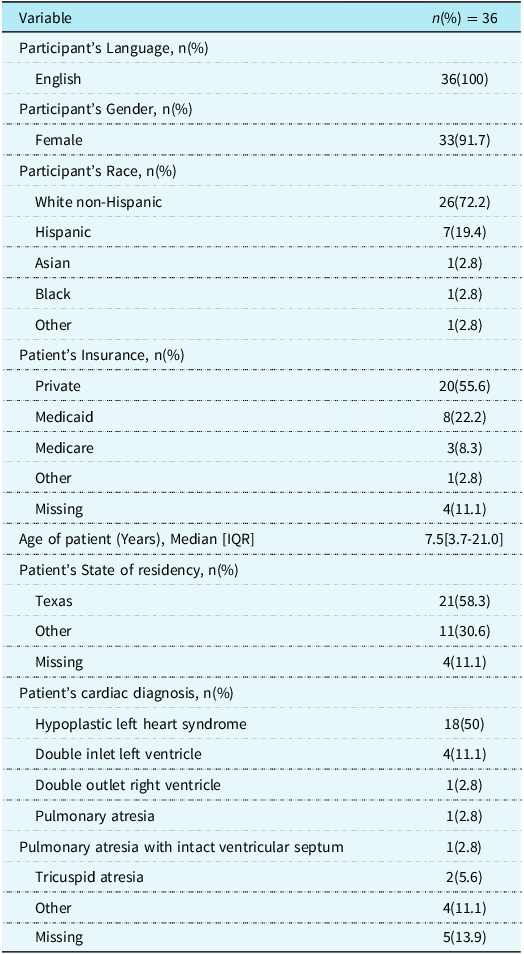
A total of 36 complete responses were identified, with 30(83.3%) from parents and 6(16.7%) from patients (Table 1).
Demographic and clinical characteristics

Parent demographics
Out of the 30 parents, 29(96.7%) were female, 24(80.0%) identified the patient as White non-Hispanic, and 17(56.7%) said the patient was privately insured. The median age of the parents’ child was 6.5[interquartile range: 3.0- 12.8] years, and 16(53.3%) said their child resided in Texas. The most common SV lesion was hypoplastic left heart syndrome in 16(53.3%).
Patient demographics
Out of the 6 patients, 4(66.7%) were female, the most common patient race was Hispanic (n = 3, 50.0%), and 3(50.0%) were privately insured. The median age of patients was 33.0[interquartile range: 27.3–42.5] years, and 5(83.3%) resided in Texas. The most common SV lesion was hypoplastic left heart syndrome for 2(33.3%) of the patients, and 2(33.3%) had left this section blank, and was categorised as a “missing” diagnosis.
Rating of the gaps in care
Overall, the gap in care with the highest median score was “The uncertainty of the prognosis and potential complications of single ventricle CHD when reaching adulthood” with a median score of 9.5[interquartile range:8.0–10.0] (Figure 1). This continued to be the highest-rated gap in care in the weighted score at 342. It was rated first by 24(66.7%) respondents and received the highest total rating score with 77 points (Figure 2). The gap in care with the lowest median and weighted score was “Pregnancy termination presented repeatedly”, scoring 1[interquartile range:1.0–7.0] and 13, respectively. It was rated first by 3(8.3%) respondents and received the lowest total rating score with 9 points (Table 2)
Median score per gap in care.

Total rating score per gap in care.

Overall rating of gaps in care (n = 36)

Parent rating of the gaps in care
For the 30 participants who were parents, the gap in care with the highest median score continued to be “The uncertainty of the prognosis and potential complications of single ventricle CHD when reaching adulthood” with a median score of 10.0[interquartile range:8.3–10.0] and a weighted score of 300. It was rated first by 22(73.3%) respondents and received the highest total rating score with 69 points. The gap in care with the lowest median and weighted score was “Pregnancy termination presented repeatedly”, 1.0[interquartile range:1.0–7.0] and 13, respectively. It was rated first by 3(10%) of parents and received the lowest total rating score with 9 points (Table 2).
In univariate analysis, median score differed by patient race reported by parents for several gaps in care. For the gap in care, “The stress and changing responsibilities as your child transitions to school-age”, parents of white non-Hispanic patients rated the gap in care with a median score of 7.0[interquartile range:6.0–8.5] while parents to other races rated it 10.0[interquartile range:9.5–10.0](p = 0.037). For the gap in care “Transition to adult health care”, parents of white non-Hispanic patients rated the gap in care 6.5[interquartile range:4.8–9.0] while parents of other races rated it 9.5[interquartile range:8.0-10.0](p = 0.017). “A lack of practical knowledge of navigating resources (parking, childcare, meals, etc.) to make any hospital stay less burdensome” was rated 5.0[interquartile range:2.5–7.0] by parents of white non-Hispanic patients while parents to other races rated it 8.5[interquartile range:5.8–9.8](p = 0.037). For the gap in care, “Sometimes there is a lack of compassion and empathy in the way clinicians interact with you”, parents of white non-Hispanic patients rated it 5.0[interquartile range:1.3–6.8] while parents to other races rated it 9.0[interquartile range:8.0–10.0](p = 0.008). In terms of cardiac diagnosis, “Accessing affordable health insurance” was rated 9.0[interquartile range:8.0-10.0] by parents of patients with hypoplastic left heart syndrome, while parents of patients with other cardiac diagnoses rated it 7.0[interquartile range:4.0–8.0]. Parent gender, patient insurance, age of patient, or state of residence were not associated with gap ratings (Supplement 1).
When analysing the matrix of race/ethnicity and insurance in parent responses, significant differences were revealed in the ‘Transition to adult healthcare’ gap in care. Parents of children with non-private insurance from “Other” racial/ethnic groups reported the highest median score (10.0[interquartile range:10.0–10.0]), while White non-Hispanic families with non-private insurance had the lowest median scores (3.0[interquartile range:2.0–5.0], p = 0.006). Differences were also seen in the gap in care: “Sometimes there is a lack of compassion and empathy in the way clinicians interact with you.” The highest median score was parents of privately insured children from “Other” racial/ethnic groups (10.0[interquartile range:9.5-10.0]), whereas the lowest was reported by “Other” racial/ethnic families with private insurance (5.0[interquartile range:1.0–5.8], p = 0.015). No other gaps in care showed significant differences based on race/ethnicity and insurance type (Supplement 2).
Patient rating of the gaps in care
For the 6 participants who were patients, the gap in care with the highest median scores were “Rescheduling surgical procedures” and “Transition to adult health care” (10.0[interquartile range:8.0–10.0 and 10.0] [interquartile range:6.0–10.0] respectively), with the highest weighted scores of 290 for both. Four gaps in care were rated first by 3(50%) respondents: “Sometimes there is a lack of compassion and empathy in the way clinicians interact with you”, “Transition to adult health care”, “Finding an adult single ventricle CHD specialist is challenging”, and “Rescheduling surgical procedures”. The gap in care that received the highest total rating score was “Support in family planning or information about potential risks related to having children” (12 points). The gap in care with the lowest median and weighted score was “Limited guidance about the transition to adolescence”, of 0.0[interquartile range:0.0–0.0] and 0, respectively. It was not ranked first by any respondents and received the lowest total rating score with 0 points (Table 2).
Discussion
Among all participants, the gap in care with the highest median score was “The uncertainty of the prognosis and potential complications of single ventricle CHD when reaching adulthood”. For parents, this remained the highest rated, yet patients rated “Rescheduling surgical procedures” and “Transition to adult health care” as the highest median scores. In univariate analysis, racial differences emerged in rating gaps in care, with parents of white non-Hispanic patients reporting lower scores than parents of other races. The gaps in care that showed these differences in ratings were “Sometimes there is a lack of compassion and empathy in the way clinicians interact with you” (5.0[interquartile range:1.3–6.8] vs. 9.0[interquartile range:8.0–10.0], p = 0.008), lack of practical non-medical (5.0[interquartile range:2.5–7.0] versus 8.5[interquartile range:5.8–9.8], p = 0.037), stress during the child’s transition to school-age (7.0[interquartile range:6.0–8.5] versus 10.0[interquartile range:9.5–10.0], p = 0.037), and lastly, transition to adult health care (6.5[interquartile range:4.8–9.0] versus 9.5[interquartile range:8.0–10.0], p = 0.017).
When examining the nuances in how patients rated gaps in care, differences were noted across the scoring methods. While “Rescheduling surgical procedures” and “Transition to adult health care” received the highest median and weighted score for patients, these did not achieve the highest total rating score. Support with family planning had the highest total rating score for patients (12 points). This suggests that while both gaps in care with high median scores may have been viewed with higher impact, there is a broader emphasis on support for family planning and improving empathetic interactions with clinicians from the perspective of patients.
Patients with single ventricle CHD and their families face distinct challenges throughout their care journey and understanding what matters most to them is crucial for improving care. However, patients and caregivers often have differing perspectives on these needs. This paper explores how they prioritise gaps in care to ensure their input informs intervention decisions in the future. The survey’s structured rating system for this study provided a systematic approach to identifying key gaps in care, revealing that many were perceived as highly important. Participants were able to rate gaps in care from 1–10 and could assign a score of 10 to multiple gaps in care, which occurred 61.1% of the time, highlighting the need for improvement across various areas. Usually, clinicians and administrators set priorities in addressing gaps in care without firsthand patient experience, while patients and families identifying challenges may not grasp the intervention execution. Reference Benner, Hughes, Sutphen and Hughes12,Reference Levesque and Sutherland13 When these perspectives are used in isolation, they fail to highlight the full scope of the issues.
When comparing ratings, parents prioritised gaps in care related to long-term uncertainty and potential complications of single ventricle CHD when reaching adulthood, reflecting the need for a clearer understanding of potential outcomes, given the improvement in survival of this population. This aligns with the role of parents as caregivers who are usually responsible for managing their child’s care over time. The uncertainty of long-term outcomes creates anxiety for parents, who may struggle with the balance of preparing their child for independence while also fearing potential health crises. Reference Lumsden, Smith, Twigg, Guerrero and Wittkowski14 Another consideration is that many families in this study have moved beyond the acute interstage period, where survival and immediate medical stability are the primary concerns. Reference Rudd, Ghanayem and Hill15 Once past this high-risk period, parents may have more mental and emotional bandwidth to shift their concerns toward long-term issues. This shift in focus aligns with developmental changes in both the child and the family. Parents are no longer just fighting for survival but are now planning for a lifetime of care. Further work on exploring whether parents of children still in early surgical stages prioritize different gaps in care compared to those with older children or adolescents is needed.
Understanding the needs of caregivers and patients requires identifying the social and clinical drivers of health that shape their care experiences. In our study, patient race and cardiac diagnosis were associated with differences in how parents prioritized gaps in care.
Stress during transitions to school age and adult healthcare
Parents of children of other races had more pronounced concerns about the stress associated with major transitions, such as entering school or moving into adult healthcare than parents of White non-Hispanic children. Prior research has shown that Black and Hispanic children with heart conditions often face greater socio-economic challenges and barriers to healthcare access compared to their non-Hispanic White counterparts, which can contribute to heightened stress for caregivers during these critical transitions. Reference Judge, Downing, Nembhard, Oster and Farr16
Lack of clinician compassion and empathy
Parents of children of other races with single ventricle CHD rated lack of empathy and compassion from clinicians higher compared to parents of White, non-Hispanic patients. This aligns with previous studies’ findings, where empathy scores were numerically lower for patients from various racial and ethnic groups compared to White patients; these differences were not statistically significant. Reference Roberts, Puri, Trzeciak, Mazzarelli and Trzeciak17 However, clinician empathy remains essential for high-quality care. Future research should explore how historically disadvantaged minorities, whether due to SES, race, or ethnicity, may have different expectations of clinician empathy based on experiences of discrimination.
A lack of practical knowledge of navigating resources to make any hospital stay less burdensome
Parents of children of other races with single ventricle CHD prioritised non-clinical support during hospital stays more highly than parents of White, non-Hispanic children. Race and socio-economic status (SES) are closely linked, and often face systemic barriers that result in lower income, wealth, and access to resources compared to their White counterparts. Reference Williams, Priest and Anderson18 Studies have shown that SES can influence the treatment provided, access to care, and patient-provider interactions, with lower SES patients reporting differences in these areas. Reference Arpey, Gaglioti and Rosenbaum19 Lower SES can increase the perceived importance of practical, non-clinical needs, such as assistance with parking, meal costs, and navigating hospital systems; factors that may seem less pressing for higher-income families but are significant for those with limited resources. These systemic issues may contribute to parents’ heightened concern about non-clinical support during hospital stays and access to affordable health insurance.
Access to affordable health insurance
Finally, access to affordable health insurance was rated higher by parents of children with hypoplastic left heart syndrome than in parents of children with other types of SV lesions. Even though SV patients may undergo similar staged surgeries and care journeys, hypoplastic left heart syndrome carries a higher risk of complications, long-term medical dependency, and adverse cardiovascular events. Reference Dib, Poirier and Samuel20 Dib et al.’s multicentre retrospective cohort study showed that hypoplastic left heart syndrome was associated with longer follow-up, a higher risk of cardiovascular adverse outcomes encompassing atrial arrhythmia, thromboembolic events, transplant, and ultimately death. These complications would impact patients and families as a financial burden, leading parents to prioritise affordable health insurance more than parents of other SV patients.
Our matrix analysis revealed disparities in parent-reported concerns regarding transition to adult healthcare, influenced by both race/ethnicity and insurance status. Parents of children from racial/ethnic minority groups with non-private insurance reported the highest median scores. Challenges in establishing well-resourced transitional clinics have existed in paediatric CHD patients, yet insurance obstacles and racial disparities complicate this process even further. Reference Cabrera Fernandez, Lopez, Bravo-Jaimes and Mackie21,Reference Agha, Glazier, Moineddin, Moore and Guttmann22 The correlation between race and insurance in the gap in care on lack of compassion and empathy in clinician-patient interactions highlights the multifaceted nature of care disparities. By considering both institutional and interpersonal factors as contributors to the healthcare experience, the lack of compassion reported reflects broader concerns about trust and communication in the healthcare system. Reference Singh, King-Shier and Sinclair23,Reference Khatri, Nguemeni Tiako, Gebreyesus, Reid, Jacoby and South24 The importance of performing matrix analysis allows a better understanding that disparities often coexist and compound the challenges our patient population faces during these key transitions in their care journey.
Addressing the identified gaps in care for patients with single ventricle CHD and their families requires a shift toward collaborative, patient and family-centered solutions. Moving forward, a co-design approach, where patients, families, clinicians, healthcare administrators, and other stakeholders collaboratively design interventions, can help ensure that solutions address both the priorities and real-world challenges faced by all. Palumbo et al. show that co-design improves patient-centered care by enhancing healthcare services, driving system-wide changes, and improving non-clinical outcomes. The effectiveness of co-design varies by region, depending on healthcare system structures, and its success relies on strong stakeholder engagement, transparency, and alignment with broader healthcare priorities. Reference Silvola, Restelli, Bonfanti and Croce25
The effort-impact matrix fits well into the concept of co-design by promoting a collaborative approach to prioritising healthcare interventions. The effort impact matrix is a framework that allows for the evaluation of potential initiatives by balancing the anticipated impact with the effort required to implement them, helping teams focus on interventions that provide the greatest benefit with the least resources. Reference Pelletier, Beaudin and van Leeuwen26 It has been used in quality improvement as it allows teams to focus on potential benefits versus the resources needed to execute them. Reference Atkins, Briffa, Connell, Buttery and Jennings27 The optimal result in the grid of the effort impact matrix would be in the quadrant of “high impact, low effort”. By introducing the effort-impact matrix, there would be a collaboration between clinical expertise and patient perspectives to prioritize healthcare interventions.Reference McCallum, Ollson and Stefanovic28
For example, in one long-term acute care hospital, the effort-impact matrix was used to reduce patient safety risks during hospital transfers. Among several options, barcode scanning for patient wristbands emerged in the “high-impact, low-effort” quadrant and was implemented first, reducing medication errors and improving identification accuracy. Reference T., Heelon and Siano29 In outpatient settings, primary care teams have used the matrix as Lean-based workflow maps to evaluate and redesign inefficient processes. van Eeghen et al. (2016) used staff feedback to uncover bottlenecks in behavioural health referrals. Interventions like adjusting referral handoff workflows and streamlining intake procedures were prioritised using an effort–impact framework, resulting in improved referral completion rates (from 60 % to 74 %) and reduced wait times.Reference van Eeghen, Littenberg, Holman and Kessler30
The matrix has also been applied to chronic disease care management, where teams must choose among multiple competing priorities. For example, a QI initiative in an academic paediatric endocrinology clinic implemented the Six Core Elements of Health Care Transition™, including co-designed interventions such as personalised transition checklists, provider education scripts, and integration of transition readiness assessments into the electronic health record. The clinic prioritised interventions that were both high-impact (elevating transition preparedness) and low-effort (easily integrated into workflow), and saw outcomes like a doubling in documentation of transition goals among youth with type 1 diabetes from 0 % to 100 % in 12 months. Reference Minchau, Vance and Barnes31 In the context of single ventricle CHD care, this co-design approach ensures that the interventions selected are not only high-impact and feasible but also align with the unique needs and preferences of patients and their families, leading to more effective and tailored solutions that improve overall healthcare outcomes.
Limitations
This study has several limitations that should be acknowledged. First, the small sample size, particularly the low number of patient responses, limits the generalizability of the findings. Furthermore, the median age of patient respondents was 33 years [interquartile range: 27.3-42.5], meaning they had undergone their palliation surgeries years ago. Their perspectives on care may differ from those of parents responding on behalf of their children, whose care journeys are more recent. These temporal differences may have contributed to the observed discrepancies between the two groups surveyed. Additionally, the cohort lacked demographic diversity, with most participants identifying as female, English-speaking, and White non-Hispanic. This homogeneity may not fully capture the experiences or priorities of more diverse populations.
Another limitation could arise from the survey distribution methodology, which involved sharing on online parent groups and other social platforms. This would allow participants receiving care at different medical centres to be included in this study. Variability in institutional practices and resources may have influenced participants’ experiences, introducing potential inconsistencies in reported priorities and perceptions of care. The use of retrospective self-report data also introduces the potential for poor recall, as participants’ responses may be influenced by more recent experiences rather than accurately reflecting their entire care journey. Similarly, recency bias could also affect responses given recent healthcare experiences. However, if there are consistent gaps that span across different participant groups, ages, and demographics, these issues are likely to remain highly rated regardless of the influence of recency bias. Finally, while the structured rating system of the survey facilitated systematic analysis, it may have constrained participants from fully expressing nuanced or less common concerns. This could have led to the omission of emerging gaps in care that were not previously identified in the original study.
Conclusion
Healthcare delivery redesign must be a collaborative effort, involving all stakeholders: patients, parents, clinicians, and health systems working together. By combining patient-identified priorities with clinician expertise, healthcare systems can more effectively allocate resources and co-design interventions that are both practical and meaningful. The effort-impact matrix serves as a powerful tool to guide this process, promoting a collaborative, inclusive, and relationship-centered approach to improving the quality of care for individuals with single ventricle CHD and their families. This strategy can be implemented in further care interventions for chronic conditions and may serve as a model to prioritise the gaps in care to be addressed.
Supplementary material
The supplementary material for this article can be found at https://doi.org/10.1017/S1047951125101157
Financial support
This research received no specific grant from any funding agency, commercial, or not-for-profit sectors.
Competing interests
None.