Published in 1931, the ‘Antinoopolis charioteers’ quickly became one of the most well-known illustrated papyri.Footnote 1 The papyrus, usually assigned to the sixth century c.e., contains a painted image showing parts of a standing group of six charioteers dressed in colourful outfits, with one of the figures holding a whip. They are positioned in front of an arch that may represent an arcade (see Fig. 1). Its level of detail, showing the horizontal straps around the abdomen characteristic of charioteers, and especially its vivid colours, have captivated classicists and art historians.Footnote 2 The image is broken off on the left side, right side, and at the bottom, so there was clearly more to the picture. The original editor noted the scant traces of text above the image, but it was more than forty years before Eric G. Turner pointed out that more extensive remains of lines of text had survived on the back side of the papyrus.Footnote 3
The Antinoopolis charioteers papyrus, horizontal fibres (left) and vertical fibres (right); images Courtesy of The Egypt Exploration Society and the Faculty of Classics, University of Oxford.

These letters marked the left edge of a column of text. Turner offered a tentative reading of the letters but did not identify the text. And in the following half century, no identification of the text has proven persuasive.Footnote 4 In what follows, I argue that the folium preserves an episode from a version of the Alexander Romance. I then revisit the painting in light of this identification, reflect on the codicology of the piece, and briefly explore the text of this piece among other papyrus fragments of ‘Alexander literature’.
IDENTIFICATION OF THE TEXT
To judge by its transmission in many versions across several languages, the Alexander Romance must have been one of the more popular texts in Late Antiquity and the Medieval period.Footnote 5 This collection of stories about Alexander the Great has both a tradition of illustrated editions and, in some versions, an episode that includes a chariot race. While I am not aware of a standing group of charioteers being pictured in any surviving illustrated manuscripts of the Romance, I have not carried out anything resembling a thorough survey of the many illustrated versions.Footnote 6 In any event, the picture on the Antinoopolis fragment nicely matches a scene narrated in some of the Greek recensions of the Romance in which Alexander participates in a chariot race with eight other competitors (Book 1, chapter 19 in traditional numbering of the text).Footnote 7 Given that the lines of text on the back side of the papyrus are just beginning as the papyrus breaks off, there would have been ample space for an additional three figures to the left of the six that are visible or partly visible in the surviving portion of the illustration. This fact alone seems to me to be sufficient reason to test this identification against the letters surviving on the page. Turner read the following:

There are multiple Greek recensions of the Alexander Romance, and the passage concerning the chariot race varies somewhat, both in the number of words involved and in the choice of terms. The limited number of surviving letters on the folium also makes establishing a fully convincing match of texts somewhat challenging, but a reasonable case can be made for a relevant passage fitting the handful of surviving letters.
Perhaps the best place to start is the paragraphos, which, as Turner noted, may mark the beginning of a new section. And indeed, although Turner did not point it out, the line that begins below the paragraphos extends beyond the left of the edge of the written column, an instance of ekthesis, which also suggests a sense break with what preceded. Turner read the surviving letters of the line under the paragraphos as ηλα̣.Footnote 8 In some of the recensions of the Alexander Romance that contain the account of the chariot race, the sentence in which the chariot race begins (after the introduction of the nine charioteers) reads:
ἠλάλαξεν ἡ σάλπινγξ τὸ ἐναγώνιον μέλος.Footnote 9
A reconstruction can be built around this sentence and aligned with the letters and traces of letters on the papyrus. In the text below, I draw mainly from the β recension of the Romance, as the α recension seems problematic in these lines. I use the text of Bergson (deviations from Bergson’s text are explained in the notes).Footnote 10 I retain Turner’s numbering of the lines.

Notes on the text
-
Line 1: Only a small spot of ink remains in this line, but it is not inconsistent with a phi. The reconstructions in the lacunae in lines 1–3 require that the ordinal numbers be spelled out as they are in Bergson’s edition. In Leiden University Library Vulc. 93, fol. 197r (a representative of the β recension for this portion of the text), the numbers are spelled out, but in another manuscript of the β recension that I was able to consult, the numbers are indicated by single letters (Paris, BnF grec 1685, fol. 10r). This is true also of the α recension in Paris, BnF grec 1711, fol. 398r. At least some representatives of the γ recension fully spell out the ordinals (e.g. Oxford, Bodleian Library MS Barocci 20, fol. 15v and Paris, BnF Suppl. grec 113 fol. 20r).
-
Line 2: Turner’s omicron appears correct.
-
Line 3: Turner’s epsilon appears correct. I have followed the β recension and the Armenian in restoring the ninth name as Νικόμαχος Λοκρός. This results in a line of only 21 letters (as opposed to the average length of a full line here, which is about 26 letters). Longer versions of the name exist in other traditions. BnF grec 1711, fol. 398r has Κλινόμαχος Λοκρός (corrected in Kroll’s edition of the α recension to follow the β recension and the Armenian), and the γ recension has Κριτόμαχος ὁ Λοκρός, but these longer names are not otherwise attested. Perhaps the definite article should be added before Λοκρός.
-
Line 4: Here the surface of the papyrus is quite damaged, but the traces of ink are consistent with an epsilon. The α recension reads ἔστησαν ἐπὶ τὴν ἱππαφεσίαν. At 23 letters, this would also be an acceptable reconstruction. Raabe’s retro-translation of the Armenian reads οὗτοι ἔστησαν ἐν τῷ ἱπποδρόμῳ. The ink traces at the damaged beginning of this line could also be construed as the remains of an omicron, and at 25 letters, this reconstruction would also be satisfactory.
-
Line 5: Turner’s reading appears correct and fits the reading of the α recension of the Romance at this point (this line is absent from the β recension, but an equivalent phrase is present in the Armenian version—ἐπὶ τῶν ἁρμάτων πάντες in Raabe’s retroversion). The reconstructed line is also shorter than the others (22 letters). This can be explained by the paragraphos, indicating the end of a section, thus some extra blank space at the end of the line would not be out of place.
-
Line 6: Turner’s reading appears correct, and I regard the alpha as virtually certain. Turner did not note the ekthesis in this line, but the line quite clearly extends into the left margin.
-
Line 7: Turner read μω̣, interpreting the c-shaped curve before the break as the leftmost stroke of an omega, but a horizontal stroke suggesting an epsilon or a theta is faintly visible. The α recension reads here: μέλος· ἀφέθη ἡ ἀφετηρία, προεπήδησαν πάντες ὀξεῖ ὁρμήματι. This cannot be confidently matched with the surviving letters on the papyrus in lines 7–9. Bergson and Stoneman bracket the phrase [ἐξῆλθον αἱ ταβλώσεις τῶν ἵππων] in their editions of the β recension, but the presence of this phrase (or something like it) in the papyrus seems certain. On the odd term ταβλώσεις see W.J. Aerts, The Byzantine Alexander Poem, vol. 1 (Berlin, 2014), 297.
-
Line 8: Turner’s reading is correct.
-
Line 9: Turner read κα ̣, but a vertical stroke is clearly visible at the edge of the break in the papyrus and is consistent for what we would expect in a gamma. The total of 23 letters reconstructed in this line is slightly less than the number of letters in the other full lines (24–29 letters), but this line includes a break between sentences, which probably means the inclusion of a punctuation mark and possibly some additional space before the beginning of the next sentence.
-
Line 11: Turner read προ, but only a very small portion of the third letter actually survives, and the traces of ink are not incompatible with an omega. The καί supplied in the lacuna is absent in the β recension but present in the α recension. Its presence in our papyrus is perhaps to be preferred, given the average number of letters per line.
-
Line 12: Turner’s kappa and alpha are correct. The vertical stroke of the iota is also visible. Turner missed a lightly written paragraphos in the margin just above the break in the papyrus. This line is short (20 letters), but like line 5, it comes at the point of a paragraphos and section break.
-
Line 13: Turner read only a doubtful phi in this line. He seems to have been deceived by the isolated vertical stroke, but the stroke sits squarely between the upper and lower notional lines. A better explanation (suggested to me by Ben Henry) would be to regard this upright stroke as the right vertical leg of a mu, with a slight trace of ink on the edge of the papyrus break marking the left leg of a mu, and another trace directly below the left leg of the kappa in line 12 as the remains of the curve of an omicron extending out into the left margin as another instance of ekthesis after a paragraphos. The α recension reads here: ὑστερήσαντες ἀτονησάντων, which cannot easily be accommodated to the available space and ink traces.
With this text in place, we can turn to the small group of letters preserved above the painting on the other side of the papyrus. Turner proposed the following text:

Turner argued that the script was the same on both sides of the papyrus, and this seems correct.Footnote 11 The ink and the letter forms are very similar, as far as the very limited evidence allows us to judge. The letters above the painting are, however, slightly smaller than the letters on the other side of the papyrus. The height of the notional lines for the writing on the vertical fibres is about 5 mm, while the height of the letters above the painting is closer to 4 mm. Similarly, the width of letters with a square modulus (e.g. epsilon, kappa) on the vertical fibres is about 6 mm, while the width of the epsilon and sigma above the painting is about 4.5 mm. Thus, if we posit that the width of the written area is about the same, we should have a few more letters per line in the text above the painting.
Having plausibly identified the text on the other side of the papyrus, one possibility for identifying the text above the painting immediately suggests itself. The last line above the image ends with an iota followed by a high dot marking the conclusion of a sentence. The text restored on the vertical fibres comes from Book 1, chapter 19 of the Alexander Romance. In the β recension, the final sentence of the preceding chapter is καὶ ἀπέστησαν ἀπ᾽ ἀλλήλων διαμαχόμενοι. Again, a plausible restoration can be built around this.

Notes on the text
-
Line 1: The ink trace that Turner interpreted as a punctuation mark is a different colour from the ink of the text and unrelated to the text. There is no text visible in this line.
-
Line 2: There is a trace of ink at the upper left tip of the fragment that has the appearance of the lower right corner of a loop (if the fibres are properly placed), but the base of the loop is elevated from the lower notional line by about 1 mm. A rho seems possible, but the lower portion of the loop seems too thick in comparison to the clear rho on the other side of the papyrus. The reading is doubtful.
-
Line 3: The surface of the papyrus is abraded here, and the traces of ink find no good match in the β recension. The α recension, however, lacks καί at this point and instead has ταῦτα εἰπόντες. The letters -τες fit well with the surviving ink.
-
Line 4: The trace of a letter that Turner detected before the iota was a slight horizontal mark, a serif, that is typical of how this copyist executes a vertical stroke (see the examples of kappa on the other side of the papyrus). In the α recension, the last word of this section is διαδακνόμενοι, which is also a possible restoration here, though given the relative shortness of the line, διαμαχόμενοι should perhaps be preferred.
Another possibility (suggested to me by Will Robins) is that these slightly smaller letters are part of a caption for the picture. I cannot exclude this possibility, but, given the relatively tidy fit of the ending lines of Book 18, I prefer that option.
OBSERVATIONS ON THE PAINTING
With the text now plausibly identified, it is interesting to revisit some details of Gasiorowski’s original analysis of the painting. He had noted that it was a bit odd that all of the charioteers were simply standing around, and he very tentatively suggested a possible scenario to explain such an image: ‘We must have here a representation of a moment just before the races began; to decide exactly what moment is in my opinion not possible in the present state of knowledge. The drawing of lots was done in the circus itself, and therefore an arcade would be quite in place.’Footnote 12 In fact, it is exactly this moment, the casting of lots before a chariot race, where our text commences. Just before the naming of the racers, we read (in the β and γ recensions): ἐτέθησαν λοιπὸν τὰ τοῦ ἀγῶνος πάντα καὶ ἡ κάλπη ἐκληρώθη. The α recension reads ἐτέθη ὑδρία καὶ ἐκληρώθη. The lots had just been cast using the urn (κάλπη or ὑδρία), and the text preserved on the papyrus names the charioteers who had drawn the lots for the seventh, eighth and ninth positions.
Another detail that Gasiorowski noted was that the image appeared to emphasize two figures in the scene, the figure on the front left and the central figure with the whip: ‘These two charioteers appear to be more important than the others, not only by their position in the front line of the group, but also by their gestures.’Footnote 13 Once again, this description would be apt for the situation in our narrative. While the race in the Romance involves nine charioteers, the focus is clearly on the rivalry between just two competitors, Alexander and Nikolaos of Akarnania. Without the benefit of additional images from the codex, it would be difficult to know which of the two primary figures is meant to represent Alexander. In any event, it is an indication of the acumen of Gasiorowski’s analysis that he detected these details without the benefit of knowing the narrative scene being depicted.
Turner drew attention to the fact that some of the charioteers were ‘looking to the left, as if at some object not now visible to us’ and argued that the ‘principal subject’ of the scene likely was in an area of the papyrus that has been lost.Footnote 14 It is certainly clear that much of the illustration is missing. The image would likely have continued across the width of the written area of the page and perhaps even extended into the area of the left margin, just as it extends into the area of the right margin. If the proposed identification of the text is correct, it would be safe to assume the image contained three additional charioteers. But what of the remaining space and the possible ‘principle subject’ suspected by Turner? One possibility is the κάλπη or ὑδρία, the vessel from which the lots were drawn to determine the racing positions.Footnote 15 This object and its operation formed part of the iconographic tradition of the chariot races in Late Antiquity. For instance, the device and its operator feature among several images related to chariot racing that are carved on a marble artefact in the Bode Museum in Berlin. This artefact, usually described as a gambling machine (Kugelspiel), was found near the hippodrome in Constantinople in 1834 (see Fig. 2).Footnote 16
Chariot racing scenes on a gambling machine, including the urn for drawing lots (upper left); Berlin, Bode Museum, Museum für Byzantinische Kunst, inv. 1895; image source: Brent Nongbri 2025.

The lower register shows a racer in action, and the upper register shows a figure operating the machine for drawing lots (left) and a charioteer with a whip (right). The lot machine seems to have consisted of a ceramic vessel with a narrow neck rotated on a horizontal bar within a rectangular frame.Footnote 17 The Kugelspiel in the Bode Museum has been assigned to dates ranging from the fifth to the sixth century and may well be roughly contemporary with the production of the Antinoopolis charioteers papyrus.
The device for drawing lots also appears among the many chariot-racing-themed reverses on contorniate medallions (see Fig. 3).Footnote 18 While these medallions are difficult to date with precision, it is generally agreed that the series that included the image of the drawing of lots on the reverse was produced at some point between the middle of the fourth century and the middle of the fifth century.Footnote 19
Reverse of a contorniate medallion showing the machine for casting lots (Bibliothèque nationale de France, département Monnaies, médailles et antiques, AF.17308); image source: Gallica.bnf.fr.

The medallion shows the device for drawing lots along with three standing figures. The figure on the left stands with the left hand on the horizontal bar of the machine. The figure on the right, who also seems to grasp the horizontal bar of the machine with the right hand, wears garments characteristic of a charioteer and appears to hold a whip in the left hand. The central figure stands behind the device and holds up an object in the right hand, likely one of the balls (σφαιρία) that had been placed in the vessel.
In short, the drawing of lots before the chariot race seems to have been a matter of some import and thought worthy of visual memorialization in the form of a depiction of the operation of the urn.Footnote 20 A similar image may well have appeared to the left of the standing charioteers in the lost portion of the illustration on the Antinoopolis papyrus.Footnote 21
CODICOLOGY
It was recognized early on that this folium must have been quite large by the standards of papyrus codices.Footnote 22 Determining the exact dimensions of a fragment with an imperfectly preserved text block and margins is always a fraught enterprise. And, with a text as unstable as that of the Alexander Romance, the dangers are even greater. Nevertheless, it seems worthwhile to hazard a few observations, with the reservation that all of what follows is tentative and hypothetical.
Turner estimated a page breadth between 22 cm and 25 cm and a height of between 32 and 33 cm.Footnote 23 He spelled out his reasoning for the estimate of the width: ‘Even if the subject matter of the text turns out to be prose, the lines on the back are likely to have contained at least fifteen letters.’Footnote 24 For the estimated height of the page, Turner seems to have relied on analogies with other illustrated Greek codices, namely the Ambrosian Iliad (estimated height of 32.6 cm) and the Vienna Genesis (estimated height of 33.3 cm).
Based on the text reconstructed above, we could estimate a written space with a breadth of perhaps 18–20 cm. The surviving portion of the left margin of the verso is relatively large (6 cm) but still incomplete, as the painting is broken along its right edge. So we should likely add at least one centimetre for a minimal outer margin of 7 cm.Footnote 25 Inner margins are typically less wide, so we might posit 4 cm for a total page width of about 29–31 cm.
Estimating the height of the page involves even more unknowns. If the suggestions for the text above the painting are basically correct, then the number of lines ‘missing’ between [διαμαχόμενο]ι on the recto and Φ̣[ωκαεύς] on the verso would be about 13.Footnote 26 How these lines might be distributed between the space below the illustration and the space above the text on the verso is also difficult to guess. In the Vienna Genesis, the illustrations occupy the bottom portion of the page, with no continuation of the text block under the illustrations.Footnote 27 In other roughly contemporary illustrated codices, however, illustrations are placed at the top or in the middle of the page and do have lines of text under the image.Footnote 28 In our case, it would make sense for at least the first few lines of Book 1, chapter 19 to fall below the illustration in order to set the scene with the nine charioteers. A plausible reconstruction could look something like this:
μετὰ δὲ ἡμέρας ὀλίγας ἐπέστη ἡ τοῦ
ἀγῶνος προθεσμία. καὶ εἰσῆλθον
ἁρμελατῆσαι ἐννέα, οἱ μὲν τέσσαρες
If something like these three lines filled out the bottom of the page on the recto, then we could calculate about 10 lines of missing text above the top of our fragment on the verso. In the preserved block of text on the verso, 10 lines of text occupies a height of about 9 cm, so we would need to add 9 cm to the existing 12 cm of the fragment, plus the lost feet of the charioteers (2.5 cm?), the three lines of hypothetical text below the image (2.5 cm), a lower margin (6–7 cm?) and an upper margin (4–5 cm?). We might then have a page of about 29–31 cm broad and 36–8 cm high, somewhat larger than Turner had imagined. In fact, it would rank among the largest surviving papyrus codices.Footnote 29 We should perhaps imagine a page roughly the size of the Vienna Dioscorides (originally about 30 cm broad and 36 cm high). Such a large format is not entirely surprising for the Antinoopolis charioteers papyrus given the quality of both the painting and the script, but, again, this is all highly conjectural.
THE TEXT OF THE ALEXANDER ROMANCE
Although the Antinoopolis papyrus preserves only a small number of letters, it confirms the antiquity of the general contours of the β recension for this passage. It is a pity that the α recension is not more reliable at this point for a complete comparison.Footnote 30 When the texts of the α recension and the β recension are both extant and diverge from one another, the papyrus sides with the α recension probably twice (ἐπ[οχούμενοι τοῖς ἅρμασιν], verso line 5 and [ταῦτα εἰπόν]τες, recto line 3), and it sides with the β recension three times (ἠλά[λαξεν], verso line 6; [ἐξῆλθον αἱ ταβλώσεις τῶν ἵπ]πω[ν· ἠνοίχθησαν αἱ ἀφετηρίαι τῶν] καγ̣[γέλλων·], verso lines 7–9; ο̣[ἱ] μ̣[ὲν οὖν ὑστεροῦντες ἠτόνησαν], verso line 13).Footnote 31 Based on such slim evidence, it is difficult to decide whether we have a manuscript of the α recension that contains some readings from the β recension or vice versa. The β recension is usually thought to have been produced between the fourth century and the middle of the sixth century. If the Antinoopolis papyrus turns out to be a representative of the β recension, it may stand quite close to the beginning of that tradition.
Another possibility that must be considered is that the papyrus presents a different form of the text altogether. The Alexander Romance has been described as an ‘open text’, an unstable cluster of narratives that are sufficiently similar to be considered the versions of the ‘same’ basic story but sufficiently different to resist reconstruction of any single fixed ‘authorial’ text.Footnote 32 Given such a fluid textual tradition it is perhaps unsurprising that a sixth-century copy would not fit perfectly into recensions distilled from much later medieval copies.
THE ANTINOOPOLIS CHARIOTEERS AND OTHER PAPYRI OF THE ALEXANDER ROMANCE
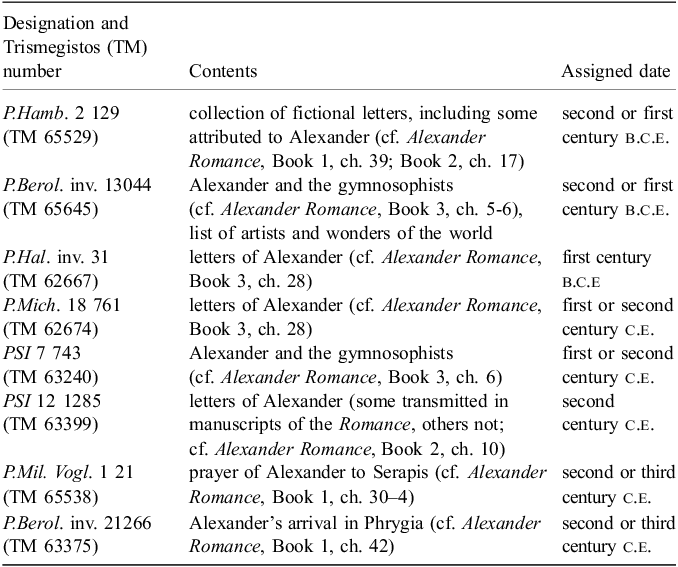
The instability of the text of the Alexander Romance also complicates comparison with the other surviving papyrus manuscripts related to this text. The compilation/composition of the Alexander Romance is usually assigned to the third century c.e., but related textual material survives from much earlier dates.Footnote 33 A search in the Leuven Database of Ancient Books for ‘work = Historia Alexandri Magni’ yields nine results.Footnote 34 One of these is a writing exercise on an ostracon.Footnote 35 The other eight preserve what appear to be continuous Greek texts containing what might best be called ‘Alexander literature’. All of these items are papyrus rolls in various states of disrepair. These eight papyri are listed in Table 1.
Papyri from Egypt containing ‘Alexander literature’

Table 1: Long description
Table with eight rows and three columns. Column headers are Designation and Trismegistos (TM) number, Contents, and Assigned date. Row 1: Designation and Trismegistos (TM) number: P.Hamb. 2 129 (TM 65529); Contents: collection of fictional letters, including some attributed to Alexander (cf. Alexander Romance, Book 1, ch. 39; Book 2, ch. 17); Assigned date: second or first century B.C.E. Row 2: Designation and Trismegistos (TM) number: P.Berol. inv. 13044 (TM 65645); Contents: Alexander and the gymnosophists (cf. Alexander Romance, Book 3, ch. 5-6, list of artists and wonders of the world); Assigned date: second or first century B.C.E. Row 3: Designation and Trismegistos (TM) number: P.Hal. inv. 31 (TM 62667); Contents: letters of Alexander (cf. Alexander Romance, Book 3, ch. 28); Assigned date: first century B.C.E. Row 4: Designation and Trismegistos (TM) number: P.Mich. 18 761 (TM 62674); Contents: letters of Alexander (cf. Alexander Romance, Book 3, ch. 28); Assigned date: first or second century C.E. Row 5: Designation and Trismegistos (TM) number: PSI 7 743 (TM 63240); Contents: Alexander and the gymnosophists (cf. Alexander Romance, Book 3, ch. 6); Assigned date: first or second century C.E. Row 6: Designation and Trismegistos (TM) number: PSI 12 1285 (TM 63399); Contents: letters of Alexander (some transmitted in manuscripts of the Romance, others not; cf. Alexander Romance, Book 2, ch. 10); Assigned date: second century C.E. Row 7: Designation and Trismegistos (TM) number: P.Mil. Vogl. 1 21 (TM 65538); Contents: prayer of Alexander to Serapis (cf. Alexander Romance, Book 1, ch. 30-4); Assigned date: second or third century C.E. Row 8: Designation and Trismegistos (TM) number: P.Berol. inv. 21266 (TM 63375); Contents: Alexander’s arrival in Phrygia (cf. Alexander Romance, Book 1, ch. 42); Assigned date: second or third century C.E.
All but one of these papyri are typically regarded as precursors to, and perhaps source material for, the composition of the Alexander Romance.Footnote 36 The single piece that is now thought to be part of a continuous text of a version of the Romance proper is P.Berol. inv. 21266. This strip from a papyrus roll contains a form of Book 1, chapter 42 and is usually assigned to the second or third century c.e. The Greek text of the α recension is unfortunately lost at this point in the narrative, but the text of P.Berol. inv. 21266 shows only partial agreement with that of the β recension. It does, however, seem to be very closely related to the Armenian version.Footnote 37 The situation with the other papyri is similar, at least at the points at which they significantly overlap with the medieval recensions of the Alexander Romance; the overlapping texts are close enough to be recognizable as versions of the ‘same’ passages, without showing exclusive agreement with any of the recensions.Footnote 38
In terms of materiality, these papyrus rolls vary in quality of production. P.Hal. inv. 31 is a small fragment (ca. 6 cm high and 4 cm wide) damaged on all sides, but it likely came from a quality papyrus roll (its script was properly described by its editor as a ‘sorgfältige Buchschrift’).Footnote 39 P.Berol. inv. 13044 is written in a rough-and-ready hand that is competent but not formal. P.Berol. inv. 21266, P.Mich. 18 761 and PSI 12 1285 are written in legible, though not elegant, scripts, and they were inscribed on the back sides of previously used papyrus rolls (the ‘Alexander’ texts are written against the fibres rather than along them). This suggests that these pieces were not productions of the highest quality. P.Hamb. 2 129 and P.Mil. Vogl. 1 21 are written in good clear scripts but on somewhat ‘short’ rolls, only about 15–17 cm high (as opposed to a more typical height of about 30 cm).Footnote 40 PSI 7 743 presents a special case. These fragments of a papyrus roll preserve a generous upper margin, and the script is a well-executed Latin capital (resembling the ‘rustic capital’) that spells out a Greek text of Alexander’s dialogue with the gymnosophists. We perhaps have here an exercise for a Latin speaker learning Greek.
The primary material difference between these pieces and the Antinoopolis papyrus is of course the format. The charioteers papyrus represents the first papyrus codex of the Alexander Romance to come to light. The Antinoopolis papyrus is also considerably later than any of the other Alexander papyri and represents a different literary setting. It can be challenging to compare material features across time and formats, but it is safe to say that none of the papyrus roll copies of Alexander literature approach the production value of the Antinoopolis charioteers codex. With its rich illustration, wide margin, and highly formal script, it stands in a class by itself among these papyri.
CONCLUSIONS
Until now, the earliest known illustrated manuscript of the Alexander Romance in Greek was Oxford, Bodleian Barocci 17, a codex of the thirteenth century with a modest and incomplete set of illustrations. If it is correct that the Antinoopolis papyrus was produced in the sixth century, then we have pushed back the evidence for a Greek illustrated edition of the Romance by seven centuries and recovered a small portion of the late antique image cycle of the Alexander Romance.
The identification of the papyrus also places what must have been a fairly luxurious illustrated edition of the Romance in Antinoopolis in the sixth century, which adds a dimension to the literary milieu of the city in that period.Footnote 41 In the larger late antique Egyptian context, it confirms the continued presence of the Greek Alexander Romance in the period when the Coptic tradition of Alexander literature may have been in formation.Footnote 42 In terms of book history, the Antinoopolis papyrus now provides evidence for an illustrated papyrus codex that rivalled the finest illustrated parchment codices in page-size and production value.
As noted at the outset, I have not made a systematic survey of the illustrated ‘Alexander’ manuscripts to find a parallel for the image of the standing charioteers. This is obviously a primary desideratum. A second would be a careful review of the proposed text of the papyrus by those with greater expertise in the complicated textual history of the Alexander Romance, especially those who can assess the text and paratexts of the Armenian manuscripts and who may be able to improve the reconstructions proposed here. I look forward to seeing what others are now able to tease out of this tantalizing papyrus fragment.