Introduction
Half of all patients suffering from major depressive disorder (MDD) relapse within 2 years after recovery (Kanai et al., Reference Kanai, Takeuchi, Furukawa, Yoshimura, Imaizumi, Kitamura and Takahashi2003) and about 80% of patients in remission experience at least one recurrence in their lifetime (Vos et al., Reference Vos, Haby, Barendregt, Kruijshaar, Corry and Andrews2004). Rates of relapse increase with every subsequent episode (Ferrari et al., Reference Ferrari, Charlson, Norman, Patten, Freedman, Murray and Whiteford2013; Keller & Boland, Reference Keller and Boland1998), the time remaining in recovery decreases (Solomon et al., Reference Solomon, Keller, Leon, Mueller, Lavori, Shea and Endicott2000) and the likelihood of recovery diminishes with longer durations of previous episodes (de Carlo, Calati, & Serretti, Reference de Carlo, Calati and Serretti2016; Otte et al., Reference Otte, Gold, Penninx, Pariante, Etkin, Fava and Schatzberg2016; Spijker et al., Reference Spijker, de Graaf, Bijl, Beekman, Ormel and Nolen2004). Therefore, understanding the pathophysiology of course of illness is of utmost clinical importance.
Current models of recurrence focus on risk factors associated with a less favorable course. These include demographic variables (e.g. gender and socioeconomic status) (Burcusa & Iacono, Reference Burcusa and Iacono2007) and clinical characteristics (higher symptom severity and longer duration especially of the first episode, psychiatric comorbidities, etc.) (Kraus, Kadriu, Lanzenberger, Jr., Carlos, Jr., & Kasper, Reference Kraus, Kadriu, Lanzenberger, Carlos and Kasper2019; Penninx et al., Reference Penninx, Nolen, Lamers, Zitman, Smit, Spinhoven and Beekman2011). Also, psychological factors such as the level of psychosocial functioning or stressful life events are associated with recurrent MDD (Burcusa & Iacono, Reference Burcusa and Iacono2007; Hovens et al., Reference Hovens, Giltay, Wiersma, Spinhoven, Penninx and Zitman2012; Penninx et al., Reference Penninx, Nolen, Lamers, Zitman, Smit, Spinhoven and Beekman2011). ‘Scar theories’ try to explain the increased rates of relapse in the course of MDD (Burcusa & Iacono, Reference Burcusa and Iacono2007). They postulate that depression itself increases the vulnerability to become depressed again, for example as sensitivity to future stressful life events increases (Post, Leverich, Xing, & Weiss, Reference Post, Leverich, Xing and Weiss2001). At a biological level, this could be translated to an elevated hypothalamic–pituitary adrenal (HPA) axis (Oberlander et al., Reference Oberlander, Weinberg, Papsdorf, Grunau, Misri and Devlin2008; Targum, Reference Targum1984; Varghese & Brown, Reference Varghese and Brown2001) that becomes increasingly dysregulated in the course of MDD (McEwen, Reference McEwen2003; Zaremba et al., Reference Zaremba, Dohm, Redlich, Grotegerd, Strojny, Meinert and Dannlowski2018a, Reference Zaremba, Enneking, Meinert, Förster, Bürger, Dohm and Dannlowski2018b). As a consequence, increased glucocorticoid secretion might potentially reduce myelination (Jauregui-Huerta et al., Reference Jauregui-Huerta, Ruvalcaba-Delgadillo, Gonzalez-Castañeda, Garcia-Estrada, Gonzalez-Perez and Luquin2010), inhibit a brain-derived neurotrophic factor important for the formation of neural connections and dendritic branching (Campbell & MacQueen, Reference Campbell and MacQueen2004), and thus, affect fiber microstructure. A non-invasive technique to measure fiber structure is diffusion tensor imaging (DTI). DTI quantifies water diffusion to reflect myelination, axon density, axon diameter, and number of fibers (Le Bihan, Reference Le Bihan2003; Winston, Reference Winston2012). Its interpretation is limited, as DTI estimations are also influenced by fiber crossings and general fiber orientation in healthy fiber structure (Jones, Knösche, & Turner, Reference Jones, Knösche and Turner2013). Nonetheless, reduced fiber integrity in MDD patients compared to healthy controls has already been meta-analytically confirmed (Wise et al., Reference Wise, Radua, Nortje, Cleare, Young and Arnone2016).
In DTI studies, results investigating course of illness are contradictory (de Diego-Adeliño et al., Reference de Diego-Adeliño, Pires, Gómez-Ansón, Serra-Blasco, Vives-Gilabert, Puigdemont and Portella2014) found a negative association of frontal white matter integrity and course of illness using the duration of illness and number of previous episodes. Similarly, Abe et al. (Reference Abe, Yamasue, Kasai, Yamada, Aoki, Inoue and Ohtomo2010) found a trend of a negative association with total days depressed in the anterior cingulate cortex and the left frontal white matter. Other studies failed to find any association between white matter and course of illness using illness duration and number of depressive episodes (Guo et al., Reference Guo, Liu, Chen, Xu, Wu, Ma and Zhao2012a; Li et al., Reference Li, Ma, Li, Tan, Liu, Gong and Xu2007).
A meta-analysis by Murphy and Frodl (Reference Murphy and Frodl2011) illustrated that course of illness measured with the mean illness duration per study was associated with reduced fiber integrity in the superior longitudinal fasciculus (SLF). They were, however, unable to disentangle the effects of course of illness from the effects of acute symptomatology, as they overlapped anatomically. As residual symptoms are common and persistent after severe episodes (Kennedy, Abbott, & Paykel, Reference Kennedy, Abbott and Paykel2004) and are a risk factor for relapse (Burcusa & Iacono, Reference Burcusa and Iacono2007; Paykel, Reference Paykel2008), it is possible that the course of illness is a confounder driving the significant effect of acute symptomatology or vice versa. However, for a potential theory of the neurobiological underpinnings of MDD, it is important to distinguish state (e.g. acute symptomatology) from prolonged (e.g. course of illness) effects. The former, on the one hand, would indicate present psychopathological processes which might for example be used to guide treatment evaluations. The latter, on the other hand, could help to understand the devastating effects of MDD chronicity and might help to identify patients with higher need for more intensive care.
Thus, to separate course of illness from acute symptomatology, two facets of the latter will be differentiated: first, the categorical distinction of patients suffering from an acute depressive episode compared to remitted MDD (disease state, acute v. remitted MDD) and second, the self-reported continuum of the number and severity of depressive symptoms (symptom severity). On the one hand, disease state was associated with decreased fiber integrity in the ventromedial prefrontal region in treatment-resistant MDD compared with remitted recurrent MDD (de Diego-Adeliño et al., Reference de Diego-Adeliño, Pires, Gómez-Ansón, Serra-Blasco, Vives-Gilabert, Puigdemont and Portella2014), whereas no distinction of patients with an acute MDD episode compared with remitted MDD patients was found in other studies (Bae et al., Reference Bae, MacFall, Krishnan, Payne, Steffens and Taylor2006; Harada et al., Reference Harada, Ikuta, Nakashima, Watanuki, Hirotsu, Matsubara and Matsuo2018). Symptom severity in MDD patients, on the other hand, has been linked to reduced fiber integrity in the SLF, the corticospinal tract, the uncinate fasciculus and frontal brain regions in general (Bergamino, Kuplicki, Victor, Cha, & Paulus, Reference Bergamino, Kuplicki, Victor, Cha and Paulus2017; Dalby et al., Reference Dalby, Frandsen, Chakravarty, Ahdidan, Sørensen, Rosenberg and Ostergaard2010; de Diego-Adeliño et al., Reference de Diego-Adeliño, Pires, Gómez-Ansón, Serra-Blasco, Vives-Gilabert, Puigdemont and Portella2014; Nobuhara et al., Reference Nobuhara, Okugawa, Sugimoto, Minami, Tamagaki, Takase and Kinoshita2006; Repple et al., Reference Repple, Mauritz, Meinert, de Lange, Grotegerd, Opel and van den Heuvel2020). Yet again, other studies found no association (Abe et al., Reference Abe, Yamasue, Kasai, Yamada, Aoki, Inoue and Ohtomo2010; Bae et al., Reference Bae, MacFall, Krishnan, Payne, Steffens and Taylor2006; Guo et al., Reference Guo, Liu, Chen, Xu, Wu, Ma and Zhao2012a, Reference Guo, Liu, Xue, Gao, Wu, Ma and Zhao2012b; Jia et al., Reference Jia, Huang, Wu, Zhang, Lui, Zhang and Gong2010; Li et al., Reference Li, Ma, Li, Tan, Liu, Gong and Xu2007).
The contradictory results concerning the systematic association between course of illness, disease state, and symptom severity in MDD patients and white matter microstructure could in part be due to small and heterogeneous samples (Burcusa & Iacono, Reference Burcusa and Iacono2007). Furthermore, the methods used to quantify these three factors differ considerably. Zaremba et al., (Reference Zaremba, Enneking, Meinert, Förster, Bürger, Dohm and Dannlowski2018b) demonstrated reduced hippocampal gray matter volume in patients suffering from MDD using the duration and number of hospitalizations, whereas no association was found with the duration and frequency of depressive episodes. These results highlight that different operationalizations of the same construct can lead to divergent results. Patients might be able to specify hospitalizations more reliably, as they constitute a decisive event in their everyday life. In addition, hospitalizations can be verified using medical records. The number of depressive episodes, on the other hand, are a less clear cut construct for patients and can be prone to autobiographical memory biases (Williams et al., Reference Williams, Barnhofer, Crane, Herman, Raes, Watkins and Dalgleish2007).
Understanding the biological basis of white matter fiber structure alterations in depressed patients is a prerequisite to improve clinical care. The aim of this study was, thus, to replicate the meta-analytical results of Murphy and Frodl (Reference Murphy and Frodl2011) and to distinguish acute symptomatology (disease state and symptom severity) and course of illness. This distinction between state (acute symptomatology) and prolonged (course of illness) effects is important, to further the understanding of the neurobiological underpinnings of MDD. To this end, three concepts were analyzed: (1) disease state, defined as the presence of clinically relevant depressive symptoms in acute MDD patients in comparison with remitted MDD patients; (2) current symptom severity, defined as the dimensional measurement of depressive symptom severity (BDI-scores); and (3) course of illness, defined as the number of hospitalizations in the past. We expect that all three concepts should be associated with reduced fiber integrity in the SLF replicating meta-analytical results (Murphy & Frodl, Reference Murphy and Frodl2011). Furthermore, the effects of disease state and symptom severity are analyzed in conjunction with the number of hospitalizations to distinguish their respective effects.
Materials and methods
Participants
A total of 531 participants were selected from the FOR2107-cohort (see online Supplementary S1) for this cross-sectional study (Kircher et al., Reference Kircher, Wöhr, Nenadic, Schwarting, Schratt, Alferink and Dannlowski2019; Vogelbacher et al., Reference Vogelbacher, Möbius, Sommer, Schuster, Dannlowski, Kircher and Bopp2018); N = 250 currently depressed patients (N = 149 female, M age = 37.28, s.d.age = 13.24) compared with N = 281 remitted depressed patients (N = 141 in partial remission, N = 140 in complete remission; N = 189 female; M age = 36.57, s.d.age = 13.41). Data were collected at two scanning sites (Marburg and Münster). As the body-coil had to be exchanged in Marburg mid recruitment, three different scanner settings had to be addressed in all analyses (Marburg pre body-coil, Marburg post body-coil and Münster).
The Structural Clinical Interview for DSM-IV-TR (SCID-I) (Wittchen, Wunderlich, Gruschwitz, & Zaudig, Reference Wittchen, Wunderlich, Gruschwitz and Zaudig1997) was used by trained personnel to verify clinical diagnoses. Exclusion criteria comprised age below 18 or above 65 years, history of substance dependence, bipolar disorder, schizophrenia, schizoaffective disorder, neurological abnormalities, history of seizures, longer periods of unconsciousness or severe head trauma, severe physical impairment, claustrophobia, color blindness, and general magnetic resonance imaging (MRI) contradictions. To measure medication intake, the Medication Load Index (Redlich et al., Reference Redlich, Dohm, Grotegerd, Opel, Zwitserlood, Heindel and Dannlowski2015) was used. The Medication Load Index is a composite measure reflecting dose and number of prescriptions irrespective of active components. The sum of all psychopharmacological medication per patient was calculated with dosage categories of absent (= 0), low (= 1, a dosage equal or lower than average), or high (= 2, a dosage greater than average) relative to the midpoint of the daily dose range recommended by Physician's-Desk-Reference (2017). Patients were asked to report the number of previous hospitalizations. All patients underwent inpatient treatment predominantly for a severe depressive episode. To assess current depressive symptoms the Beck Depression Inventory (BDI) (Beck, Ward, Mendelson, Mock, & Erbaugh, Reference Beck, Ward, Mendelson, Mock and Erbaugh1961) was used. Socioeconomic status was operationalized as the monthly income per household.
The authors assert that all procedures contributing to this work comply with the ethical standards of the relevant national and institutional committees on human experimentation and with the Helsinki Declaration of 1975, as revised in 2008. All procedures involving human patients were approved by the ethics committees of the Medical Faculties of the Universities of Münster (2014-422-b-S) and Marburg (AZ: 07/14). All experiments were performed in accordance with the ethical guidelines and regulations. Written informed consent was obtained from all participants prior to examination. They received financial compensation (50€) for participation after the testing session.
DTI data acquisition
The following methods were already described in greater detail in previous analyses (Meinert et al., Reference Meinert, Repple, Nenadic, Krug, Jansen, Grotegerd and Dannlowskiaccepted). Data were acquired using a 3T whole body MRI scanner (Marburg: Tim Trio, Siemens, Erlangen, Germany; Münster: Prisma, Siemens, Erlangen, Germany) using a GRAPPA acceleration factor of 2. Fifty-six axial slices, 2.5 mm with no gap, were measured with an isotropic voxel size of 2.5 × 2.5 × 2.5 mm3 (TE = 90 ms, TR = 7300 ms). Five non-diffusion-weighted (DW) images (b 0 = 0) and 60 DW images with a b-value of 1000 s/mm2 were measured. To ensure data quality open-source software DTIPrep (Oguz et al., Reference Oguz, Farzinfar, Matsui, Budin, Liu, Gerig and Styner2014) was used with default options correcting for slice-wise and gradient-wise inconsistencies plus eddy-current, head motion, bed vibration, and pulsation or venetian blind artifacts. DW images affected by artifacts were excluded with more than 20% of excluded images resulting in the complete drop-out of that participant before matching. The included participants had 64.27 images on average (s.d. = 1.42, range: [54–65]).
Image processing
FSL5.0.10 (FMRIB Image Analysis Group, Oxford, UK, http://fsl.fmrib.ox.ac.uk/fsl/fslwiki/) (Jenkinson, Beckmann, Behrens, Woolrich, & Smith, Reference Jenkinson, Beckmann, Behrens, Woolrich and Smith2012; Smith et al., Reference Smith, Jenkinson, Woolrich, Beckmann, Behrens, Johansen-Berg and Matthews2004; Woolrich et al., Reference Woolrich, Jbabdi, Patenaude, Chappell, Makni, Behrens and Smith2009) was used for preprocessing and analysis. The DW images were corrected for eddy and motion artifacts using FSL's ‘eddy’ (Andersson & Sotiropoulos, Reference Andersson and Sotiropoulos2016), with b-vectors being rotated after eddy correction. As reference for alignment, the first b 0 image was used after automated skull stripping with the Brain Extraction Tool (Smith, Reference Smith2002) in FSL. For diffusion tensor estimation the ‘DTIFIT’ within FMIRB's Diffusion Toolbox (FDT) (Behrens et al., Reference Behrens, Woolrich, Jenkinson, Johansen-Berg, Nunes, Clare and Smith2003) was used to generate tensor-derived maps, resulting in an estimation of fractional anisotropy (FA), mean diffusivity (MD), radial diffusivity (RD), and axial diffusivity (AD) for each voxel per participant. FA is defined as the normalized variance of the three eigenvalues about their mean. FA quantifies directional diffusion, ranging between 0 and 1, reflecting isotropic and anisotropic diffusion, respectively. AD reflects diffusivity along the primary diffusion direction, which should represent tract orientation and RD perpendicular to the tract. MD is calculated as the average of all three dimensions. In general, increased MD and decreased FA can hint at neuronal injury, increased AD was associated with damage to the axon, and increased RD with demyelination (Feldman, Yeatman, Lee, Barde, & Gaman-Bean, Reference Feldman, Yeatman, Lee, Barde and Gaman-Bean2010). However, any interpretation has to be drawn with caution, as the number of fibers, fiber crossings, and general fiber orientation can also influence diffusion metrics in healthy fiber structure (Jones et al., Reference Jones, Knösche and Turner2013).
Analysis
Analyses on demographic data were conducted using IBM SPSS Statistics 25 (SPSS Inc., Chicago, IL, USA). Tract-based spatial statistics (TBSS) (Smith et al., Reference Smith, Jenkinson, Johansen-Berg, Rueckert, Nichols, Mackay and Behrens2006) was used to reduce partial volume effects and registration misalignments. First, FA images were aligned to the FMRIB58_FA template [1 × 1 × 1 mm3 Montreal Neurological Institute (MNI) standard space] using FMRIB's non-linear image registration tool. Second, the mean of all aligned FA images was skeletonized with a threshold of 0.2. Third, the mean FA skeleton was filled with the maximum weighted for distance FA values orthogonal to the skeleton from each participant's aligned FA image. The same registration steps were used on MD, AD, and RD maps. Voxel-wise statistical analyses were performed in skeleton space, correcting for multiple comparisons with a threshold-free cluster enhancement (TFCE) (Smith & Nichols, Reference Smith and Nichols2009) approach using the non-parametric permutation testing implemented in FDT's ‘randomise’ (Nichols & Holmes, Reference Nichols and Holmes2002) (5000 permutations) with default values provided by –T2 option optimized for TBSS. The null distribution of permutated input data of the maximum TFCE scores was used to determine significance, correcting for the family-wise error (FWE) at p < 0.05. In case of significant results peak voxel MNI coordinates and cluster sizes were retrieved with the ‘cluster’ tool implemented in FSL and tract labels were extracted with FSL's ‘atlasquery’ using the ‘JHU White-Matter Tractography Atlas’ (Hua et al., Reference Hua, Zhang, Wakana, Jiang, Li, Reich and Mori2008; Mori, Wakana, van Zijl, & Nagae-Poetscher, Reference Mori, Wakana, van Zijl and Nagae-Poetscher2005; Wakana et al., Reference Wakana, Caprihan, Panzenboeck, Fallon, Perry, Gollub and Mori2007). FSL's ‘fslstats’ was used to extract mean diffusion metric values of significant clusters. The total intracranial volume (TIV) was extracted from T1 images using the Computational Anatomy Toolbox (CAT-12, http://www.neuro.uni-jena.de/cat, v933). For the T1 sequence see Vogelbacher et al. (Reference Vogelbacher, Möbius, Sommer, Schuster, Dannlowski, Kircher and Bopp2018).
To correct for scanner differences two dummy coded variables (Marburg pre body-coil: yes v. no, Marburg post body-coil: yes v. no) with Münster as reference category were defined. The influence of disease state (acute MDD v. remitted MDD), BDI-values and number of hospitalizations were analyzed in separate analysis of covariances (ANCOVAs), with FA, AD, RD, and MD as dependent variables and age, sex, TIV, Marburg pre body-coil and Marburg post body-coil as nuisance variables. Furthermore, either disease state or symptom severity were analyzed simultaneously with number of hospitalizations to estimate the main effect of disease state/BDI-score, the main effect of number of hospitalizations and their interaction corrected for age, sex, TIV, Marburg pre body-coil, and Marburg post body-coil. The interactions of symptom severity and the number of hospitalizations were included, as additive and interactive effects, e.g. current psychopathological process being intensified in chronic patients, could not be ruled out a priori due to the lack of similar analyses in the literature.
In case of significant results, mean FA, AD, RD, and MD values per participant from the significant cluster were extracted. The same ANCOVA as mentioned above was repeated with additional variables for medication intake (Medication Load Index), socioeconomic status (monthly income), month since first psychiatric treatment, and presence of comorbid diagnosis (yes v. no) in SPSS to correct for their respective influence. For these analyses 23 participants had to excluded, as they did not complete all the necessary questionnaires.
As the number of hospitalizations were skewed, Cook's distance of the regression of disease state/BDI-score, number of hospitalizations, their interaction and age, sex, TIV, Marburg pre body-coil, and Marburg post body-coil on mean extracted FA, AD, RD, and MD values were calculated in SPSS. Influential data points that could exert strong leverage on the regression slope (extreme values in Cooks' distance) were excluded to check whether the regression in SPSS is robust to outliers.
Results
Descriptive statistics
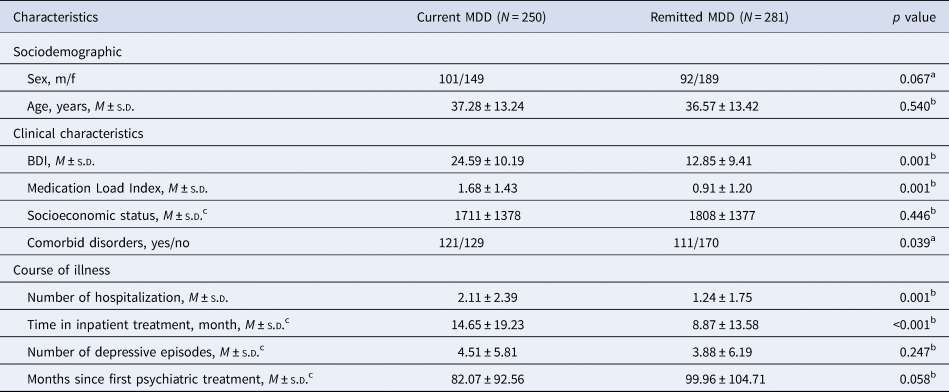
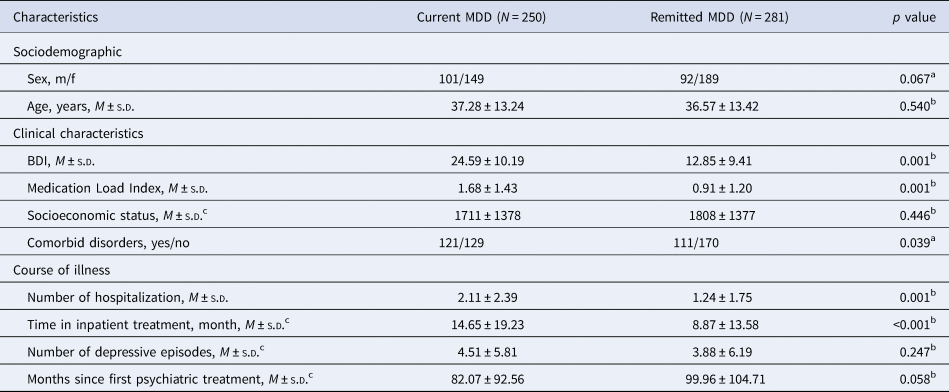
Acutely depressed patients had more prior hospitalizations compared with remitted depressed patients (t (529) = 4.82, p < 0.001; Table 1). Furthermore, a significant positive correlation between higher BDI scores and a higher number of hospitalizations was found (r = 0.198, p < 0.001).
Demographic and clinical characteristics of the sample
BDI, Beck Depression Inventory; f, female; m, male; M, mean; s.d., standard deviation.
Notes: aχ2 test, bt test, cnot all participants provided the necessary information, N min = 197 current MDD and N min = 231 remitted MDD.
Separate effects of disease state, symptom severity, and course of illness
Disease state
FA was lower although MD and RD were higher in acute MDD patients compared to remitted MDD patients (FA: p FWE = 0.031, total k = 5109 voxel in 11 clusters, peak voxel of largest cluster: x = 26, y = −40, z = 32; MD: p FWE = 0.042, total k = 3535 voxel in 3 clusters, peak voxel of largest cluster: x = 38, y = −46, z = 25; RD: p FWE = 0.027, total k = 5633 voxel in 10 clusters, peak voxel of largest cluster: x = 33, y = −40, z = 29; online Supplementary Table S1). Effects had the highest probability to be part of the bilateral SLF. No significant effects were found in AD (all p FWE > 0.226).
Symptom severity
No significant effects were found in FA, RD, AD, and MD with symptom severity (FA: p FWE = 0.218, RD: p FWE = 0.127, AD: p FWE = 0.109). However, a statistical trend was present in MD with higher values of BDI-scores being associated with higher MD values in the bilateral SLF (p FWE = 0.067).
Course of illness
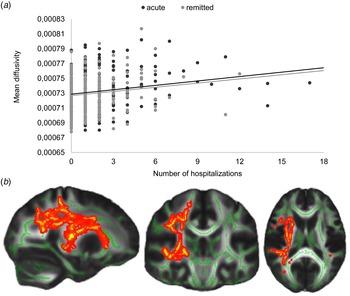
Lower FA and higher MD and RD were associated with more hospitalizations (FA: p FWE = 0.032, total k = 3874 voxel in 13 clusters, peak voxel of largest cluster: x = 37, y = 6, z = 22; MD: p FWE = 0.002, total k = 7876 voxel in 2 clusters, peak voxel of largest cluster: x = 40, y = −44, z = 23; RD: p FWE = 0.019, total k = 15 274 voxel in 17 clusters, peak voxel of largest cluster: x = 26, y = −29, z = 42; online Supplementary Table S1, Fig. 1). Again, effects had the highest probability to be part of the bilateral SLF. No significant effects were found in AD (p FWE = 0.094). This association could also be found using a combination of different course of illness variables (online Supplementary S2).
The effect of number of hospitalizations. (a) Correlation between course number of hospitalizations and mean extracted MD values in acutely and remitted depressed patients. (b) Effect displayed on the FMRIB58 template, MNI coordinates of peak voxel: x = 26, y = −24, z = 15.

ANCOVA with disease state, course of illness, and their interaction
No significant effects were found in FA (all p FWE > 0.122) or AD (all p FWE > 0.080). In MD and RD neither a main effect of disease state (MD: p FWE = 0.194, RD: p FWE = 0.110) nor an interaction of disease state × number of hospitalizations (MD: p FWE = 0.387; RD: p FWE = 0.383) reached level of significance. However, the previously observed association of MD and RD with previous hospitalizations remained significant in this model (MD: p FWE = 0.029, k = 5262 voxels in 1 cluster, peak voxel: x = 38, y = −46, z = 23; RD: p FWE = 0.040, total k = 2244 voxels in 3 cluster, peak voxel of largest cluster: x = 25, y = −29, z = 42; online Supplementary Table S1). Effects were located in the right SLF with the highest probability. This relationship was robust to outliers (online Supplementary S3). The relationship between the mean extracted MD and RD voxels from the significant cluster and number of hospitalizations remained significant even after correcting for medication intake, socioeconomic status, month since first psychiatric treatment, and presence of comorbid diagnoses (online Supplementary Table S2).
ANCOVA with symptom severity, course of illness, and their interaction
No significant effects were found in AD (all p FWE > 0.131). In FA, MD, and RD, neither a main effect of BDI-scores (FA: p FWE = 0.369, MD: p FWE = 0.160, RD: p FWE = 0.210) nor an interaction of BDI-scores × number of hospitalizations (FA: p FWE = 0.547, MD: p FWE = 0.674, RD: p FWE = 0.827) were significant. However, again a negative association of FA and a positive association of MD and RD with a more prior hospitalizations was confirmed (FA: p FWE = 0.038, total k = 1331 voxels in 2 clusters, peak voxel of largest cluster x = 37, y = −5, z = 22; MD: p FWE = 0.024, k = 6718 voxels in 1 cluster, peak voxel of largest cluster: x = 39, y = −41, z = 24; RD: p FWE = 0.029, total k = 4393 voxels in 1 cluster, peak voxel of largest cluster: x = 26, y = −31, z = 41; online Supplementary Table S1), again with the highest probability to be located in the right SLF. This relationship was also robust to outliers (online Supplementary S4). The relationship between the mean extracted FA, MD, and RD voxels from the significant cluster and number of hospitalizations remained significant even after correcting for medication intake, socioeconomic status, month since first psychiatric treatment, and presence of comorbid diagnoses in SPSS (online Supplementary Table S3).
Discussion
The present cross-sectional study aimed to differentiate the effects of acute depression (disease state and BDI-score) from the influence of chronic disease burden (number of hospitalizations) on brain microstructural integrity in a large and well characterized sample of depressed patients.
More hospitalizations were associated with decreased fiber microstructure in the SLF. Similar results were found for disease state, whereas the association with the BDI-score only approached significance. The associations found between course of illness and acute symptomatology and SLF fiber structure, respectively, are in concordance with the meta-analysis by Murphy and Frodl (Reference Murphy and Frodl2011) and confirmed the number of hospitalizations as a reliable measure to approximate course of illness in MDD consistent with results from Zaremba et al. (Reference Zaremba, Enneking, Meinert, Förster, Bürger, Dohm and Dannlowski2018b).
Moreover, we were able to expand upon meta-analytical results and disentangle the effects of course of illness and acute symptomatology: when analyzing disease state or BDI-scores in conjunction with the number of hospitalizations, associations with fiber microstructure attributed to acute depression were nullified. In return, the positive relationship between more hospitalizations and decreased fiber microstructure the right SLF remained significant. Notably, the association between number of hospitalizations and diffusion metrics in the SLF does not seem to be explained by differences in medication intake, socioeconomic status, time since first psychiatric treatment, or the presence of comorbid diagnoses, and was robust to the exclusion of outliers.
These results could be explained at a biological level by prolonged periods of elevated stress reflected in more frequent hospitalizations. This could set off a cascade of endocrinological, epigenetic, and immunological changes resulting in an increasingly dysregulated HPA axis (Bao & Swaab, Reference Bao and Swaab2019) and neurobiological changes in SLF fiber microstructure. As the SLF is a late-maturating tract and associated with healthy aging (Madhavan, McQueeny, Howe, Shear, & Szaflarski, Reference Madhavan, McQueeny, Howe, Shear and Szaflarski2014), it might be more vulnerable to neurotoxic effects over the course of a lifespan.
The role of SLF fiber integrity in the psychopathology of MDD is unclear. One possible hypothesis comes from studies of healthy controls, in which SLF microstructure was associated with cognitive deficits (Kerchner et al., Reference Kerchner, Racine, Hale, Wilheim, Laluz, Miller and Kramer2012; Salami, Eriksson, Nilsson, & Nyberg, Reference Salami, Eriksson, Nilsson and Nyberg2012; Turken et al., Reference Turken, Whitfield-Gabrieli, Bammer, Baldo, Dronkers and Gabrieli2008). Interestingly, cognitive deficits in MDD persist after remission (Bora, Harrison, Yücel, & Pantelis, Reference Bora, Harrison, Yücel and Pantelis2013; Ormel, Oldehinkel, Nolen, & Vollebergh, Reference Ormel, Oldehinkel, Nolen and Vollebergh2004; Rock, Roiser, Riedel, & Blackwell, Reference Rock, Roiser, Riedel and Blackwell2014) and a worse course of illness is associated with increased cognitive deficits (Gorwood, Corruble, Falissard, & Goodwin, Reference Gorwood, Corruble, Falissard and Goodwin2008). Furthermore, cognitive functioning is one prominent risk factor for disadvantageous occupational and psychosocial functioning (Bora et al., Reference Bora, Harrison, Yücel and Pantelis2013; Evans, Iverson, Yatham, & Lam, Reference Evans, Iverson, Yatham and Lam2014) that might in turn increase the risk for a more detrimental course of illness. Future studies need to investigate the possible link between course of illness, SLF fiber integrity, and cognitive dysfunction, to confirm this hypothesis.
Yet, SLF integrity differences in MDD cannot be explained solely by course of illness: reduced DTI metrics in the SLF compared to healthy controls were demonstrated early in the course of MDD (Wu et al., Reference Wu, Tang, Xu, Kong, Sun, Wang and Liu2010) and even in first-episode MDD patients (Guo et al., Reference Guo, Liu, Xue, Gao, Wu, Ma and Zhao2012b). It is possible that risk factors such as childhood maltreatment experiences (Huang, Gundapuneedi, & Rao, Reference Huang, Gundapuneedi and Rao2012; Meinert et al., Reference Meinert, Repple, Nenadic, Krug, Jansen, Grotegerd and Dannlowski2019) or a genetic predisposition (Barbu et al., Reference Barbu, Zeng, Shen, Cox, Clarke, Gibson and Whalley2019; Tozzi et al., Reference Tozzi, Carballedo, Wetterling, McCarthy, O'Keane, Gill and Frodl2016) might result in changes in diffusion metrics in the SLF prior to the development of MDD. Interestingly, both childhood maltreatment (Cross, Fani, Powers, & Bradley, Reference Cross, Fani, Powers and Bradley2017; Tarullo & Gunnar, Reference Tarullo and Gunnar2006) and genetic predispositions (Bao & Swaab, Reference Bao and Swaab2019; Terenina et al., Reference Terenina, Cavigelli, Mormede, Zhao, Parks, Lu and Mulligan2019) were linked to HPA axis dysfunction. Thus, similar biological mechanisms – elevated stress and a dysregulated HPA axis resulting in endocrine, immunological, epigenetic, and neurobiological changes – could lead to SLF microstructural changes prior to the onset of MDD. Future studies should try to measure HPA axis dysfunction directly and link it to fiber structure to confirm this hypothesis.
Finally, the results of this study are cross-sectional and, thus, do not allow causal inference. To completely disentangle the effects of acute symptomatology and course of illness, future longitudinal studies are necessary. In small groups of MDD patients, longitudinal studies found either associations between fiber integrity changes over the follow-up period and depressive symptom changes (Bracht, Jones, Müller, Wiest, & Walther, Reference Bracht, Jones, Müller, Wiest and Walther2015; Doolin et al., Reference Doolin, Andrews, Carballedo, McCarthy, O'Hanlon, Tozzi and Frodl2019) or no association with course of illness or symptom severity, respectively (Repple et al., Reference Repple, Zaremba, Meinert, Grotegerd, Redlich, Förster and Dannlowski2019). The largest longitudinal study to date (N = 18 959) underscores the importance of the longitudinal illness burden (Shen et al., Reference Shen, Adams, Ritakari, Cox, McIntosh and Whalley2019): Although decreased white matter microstructure was linked to depressive symptoms, the strongest association was found for the longitudinal progression of depressive symptoms in fronto-temporal association fibers. Longitudinal studies that focus on reliable measures of course of illness (e.g. number of hospitalizations) are needed.
Limitations
A few limitations should be noted: first, in this study, symptom severity and the number of hospitalizations were correlated. It should be noted that this could be due to different recruiting strategies. Currently depressed patients were recruited in psychiatric hospitals on top of newspaper advertisements and outpatient settings. Thus, currently depressed patients had a higher chance to present with at least one if not more hospitalizations. This needs to be addressed in future studies that try to replicate the effects of a negative course of illness in an entirely outpatient setting. Nonetheless, this study includes a large, representative sample that approximates the broad spectrum of MDD.
Second, in contrast to the effects of disease state, the relationship between self-reported current symptom severity and fiber structure was not significant, though a trend was present in MD. Subjective ratings of psychopathology might be less reliable than diagnostic decisions from trained personnel. On the other hand, the lack of a strong association with symptom severity strengthens the notion that depressive symptoms are not the driving force associated with the microstructure of the SLF.
Third, we argue that the number of hospitalizations is the most reliable information provided by MDD patients to determine the course of illness. This information is, however, limited as only severely depressed patients (e.g. with loss of occupational functioning and suicidal ideation) undergo inpatient treatment in Germany. This could be confirmed in the structural clinical interview, as many patients reported severe episodes at one point in their life and it is mapped by an elevated BDI score (M current = 24.59, s.d.current = 10.19, Table 1) in the currently depressed sample. This point slightly limits the transferability of our results to less severe MDD patients and countries with different inpatient treatment practices.
Finally, although we correct current medication intake, previous medication and treatment history (e.g. psychotherapy and electroconvulsive therapy) could also affect the described association with course of illness. Future studies should assess these previous medication details in order to investigate this possible association in more detail.
Conclusion
Course of illness in MDD – but not acute symptomatology – is associated with decreased structural integrity of the SLF. The major strength of this study was the use of large, well characterized patient group that allowed disentangling acute from cumulative effects of MDD on fiber structure. These results highlight that the number of hospitalizations is a feasible measure to approximate clinical course of MDD. It remains unclear, to what extent fiber microstructural changes are reversible and whether they can be influenced by treatment. The SLF is, hence, an important target for future longitudinal analyses investigating MDD recurrence.
Supplementary material
The supplementary material for this article can be found at https://doi.org/10.1017/S0033291720002950
Acknowledgements
This work is part of the German multicenter consortium ‘Neurobiology of Affective Disorders. A translational perspective on brain structure and function’, funded by the German Research Foundation (Deutsche Forschungsgemeinschaft DFG; Forschungsgruppe/Research Unit FOR2107). Principal investigators (PIs) with respective areas of responsibility in the FOR2107 consortium are: Work Package WP1, FOR2107 cohort and brainimaging: Tilo Kircher (speaker FOR2107; DFG grant numbers KI 588/14-1, KI 588/14-2), Udo Dannlowski (co-speaker FOR2107; DA 1151/5-1, DA 1151/5-2), Axel Krug (KR 3822/5-1, KR 3822/7-2), Igor Nenadic (NE 2254/1-2), Carsten Konrad (KO 4291/3-1). WP2, animal phenotyping: Markus Wöhr (WO 1732/4-1, WO 1732/4-2), Rainer Schwarting (SCHW 559/14-1, SCHW 559/14-2). WP3, miRNA: Gerhard Schratt (SCHR 1136/3-1, 1136/3-2). WP4, immunology, mitochondriae: Judith Alferink (AL 1145/5-2), Carsten Culmsee (CU 43/9-1, CU 43/9-2), Holger Garn (GA 545/5-1, GA 545/7-2). WP5, genetics: Marcella Rietschel (RI 908/11-1, RI 908/11-2), Markus Nöthen (NO 246/10-1, NO 246/10-2), Stephanie Witt (WI 3439/3-1, WI 3439/3-2). WP6, multi-method data analytics: Andreas Jansen (JA 1890/7-1, JA 1890/7-2), Tim Hahn (HA 7070/2-2), Bertram Müller-Myhsok (MU1315/8-2), Astrid Dempfle (DE 1614/3-1, DE 1614/3-2). CP1, biobank: Petra Pfefferle (PF 784/1-1, PF 784/1-2), Harald Renz (RE 737/20-1, 737/20-2). CP2, administration. Tilo Kircher (KI 588/15-1, KI 588/17-1), Udo Dannlowski (DA 1151/6-1), Carsten Konrad (KO 4291/4-1).
Acknowledgements and members by Work Package 1: Henrike Bröhl, Bruno Dietsche, Rozbeh Elahi, Jennifer Engelen, Sabine Fischer, Jessica Heinen, Svenja Klingel, Felicitas Meier, Torsten Sauder, Annette Tittmar, Dilara Yüksel (Dept. of Psychiatry, Marburg University). Mechthild Wallnig, Rita Werner (Core-Facility Brainimaging, Marburg University). Carmen Schade-Brittinger, Maik Hahmann (Coordinating Centre for Clinical Trials, Marburg). Michael Putzke (Psychiatric Hospital, Friedberg). Rolf Speier, Lutz Lenhard (Psychiatric Hospital, Haina). Birgit Köhnlein (Psychiatric Practice, Marburg). Peter Wulf, Jürgen Kleebach, Achim Becker (Psychiatric Hospital Hephata, Schwalmstadt-Treysa). Ruth Bär (Care facility Bischoff, Neunkirchen). Matthias Müller, Michael Franz, Siegfried Scharmann, Anja Haag, Kristina Spenner, Ulrich Ohlenschläger (Psychiatric Hospital Vitos, Marburg). Matthias Müller, Michael Franz, Bernd Kundermann (Psychiatric Hospital Vitos, Gießen). Christian Bürger, Fanni Dzvonyar, Stella Fingas, Hannah Lemke, Kordula Vorspohl, Bettina Walden, Dario Zaremba (Dept. of Psychiatry, University of Münster). Harald Kugel, Jochen Bauer, Walter Heindel, Birgit Vahrenkamp (Dept. of Clinical Radiology, University of Münster). Gereon Heuft, Gudrun Schneider (Dept. of Psychosomatics and Psychotherapy, University of Münster). Thomas Reker (LWL-Hospital Münster). Gisela Bartling (IPP Münster). Ulrike Buhlmann (Dept. of Clinical Psychology, University of Münster).
We are deeply indebted to all participants of this study, the recruitment sites, and their staff.
Financial support
This work was supported by the German Research Foundation (Deutsche Forschungsgemeinschaft, DFG) (TK, grant numbers KI 588/14-1, KI 588/14-2, KI 588/15-1, KI 588/17-1), (UD, grant numbers DA 1151/5-1, DA 1151/5-2, DA 1151/6-1, SFB-TRR58, Projects C09 and Z02), (AK, grant numbers KR 3822/5-1, KR 3822/7-2), (IN, grant numbers NE 2254/1-2), (AJ, grant numbers JA 1890/7-1, JA 1890/7-2), (TH, grant number HA 7070/2-2); the Interdisciplinary Center for Clinical Research (IZKF) of the medical faculty of Münster (UD, grant number Dan3/012/17), (NO, grant number SEED 11/18); ‘Innovative Medizinische Forschung’ (IMF) of the medical faculty of Münster (RR, grant numbers RE111604, RE111722), (JR, grant number RE221707), (EJL, grant number LE121703), and the Deanery of the Medical Faculty of the University of Münster.
Conflict of interest
Tilo Kircher received unrestricted educational grants from Servier, Janssen, Recordati, Aristo, Otsuka, and neuraxpharm. This funding is not associated with the current work. On behalf of all other authors, the corresponding author states that there is no conflict of interest and nothing to disclose.