IntroductionFootnote §
‘Law needs to be understood as a set of techniques of spatial organization and governance – a body of spatial representations – and as a framework for an ensemble of everyday spatial practices.’ (Butler, Reference Butler2009, p. 322)
‘The market has invaded new spheres which were hitherto considered the privileged domain of the state … we are thus in the midst of a new process of the privatization of the social, of establishing new enclosures.’ (Žižek, Reference Žižek2009, p. 144)
Public spaces are of social and political importance, particularly in how they are the key locations ‘where dissent and affirmation become visible’ across a long period (Staeheli and Mitchell, Reference Staeheli and Mitchell2007, p. 1) and how they relate to general principles of democracy (Carr, Francis, Rivlin and Stoner, 1992, pp. 45–46). With this in mind, how public spaces are defined, recognised, limited or promoted by law is a question of some interest. However, care must be taken not to equate the broader sociopolitical importance of public spaces with a simple (albeit useful) categorisation of places, facilities or environments into boxes of public and private. This article considers a number of developments in the broad area of public spaces, suggesting links between ‘material’ and ‘virtual’ spaces, testing how spaces are defined and delimited (with ‘walls’ both material and virtual) and situating such in wider literatures of geography and of media and communications studies.
It is recognised that social sciences have undergone a ‘spatial turn’ and there is also some interest in the spatial dimension of law, in particular in the relationship between law and the city (e.g. Philippopoulos-Mihalopoulos, Reference Philippopoulos-Mihalopoulos2007) and law and geography (e.g. Holder and Harrison, Reference Holder and Harrison2003). The case for a holistic approach to social space and physical space by legal scholarship has been put (e.g. Benda-Beckmann, Benda-Beckmann and Griffiths, Reference Benda-Beckmann, Benda-Beckmann, Griffiths, von Benda-Beckmann, von Benda-Beckmann and Griffiths2009). The approach that informs much of this work, and relates to this article, is critical legal geography. In an article published in both a law journal (Blomley and Bakan, Reference Blomley and Bakan1992) and a geography journal (Bakan and Blomley, Reference Bakan and Blomley1992), the relationships between critical studies in law and in geography were set out almost twenty years ago. The key critique is that of the fixed, pre-political and objective claims for both law and space, with the role of space alongside time in legal studies being emphasised along with the need to combine law's critique of law and geography's critique of space. The approach has three tasks: to identify the implications of ‘frozen' legal and spatial representations, to demonstrate how they are socially constructed, and to analyse how these dominant approaches can be challenged in the interests of ‘progressive social change' (Blomley and Bakan, Reference Blomley and Bakan1992, p. 690). An example of this approach, it could be argued, is what Zick calls an ‘expressive topography’ (2009, p. 25) of outdoor speech, which explores some similar themes to those discussed here.
The influence of Henri Lefebvre in this debate should also be noted. Within geography, Mitchell takes both his key phrase and his intellectual framework from him in his text on The Right To The City (Mitchell, Reference Mitchell2003), and Zick's First Amendment-focused review of outdoor speech also draws inspiration from the same source (2009, pp. 10–12). More recently, there have been two contributions from Australian legal scholars regarding the more specific value of Lefebvre's analysis within law, moving the debate forward by a considerable degree. The first is Beattie's use of a theoretical framework including Lefebvre, Habermas and others in his study of media (including Internet) censorship under Australian law, Community, Space and Online Censorship (Beattie, Reference Beattie2009). The other approach is that of Butler, who pays particular attention to the close reading of Lefebvre as an important theoretical and methodological frame for the development of critical legal geography, as associated with Blomley, bringing together critical legal studies and critical geography (Butler, Reference Butler2009, p. 314). Harvey points out, though, that despite the assumptions of some interdisciplinary work, there is more to the understanding of space than Lefebvre's publications (Harvey, Reference Harvey and Harvey2006, pp. 130–31), and Borden suggested in his study of skateboarding that a Lefebvrian approach was more of a sensibility than a system (Borden, Reference Borden2001, pp. 9–11). Most recently Layard (Reference Layard2010) uses the work of Lefebvre and others to illustrate and explain a detailed case-study of the development of Cabot Circus in the city of Bristol. In this spirit, the reader should not expect this contribution to the growing literature on public spaces to duplicate the Lefebvrian analysis of others, but it is suggested that the choice of sources and the conclusions reached means that this article can explore similar territory to that considered by these scholars.
With this in mind, the reason for the joint consideration of material and virtual spaces should be explained. A starting point is Kohn's argument that while new shopping malls are ‘designed to recreate the atmosphere of old-fashioned downtowns’, the reality is that the activities that once ‘gave city centers their dynamism and variety’, such as political expression, are restricted (Reference Kohn2004, p. 2). This critique, as will be argued below, is supported by various judicial decisions in the US, the UK and elsewhere, but there are some problems with the remaining old-fashioned downtowns, too. It will be argued, however, that the promise of online communication is similarly situated. As more time is spent in front of a computer screen or using an increasingly ubiquitous portable device such as a mobile phone or PDA, the type of communication and activity that is possible in electronic communication must also be scrutinised. This must not be limited to listing material changes, but also considering the ‘socio-economic and socio-political changes’ associated with emerging ways of living, as Glasze argued in his analysis of private residential communities (2005, p. 222).
Just as the political campaigner may be concerned about the ability to reach an audience of shoppers inside private malls, such an individual will also wonder how the Facebook user sitting indoors can be contrasted with the person strolling down the pavement in terms of being the audience for a communication or a participant in a conversation. This is not to suggest that online communication displaces all real-world interaction – such would be a foolish and demonstrably inaccurate claim – but similarly, when wide claims are made as to the importance of the Internet in everyday life, there are some similarities between the two domains. The prevalence of private property in the urban landscape, and the classification of the overwhelming majority of Internet spaces as legally private, is thus cause for concern. The term ‘pseudo-public spaces’ is used here to emphasise the relatively clear lack of legal authority as compared with assumptions or good intentions, on the basis that a truly public space requires both geographical/cultural/media (as appropriate) and legal/regulatory understandings of ‘public’ to be present.
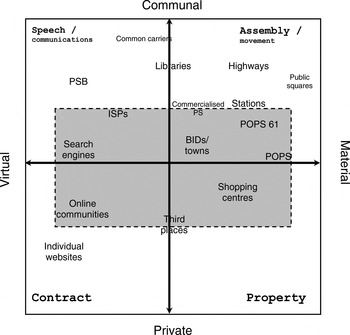
Figure 1 illustrates the indicative positioning of the matters under discussion, with pseudo-public spaces tentatively highlighted in the grey box. Rather than introducing such in terms of a public/private dichotomy, these spaces can contain elements of communal and private status or use, and are found in material and non-physical/virtual contexts (alternatively, tangible and intangible). Each of the four quadrants also relates to a dominant (but not exclusive) legal approach: freedom of assembly and movement, freedom of speech and communication, contract (and related use of IP licensing), and property (and related criminal and civil enforcement).
Illustration of communal/private and material/virtual spaces.

In Parts I and II, I explore selected issues in relation to public space and private alternatives or versions of such, mentioning publicly owned private spaces (in general, and a specific form introduced in New York in 1961 (abbreviated POPS 61)), shopping centres, town centres, ‘third places’, highways and finally commercialised public spaces. These explanations provide further detail on the relative positioning of each category on the diagram. While the subject of detailed treatment by architectural criticism in particular, a number of writers argue that the question of public and non-public space is neglected within legal scholarship. For example, Mead notes that civil liberties and ‘protest law’ discussions tend to omit or gloss over the location(s) of protest and assembly (2010, p. 167), while Zick notes that First Amendment scholars in the US appear to have ‘lost interest’ in what was a profound issue regarding outdoor speech in earlier decades (2009, p. xii). Although the position has now changed, according to some as a result of academic attention (Roberts, Reference Roberts2007, p. 235), Gray and Gray expressed some unease at how the influential decision in CIN Properties Footnote 1 attracted virtually no critical attention (1999a, p. 46).
The concept of public space itself is broad. One typology covers – including top-level headings only – public parks, squares and plazas, memorials, markets, streets, playgrounds, community open spaces, greenways, atrium, found spaces and waterfronts (Carr et al., Reference Carr, Francis, Rivlin and Stone1992, pp. 79–84). Others include baths and libraries alongside parks and squares (Bridge and Watson, Reference Bridge, Watson, Bridge and Watson2000, pp. 370–71), with the reference to libraries being an important dimension of the argument developed in Part III regarding the Internet. In this section, I develop the idea that the assumptions of Internet regulation can serve to concentrate power in private hands (as argued in Mac Síthigh, Reference Mac Síthigh2008) with particular reference to online communities based on social networking and user-generated content, but including the role played by Internet service providers and search engines.
I Private ownership of physical space
1.1 Shopping malls/centres
The key example of controversial pseudo-public space is a shopping centre. Such centres are important features in various locations, including city centres, out-of-town locations and indeed more rural areas. Within US law, they have served as a flashpoint of public–private tensions through the regulation of speech and the application of state action doctrine. Indeed, this mixed record shows a court system struggling with changing patterns of settlement and of consumption, but also hampered by the narrow approach taken by US constitutional law to the state and the applicability of constitutional rights outside their negative expression. Despite the assumption that the First Amendment is a powerful protection of free speech, it is also a protection that is, textually and in practice, a restriction on ‘Congress’ and on other agents of the state rather than a promotion of a free-standing value of the freedom of expression. However, other jurisdictions, including the UK, have also treated the matter as one of property law in the first instance, with the only response being an (unsuccessful) formulation of a positive obligation on the state to facilitate freedom of assembly and expression.
Some argue that a shopping centre is in fact a public space that is privately owned, as individuals are admitted without discrimination (Beauregard, Reference Beauregard, Sophie Body-Gendrot and Garbaye2008, p. 29). However, even with this suggestion in mind, it is more appropriate to treat this category separately since the space is more clearly enclosed than the open-space style in both types of POPS discussed below. The more sceptical refer to the mall as ‘private space masquerading as public space’ (Simon, Reference Simon2009, p. 68), referring to the ability of the owner or manager to exclude, as in the case of coffee shops through ‘selective enforcement’ of policies (Simon, Reference Simon2009, pp. 92–93). There is a necessity to take context into account; Mead's core contention is that there is a qualitative difference between the regulation of the back garden of an individual and spaces such as the car park of a polluting multinational corporation (2010, p. 130), suggesting distinctions based on size, relative size and (more persuasively) power, impact and former public ownership as the basis of a graduated approach. Ultimately, though, it is hard (even for advocates of the shopping-centre model, at least for the first clause) to disagree with Shaftoe's assessment that such spaces are ‘a kind of sanitized version of public space, without any of the rough edges or unpredictability that make true public space so vital and democratic’ (Reference Shaftoe2008, p. 77). Similarly, as shopping centres (and other similarly situated structures) become more important, the consequences of private decisions for free circulation of the entire population are important, even when apparently fearful or whimsical decisions like bans on particular clothing or headwear are in place.
It is appropriate to note at this early stage the established US legal principle found in Marsh v. Alabama,Footnote 2 although it will also be relied upon in later arguments pertaining to ‘town centres’. In Marsh, it was held that a town owned and managed by a corporation deserved particular treatment in the context of the application of criminal trespass legislation. The Supreme Court refused to allow a restriction on leafleting on these streets that resembled the more conventional non-private town to be enforced through this law. Despite the unquestioned private ownership of the land in question, Black J placed particular emphasis on the fact that citizens in company towns were the same, in the view of the law, as citizens more generally. The right to receive information was specifically highlighted, with it being argued that there was ‘no more reason … than … with respect to any other citizen’Footnote 3 to deprive residents of the town of receiving uncensored information, as protected by the First Amendment.
However, the trend since Marsh has been quite restrictive, despite initial approval and application of the case in the context of shopping centres, such as in Amalgamated Food Employees Union Local 590 v. Logan Valley Plaza,Footnote 4 which was (effectively) set aside by 1976.Footnote 5 In Lloyd v. Tanner,Footnote 6 for example, a restriction on leafleting in a private shopping centre was not found to raise First Amendment issues. The weaknesses of the First Amendment are also apparent here, with immediate differences opening up between individual states in how they protect public space (Freedman, Reference Freedman1988). This can be illustrated by reference to the Supreme Court's decision in Pruneyard v. Robins,Footnote 7 where, relying on the free speech provisions of the California constitutionFootnote 8 rather than the federal constitution, a broader concept of the right to use certain privately owned spaces was upheld. The differences between the constitutions are that while the text of the latter is directed, in the way of much of the Bill of Rights, to protecting citizens against the federal government, California's text (and the development of such by the courts over time) is instead focused on speech itself as well as on laws. In New Jersey, too, shopping centres can be considered as the ‘functional equivalents of business districts’.Footnote 9 This important decision (see Soley, Reference Soley2002, pp. 155–58) uses the same language as that of Logan Valley Plaza,Footnote 10 despite the subsequent fate of the latter before the Supreme Court. Finally, some state constitutions containing provisions for electoral petitions have also be used to support speech on private land in relation to such petitions, as in Oregon and Washington. Although those findings have been limited or abrogated in further proceedings (Soley, Reference Soley2002, p. 160), they provide some hope to the potential litigant in that there may be the opportunity to elude some of the limitations of the First Amendment regarding claims of this nature.
In the UK also, these matters have been litigated. The case that was the subject of the most detailed argument was the matter that reached the European Court of Human Rights as Appleby v. UK,Footnote 11 where the analysis focused on the question of a possible positive obligation on the UK to prevent the owner of a shopping centre from acting in a way that prevented political activity in the centre. The Court considered (but ultimately rejected) the notion of an emerging international consensus on this matter. The campaigners had alternative methods of communicating their message, and the property rights of the owners were also relevant (although for an alternative approach to property rights and limitations to such, see Rowbottom, Reference Rowbottom2005, pp. 199–201). An equally important case, though, is CIN Properties v. Rawlins,Footnote 12 which contained features that are increasingly present on a much wider scale, such as the long lease of a site from a local authority, the stopping up of highways, the use of recognisable forms such as ‘streets’ and ‘squares’, and the lack of an agreement for highway or ‘walkway’ status. The last of these is a particularly (and relatively rare) statutory concept found in the Highways Act 1980 and associated regulations. The Court of Appeal upheld the right of the owner of the shopping centre to exclude named individuals (unsurprisingly, ‘mostly unemployed youths, of whom the majority were black’; Gray and Gray, Reference Gray, Gray and McLean1999b), and the then European Commission on Human Rights (ECHR) found that the exclusion did not engage the right of assembly.Footnote 13 As Layard now argues, it is the very combination of features like stopping up, compulsory purchase and conditional planning permission that shape these emerging spaces (2010).
A slightly different question, although one not dealt with in the major discussions of this issue, is posed by the political activities of tenants within a centre. This may be a less frequent occurrence than that of the activities of visitors and shoppers, but – for those retailers that have an interest in political campaigning – it is a highly pertinent one. This was illustrated in 2008 by the Fair Trial campaign of Lush, which attracted the attention of centre owner Oracle in respect of posters highlighting the cases of Binyan Mohammed and Sami al-Haj (Stafford-Smith, Reference Stafford-Smith2008). Given the high profile of these cases, and the subsequent important decisions of the UK courts, the decision of Lush to highlight these cases, in conjunction with Reprieve, is perhaps vindicated. However, the legal agreements between Oracle and Lush prohibited displays that are, in the reasonable opinion of the former, of a ‘distasteful, offensive or political nature’. Indeed, while there may be other issues with a general good-taste requirement, the specific mention of political messages is undoubtedly a suggestion that the shopping centre remains hostile to political speech, even where the tenant has paid a significant fee to make use of the space and remains entitled to be provocative, controversial but above all commercial with little control by the landlord. Of course, while it is possible for a retailer (or anyone) to be the outright owner of a high-street store – and of course be subject to the limited control of legislation such as that relating to the control of indecent displays – this is not likely in the shopping centre where the lease (in its various guises) is essentially the only form of ownership.
1.2 Privately owned public space (POPS 61)
The former practice of the New York city planning system of categorising and encouraging privately owned public space is noted here and in the diagram above as POPS 61. This approach has been the subject of a detailed review (Kayden, Reference Kayden2000) and contains a number of relevant features. From 1961 onwards, applicants could, under the terms of a Zoning Resolution, include a proposed POPS as a method to achieve permission for higher buildings. By allowing a ‘bonus’ to the allowable floor area ratio (total floor area / site area) in respect of qualifying POPS, a developer could build a structure with more floors than would otherwise be permitted. It can be argued that there are some similarities between this approach (which is based on modern concepts of the state role, on behalf of the public, in legal control over planning and development) and that of the ground landlords in the West End of London, where public squares were provided as part of a sense of social responsibility related to civic humanism (Carré, Reference Carré, Body-Gendrot, Carré and Garbaye2008), although some of this development was also based on fortification and restriction (Minton, Reference Minton2009, pp. 19–20).
For present purposes, one of the most important requirements of the New York scheme was the requirement (albeit with some non-compliance) for an information board, naming the space as a public space and setting out the facilities, opening hours and other useful information (Kayden, Reference Kayden2000, pp. 17, 56). This meant that the quite prescriptive aspects of the scheme, including seating and trees (p. 27) would not just be present, but formally confirmed and promoted. This is potentially more powerful than the traditional elite-driven approach in London where the good faith of the private landlord is a key aspect of the success or failure of an attempt to promote the public interest through private development. In the present-day UK, there are of course statutory devices such as Section 106 of the Town and Country Planning Act 1990, but the focus here in practice is on expenditure (private contribution to the cost of public facilities in return for permission to undertake an otherwise unacceptable development), with the model agreement remaining extremely vague on categories such as the awkwardly headed ‘property / open space / play areas / public squares / amenity space’ and the separate concept of community facilities (Law Society, 2006). Furthermore, the suggestion that obligations under UK law in the case of features such as open space or rights of way are reasonable if it seeks ‘to restore facilities, resources and amenities to a quality equivalent to that existing before the development’ (Office of the Deputy Prime Minister, 2005, p. B16) is clearly a constraint.
Although the ownership of the spaces in New York remained clearly private, there was some attempt to moderate this in earlier stages through devices such as a reasonableness requirement in respect of the control of the space regarding political activities, photography and other uses (Kayden, Reference Kayden2000, p. 38). Yet, in many cases, developments of this nature can serve as indicators of status on the part of the developer or occupier, without the full range of uses that the planner might have expected (Carr et al., Reference Carr, Francis, Rivlin and Stone1992, p. 15). Indeed, the comprehensive analysis of these spaces by Kayden and colleagues does suggest that denial of access, annexation (particularly through ‘café creep’ or the setting out of tables and chairs for private-profit purposes) and the diminution of amenities through withdrawal or poor maintenance (2000, pp. 56–57) are present, serving as a reminder of the limitation of formal ex ante measures, particularly where ongoing enforcement is weak.
1.3 Privately owned public space (POPS 2)
A familiar feature in present-day urban Britain is the privately owned public space that adopts some of the forms of public space, through naming, location or design, but with little by way of formal designation or promotion as such. In the case of ‘The Scoop’ in London, a contrast is suggested between the use of the Greek agora style and the presence of control through interventionist security staff and inconsistent behaviour, particularly towards those whose presence is not welcomed by owners, such as youths wearing ‘hoodies’ as compared with other youths (Cummings, Reference Cummings2009, p. 47). Indeed, if there is any sign present, it is more likely to be expressed in a negative fashion. Examples include specific exclusions (no cycling, no busking), claims as to ownership (this space is owned by A), and statements regarding the absence of public rights of way. Private security guards play an important role in the regulation of these spaces. The particular issue with these spaces is that they create the impression of democratic participation while offering no guarantee as to the realisation of this goal. An alternative would be to consider the designation of spaces of this type as including elements of permitted access and conduct; this could be coupled with Mead's case for a ‘permanent minimum provision' of protest spaces or an access-based approach serving as a counterweight to the principle that absolute title to land means that protest is wholly at the discretion of the landowner (2010, pp. 119–20). Similarly, Zick wonders why the type of tax incentives and negotiated or mandated easements used in other areas of planning could not be used for the creation of expressive spaces (2009, pp. 175–78), although Roberts's suggestion of reading easements into the relevant dominant tenements would, as he admits, be of less immediate value in the case of expressive activity than simple access and movement (2007, p. 256).
1.4 Redeveloped city centres
The development of business improvement districts (BIDs) and urban regeneration projects of various types has highlighted the anxieties of various parties regarding the private control of public space (Kingsnorth, Reference Kingsnorth2009, pp. 171–81). Some of these are a legacy of the former Urban Development Corporations, etc. (Imrie and Thomas, Reference Imrie, Thomas, Imrie and Thomas1999), which were an important Thatcherite project, serving in one review as the ‘New Right’ version of the new towns associated with earlier social democratic agendas (Cochrane, Reference Cochrane, Imrie and Thomas1999, p. 252) and using the lack of procedural safeguards to develop without the type of consultation or negotiation found in conventional local authority activities (Minton, Reference Minton2009, pp. 10–11). Others simply rely on the powers to sell land of local authorities (including requisitioning using various statutory powers) and the separate ability to extinguish rights of way, or even to set up local schemes and make use of other legal instruments, including policing powers (Minton, Reference Minton2009, pp. 41–44). BIDs and private owners or managers of town centres are powerful political forces. Their role is influenced by ‘broken windows’ theories regarding crime reduction, but they will in turn campaign to pass more restrictive laws and regulations supporting commercial interests regarding undesirable conduct within their areas of influence (Duneier, Reference Duneier1999, pp. 231–39). They are linked to the discussion of shopping centres through the intention of designers to bring the best of the out-of-town shopping centre to the city centre. As an example, the developers of Liverpool One drew on the huge Bluewater centre as a model (Minton, Reference Minton2009, p. 17), and other projects such as that in Bristol (Layard, Reference Layard2010) have ambitious mission statements and far-reaching consequences for street use.
The concept of the business improvement district relies heavily on the notion of the gated community and the related concept of the highly managed condominium. Gated communities do resemble local authorities in some ways, but with very significant differences in areas such as certain rights to discriminate as to ownership of property, control over entry of visitors, and the direct regulation of the behaviour of residents (Nelson, Reference Nelson2005, pp. 11–13), and are now found to a much greater extent than before in the UK (Glasze, Reference Glasze2005, p. 222). As Low has observed, however, the first stage in a process that leads to true private management is ‘sealing off, redesigning and re-opening with intensive surveillance and policing’ (Reference Low, Low and Smith2006, p. 83). The same process does appear to be in place in some redeveloped city centres. Another feature of the literature on gated communities that can be explored in the case of BIDs and across many of the issues discussed in this article is the way that Kennedy (Reference Kennedy1995) repositions the legal analysis of such communities in terms of the (direct and indirect) impact on others (non-members or non-residents). Finally, the so-called ‘Tesco towns’, supermarket-led mixed-use developments where developers are able to make Section 106 commitments for a range of housing and other uses alongside a proposed supermarket (Minton, Reference Minton2010), represent another possible future for legally influenced urban development in the UK.
1.5 Third places
A dimension of further importance, where the physical and the virtual overlap and where commercial culture remains controversial, is the popular idea of the ‘third space’, the setting of informal public life beyond home and work discussed by Oldenberg in The Great Good Place (Reference Oldenberg1997). Argued to have a levelling effect and of particular political value in societies where freedom of association is restricted, third places such as coffee houses have been influential in the promotion of democratic participation, particularly in the pre-press era (1997, pp. 25, 66, 189). Despite the perception that Oldenberg is an uncritical supporter of ‘Starbucks culture’ (as summarised and debunked in Simon, Reference Simon2009, p. 102), Oldenberg is very critical not just of the focus on shopping and consumption that has been such a part of twentieth-century planning in the United States (Reference Oldenberg1997, pp. 203–209), but of the ‘total nonsense’ expressed by enthusiasts for the shopping mall and the argument that it is a recreation of the fabled Main Street. It is important how Oldenberg's argument includes a consideration of the role of physical space in democratic culture and the conflict between this culture and the commercial imperative that has been at the heart of purportedly community-based design. In a world where music in Starbucks is played through modified CD players that only play company-issued discs and local papers can often not be distributed (Simon, Reference Simon2009, p. 117, p. 155), the third place holds both promise and threat, a feature certainly shared with the online communities that we will discuss in a later section. Nevertheless, the concept itself is new and even more fluid than other types of structure or location, and is to some extent mediated by laws of general application (e.g. regarding discrimination in the provision of services), and therefore must surely be at the outer bounds of the pseudo-public space problem, if at all, at least at the present time.
II Public ownership of physical space
2.1 Squares, stations and highways
Having considered some situations where the primary mode of control is through the law of property, it is now appropriate to consider those spaces situated towards the top right of Figure 1, where control tends to be expressed in terms of the law on assembly and movement instead. The mere status of a given space as public land does not mean that it will be a guaranteed location for particular activities. Challenges to decisions of public authorities still needed to be brought under the system of judicial review, although since the enactment of the Human Rights Act 1998, it is clearly possible to use the Act (and Article 11 of the Convention) as the basis of a challenge to a decision to prohibit protest (Mead, Reference Mead2010, pp. 126–29). Presumably, other activities such as speech (as protected by Article 10) would be similarly situated. Of course, not all possible uses of public space fit neatly into Convention categories, and remedies under judicial review remain available.
At its widest extent, the upholding of an airport by-law by the Court of Appeal in (pre-privatisation) 1980 is an illustration of the role of the individual as consumer. In Cinnamond v. British Airports Authority,Footnote 14 claims by unlicensed minicab drivers regarding the use of a by-law to exclude them from Heathrow Airport other than as ‘bona fide passengers’, including unreasonableness, unfair procedures and lack of vires were unsuccessful. However, the clear commercial purpose of their own entry may be relevant in marking the case as an adjudication between two commercial purposes (personal travel and seeking business), with the latter already controlled by other by-laws. Note also the comments of Lord Denning MR, who (with Shaw LJ) noted that the airport authority (as then constituted) was not in the same position as a private landowner, despite some nineteenth-century authority regarding railway stations that might have suggested otherwise.Footnote 15
The other area of interest is the curious legal category of ‘highways’ and ‘rights of way’. The origin of public rights of way is argued to be functional rather than legal, as demonstrated by the history of these rights being situated between churches and settlements rather than to natural curiosities (Mason, Reference Mason, Light and Smith1998, p. 180). We shall focus here on highways, which are, in the modern day, governed by a range of statutory and common-law provisions. Highways, which include carriageways, footpaths, bridleways and more, on the contrary, should not be considered as easements (Sauvain, Reference Sauvain2004, p. 11); there is also a separate concept of the ‘street’ (pp. 304–305) which is poorly defined by statute. For our purposes, the most important thing about a highway is how the rights of individuals can be considered as ancillary to its status. After DPP v. Jones,Footnote 16 and the comments of Irving LJ in the majority on the common law and ECHR aspects of the use that can be made of a highway, it is the case that the legal right of access to a highway goes beyond its use for passage and encompasses other (unenumerated) non-obstructive reasonable uses, including assembly. Therefore, whether a particular space falls into the legal category of highway has a broader impact on behaviour and expression, and conversely, any removal of highway status reshapes that space. Section 31 of the Highways Act 1980 does attempt to provide for the presumption of the dedication of a particular route as a highway after twenty years of uncontested use, although signs declaring that no such intention exists are familiar in the UK, particularly in privately owned public spaces. Although the various aspects of this area are complex and highly bureaucratised, the alternative of the ‘public realm agreements’ that are entered into by local authorities and developers to follow stopping up or extinguishment (Minton, Reference Minton2009, p. 31) has not been tested in the courts and is essentially an extra-statutory one.
2.2 Commercialised public space
There is an important cultural dimension too to uncontroversially public spaces. Hadfield argues that the night-time economy is a communal, privatised space rather than a public one, with the participating individuals doing so in their capacity as consumers rather than as citizens (Reference Hadfield2006, pp. 123–24). Non-consumers may find themselves excluded from this ‘communal space of consumption’ (pp. 131–33). In this regard, it may be wondered whether even the aspects of the busy urban centre at night that are publicly owned and policed can still be considered as distinguishable from public spaces more generally. On the other hand, but still consistent with this distinction, patterns of social activities, particularly associated with subcultures or marginalised groups, can have wider implications. Beattie uses the example of a ‘gay part of town’ to suggest that, despite the possible advantages of co-location and safe spaces, this can provide ‘a ready alibi, a denial that homosexual practices permeate society generally’ (2009, p. 142).
The restructuring of places as centres for consumption (in Urry's description; Reference Urry1995, p. 1) has consequences for the legal articulation of public space. This restructuring has previously been a major factor in the marginalisation of leisure uses such as skateboarding (Borden, Reference Borden2001, pp. 249–53). Whether a particular space is used for exclusive or inclusive purposes, be it the night-time street of pubs or otherwise, relies very heavily upon planning legislation and associated decisions, as well as specialist legislation such as licensing laws. However, the direction of travel of the law here is clearly away from a consideration of the relationship between law and space, with legislation such as the Licensing Act 2003 confirming that factors such as the number of licensed premises on a street or in an area is no longer relevant to licensing decisions. The one exception, at least in part as a response to contemporary moral panics, is the recent changes that reclassify ‘lap-dancing’ clubs as sexual entertainment venues (formerly sex encounter venues), subject to the more specialist control of the Local Government (Miscellaneous Provisions) Act 1982 rather than the deregulatory Licensing Act 2003. It is acceptable to favour social concerns over the pursuit of profit where sex is involved, but not for other reasons. The change in legislation here is also facilitated by the diverse range of supporters (ranging from feminist organisations to conservative tabloid newspapers).
A more direct method of commercialisation is, of course, advertising. One recent suggestion associated with the think-tank Compass (Gannon and Lawson, Reference Gannon and Lawson2010, pp. 10–11, 16–18) is to distinguish between media and other advertising, arguing that a newspaper reader or television subscriber makes ‘the choice to look at the adverts that come with it’, but ‘in the street or when using public services or public transport it should be different’. This is indeed a wide definition of what is summarised in a list of recommendations as banning advertising in public space, although the authors can point to some moves in this nature in the Brazilian city of São Paulo. There is a subsequent discussion of controlling Internet advertising, although the focus is on behavioural advertising and privacy, with a call made for a further discussion. Indeed, the idea that public streets could be ad-free without at least equivalent consideration of Internet communications reminds us of the need to address both environments, particularly where there are connections between them (wireless Internet use in a library, park or street, for example).
III Non-physical space
The consideration of the role of communications in physical space that completed Part II will be developed in this part to non-physical space, where communications itself becomes the space as well as the purpose. In the earlier days of the publishing and dissemination of content on the Internet, a community of early-adopters (followed by perceptive legal scholars) had significant knowledge of the legal position (or lack of same) with regard to particular issues, including freedom of expression. Users rightly saw the greatest threat coming from government censorship. A decade ago, Marsden (Reference Marsden and Marsden2000) recognised that this system was undergoing a change, with a growth in legal disputes matching the growth, popularisation and globalisation of the online world. Today, this stable system includes over 1.5 billion users, but with many interactions controlled by standard terms and conditions and powerful intermediaries (at the level of access or of individual platforms or services), well beyond normal consumer relations. Indeed, despite significant advances in expanding Internet access across the world, and high-profile uses of technology as a tool to circumvent censorship, major players continue to exercise their powers in a restrictive fashion. Social networking sites and user-generated content platforms may be popular with young users, but there are persistent problems with using these services for political or controversial communications (Mac Síthigh, Reference Mac Síthigh2008, pp. 82–83). For example, YouTube's standards for ‘mature’ content were significantly tightened in 2008, meaning that more content than before could only be accessed through registered accounts (rather than on the open Internet; YouTube Blog, 2008), and Apple continues to restrict controversial applications on its App Store (Wortham, Reference Wortham2010), the sole official method of obtaining applications for use on the iPhone or iPod Touch, vindicating Zittrain's (Reference Zittrain2007) prediction that the capability of control on services of this nature would cause problems in the future. Some writers have proposed that those who control access to the Internet could be treated as quasi-private or quasi-public (Braman and Roberts, Reference Braman and Roberts2003, p. 444), making similar arguments (in the face of narrow judicial treatment) as Gray and Gray (Reference Gray and Gray1999a) did in respect of physical spaces. Indeed, others have even considered emerging ‘virtual worlds’ such as Second Life as possibly amenable to a ‘company town’ approach (Jenkins, Reference Jenkins2004; Zack, Reference Zack2007). These may be limitations on contractual arrangements (the type of presumptions, invalidity rules and non-waiver provisions that one might find in consumer laws), not dissimilar to the easement-based approach suggested by Roberts (Reference Roberts2007) in the case of physical spaces. In each case, we see the way in which advocates rely on the lessons of the analysis of physical space (in judicial terms or otherwise) in building an argument regarding emerging spaces.
This use of metaphor provides a good opportunity to get to the heart of the matter. The incorporation of the company town itself into free speech protection came at a relatively early stage in the development of First Amendment jurisprudence, and was a recognition that the company town was playing the role that the state would play. Scrutiny was necessary not as an objection to the company that managed the town but in order to vindicate the expressive and information rights of the citizens that had the good or bad fortune to be present in the town in question. A suggestion, then, is that the influential corporations involved in controlling and moderating access to and use of the Internet could similarly be subjected by freedom of expression provisions, not as a method of market regulation or state control but limited to protecting the rights of individuals and groups, particularly in terms of culture and expression.
One feature of media and telecommunications law that could be a useful corrective is the common carrier. This enables some control of private action in the public interest, noting the special status of particular classes of private body and adopting appropriate legal principles. Common carriers as originally understood were responsible for carrying goods or people, or in some cases providing services to the public, but the doctrine is also a very important one in US telecommunications law (Nunziato, Reference Nunziato2009; Marsden, Reference Marsden2010). The most important aspect of a legal principle of this nature is that there is, in general, a linked obligation and benefit, or a series of obligations and benefits. So, for example, the obligations of a common carrier might be a requirement to carry all goods, or to follow sector-specific rules in how it deals with customers, both of which interfere with absolute concepts of commercial freedom. Benefits, though, can include being excluded from certain types of liability, or participation in a regulated sector not open to other businesses, both of which would constitute a departure from generally applicable principles of law. This is similar to the incentive-based approach to planning discussed above, and also capable of application to negotiated agreements for public–private collaboration or town centre redevelopment. Common carrier status can be understood as encompassing a range of issues, without a single, precisely defined notion of common carriage that is applicable in all cases, although this does mean that public discussion of common carriage is somewhat based on impressions and idealised notions.
Common carrier status for radio (services or stations, rather than transmission facilities) was given serious consideration in the 1920s in the United States (Benjamin, Reference Benjamin2006, p. 74). As the then Secretary of Commerce Hoover put it, a single individual or group should not be allowed to ‘place themselves in a position where they can censor the material which shall be broadcasted to the public’; the debate was based on a conflict between ‘newspaper’ and ‘telegraph’ models (Schmidt, Reference Schmidt1976, p. 142). The approach followed, though, was not to designate broadcasters as common carriers, but to place certain obligations on them. For example, Section 18 of the first Radio Act 1927 (subsequently Section 315 of the 1934 Communications Act) requires stations to provide equal time to political candidates, although an attempt to broaden the definition of politics and also regulate rates for political advertising was unsuccessful. Similarly, the US Supreme Court ultimately classified cable networks as broadcasters (and therefore not capable of being common carriers) in FCC v. Midwest Video.Footnote 17 This case, which related to the availability of public access channels, turned on statutory interpretation rather than pure constitutional arguments, and was abrogated to some extent by subsequent legislation. There is a division across courts of appeal on the status of cable networks, and this therefore is not a suitably encouraging template for the treatment of some Internet actors as public forums or common carriers (Stein, Reference Stein2006, pp. 68–72). The history of the development of the cable network is important, as in the period of its introduction across the late 1960s and early 1970s, hopes were expressed that cable television would be pluralist, decentralised, diverse, non-homogenous and welcoming to public access services (Schmidt, Reference Schmidt1976, p. 204). It is striking how this approach is replicated in claims about the ability of the Internet to support these same goals.
The role of public service broadcasting in providing a cultural space for diverse political, artistic and social expression is important within the jurisdictions that provide for it. The BBC, for example, should not be defined as no more than a set of legal provisions that give the organisation legal personality and the right to broadcast. Instead, it includes the voices and ideas that it carries, and the impact of these transmissions on the life of the community and nation. The idea that the Internet can provide (though not necessarily as an automatic consequence of technology) the much-missed opportunities for the function once and briefly fulfilled by the eighteenth-century ‘bourgeois’ coffee-house culture (which Habermas himself argues was replaced, in part, by earlier forms of mass media) is popular in Internet studies (Papacharissi, Reference Papacharissi2002). In the context of deliberative democracy and destabilised political systems (Dahlgren, Reference Dahlgren2005), a certain scepticism with regard to the claims that media law is of the past because the Internet is the ultimate public sphere must be maintained, and indeed some recent empirical work addresses this question (Gerhards and Schäfer, Reference Gerhards and Schäfer2010), with the authors arguing that there is ‘only minimal evidence’ supporting the hypothesis that the Internet is a ‘better’ public sphere than print media. Therefore, with the success or failure of non-physical spaces remaining an open question, we can proceed to the analysis of the full set of spaces.
IV Response
In this Part, some general points of interest regarding the response to problems of space are considered, with some of the connections between the various issues discussed above being made more explicit. Ultimately, as Nunziato did in an entirely American context, where she notes both legal and social changes in relation to public forums physical and virtual (2009, pp. 47–48), this is a rather pessimistic analysis, at least from the point of view of those who would support the legal enforcement of access and use rights in relation to space. In the present study, it has been considered appropriate to assess the ideological basis of various claims regarding space, an issue not focused on in other critiques. It should be noted that there are material differences in emphasis in how the physical-space aspect of this issue is addressed by campaigners, with implications for the use of these arguments in other contexts. Take the approach taken by the ‘Manifesto Club’, which has issued reports and statements regarding the policing of public space, including a feature in architectural magazine Blueprint in summer 2009. A review of the other campaigns of this association indicate a strongly libertarian approach (e.g. Manifesto Club, 2008), with little discussion of advertising or commercialisation but some attempt to suggest that restrictions on smoking or drinking are particularly relevant to a consideration of public space (Cummings, Reference Cummings2009). The organisation also campaigns against vetting procedures for adults working with children and in favour of international air travel. There is clear overlap (through intellectual approaches as well as the individuals involved) between this association and other libertarian approaches associated with the Institute of Ideas and the former Living Marxism / LM magazine (itself emerging from the defunct Revolutionary Communist Party; Cohen, Reference Cohen2006; Turner, Reference Turner2010). The narrative here is therefore one that is primarily suspicious of the state and based on the autonomy of the individual, sceptical even of environmental laws more generally. While there is some value in highlighting the connections between various forms of state control, there remains the opportunity to explore approaches to public spaces that rely on other critiques. One approach is that of Minton (Reference Minton2009), who puts forward arguments about community, social solidarity and a positive model of the role of a revitalised public sector, in a polemic that is particularly informed by a sense of the social relevance of architectural, design and planning choices. A slightly different version of this (although relying on some of Minton's earlier arguments in the sections of most interest to us) is the way in which Kingsnorth (Reference Kingsnorth2009) frames his criticism of privately owned spaces as part of a wider discussion of the problems of national and transnational capitalism, ranging from the disappearance of the local pub to the influence of agribusiness and the power of huge supermarkets. There are some similarities between the last of these approaches and the unexpected way that Hadfield (2007), as Chatterton and Hollands (Reference Chatterton and Hollands2003) did before, presents the urban night-time environment as a commercialised space. Most importantly, we can more appropriately understand the links between physical spaces and online communities with Kingsnorth's understanding of the neglected aspects of globalisation than with the Manifesto Club's approach, which is directed to different (and less transferable) ends.
Indeed, the private spaces discussed in Part I and the media spaces discussed in Part III share a number of common features, despite the different ways in which control is enforced. Both are publicised and promoted in the language of community and human interaction, but are in a legal sense the subject of strict private sector control. Both play roles that have, in earlier years, been at the heart of the business of government in most countries (although, as suggested in Part II, public spaces themselves are subject to other threats). In mixed economies, public authorities provide and maintain the streets on which private enterprise and public rights co-exist, and manage limited spectrum so as to enable public and private broadcasters to communicate and listeners and viewers to receive a range of viewpoints. Both the street and the conventional electronic media had their failings, some of which are indeed the fault of poor public administration, whether it be crime and urban decay or heavy-handed censorship and protectionism. But choices are important: neither those who live in a city nor wider collective imagination acknowledge ‘the role urban space and urban design play in the ideological and material condition of the city and its residents’, meaning that the production and reproduction of ‘cultural codes built into the cityscape’ can be overlooked (Lasker, Reference Lasker2002, p. 1142). Lessig's analysis (Reference Lessig1999/2006; Reference Lessig2002) of ‘code as law’ (itself recognising the similarities between code and architecture as one of four modalities of regulation, alongside law, markets and norms) was – in later development – important in considering the need to subject default settings, technological designs and embedded values to the type of scrutiny that ‘old’ code (in law books) receives.
Furthermore, as in situations where changing patterns of work, settlement and even weather contribute to a private shopping centre becoming the real city centre for citizens, where there is weak public media or fragmentation (Staeheli and Mitchell, Reference Staeheli and Mitchell2007, p. 76), online spaces may do the same with regard to conventional media and indeed other forms of interaction. Kilian's (Reference Kilian, Light and Smith1998) two themes for public spaces, as sites of both contact and representation are clearly relevant. Blackmar (Reference Blackmar, Low and Smith2006) argues that the modern so-called ‘commons’ have the primary purpose of the protection of promotion of private property and capital, and a similar, though limited, process can be noted in the case of the behaviour of Internet service providers, many of whom are making use of publicly regulated spectrum or physical wires built with public support or acquiescence, an even more significant issue. This is not merely an issue of principle; in the case of land, the ‘socio-political demographic skew of landholding means that certain types of messages and protests may be favoured and others sidelined entirely’ (Mead, Reference Mead2010, p. 408) and Internet service providers can use their power to further their own political and financial self-interest. Indeed, the right to the Internet has become a part of the debate on network neutrality (Nunziato, Reference Nunziato2009), and sceptical approaches to entities like Google are becoming prominent. From the point of view of the user, the interference of the private owners in online communities is less obvious and interventionist than the manager of the gated community or the private security staff in an apparently public but officially private city ‘street’ or ‘square’. One must also be careful in avoiding stretching the metaphor too far, with one significant difference being the suggested facet of online spaces of contributing to fragmentation (i.e. similarly-minded people talking to one another; Sunstein Reference Sunstein2007), which may contradict the purpose of public space (and indeed public broadcasting) as being a meeting point for ideas as well as people.
The uncontested fact that the new online media is in many ways more ‘open’ and accessible than the state-regulated environment that came earlier (which is rarely the case when it comes to the private control of physical space!), means that there may not be such organised opposition to enclosure in the digital case. There is also a strong link between physical public space and new media space, in that, as social habits move away from the former, the latter takes on greater importance. This is not to suggest that the former are no longer necessary and should be disregarded – Mitchell (Reference Mitchell2003, pp. 146–48) is rightly critical of such a postulation, as is Zick (Reference Zick2009) – but to consider that legal tools designed to protect the public aspect of physical space should also be considered in the context of the Internet, and must therefore form a part of the analysis of the necessary system of media law that should apply to Internet media.
The significant category of private neighbourhoods in the US, though, has been the subject of ongoing judicial and legislative dialogue, even to the extent of state legislation pre-empting rules regarding matters such as pets and a federal statute protecting the right to erect satellite dishes (Nelson, Reference Nelson2005, pp. 100–101) and a widely discussed reasonableness requirement for the regulation of the conduct of residents (pp. 52–54). This suggests that the door is not and should not be shut on new ways of ‘living’ that are still subject to some form of law. Gray and Gray's proposed ‘reasonable access rule’ (1999a, p. 79) for quasi-public land (‘privately owned premises to which the public enjoys a general or largely unrestricted invitation’) is designed as an exception to the general law of trespass (which in this context can be understood as an enforcement mechanism for property). This approach is a prototype for a geographically informed approach but requires further development. Adopting Shaftoe's simple and compelling definition of convivial space (‘open, public locations (usually squares or piazzas) where citizens can gather, linger or wander through’; Reference Shaftoe2008, p. 4) could go some distance towards articulating what could be an important feature in both planning law and development policy. Care needs to be taken, though, with this notion and with the individual-based exception of Gray and Gray (Reference Gray and Gray1999a); the encroachment of consumerism through apparently lively ‘pavement cafes’ (Saint, Reference Saint2009) or the application of DPP v. Jones to commercial activities (e.g. the holding in Scott v. Mid-South Essex Justices Footnote 18 regarding a fast-food trailer on a highway) should be treated with caution, and perceiving the problem in anti-state or good-design principles alone is unhelpful. This is particularly relevant when we consider the problems of Internet communication, where there have been great achievements in terms of removing some aspects of state censorship and facilitating direct person-to-person communication, but in an environment that is increasingly surveilled, profiled, advertising-saturated and gatekeeper-controlled.
Conclusion
The absence of state intervention rarely means an unconstrained environment – a point that is becoming obvious in the case of physical spaces, but still underappreciated regarding the Internet. ‘The paradox is that, in today's digitalized society where not only the state but also big companies are able to penetrate and control individual lives to an unheard-of extent, state regulation is needed in order to maintain the very autonomy it is supposed to endanger’ (Žižek, Reference Žižek2009, p. 32). Private parties can regulate the users of their services with all the power and influence of ‘real’ law, with the acquiescence and therefore the tacit approval of the state. The failure to comprehend the value of public space in one context can influence the legal reception of new developments in another, with the result being Kohn's lament at the prospect of there being ‘no Central Park in cyberspace’ (Reference Kohn2004, p. 213). Lastowka's (Reference Lastowka2008) analysis of the leading search engine, which focuses on trademarks, refers to Google's activities, unsurprisingly, as the state ceding its role to ‘Google's Law’ in the title of and introduction to his study, drawing on Lessig's (Reference Lessig1999/2006) work on the regulatory role of code. Laidlaw (Reference Laidlaw2008) has suggested that there is a need for ‘public interest duties’ to relate to search engines, citing algorithm design, manual manipulation of rankings, unbiased results and respect for dignity as examples of issues that engage public interest concerns. Like property owners in modern cities, search engine operators resist the idea that they are common carriers or anything like it, and can point to their own status as speakers as compared with ISPs; Google has been a strong advocate of net neutrality, calling for restrictions on ISPs engaging in discriminatory behaviour or pricing regarding particular content or services. Ultimately, critics can draw upon the case-study in the original critical legal geography articles, regarding safety in the workplace. It is helpful to this discussion insofar as the authors argue that the result of decisions on this topic was to ‘“space out” certain people, by virtue of their supposed “geo-legal” location' (Blomley and Bakan, Reference Blomley and Bakan1992, p. 670). This article has shown how the spacing out of unwanted users is a key feature of present-day open spaces and online communities, and the mapping of these actions is an ongoing and urgent project for scholars to engage in.