


Introduction
Childcare is an important service that many working families rely on. Expanding public childcare is a popular political proposal at the national and international levels because of its projected social and economic spillovers. The rationales for federal involvement in childcare policy range from boosting workforce participation and tax revenue to improving child outcomes and social mobility.
Childcare policy is also historically charged. 20th-century socialist and communist regimes experimented with comprehensive childcare programmes to boost workforce participation and production and signal an ideological commitment to gender equality (Geiger, Reference Geiger1968; Piano, Reference Piano2022; Woods and Frankenberger, Reference Woods and Frankenberger2018). East Germany was among these regimes; the Mother and Childcare and Women’s Rights Acts were adopted by the German Democratic Republic in 1950, establishing a range of childcare programmes that complemented compulsory full-time employment for women (Lippmann et al., Reference Lippmann, Georgieff and Senik2020). Universal childcare is popular today as a feature of social safety net programmes in mixed economies. The European Union has recommended childcare expansion for its member states on the basis of supporting working parents and addressing child poverty (European Commission, 2021). Member states were required to submit national action plans detailing how they would expand childcare and other programmes included in the European Child Guarantee by 2030 (European Commission, 2021).
Germany has been on the path to universal childcare since reunification in 1990. The unified government relied largely on economic institutions from the West but retained some social policies, including those relating to out-of-home childcare, from the East (Bauernschuster and Rainer, Reference Bauernschuster and Rainer2012). In 1996, a ‘right to childcare’ guaranteeing childcare access was mandated by Germany’s federal courts for children aged three to six. Guaranteed childcare spots were extended to all children over one year of age in 2013. Today, former East Germany boasts high childcare rates and is upheld as a model for gender equality and high labour force participation among women. In the West, childcare expansion has been much slower, and advocates estimate there is unmet demand for 250,300 children under age three (approximately 14 percent of the age cohort) in West Germany (Antenne Bayern, 2025; Debus et al., Reference Debus, Son and Wagner2025).Footnote 1
Institutional economics can help explain the divergence in policy implementation. The institutional stickiness framework introduced by Boettke et al. (Reference Boettke, Coyne and Leeson2008) provides analytical leverage for interpreting the limited reach of federal childcare policies. Institutional changes that are implemented exogenously have less sticking power than those that emerge from existing practices. The right to childcare introduced exogenous institutional changes that were foreign to the Western region of Germany because they formalised practices that were developed under Soviet occupation in the East.Footnote 2 This policy case study parallels that of Arvanitidis and Papagiannitsis (Reference Arvanitidis and Papagiannitsis2024), which uses an environmental policy case to model the interaction between institutions with exogenous and endogenous origins.
The mechanism through which childcare norms and practices have persisted in former East and West Germany is the subsidiarity principle, which itself is an institutional feature embedded in Germany’s political processes. Subsidiarity is codified in the German constitution and includes a commitment to empowering smaller, private units to provide social services. Decentralised political processes check the influence of federal mandates, even if a service is declared ‘guaranteed’. This article adds to a growing body of work on institutional persistence, for example, Bentkowska (Reference Bentkowska2021) and Douarin and Schnyder (Reference Douarin and Schnyder2025), by theorising subsidiarity as a political-legal principle and a mechanism for institutional stickiness.
The German case study builds on multidisciplinary research documenting the persistent East–West divide in gender and family norms, religion, and political ideology (Bauernschuster and Rainer, Reference Bauernschuster and Rainer2012; Becker et al., Reference Becker, Mergele and Woessmann2020; Lippmann et al., Reference Lippmann, Georgieff and Senik2020; Pfau-Effinger and Smidt, Reference Pfau-Effinger and Smidt2011; Rosenfeld et al., Reference Rosenfeld, Trappe and Gornick2004). Beblo and Görges (Reference Beblo and Görges2018) demonstrate that the institutions governing life in East and West Germany shaped gender-specific preferences that are still observable today, affecting employment and childcare decisions. Bode (Reference Bode2003) and Mätzke (Reference Mätzke2019) document how decentralised implementation has perpetuated the East–West divide. This article bridges these literatures by applying the institutional stickiness framework to explain why regional patterns emerged and how subsidiarity created a self-reinforcing pattern of institutional persistence.
The article will proceed as follows. The following section positions subsidiarity as a mechanism by which endogenous institutions persist, adding a dimension to the Boettke et al. (Reference Boettke, Coyne and Leeson2008) framework. Next, the case study of Germany’s childcare guarantee will examine in detail the federal childcare policies that have been introduced since 1990, from their ideological origins to practical implementation. Identifying the processes by which German family policies take effect helps to explain why average enrolment and style of childcare vary greatly across Eastern and Western states.
Theory
Institutional stickiness
Economists have sought to understand institutional path dependence, how institutional change can be successful, and why it sometimes fails. Boettke et al. (Reference Boettke, Coyne and Leeson2008) present an institutional stickiness framework that theorises how history matters for institutional transitions and what the implications are for development economics.
Important to the framework is the distinction between endogenous and exogenous institutional changes. The authors highlight merchant law (lex mercatoria) as an example of emergent rules for economic interaction. Institutions that began as mutually agreed-upon practices among merchants were gradually formalised across Europe as courts recognised features of lex mercatoria as binding legal principles. Such institutions are endogenous; these rules are effective and durable because they represent consensus within a group. Not all institutions are endogenous with emergent properties. Governments and international organisations are concerned with crafting policies targeted at specific outcomes. Development and aid efforts aim to ‘export’ democratic institutions. As in the case of many nation-building efforts, the individuals affected by top-down institutional change experience discontinuity between their way of life and the exogenous rules introduced by foreign actors (Coyne, Reference Coyne2013).
Most institutional changes in the modern era fall between the two extremes of common law and nation-building. In the institutional stickiness framework, these are policy changes introduced by indigenous or local authorities but are implemented in a top-down fashion in order to manipulate a particular result. Nations compete to achieve the best outcomes for their constituents and regularly ‘import’ institutions that have proven effective elsewhere. To policymakers’ dismay, these policy changes are not effective if they clash with an established way of life. Boettke et al. (Reference Boettke, Coyne and Leeson2008: 340) explain: ‘Institutional stickiness is a function of the congruence between an institution and the underlying norms, beliefs, and knowledge of the individuals expected to operate under it’.
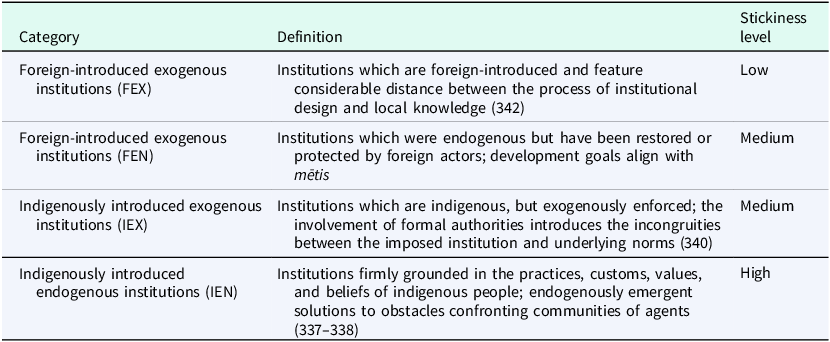
The taxonomy in Table 1 includes four potential sources of institutional change: foreign-introduced exogenous institutions (FEX), foreign-introduced endogenous institutions (FEN), indigenously introduced exogenous institutions (IEX), and indigenously introduced endogenous institutions (IEN). Endogenous institutions are naturally aligned with the community’s knowledge, culture, and norms; exogenous institutions may conflict with underlying norms (Boettke et al., Reference Boettke, Coyne and Leeson2008). The authors incorporate a Greek concept of local knowledge and practices called mētis (338). Mētis encapsulates the knowledge, skills, culture, norms, and informal practices resulting from local interactions, and concordance with the underlying mētis in a community gives an institution its stickiness.
FEX, FEN, IEX, and IEN institutions

Table 1. Long description
A table categorizing institutions by their origin and stickiness level. The table has four rows and three columns. The columns are labeled Category, Definition, and Stickiness level. Row 1: Foreign-introduced exogenous institutions (FEX), Institutions which are foreign-introduced and feature considerable distance between the process of institutional design and local knowledge (342), Low. Row 2: Foreign-introduced exogenous institutions (FEN), Institutions which were endogenous but have been restored or protected by foreign actors; development goals align with métis, Medium. Row 3: Indigenously introduced exogenous institutions (IEX), Institutions which are indigenous, but exogenously enforced; the involvement of formal authorities introduces the incongruities between the imposed institution and underlying norms (340), Medium. Row 4: Indigenously introduced endogenous institutions (IEN), Institutions firmly grounded in the practices, customs, values, and beliefs of indigenous people; endogenously emergent solutions to obstacles confronting communities of agents (337-338), High.
Source: Table created based on ideas in Boettke et al. (Reference Boettke, Coyne and Leeson2008) with the author’s addition of FEN institutions.
The institutional takeover of eastern Germany by Soviet occupants falls into the FEX category. The drastic transition was welcomed by some and defied by others; the German Communist party had twice as much support in the East as in the West in the 1924 elections, and party leadership would work alongside Soviet forces to establish a communist regime (Becker et al., Reference Becker, Mergele and Woessmann2020).Footnote 3 Still, while the success of the foreign actors relies in part on their collaboration with indigenous leadership, this does not negate the fact that the German Democratic Republic was established with violence and force or that it was the unwelcome result of a devastating military surrender (Naimark, Reference Naimark1995).Footnote 4 From 1947 to 1989, between 350,000 and 500,000 Soviet troops occupied the German Democratic Republic (Naimark, Reference Naimark1995). Landowners at large were driven from their homes by Soviet forces who confiscated property to establish a collectivist economy (Goeckel, Reference Goeckel1990). Sources of cultural influence, including religion and opposing political ideologies, were suppressed and replaced with socialist propaganda (Naimark, Reference Naimark1995).
West Germany’s post-war transition away from fascism was peaceful relative to the forceful collectivisation and containment occurring in the East.Footnote 5 Institutions endogenous to Germany, including their constitution and elections, were re-established by foreign occupants from the U.S., U.K., and France in partnership with the Christian Democratic Union and Christian Social Union (Schwarz, Reference Schwarz1995). Konrad Adenauer of the Christian Democratic Union would be the first chancellor of West Germany, and his focus was on restoring Germany’s democratic heritage (Schwarz, Reference Schwarz1995).
The return to democracy in the West may be described as a FEN institutional change. Though this classification is not part of the Boettke et al. (Reference Boettke, Coyne and Leeson2008) taxonomy, the authors specify that top-down institutional change will only be accepted when this compatibility or ‘congruence’ is present. FEN institutional change describes cases in which external actors reintroduce or reinforce institutional arrangements that are already broadly compatible with local norms, beliefs, and historical practices. Unlike FEX institutions, FEN institutions exhibit relatively high levels of congruence with underlying mētis, allowing them to achieve legitimacy and durability despite their foreign origin. The post-war reconstruction of democratic governance in West Germany best fits this category because with the re-establishment of the German constitution, foreign occupants restored institutions that were broadly aligned with Germany’s pre-Nazi legal and political traditions.
Subsidiarity as mechanism
Subsidiarity has been a feature of German law since the Weimar Republic and continues to impact policymaking today (Mätzke, Reference Mätzke2019). The idea is most explicit in Article 72(2) of the Basic Law for the Federal Republic of Germany (1949), which specifies that ‘Federal legislation is permitted only if necessary to establish equivalent living conditions or maintain legal or economic unity’. This particular wording has been in effect since reunification in an effort to strengthen its applicability, though courts struggle to assign its meaning consistently (Taylor, Reference Taylor2006). Subsidiarity is most commonly applied to questions of social service provision (Zimmer, Reference Zimmer, Ongaro and Van Thiel2020). The following sub-principles guide the country’s Child and Youth Services division (2026):
-
a. Whatever the individual, the family, or groups and associations can do independently must not be appropriated by a higher authority or by the state.
-
b. The state still has a duty to, if necessary, empower these smaller, private units to act by providing the requisite assistance.
-
c. In the context of child and youth services, subsidiarity refers to conditional priority over the public-sector provider when it comes to providing services.
These principles have helped to create a layered decision-making system that places limits on the central government’s capacity to make policy concerning children and youth. The responsibility assigned to families, groups, and associations helps make sense of Germany’s fragmented childcare infrastructure.
Subsidiarity connects directly to the Boettke et al. (Reference Boettke, Coyne and Leeson2008) concept of mētis, or localised knowledge, norms, habits, and informal practices that emerge through repeated social interaction. In the German context, subsidiarity preserved the authority of municipalities, churches, welfare associations, and families in the provision of childcare and related social services. A long history of public-philanthropic partnership in the provision of social services created a robust infrastructure of large welfare associations (Wohlfahrtsverbände), which receive financial support from municipal governments and play a part in setting local policy in the West (Evers et al., Reference Evers, Lewis and Riedel2005).Footnote 6 These institutions function not merely as service providers but as carriers of region-specific mētis regarding family life and the role of the community in childcare.
The dispersion of decision-making authority across multiple levels and sources is central to institutional economics, though it is not always referred to as subsidiarity. Decentralised governance structures find their merit in enabling adaptation, experimentation, and competition among institutional arrangements, according to Hodgson (Reference Hodgson2006). Decentralised systems face fewer structural knowledge problems and are able to evolve in response to local conditions (Hayek, Reference Hayek1945). A plurality of decision-makers will lead to a more diverse range of options that better represent individual preferences.
Local oversight of social services adds an explanatory layer to the institutional stickiness framework. Institutions that are congruent with underlying norms and practices – IEN institutions – tend to exhibit high levels of durability. In West Germany, subsidiarity enabled the duration of local childcare norms: it aligned formal governance structures with existing social norms around family, religion, and local responsibility. This alignment contributed to the persistence of decentralised childcare provision even in the face of expanding federal involvement and European-level policy initiatives.
If institutional stickiness were not operating as a limiting factor in Germany’s childcare regime, we would see convergence in childcare uptake as a response to the federal government’s prioritisation of the issue. Armed with a childcare guarantee, West German mothers would enter the workforce at rates similar to those of East German mothers. Alternatively, East Germany could have rejected the childcare guarantee, effectively stopping its expansion through local channels of influence. Instead, childcare use follows other patterns of slow convergence in Germany – including religious participation, political attitudes, and economic opportunity – all of which are intertwined to some degree with regional and local governance and the underlying mētis (Gramlich, Reference Gramlich2019; Hungerland, Reference Hungerland2025).
Williamson’s (Reference Williamson1985, Reference Williamson2000) transaction cost economics helps to explain why Germany’s childcare system has summoned increasing involvement from federal policymakers. When decentralised systems produce less-than-uniform results, higher levels of government step in to minimise the costs of coordination, monitoring, and enforcement (Williamson, Reference Williamson1985). In Germany, this is justified by the provisions in Article 72(2) which grant the federal government the ability to pursue the all-encompassing goals of equivalent living conditions and economic unity. Childcare is one of the chosen strategies, but subsidiarity requires persuasion towards a national goal rather than coercion.
The role of a decentralised governance structure in cases of institutional stickiness has a flip side. An unresolved question in the present case study is why pre-war norms around workforce participation and childcare did not persist under the German Democratic Republic. One answer put forth by scholars is that the construction and enforcement of the Berlin Wall divided territories with pre-existing differences in ideology and culture, deepened even further by migration (Becker et al., Reference Becker, Mergele and Woessmann2020; Klüsener and Goldstein, Reference Klüsener and Goldstein2016). Another perspective is that institutional stickiness does not survive coercion and violence. Identifying subsidiarity as a mechanism for institutional persistence helps to address this puzzle; assigning civil society ‘conditional priority over the public-sector provider’ preserved hubs of culture and self-organisation that proved robust through major institutional changes (Child and Youth Services in Germany, 2026).
The argument that subsidiarity is facilitating institutional stickiness is supported by literature on the role of social networks and the transmission of local knowledge and rules (Minbaeva et al., Reference Minbaeva, Ledeneva, Muratbekova-Touron and Horak2023), as well as the historical record of social network decay following collectivisation (Geiger, Reference Geiger1968; Woods and Frankenberger, Reference Woods and Frankenberger2018). Piano and Flowers (Reference Piano, Flowers, Maltsev and Singh2026) show that Soviet Socialist Republics which underwent religious persecution and forced secularisation experienced the rapid unravelling of longstanding institutions such as marriage. In general, autocratic regimes target civil society because they are threatened by alternative sources of ideas, culture, and loyalty (Piano, Reference Piano2022). Civil society is a bulwark of ideas, traditions, and norms, and when civil society organisations are suppressed, institutional persistence is too.
Case study: Germany’s child care guarantee
If social services are local responsibilities, what can be expected of Germany’s childcare guarantee? At least three major childcare policies have been passed at the federal level since German reunification in 1990. The following subsections will specify the source of the decision, the source of funding, and the entities responsible for implementation. These features, as well as the results of each policy change in the eastern and western regions, provide a glimpse into the dynamics of multi-level policymaking.
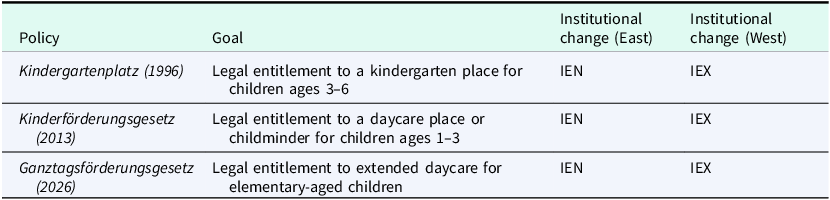
Table 2 situates each policy change within the institutional stickiness framework. The predictions are as follows: Because it is endogenous to pre-war Germany, we expect the right to kindergarten (Kindergartenplatz) to be accepted to a similar degree in the East and West. In contrast, we expect the right to childcare under age three (Kinderförderungsgesetz) to be more widely accepted in the East because it is in line with norms and attitudes characteristic of the German Democratic Republic. The German Democratic Republic underwent a FEX transition in 1949; foreign ideas became prevalent in the German Democratic Republic (GDR) through propaganda, forceful suppression of opposing values, and ideological sorting via migration (see theory section). At the time of reunification in 1990, collectivist values and practices were integrated into the institutional structure of East Germany.
Childcare policy and institutional change in Germany

Table 2. Long description
The table has four rows and four columns. The columns are labeled Policy, Goal, Institutional change (East), and Institutional change (West). The rows are labeled with different policies and their goals. Row 1: Policy, Kindergartenplatz (1996); Goal, Legal entitlement to a kindergarten place for children ages 3-6; Institutional change (East), IEN; Institutional change (West), IEX. Row 2: Policy, Kinderförderungsgesetz (2013); Goal, Legal entitlement to a day care place or childminder for children ages 1-3; Institutional change (East), IEN; Institutional change (West), IEX. Row 3: Policy, Ganztagsförderungsgesetz (2026); Goal, Legal entitlement to extended day care for elementary-aged children; Institutional change (East), IEN; Institutional change (West), IEX.
Notes: FEX and FEN institutional changes are not absent from the history of German childcare. See theory section for a discussion of the FEX and FEN transitions that occurred immediately following World War II.
Kindergartenplatz: Legal entitlement to a kindergarten place
The 1992 Law on the Welfare of Youth expressed the goals of reunified Germany regarding the childcare and education of children three and up and included a codified re-commitment to subsidiarity (Bode, Reference Bode2003). In 1996, an amendment to the Law on the Welfare of Youth mandated local authorities to offer kindergarten to all children ages three to six, when compulsory school begins (Bode, Reference Bode2003). The amendment established a legal entitlement to childcare (kindergarten) that was backed by the Federal Constitutional Court, meaning parents could demand a spot.
For East Germans, the right to childcare was an IEN change reinforcing existing social services for working mothers. East Germany relied on compulsory work to achieve centrally planned production goals, and the system was presented as the ‘liberation’ of women from the home.Footnote 7 The Mother and Childcare and Women’s Rights Acts, adopted by the German Democratic Republic in 1950, established the childcare infrastructure to support this goal (Lippmann et al., Reference Lippmann, Georgieff and Senik2020). In an even more explicit fashion, the 1952 Measures to Increase the Number of Women Active in Industry expanded nurseries, kindergartens, and after-school care for the dual purpose of enabling women to work full-time and educating their children in collectivist values (Budde, Reference Budde and Torstendahl1989; Heisig and Zierow, Reference Heisig and Zierow2020).
The 1996 declaration of a right to childcare was an IEX change for the residents of former West Germany. Though the law was decided democratically with bipartisan support, the very instance of federal involvement in childcare was a shock to the social service sector in the West. The promise from the federal government that states and municipalities would expand childcare represented a compromise between political regimes. The compromise is visible in Germany’s bilateral unification contract, which makes a commitment to adopting work-family supports from the East upon reunification (Fagnani, Reference Fagnani2012). The document states that unified Germany must ‘strengthen the legal position of working mothers and fathers in regards to work/family reconciliation’, which more closely resembles the GDR’s social agenda (Fagnani, Reference Fagnani2012).
It was argued in the theory section that subsidiarity is a channel, or mechanism, for institutional stickiness. Though the top-down policy goal of childcare as a support for full employment originated outside of West Germany, a unique childcare infrastructure did emerge in the West that aligned with forms of childcare endogenous to pre-war Germany. Kindergarten was provided by voluntary organisations for working class children in Germany long before separation and this continued in the West, while welfare associations were forced to dissolve into a central welfare organisation in the East (Bode, Reference Bode2003). The kindergartens operating in West Germany were and still are largely run by welfare associations, while in the former GDR, most are public centres inherited from state-owned enterprises and continue to be run by local authorities (Debus et al., Reference Debus, Son and Wagner2025).
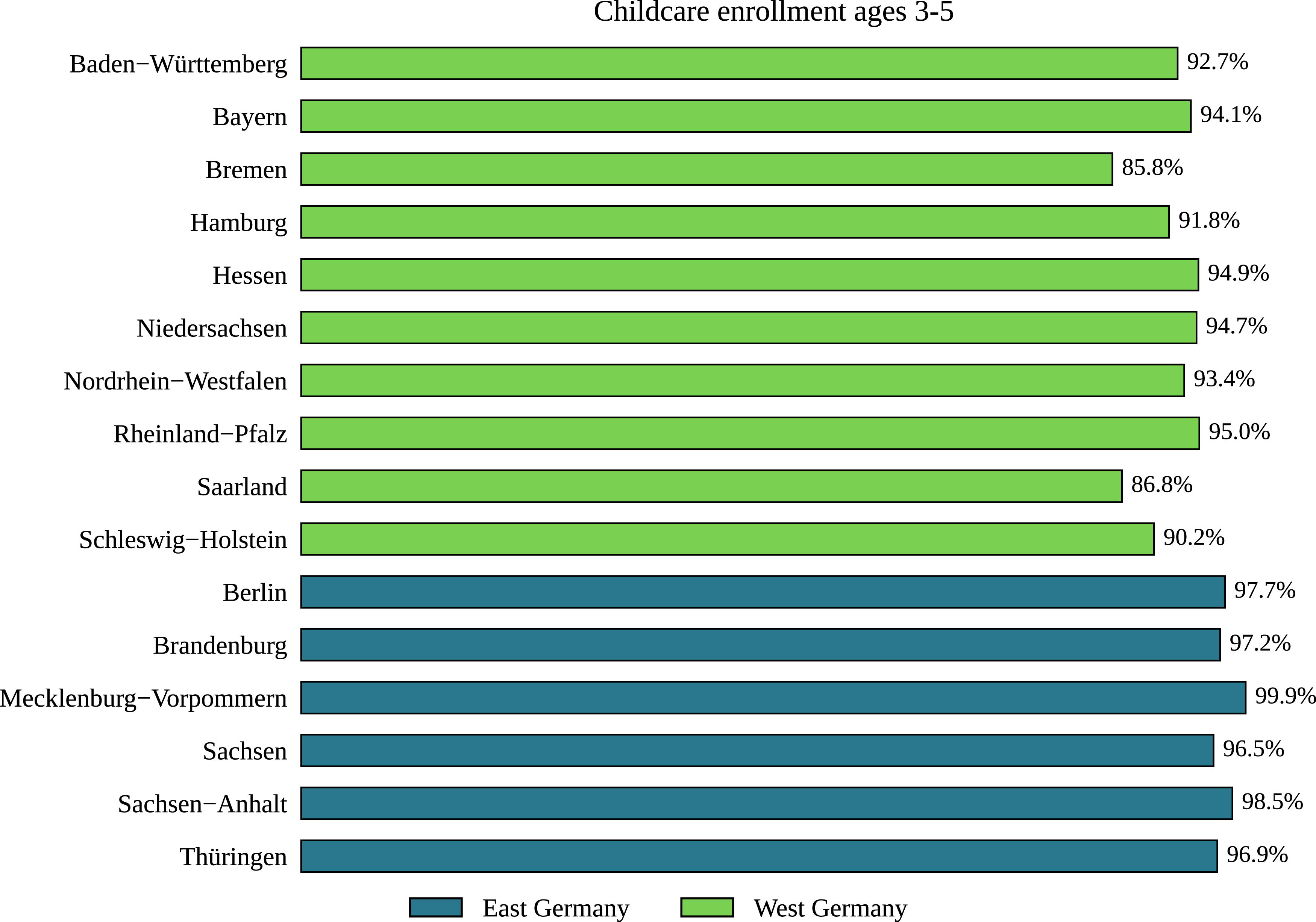
The 1992 law doubled down on subsidiarity, positioning the federal and state governments to provide ‘requisite assistance’ to local social service providers. Welfare associations and other non-profit childcare providers received financial support from the state, and municipalities were charged with expanding the supply of kindergarten seats to fulfil the legal guarantee created at the federal level (Bode, Reference Bode2003). Authorities in each municipality determine how to use funds, build the childcare workforce, and reconcile local norms with national goals (Bode, Reference Bode2003). By 1999, 600,000 spots were created in kindergartens in West Germany (Fagnani, Reference Fagnani2012), and today children are enrolled in kindergarten at roughly the same rates in Eastern and Western states (see Figure 1). Because local levels of governance have so much responsibility, the expansion of services has less to do with top-down mandates and more to do with collaboration between municipalities, non-profit welfare associations, private centres, and churches in response to changing family needs.
Percent of children ages 3–5 enrolled in childcare in German states (2025).
Source: Statistisches Bundesamt (Destatis) (2025). Enrolment measured on March 1, 2025; population measured December 31, 2024. Author calculations.

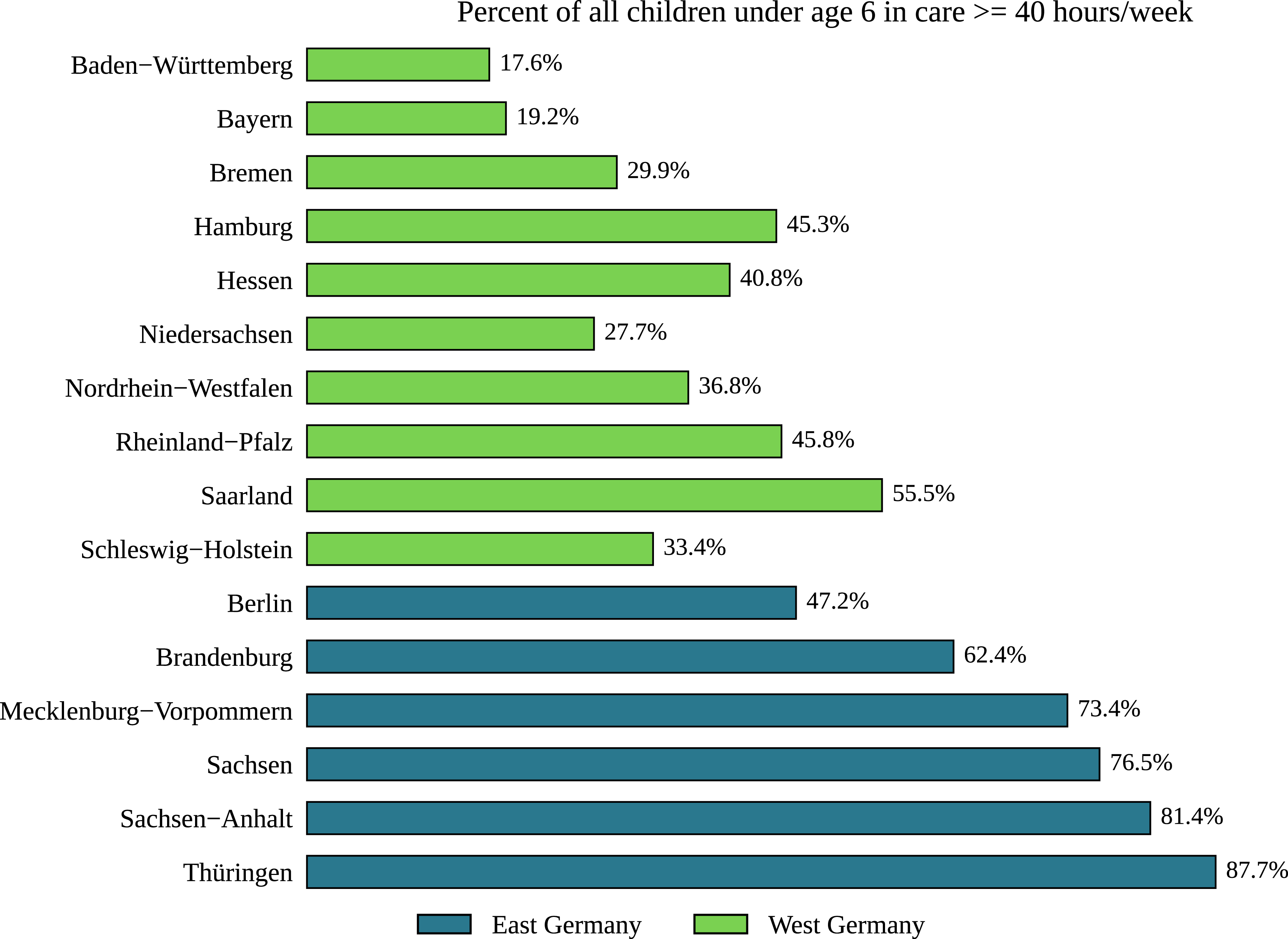
One area where institutional stickiness is noticeable in the East and West is in the hours of operation among childcare centres. Figure 2 shows the percentage of children enrolled in full-time childcare across German states, and children under six in West Germany are half as likely to be enrolled in 40 hours per week of childcare than their peers in the East.Footnote 8 Other policies endogenous to West Germany’s norms are simultaneously at work: In 2000, a legal right was established for parents of children under age nine to opt for part-time work in their current position, which contributes to the prominence of part-time work among mothers (Pfau-Effinger and Smidt, Reference Pfau-Effinger and Smidt2011).
Percent of children enrolled in full-time childcare in German states (2025).
Source: Statistisches Bundesamt (Destatis), (2025). Author calculations.

The norm of part-time care in West Germany appears to be maintained by low demand for full-time care, rather than the inverse. This pattern reflects the values and attitudes of women in the West towards work which have persisted through institutional transitions. Beblo and Görges (Reference Beblo and Görges2018) compare individuals living in the same region but socialised under different regimes, focusing on pre-1989 cohorts and migrants. Controlling for demographics, education, income, employment, and family structure, they find that East German upbringing predicts more egalitarian work preferences, captured in various surveys on work and family attitudes. Lippmann et al. (Reference Lippmann, Georgieff and Senik2020) show some average differences in time spent on household labour regardless of income level. But favouring part-time work in the West is tied directly to motherhood: before giving birth to a first child, women in West Germany are more likely to hold a full-time job, reflecting labour market conditions that have consistently been stronger in the West since reunification (Fauser et al., Reference Fauser, Struffolino and Levanon2024). After a woman’s first birth and a year of maternity leave, East German women are significantly more likely to work full-time jobs than their Western counterparts (Fauser et al., Reference Fauser, Struffolino and Levanon2024).
East and West Germany have taken different paths to expanding childcare for three-to six-year-olds. East Germany complies more closely with the federal policy and its goal of supporting women’s full-time work by offering more opportunities for full-day childcare in state-run centres. The plurality of childcare providers in West Germany is more diverse and serves a different set of purposes, including supporting mothers’ part-time work and expanding the services of welfare associations. Decentralised governance allowed pre-reunification childcare institutions and infrastructure to continue under the new childcare guarantee.
Kinderförderungsgesetz: legal entitlement to a daycare place
Since the initial childcare guarantee that accompanied German reunification, attention on the economic importance of early childhood education has continued to mount. In 2002, the European Council called on member countries to increase childcare provision for the purpose of enhancing gender equality and boosting economic output (Fauser et al., Reference Fauser, Struffolino and Levanon2024). In 2008, a major childcare reform (Kinderförderungsgesetz), or ‘child care funding act’, announced a financial commitment to expanding public childcare provision for children under three in Germany, with the specific goal of placing 35 percent of under-threes in public daycare by 2013 (Fauser et al., Reference Fauser, Struffolino and Levanon2024). The reform primarily targeted West Germany, where only 8.1 percent of children under three attended subsidised childcare in 2007, compared to 37.4 percent in East Germany (Fauser et al., Reference Fauser, Struffolino and Levanon2024). Essentially, this law created a right to childcare that parallels the 1996 declaration and expands its provision to under-threes.
As previously discussed, the supply of childcare is largely made up of non-profit welfare associations in West Germany. Childcare is one of many social services provided by the independent sector, and according to the principles of subsidiarity, the government must restrain itself to a supporting role. Survey data on women’s preference for work in their child’s first years shows that the low rate of provision that Kinderförderungsgesetz sought to address was aligned with demand for early childcare (Pfau-Effinger and Smidt, Reference Pfau-Effinger and Smidt2011). As a result, this childcare guarantee was an IEX institutional change, representing an attempt to ‘fix’ a deficiency in the emergent state of affairs.
In addition to the looming legacy of the communist regime, another foreign influence on this policy is the European Union. The Barcelona targets, which recommend childcare and education expansion for the enhancement of gender equality in employment, have motivated many of Germany’s peer states to drastically increase spending in pursuit of international policy targets (Fauser et al., Reference Fauser, Struffolino and Levanon2024). The Barcelona targets move Germany’s childcare policies toward the FEX category, predicting even less stickiness in areas where endogenous norms clash with the European Union’s ideals.
Table 2 identifies Kinderförderungsgesetz as an IEN institutional change for those in East Germany. Similar to the 1996 childcare expansion, the motivation for increased public investment in childcare echoes social policies formed under the GDR. East Germany had a childcare infrastructure for children below three, but it contracted from 58 percent in 1991 to 35 percent in 2002 (Pfau-Effinger and Smidt, Reference Pfau-Effinger and Smidt2011). The 2008 Act, which would establish the right to early childcare in 2013, aimed to reverse this trend and restore full-time childcare services for all ages.
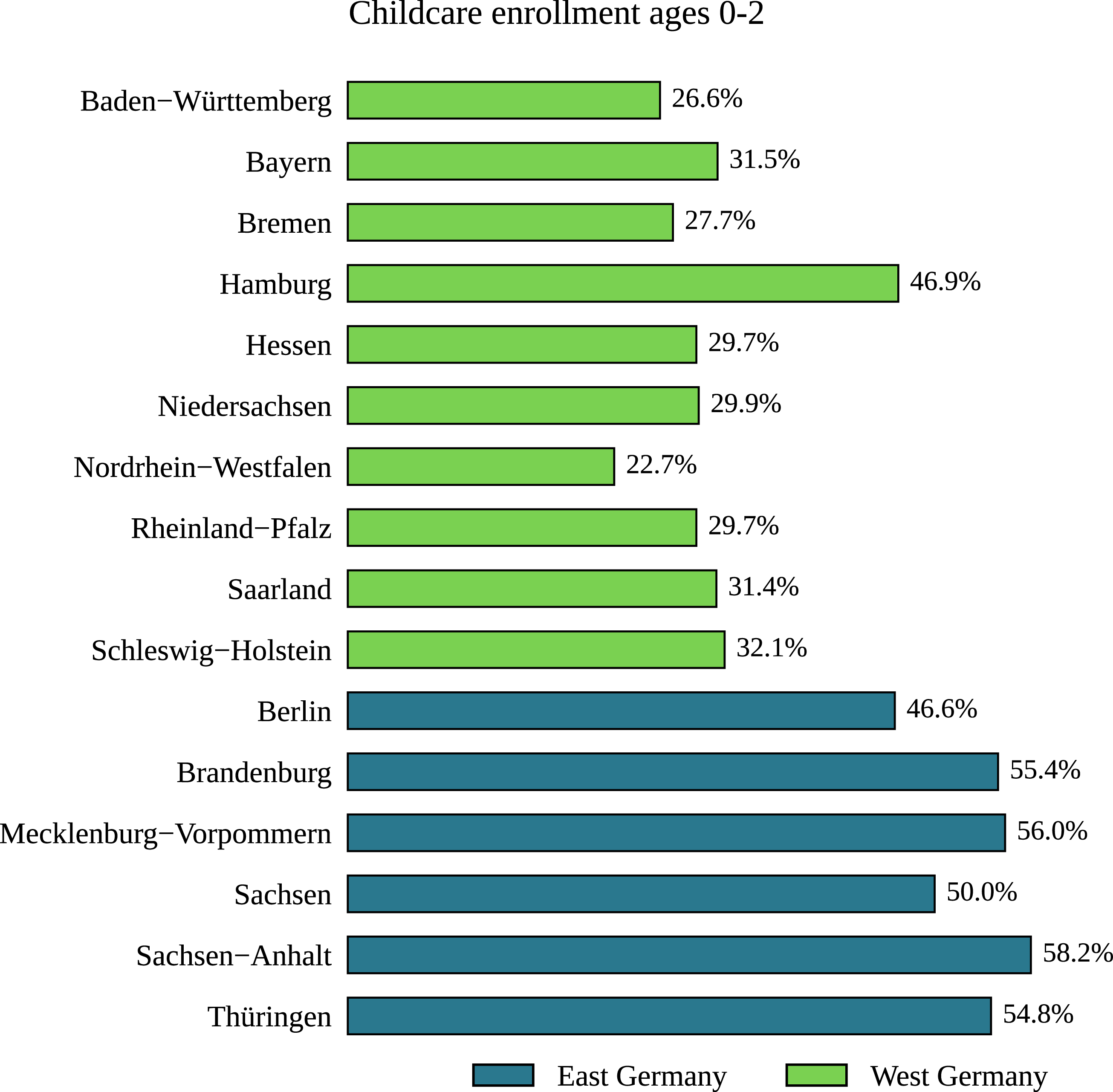
Institutional stickiness predicts that policy change will be more successful, or more widely adopted, when it is simply formalising an IEN. Kindergarten was familiar to each region, although interpreted differently in practice. But childcare for under-threes had almost no existing infrastructure in the West, making pre-unification norms even more sticky for nurseries than kindergartens. Figure 3 provides a current snapshot of the East–West divide on early childcare.
Percent of children ages 0–2 enrolled in childcare in German states (2025).
Source: Statistisches Bundesamt (Destatis) (2025). Enrolment measured on March 1, 2025; population measured December 31, 2024. Author calculations.

Early childcare is expected to expand with more time, albeit in a region-specific fashion that unfolds similarly to care for other age groups. In an event study of Kinderförderungsgesetz, Fauser et al. (Reference Fauser, Struffolino and Levanon2024) find an increase in part-time work for mothers with children under three following the 2008 reform in both regions, which aligns with Goldin’s (Reference Goldin2014) observations of women’s willingness to ‘pay’ for flexible work arrangements as earnings increase. Debus et al. (Reference Debus, Son and Wagner2025) test determinants of the level of full-time daycare places per capita in 1,109 German cities, and find that age and gender of mayor, political affiliation of mayor, political party majority in city parliament, and unemployment rate are significant in addition to location in East or West Germany.
As with legal protections for part-time work, maternity leave policies cannot be overlooked as a factor in shaping childcare use. In 1992, the recently unified German government implemented Elternzeit, a policy which guaranteed a parent the ability to return to his or her former job up to three years following the birth of a child (Fagnani, Reference Fagnani2012). The employment guarantee was accompanied by a cash-for-care benefit of €150 per month for up to three years (Reimer et al., Reference Reimer, Erler, Schober, Blum, Koslowski, Blum, Dobrotić, Macht and Moss2019). The standard cash-for-care transfer ended in 2015 but is still available at the state level in Bavaria and Saxony (Reimer et al., Reference Reimer, Erler, Schober, Blum, Koslowski, Blum, Dobrotić, Macht and Moss2019). In its place is the Federal Law of Parental Allowance and Parental Leave (Elterngeld), which expanded the former parental benefit system with cash support for all families earning less than €500,000 annually (Camp et al., Reference Camp, Trzcinski, Resko, Nieuwenhuis and Maldonado2014). The programme subsidises lost income with 67 percent of their previous net earnings for 12 months, with a minimum payment of €300 and a maximum payment of €1800 per month (Fagnani, Reference Fagnani2012). The three-year employment guarantee associated with Elternzeit was upheld, but the reform incentivises returning to work after one year (Camp et al., Reference Camp, Trzcinski, Resko, Nieuwenhuis and Maldonado2014).
Ganztagsförderungsgesetz: legal entitlement to extended school hours
Beginning in August 2026, all first-graders in Germany will have a legal entitlement to full-time care in public primary school through the All Day Support Act, which includes eight hours of care five days a week (German Federal Government, 2021). Primary school is four years with students usually aged six to ten. The entitlement will extend gradually and will apply to all four years of primary school by 2030. It is supported by 3.5 billion additional euros earmarked for education funding (German Federal Government, 2021).
The traditional model of primary school in Germany is a half-day schedule of about 20–25 hours per week, with students going home for lunch and spending the remainder of the day in family care (RPTU Kaiserslautern–Landau University of Technology, 2026). The expansion of school hours comes as a continuation of the federal government’s prioritisation of childcare. With a federal right to full-time care in place for children under school age, families reach a ‘cliff’ of care in areas where part-day primary school dominates.
The transition from nursery level daycare to primary schools is still a challenge for many families… The demand for all-day services for primary-age children cannot yet be met. When children reach school age, they are no longer entitled to a place in daycare although the school day often ends at lunchtime. This is why more quality daycare options are needed for primary school children–in the afternoons too (German Federal Government, 2021).
The proposed plan will cover holidays and summer months, with schools allowed to close for a maximum of four weeks per year (Wilmes, Reference Wilmes2026). Schools will be divided into ‘structured’, where all-day attendance is mandatory, and ‘flexible’, where in theory parents can choose how much additional care is needed (Wilmes, Reference Wilmes2026).
One would expect the same dynamics that govern the implementation of all-day childcare to apply to Ganztagsförderungsgesetz when the guarantee takes effect in August 2026. Like childcare policies, federal education policies depend on the cooperation of states and municipalities. The institutional stickiness framework informs two pattern predictions.
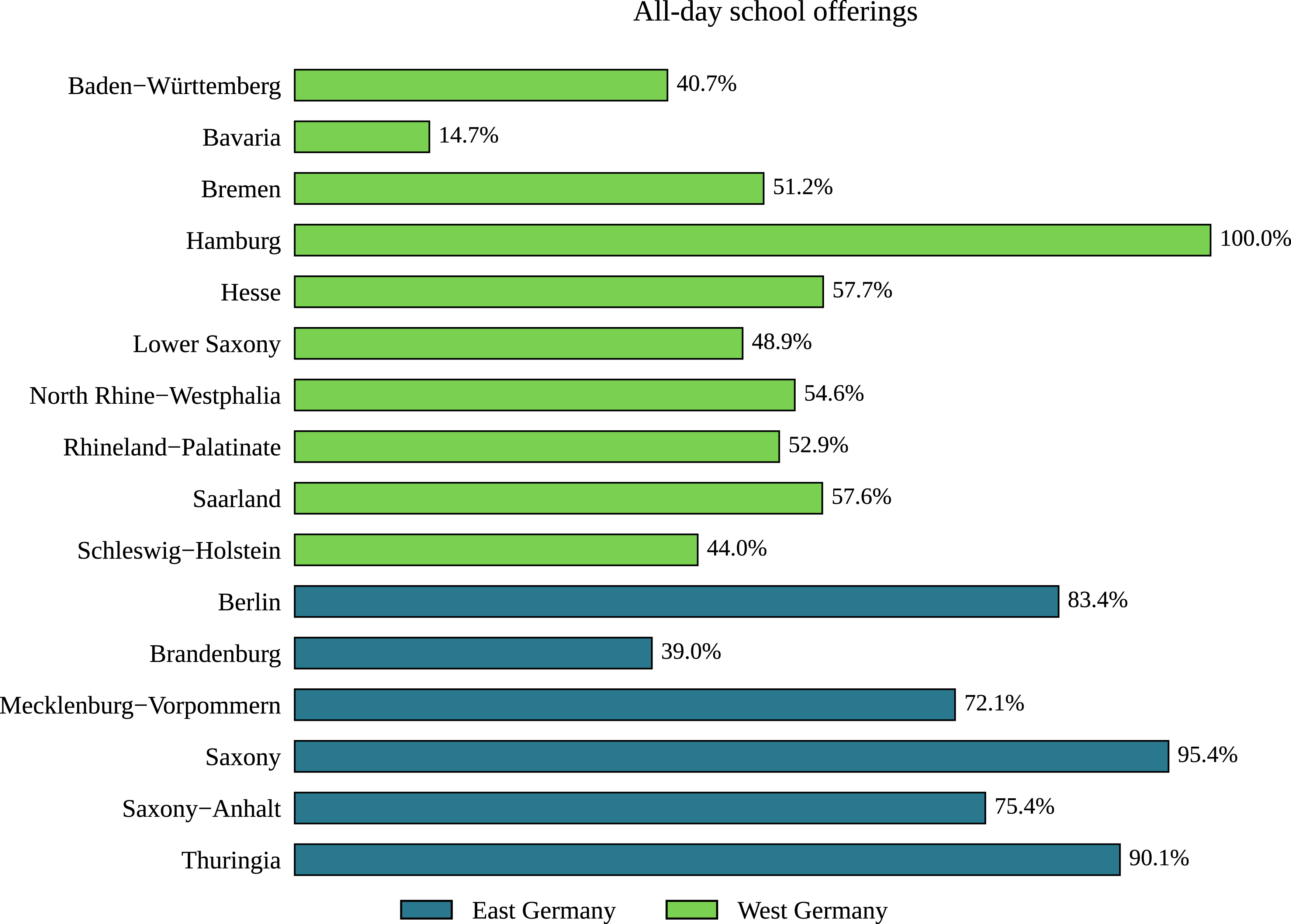
First, existing regional patterns in all-day primary school offerings will persist if current education policies are endogenous. Flexible school schedules, providing optional full-day care, are expected to be more common in the West than in the East. Figure 4 shows that all-day care is more prominent in East German states ahead of the August 2026 policy change. The share of total primary school spots that offer all-day coverage is 77.8 percent in East Germany and 45.1 percent in the West (Standing Conference of the Ministers of Education (KMK), 2024). The national share is 51 percent, reflecting a larger youth population in the West (Standing Conference of the Ministers of Education (KMK), 2024).
Percent of primary schools offering all-day programs in German states (2024).
Source: Standing Conference of the Ministers of Education and Cultural Affairs (KMK): General Education Schools with All-Day Programmes, 2024, Table 3.2.2. Public primary schools only. Author calculations. Note: Hamburg’s 100 percent reflects its universal school-based all-day offer; actual participation may be lower.

Second, if subsidiarity enables the representation of local traditions and norms in policymaking, waiting lists will not be as large a concern as some experts say. The federal government estimates demand for all-day school hours to be around 75 to 80 percent, with only 51 percent of schools offering the service (German Federal Government, 2021). ‘This gap is now to be closed’, announced Federal Minister for Family Affairs Franziska Giffey (German Federal Government, 2021). A consulting group for navigating government benefits warns parents to expect waiting lists and specifies that ‘hardship cases’ will be taken into account in the allocation of services (PME Family Service Group, 2025). But in states where parents value all-day care, it is likely that education policymakers have already begun to make necessary expansions.
Generally speaking, Ganztagsförderungsgesetz is an IEN institutional change as experienced by East Germans because it is a legal formalisation of an existing norm. All-day care was required to support the German Democratic Republic’s production goals, and the educational infrastructure persisted through reunification as a feature of work and family life.
Guaranteeing all-day primary school will be more difficult to achieve in West Germany because of the nature of the change – Ganztagsförderungsgesetz is an IEX institutional change to West Germany. Augustin-Dittmann (Reference Augustin-Dittmann2010) explains that West Germany has historically rejected all-day school proposals as an explicit refusal of National Socialist education and Soviet education policy reforms introduced in the GDR as well as other FEX education models that the Allies might have imported. As with former policies, the exogenous influence of the European Union gender equality targets also has a hand in shaping Ganztagsförderungsgesetz.
While regional patterns currently reflect IEN and IEX predictions, some Western states and municipalities have chosen to embrace extended school hours. Hamburg is a small state in West Germany and was an early adopter of all-day primary school (Hamburg Authority for Schools, Family and Vocational Training, 2026). Its metropolitan landscape has led to a greater demand for full-time childcare and school hours than is observed in most other Western states (see Figures 2 and 3). Although the state is in West Germany, education authorities have been responsive to residents’ interest in extending school hours to mirror that of Eastern states or other cities in Europe.
Hamburg’s example shows that pre-reunification norms do not have to persist, and subsidiarity can facilitate evolution just as it facilitates persistence. When the federal government attempted to guarantee all-day school in 2003, conservatives opposed federal intervention, but not the service itself. ‘Full time offers inside or outside of schools should be expanded in line with demand’, wrote the Christian Democratic Union’s Federal Board of Education in 2002 (Augustin-Dittmann, Reference Augustin-Dittmann2010). Communities will respond differently according to the underlying mētis, making national reforms difficult to achieve. If rapid convergence among states or fierce competition over structured all-day primary school places ensues, the institutional stickiness framework will be called into question.
Conclusion
Despite massive investments in expanding childcare infrastructure and backing legislation with legal rights to services, the conversation around childcare in Germany sounds remarkably familiar to concerns voiced in other Western countries. Concerns about quality and access are raised by organisations advocating for more political action on the issue (Bertelsmann Foundation, 2022). The problem that activists seek to identify may not be funding or political commitment but the very structure of governance.
Federal childcare guarantees altered the formal institutional environment, but subsidiarity limited the extent to which centralised policy could displace locally embedded practices and expectations. As a result, informal institutions and social norms remained regionally differentiated even as formal legal structures converged after reunification. Subsidiarity therefore acted as a mechanism through which mētis was preserved and reproduced across generations, contributing to the institutional stickiness described by Boettke et al. (Reference Boettke, Coyne and Leeson2008). The clash between Germany’s top-down policies and decentralised political system illustrates the claim that the most successful rules and practices have emergent origins.
Subsidiarity assigns responsibilities to private individuals, families, groups, and associations and limits the duties of the state. Because childcare has historically been under the jurisdiction of families and voluntary associations in Germany, the federal government’s efforts are dependent on local initiatives for their success. Civil society entities also serve as hubs of self-organisation, culture, norms, and tradition. Treating subsidiarity as both a governance principle and a mechanism of institutional stickiness through which mētis is preserved gives proper weight to past and present cultural, political, and economic institutions in shaping policy outcomes.
Germany’s fragmented history complicates the case study and adds yet another layer to the institutional stickiness paradigm. If exogenous ideas are to become endogenous, hubs of indigenously-held ideas must be extinguished and replaced. Full-time childcare policies are classified as endogenous to East Germany because they resemble workforce supports from the German Democratic Republic, but a longer view of history reveals these became ‘norms’ by force. The implication is that if government wishes institutional stickiness to be untrue, they must target local sources of influence. In the recent history of Germany, decentralised governance in the provision of social services has checked legislators’ ability to achieve uniform policy outcomes.
Countries wishing to confer a right to childcare can learn from the German case study. Billions of euros in capital investments and subsidies have not ‘solved’ childcare. The childcare regime that was established via central planning in the German Democratic Republic eliminated non-state sources of care, which transformed ideology and infrastructure. In West Germany, the involvement of voluntary associations and other civil society organisations in childcare and social services makes up a diverse network, and prominent part-time childcare and women’s work is an emergent result. The upside of subsidiarity is institutional pluralism, rivalry, and adaptation in response to changing needs; the downside, to some, is the stubbornness it enables.
Acknowledgments
The author would like to thank the Menard Family Center for Economic Inquiry at Creighton University and the Hayek Program for Advanced Study in Philosophy, Politics, and Economics at the Mercatus Center at George Mason University for supporting the project and facilitating workshop opportunities throughout the preparation of the manuscript.

 Open access

