Introduction
Infants born with critical CHD experience multiple feeding disruptions. Regardless of the disease severity or the type of surgical intervention, 43–64% of patients are diagnosed with dysphagia. Reference Narawane, Rappazzo, Hawney, Clason, Roddy and Ongkasuwan1,Reference Jones, Desai and Fogel2 Patient, medical, surgical, and environmental factors during the hospital course for infants with critical CHD significantly contribute to dysphagia risk during a key time period of oral skill development. Dysphagia is associated with respiratory instability, increased metabolic demand that requires increased nutritional volume or calories to gain weight normally, increased risk for aspiration that contributes to feeding disruptive patterns or oral aversion, and reduced state regulation with difficulty waking for feeding and demonstrating low energy and stamina for reliable participation. Reference Jones, Desai and Fogel2 Dysphagia may be a consequence of brain injury or dysmaturity, associated genetic syndromes and reduced gastrointestinal tolerance of feedings. Reference Jones, Desai and Fogel2 Patients with critical CHD have prolonged intubation periods with negative oral stimulation, extended hospitalisation, stressful surroundings such as bright lights and loud sounds, painful procedures, and separation from family/caregivers. In addition, early therapeutic interventions such as catheterizations, surgery, and transesophageal echocardiogram disrupt the infant’s feeding skill acquisition and increase the risk for aspiration related to exposure to sedation medication, deconditioning, intubation, length of stay, and surgical complications. Reference Narawane, Rappazzo, Hawney, Clason, Roddy and Ongkasuwan1–Reference Kohr, Dargan and Hague6 These complications can include vocal cord and diaphragm motion impairment. Reference Narawane, Rappazzo, Hawney, Clason, Roddy and Ongkasuwan1–Reference Kohr, Dargan and Hague6 Many infants with critical CHD and dysphagia require additional support to maintain adequate growth such as increased caloric density of feedings, supplemental nutrition via feeding tubes, and/or the use of other forms of nutrition such as total parenteral nutrition and lipids.
Historically, thickened liquids are used to treat gastrointestinal reflux, weight gain, and oropharyngeal dysphagia or swallowing deficits. Feeding therapists, physicians and advanced practice providers utilise thickened liquids as a modification to address swallowing deficits, specifically aspiration, when swallowing dysfunction is diagnosed with a formal instrumental evaluation such as videofluoroscopic swallow study (X-raying patients while consuming barium) or flexible endoscopic evaluation of swallowing (inserting a thin fiberoptic endoscope through the nose and above the pharynx to visual liquid or food bolus movement while swallowing). Reference Luca, Miron and Mîndru7–Reference Madhoun, Siler-Wurst, Sitaram and Jadcherla14 Current studies suggest that thickened liquids have increased viscosity and thus move slower than thin liquids. This is thought to improve the infant’s ability to control the liquid in their pharynx and provide better coordination of airway closure during the swallow response. Appropriate airway closure decreases the occurrence of deep laryngeal penetration and aspiration, thus decreasing dysphagia, improving swallowing mechanics, and decreasing length of hospitalisation. Reference Goldfield, Smith, Buonomo, Perez and Larson11,Reference Duncan, Amirault, Mitchell, Larson and Rosen15 The use of thickened liquids provides an opportunity for infants experiencing dysphagia to continue oral feeding and develop feeding skills during critical periods of recovery and growth.
When consideration is taken for the type of thickener, the level of thickened liquids prescribed, and ongoing support from a feeding therapist, most infants aged 8–9 months with dysphagia, identified on a swallow study, had symptomatic improvement. Reference Luca, Miron and Mîndru7 Parents reported significant decrease in the frequency of apnoea, reduced coughing/choking, less resistance to feeding, decreased vomiting, and improved volume of oral intake following the use of thickened oral feedings. Reference Krummrich, Kline, Krival and Rubin16,Reference Duncan, Cohen and Du17 Parental attitude towards the use of thickened oral feeding was positive when thickening is used to manage dysphagia compared to gastrointestinal reflux disease. Reference Duncan, Cohen and Du17 Studies suggest additional benefits to thickened oral feeds including improved lung health with fewer respiratory admissions, shorter hospital length of stay, and better swallowing mechanics. Reference McSweeney, Kerr, Amirault, Mitchell, Larson and Rosen13,Reference Duncan, Cohen and Du17 Additionally, in animal and adult models, there was no difference in the amount of hydration received from even the highest level of thickened liquid, indicating a possible decrease in concern for hydration with thickened liquids. Reference McCallum18
Thickening practices including the type of thickening agent used and the level of thickened liquid prescribed often vary across centres and from clinician to clinician. There are various options for thickening liquids including food-based agents such as rice cereal, oatmeal cereal, pureed fruits/vegetables, and yogurt. Reference Duncan, Larson, Davidson, May, Rahbar and Rosen8,Reference Brinker, Winn and Woodbury9 Commercial thickening agents utilise modified cornstarch or gum-based products (xantham gum used in SimplyThick and tapioca maltodextrin and carob bean gum used in Gelmix). Choosing the appropriate type of thickening agent for an infant is often influenced by the patient’s medical comorbidities including prematurity, history of necrotising enterocolitis, evidence of milk protein intolerance, and the type of milk consumed (human milk versus formula) as not all thickening agents thicken human milk adequately. Reference Duncan, Larson, Davidson, May, Rahbar and Rosen8 The level of thickness required often varies from patient to patient and should be determined via formal evaluation as mentioned above. The International Dysphagia Diet Standardisation Initiative outlined a universal approach to labelling the thickness level of liquids in 2019. Reference Cichero, Lam and Steele19 Liquids are defined in number levels, starting with Level 0 (Thin Liquids), Level 1 (Slightly Thick), Level 2 (Mildly Thick), Level 3 (Moderately Thick), and Level 4 (Extremely Thick/Pureed) (Supplement 1). Reference Cichero, Lam and Steele19 This is an important distinction as it allows for consistent communication of thickening levels with a standard process to be used by clinicians around the world. For example, prior to 2019, often a set recipe was used to achieve a specific consistency level. However, this did not allow for variations in thickness that were affected by temperature changes or length of time a liquid was allowed to thicken prior to consumption. Subjective judgement may be applied to the thickened liquid that appears too thick or too thin. The International Dysphagia Diet Standardisation is a bedside tool that includes measuring 10 mL of the thickened liquid in a 10-mL slip tip syringe, allowing it to drain for 10 s then quantify the remaining volume left in the syringe. This simple drip test ensures consistent thickening levels and may alleviate the feeders’ concerns regarding accurate thickness.
Despite some indication of benefit from thickened liquids, utilisation for dysphagia management in infancy remains a controversial practice given concerns regarding gastrointestinal complications such as constipation, diarrhoea, reduced gut motility, nutrition displacement, exposure to arsenic in cereals, potential allergens, and necrotising enterocolitis. Infants with critical CHD inherently present with potentially increased risk factors for gastrointestinal complications secondary to altered systemic blood flow with the possibility for decreased gut profusion. Reference Kelleher, McMahon and James10 Furthermore, infants with critical CHD may experience differences in their gut microbiome both at baseline and after surgical intervention requiring cardiopulmonary bypass, placing the infant at risk for developing intestinal ischaemia and necrotising enterocolitis. Reference Koc, Magner and Murphy20 The nutritional displacement of human milk and formula with the carbohydrates found in thickeners can also lead to excessive weight gain and changes to the osmolality of the nutrition causing constipation or diarrhoea. Additional concerns include exposure to toxins including high levels of arsenic found in rice cereal. Reference Madhoun, Siler-Wurst, Sitaram and Jadcherla14,Reference McCallum18,Reference Abdulezer21–Reference Carignan, Punshon, Karagas and Cottingham23
From a psychosocial perspective, parents of infants with dysphagia who require thickened oral feedings can experience distress around thickening the feedings. Barriers exist for families when thickened liquids are prescribed such as access to purchasing commercial thickening agents and the financial burden associated with purchasing thickeners, which have variable insurance coverage state by state. In addition, the process of preparing and offering thickened feeding can be complex and challenging to accurately learn recipes to achieve the appropriate level of thickness recommended for their child. Reference LaManna, Hatfield and McCann25
Minimal information is available in the literature describing the use of thickened liquids to support feeding outcomes for young infants with critical CHD. The goal of this project was to describe the current state of practice in the use of thickened liquids for dysphagia management in infants with critical CHD across paediatric cardiac surgical centres in the United States of America and internationally.
Methods
Data analysis
Survey data was analysed via the Microsoft Forms Platform (Microsoft Corporation, 2018). Multiple-choice survey data was analysed using descriptive statistics (frequencies, percentages). Responses to the open-ended questions were reviewed and coded into categories by general themes. This survey did not meet the criteria for human subject research as no private information was obtained regarding individuals, but rather opinions regarding general practices of caregivers completing the survey. Therefore, the study was not submitted by the team for formal review by an Institutional Review Board. However, the study was conducted and reported in accordance with principles of transparent and rigorous reporting, including adherence to key elements of the STROBE guidelines for observational research where applicable.
Sample
This is a cross-sectional survey that utilised convenience and snowball sampling by targeting 52 hospitals affiliated with the Cardiac Newborn Neuroprotective Network a Special Interest Group of the Cardiac Neurodevelopmental Outcome Collaborative. Forty-five of the affiliated hospitals are in the United States of America and 7 are international. The survey was distributed to 238 potential participants through the collaborative google group on the Microsoft Forms Platform (Microsoft Corporation, 2018). The 238 potential participants were identified through the membership directory of the Cardiac Newborn Neuroprotective Network, a Special Interest Group of the Cardiac Neurodevelopmental Outcome Collaborative. All participants were members of the network and included professionals such as physicians, advanced practice providers, nurses, speech–language pathologists, psychologists, occupational therapists, and physical therapists, reflecting a multidisciplinary approach to the care of infants with critical CHD. The survey was open for 4 weeks, between 05/2023 and 06/2023.
Instruments
The survey focused on dysphagia treatment practices for infants less than 6 months of age who underwent congenital heart surgery with persistent dysphagia symptoms despite typical oral feeding modification techniques. The survey included 24 questions (Supplement 2) including centre and participant information and feeding practice-focused questions. The feeding practice questions were formulated by a focus group of speech–language pathologists, who are cardiac feeding specialists, across four institutions with embedded paediatric cardiac surgical care. Questions were multiple choice with the availability of a free text option.
Results
Site characteristics
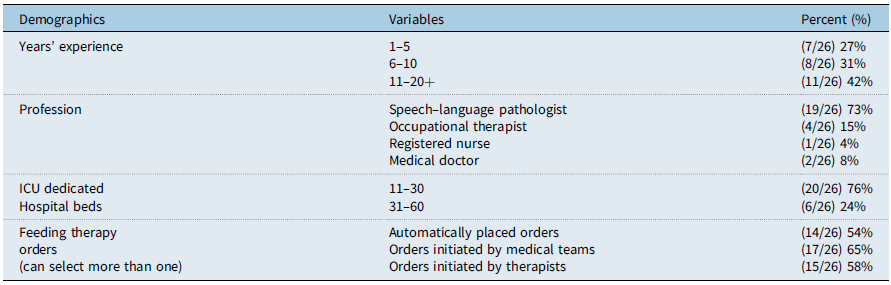
A total of 26 individual responses were received for a response rate of 11%. This represented 21 unique hospitals in the United States of America with cardiac intensive care units (ICU) which represents a 40% hospital response rate. No responses were received from the international institutions. Seventy-six percent (20/26) of the hospitals that responded reported a medium size centre with 11–30 beds in the ICU and 24% (6/26) were large centres with 31–60 beds in the ICU. Most respondents were speech–language pathologists (19/26, 73%) and years of experience ranged from 1 to 5 years (7/26, 27%), 6 to 10 years (8/26, 31%) and 11to 20 years (11/26, 42%). Orders for feeding therapists were automatically received postoperatively (14/26, 54%), as needed by the medical team (17/26, 65%), and by therapist request (15/26, 58%) (Table 1).
Respondent Demographic.

Thickening liquid practices
Thickened liquid treatment for dysphagia was used by 92% (24/26) of survey participants, which was 20 of the 21 hospitals (Figure 1A). See Figure1A for the use of thickened liquids by medical diagnosis. Thickened liquids for dysphagia were recommended after a video fluoroscopic swallow study (21/26, 81%), a fiberoptic endoscopic evaluation of swallowing (38%, 10/26), a bedside swallow exam (7/26, 27%), a swallowing treatment session (8/26, 31%), or never provided (2/26, 8%).
Survey results. (a) Use of thickened liquid per medical diagnosis percent of respondents using thickened liquids per medical diagnosis, gastroesophageal reflux disease (GERD), CHD, necrotizing enterocolitis (NEC) vocal cord mobility impairment (VCMI). (b) Type of thickening agents used for formula and human milk. Add riceformula (AR formula). (c) Higest and most commom level of thickened liquids used for oral feeding. Respondents indicated the highest level of thickened liquids allowed at their center and most common level of thickening provided. The international dysphagia diet standardisation initiative (IDDSI) (supplement 2). (d) Strategies employed with difficulty extracting thickened liquids from nipple. Strategies by respondents to improve extraction of thickened liquids from bottle nipples. Ultra-preemie nipple (UP nipple).

The most common reasons for recommending thickening after a formal instrumental evaluation were for aspiration with a cough (20/26, 77%), silent aspiration (19/26, 73%), deep laryngeal penetration (14/26, 54%), and aspiration risk such as pooling in the pharynx (7/26, 27%). See Figure 1B for types of thickener used for human milk and formula. Respondents used the International Dysphagia Diet Standardization Initiative drip test to determine recipes for thickening (22/26, 85%) (Supplement 1), utilised hospital-specific instructions on the thickening agent (3/26, 12%), and unknown if respondents’ team uses the International Dysphagia Diet Standardization Initiative drip test or standard mixing per recommendations on the thickening agent or viscometer (3/26, 12%).
Barriers to the use of thickened oral feeding included parental adherence to recommendations (12/26, 46%), financial resources (14/26, 54%), availability of thickener (9/26, 35%), medical team concerns (11/26, 42%), therapist concerns (9/26, 35%), dietitian concerns (6/26, 23%), centres’ feeding culture (6/26, 23%), and lack of options for outpatient follow-up (7/26, 27%). Figure 1C delineates the highest level of thickening and the most common level of thickening provided. Figure 1D indicates the percentage of strategies to extract thickened liquids from a bottle nipple.
Post-discharge feeding and developmental support were common and occurred in a variety of settings including cardiac-specific feeding clinics, general feeding clinics, early intervention, home health, occupational therapy, and outpatient nutrition services. Ongoing outpatient dysphagia workup and clinical care existed with gastrointestinal and otolaryngology to facilitate repeat instrumental assessment and advanced aerodigestive support.
Variability in practice was observed on this survey with respondents from the same centres regarding how orders were received, thickening for gastrointestinal reflux, thickening for vocal cord movement impairment, typical thickness utilised for dysphagia, offering thickened liquids without a formal assessment, and highest level of thickness offered at their facility. One hundred percent of respondents reported that they do not offer thickened oral feeding had 1–5 years’ of experience (7/26, 27%) compared to 100% of respondents with 11–20 years’ of experience (11/26, 42%) who offer thickened oral feeding for dysphagia.
Discussion
Dysphagia is a common challenge for practitioners, patients, and families after congenital cardiac surgery. Reference Narawane, Rappazzo, Hawney, Clason, Roddy and Ongkasuwan1–Reference Kohr, Dargan and Hague6 Thickened oral feedings are commonly used as treatment for dysphagia in infants with critical CHD. The use of thickened oral feedings continues to be of variable practice and current guidelines for their use do not exist. To our knowledge, this survey is the first to examine multicenter thickening practices for dysphagia management in infants with critical CHD.
Most cardiac centres that responded reported recommending thickened oral feedings for infants with documented aspiration on an instrumental assessment (21/26, 81%), even for very high-risk infants including those with single ventricle physiology and a history of necrotising enterocolitis with close supervision.
Madhoun and colleagues surveyed neonatal ICU feeding therapists and providers regarding thickened feeding practices. Reference Madhoun, Siler-Wurst, Sitaram and Jadcherla14 They concluded that the use of thickened feedings is prevalent in newborn ICUs; however, there is a lack of standardisation in achieving the desired thickness as well as variability in provider practice and attitudes regarding thickening. The International Dysphagia Diet Standardization Initiative drip test which standardises recipes for thickened liquids was not available at the time of Madhoun et al (2015) study. Standard thickening ensures safe thickened oral feeds and supports family thickening education for generalisation to the home environment. In the current survey of paediatric cardiac surgery centres, 85% (22/26) of survey respondents and 18 of the 21 hospitals indicate using the International Dysphagia Diet Standardization Initiative drip test to ensure an accurate level of thickness and decrease the risk for inconsistent thickening practices.
The current survey also found that the use of thickened liquids was prevalent for infants with single ventricle physiology both in the interstage period and after the Glenn procedure (22/26, 85%), despite the potential risk for intestinal complications due to impaired gut perfusion. This suggests that centres were supporting techniques to treat dysphagia for infants with critical CHD and could be using thickened liquids to support tube weaning or succumbing to the pressure to feed orally despite dysphagia and the risks of thickened liquids.
Our survey did not clarify whether centres using thickened oral feedings for single ventricle infants were indicated for full volumes or partial oral feeds. This would be an important addition to future studies. Full volumes of thickened liquids may facilitate sooner tube weaning and small volumes may be better tolerated for infants at high risk for gastrointestinal complications while still allowing for oral feeding practice. Provision of thickened liquids to infants with a history of medical necrotising enterocolitis with close supervision was reported by 69% (18/26) of respondents. This may indicate a decreased concern for potential adverse events or embedded systematic monitoring of concerns to support oral feeding transition. Similarly, a systematic review revealed that thickened liquids did not cause adverse events in healthy children. Reference Gosa, Schooling and Coleman27 While this is promising, it is difficult to generalise results for infants and children with complex medical challenges. The prevalence of adverse consequences with thickened liquids in infants and children with critical CHD has not been reported in the literature.
Respondents to this survey reported observing improved clinical signs with the implementation of thickened feeds, but the specific signs were not delineated in this survey. Previous research revealed that thickeners were typically well tolerated with adequate symptom improvement and few side effects with close follow-up care. Reference Duncan, Larson and Rosen28 Children with aspiration risk, demonstrated by laryngeal penetration on an instrumental swallow study, benefited from thickened oral feedings as evidenced by decreased pulmonary hospitalisations. Reference Duncan, Larson, Davidson, May, Rahbar and Rosen8 Elimination of aspiration risk may have been the clinical improvement observed by our respondents and future studies would benefit from describing the signs.
While thickening feeds are reported to be a commonly used intervention for dysphagia, barriers to prescribing thickened feeds are also identified. Most respondents reported financial resources as the primary barrier to prescribing thickened liquids, which is in congruence with the adult literature describing the economic burden of dysphagia. Reference Attrill, White, Murray, Hammond and Doeltgen29 Commercial thickeners are not reliably covered by medical insurance or government assistance programmes, placing a significant burden on the family. The family’s ability to obtain a thickener must be considered prior to making recommendations.
Research examining the use of thickened feeding for dysphagia management in infants and children with critical CHD is essential to understanding the efficacy of this intervention and its potential adverse consequences. There is sufficient evidence regarding the risk for dysphagia in this population. Reference Narawane, Rappazzo, Hawney, Clason, Roddy and Ongkasuwan1 However, management strategies have not been well explored, resulting in the inconsistency of care. This was illustrated in our survey results, with inconsistent responses provided by respondents from the same institution, demonstrating the variability of clinical practice regarding infant feeding within the same centre.
There are limitations inherent to survey research. Our survey potentially included selection bias due to targeting the survey to a small, specific group of possibly like-minded professionals within the same international collaborative. While the Cardiac Newborn Neuroprotective Network includes a substantial number of paediatric cardiac surgical centres in the United States, it does not comprehensively represent all cardiac units across the country. As such, the survey results may reflect practices from a subset of centres with a specific focus on neurodevelopmental care, which may limit the generalizability of the findings to all paediatric cardiac units. This may have led to more similar responses and limited the generalizability of the overall findings. The survey itself relied on self-reported data, which could have been influenced by recall bias and interpretation of survey questions. Reference Cull, O’Connor, Sharp and Tang30 In addition, the survey was created by experts in the field but did not use a validated survey to focus on this specific research question. We recommend that future research should include observational and longitudinal data to objectively measure the effectiveness and long-term outcomes of thickened liquid across different centres including a standardised protocol for measuring dysphagia interventions. This includes addressing the variability in the practice use of thickened liquids, to describe the impact of thickened liquids on high-risk infants, including investigation of the intestinal biome, necrotising enterocolitis, nutrition, growth, allergies, lung health, as well as oral feeding outcomes. Insights into further study of thickened oral feedings are provided in Figure 2. Future research could provide clear guidance toward best practices in dysphagia care for infants with critical CHD and evidence-based guidelines for clinical use.
Insight into further study of thickened oral feedings and infants with critical CHD. *necrotizing enterocolitis (NEC), videofluoroscopic swallow study (VFSS), and fiberoptic endoscopic evaluation swallow (FEES).

This survey denotes the beginning of understanding current practices regarding thickened oral feeds specific to infants with critical CHD. Additionally, it characterises a starting point to evaluate the utility of thickened oral feeds for infants with critical CHD.
Acknowledgements
None.
Funding Source
None.
Financial disclosure
The authors have no financial relationships relevant to this article to disclose.
Competing of Interest
The authors have no conflicts of interest relevant to this article to disclose.