INTRODUCTION
Modern medical physicists apply knowledge of the physical sciences to expand and enhance the diagnosis and treatment of disease, to maintain the safety of patients, to further multidisciplinary cooperation and to contribute to the overall body of scientific knowledge. Medical physicists or clinical scientists, as some prefer to be known, function in a number of specialist areas such as radiotherapy, nuclear medicine, magnetic resonance imaging and diagnostic radiology amongst others. They are increasingly an integral part of the radiation oncology team where their primary role is to ensure that the highest level of patient care is maintained. The ongoing introduction of new technology, new techniques and increasing innovation requires that radiotherapy physicists keep adding to their core knowledge and experience through professional development. New cancer treatment modalities such as intraoperative radiotherapy, TomoTherapy, intensity-modulated radiotherapy and image-guided radiotherapy make it compulsory for radiotherapy physicists to apply their fundamental knowledge of dosimetry, quality assurance and treatment planning to the management of cancer.
The National Radiotherapy Advisory Group (NRAG) strongly recommends that National Health Service (NHS) radiotherapy services in England should be increased by approximately 90% by the year 2016 in line with an ageing population and earlier detection of cancer.Reference Williams1 This has implications for the recruitment and training of radiotherapy physicists as the size of the workforce is a significant limiting factor in improving patient care. Radiotherapy physicists in the UK are fairly mobile, and it is not uncommon that by mid-career, some have worked for more than three Health Trusts. Equipment and systems vary from trust to trust, and although a physicist may have achieved competence within a particular clinical setting, this is not automatically transferrable to another. A further period of training or embedding is required to overcome this technology gap and the associated differences in local practice. It is this progressive expansion of individual knowledge within a structured learning environment that allows a radiotherapy physics team to be considered a community of practice (COP). COPs are vehicles for increasing intellectual capital and for improving individual, practice and organisational performance. By contrast, in Germany there is in general less mobility among the radiotherapy physicists once they have obtained a permanent position. This paper will investigate the attitudes to learning and the conditions under which radiotherapy physicists in both countries acquire knowledge and suggest ways to better facilitate knowledge sharing within this COP.
METHODS
The methods used for this work comprised a literature review and peer group surveys in the UK and Germany. A literature search strategy was implemented using the indexed databases ‘Pubmed’, ‘BioMed Central’, ‘Scirus’ and ‘Ojose’ for search terms that included knowledge sharing, COP, and knowledge base. Relevant papers published in English between 1990 and 2008 were appraised to identify publications specifically defining the radiotherapy physics team as a COP. A working definition of a COP was taken to be groups of people who share a common purpose and who interact with the intent to share knowledge.Reference Ruopp2
Based on authors’ observation and experience, we conceptualised a model of a COP for radiotherapy physicists based on the premise that information only becomes knowledge when there is relevance and context. We make the distinction between explicit and tacit knowledge defined as follows. Explicit knowledge represents knowledge that has been codified, usually in the form of text. Tacit knowledge represents knowledge that individuals have accumulated over years of decision-making. New explicit knowledge can be created from empirical research, while tacit knowledge, the expertise that forms the art of professional practice, is generated by experience while immersed in daily practice.Reference Sandars and Heller3
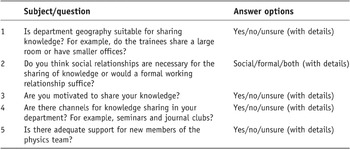
Previous research has highlighted five factors affecting knowledge sharing within COPs in other specialist areas. These are as follows: spatial factors which influence the opportunity for knowledge sharing; the importance of social relationships to the sharing of knowledge; the motivation to share knowledge; channels for knowledge sharing and support for new members of the COP.Reference Argote, Ingram, Levine and Moreland4 We conducted a peer group survey (Table 1) which incorporated these five factors to derive empirical data specifically from trainee medical physicists in the UK and Germany. This form of semi-structured remote interview was conducted on the basis of a loose structure consisting of open-ended questions that defined an area to be explored. The interviewee was able to diverge in order to pursue an idea in more detail.Reference Britten5
A peer group survey designed to derive empirical data specifically from trainee medical physicists in the United Kingdom and Germany

Communication with the peer group was facilitated by the use of national medical physics e-mail bases accessible to the majority of medical physicists in the UK and Germany. The latter mailing list includes subscribers from German-speaking medical physicists in countries like Austria and Switzerland. Responses were collected over a period of 2 weeks for the UK and 3 weeks from the German mailing list, respectively. A qualitative analysis was performed by the authors. In Germany, training leads to either state certification in radiation protection for the use of ionising radiation in medicine (‘Fachkunde im Strahlenschutz’) and/or the certificate in medical physics (‘Fachanerkennung’) by the German national medical physics society (Deutsche Gesellschaft für Medizinische Physik, DGMP); an additional sixth question on this topic was included for statistical purposes. All information was kept confidential.
RESULTS
Literature review
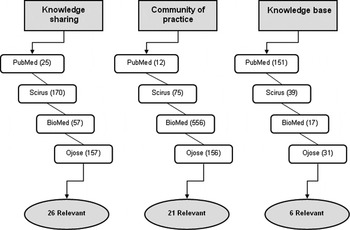
In total, 1,446 publications were found from a search of the ‘PubMed’, ‘Scirus’, ‘BioMed Central’ and ‘Ojose’ databases. For the search phrase ‘knowledge sharing’, 409 publications were found of which 26 were considered to be relevant based on their abstracts. For ‘COP’ and ‘knowledge base’, the findings were 799 (21 relevant) and 238 (6 relevant), respectively. Based on their abstracts, less than 4% of the publications found were deemed relevant for the purposes of this study (Figure 1). In other words, the concept of the radiotherapy physics team as a COP has not, to the best of our knowledge, been previously proposed in the literature. We therefore sought to equate our concept of the radiotherapy physics team as a COP with other instances in the NHS. The details of such collaborative efforts are outside the scope of this paper, but examples include breast cancer services, mental health services and midwifery.
Results of a literature search of the ‘PubMed’, ‘Scirus’, ‘BioMed Central’ and ‘Ojose’ databases. The search phrases used were: Knowledge Sharing, Community of Practice and Knowledgebase.

The literature suggests that the profile of COPs in a clinical setting is growing as recognition spreads within the private sector as well as public sector health care organisations. It is increasingly seen as being essential for the spread of best practice to improve patient care.Reference Bate and Robert6,Reference Boud and Middleton7 The need to integrate tacit and explicit knowledge, and to ensure that the result is relevant to the context in which it is being used is recognised in the literature. In a knowledge-generating environment such as radiotherapy, physicists function not in series but in parallel. The quantity and quality of their output is dependent upon interactions between the group’s members and the degree of cognitive cooperation they achieve within their COP.Reference Gunderman and Chan8 A distinction may be made between information and knowledge, in that information is merely a raw material of unproven applicability to the achievement of some objective, whereas knowledge represents the purpose for which we use such information.
NRAG suggests that a radical workforce re-design focusing on skills is required to address shortages and recruitment difficulties in the radiotherapy physics sector. An estimated 80% of practice could be managed by non-medical practitioners who have the necessary knowledge and skills, and are based entirely within the radiotherapy centre. For this advanced level of knowledge to be achieved in the short term, the authors suggest that a combination of advanced systems such as the Virtual Environment for Radiotherapy Training (VERT) and the promotion of the radiotherapy physics team as a COP is the way forward.Reference Bridge, Appleyard, Ward, Philips and Beavis9
Peer group survey
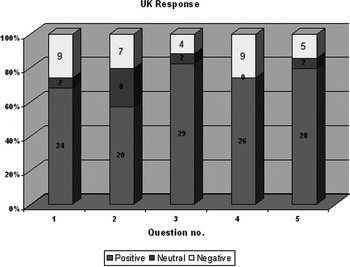
The standard route for medical physics training in the UK takes an average of 4 years and includes an accredited MSc degree with a significant medical physics component. Successful completion leads to corporate membership of the Institute of Physics and Engineering in Medicine (IPEM) and in most cases, state registration. As of July 2008, trainee clinical scientists and students represented approximately 25% of the total membership of the IPEM. Although it is not known exactly how many trainee medical physicists use the national medical physics mail base in the UK, the number of respondents (n = 35) from 26 different NHS Trusts was considered acceptable. On the question of ‘Is department geography suitable for sharing knowledge (Q1)?’, 69% (n = 24) responded positively, 26% negatively and 5% were unsure. A common theme among the positive respondents was that trainees tend to be located in open-plan offices shared with more experienced physicists. This encourages proactive interaction and also facilitates passive learning by ‘overhearing’. Even in small medical physics departments with a single trainee, they found more experienced physicists very accessible. Where the response was negative, the major drawbacks were that the Trust was spread over multiple sites or over an extended local area, meaning that contact with other trainees and more senior physicists was limited. Those who were unsure cited the fact that during the course of their training, they changed offices and were only in sporadic contact with other physicists.
The response to the question of ‘Do you think social relationships are necessary for the sharing of knowledge or would a formal working relationship suffice (Q2)?’ was less well defined. Of the respondents, 57% (n = 20) preferred social interaction. However, 20% favoured more formality and 23% thought a combination of both to be ideal. Of those who preferred social relationships, the common theme was that they reduced inhibitions and made it easier to ask questions. Those who sought formality tended to be more advanced trainees and those from larger departments. Approximately one in five respondents thought a combination of the two was most suitable and could be applied to all situations, for example, by adopting a social approach to trainees at a similar level and a more formal one to senior staff.
On the question of ‘Are you motivated to share your knowledge (Q3)?’, 83% (n = 29) of respondents were positively inclined to the idea of knowledge sharing. Many actively seek out their peers to exchange ideas in an informal manner. The minority (n = 4) who were reluctant tended to be located in large medical physics departments and felt unsure about volunteering information in the presence of senior physicists.
On the question of ‘Are there channels for knowledge sharing in your department? For example, seminars and journal clubs (Q4)?’, the response was mainly positive and 74% (n = 26) of those polled found the local arrangements to be conducive to knowledge sharing. However, a significant number (26%) found the availability of such channels to be inadequate with one respondent reporting a complete lack of them.
On the final question of ‘Is there adequate support for new members of physics team (Q5)?’, 80% (n = 28) responded in the affirmative. They mostly found support from senior staff to be comprehensive and structured induction courses were praised. Those who found the support inadequate (14%) implied that the size of the department and geographical layout were the main causes. Figure 2 shows the results of the UK peer group survey.
Results of the UK peer group survey to derive empirical data regarding: (1) Spatial factors which influence the opportunity for knowledge sharing; (2) the importance of social relationships to the sharing of knowledge; (3) the motivation of share knowledge; (4) channels for knowledge sharing and (5) support for new members of the radiotherapy physics COP.

The route for medical physics training in Germany differs from the one in the UK. To be recognised as a medical physics expert (MPE) according to radiation protection laws in Germany requires a degree in physics, technical engineering or equivalent natural science, two courses in radiation protection of a minimum of 24 h and 48 h, each with a written exam and 2 years of practical training (‘Sachkunde’) which must include a minimum of 6 months work with linear accelerators. The German state specifies the scope of ‘Fachkunde’ of the MPE. The ‘Fachkunde’ has to be renewed every 5 years through attendance of accredited courses in radiation protection for a minimum of 8 hours. Concurrent with this national system for attaining the ‘Fachkunde’ in radiation protection for ionising radiation is a system for medical physics certification (‘Fachanerkennung’) by the DGMP, which is registered by the European Society of Organisations for Medical Physics (EFOMP). This is also based on a university degree, but requires theoretical training of 360 hours, a minimum of 3 years practical training and successful completion of an oral examination. Continuous education in medical physics according to EFOMP guidelines can be certified every 5 years by presenting proof of relevant professional activity to the DGMP commission for continuous education. The number of medical physicists in training in Germany is unknown as there is no official training program to obtain the ‘Fachkunde’ in radiation protection. Despite the recommendation to register the start of the training for the ‘DGMP Fachanerkennung’ with the corresponding DGMP commission, few do so, and therefore, the number of current trainees in Germany is not fully known. Up to March 2009, 595 ‘Fachanerkennungen’ had been granted which compares to about half of the 1,200 DGMP members. The translated questions of the survey were answered by 26 respondents including two from an Austrian mailing address. These will not be treated separately for simplicity as no major differences exist between Germany and Austria with respect the working conditions in medical physics.
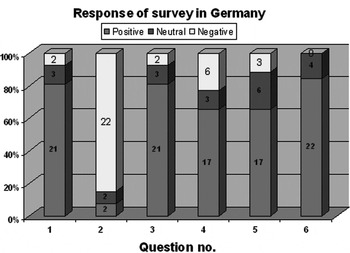
The results of the survey are shown in Figure 3. Department geography (Q1) is regarded as positively in Germany as in the UK, with 81% (n = 21) positive responses to 8% (n = 2) negative. As in the UK, German medical physicists are often located in an open-plan office. This proximity facilitates the exchange of knowledge during working hours, and 85% (n = 22) regard formal contact (Q2) as sufficient compared to 8% (n = 2) who would explicitly extend scientific discussions outside business hours. Nevertheless, good social contact beyond the workplace is regarded as helpful by most respondents. The motivation for exchange of knowledge (Q3) is reported positively by 81% (n = 21), while 8% (n = 2) identify obstacles. This question of the survey relates to the subsequent one (Q4) as questions from trainees are usually fielded by senior medical physicists on a case-by-case manner and are not covered in a scheduled or systematic way. More than one respondent noted ‘if you ask politely, you readily receive an extensive explanation’. Regular seminars or journal clubs queried in Q4 exist mostly in larger medical physics groups. For smaller groups of two or three medical physicists, reports after visits to external seminars or conferences are the usual channel for organised exchange of knowledge. Consequently, a smaller number responded positively 65% (n = 17), while a significant group of 23% (n = 6) responded negatively, referring to the restricted opportunities to benefit from these external channels of knowledge sharing. A few responses mention interdisciplinary team sessions with clinicians which incorporate more formal elements of knowledge exchange.
Results of peer group survey in Germany to derive empirical data regarding: (1) Spatial factors which influence the opportunity for knowledge sharing; (2) the importance of social relationships to the sharing of knowledge; (3) the motivation to share knowledge; (4) channels for knowledge sharing; (5) support for new members of the radiotherapy physics COP, and (6) additional statistical questions, if the aim of training of “Fachkunde” (= positive), “DGMP Fachanerkennung” (= negative) or both (= neutral).

The support for new members of the physics team (Q5) was regarded positively by 65% (n = 17) of respondents. This is despite the fact that no structured system exists in Germany for new members of the medical physics team during their practical training, and only a few centres have set up local training schemes. New trainees are usually assigned to an experienced senior medical physicist, and practical experience is gained through regular duties and problem solving. This is reflected by neutral responses of 23% (n = 6). An additional question (Q6) regarding the aims of current training emphasises the importance placed on obtaining the official certificate in radiation protection for ionising radiation (‘Fachkunde’) by 85% (n = 22). This is the sum of 13 pursuing only the ‘Fachkunde’ and 9 ‘Fachkunde’ and ‘DGMP Fachanerkennung’ simultaneously.
DISCUSSION
The results of the literature survey and the peer group survey give an insight into conditions and attitudes to training in the UK and Germany. It is acknowledged that there is a significant training requirement within both medical physics communities. To meet this requirement, the radiotherapy physics departments need to focus on a common sense of mission to form a COP. Radiotherapy physicists are required to keep abreast of scientific and medical research in their own and other fields, and to continuously develop their scientific, computational and management competencies. Much of this knowledge is gained through peer-to-peer interaction in a structured environment, enabling the individual to increase their tacit knowledge. Such interaction among peers will allow issues to be framed within their context, information to be shared, decisions to be made and protocols to be developed.
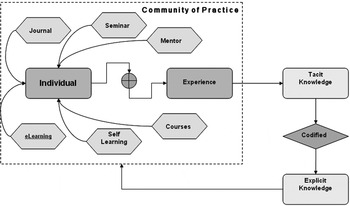
Figure 4 illustrates the continuous learning loop relating tacit knowledge, explicit knowledge and the radiotherapy physics COP. Physicists expand their core knowledge through various channels such as departmental seminars, scientific journals and books, mentorship, online learning, training courses and self-learning. This forms a subset of the body of knowledge within the radiotherapy COP and when combined with the everyday experience of the individual, becomes tacit knowledge. The individual may choose to codify this tacit knowledge through the creation of work instructions, protocols, scientific publications, class solutions for complex treatment plans, or through the patenting of ideas. This explicit knowledge augments the radiotherapy COP for the benefit of other physicists who in turn may incorporate that knowledge with their own experience to generate new tacit knowledge. In this way, the learning loop is perpetuated.
The continuous learning loop relating tacit knowledge, explicit knowledge and the radiotherapy community of practice.

The successful translation from theory to practice of the concept of a radiotherapy physics COP relies upon the expectancy-value theory (EVT). The EVT itself consists of three basic components. Firstly, individuals respond to novel information about an item or action by developing a positive opinion about the item or action. If an opinion already exists, it can and most likely will be modified by new information. Secondly, individuals assign a value to each attribute that a belief is based on. Thirdly, an expectation is created or modified based on beliefs and values.Reference Wigfield and Eccles10 For example, a radiotherapy physicist encounters positive feedback about their local COP. The physicist assigns a positive value to the concept of the radiotherapy physics team as a COP, so the physicist has the expectation that their learning experience will be positive. When the physicist actually finds this to be the case, they adopt it as a useful concept.
The radiotherapy physics COP highlights the difference between knowledge sharing and information exchange. Information consists of a structured arrangement of facts and figures, while knowledge provides insights and interpretations, and refers to specific situations. The body of knowledge within the radiotherapy COP evolves through interpersonal sharing and the use of information pools such as databases. Time constraints and lack of a recognised departmental information repository may bias trainee physicists towards verbal communication of their ideas and solutions to others rather than commit them to a database.
The concept of communities of practice is increasingly recognised as being vital for health care organisations such as the NHS. However, the level of acceptance has been lower than anticipated. The successful development of COPs requires strong leadership especially in healthcare trusts where knowledge exchange occurs across professional boundaries. Interaction within the radiotherapy COP is a part of continuing professional development and time should be allowed for this.Reference Gorry11,Reference Fraser, Marcella and Middleton12 Although our surveys showed that there is a strong, latent desire to share knowledge, it may prove difficult to obtain support for a core group to develop a shared knowledge repository. However, there is a definite case for such a resource in any COP.Reference Laalo13 The conventional idea that ‘knowledge is power’ can be taken further to mean that ‘knowledge sharing is power’.Reference Hansen, Nohria and Tierney14
COPs themselves may develop internal barriers to knowledge sharing such as hoarding of knowledge, clique formation, limitation of innovation and exclusiveness with regard to membership.Reference Wenger15 Other barriers encountered are busy work schedules, new staff lacking the confidence to ask questions or make suggestions in a formal setting, lack of a knowledge sharing infrastructure such as a document base, absence of networking outside the local COP and only a token institutional commitment to the facilitation of knowledge sharing. Despite differences in national approaches to the training of new members of the radiotherapy physics team, our survey of training attitudes in the UK and Germany highlighted two common obstacles to knowledge sharing in the radiotherapy COP, namely spatial factors (departmental layout) and the lack of internal channels for knowledge sharing such as journal club meetings and departmental seminars.
PROMOTING KNOWLEDGE SHARING
We suggest several methods to promote knowledge sharing within the radiotherapy physics COP. A simple list of names and areas of expertise of all physicists would facilitate the quick embedding of new members into the COP of larger radiotherapy physics groups. Even established members may be unaware of the potentially useful skills of their colleagues and such a list could reduce process redundancy.
Greater use of web-based facilities also contributes to knowledge sharing beyond the local physics group. In our view, it is essential that any medical physics department promotes a corporate image within the domain of their health trust. The availability of a medical physics Website on both the Internet and intranet would enhance the recruitment and induction of new members of the COP. Such Websites are dynamic and continuously evolving, and could be a useful training resource for trainees in the local radiotherapy COP, as well as their colleagues at other training centres.
The creation of an interactive knowledge base, for example, in the form of a mind map rather than a mere electronic document store would enhance the rapid spread of explicit knowledge within the radiotherapy COP. Such knowledge bases accept search string inputs, and many commercial systems are readily available. This database could be very easily made accessible to external users via the Internet.
The establishment of research micro-communities within the larger COP is another way to solidify tacit knowledge and create new explicit knowledge. Within such groups, ideas are created and modified, current research areas described, collaborations formed and available resources more efficiently utilised. This relies upon active support from the management structure providing the necessary time for this exchange of knowledge, and all members of the radiotherapy COP should be encouraged to participate.
CONCLUSION
The need for more trained medical physicists in radiotherapy in Germany has already been stated by a common declaration of DGMP and the German Society for Radio OncologyReference Wucherer and Herrmann16 in 2001, and by NRAG in 2007. In 2009, the situation in Germany has not improved. Indeed, the shortage of skilled medical physicists in radiotherapy for the staffing of new facilities or replacing retiring physicists has increased. This is due to a lack of paid training positions for new members of the physics team and lack of faculty positions at universities providing the organised theoretical knowledge transfer and physical science development in radiotherapy that could attract young physicists. In the UK, physicists already perform to an exceptionally high level and are prepared to work for additional hours to provide a high-quality radiotherapy service. Even more will be expected of medical physicists in the short term, and new ways of working and learning will need to be implemented. Flexible working structures are already in place, but innovative learning paths are under-explored in the health care system.
We believe that the recognition of the radiotherapy physics team as a COP is the first step towards enhancing the efficiency of learning among its members. The potential benefits apply across the spectrum of experience levels from trainee to consultant physicist. Our surveys have shown that while most trainees are adequately supported, there are two areas where improvements can easily be made. Spatial factors, such as departmental geography, may not always be conducive to knowledge sharing but can readily be altered in most cases. The paucity of departmental seminars and journal club meetings has been highlighted as a problem at some training centres. Again, with adequate management support, and proper planning and organisation, this is not an insurmountable obstacle. Radiotherapy physics at the clinical level is a highly interdisciplinary field involving collaboration with oncologists, surgeons, radiographers, anaesthetists and pathologists among others.Reference Armoogum, Ackland and Gardner17 This demonstrates the potential to form COPs involving other professionals. The concept of a radiotherapy physics COP while underpinned by processes and technologies is an abstract, intangible entity. Essentially, it is a way of thinking, a mindset and once adopted, becomes second nature. Gathering knowledge is easy, sharing it is difficult.
Acknowledgements
The authors wish to acknowledge the feedback of all the trainee clinical scientists who responded to the online survey of training attitudes in the UK and Germany. Special thanks to Carola Goldmann for proof-reading this article.