

Pain is recognised as a problem of significant concern worldwide and in the latest Global Burden of Disease Study, low back pain was identified as the biggest contributor worldwide to Years Lived with Disability (YLDs) (Froud et al., Reference Froud, Patterson, Eldridge, Seale, Pincus, Rajendran and Underwood2014). People with chronic pain may experience depression and anxiety, social isolation, stigma, and unemployment (Institute of Medicine (US), 2011; MacNeela, Doyle, O'Gorman, Ruane, & McGuire, Reference MacNeela, Doyle, O'Gorman, Ruane and McGuire2013; Newton, Southall, Raphael, Ashford, & LeMarchand, Reference Newton, Southall, Raphael, Ashford and LeMarchand2013), and severe pain has been found to have a stronger impact on health-related quality of life than nearly all other conditions (Stewart, Woodward, Rosen, & Cutler, Reference Stewart, Woodward, Rosen and Cutler2008).
There is evidence to suggest that people who accept their chronic pain have a higher quality of life, lower levels of disability and distress, and function better emotionally, socially and physically (Esteve, Ramírez-Maestre, & López-Martínez, Reference Esteve, Ramírez-Maestre and López-Martínez2007; Gillanders, Ferreira, Bose, & Esrich, Reference Gillanders, Ferreira, Bose and Esrich2013; LaChapelle, Lavoie, & Boudreau, Reference LaChapelle, Lavoie and Boudreau2008; McCracken & Eccleston, Reference McCracken and Eccleston2005; Morley, Davies, & Barton, Reference Morley, Davies and Barton2005; Viane, Crombez, Eccleston, Devulder, & De Corte, Reference Viane, Crombez, Eccleston, Devulder and De Corte2004; Vowles, McCracken, & Eccleston, Reference Vowles, McCracken and Eccleston2008). Findings on the specific pathways linking pain acceptance to quality of life outomes are less clear. On the one hand, Viane et al. (Reference Viane, Crombez, Eccleston, Devulder and De Corte2004) found that acceptance had a unique contribution to mental health beyond that of pain severity or catastrophising, but that it did not predict physical functioning. On the other hand, Gillanders et al. (Reference Gillanders, Ferreira, Bose and Esrich2013) found that acceptance mediated the relationship between pain and physical dysfunction but not between pain and emotional dysfunction. These discrepant findings suggest a need for additonal studies on the components of pain acceptance important for quality of life outomes.
It is also unclear what the components of acceptance are and how acceptance develops. For instance, Geiser (Reference Geiser1992) identified two acceptance factors with strong associations with patient outcomes: pain willingness and activity engagement. Pain willingness involves being willing to experience pain without using unnecessary avoidance and control, and activity engagement relates to participating in activities whether or not pain is experienced (McCracken, Vowles, & Eccleston, Reference McCracken, Vowles and Eccleston2004). Risdon, Eccleston, Crombez, and McCracken (Reference Risdon, Eccleston, Crombez and McCracken2003) considered chronic pain acceptance to include taking control, living day to day, acknowledging limitations, empowerment, accepting loss of self, more to life than pain, don't fight battles that cannot be won, and spiritual strength. Participants in the Ojala et al. (Reference Ojala, Häkkinen, Karppinen, Sipilä, Suutama and Piirainen2014) study believed that chronic pain acceptance involved acknowledging that pain would never go away, and ceasing denial and avoidance of pain. LaChapelle et al. (Reference LaChapelle, Lavoie and Boudreau2008) found chronic pain acceptance among women with arthritis and fibromayalgia to involve realising they needed help, receiving a diagnosis, realising there was no cure for their pain and realising the need to redefine what was ‘normal’ (LaChapelle et al., Reference LaChapelle, Lavoie and Boudreau2008). Acceptance was seen as a process that began with a diagnosis, which was considered critical to achieving acceptance. Kostova, Caiata-Zufferey, and Schulz (Reference Kostova, Caiata-Zufferey and Schulz2014) also found that the absence of a diagnosis hindered the acceptance process for people with rheumatoid arthritis.
More qualitative studies on personal meanings of acceptance held by those living with chronic pain might address the gap in the literature about the qualities of acceptance important for living well with pain (Osborn & Rodham, Reference Osborn and Rodham2010). For instance, the two widely accepted pain acceptance factors, pain willingness and activity engagement, have not been well explored in qualitative studies on acceptance of chronic pain. To address this deficit in the literature, the current study has two related aims: (1) to explore pain willingness and activity engagement in the lives of people with chronic pain; and (2) to find out what people believe helps them to successfully get on with life in spite of chronic pain.
Method
Research Design
The research was part of a larger study which also investigated illness beliefs of people with chronic pain. An interview schedule was developed with questions about participants’ beliefs about their pain, for use in the study on illness beliefs. A qualitative approach was chosen for this study because such approaches enable flexible, in-depth exploration of questions of interest (Smith, Reference Smith2008). Thematic analysis was used because it ‘is a method for identifying, analysing and reporting patterns (themes) within [qualitative] data’ (Braun & Clarke, Reference Braun and Clarke2006, p. 79), which the study required. Thematic analysis is often used with interview data and is well suited for uncovering and clarifying participants’ perspectives and experiences in relation to the phenomenon being studied. The approach does not have a specific theoretical or epistemological foundation and can be used flexibly with different theoretical approaches (Harper & Thompson, Reference Harper and Thompson2011). Thus, it was seen as an appropriate choice for the current study.
Participants
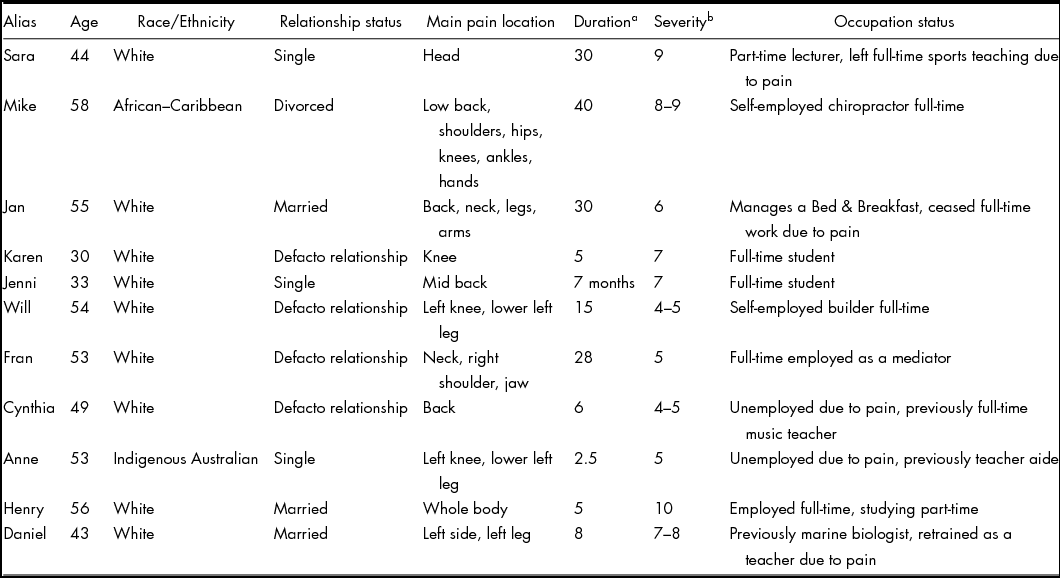
Participants were a purposive sample of 11 adults self-reporting non-malignant pain for at least six months. There were seven females and four males, aged between 30 and 58 years (M = 48, SD = 9.43). Participants were recruited by word of mouth. A brief questionnaire was used to gather demographic data (see Table 1).
Participant Demographics

a Pain Duration = Number of years pain has been experienced. Where multiple pain sites exist, duration relates to site with longest duration.
b Severity = Highest level of pain severity in last 30 days or in most recent pain episode, where 0=no pain and 10=most severe pain imaginable.
Ethical Considerations
The study received ethical clearance from the Queensland University of Technology (QUT) Human Research Ethics Committee (Ethics Approval Number: 1400000560). Written informed consent was obtained before beginning each interview.
Data Collection
All interviews were conducted by the first author (CT) and were held at the QUT, at a chiropractic clinic, and at public locations negotiated with participants. Each interview began with a general question inviting the participant to describe their pain experience from the beginning, followed by questions tapping into illness beliefs and acceptance. The interviews were conversational, to allow in-depth exploration of participants’ experiences. Throughout the interviews, prompts such as ‘can you tell me more about that?’, were used to encourage participants to expand on their responses.
Purposive sampling was used to enhance the credibility and trustworthiness of the data. Participants were recruited from a chiropractic clinic (1), the QUT fourth year psychology cohort (2), and via word of mouth. Three individuals known to the first author who self-identified as chronic pain sufferers were approached and they agreed to participate. These individuals named other persons with chronic pain (5), all of whom agreed to participate in the study.
Participants responded to questions in semi-structured interviews that ranged from 45 minutes to 1 hour in length. Interviews were recorded using the voice memo application on an iPhone 4S, and recordings were uploaded to a laptop, after which they were deleted from the iPhone. All interviews were conducted by the first author (CT). The interview questions addressed the following topics: (1) whether the participant had been able to get on with their lives and what they believed helped them to do so; (2) pain-related activity limitations; (3) whether it was important to keep pain under control; (4) use of avoidance to manage pain and (5) what would help them to get on with life.
Data Analysis
All interviews were transcribed verbatim using InqScribe transcription software (2013). The data were coded and analysed using Atlas.ti qualitative data analysis and research software (Atlas.ti, 2012). Thematic analysis followed the process recommended by Braun and Clarke (Reference Braun and Clarke2006) with minor variations, and included the following steps: (1) familiarisation with the data, which involved listening to each recorded interview and reading the transcripts; (2) initial coding of transcripts; (3) second coding of transcripts; (4) searching for themes by reviewing codes, associated coded extracts and analytic memos and by analysing thematic maps; (5) third round of coding and (6) naming themes. Analytic memos were also used throughout to record thoughts and impressions. Interview transcripts and recordings were revisited a number of times. This immersion in the data gave us a deeper sense of the participants’ experiences and meanings and facilitated identification of patterns across the data. We used a primarily theoretical (rather than data-driven) thematic analysis approach (Braun & Clarke, Reference Braun and Clarke2006), in that theory-informed interview questions were used to elicit information about participants’ pain willingness and activity engagement and experience of getting on with life. However, by using data from participants’ pain stories and from the questions aimed at uncovering illness beliefs, our approach was also data-driven.
The second author was a decision partner in the selection of the coding and analysis process for this research. The primary collection, coding and analysis was undertaken by the first author, with the second author reviewing this output and providing second-order analysis to align respondent comment and intent with the final written description in this manuscript. Analysis was iterative, with each round of analysis leading to refinement of codes and themes. Extracts were coded and themes named on the basis of their relevance to theory and study aims. Throughout the analysis, the authors communicated frequently to discuss connections between codes, meaning units and themes, patterns in the data and the naming of themes.
Results
Pain Willingness and Activity Engagement
Nine of the 11 (82%) participants gave specific examples of pain willingness and activity engagement.
For example, once when mum came up to visit, and I had spondylolisthesis as well, in my spine, so I was in a bad way. I could not sit up. But I figured, I really wanted to show mum what it was like up north, so I remember planning “well, I'll lie in the back seat and put the seatbelt on. I'll direct mum with the map and she can drive, and I can get out” — cause I couldn't sit, but I could lie or stand — “and then I'll get out when we get to the Curtis Figtree. . . - Sara (head and neck)
Jan spoke of choosing to continue to work against the advice of a specialist:
I went to a specialist because I'd get days where my back would just catch or I couldn't move or I'd vomit with the pain it was so extraordinary, and it was really affecting my lifestyle. . . He basically said you have to change your lifestyle, relax, stop working, which is ridiculous when you're 40-odd and you need to earn an income. So I didn't stop working, of course.’ Jan (back, neck, legs and arms)
Mike (pain in multiple joints) works full-time as a chiropractor, and is setting world records in powerlifting at 60 years old, which involves weight training four times a week. Henry (whole body) works full-time and studies part-time. Daniel (left side and left leg), a marine biologist who retrained as a teacher because of his pain, said:
I guess, what I found most interesting about that was. . . the teaching thing I thought was gonna be, you know, a more sedentary lifestyle, uh, and look, I'm much busier and more active than I was prior to having avascular necrosis.
Our results correspond with those of other researchers. For example, participants in the LaChapelle et al. (Reference LaChapelle, Lavoie and Boudreau2008) study emphasised the importance of enduring pain in order to have desired experiences. Also, like participants in the Ojala et al. study (Reference Ojala, Häkkinen, Karppinen, Sipilä, Suutama and Piirainen2014), four of our participants (36%) reported that avoiding and denying pain led to negative consequences. However, it generally took years of living with pain for participants to realise it was best to be active and engaged with life, as other researchers have found (e.g., Dickson, Knussen, & Flowers, Reference Dickson, Knussen and Flowers2008; Ojala et al., Reference Ojala, Häkkinen, Karppinen, Sipilä, Suutama and Piirainen2014). For instance, Sara (head and neck) observed: ‘. . . it got to the point where I thought, “oh, stuff it. I'm not staying in bed anymore, because I've got pain if I lie in bed and I've got pain if I go out”’. And Cynthia said, ‘You know, eventually I said, ‘what choice do I have? I either lie in bed 4 days a week or I get up and just make a go of it’. (back) Our participants also described activity engagement and pain willingness fluctuations that depended on their position in the hope-despair cycle (see Corbett, Foster, & Ong, Reference Corbett, Foster and Ong2007). These results suggest that acceptance, too, fluctuates.
Pain Avoidance and Activity Restrictions
Although participants gave clear examples of willingness to experience pain in order to do things that were important to them, nine participants (82%) gave examples of activity avoidance and unwillingness to experience pain.
When you're home and you're tired and you're achy and sore, and you have a barbecue to go to and you've been working all week and your back is killing you and you don't want to stand up or sit in the car and drive there. It's easier to stay home, put it off. Mike (pain in multiple joints)
And Henry said:
There's things where I think “oh, no. I just couldn't be bothered”. I just don't, you know, I would've normally loved to do that but I just. . . it's too hard. (whole body)
According to Daniel:
There's things that I just can't do. Like I can't walk long distances. Cos that's . . . it's just. . . it's not good for me anyway, but it also exacerbates the pain, like it just makes it worse. So, there's some things that I don't do. (left side and left leg)
Finally, from Fran: ‘So I have made certain decisions about what I will and will not do to minimise the impact on my body. I don't want to damage it any further or make it worse’. (neck, shoulder and jaw)
In many cases, the activities our participants usually avoided were recreational or social activities. This effect of chronic pain on social participation is well-recognised (Breivik, Collett, Ventafridda, Cohen, & Gallacher, Reference Breivik, Collett, Ventafridda, Cohen and Gallacher2006; Campbell & Guy, Reference Campbell and Guy2007; Dennis, Larkin, & Derbyshire, Reference Dennis, Larkin and Derbyshire2013; Newton et al., Reference Newton, Southall, Raphael, Ashford and LeMarchand2013). Although participants said they were often too tired or in too much pain to attend social functions, social withdrawal was also a response to previous experience (or fear) of not being believed or understood, an effect of chronic pain found in research on the stigmatising impact of chronic pain (Holloway, Sofaer-Bennett, & Walker, Reference Holloway, Sofaer-Bennett and Walker2007). This stigmatisation is associated with loss of self and is a barrier to adjustment to chronic pain (Holloway et al., Reference Holloway, Sofaer-Bennett and Walker2007; Newton et al., Reference Newton, Southall, Raphael, Ashford and LeMarchand2013), both of which were described by our participants Anne and Cynthia, who said they were not getting on with their lives.
Use of medication
Most participants (73%) used over-the-counter or prescription medication to manage their pain. For some, pain medication was used before activities where they feared pain would increase, and several participants were on long-term opoid pain medication. A number of participants also said they would try new pain medication or pain management techniques if they became available. It is noteworthy that participants with very high levels of pain said pain medication did little to reduce their pain, but they continued to use them. One explanation for this behaviour is that any treatment, even short-lived or ineffective treatment, reassures the individual that they are actively getting someone to help them (Campbell & Guy, Reference Campbell and Guy2007). Thus, the use of medication can be seen not only as a pain avoidance measure, but as a way of taking action to minimise the effects of pain, making activity engagement possible.
In summary, avoidance and control of pain was evident even though participants also gave examples illustrating acceptance of their pain. It is important to emphasise that the aim of acceptance is to improve functioning in certain situations to facilitate values-based action and is unlikely to be present all the time (McCracken & Vowles, Reference McCracken and Vowles2014). Therefore, determining whether specific behaviours are appropriate is important, and pain avoidance should be evaluated based on whether it passes the ‘workability’ test; that is, whether it takes the individual towards or away from values-based action (Dahl, Luciano, & Wilson, Reference Dahl, Luciano and Wilson2005). However, it can be difficult for people with chronic pain to know when they are imposing unnecessary restrictions on activities, or whether they should use medication, because of shared social understandings about pain, including the belief that avoiding pain and restricting activities is necessary. Education about pain might help with this, as other researchers have found (see Meeus, Nijs, Van Oosterwijck, Van Alsenoy, & Truijen, Reference Meeus, Nijs, Van Oosterwijck, Van Alsenoy and Truijen2010; Moseley, Reference Moseley2004).
Themes Related to Getting on With Life
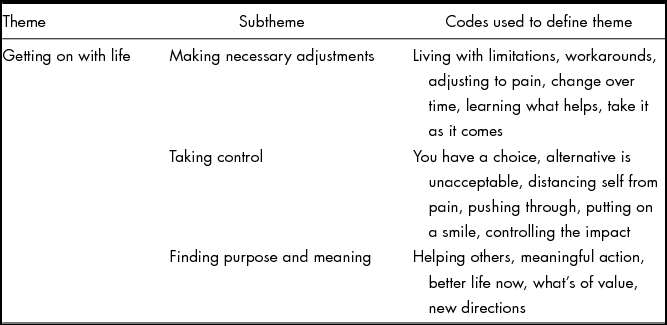
Three subthemes resulted from the data analysis: making necessary adjustments, taking control and finding meaning and purpose (see Table 2). Nine of the 11 participants (82%) said they were getting on with their lives in spite of chronic pain, and two said they had not been able to get on with life. The themes are considered next.
Final Themes and Subthemes
Theme one: making necessary adjustments
All of the participants reported that their lifestyles, activity levels or work situation had changed because of their pain. Whilst nine (82%) acknowledged choice or recognised the importance of adjusting, the two participants who were having the greatest difficulty adapting to their pain felt forced to live with undesirable changes. As an example of acknowledging the need to make changes, Sara said she arranged her work schedule to manage her symptoms: ‘I work two days a week at the moment. But you see, I work in sort of 4 hour shifts. So that's enough that I can actually manage what's going on’. (head and neck)
‘You just have to be adaptable, I think. . . I guess I know what I can manage and I just do what I can when I can. And even if I can't do as much as I want, I do a bit, which gets you there eventually’. Fran (neck, shoulder and jaw)
‘Like, I take up a group of university students to Lizard Island every year. And there's a really long hike that we do as part of that . . . I don't do that hike. And I make that really clear in any employment or any job that I take on that I can't walk’. Daniel (left side and left leg)
When people with chronic pain accept their pain-related limitations, they adjust better to chronic pain. Accepting limitations was an important feature of getting on with life for participants in our study, as in other research (e.g., Kostova et al., Reference Kostova, Caiata-Zufferey and Schulz2014; LaChapelle et al., Reference LaChapelle, Lavoie and Boudreau2008; Risdon et al., Reference Risdon, Eccleston, Crombez and McCracken2003). The negative impact of chronic pain on the ability (and in some cases, the willingness) to engage in identity-related activities contributes to the loss of self that can plague chronic pain sufferers (Crowe et al., Reference Crowe, Whitehead, Gagan, Baxter, Pankhurst and Valledor2010), which seemed to be the case for our two participants who were struggling to adapt to their pain.
Theme two: taking control
Participants needed to be active and assertive in the management of their chronic pain, as described by Henry: ‘I'm going to control IT; it's not going to control ME’. (whole body) Henry explained that taking control meant controlling his life, rather than controlling pain. For Daniel, reducing his medication helped him to have more control. He said:
I've actually weaned myself off of quite a few drugs. Off Lyrica and a few other things that I found mentally, um, damaging. I just felt stupid on them, basically, so I prefer to have more pain and be clear than have less pain and be dopey (left side and left leg).
Sometimes taking control meant following advice of health professionals, as Fran explained: ‘I've learnt, like a couple of physios told me, don't do this, don't do this, so I'm much more careful about what I do and don't do.’ (neck, shoulder and jaw). On the other hand, for Karen (knee) taking control meant disregarding professional advice: ‘like if I was told I should never run again, I don't think I'd take that advice, because I kind of need it for my mental health’.
The loss of personal control and its impact on self and identity is well-documented in the chronic pain literature (Crowe et al., Reference Crowe, Whitehead, Gagan, Baxter, Pankhurst and Valledor2010; LaChapelle et al., Reference LaChapelle, Lavoie and Boudreau2008; Rodham, McCabe, Pilkington, & Regan, Reference Rodham, McCabe, Pilkington and Regan2013) and four (36%) of our participants thought that regaining a sense of control was an important aspect of successfully getting on with life. The salience of this factor is supported by the experiences of the two participants in our study who still felt controlled by pain: They said they had not been able to get on with life.
Theme three: finding purpose and meaning
Some participants (36%) emphasised the importance of having a purpose, finding meaning in their pain experience or which helped them to live with their chronic pain. For instance, Mike is a health professional who gets enormous satisfaction from the relief he is able to offer other people who experience pain. He said, ‘the outcome you want is not the reason you do it, right? It's the process, the day to day experience of doing that which has some sort of meaning’ (pain in multiple joints). For Jenni (mid-back), passion for her university studies and future career motivates her to get on with her life. She said ‘I know this is what I want to do, whether I have pain or whatever, and I don't want to give it up’. Daniel said, ‘finding the things that are of value gives you meaning and then having meaning helps make the whole thing better’. (left side and left leg)
Pain had a positive meaning for some participants. Henry said,
In terms of focusing on what's real and what's important and what's, you know, useful in your life, um, you know, it really does focus down very very very clearly on what is important and I've used that, I've used the pain really nicely in that sense, so in some ways I've really, I welcome the pain. (whole body)
Sara, too appreciates the positive impact of pain on her life. She said ‘I'm not stressed, and I think, if I had not had that.. all those things happen, I'd be driving myself like a workaholic’. (head and neck)
And Daniel explained,
‘If I didn't have the pain I wouldn't be searching for the meaning as clearly too, you know, so that's why I don't see it as being a bad thing. So, um, if I didn't have the pain I wouldn't be in the position that I'm at and apart from the pain, I'm pretty happy with that position’. (left side and left leg)
The positive meaning of pain is supported by Ojala et al. (Reference Ojala, Häkkinen, Karppinen, Sipilä, Suutama and Piirainen2014), whose participants described ways they had grown as a result of pain. Our results are also consistent with Aldrich and Eccleston's (Reference Aldrich and Eccleston2000) findings on the diverse meanings of pain: In addition to negative meanings of pain, pain can also provide opportunities for self- or spiritual growth.
Difficulties Getting on With Life
Two participants said they had not been able to get on with their lives. For instance, Anne said, ‘No, because with the last job, you know, I felt. . . I was angry with myself for not being honest about my knee and . . . I guess I took it very sensitively’. (left knee and lower left leg)
Cynthia observed:
I don't know, because I've had to deal with all the trauma of it, because as soon as I start thinking about it I get really upset and angry. And I'm still really angry. . . I don't know if I could label it, because it sort of comes out as a traumatic thing, it's sort of very traumatic. And because it wasn't my fault, it just . . . I did nothing wrong. I mean . . . I didn't crash my car into a brick wall or anything. I was quite innocent. (back)
Cynthia and Anne were among four participants who said that they had been changed negatively by pain, but Cynthia and Anne had a sense of loss that was a source of much suffering for them, which was evident throughout their interviews. Cynthia said she was once a strong, brave person who is not used to being a weakling sitting in the corner going ‘struggle, struggle, struggle’. She described herself now as an ‘injured chicken with a broken wing’.
When asked what would help her to get on with her life, Anne (left knee and lower left leg) said ‘I would have to be employed’. She also spoke of her anxiety about walking:
Um, I don't walk. . . I used to walk, you know, just with the dogs, or do a 50 minute walk, actually, in the morning and in the evening. Um, I did try and do that again but the clicking clicks in and you feel like you're starting to become unstable, so.. and there's a certain amount of pain where you have to sit down.
Cynthia said:
I don't know, I've even thought of getting a private trainer. I thought maybe a private trainer would know more about, you know, what I'm doing wrong. Um, no, I can't see anything, any sort of help. I do still get a fair amount of help already, so. Five or six doctors I still see.. (back)
Similar to other research (e.g., Morley et al., Reference Morley, Davies and Barton2005; Smith & Osborn, Reference Smith and Osborn2007), this study found that chronic pain can have a negative impact on the self and identity, which was described by four participants, but was particularly problematic for Anne and Cynthia. They can be considered to have experienced self-pain enmeshment, which involves believing the future hoped-for self is dependent on the absence of pain. According to the self-pain enmeshment theory, chronic pain entraps the sufferer's self, which can result in high levels of distress and illness behaviour (Pincus & Morley, Reference Pincus and Morley2001). Dickson et al. propose that accepting the loss of the anticipated self is critical to adjustment to chronic pain (2008). Rather than encouraging acceptance of the loss of the anticipated self, Acceptance and Commitment Therapy (ACT) addresses attachment to the conceptualised self by teaching clients to see the self as ‘a secure and continuous I who from which events are experienced’ (Luoma, Hayes, & Walser, Reference Luoma, Hayes and Walser2007, p. 19).
Implications for Chronic Pain Counselling Practice
Where counselling or clinical intervention does occur, ACT-based acceptance could be taught and clients could be trained to assess their avoidance behaviours for workability. Also, an ACT therapeutic process addressing the conceptualised self might help people to see themselves as whole and separate from the events of their lives, including changes in their bodies, roles and activities. Health professionals who identify unnecessary pain avoidance or activity restrictions in their patients could address this or refer to appropriately trained mental health professionals. As previously discussed, education and training is also needed by health professionals, who are sometimes the source of misinformation.
Strengths and Limitations
A strength of this study is that the study examined the two pain acceptance factors using a qualitative methodology, providing a nuanced view of participants’ pain willingness and activity engagement that we did not find in the extant literature. Because of the recruitment method used and the qualitative study design, results from the study cannot be generalised beyond the participants studied. However, the commonalities in participants’ responses suggest that the findings may be cautiously applied to other people with chronic pain. A possible limitation of our research is that the expression ‘getting on with life in spite of chronic pain’ was used to draw out participants’ experiences of and views on acceptance, but participants may have understood the expression to mean something other than what was intended.
Future researchers would do well to investigate how people can achieve acceptance of chronic pain both with and without professional intervention. Such research would facilitate the development of appropriately targeted education, counselling and clinical interventions.
Conclusions
The current study suggests that people with chronic pain need education about chronic pain, and, in particular, about the effects of social withdrawal and avoidance and control of pain. The beliefs people hold about chronic pain, including its effects and how to manage it, appear to lead to unnecessary restrictions and contribute to distress and disability.
Funding
Financial support for this research was provided by a Manuscript Completion Award from the Centre for Accident Research and Road Safety - Qld (CARRS-Q) at Queensland University of Technology.