Among anxiety disorders, generalised anxiety disorder (GAD) has been determined to be one of the most ubiquitous, with 1-year prevalence rates ranging from 3% to 8% (Sadock & Sadock, Reference Sadock and Sadock2007; Kessler, Chiu, Demler, & Walters, Reference Kessler, Chiu, Demler and Walters2005). In light of its prevalence, significantly deleterious impact on life functioning (Ormel et al., Reference Ormel, VonKorff, Ustun, Pini, Korten and Oldehinkel1994; Schonfield et al., Reference Schonfeld, Verboncoeur, Fifer, Lipschutz, Lubeck and Buesching1997), and high comorbidity (Brawman-Mintzer et al., Reference Brawman-Mintzer, Emmanuel, Jarrell and Ballenger1993; Brown, Barlow, & Liebowitz, Reference Brown, Barlow and Liebowitz1994; Brown, Campbell, Lehman, Grisham, & Mancill, Reference Brown, Campbell, Lehman, Grisham and Mancill2001; Brown, Marten, & Barlow, Reference Brown, Marten and Barlow1995; Bruce, Machan, Dyck, & Keller, Reference Bruce, Machan, Dyck and Keller2001), special research has been undertaken to furnish self-report assessments of theoretically salient features of GAD that evince sound psychometric properties. Several conceptualisations underscore disparate constructs relevant to the etiology and maintenance of GAD symptoms. Contemporary models of GAD accord great importance to the function of worry, intolerance of uncertainty, experiential avoidance, general distress, and trait anxiety (Behar et al., Reference Behar, DiMarco, Hekler, Mohlman and Staples2009).
Among the myriad assessments currently available, the following have been considered especially relevant to these core constructs underlying GAD: the Penn State Worry Questionnaire (PSWQ), the Intolerance of Uncertainty Scale (IUS), the Acceptance and Action Questionnaire II (AAQ-II), the subscales of the Mood and Anxiety Symptoms Questionnaire (MASQ), and the trait component of the State-Trait Anxiety Inventory (STAI-T). A principal component of GAD, as underscored in the DSM-IV and evidenced by prior literature (Ruscio, Reference Ruscio2002; Ruscio & Borkovec Reference Ruscio and Borkovec2004), is pathological worry. Meyer, Miller, Metzger, and Borkovec (Reference Meyer, Miller, Metzger and Borkovec1990) designed the PSWQ as a measure of worry, which has enjoyed increasing prominence and has achieved good psychometric properties (Molina & Borkovec, Reference Molina, Borkovec, Davey and Tallis1994). Intolerance of uncertainty, that is, an extreme aversion to ambiguous future events that may eventuate in negative outcomes, has been postulated as a cognitive schema contributing to the maintenance of GAD (Dugas, Gosselin, & Ladouceur, Reference Dugas, Gosselin and Ladouceur2001). The original French version of the Intolerance of Uncertainty Scale (Freeston, Rheaume, Letarte, Dugas, & Ladouceur, Reference Freeston, Rhéaume, Letarte, Dugas and Ladouceur1994), along with the English version (Buhr & Dugas, Reference Buhr and Dugas2002), has exhibited good internal consistency and test–retest reliability in college samples. Experiential avoidance, of which the AAQ II is a measure, has been identified as a cardinal characteristic of GAD, as worry has been conceptualised to function as a means of avoiding negative thoughts (Roemer & Orsillo, Reference Roemer and Orsillo2002). The MASQ assesses the tripartite model of anxiety and depression accounting for common and disorder specific features (Watson & Clark, Reference Watson and Clark1991). Core constructs reflecting broad domains of emotional distress, such as general anxious distress and dysphoric distress, and disorder specific symptoms, such as anxious arousal, have been implicated in GAD (e.g., for a consideration of GAD as a pure manifestation of high trait anxiety, see Rapee, Reference Rapee1991; for an illustration of anxious arousal as tempermentally and etiologically relevant to GAD, see Rapee, Reference Rapee, Vasey and Dadds2001; for an account of the relevance of dysphoria in GAD, see Brawman-Mintzer et al., Reference Brawman-Mintzer, Emmanuel, Jarrell and Ballenger1993; Pini et al., Reference Pini, Cassano, Simonini, Savino, Russo and Montgomery1997). Given conceptualisations of GAD as a residual diagnostic category capturing individuals with high levels of generalised trait anxiety, the STAI-T (Spielberger, Reference Spielberger1983) has been proposed as a valid measure of GAD (Fisher & Durham, Reference Fisher and Durham1999).
Essential in the consideration of the merits of any measurement is its discriminatory ability. Receiver operating characteristic analysis (ROC) enables researchers to appraise whether some measures reliably distinguish those with some disorder from those without (Kraemer, Reference Kraemer1992; Hanley & McNeil, Reference Hanley and McNeil1983). The area under the curve (AUC) indexes the probability that an assessment will correctly classify individuals. In addition to ascertaining whether an instrument provides correct classifications, ROC yields information that allows for the determination of cut-off scores, sensitivity, specificity, and comparisons between measurements.
In ROC research in clinical psychology, it is often the case that the binary classification of individuals with and without some disorder entails comparisons of those manifesting the disorder of interest and those manifesting disorders other than that of interest, as opposed to those without any disorder at all (Fresco, Mennin, Heimberg, & Turk, Reference Fresco, Mennin, Heimberg and Turk2003; Leentjens, Verhey, Luijckx, & Troost, Reference Leentjens, Verhey, Luijckx and Troost2000; Peters, Reference Peters2000). The nature of the ‘without-disorder’ group composition may bear on an assessment's discriminatory ability, and furthermore may illuminate the classificatory ability of whatever psychological construct is measured by the assessment. Perhaps some feature is important in demarcating disorders A and B that is not as important in demarcating disorders A and C. In regard to GAD, such considerations appear to be of consequence with respect to two other clusters of disorders: other anxiety disorders and mood disorders. By virtue of its highly comorbid nature, with 60–90% of primary GAD patients receiving diagnoses for another disorder (Brawman-Mintzer et al., Reference Brawman-Mintzer, Emmanuel, Jarrell and Ballenger1993; Brown et al., Reference Brown, Barlow and Liebowitz1994; Brown et al., Reference Brown, Barlow and Liebowitz2001; Sanderson & Barlow, Reference Sanderson and Barlow1990), this disorder warrants special attention in determining the discriminatory utility of various assessments designed to reflect its core constituent symptoms.
Although some impugn the merits of retaining GAD as a separate diagnostic category in consequence of its relatively low reliability (for a review, see Andrews et al., Reference Andrews, Hobbs, Borkovec, Beesdo, Craske, Heimberg and Stanley2010; for an alternative proposal, see Watson, Reference Watson2005), extant literature has attempted to delineate core characteristics of GAD that legitimise its specificity among anxiety and mood disorders (Dugas, Marchand, & Ladouceur, Reference Dugas, Marchand and Ladouceur2005; Dupuy & Ladouceur, Reference Dupuy and Ladouceur2008). The diagnostic stability of GAD has been undermined by research demonstrating high levels of comorbidity with other anxiety and depressive disorders and lack of taxonicity (Brown et al., Reference Brown, Barlow and Liebowitz2001; Marcus, Sawaqdeh, & Kwon, Reference Marcus, Sawaqdeh and Kwon2014; Ruscio, Reference Ruscio2002). Relatively little research has been conducted to determine the specificity of GAD relevant constructs with respect to depressive disorders and other anxiety disorders. The extent to which characteristic features of GAD achieve discriminatory significance validates GAD as a distinct diagnostic entity. Prior research endeavours have employed ROC analyses to appraise several of the scales used in this current study, though not with our specific group configurations (e.g., for an analysis of the PSWQ in the context of GAD and social anxiety disorder, see Fresco et al., Reference Fresco, Mennin, Heimberg and Turk2003; for an analysis of the IUS in the context of an anxiety disorder and no disorder, see Comer et al., Reference Comer, Roy, Furr, Gotimer, Beidas, Dugas and Kendall2009; for an analysis of the MASQ-AD in the context of depression and the absence of depression, and an analysis of the MASQ-AA in the context of anxiety diagnoses and the absence of an anxiety diagnosis, see Boschen & Oei, Reference Boschen and Oei2007; for an analysis of the STAI-T in the context of anxiety diagnoses and the absence of an anxiety diagnosis, see Stark et al., Reference Stark, Kiely, Smith, Velikova, House and Selby2002).
The current study addresses the discriminatory ability of several theoretically relevant measurements in classifying DSM-IV GAD and other anxiety and mood disorders. We expect that the discriminatory ability of some measurements will depend on the composition of the without-GAD comparison group. Our hypotheses are twofold. As regards comparisons between those with GAD and a heterogeneous group of individuals with other anxiety disorders, it is hypothesised that the following scales will accomplish successful classification: the PSWQ, as worry has been substantiated as a construct highly specific, if not almost pathognomonic, to GAD (Fresco et al., Reference Fresco, Mennin, Heimberg and Turk2003); the IUS, as intolerance of uncertainty was determined to be greater in GAD than in panic disorder with agoraphobia, in anxiety disorders other than GAD, and in depression (Dugas et al., Reference Dugas, Marchand and Ladouceur2005; Dugas, Schwartz, & Francis, Reference Dugas, Schwartz and Francis2004; Ladouceur et al., Reference Ladouceur, Dugas, Freeston, Rhéaume, Blais, Boisvert and Thibodeau1999); and the general dysphoric distress subscale of the MASQ, as Kendler, Neale, Kessler, Heath, and Eaves (Reference Kendler, Neale, Kessler, Heath and Eaves1992) have identified common genetic markers and environmental conditions between GAD and major depression, which may indicate that GAD can function more like depression when compared against other anxiety disorders. The other measurements assess common features of anxiety disorders (e.g., experiential avoidance, assessed by the AAQ-II, has been implicated in several mood and anxiety disorders, cf. Hayes et al., Reference Hayes, Strosahl, Wilson, Bissett, Pistorello, Toarmino and McCurry2004) and, therefore, are not predicted to achieve significant discriminatory ability between these two groups. As regards comparisons between those with GAD and those with mood disorders, it is hypothesised that the following scales will accomplish successful classification: both the PSWQ and the IUS, for the similar reasons as those previously mentioned; STAI-T, as it reflects trait anxiety, which has been conceptually associated with GAD (Rapee, Reference Rapee1991); the anxious arousal subscale of the MASQ, as it reflects anxiety-specific symptomatology as postulated by the tripartite model (Watson & Clark, Reference Watson and Clark1991); and the general anxious distress scale of the MASQ, as more recent conceptualisations of GAD construe this disorder as an expression of anxiety-related stress (Watson, Reference Watson2005). All other scales were not expected to reliably distinguish GAD and mood disorders in consequence of their assessing features common to both groups.
Methodology
Participants
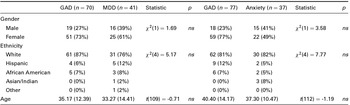
Participants were 197 individuals, aged from 18 to 74 (M = 36.43, SD = 2.84), who were seeking treatment at an anxiety and mood disorders clinic in the northeastern United States. Participants were assessed for primary psychopathology using the Structured Clinical Interview for DSM-IV-TR Axis I Disorders and received diagnoses of anxiety disorders (e.g., GAD, social phobia, panic disorder, specific phobias) or mood (e.g., depression, dysthymia) or both. Exclusion criteria included clinically significant signs of psychosis or any organic mental disorders. No participants in this sample met exclusion criteria and participants did not significantly differ on any demographic characteristics. Participants identified as White (81.7%), Hispanic (8.6%), African American (7.1%), and ‘other’ (2.5%), and 67.5% of the sample were female. An institutional review board approved the study and informed consent was obtained from participants before inclusion into the study. Fewer individuals (n = 189) completed the AAQ-II, as it was administered at a later time.
Procedures and Group Composition
After consent was obtained, self-report questionnaires, including those emphasised in the current study, were completed prior to individual psychotherapy treatment. Following completion of the questionnaire battery, individuals were administered the clinician version of the Structured Clinical Interview for DSM-IV Axis I and II disorders (SCID-I and SCID-II).
Two comparison group dyads were constructed, including the GAD group versus mood disorder group dyad and the GAD group versus anxiety disorder group dyad. The former dyad contained a group of individuals with a primary diagnosis of GAD and a group of individuals with only mood disorders, whereas the latter dyad contained another group of individuals with a primary diagnosis of GAD and a group of individuals with anxiety disorders other than GAD. Of the 197 participants, 28 cases were shared between both the GAD group versus mood group dyad and the GAD group versus anxiety group dyad, such that the total of all four groups yielded 225 cases. Certain exclusion criteria were imposed on group compositions within each dyad for comparison purposes.
For the GAD group versus mood disorder group dyad, none of the individuals in the former group were diagnosed with a mood disorder, whereas none of the individuals in the latter group were diagnosed with an anxiety disorder. Comorbidity with same-classification disorders was permitted within groups (e.g., comorbidity between GAD and social phobia was permitted in the former group, as was comorbidity between depression and dysthymia in the latter). Within this GAD group (n = 70), 71.43% exhibited comorbid diagnoses, the most prevalent of which were social phobia (24.29%), panic disorder (17.14%), specific phobia (10.00%), and obsessive compulsive disorder (5.71%). The mood comparison group (n = 41) contained mostly depression (85.37%), dysthymia (4.87%), and bipolar disorder (4.87%).
For the GAD group versus anxiety disorder group dyad, none of the individuals of the former group were diagnosed with another anxiety disorder, whereas none of the individuals of the latter group were diagnosed with a mood disorder. Comorbidity was permitted between GAD, mood, and eating disorders in the former group and among anxiety disorders in the latter. Within this GAD group (n = 77), 74.02% exhibited comorbid diagnoses, the most prevalent of which were depression (58.44%), eating disorders (6.49%), and dysthymia (2.59%). The anxiety comparison group (n = 37) contained mostly social phobia (54.05%), anxiety disorder not otherwise specified (16.21%), and panic disorder (10.81%).
Measures
Penn State Worry Questionnaire
The PSWQ (Meyer et al., Reference Meyer, Miller, Metzger and Borkovec1990) is a 16-item inventory used to measure the generality, excessiveness, and uncontrollability of pathological worry. The PSWQ assesses an individual's tendency to worry in general, as opposed to in relation to specific worry topics. Eleven statements convey the presence of pathological worry (e.g., ‘My worry overwhelms me’) and the remaining five items refer to the absence of this construct (e.g., ‘I do not tend to worry about things’). Participants are asked to rate how ‘typical or characteristic’ each statement is of themselves on a 5-point Likert scale ranging from 1 (not at all typical) to 5 (very typical). The PSWQ has demonstrated strong internal consistency (α = .95) and good test–retest reliability (Meyer et al., Reference Meyer, Miller, Metzger and Borkovec1990).
Intolerance of Uncertainty Scale
The IUS (Original French version: Freeston et al., Reference Freeston, Rhéaume, Letarte, Dugas and Ladouceur1994; English translation: Buhr & Dugas, Reference Buhr and Dugas2002) is a 27-item inventory that measures intolerance of uncertainty. The IUS includes items related to uncertainty, emotional and behavioural reactions to ambiguous situations, the consequences of uncertainty, and attempts to control future events. Participants are asked to indicate to what extent each statement is characteristic of them using a 5-point Likert scale ranging from 1 (not at all) to 5 (entirely). The IUS has excellent internal consistency (α = .94), good test–retest reliability over 5 weeks (r = .74), and has demonstrated convergent and divergent validity (Buhr & Dugas, Reference Buhr and Dugas2002).
Mood and Anxiety Symptom Questionnaire (Short Form)
The MASQ Short Form (Watson & Clark, Reference Watson and Clark1991) is a 62-item measure designed to aid in the assessment of and discrimination between anxiety and depression. This measure assesses the constructs of the tripartite model of anxiety and depression. Negative affect is measured by three general distress scales: anxious (GD-A), depressive (GD-D), and mixed (GD-M) symptoms. Depression specificity is measured by the anhedonic depression (AD) scale, which consists of two sets of items: one related to low positive affect and one related to loss of interest. Anxiety specificity is measured by the anxious arousal (AA) scale, designed to measure levels of physiological hyperarousal (PH). Participants are asked to rate how much they have experienced a given symptom during the past month on a 5-point Likert scale ranging from 1 (not at all) to 5 (extremely). The MASQ has shown good convergent and discriminant validity, reliability, and a stable factor structure in adult samples (Watson et al., Reference Watson, Weber, Assenheimer, Clark, Strauss and McCormick1995). The internal consistency of each subscale is excellent, with coefficient alphas reported to range from .78 to .92.
Acceptance and Action Questionnaire, Version II
The Acceptance and Action Questionnaire I (Hayes et al., Reference Hayes, Strosahl, Wilson, Bissett, Pistorello, Toarmino and McCurry2004) is a nine-item measure of experiential avoidance. Hayes and colleagues (2004) found that higher scores on the AAQ were associated with higher levels of general psychopathology. Participants are given statements (e.g. ‘I'm not afraid of my feelings’) and asked to indicate how truly each item applies to them using a 7-point Likert scale ranging from 1 (never true) to 7 (always true). The AAQ-II (Bond et al., Reference Bond, Hayes, Baer, Carpenter, Guenole, Orcutt and Zettle2011) is a 10-item measure that looks to improve upon the original AAQ's internal consistency, while shifting to assess psychological flexibility in accordance with the development of the acceptance and commitment therapy model. The reliability of the AAQ-II is consistently above the AAQ-I, with a mean alpha coefficient across the six samples of .84 (.78–.88), and the 3- and 12-month test–retest reliability is .81 and .79 respectively (Bond et al., Reference Bond, Hayes, Baer, Carpenter, Guenole, Orcutt and Zettle2011).
State Trait Anxiety Inventory, Trait Scale
The State Trait Anxiety Inventory (Spielberger, Reference Spielberger1985) consists of two 20-item scales that assess and differentiate between state and trait anxiety in adults: State and Trait. Trait anxiety (T-Anxiety) refers to relatively stable individual differences in anxiety proneness as a personality trait. The T-Anxiety Scale (STAI Form Y-2) consists of 20 statements that evaluate how the respondent feels ‘generally’. It consists of 11 Anxiety Present items (‘I feel nervous’) and 9 Anxiety Absent items (‘I feel secure’). Participants respond using a 4-point Likert scale ranging from 1 (almost never or not at all) to 4 (almost always or very much so). Scores vary from a minimum of 20 to a maximum of 80. The STAI Trait scale has been found to have excellent internal consistency (α = .86 to .92) and levels of test–retest stability that would be expected for a trait measure (e.g., test–retest correlations across 1–4 months range from .73 to .86; Spielberger, Reference Spielberger1983). The STAI has demonstrated both convergent and discriminant validity (Spielberger, Reference Spielberger1983).
Data Analytic Strategy
Logistic regression analyses were conducted across both group dyads to determine whether these measures simultaneously predict the presence of GAD. Only those measures hypothesised to significantly discriminate the presence of GAD were included as predictors (i.e., for GAD vs. other anxiety disorder dyad: PSWQ, IUS, and GD-D; for GAD vs. mood dyad: PSWQ, IUS, AA, GD-A, and STAI). If significant group differences in demographic characteristics emerged, then these variables would be included into the regression model to control for potential confounds. All ROC analyses were conducted using STATA version 12. With respect to the area under the curve (AUC), values approaching 1 indicate perfect classification, whereas values approaching .5 indicate classification near chance level. Cut-off points may be established for scores that maximise sensitivity and specificity. Furthermore, comparisons may be facilitated between different AUCs within the same comparison group dyad to determine if one assessment bears significantly better discriminatory abilities than another, by way of chi-square statistic (Hanley & McNeil, Reference Hanley and McNeil1982, Reference Hanley and McNeil1983).
Results
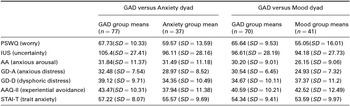
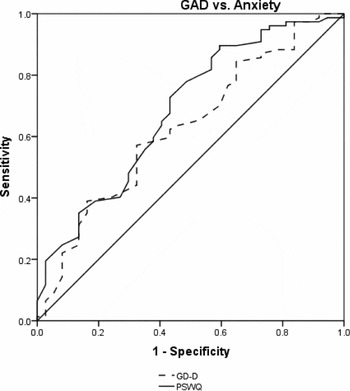
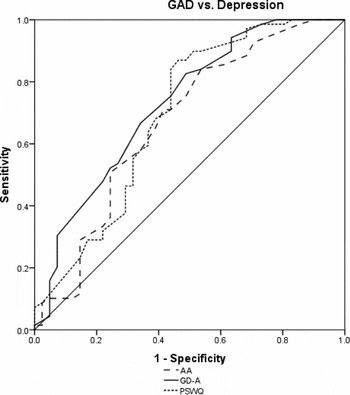
Refer to Tables 1 and 2 for descriptive and demographic statistics and to Figures 1 and 2 for significant ROC curves. Because pairwise comparisons of the demographic characteristics revealed no significant group differences, we estimated the logistic regression model without including demographic variables as covariates.
Descriptive Statistics

Demographic Information

Note: Categorical variables reflect number and percentage of people in each group, whereas the continuous variable (i.e., age) reflects mean and standard deviation. MDD = major depressive disorder.
Receiver operator characteristic analysis for PSWQ and GD-D in a sample of patients with GAD and anxiety disorders other than GAD.

Receiver operator characteristic analysis for PSWQ, GD-A, and AA in a sample of patients with GAD and mood disorders.

GAD Group Versus Mood Disorder Group Dyad
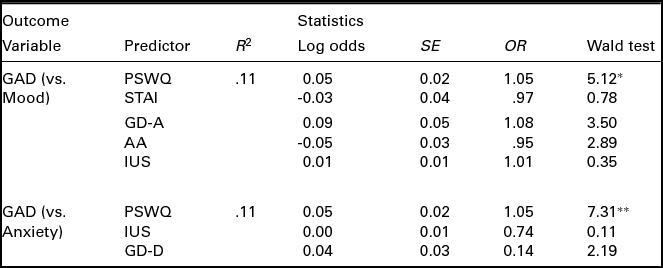
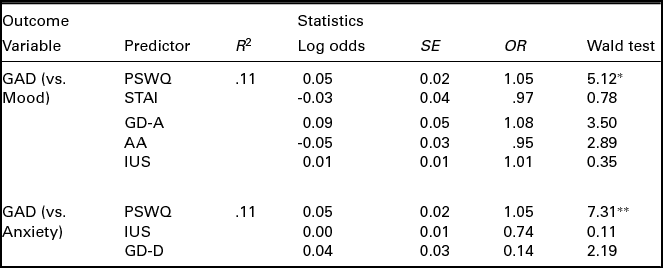
Results of the logistic regression analysis revealed that only the PSWQ significantly predicted the presence of GAD (OR = 1.05, p < .05), while controlling for the other symptom variables (Table 3). The Cox and Snell estimation of R-squared indicated that the model accounts for 11% of the variance.
Multiple Logistic Regression Models
Note: N = 111 for GAD vs. Mood dyad; N = 114 for GAD vs. Anxiety dyad. OR = Odds ratio, reflecting the exponentiation of the log odds.
*p < .05, **p < .01 (two-tailed).
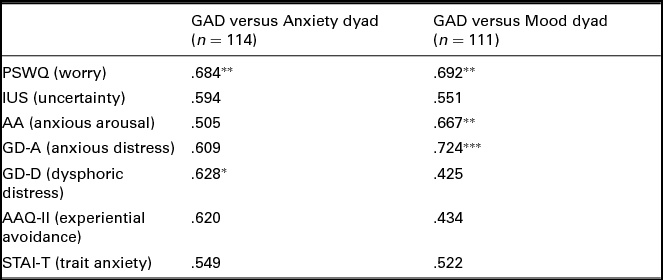
Of the seven scales, three achieved a significant AUC, suggesting that the constructs assessed by them may have some possible discriminatory function. ROC analyses revealed that the PSWQ (AUC = .692, p = .001), the general anxious distress (GD-A) scale of the MASQ (AUC = .724, p < .0001), and the anxious arousal (AA) scale of the MASQ (AUC = .667) performed significantly better than chance in classifying individuals with GAD versus a heterogeneous group of individuals with mood disorders (Table 4). No one assessment had significantly greater discriminatory ability than another, as indexed by comparisons of the AUCs; PSWQ versus GD-A, χ2(1) = .45, p = ns; PSWQ versus AA, χ2(1) = .13, p = ns; GD-A versus AA, χ2(1) = 1.73, p = ns.
Area Under Curve of ROC Analyses

Note: *p < .05; **p < .01 (two-tailed).
Cut-off scores were established for each scale by optimising both sensitivity and specificity. A score of 62 achieved 68.12% sensitivity and 60.98% specificity for the PSWQ, resulting in 65.45% of the sample being correctly classified. A score of 28 achieved 65.71% sensitivity and 65.85% specificity for the GD-A, resulting in 65.77% of the sample being correctly classified. A score of 26 achieved 70.00% sensitivity and 58.54% specificity for the AA, resulting in 65.77% of the sample being correctly classified. An alternative score of 27 achieved 64.29% sensitivity and 60.98% specificity, providing greater specificity, though not greater optimisation of both sensitivity and specificity, than that obtained by a score of 26 and resulting in 63.06% of the sample being correctly classified.
GAD Group Versus Other Anxiety Disorder Group Dyad
Similarly, results of the logistic regression analysis revealed that only the PSWQ significantly predicted the presence of GAD (OR = 1.05, p < .01) while controlling for the other symptom variables (Table 3). The Cox and Snell estimation of R-squared indicated that the model accounts for 11% of the variance.
Of the seven scales, two achieved a significant AUC. ROC analyses revealed that the PSWQ (AUC = .684, p < .01) and the general dysphoric distress (GD-D) scale (AUC = .628, p < .05) performed significantly better than chance in classifying individuals with GAD versus a heterogeneous group of individuals with anxiety disorders other than GAD (Table 4). No one assessment had significantly greater discriminatory ability than the other, as indexed by comparisons of the AUCs; PSWQ versus GD-D, χ2(1) = .76, p = ns.
Cut-off scores were established for each scale by optimising both sensitivity and specificity. A score of 65 achieved 64.94% sensitivity and 59.46% specificity for the PSWQ, resulting in 63.16% of the sample being correctly classified. A score of 37 was selected as a possible candidate and achieved 62.34% sensitivity and 56.76% specificity for the GD-D, resulting in 60.53% of the sample being correctly classified. An alternative score of 41 achieved 57.14% sensitivity and 67.57% specificity, providing greater optimisation of both sensitivity and specificity and resulting in 60.53% of the sample being correctly classified.
Discussion
Overall, four of the seven proposed scales and subscales demonstrated significant discriminatory ability in classification of comorbid GAD and other anxiety and mood disorders. Worry, as assessed by the PSWQ, received the most support as a prominent symptom of GAD, given that it distinguished GAD from both anxiety and mood disorders (AUC = 0.692 and AUC = 0.684, respectively). Moreover, only worry significantly predicted presence of GAD, while controlling for other symptom domains. In the context of GAD versus other anxiety disorders, general distress related to depressive features (GD-D) also demonstrated significant discriminatory abilities (AUC = .628). With respect to GAD versus mood disorders, two other constructs in addition to worry performed significantly well in classification, general distress related to anxiety (GD-A) and anxious arousal (AA; AUC = .724 and AUC = .667 respectively).
Although it may not be surprising that worry was identified as the principal construct differentiating GAD from mood and anxiety disorders, as many regard GAD as a pathological expression of diffuse worry (Andrews et al., Reference Andrews, Hobbs, Borkovec, Beesdo, Craske, Heimberg and Stanley2010), this symptom underlies several other syndromes, such as depression (Starcevic, Reference Starcevic1995) and anxiety disorders (Chelminski & Zimmerman, Reference Chelminski and Zimmerman2003). Olatunji, Broman-Fulks, Bergman, Green, and Zlomke (Reference Olatunji, Broman-Fulks, Bergman, Green and Zlomke2010) conducted a taxometric analysis on worry across anxiety and depression, confirming the dimensional nature of worry as it contributes to the pathogenesis of anxiety, depression, and stress. Thus, it is of consequence that the results of the current study tentatively support the use of the PSWQ as an initial screening measure to identify GAD. Although worry did accomplish significant classification of GAD in the current study, it did not reveal especially remarkable discriminatory properties, with AUC results that can be construed as providing ‘fair’ classification and modest sensitivity and specificity. Although highly associated with GAD, worry is not entirely unique to this one disorder. Extant literature has afforded converging evidence that instances of perseverative negative thinking such as worry constitute transdiagnostic process across emotional disorders (Mennin & Fresco, Reference Mennin and Fresco2013). As such, the utility of the PSWQ should be construed in accord with these limitations.
The fact that dysphoric distress significantly discriminated between GAD and other anxiety disorders might be consistent with current conceptualisations emphasising the commonality between GAD and depressive disorders. Prior literature has contended that both syndromes share identical predisposing genetic markers (Kendler, Reference Kendler1996; Kendler et al., Reference Kendler, Neale, Kessler, Heath and Eaves1992), exhibit similar etiologies (Moffitt et al., Reference Moffitt, Harrington, Caspi, Kim-Cohen, Goldberg, Gregory and Poulton2007), and share significant symptomatology (Slade & Watson, Reference Slade and Watson2006). Such evidence might comport with proposals to subsume GAD and depression under a single nosological category of distress disorders, suggesting GAD might differ from fear-based anxiety disorders. Consistent with such considerations, our evidence indicates that general dysphoric distress modestly discriminates GAD from other fear-based anxiety disorders (e.g., social anxiety disorder, panic disorder).
General anxious distress performed well in distinguishing GAD from mood disorders (AUC = .724). Consideration of the nosological history of GAD as a residual category of nondescript anxiety in the DSM-III (Heimberg, Turk, & Mennin, Reference Heimberg, Turk and Mennin2004) and the swath of literature identifying GAD symptoms with anxious distress (Brown, Chorpita, & Barlow, Reference Brown, Chorpita and Barlow1998; Fresco, Heimberg, Mennin, & Turk, Reference Fresco, Heimberg, Mennin and Turk2002; Hong, Reference Hong2007; Watson, Reference Watson2005) legitimises the utility of general anxious distress as a being sensitive to GAD. The modest success of anxious arousal (i.e., physiological hyperarousal) in discriminating GAD and mood disorders informs current controversies about the relevance of physiological hyperarousal to GAD. Notwithstanding the fact that physiological hyperarousal was initially posited as a cardinal feature of all anxiety disorders (Watson & Clark, Reference Watson and Clark1991), some empirical conceptualisations of GAD dismiss the essentialness of physiological arousal in GAD (Brown et al., Reference Brown, Chorpita and Barlow1998; Joiner et al., 1999). In fact, the symptomatology of GAD in both the DSM-IV and DSM 5 reflects the attenuated importance of physiological hyperarousal with the removal of autonomic features. Newman and Llera (Reference Newman and Llera2011), however, reviewed several experimental studies that corroborate the relationship between GAD and physiological hyperarousal. The function of worry in GAD has been elucidated as a thought process that diminishes physiological hyperarousal by way of avoidance. Given the discrepant conclusions from extant literature, the current results extend our understanding of anxious arousal by indicating that it might achieve modest discrimination between GAD and mood disorders.
Because of GAD's theoretical association with intolerance of uncertainty (Dugas, Gagnon, Ladouceur, & Freeston, Reference Dugas, Gagnon, Ladouceur and Freeston1998; Dugas & Robichaud, Reference Dugas and Robichaud2007; Ladouceur, Blais, Freeston, & Dugas, Reference Ladouceur, Blais, Freeston and Dugas1998) and trait anxiety (Fisher & Durham, Reference Fisher and Durham1999), it may be counterintuitive that neither accomplished significant classification. Recent empirical research affords evidence that intolerance of uncertainty functions as a transdiagnostic process underlying several emotional disorders (Mahoney & McEvory, Reference Mahoney and McEvoy2012). Additionally, most literature identifies intolerance of uncertainty as a significant predictor of common symptoms of GAD rather than of GAD itself (Buhr & Dugas, Reference Buhr and Dugas2006; Dugas, Freeston, & Ladouceur, Reference Dugas, Freeston and Ladouceur1997; Khawaja & Chapman, Reference Khawaja and Chapman2007). With respect to the STAI-T, trait anxiety failed to distinguish GAD from other disorders, which is consistent with earlier studies. Endler, Cox, Parker, and Bagby (Reference Endler, Cox, Parker and Bagby1992) ascertained no significant differences in trait anxiety across anxiety and depression. Many regard experiential and emotional avoidance as processes that manifest across most mood and anxiety disorders (Hayes, Wilson, Gifford, Follette, & Strosahl, Reference Hayes, Wilson, Gifford, Follette and Strosahl1996; Hayes et al., Reference Hayes, Strosahl, Wilson, Bissett, Pistorello, Toarmino and McCurry2004; in GAD, Mennin, Heimbeg, Turk, & Fresco, Reference Mennin, Heimberg, Turk and Fresco2005; in depression, Tull & Gratz, Reference Tull and Gratz2008). As such, the inability of the AAQ-II to accomplish significant discrimination between GAD and other anxiety and mood disorders dovetails with prior literature.
Conclusions from this study should be interpreted with respect to certain limitations. Among those diagnosed with primary GAD, comorbidity was permitted in virtue of the rarity of ‘pure’ expressions of GAD. The discriminatory properties of the investigated measures could have been influenced by comorbid presentation. That notwithstanding, circumscribing the analyses to instances of pure GAD would be antithetical to our principal endeavour, as GAD naturally manifests as a comorbid presentation (Brown et al., 2001). Analyses conducted on individuals with a pure presentation would yield results that lack generalisability to typical occurrences of the disorder. Furthermore, we mitigated such contamination by forbidding GAD to be comorbid with disorders of the comparison group for each dyad. Because the diagnostic criteria of GAD have remained the same across the DSM-IV and DSM-5, the results of the current study continue to reflect the most contemporary conceptualidation of GAD.
Conclusions
In light of the complex nosological issues surrounding GAD, the current study supports the notion that several constructs theoretically relevant to GAD lack robust specificity. Although some measures accomplished successful classification, their modest AUCs suggest substantive symptomatic overlap persists between this syndrome and other anxiety and mood disorders. The current results imply that the PSWQ would be the most profitable for diagnosis and initial screening purposes, as it is the only measure that significantly distinguished GAD from both comparison groups. Moreover, the results suggest that a cut-off score of 62 would accomplish optimal discrimination between those with GAD and those with depressive disorders, and that a cut-off score of 65 would accomplish optimal discrimination between those with GAD and those with other anxiety disorders. It is of consequence that measures other than worry were significantly better than chance in classifying GAD. The current study fosters an appreciation for a more nuanced perspective regarding the classification of GAD, given several measures differentially discriminated GAD depending on the comparison group. The clinical utility of those scales that obtained significant AUCs should be interpreted with circumspection, as their discriminatory abilities afford only tenuous support for their utility in identifying GAD. As such, clinicians should acknowledge the inherent difficulties in identifying GAD, which likely does not constitute a delimited, well-defined syndrome. Because of the difficulties inherent in the assessment and classification of GAD, further research should be undertaken to ascertain the validity of this diagnostic entity by attempting to delineate more unique components of this syndrome.