INTRODUCTION
A major concern in the definition of a data register protocol is to ensure that all behaviours have the same chance of being counted, by establishing a precise method for data registering (Altmann, Reference Altmann1974). By doing this, the probability that the behavioural register is biased towards more noticeable behaviours or by more active individuals is minimized. The animal focal method is preferred, since selection occurs at individual level and the precise onset and offset of all behaviours are noted. However, the following of each individual in a group is not always possible, and researchers have to rely on sampling techniques. In this case, a critical step is the definition of time intervals for registers in order to ensure the assumption of data independency for statistical analyses.
Martin & Bateson (1993) argue that the shorter the time interval, the more accurate the sample record will be. However, short sampling intervals may be difficult for the identification of the behaviour, whereas long intervals relative to the duration of behaviour may result in missing data entries. One aspect of sampling intervals not thoroughly discussed by these authors is time dependency.
Time dependency recognizes the tendency to register the same behaviour (or group size, spatial position or any other dependent variable) on consecutive interval samples, and thus exaggerate the sample size of a variable. According to Janson (Reference Janson1990) a solution to this question is to sub-sample data at increasing register intervals until successive observations are no longer significantly correlated. Testing autocorrelation, however, is not a simple task, requiring extra effort on mathematical modelling and, usually, the collection of focal continuous data to use as the control against which protocols with sub-samples of data taken at increasing time sampling intervals are tested (Setz, 1985; Engel, Reference Engel1996; Jauhiainen & Korhonen, Reference Jauhiainen and Korhonen2005).
Studies of cetaceans have moved from characterizations of types of natural behaviour based on ad libitum samples to a more rigorous measurement of activity budget, following defined protocols and time intervals for data registering (Mann, Reference Mann1999, Reference Mann and Mann2000). Nonetheless, great variations still occur in definitions of behaviour (see for example definitions of rest (Würsig & Würsig, Reference Würsig and Würsig1980; Constantine et al., Reference Constantine, Brunton and Dennis2004); forage (Norris & Dohl, Reference Norris, Dohl and Herman1980; Lusseau, Reference Lusseau2003a; Monteiro et al., Reference Monteiro, Souto and Nascimento2006)), and on time intervals used to register behaviour.
In this paper we describe a simple analysis designed to evaluate the best sampling interval for a behavioural record of the estuarine dolphin (Sotalia guianensis), based on discussions made by Setz & Hoyos (Reference Setz and Hoyos1985). These authors argue that if the sampling interval is too short relative to the duration of behaviour, then there will be an over estimation of this behaviour in data collection. Conversely, if sampling intervals are too long relative to duration of behaviour, there will occur an under estimation in data collection. Therefore, we formulated the following hypothesis: if time dependency exaggerates the sample size of behaviour counting, then its values should be larger at shorter rather than at longer intervals.
MATERIALS AND METHODS
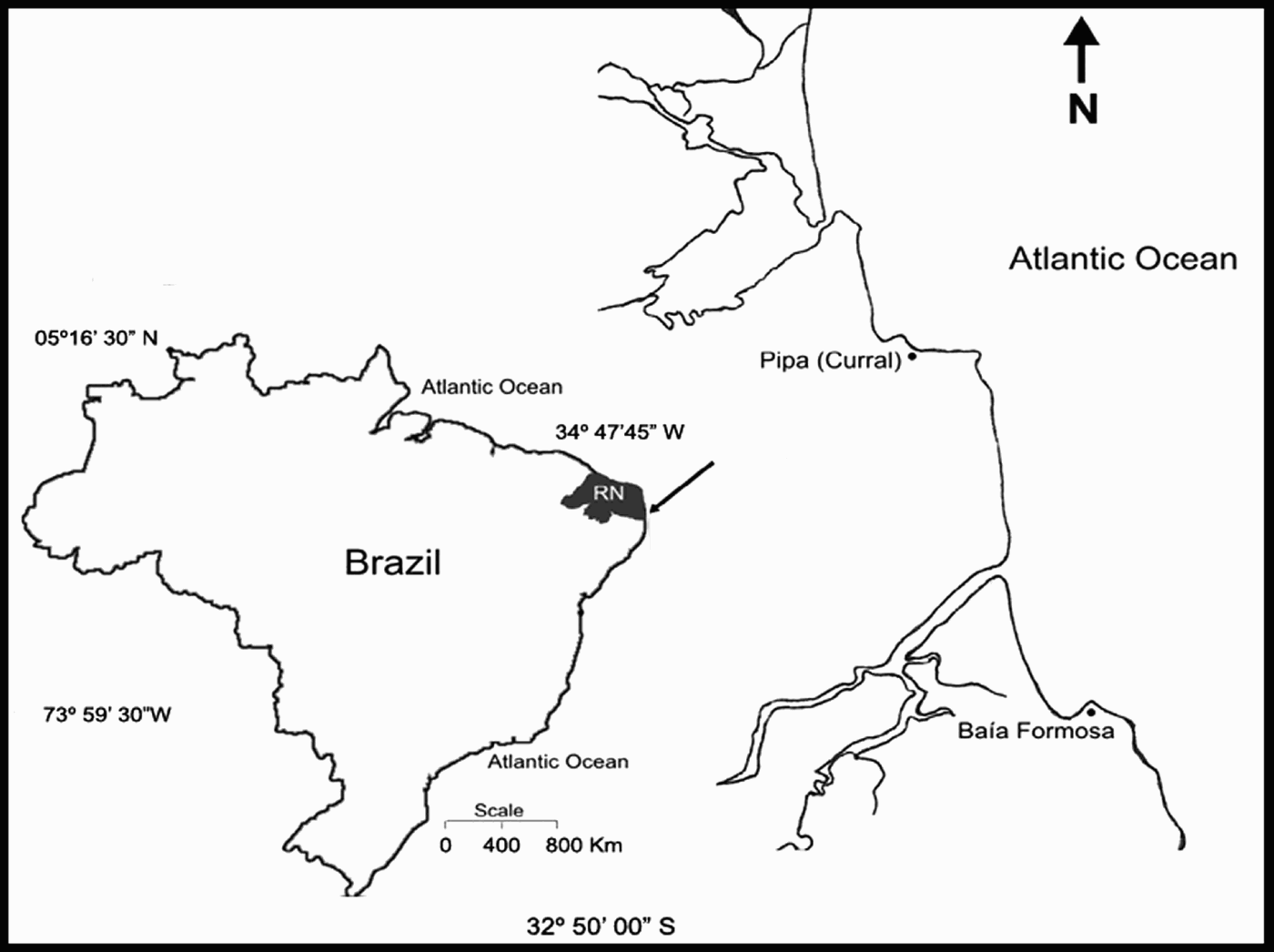
This study was conducted on an open water coastal population inhabiting Formosa Bay, southern coast of Rio Grande do Norte (6°22′s 35°00′W; Figure 1). The nearest river mouth is situated about 7.5 km from the bay. The bay is encircled by cliffs approximately 30 m in height and having sandy beaches which are heavily strewn in places with beach rocks, forming bays which are sheltered from the prevailing trade wind and ocean currents. The area presents a gradually shelving seabed, alternately rocky and sandy, with an average depth of 6 m. This region displays a tropical climate with an annual average temperature of 26°C.
Study area: Baía Formosa Bay, south coast of Rio Grande do Norte, Brazil.

Our study was conducted during the dry season, from December 2005 to April 2006, over an aggregate period of 40 days (8 consecutive days per month), totalling 251 hours of field effort and 113 hours of data collection. Daily observations lasted for 6–8 hours and animals were observed with the naked eye and with the help of binoculars from a fixed point situated on the cliff top. The distances from observer to the animals ranged from 50 to 100 m depending on the tide. The group focal instantaneous–interval sampling method of data collection was employed (Altmann, Reference Altmann1974; Mann, Reference Mann1999, Reference Mann and Mann2000), that is, the behaviour presented by the majority (more than 50%) of the animals in a group was assumed to be the group activity and this was noted at 2 minute intervals.
Only groups within the bay were observed. The definition of a group was spatial, adapted from Shane (Reference Shane, Leatherwood and Reeves1990), as an aggregation of dolphins observed in apparent association, being close to each other (three body lengths apart) and moving in the same direction, often but not always, engaged in the same activity. When individuals split into more than one group we continued observation on the group closest to the shore, and followed this group until they left the bay or until they merged with another group within the bay. All the individuals were classified as adult due to their similarity in body size and colour.
Although animals were not individually identified, we counted animals in each group based on spatial position and intervals of surfacing to breathe. Calculated intervals between breaths were between 24 seconds and 31.48 seconds for adults and from 13 seconds to 23.85 seconds for immature animals (Valle & Mello, Reference Valle and Vaz2005; Garri, Reference Garri2006). Thus, surfacings occurring in short time intervals (less than 20 seconds) in the same area or surfacing at slightly longer intervals (30 seconds), but at distant areas were considered as performed by different individuals.
The defining characteristics of the behavioural states considered in this paper were adapted from several authors: (1) feeding/foraging: involved variable directional movement periodically interrupted by events of persecution and lunges towards a prey. This may or may not result in a successful catch of prey (cf. Norris & Dohl, Reference Norris, Dohl and Herman1980); (2) social behaviour: high level activity of the dolphins, where they remain longer on the surface and indulge in intense physical contact (cf. Balance, Reference Ballance1992); (3) travel: characterized by a uniform directional movement without interruptions by events of persecution, lunges or catches of prey (cf. Balance, Reference Ballance1992). We did not differentiate speed travel; and (4) rest: characterized by a pronounced diminution in one level of activity and very slow rate of swimming, without defined direction (cf. Würsig & Würsig, Reference Würsig and Würsig1980). These categories were taken to be mutually exclusive, that is, at each data sample only one behavioural category could be noted.
The duration of behaviour was calculated by adding sequences of behavioural registers (i.e. many sequences of each behaviour could occur within the same day). Each sequence was considered an independent behavioural state if they occurred on at least two sampling registers (4 minutes) apart.
Analyses were conducted on the daily proportion of each behavioural state, calculated by dividing the number of registers of each behaviour by the total number of register of all behaviours each day. The total data sample varied according to the interval under analysis (larger for 2 minutes and smaller for 8 minutes intervals). Data were not normally distributed. Non-parametrical tests of Spearman (rs), Friedman and Wilcoxon were conducted. Significance values were set to 5% for Spearman (rs), Friedman and 0.8% for Wilcoxon analysis.
RESULTS
Mean group size was three with a maximum of 15 individuals. Analyses show that number of animals in the group is not correlated to behaviour presented (forage: rs = 0.43; P = 0.670; social: rs = –0.12; P = 0.439; travel: rs = –0.1; P = 0.278; and rest: rs = 0.01; P = 0.343). Rates of behaviour did not vary with tide or with time of the day (Queiroz, Reference Queiroz2006), therefore, we used all data for analyses.
Mean duration of each behavioural state differed: forage: 11.7±6.78 min (or 5.75±3.39 registers in sequence); rest: 7.8±2.9 min; travel: 6.85±4.79 min; social: 4.7±3.24 min. These were statistically significant differences (χ2P = 68.65; df = 4, P < 0.001—and significant values for all pair-wise comparisons on Wilcoxon tests). The duration of behavioural states did not correlate with the number of individuals performing the behaviour (forage: rs = 0.43; P = 0.670; rest: rs = 0.01; P = 0.343; travel: rs = –0.1; P = 0.278; social: rs = –0.12; P = 0.439), therefore, we used all data for analyses.
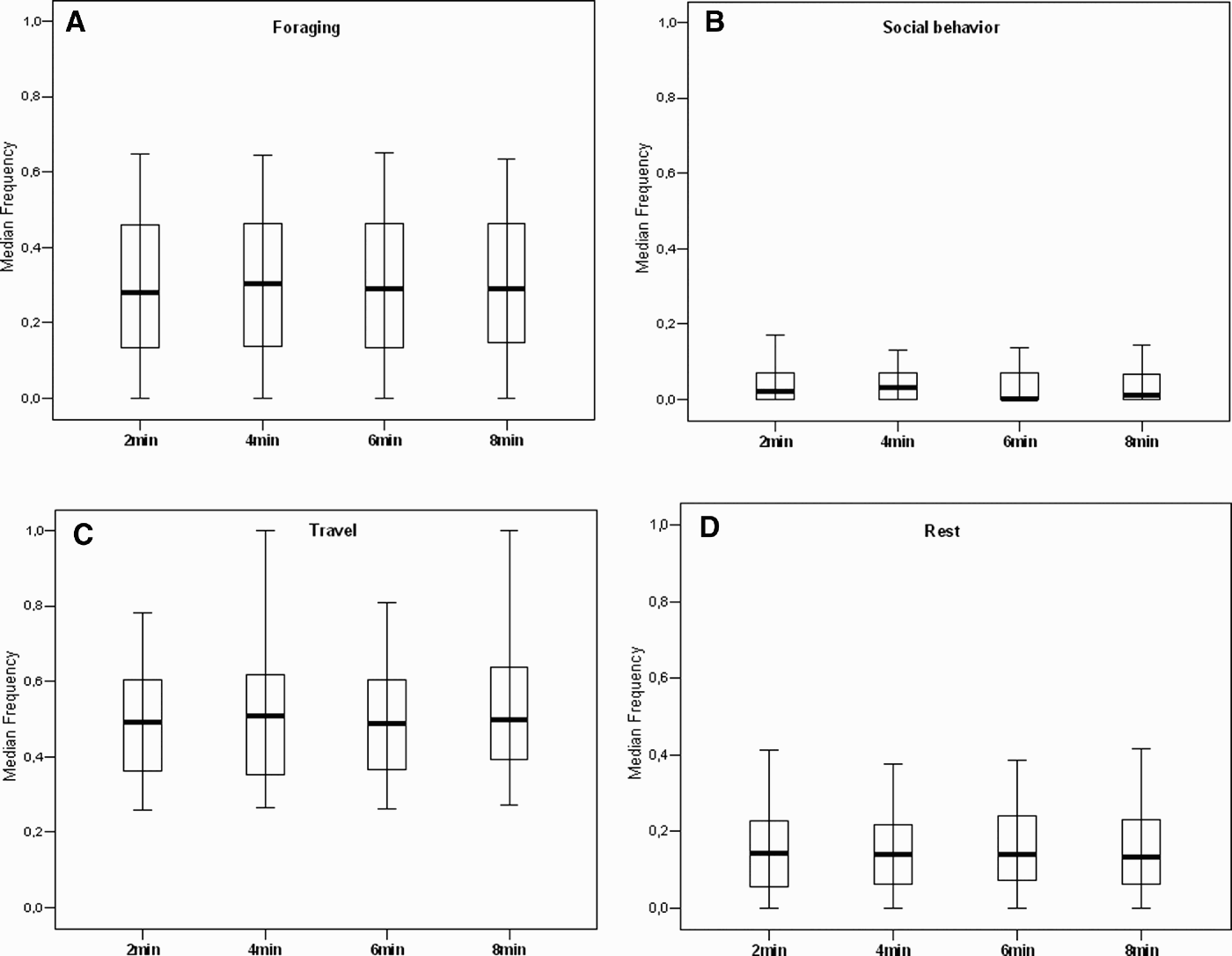
The daily proportions of social behaviour and rest did not statistically differ when intervals of registers varied, occurring at a proportion of approximately 3% and 15%, respectively (χ2p = 7.081; df = 4, P = 0.132; χ2p = 1.649; df = 4, P = 0.800; see Figure 2 and Table 1).
Behavioural proportions registered using different intervals.

Statistical results for dyadic comparisons of each behavioural category proportion in different time registering intervals (P ≤ 0.008).

Values for forage differed statistically when intervals of register varied (χ2p = 11.848; df = 4, P = 0.019), on overall comparison, with greater median values found at 2 minutes (29.1%) than at 8 minutes (28.2%), which corresponds to a variation of 3.52% on measurements. Mean values were 29.9% and 29.3%, respectively. However, dyadic comparisons with reduced P values show that these were not statistically significant differences (see Table 1 for dyadic comparisons).
Again we found no overall significant difference for travel, although we found smaller median values at 2 minutes (49.5%) than at 8 minutes (50%), corresponding to a variation of 0.84% on measurements. Mean values were of 51.7% and 51.7%, respectively.
DISCUSSION
Our analyses show that, although values of forage and travel behaviour vary when different intervals of registers are used, these were not statistically significant differences (magnitude is less than 5% on median values, and mean values are very similar). Values of the other two behavioural categories (rest and social) did not vary when different intervals of registers are used. There are two possible explanations for this result.
Firstly, the large values of standard deviations relative to median values within each behavioural category (probably related to local or daily variations in ecological conditions) may hinder a precise definition of sampling intervals. This difficulty is even greater when one is trying to sample several behavioural categories at the same time, given the significant differences in duration of different behaviours.
Nonetheless, our results suggest that studies of estuarine dolphin using register intervals shorter than 8 minutes may be overestimating the median rates of forage behaviour. As forage is the longer duration behaviour observed in this study, this tendency is in agreement with the possibility of overestimation discussed by Setz & Hoyos (Reference Setz and Hoyos1985). It is also noteworthy that this possible overestimate of forage is accompanied by an underestimation of travel behaviour at shorter intervals relative to longer intervals.
This last point also warns of the fact that not only time dependency but difficulties on defining foraging behaviour and travel behaviour (particularly when individuals are in ‘search’ between episodes of lunges and catches) may be biasing data collection. Thus, it is possible that this overestimate of forage behaviour at short intervals may result from registering a ‘search’ as forage on consecutive minutes after an event of lunge or catch. Conversely, when registering at longer intervals a ‘search’ may be registered as travel due to the rarity or delays of lunges or catches (see Discussion on this regard in Tosi (Reference Tosi2007) and Tosi & Ferreira (in preparation)). This problem of sampling intervals needed to define a behaviour is also discussed by Martin & Bateson (1993), which suggests in these cases, the definition of a more refined ethogram is required.
A second possibility is that the time dependency of these behaviours is shorter than 2 minutes, and therefore, registers at this interval may be considered independent data for statistical analyses, or the opposite, the time dependency is longer and an even greater interval should be tested in order to detect it.
This possibility, however, requires more detailed studies to be confirmed. Although Engel (Reference Engel1996) describes a similar procedure to test time dependency in male scimitar-horned oryx (Oryx dammah), it should be noted that the test employed in our study relates only to a first exploration of the data. It is the first step forward in what Martin & Bateson (1993) said about not defining sampling intervals as a trial and error procedure. More detailed analyses should be conducted before one can confirm the presence or absence of time dependency and assert what is the proper sampling interval for data collection on estuarine dolphin.
Sotalia guianensis is the most common dolphin in Brazilian shallow waters, and it has been studied by many research groups from south to north Brazil (Geise et al., Reference Geise, Gomes and Cerqueira1999; Lodi, Reference Lodi2003; Daura-Jorge et al., Reference Daura-Jorge, Wedekin, Piacentini and Simões-Lopes2005, Reference Daura-Jorge, Rossi-Santos, Wedekin and Simões-Lopes2007; Azevedo et al., Reference Azevedo, Oliveira, Viana and Sluys2007; Wedekin et al., Reference Wedekin, Daura-Jorge, Piacentini and Simões-Lopes2007). Unfortunately, there is no common ethogram and register intervals for the continuous accompanying of these groups, which makes it difficult to compare results (although some basic behavioural categories are used, studies vary greatly on sampling intervals). Given the ever-growing occupation of coastal areas and increasing boat traffic, attributable to both the tourism and fishery industries, comparisons among studies are of major importance for the definition of conservation measures by indicating the area required by the animals to carry out their daylight activities, their degree of site fidelity, seasonal variation in numbers (e.g. Karczmarski & Cockcroft, Reference Karczmarski and Cockcroff1999) and environmental perturbations (e.g. Lusseau, Reference Lusseau2003a, Reference Lusseaub).
In this study, we used non-overlapping straightforward definitions of behaviours and tried to evaluate the register interval that maximizes our data collection effort while in the field. Considering the difficulty of observing these animals, the normally restricted time to conduct researches, the great differences in duration within and among behavioural categories, and until further analysis on Sotalia behavioural time dependency is presented, we will assume that the 2 minutes sampling interval constitutes a reasonable compromise for record of several behavioural categories during field work.
To our knowledge, this is the first study attempting to define a proper sampling interval for studies on estuarine dolphins. Although more precise behavioural definitions are needed, and the number of categories on the register protocol will vary depending on the hypothesis of each research, we hope we have contributed to Brazilian cetology for the definition of a common protocol for fast and continuous assessment of different estuarine dolphin populations throughout our coast.
ACKNOWLEDGEMENTS
R.E.M.Q. acknowledges Projeto Pequenos Cetáceos for travel support during data collection. R.G.F. was supported by Capes Grant PRODOC/PRODEMA UFRN.