Introduction/Background
The recent terror attacks of Brussels (Belgium) in March 2016 and Paris (France) in November 2015, along with the huge number of refugees fleeing from Syria to Europe, have increased a growing awareness of the necessity to think about disaster response and disaster medicine, not only in the medical community. The severity of the effects of disasters are increasing with the growth of global population.Reference Guha-Sapir, Hoyois and Below 1 According to the United Nations Office for Disaster Risk Reduction (UNISDR; Geneva, Switzerland), from 2000 to 2012, disasters have caused approximately $1.7 trillion (US) of economic damage, directly affected 2.9 billion people, and caused an estimated 1.2 million fatalities. 2 In 2004, the World Association for Disaster and Emergency Medicine (WADEM; Madison, Wisconsin USA) underlined the need for the professionalization of the health response to disasters. WADEM recommended the development of standards and guidelines, even for undergraduate students, of all the relevant fields related to health in disasters,Reference Archer and Seynaeve 3 when additional knowledge is required due to the typical disproportion among the number of casualties and the available resources.Reference Ripoll Gallardo, Djalali and Foletti 4 , Reference Burkle, Lyznicki and James 5 Many governments, scientific institutions, and universities across the world assessed the required expertise for dealing with disasters, and designed different solutions for including disaster medicine education in their training of different medical personnel.Reference Coule and Schwartz 6 - Reference Burkle 14 Medical students were also noted to take part in disaster responses at different events.Reference Reyes 15 , Reference Sabri and Qayyum 16 Since 2003, a specific knowledge in disaster medicine forms a constituent of the final state examination of medicine in Germany. 17 Therefore, a specific curriculum was created in 2006 by the Protection Commission at the German Ministry of the Interior (Berlin, Germany), the German Society for Disaster Medicine (Kirchseeon, Germany), and the Federal Office of Civil Protection and Disaster Assistance (Bonn, Germany), and then was given to the Deans of the German medical universities for acknowledgement and implementation. 18 The resulting course was published by Pfenninger and colleagues and consisted of 14 modules composed of two-hour units, including one examination part.Reference Pfenninger, Domres, Stahl, Bauer, Houser and Himmelseher 19 To the best of the authors’ knowledge, after the approval of the disaster medicine curriculum in German medical schools, no evaluation has taken place to show the level of its implementation across the country and the status of the perceived knowledge and interest of German medical students in this field. The aim of this study was to assess the self-perception of medical students’ knowledge and interest in disaster medicine nine years after the implementation of a standardized disaster medicine curriculum in German medical schools.
Methods
Study Design, Population, and Administration
The study was a prospective, cross-sectional, observational study of medical students in Germany using a web-based, purpose-designed questionnaire. Data were collected with the questionnaire software SurveyMonkey, Version 2.0 (SurveyMonkey Europe; Dublin, Ireland). An invitation e-mail with a link to the questionnaire was sent to the German student councils of all 37 universities with medical faculties. Each student council was asked to deliver the e-mail to all the affiliated medical students of all semesters and genders. The participation was voluntary, anonymous, and confidential. The completion of the questionnaire implied participants’ consent to give the authors the right to use the information provided. The Research Center in Emergency and Disaster Medicine (CRIMEDIM), in Novara, Italy, coordinated this work as a master thesis of the European Master in Disaster Medicine (EMDM). As all data were identified and reported in aggregate, the local Ethics Committee of the Università del Piemonte Orientale, Novara, Italy, deemed the study exempt from institutional review approval.
Survey Tool
The data collection was accomplished by using a questionnaire containing 27 mandatory and 11 optional questions about disaster medicine, which were multiple-choice and closed (Appendix 1; available online only). The questionnaire was short, straightforward, and in clear language to make a five-minute completion possible. It was designed in German and in English to allow participation of foreign students residing in Germany. The questions were grouped into four sections placed between introduction and closing remarks:
-
1. General Data and Demographics of the Respondents.
-
2. Previous Disaster Medicine Educational Experiences of the Participants. In this section, optional questions were included to assess the contents and type of training in greater depth.
-
3. Self-Perception of Knowledge Base in Disaster Medicine. The participants were asked to self-evaluate their knowledge of Pfenniger’s curriculum contents through rating the level of agreement with statements using an anchored 5-point Likert scale (0=“strongly disagree;” 1=“disagree;” 2=“neutral;” 3=“agree;” and 4=“strongly agree”). The following topics of the 13 modules, recommended by Pfenninger, were assessed: (1) terminology, type, and legal aspects of disasters; (2) tactics and leadership; (3) special aspects of disaster medicine; (4) disaster management in hospitals; (5) previous disaster assistance experiences; (6) mass-casualty triage; (7) evacuation; (8) primary health care in disasters; (9) specific health care in disasters; (10) accidents with radioactive material and decontamination; (11) transport and accidents of chemical material and decontamination; (12) ethical basics and quality management in disaster medicine; and (13) diseases triggered by disaster stress and procedures of psychosocial support.
-
4. Students’ Attitude about Disaster Medicine in the Training System. The answers to this section were also assessed with the same 5-point Likert scale as used above.
Validation and Pilot Study
The questionnaire was validated by five members of the faculty of the EMDM. The study was piloted with alumni students from the summer academy of the German Institute for Disaster Medicine (Tübingen, Germany).
Analysis
The collected data were exported from SurveyMonkey to Microsoft Excel, Version 2013 (Microsoft Corporation; Redmond, Washington USA). All analyses were performed with the dedicated statistics program IBM SPSS, Version 22 (IBM Deutschland GmbH; Ehningen, Germany). General descriptive statistics (25% quartile, median, 75% quartile, and count) were obtained for all the mandatory questions of the first section (demographics and level of training). The 5-point Likert scale used in section two was considered an ordinal scale. The median, the 25% quartile, and 75% quartile were used for the description of the ordinal-scaled variables.
Non-parametric tests were used for the analysis of differences between subgroups of the study population. McNemar-Test was used to compare two associated nominal-scaled samples. Mann-Whitney-U-Test was used to compare two independent samples. A P value <.05 was considered statistically significant for both tests.
Results
A total number of 1,105 people answered the questionnaire. From these, 29 participants were not medical students and were excluded. A further 84 participants who did not complete all questions were not included. Therefore, the final number of participants was 992.
Demographics
Out of the participants, 618 (62.3%) were female and 374 (37.7%) were male, with an average age of 24.4 years. Participants were included from all 12 regular semesters with a median of semester seven. A group of 234 (23.6%) participants had already finished a post-secondary education to work within the German Emergency Medical Service (EMS) system.
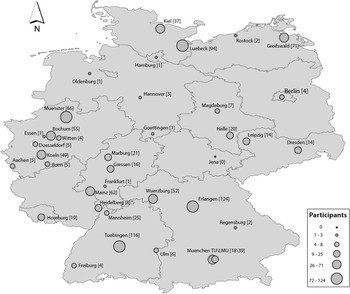
The participants belonged to 36 of the 37 medical schools within Germany. The distribution of respondents across the country is shown in Figure 1.
Geographical Distribution of Participants. Note: The map was created with Esri ArcGIS (Esri; Redlands, California USA) on the basis of an open data set of the German Federal Office of Cartography and Geodesy.Reference Mortelmans, Bouman, Gaakeer, Dieltiens, Anseeuw and Sabbe 20

Previous Disaster Medicine Training
More than one-half (n=535; 53.9%) of the participants were already aware of the medical specialty “disaster medicine” and 401 (40.4%) attended courses on this.
One hundred twenty-one (12.2%) attended courses on the specialty at their university. Most participants (48 [41.0%]) were taught in the year 2014 and received an average of 10 hours of training. The training was delivered as elective course in 53.7% of the cases. Responders stated that the three most commonly taught subjects from Pfenninger’s curriculum were: primary health care in disasters (59.4%), mass-casualty triage (45.3%), and previous disaster assistance experiences (38.3%). Twenty (16.5%) out of those students who attended courses in their university had completed an EMS post-secondary education before starting medical school.
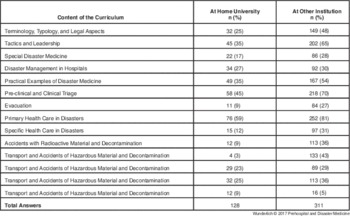
Three hundred and seven (30.9%) participants attended lectures in disaster medicine at other institutions outside their university. The year when most (59 [20.8%]) participants were taught at these institutions was 2012, and they were trained an average of 49 hours. These lectures were elective for 57.7% of participants and mandatory for 42.3%. The majority of lectures were part of courses run by the fire brigade or volunteer organizations (eg, the German Red Cross; Berlin, Germany). One hundred fifty-seven (51.1%) of these attendees had completed an EMS post-secondary education before entering the medical school. Analysis of the lecture content identified that “primary health care in disaster” was the most common subject (81.0%), followed by “preclinical and clinical triage” (70.1%) and “tactics and leadership” (65.0%). A complete breakdown is listed in Table 1.
Subjects Taught to the Participants

Self-Perception of Medical Students’ Knowledge
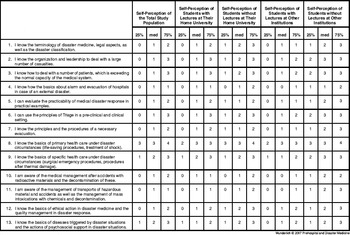
As shown in Table 2, in 10 out of 13 topics, the median knowledge perceived by students was “1,” in two contents “2,” and in one content “3.”
Self-Perception about the Knowledge of the Disaster Medicine Curriculum

The perceived knowledge in 11 out of 13 topics of those participants who did the training at their university was higher compared to those participants without any training. This difference was statistically significant (P<.001).
Likewise, there was also a statistically significant difference (P<.001) between the perceived knowledge of those participants who received the lessons in other institutions compared to those participants without any prior training.
Students’ Attitude about Disaster Medicine in the Training System
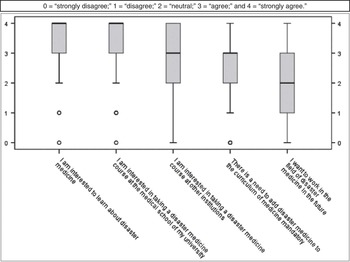
The participants strongly agreed (“4”) with the statement “I am interested to learn about disaster medicine.” They also strongly agreed (“4”) with the statement “I am interested in taking a disaster medicine course at the medical school of my university.” They agreed (“3”) with the statement “I am interested in taking courses about disaster medicine outside my university.” The necessity to add a compulsory specialty “disaster medicine” in the medical curriculum in Germany was agreed (“3”). The overall response of participants was neutral (“2”) with regards the statement “I want to work in the field of disaster medicine in the future.” Details are listed in Figure 2.
Students’ Attitude about Disaster Medicine in the Training System.

Discussion
This study assessed the self-perception of medical students’ knowledge and interest in disaster medicine nine years after implementation of a standardized disaster medicine curriculum in German medical schools. It shows a dichotomy between the interest of the students in the topic and the application of the suggestions given by WADEM and by the curriculum suggested by Pfenninger and colleagues in contrast with the implementation at the academic level nationwide.
The survey indicates that the Pfenninger curriculum of disaster medicine was poorly implemented in the last nine years. In fact, only the minority of respondents had attended a curricular course on the topic, which in the majority of cases was delivered in other institutions out of the university and as an elective option. Although professionalization of the health response is an actual concern, still several studies show that disaster medicine has rarely been included in medical school curriculum either in Europe or overseas. The Netherlands has no disaster medicine programs in their medical school.Reference Mortelmans, Bouman, Gaakeer, Dieltiens, Anseeuw and Sabbe 20 In Italy, elective courses are delivered in several medical universities, but on a voluntary basis and as strong action of a motivated local medical student association.Reference Ingrassia, Ragazzoni, Tengattini, Carenzo and Della Corte 21 Belgium has a limited introduction of such an educational program in few universities.Reference Mortelmans, Dieltiens, Anseeuw and Sabbe 22 Only a small percentage of US medical schools currently incorporate disaster medicine in their core curriculum.Reference Smith, Levy, Hsu and Lee Levy 23 In China, disaster medicine has not been included either in the undergraduate curriculum of medical schools nor in the continuing medical education.Reference Su, Han and Chen 24 In addition, the amount of dedicated time devoted to disaster medicine highlights the insufficient attention German medical schools are posing to the professionalization of future physicians in disaster and major incident management. The poll indicates that is less than one-half of that recommended in the German disaster medicine curriculum. Moreover, only students who engage in volunteer work benefit from training since the training courses are proposed, in the majority of cases, as an elective option either when lectures are delivered in university or in other institutions.
Findings from the responses to the section on specific disaster topics covered indicate poor compliance with the German disaster medicine curriculum. Uniformity in training plays a vital role in the recognition of a profession. In fact, standard curricula seek to homogenize terminology, methods, procedures, and organization in order to achieve appropriate consensus about common objectives.Reference Alexander 25 The study shows that the knowledge level of disaster medicine was not satisfactory among German students. This is consistent with study results of medical students’ knowledge of major incident and disaster conducted by Kaiser and colleagues, where few of them believed that they were receiving adequate education and training and only one-half of them felt they were sufficiently skilled to respond to a natural disaster or pandemic influenza.Reference Kaiser, Barnett, Hsu, Kirsch, James and Subbarao 26
Nevertheless, the sub-group of German students who had received lectures at their universities or in other institutions stated a higher self-perception of knowledge in nearly all categories.
To ensure that health care systems operate efficiently in the setting of a disaster or mass-casualty event, future physicians must begin to develop an understanding of their role in the context of a local or national response. The German students seem to be aware of this situation; most of the respondents find it necessary to add disaster medicine in their regular curriculum as a mandatory course.
The perception of the importance of disaster education and training among medical students has already been widely documented.Reference Su, Han and Chen 24 , Reference Kaiser, Barnett, Hsu, Kirsch, James and Subbarao 26 , Reference Scott, Carson and Greenwell 27 In the Netherlands, 51% of surveyed students considered that disaster medicine should absolutely be taught in the regular medical curriculum,Reference Mortelmans, Bouman, Gaakeer, Dieltiens, Anseeuw and Sabbe 20 and in Italy, 91.4% would welcome the introduction of a course on disaster medicine in their core curriculum.Reference Ragazzoni, Ingrassia, Gugliotta, Tengattini, Franc and Corte 28
It is a societal imperative to prepare all future physicians with the fundamentals to understand and respond, if needed, to the increasing threats from natural and human-caused events. Promoting and enhancing the training capacity in the field of disaster medicine is one of the “call-to-action requirements” requested by the international community. This study provides a necessary and timely window into the current disaster education situation in Germany and facilitates a reflection about the actual implementation of the German disaster medicine curriculum, suggesting a renewal of the agreement between the German Ministry of Interior and universities.
Limitations
Since the survey was distributed widely through the student councils in Germany, it may be that the students who accepted to participate were those with a pre-existing interest in disaster medicine. It was not possible to control how many people received the questionnaire and if they participated or not. However, after the approval of the disaster medicine curriculum in German medical schools, this is the first comprehensive study that evaluates the level of its implementation across the country and the status of the perceived knowledge and interest of German medical students in this field. In addition, almost all universities with medical faculties were reached (36 out of 37). Nevertheless, the results have to be interpreted
carefully, and the conclusions cannot be extrapolated to every medical student in Germany.
The authors recognize the potential presence of participation bias, which is likely to depend on numerous factors, including some of which the authors have no control. Since the diffusion of the invitation e-mail took place through the German student councils of the universities with medical faculties, correction for such bias in the analysis was not possible without relevant information on non-participants. However, the authors are aware that studies with lower participation rates can in some situations result in less bias.Reference Stang and Jöckel 29 Moreover, the demographic data of the participants is similar compared to the total potential study population.Reference Kolbert-Ramm and Ramm 30
Another limitation was the use of dichotomous-choice questions, as opposed to a Likert scale. However, this was necessary to make the survey respondent-friendly and to simplify data collection and interpretation. Still, the opinion of this research group is that the study is promising, showing the needs of medical students in this unique bottom-up approach.
Conclusion
The results from this study provide a glimpse into the status of disaster medicine education in German medical schools and the degree of implementation of the proposed Pfenninger curriculum. No significant steps have been taken since the hand-over of the curriculum from the expert group to medical schools in Germany nine years ago. To date, only a small percentage of students have received various non-standardized training, and German medical students are inefficiently equipped to deal with disasters due to an overall lack of training on the subject matter. Despite this, the great majority of students believed that a mandatory course on disaster medicine should be part of the academic curriculum. These findings should alert university curricula designers and national authorities to do more in disaster education and training at the national level.
Supplementary Material
To view supplementary material for this article, please visit https://doi.org/10.1017/S1049023X17000280