Antibiotics are among the most frequently used medications in long-term care facilities (LTCFs); however, up to 75% of antibiotic use in LTCFs may be inappropriate.Reference Nicolle, Bentley, Garibaldi, Neuhaus and Smith 1 , Reference Peron, Hirsch, Jury, Jump and Donskey 2 The greatest contributor to inappropriate antibiotic use in LTCFs is the misuse of antibiotics for urinary tract infections (UTIs).Reference Peron, Hirsch, Jury, Jump and Donskey 2 – Reference Loeb, Simor and Landry 7 The most common problem in the treatment of UTIs among residents is misdiagnosis and treatment of asymptomatic bacteriuria with antibiotics.Reference Rotjanapan, Dosa and Thomas 8 Another common problem is the use of agents with overly broad spectra or agents that carry an increased risk of adverse drug events, such as fluoroquinolones.Reference Bradley 9 Data from 2010 and more recent data from 2014–2016 demonstrate that fluoroquinolones are the most commonly used agents used for treatment of UTI among LTCF residents.Reference Bradley 9 – Reference Kistler, Zimmerman and Scales 11 This use has continued despite recommendations specific to LTCF residents that call for restricted use of fluoroquinolones due to their risk for Clostridium difficile infection, adverse drug events, and selection of resistance.Reference Nicolle 12 , Reference Datta and Juthani-Mehta 13 According to the 2004 and 2011 treatment guidelines of the Infectious Diseases Society of America (IDSA), labeled warnings from the Food and Drug Administration, and expert opinion, fluoroquinolones should only be used for the treatment of acute cystitis when other UTI antibiotics cannot be used due to their propensity for collateral damage.Reference Gupta, Hooton and Naber 14 – 16
Although previous research suggests that antibiotic selection for UTIs may often be suboptimal, large-scale studies of how LTCF residents are treated for UTIs nationally are limited. Quantifying how UTIs are treated is a first step in improving the use of antibiotics.Reference Barlam, Cosgrove and Abbo 17 Knowledge of the most commonly used antibiotic agents and the trends in use can inform future efforts to optimize antibiotic use among LTCF residents nationally. Such data can also identify problem areas, allowing the development of targeted interventions to improve antibiotic use, ultimately improving the care of residents with UTIs. Thus, we aimed to describe antibiotic use for UTI among all VA LTCFs (known as Community Living Centers or CLCs) nationally from 2013 to 2017 and to assess trends in antibiotic use.
Methods
We conducted a retrospective study using national VA microbiology and pharmacy data accessed through the VA Informatics and Computing Infrastructure (VINCI). We included all adult residents aged ≥18 years with a UTI episode during an inpatient stay in a VA CLC unit between January 2013 to December 2017. We applied 3 inclusion criteria to identify episodes of UTI: (1) collection of urine culture, (2) initiation of a UTI-related antibiotic on the date the urine culture was taken or within the 3 days after culture collection, and (3) an International Classification of Diseases, Ninth or Tenth Revision, diagnosis code for UTI during the admission. 18
We excluded episodes that likely represented treatment of asymptomatic bacteriuria for urologic procedure or pregnancy.Reference Nicolle, Bradley and Colgan 19 Urologic procedures (eg, transurethral resection of the prostate, prostate biopsy, cycstoscopy, or urodynamic surgery) were identified using previously reported diagnosis and procedure codes and using text searches of procedure names.Reference Schroeck, Sirovich, Seigne, Robertson and Goodney 20 , Reference Hollenbeck, Ye, Dunn, Montie and Birkmeyer 21 All residents with a urologic produce that occurred within 2 weeks of the date of the index urine culture were excluded. We also excluded women of childbearing age (females aged <45 years at the time of urine culture). To avoid capturing treatment of another potential infection, we excluded episodes in which another positive culture (ie, blood, respiratory, tissue, or bone) was identified within 3 days of the index culture unless it was a positive blood culture for the same organism growing in the urine. 22 In the case of multiple UTI episodes during the study period, we excluded subsequent UTI episodes within 30 days of the first episode.
UTI episodes were stratified by urine culture results into culture-negative, culture-positive, and other episodes. Culture-negative UTI episodes were those in which no growth was identified from the urine culture. Culture-positive UTI episodes were defined as those in which no more than 2 typical uropathogens (eg, Escherichia coli, Proteus mirabilis, Klebsiella spp, Pseudomonas aeruginosa, Providencia spp, Enterobacter spp, Citrobacter spp, Morganella morganii, Serratia marcescens, Enterococcus spp, and/or Staphylococcus aureus) were isolated with quantitative counts ≥105 colony-forming units (CFU) per milliliter from the urine culture.Reference Gupta, Hooton and Naber 14 , Reference Nicolle, Bradley and Colgan 19 , Reference Nicolle 23 , Reference Genao and Buhr 24 Uropathogens of interest were chosen based on earlier work indicating that these were the most frequently isolated organisms from urine samples obtained from LTCF residents.Reference Das, Perrelli, Towle, Van Ness and Juthani-Mehta 25 All other UTI episodes were defined as those in which typical uropathogens were isolated with low quantitative counts (≤105 CFU/mL), >2 uropathogens were identified, or any other organisms were isolated from the urine culture.
We quantified the frequency and rate of antibiotic use for all UTI episodes overall and stratified by culture-positive and culture-negative UTI episodes. Frequency of use was the proportion of the number UTI episodes treated with a specific antibiotic agent/class divided by the total number of UTI episodes that met study criteria as defined above. The rate of antibiotic use was defined using antibiotic days of therapy (DOT). 22 One DOT represents administration of a single agent on a given day regardless of frequency, dose, or route of administration. For each UTI episode, we calculated the DOT for each antibiotic used from the start to the end of the treatment up to 30 days after treatment started. End of treatment was identified from gaps in antibiotic therapy of > 2 consecutive calendar days.
We summed all UTI specific antibiotic use for our study cohort and standardized it to 1,000 bed days of care (DOT per 1,000 bed days). Antibiotics were grouped into the following classes: typical genitourinary tract agents (nitrofurantoin, sulfamethoxazole/trimethoprim, fosfomycin, trimethoprim), fluoroquinolones (ciprofloxacin, levofloxacin), first- and second-generation cephalosporins (cefaclor, cefazolin, cefotetan, cefoxitin, cefuroxime, cephalexin), third- and fourth-generation cephalosporins (cefdinir, cefepime, cefixime, cefotaxime, cefpodoxime, ceftazidime, ceftriaxone), aminopenicillins (amoxicillin, ampicillin, amoxicillin/clavulanate, amipicillin/sulbactam), carbapenems and piperacillin/ tazobactam (imipenem, meropenem, ertapenem, doripenem, piperacillin/tazobactam), other multidrug-resistant [MDR] gram-negative agents (amikacin, gentamicin, tobramycin, avibactam/ceftazidime, aztreonam, ceftazidime\avibactam, tigecycline), anti–methicillin-resistant Staphylococcus aureus [MRSA]–directed agents (ceftaroline, daptomycin, linezolid, vancomycin), and other agents.
We identified time trends over the study period using Joinpoint regression models. We used Joinpoint regression program version 4.6.0.0 software (National Cancer Institute, Bethesda, MD) to calculate average annual percent change (AAPC) and 95% confidence intervals (CIs).Reference Clegg, Hankey, Tiwari, Feuer and Edwards 26 Significance was set at P < .05. The AAPC is a weighted average of the average percent change (APC) segments from a Joinpoint model with the weights equal to the duration of each APC segment.
Results
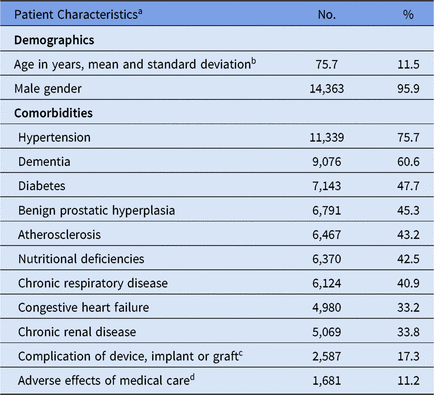
We identified a total of 28,247 UTI episodes diagnosed and treated with antibiotics within 3 days of urine culture among 14,983 Veterans admitted to 110 VA CLCs nationally. The median number of UTI episodes per Veteran was 1.0 (interquartile range [IQR], 1–2) and the median length of stay among 15,829 unique Veteran admissions was 127 days (IQR, 43–717). At the time of the first UTI episode, the average age of Veterans was 75.7 years (±11.5 standard deviation) and 14,363 (95.9%) were male. Additional baseline characteristics are presented in Table 1.
Baseline Characteristics of Veterans With Urinary Tract Infections in VA Community Living Centers Nationally, 2013–2017
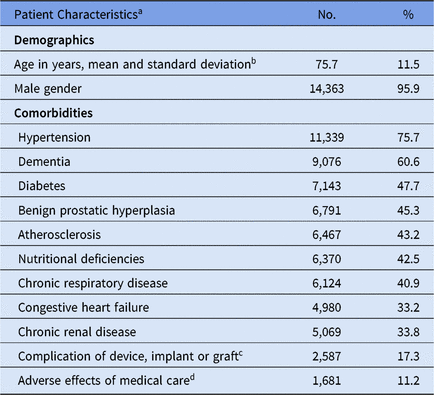
Note. VA, Veterans’ Affairs.
a Characteristics presented for 14,983 unique Veterans at the time of the first UTI episode included over the study period.
b Age measured at time of urine culture collection.
c Includes breakdown, leakage, or complication of urinary catheter.
d Includes all misadventures to patients during surgical or medical care, medical devices associated with adverse incidents in diagnostic and therapeutic use, and surgical or medical care causing abnormal reaction or complication to the patient, such as urinary catherization as a cause of complication.
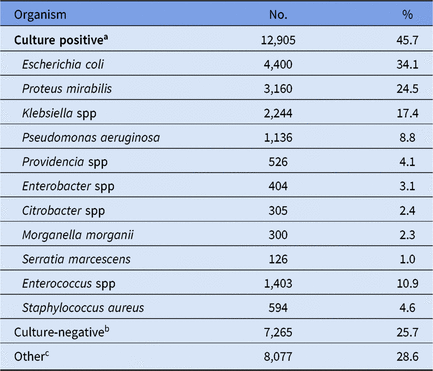
Urine culture results are presented in Table 2. Overall, 12,905 UTI episodes (45.7%) were culture positive and 7,265 (25.7%) were culture negative. Escherichia coli was recovered in 4,400 (34.1%) of culture-positive UTI episodes, followed by Proteus mirabilis and Klebsiella spp, which were recovered in 3,160 (24.5%) and 2,244 (17.4%) culture-positive UTI episodes, respectively.
Urine Culture Results Obtained From 28,247 Episodes of Urinary Tract Infection in VA Community Living Centers Nationally, 2013–2017
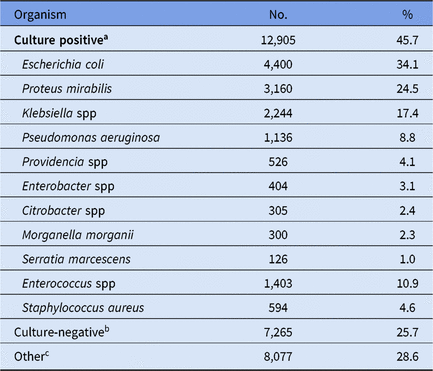
Note. VA, Veterans’ Affairs; UTI, urinary tract infection; CFU, colony-forming units.
a Culture-positive UTI episodes were defined as those in which no more than 2 typical uropathogens were isolated with quantitative counts ≥ 105 CFU/mL from the urine culture. Organism percentages are of culture-positive UTI episodes.
b Culture-negative UTI episodes were those in which no growth was identified from the urine culture.
c All other UTI episodes were defined as those in which typical uropathogens were isolated with low quantitative counts (≤105 CFU/mL), >2 uropathogens were identified, or any other organisms were isolated from the urine culture.
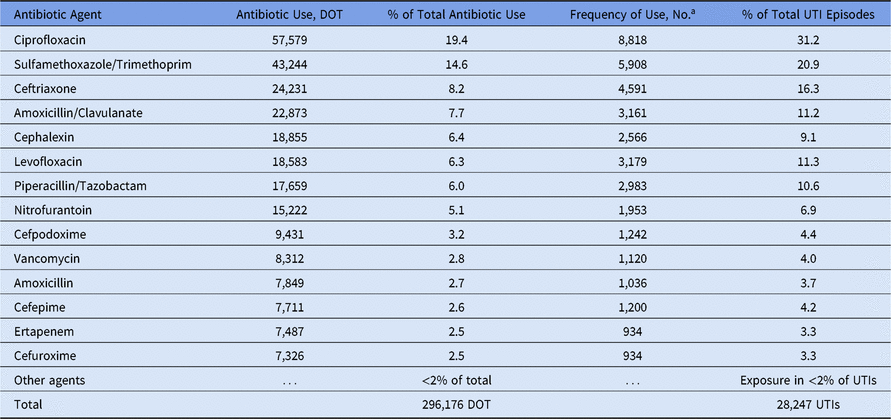
Among all UTI episodes, the most frequently used antibiotic agents were ciprofloxacin (8,818 episodes, 31.2%), sulfamethoxazole/trimethoprim (5,908 episodes, 20.9%), and ceftriaxone (4,591 episodes, 16.3%) (Table 3). Ciprofloxacin, sulfamethoxazole/trimethoprim, and ceftriaxone also had the greatest usage in DOT, accounting for 19.4% (DOT=57,579), 14.6% (DOT=43,244), and 8.2% (DOT=24,231) of the total DOT used, respectively. Broad-spectrum intravenous antibiotic agents accounted for ~20% of the total DOT used.
The rate of total antibiotic use decreased significantly by 10.1% per year (95% CI, −13.6 to −6.5%) from 20.7 DOT per 1,000 bed days in 2013 to 13.2 DOT per 1,000 bed days in 2017. The rate of fluoroquinolone (ciprofloxacin and levofloxacin) use in DOT per 1,000 bed days decreased significantly by 14.5% per year (95% CI, −20.6 to −7.8%). The proportion of UTI episodes treated with fluoroquinolones decreased significantly by 6.0% per year (95% CI, −10.4 to −1.3%) over the study period. Fluoroquinolones were used in 2,958 of 6,693 suspected UTI episodes (44.2%) in 2013 and in 1,645 of 4,675 episodes (35.2%) in 2017.
Antibiotic Use by Agent for Urinary Tract Infections in VA Community Living Centers Nationally, 2013–2017
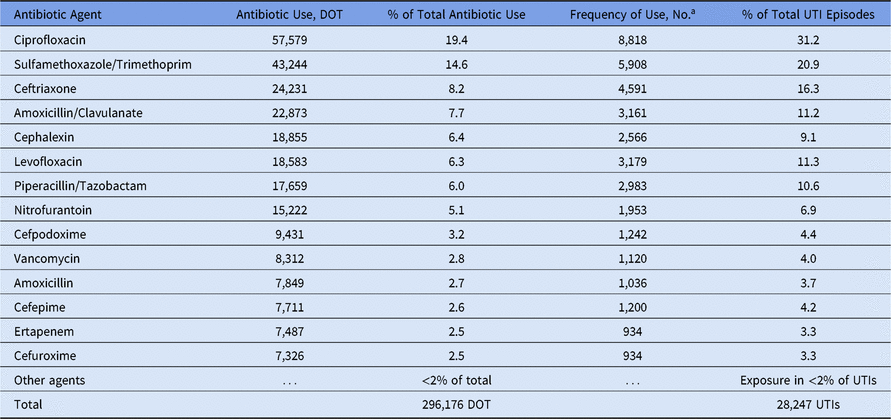
Note. DOT, days of therapy; UTI, urinary tract infection.
a Frequency of antibiotic use is not mutually exclusive, as UTI episodes could be treated with >1 antibiotic.
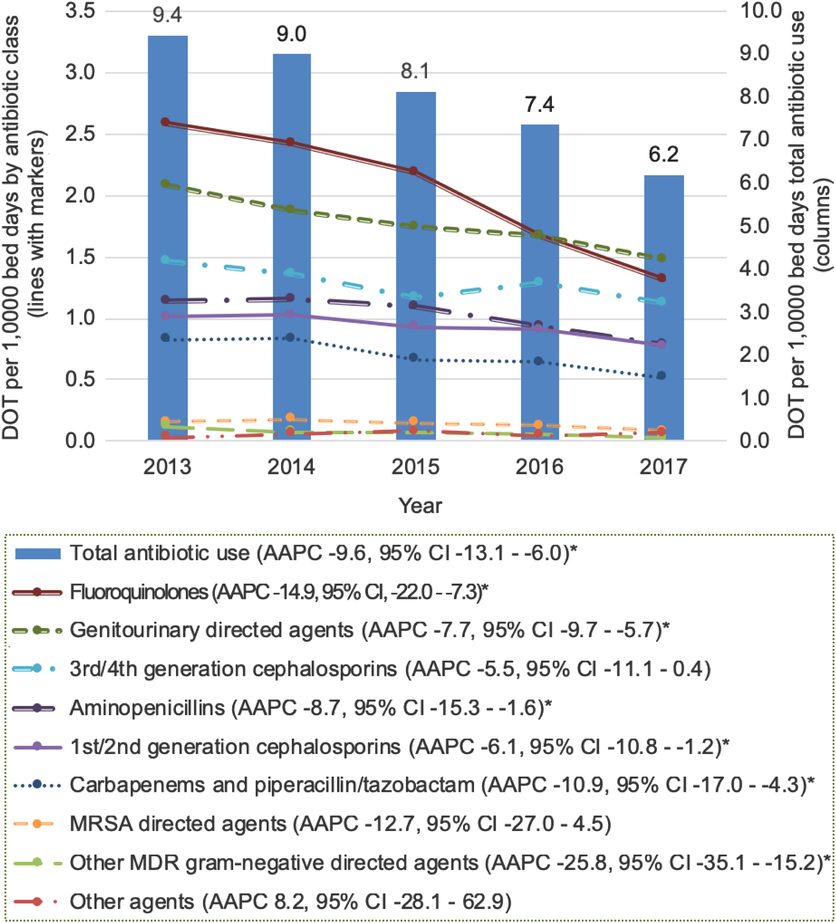
Among culture-positive UTI episodes, ciprofloxacin (4,323 episodes, 33.5%), sulfamethoxazole/ trimethoprim (3,015 episodes, 23.4%,), and ceftriaxone (2,149 episodes, 16.7%) remained the most frequently used antibiotic agents. Several significant changes in the rate of antibiotic use for culture-positive UTI episodes were observed (Fig. 1). The rate of total antibiotic use for culture-positive episodes decreased significantly by 9.6% per year (95% CI, −13.1% to −6.0%). The rate of fluoroquinolone use decreased significantly by 14.9% per year (95% CI, −22.0% to −7.3%).
Trends in the rate of antibiotic use among culture-positive urinary tract infections in VA Community Living Centers nationally, 2013–2017. Note. AAPC, average annual percent change; CI, confidence interval; UTI, urinary tract infection; MDR, multidrug resistant; MRSA, methicillin-resistant Staphylococcus aureus. AAPCs represent the average percent change per year in rate of antibiotic use in DOT per 1,000 bed days. *Significant trend at P < .05. Solid blue columns represent the rate of antibiotic use per year in DOT per 1,000 bed days (range, 9.4–6.2 DOT per 1,000 bed days). Lines with markers represent the rate of antibiotic use by class per year in DOT per 1,000 bed days.

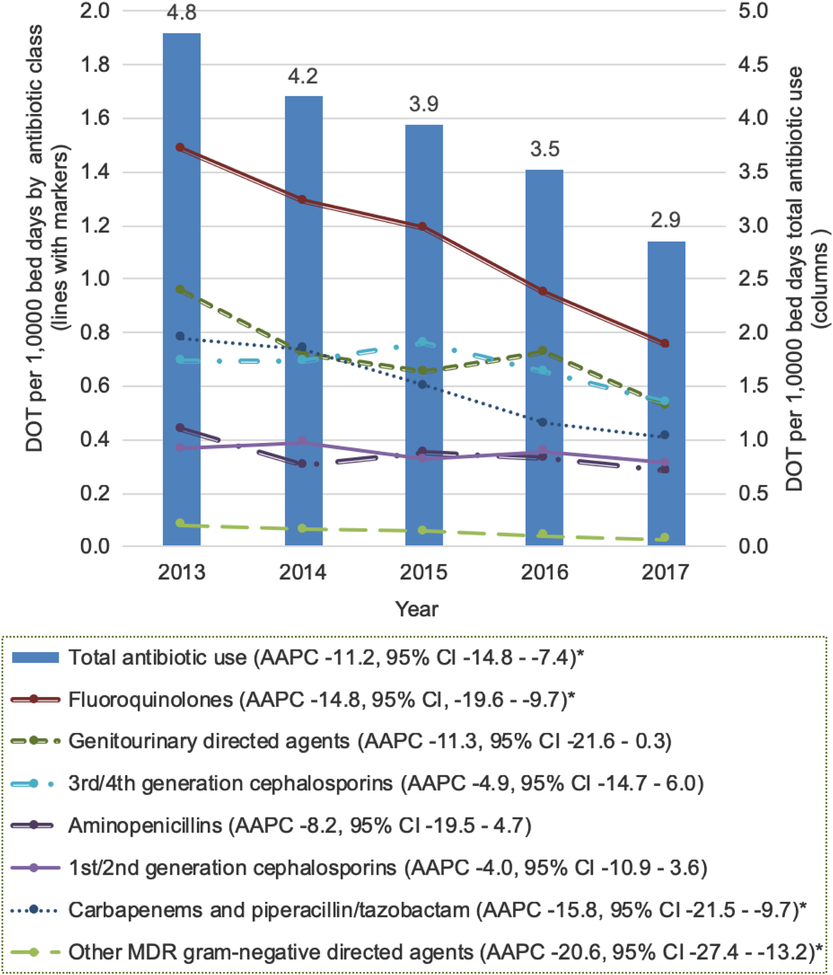
Among culture-negative UTI episodes, ciprofloxacin (1,899 episodes, 26.1%), sulfamethoxazole/trimethoprim (1,203 episodes, 16.6%), and ceftriaxone (1,167 episodes, 16.1%) also remained the most frequently used antibiotic agents. Among culture-negative UTI episodes, 19,376 fluoroquinolone DOT were used, accounting for 25.4% of all fluoroquinolone use (76,162 DOT). Trends in antibiotic use for culture-negative UTI episodes are presented in Figure 2. Significant reductions in the rates of total antibiotic use (by 11.2% per year, 95% CI, −14.8% to −7.4%) and fluoroquinolone use (by 14.8% per year, 95% CI, −19.6% to −9.7%) were observed.
Trends in rate of antibiotic use among culture-negative urinary tract infections in VA Community Living Centers nationally, 2013–2017. Note. AAPC, average annual percent change; CI, confidence interval; DOT, days of therapy; UTI, urinary tract infection; MDR, multidrug resistant. AAPCs represent the average percent change per year in rate of antibiotic use in DOT per 1,000 bed days. *Significant trend at P < .05. Solid blue columns represent the rate of all antibiotic use per year in DOT per 1,000 bed days (range, 4.8–2.9 DOT per 1,000 bed days). Lines with markers represent the rate of antibiotic use by class per year in DOT per 1,000 bed days.

Discussion
In our study of ∼15,000 Veterans diagnosed with and treated for UTIs in CLCs nationally, fluoroquinolone use decreased, as did overall antibiotic days of therapy. Results stratified by culture-positive and culture-negative UTI episodes were similar.
Ciprofloxacin, sulfamethoxazole/trimethoprim, and ceftriaxone were the most commonly used antibiotic agents. Previous studies among Veteran cohorts from outpatient and acute-care inpatient settings have also reported that these agents are among the most commonly used antibiotics for UTI.Reference Spivak, Burk and Zhang 27 , Reference Drekonja, Rector, Cutting and Johnson 28 Data from non-VA LTCFs have similarly identified fluoroquinolones as the most commonly used antibiotic class for UTIs.Reference Bradley 9 – Reference Kistler, Zimmerman and Scales 11
As expected, the typical uropathogens, including E. coli, Proteus spp, and Klebsiella spp, were the most commonly identified uropathogens among culture-positive UTI episodes.Reference Rowe and Juthani-Mehta 31 Similar to our findings, E. coli (53.6%) was the most commonly identified organism among 240 episodes of UTI among residents in 5 Connecticut LTCFs, followed by Proteus spp (14.6%) and Klebsiella spp (13.9%).Reference Das, Perrelli, Towle, Van Ness and Juthani-Mehta 25 Of the UTI episodes in our study, ∼25% were culture negative, suggesting potential overtreatment. Previous work has confirmed the overtreatment of UTI, in both the presence and absence of positive urine cultures, among older adults without symptoms of a UTI. In a study of 153 older women diagnosed with a UTI, only 87 (57%) had microbiological evidence of a UTI, yet 95% of the 66 patients with negative cultures received antibiotics.Reference Gordon, Waxman, Ragsdale and Mermel 32
Although our findings suggest potential overtreatment, they also demonstrated several impressive reductions in the use of antibiotics for UTI across VA CLCs nationally. Total antibiotic use decreased by ∼10% per year from 2013 to 2017 for all UTI episodes and by 10% among culture-positive episodes and 11% among culture-negative episodes. Improving the diagnosis and treatment of UTIs is a well-recognized antibiotic stewardship target among LTCFs.Reference Morrill, Caffrey, Jump, Dosa and LaPlante 33 Among VA medical centers, previous work has confirmed an increase in antibiotic stewardship over the study period.Reference Kelly, Jones and Echevarria 34 However, application of antibiotic stewardship principles may vary at the facility level or by region, which warrants future investigation. Previous research has demonstrated variation in antibiotic use at the facility and regional levels in non-VA LTCFs and in VA facilities.Reference Daneman, Bronskill and Gruneir 35 – Reference Huttner, Jones, Huttner, Rubin and Samore 37
Another encouraging trend we observed was the decrease in fluoroquinolone use among all UTI episodes overall and stratified by culture-positive and culture-negative episodes. Overall, the proportion of UTI episodes treated with fluoroquinolones decreased by 6.0% each year, as did the rate of fluoroquinolones use (by 14.5%). Reductions in use may be related to growing evidence of fluoroquinolone-related adverse effects, especially among older patients. 16 , 38 In 2008, a boxed warning for an increased risk of tendinitis and tendon rupture with fluoroquinolones was mandated by the Food and Drug Administration (FDA). Since that time, the FDA has issued warnings for other serious adverse effects, including exacerbation of myasthenia gravis, C. difficile infection, QT-interval prolongation, severe hypoglycemia, and mental health effects. 38 In 2013, the FDA updated label warnings for fluoroquinolones; in 2016, the FDA specifically recommended use of fluoroquinolones be avoided for uncomplicated UTIs unless no alternative treatment options were available. 16 Nitrofurantoin and sulfamethoxazole/trimethoprim are suggested empiric UTI treatment options for older patients without complicated coexisting conditions and mild UTI symptoms.Reference Datta and Juthani-Mehta 13 , Reference Fagan, Lindbaek, Reiso and Berild 41 , Reference Detweiler, Mayers and Fletcher 42 However, nitrofurantoin should be avoided in patients with pyelonephritis or a history of UTI due to P. mirabilis. Given the high prevalence of P. mirabilis we observed across VA CLCs nationally, our results suggest the avoidance of nitrofurantoin as empiric therapy; however, local resistance patterns should guide empiric therapy. Nitrofurantoin may be an option once urine culture results are available.
Although fluoroquinolone use decreased over the study period, our results demonstrated that fluoroquinolones are still a preferred treatment choice. Fluoroquinolones remained the most frequently used antibiotic class for UTIs over the entire study period, even in 2017 (35.2% of episodes). These findings may be related to our complicated study population of mostly older male Veterans. All UTIs in males are generally considered complicated.Reference Nicolle, Bradley and Colgan 19 , Reference Nicolle 23 Moreover, ∼45% of Veterans in our study had comorbid benign prostatic hyperplasia, which can lead to complicated UTIs and prostatitis related to obstructed and turbulent urine flow.Reference Schaeffer and Nicolle 39 Fluoroquinolones achieve reliable tissue concentrations in the prostate and are considered first-line in men with severe UTI symptoms or concern for prostate involvement.Reference Schaeffer and Nicolle 39 Although our findings do demonstrate impressive reductions in fluoroquinolone use for UTIs among VA CLCs nationally, there may be room for further reducing fluoroquinolone use. Focused antibiotic stewardship efforts to further fluoroquinolone use that have been successful in single-center studies include the removal of fluoroquinolones from local formularies and order sets.Reference Hecker, Fox and Son 40 , Reference Fagan, Lindbaek, Reiso and Berild 41 Overall, ∼76,000 fluoroquinolone DOT occurred over our study period, and 25% of that use was for culture-negative UTI episodes. Thus, negative cultures may be an easy target for antibiotic stewardship in CLCs to further reduce fluoroquinolone use in residents who do not have symptoms of urinary infection.
This retrospective study has several limitations. We defined UTIs as a urine culture plus antibiotic treatment in the presence of a UTI diagnosis code. We were unable to capture treatment practices for UTIs in which no cultures were obtained, for UTIs that were culture-positive and treated without a UTI diagnosis code, and for UTIs that were treated outside the VA CLC setting. We assumed that antibiotic administrations were intended for the treatment of a UTI because the antibiotic indication is often missing, however treatment could be for another infection type. To minimize this possibility, we excluded UTI episodes in which there were concomitant positive cultures from other sources and required a diagnosis code for UTI. Another limitation is that we were interested in the real-world treatment of UTIs; thus, we did not attempt to distinguish treatment of asymptomatic bacteriuria versus truly symptomatic UTI. We did attempt to exclude asymptomatic bacteriuria in the presence of urologic procedure or pregnancy. Additionally, we were unable to capture urinary catheter use and thus unable to quantify the prevalence of caterer use in our population. It is possible that catheter use declined over the study period and may account in part for the observed decreases in antibiotic use. Finally, the generalizability of our findings to other populations may be limited because our population was ∼96% male.
In conclusion, our study of >28,000 UTI episodes in VA CLCs nationally demonstrated a decrease in overall antibiotic use for UTIs, including the use of fluoroquinolone antibiotics. Antibiotic stewardship efforts across VA CLCs should be applauded and efforts should continue, especially toward reducing the overtreatment of UTI, in both the presence and absence of positive urine cultures, in patients without urinary symptoms.
Acknowledgments
The views expressed are those of the authors and do not necessarily reflect the position or policy of the US Department of Veterans’ Affairs. This material is based upon work supported, in part, by the Office of Research and Development, Department of Veterans’ Affairs.
Financial support
This study was supported by a VA Health Services Research and Development (HSR&D) Career Development Award (grant no. 15-260) and Merit Award (grant no. 15-120).
Conflicts of interest
All authors participate in projects funded by the Veterans’ Administration.
Haley Appaneal is supported in part by a Career Development Award, Department of Veterans Affairs. Aisling Caffrey has received research funding from Pfizer, Merck (Cubist), and The Medicines Company. Kerry LaPlante has received research funding or acted as a scientific advisor for Merck, Ocean Spray, Pfizer, and The Medicines Company. All other authors report no conflicts of interest relevant to this article.