Implications
This study demonstrates the importance of improving the thermal environment of neonatal piglets in order to improve growth during the suckling period for low birth weight piglets. Enhancing the thermal environment is particularly important in litters with low birth weight piglets, which is frequent in litters of highly prolific sows.
Introduction
Early life events impact both the survival (Marchant et al., Reference Marchant, Rudd, Mendl, Broom, Meredith, Corning and Simmins2000; Pedersen et al., Reference Pedersen, Berg, Jørgensen and Andersen2011; Panzardi et al., Reference Panzardi, Bernardi, Mellagi, Bierhals, Bortolozzo and Wentz2013) and the productivity (Milligan et al., Reference Milligan, Dewey and de Grau2002; Václavková et al., Reference Václavková, Daněk and Rozkot2012) of piglets. In swine, an average of 6% to 8% of all new-born piglets are stillborn (Borges et al., Reference Borges, Bernardi, Bortolozzo and Wentz2005; Vanderhaeghe et al., Reference Vanderhaeghe, Dewulf, Ribbens, de Kruif and Maes2010; KilBride et al., Reference KilBride, Mendl, Statham, Held, Harris, Cooper and Green2012) and the postpartum (pp) mortality till weaning varies between 11% and 25% depending on the housing conditions (as reviewed by Baxter et al., Reference Baxter, Lawrence and Edwards2011; Pedersen et al., Reference Pedersen, Malmkvist, Kammersgaard and Jørgensen2013), management (Baxter et al., Reference Baxter, Rutherford, D’Eath, Arnott, Turner, Sandøe, Moustsen, Thorup, Edwards and Lawrence2013) and to a great extent on the prolificacy of the sow (Rutherford et al., Reference Rutherford, Baxter, D’Eath, Turner, Arnott, Roehe, Ask, Sandøe, Moustsen, Thorup, Edwards, Berg and Lawrence2013). Therefore, it is critical to the farm economy to assure a high productivity of the live piglets until weaning. Weaning weight and variability in weaning weight are factors influencing production cost. A low weaning weight is associated with an increased economic cost due to an increased feeding cost (Morrison et al., Reference Morrison, Pluske, Smits, Henman and Collins2009) and a delayed slaughter weight (Cabrera et al., Reference Cabrera, Boyd, Jungst, Wilson, Johnston, Vignes and Odle2010; Václavková et al., Reference Václavková, Daněk and Rozkot2012). Thus, identifying early life events of the piglets influencing weight gain during lactation must be considered relevant.
It is well documented that a low birth weight (LBW) is associated with a retarded average daily weight gain (ADG) in piglets both during the lactation and post-weaning (Quiniou et al., Reference Quiniou, Dagorn and Gaudré2002; Václavková et al., Reference Václavková, Daněk and Rozkot2012) and that the birth weight is lower among piglets from large litters (Milligan et al., Reference Milligan, Dewey and de Grau2002; Quiniou et al., Reference Quiniou, Dagorn and Gaudré2002 and Reference Quiniou, Brossard and Quesnel2007). However, besides birth weight not many factors affecting pre-weaning weight gain have been identified. Hypothermia at birth has been associated with increased risk of death (Baxter et al., Reference Baxter, Jarvis, Sherwood, Robson, Ormandy, Farish, Smurthwaite, Roehe, Lawrance and Edwards2009; Pedersen et al., Reference Pedersen, Berg, Jørgensen and Andersen2011). Owing to a reduced viability of hypothermic piglets at birth, hypothermia may also potentially influence pre-weaning growth. Birth problems may be another potential factor for reduced growth. Piglets born after long birth intervals may suffer from asphyxia (Herpin et al., Reference Herpin, Le Dividich, Hulin, Fillaut, De Marco and Bertin1996; Pedersen et al., Reference Pedersen, Berg, Jørgensen and Andersen2011), and thus take longer to suckle for the first time. Asphyxia has been associated with a reduced growth rate and a lowered viability in piglets (Herpin et al., Reference Herpin, Le Dividich, Hulin, Fillaut, De Marco and Bertin1996). The condition can be estimated through the concentration of plasma lactate in the umbilical cord (Herpin et al., Reference Herpin, Le Dividich, Hulin, Fillaut, De Marco and Bertin1996). Finally, long latency to first colostrum intake may limit intake of immunoglobulins and increase susceptibility to pathogens. Therefore, long latency may be another factor contributing to reduced pre-weaning growth. In the present study we investigated the effect of early life events including measures of hypothermia, birth duration and asphyxia as well as latency to suckle, on pre-weaning growth of piglets. The study was performed using loose housed sows under three different ambient temperatures (15°C, 20°C and 25°C) throughout lactation combined with floor heating at the birth site for 12 or 48 h after birth of the first piglet, as part of another larger study (Malmkvist et al., Reference Malmkvist, Pedersen, Kammersgaard and Jørgensen2012; Pedersen et al., Reference Pedersen, Malmkvist, Kammersgaard and Jørgensen2013).
Material and methods
All procedures involving animals were approved by the Danish Animal Experiments Inspectorate in accordance with the Danish Ministry of Justice, Law No. 382 (10 June 1987) and Acts 333 (19 May 1990), 726 (9 September 1993) and 1016 (12 December 2001).
Animals and housing
This experiment was conducted at Research Centre Foulum, Aarhus University, Denmark from March 2009 to May 2010. The experiment was carried out in nine batches each consisting of eight gilts per sow during farrowing and lactation with their litter. During the first three batches gilts were used. In batch four to six the same animals were used, but now as second parity sows and only if they came into oestrus within 5 to 7 days post-weaning. In addition, second parity sows were included to substitute for those sows that were not inseminated within this time. A similar procedure was used for sows in their third parity. This resulted in a total of 39 Danish Landrace×Yorkshire crossbred sows that gave birth to 72 litters over the nine batches
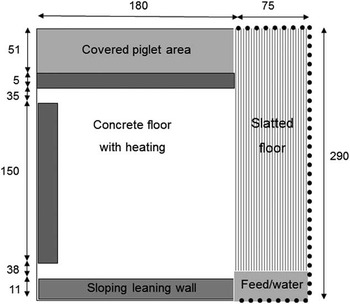
The sows were moved to individual farrowing pens 7 days before their expected farrowing, for loose housing, where they stayed until weaning that took place between 24 and 31 days of age. The farrowing room consisted of eight identical loose housing farrowing pens of 7.4 m2 each (Figure 1), with a separate creep area for the piglets. A 150 W IR heating lamp was used to heat half of the creep area. In addition, a floor heating grid embedded in a 4-cm layer of concrete covered the entire creep area. Another floor heating grid was also embedded in the concrete of the open part of the pen allowing floor heating to be regulated separately in the open space and in the creep area. Floor temperature (measured by two built-in sensors 2 cm below the surface) of the solid floor area averaged 34.8±2.6°C when turned on. The floor heating in the creep area was turned on during the entire experimental period and that in the open pen for either 12 or 48 h after parturition.
The farrowing pen for one sow and litter, with measures in centimetres. The height of the side walls was 110 cm, with solid walls (fitted with sloping leaning walls, raised 27 cm above the floor) as well as barred walls (after Malmkvist et al., Reference Malmkvist, Pedersen, Kammersgaard and Jørgensen2012).

The sows were fed twice daily with a standard dry feed (16.6% CP, 8.4 MJ net/kg) for lactating sows (ad libitum after farrowing and 3.5 kg/sow per day before farrowing). They had ad libitum access to water. Chopped barley straw was provided at 0.5 kg/pen daily. Before allocation of straw, the pens were cleaned of manure and wet straw. Piglets had ad libitum access to water through a drinking nipple. No specialized creep feeding was offered to the piglets.
Experimental treatments
The 72 litters originated from an experiment investigating the influence of duration of floor heating (12 or 48 h) on loose housed sows and their piglets kept at different room temperatures from introduction to 21 days after farrowing (15°C, 20°C and 25°C). Data related to the overall effects of the treatments on sows and piglets around parturition as well as a detailed description of the treatments are published elsewhere (Malmkvist et al., Reference Malmkvist, Pedersen, Kammersgaard and Jørgensen2012; Pedersen et al., Reference Pedersen, Malmkvist, Kammersgaard and Jørgensen2013). In short, the experimental set-up consisted of a randomized block design where the three room temperatures were randomly distributed between the three batches of same parity sows. Within each room the duration of floor heating in the open part of the pen (12 or 48 h after birth of first piglet) was randomly distributed between the eight farrowing pens within a room. This design resulted in six combinations of room temperature and duration of floor heating in the open part of the pen. A total of 11 litters were excluded from the experiment either due to premature farrowing or due to failure in the floor heating system, including wrong timing of onset of floor heating in relation to farrowing. This resulted in a total of 61 experimental farrowings with n=8 to 11 litters for the six treatment combinations of room temperature and duration of pen floor heating (15°C and 12 h: n=8, 20°C and 12 h: n=11, 25°C and 12 h: n=11, 15°C and 48 h: n=10, 20°C and 48 h: n=11, 25°C and 48 h: n=10).
The floor heating was turned on at either the onset of nest-building behaviour, defined as the first occurrence of at least five front-leg scratches per h or repeated carrying of straw without being interrupted by resting periods longer than 2 h (Thodberg et al., 2002; Pedersen et al., 2003), however, no later than the morning of day 115 of gestation. Due to individual variation in length of gestation and nest building, sows were exposed to floor heating for a variable amount of time before parturition (Malmkvist et al., Reference Malmkvist, Pedersen, Kammersgaard and Jørgensen2012).
Management procedures around the time of farrowing
To equalize the litter size, surplus piglets were removed from sows with >14 live pigs at 24 h pp. Piglets were randomly chosen and moved to non-experimental foster sows outside the test rooms. Out of the 61 sows included in the final data set, 24 sows had >14, 14 sows had 14 and 23 sows had <14 piglets, at 24 h pp.
In order to see the full consequences of the treatments, birth assistance was not performed unless in severe cases where birth intervals were longer than 3 h. The birth assistance was performed by the experimenter manually pulling out pigs from the birth canal. Sows that required birth assistance were routinely treated with antibiotics. No doses of oxytocin/prostaglandins were given to any of the sows included in the experiment. In addition, sows were also treated with antibiotics by the caretaker if they considered the sows to be febrile (i.e. rectal temperature (RT) above 39.5°C and feed refusal during 2 consecutive days pp) and if inflammation of the uterus or mammary gland was detected.
Piglets born weighing <0.5 kg at birth were humanely euthanized by a blunt-force trauma, followed by cutting the carotid artery, and consequently not included in the data analysis.
Data sampling
RT, blood sampling and weighing at birth
Within 2 min after birth, each piglet was processed and returned to the sow. First, the RT of each individual piglet was measured using a handheld ethanol-cleaned rectal digital thermometer (DIGI-TEMP Digital Thermometer; Kruuse, Langeskov, Denmark) lubricated with a gel (Børslim Bovivet gel®, Jørgen Kruuse A/S, Langeskov, Denmark). The RT was also measured at 0.5, 1, 2, 3, 4, 12, 24 and 48 h pp. The thermometer was inserted into the rectum of the piglet; if possible without lifting the piglet away from its position. In some cases, for example, due to aggressive sows, the piglets were lifted out of the pen during measurements. Second, 1 ml blood was drawn from the umbilical cord vein using a 23 gauge needle and a 2 ml syringe. If the umbilical cord was unbroken, the sample was taken while the umbilical cord was still attached to the sow. If broken or if the sow was aggressive the piglet was lifted out of the pen and the blood sample was taken close to the navel. Blood was emptied into a 2-ml ethylenediaminetetraacetic acid vacutainer, stored on ice and no later than 30 min after sampling centrifuged for 10 min at 3000×g. Plasma was stored in plastic eppendorf tubes, frozen and later analyzed for lactate using an auto analyzer, ADVIA 1650 Chemistry System (Bayer Corporation, Tarrytown, NY, USA) and according to standard procedures (lactatoxidase, Bayer® Clinical Methods), intra-assay precision (CV%) was 1.2 and 0.7 for low and high control samples and inter-assay precision (CV%) was 1.2 and 0.9 for low and high control samples, respectively. Accuracy (% bias, n=24) was −7.3% (1.49 mM) for low controls and −5.6% (5.68 mM) for high controls. Third, each piglet was weighed and finally, the piglets were carefully dried on the back and numbered for individual identification. The following day piglets were individually marked by ear tattoo, given iron injection and tail docked. In addition, male pigs were castrated on day 2 to 4 pp.
In ~25% of the piglets born, blood samples were not taken. The major reason was that the experimenter was not present at the exact time of birth of the piglet. In a few cases, blood sampling was not successful due to closing of the vein caused by early rupturing of the umbilical cord.
Piglets were also weighed individually at 24, 48 h, 7 and 21 days of age. Day 21 was chosen as the final age since no litters were weaned before that time. Weaning was performed only on specific days in the week. Thus, even though weaning on average took place around 28 days of age, some litters were weaned earlier and some were weaned later.
The birth process and time to first suckle
The duration of parturition was recorded from video as the time from the first piglet in the litter was born until the birth of the last piglet. During parturition, the time of birth of each piglet, the inter-birth interval and the birth order were also recorded.
The latency of each piglet to reach the udder and start suckling for the first time (defined as suckling at the teat for >5 s) was observed directly.
Statistical analysis
Data from piglets surviving until 21 days pp and with an intact data set were analyzed. The following mixed model (1) was used to analyze the influence of early life events on the individual piglet’s ADG (g/day) from birth to 21 days after (Y ijklm ):
 $$\eqalignno{ Y_{{ijklm}} \,=\, & \mu {\plus}\alpha _{i} {\plus}\beta _{j} {\plus}\alpha \beta _{{ij}} {\plus}Weight_{{ijklm}} {\plus}Lac_{{ijklm}} \cr & {\plus}Latsuck_{{ijklm}} {\plus}Totborn_{{ijklm}} {\plus}Pig{\rm 21}_{{ijklm}} \cr & {\plus}Lowt_{{ijklm}} {\plus}\alpha _{i} {\times}{\rm Weight}{\plus}\alpha _{i} {\times}{\rm Lac}{\plus}\alpha _{i} {\times}{\rm Latsuck} \cr & {\plus}\alpha _{i} {\times}{\rm Totborn}{\plus}\alpha _{i} {\times}\,{\rm Pig21}{\plus}\alpha _{i} {\times}{\rm Lowt}\cr & {\plus}Parity_{l} {\plus}Sow_{{k(ij)}} {\plus}{\varepsilon}_{{ijklm}} $$
Where µ is the expected mean value of the response variable, α i the effect of the ith room temperature (i: 15°C, 20°C and 25°C), β j the effect of the jth duration of floor heating (12 or 48 h), Weight the covariate birth weight, Lac the covariate concentration of lactate in cordal blood, Latsuck the covariate latency to first colostrum intake, Totborn the covariate total number of born piglets, Pig21 the covariate number of piglets at day 21 and Lowt the covariate lowest RT measured within the first 24 h of life. The interaction between room temperature and the covariates is described as α i ×Weight, etc. Parity is the random effect of the lth parity (1, 2, 3) and Sow k(ij) the random effect of the kth sow, Ɛ ijklm the residual error where m represents the individual piglets. The response value Y ijklm was normally distributed with N(μ ijklm ,σ2). We used the procedure ‘Mixed’ in the statistical software SAS (SAS Institute Inc., Cary, NC, USA) version 9.1 to analyze data.
A stepwise backward reduction of the initial model was followed using the type 3 test of fixed effects (Littell et al., Reference Littell, Miliken, Stroup and Wolfinger1996) and Satterthwaites approximation for the calculation of degrees of freedom. Covariates, interactions and fixed effects with a P-value>0.10 were removed from the model. After model reduction, the final model ended up including birth weight, lowest RT measured with 24 h pp, number of suckling piglets on day 21, and an interaction between room temperature and birth weight.
Results
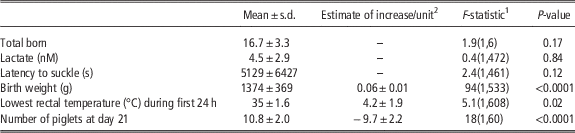
The estimated mean values for all covariates included in the start model are shown in Table 1.
Mean level (±s.d.) of the covariates included in the model with results (F-test and P-value) of the statistical analysis for individual piglet average daily weight gain

1 F-statistic with numerator and denominator d.f. in parentheses.
2 Estimates are only calculated for covariates included in the final model.
Litter size day 21 affected the individual piglet ADG during the lactation period. ADG decreased with increasing number of suckling piglets in the litter (F 1,60=18; P<0.001) as illustrated in Table 2. In addition, the lowest RT measured within the first 24 h of life significantly affected the ADG (F 1,608=5.1; P<0.05), with decreasing ADG with decreasing lowest RT (Table 2).
Results of the ADG of piglets from birth to day 21 estimated at 20°C and at different numbers of suckling piglets day 21 or at different lowest measured RT

ADG=average daily weight gain; RT=rectal temperature; pp=postpartum.
Results are shown as lsmeans±s.e.m.
A,B,CValues within a row with different superscripts differ significantly at P<0.001.
a,bValues within a row with different superscripts differ significantly at P<0.05.
1 The three columns represent the 10%, 50% and 90% percentile of number of suckling piglets day 21.
2 The lowest RT measured during the first 24 h pp, respectively.
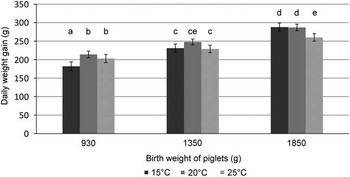
There was a significant interaction between room temperature and birth weight (F 2,444=3.5; P<0.05). Irrespective of room temperature, the ADG increased with birth weight (Figure 2). To explore this interaction, the effect of room temperature was estimated for LBW piglets and high birth weight (HBW) piglets, representing the lower and upper 10% percentile of birth weight of all sampled piglets. For the LBW piglets the ADG was higher when the piglets were housed at 20°C and 25°C compared with 15°C. With increasing birth weight, the influence of room temperature changed so that for HBW piglets, the ADG was lower at 25°C compared with at 15°C and 20°C. There were no effects on ADG either of the total number of piglets born in the litter (F 1,55=1.9; P>0.05), the lactate concentration at birth (F 1,472=0.4; P>0.05) or the latency to first suckle (F 1,461=2.4; P>0.05) (Table 1).
Results of the ADG (g/day) from birth to day 21 estimated at different birth weights, representing the 10%, 50% and 90% percentile of birth weight. The ADG is estimated for each of the three room temperatures (15°C, 20°C and 25°C). Lsmeans with s.e.m. are shown. The interaction between birth weight and room temperature significantly influenced the ADG (P<0.05). Different letters indicate post-test differences at P<0.050. ADG=average daily weight gain.

Discussion
A low RT has been associated with an increased mortality in piglets (Tuchscherer et al., Reference Tuchscherer, Puppe, Tuchscherer and Tiemann2000; Baxter et al., Reference Baxter, Jarvis, Sherwood, Robson, Ormandy, Farish, Smurthwaite, Roehe, Lawrance and Edwards2009; Pedersen et al., Reference Pedersen, Berg, Jørgensen and Andersen2011), and our study showed that even though piglets with a low RT survive during the lactation period, their daily weight gain (ADG) is reduced compared with that of piglets with a higher RT during the first 24 h of life. Some suggestions have been given as to how the early RT might be increased, for example, by adding floor heating at the birth site during the first critical period of survival (Malmkvist et al., Reference Malmkvist, Pedersen, Damgaard, Thodberg, Jørgensen and Labouriau2006). In addition, in our previously published data from the same data set, Pedersen et al. (Reference Pedersen, Malmkvist, Kammersgaard and Jørgensen2013) reported that at a relatively low ambient temperature (15°C), piglets had a lower minimum RT, and the RT was slower at recovering and reaching 37°C compared with in piglets kept at higher ambient temperatures (20°C to 25°C). Furthermore, the authors showed that LBW piglets (birth weight in the 10% percentile) had a lower minimum RT than HBW (birth weight belonging to the 90% percentile) piglets. Consistent with previous studies (Herpin et al., Reference Herpin, Le Dividich, Hulin, Fillaut, De Marco and Bertin1996; Václavková et al., Reference Václavková, Daněk and Rozkot2012), we found that a LBW was the most important factor for explaining a low ADG in piglets during the nursing period. As discussed by Fraser et al. (Reference Fraser, Kramer, Pajor and Weary1995), competition within litters occurs, and so the reduced ADG seen in our study may be due to the LBW piglets being less able to compete for teats during milk let-down. This is in accordance with Milligan et al. (Reference Milligan, Dewey and de Grau2002) who found a reduced weight gain in low-neonatal-weight piglets and also suggested LBW piglets may be at a competitive disadvantage compared with their heavier litter mates.
The litter size at birth had no significant impact on the ADG of the piglets, most likely due to that litter size was reduced to a maximum of 14 piglets within 1 day of farrowing. However, the number of suckling piglets on day 21 did impact the ADG, the ADG being negatively correlated with the number of suckling piglets. This is in agreement with several previous studies showing a reduced weight at weaning in large litters (Milligan et al., Reference Milligan, Dewey and de Grau2002; Andersen et al., Reference Andersen, Nævdal and Bøe2011) and a Danish study indicating that in larger litters (11 to 15 suckling piglets), the addition of one extra piglet results in a reduction in weaning weight of ~150 g/extra piglet (Thorup, Reference Thorup2010).
A significant interaction was found between the room temperature and the birth weight of the piglets, and so the ADG of LBW piglets increased at higher ambient temperatures (20°C and 25°C) whereas a high temperature (25°C) was accompanied by a decreased ADG of HBW piglets. One explanation for the different response in HBW and LBW piglets to the increased room temperature may be that a LBW is associated with limited energy stores (Hakkarainen, Reference Hakkarainen1975). Therefore, LBW piglets are more prone to heat loss (Lay et al., Reference Lay, Matteri, Carroll, Fangman and Safranski2002), and so by increasing the ambient temperature, the heat loss challenge on the LBW piglets was reduced. In contrast, the ADG of HBW piglets was reduced when these piglets were kept at 25°C. This reduction in ADG could be due to a reduced milk production in the sow that may have been experiencing heat stress during lactation when kept at 25°C. The suggested reduction in sow milk productivity in the current study was likely low as the feed intake during the lactation was unaffected by the ambient temperature (reported in our previously published data from the same data set in Malmkvist et al., Reference Malmkvist, Pedersen, Kammersgaard and Jørgensen2012). However, without measuring milk output in a more direct manner this reasoning can only be suggested. Sows in the current study were loose housed and thus able to thermoregulate by lying laterally on the slatted floor. This behaviour increased with increasing temperature (reported in the study conducted by Malmkvist et al., Reference Malmkvist, Pedersen, Kammersgaard and Jørgensen2012). Other studies have also shown an effect of room temperature on both piglet weight gain and sow productivity. Both Quiniou and Noblet (Reference Quiniou and Noblet1999) and Renaudeau and Noblet (Reference Renaudeau and Noblet2001) found a reduced piglet weight gain and a lowered sow milk production when crated sows were housed at 29°C compared with lower temperatures. In contrast to the present study, however, Quiniou and Noblet (Reference Quiniou and Noblet1999) did not find any significant effect of room temperature on ADG when comparing sows and piglets housed at 18°C, 22°C or 25°C. The reason why no difference was found on piglet growth rate at the three temperatures may be because the authors did not consider LBW and HBW piglets separately. Furthermore, the lower ambient temperature in our study was 15°C whereas in the study by Quiniou and Noblet (Reference Quiniou and Noblet1999), the lowest temperature was 18°C and so it is likely that the challenge to the LBW piglets may have been lesser in the study by Quiniou and Noblet (Reference Quiniou and Noblet1999). In addition, the birth weight of piglets born by Danish high prolific sow lines is considerably lower (1374 g in the present study) than the birth weight of piglets of most other genotypes, due to a successful genetic selection for litter size. Thus, we speculate that piglets born by Danish genotypes may be more prone to hypothermia than piglets born by other genotypes.
By considering the impact of the three ambient temperatures used in the present study, our results indicate that for loose housed sows with floor heating at the birth site (either for 12 or 48 h pp) a room temperature of 20°C during the majority of the lactation period may be preferred since it improves the ADG of LBW piglets without having a negative impact (as seen at 25°C) on HBW piglets. It is known, that there is a positive effect of increasing the room temperature to 25°C on hypothermia at birth (reported in the study by Pedersen et al., Reference Pedersen, Malmkvist, Kammersgaard and Jørgensen2013) and thus on chances of survival (Tuchscherer et al., Reference Tuchscherer, Puppe, Tuchscherer and Tiemann2000; Pedersen et al., Reference Pedersen, Berg, Jørgensen and Andersen2011). Combing this information with results suggesting that loose housed sows may be less heat stressed than crated sows (Malmkvist et al., 2012), suggests that the best overall strategy in a loose housing system is to increase the room temperature to 25°C shortly around parturition of the first litter in a batch, while lowering the room temperature to 20°C shortly after birth of the last born litter in the batch. This recommendation may optimally be applied under production conditions where batch farrowing housing systems are used. In a batch farrowing system, sows will be weaned on the same day and thus insemination usually falls within 3 days, resulting in farrowing time being synchronized within a time window of 5 to 6 days. Such a variation is similar to the one achieved in the current study where all sows in a batch farrowed within 5 days. In addition, the housing system used may play a role. In case the sows are crated, increasing the room temperature to 25°C during farrowing may induce heat stress as demonstrated in lactating sows (Prunier et al., 1997), while knowledge is lacking about the resistance of crated sows to heat stress during the peri-parturient period. Thus, the recommendation of transiently increased room temperatures around parturition is so far only applicable for loose housed sows with synchronized deliveries as under batch farrowing conditions.
Contrary to our expectations, neither the latency to first suckle nor plasma lactate concentration from the umbilical cord had significant effect on the ADG of the piglets. Herpin et al. (Reference Herpin, Le Dividich, Hulin, Fillaut, De Marco and Bertin1996) found a positive correlation between growth rate till day 10 pp and lactate in arterial blood from the umbilical cord, while no correlation was found on time to reach the udder. In our study we included all covariates in one model to estimate the effects of the covariates on ADG. Thus, covariates such as lowest RT during first 24 h may have explained most of the variation in ADG caused by lactate, since lactate and lowest RT may be highly correlated. In addition, in our study more piglets may have died due to, for example, asphyxia at birth since ADG was measured till day 21 pp, and not day 10 pp as in Herpin et al. (Reference Herpin, Le Dividich, Hulin, Fillaut, De Marco and Bertin1996). Consequently, we cannot exclude that those piglets most strongly affected by hypoxia could have died and therefore did not contribute to the analysis and our results. Thus, it is not possible to exclude that asphyxia at birth may have some impact on the growth rate in particular during the early period even though we did not find such effect over the study period of 21 days.
Conclusion
In conclusion, we found that hypothermia at birth negatively affected the ADG of suckling piglets. Thus, means to avoid hypothermia at birth are not only important for survival but also for the later growth of the suckling piglets. Increased room temperature may be one way of avoiding hypothermia at birth in a loose housing system. In accordance with this, our results suggest that a room temperature of 25°C (rather than 15°C or 20°C) during the nursing period of loose housed sows improved the growth of LBW piglets. However, our results also showed that HBW piglets had reduced ADG at 25°C compared with 20°C which suggests that the best overall strategy in a loose housing system may be to increase the room temperature to 25°C during farrowing of the first sow in a batch and to reduce it to 20°C shortly after birth of the last litter in the batch.
Acknowledgement
This study was part of the project ‘The Intelligent Farrowing Pen’, funded in co-operations by Skov A/S, the Department of Animal Science at Aarhus University and the Danish National Advanced Technology Foundation.