1. Introduction
Spatial language is used to share information about spatial locations. Statements like “The car is on the left of the supermarket”, “The spider is behind the bee”, or “The box is under the desk”, communicate the location of an object (the located object; LO) with respect to the location of another object (the reference object; RO), whose location is assumed to be known. Production and comprehension of such statements are influenced by the geometric properties of the mentioned objects. Studies by Carlson and colleagues, for example, showed that changing the geometric properties of the RO impacts the acceptability of a given spatial term (Carlson & Van Deman, Reference Carlson and Van Deman2008; Carlson-Radvansky & Irwin, Reference Carlson-Radvansky and Irwin1994; Carlson-Radvansky & Logan, Reference Carlson-Radvansky and Logan1997). While the effects concerning the geometric properties of the RO are well documented, LO properties have been often considered unimportant. For example, cognitive linguists claimed that the information extracted from the LO is secondary to language comprehension, given that the LO is only the goal of a spatial description and its geometry is often ignored (Landau, Reference Landau, Bloom, Peterson, Nadel and Garrett1996; Landau & Stecker, Reference Landau and Stecker1990; Talmy, Reference Talmy, Pick and Acredolo1983). In line with this view, previous experimental studies have often used a LO that was represented as an object without any directional/orientational geometric information (e.g., a circle, as in Carlson & Van Deman, Reference Carlson and Van Deman2008; Carlson, West, Taylor, & Herndon, Reference Carlson, West, Taylor and Herndon2002).
The results of recent computational modelling work suggested something different by showing that the information concerning the LO may be associated with the selection of a reference frame. The model presented in Schultheis and Carlson (Reference Schultheis and Carlson2017) revealed that (a) it was not complete reference frames but parts of reference frames that were competing for selection, and that (b) it was likely that information determining which parts of a frame were selected was not restricted to the type of information commonly discussed in the literature (i.e., information pertaining to the absolute, relative, and intrinsic frame as introduced by Levinson, Reference Levinson2003) but also comprised contextual cues in the environment, such as, for example, axes of symmetry or the geometric properties of salient objects. It has also been shown that the geometric features of the LO were important for spatial language understanding (Burigo & Sacchi, Reference Burigo and Sacchi2013). Within scenes presenting the LO rotated such that its axial configuration did not match the axial configuration of the RO, the comprehension and the production of a spatial description took longer compared to scenes where the axial configurations of the two objects were congruent. This effect has been interpreted as a failure in applying the logic property of converseness (Burigo, Coventry, Cangelosi, & Lynott, Reference Burigo, Coventry, Cangelosi and Lynott2016): if the description “The box is above the vase” is appropriate in describing a given scene, its converse description “The vase is below the box” should also be a valid description (Levelt, Reference Levelt, Bloom, Peterson, Nadel and Garrett1996). But with the LO pointing towards the RO such that the geometric information of the two objects was in conflict, converseness did not hold and the acceptability of the spatial preposition used to describe the spatial relation between the two objects decreased. This conveys that the understanding of spatial language and the associated computation of converseness depend on the axial configuration of the LO and, consequently, on the geometric information people could extract from it. The geometric information associated with an object’s axes is its orientation and direction, but which of these plays a critical role for spatial language understanding remains to be established. In the current study, we present a series of experiments that addresses this critical question.
There is much evidence showing that detecting and processing the direction of an object is important (e.g., Dyde, Jenkin, & Harris, Reference Dyde, Jenkin and Harris2006), in particular for object recognition (Howard, Reference Howard1982; Jolicoeur, Reference Jolicoeur1985; Rock, Reference Rock1973). On the other hand, there is not much evidence in support of the idea that the orientation of an object also plays some role, but this can be because in everyday language orientation and direction are often confounded, with direction being used to implicitly suggest some sort of change in orientation. Conventionally, orientation has been defined as the imaginary rotation that must be applied to an object from a reference placement to its current placement (Twiss & Moores, Reference Twiss and Moores1992). Perceptually, orientation has been associated with the information people extract from the object’s primary axis, which is determined by its axes of symmetry or its axis of elongation. Usually these axes overlap, but in a study in which this information was disjointed, Sekuler and Swimmer (Reference Sekuler and Swimmer2000) showed that both of these axes were important. However, the degree to which these axes were used depended on their saliency: when the elongation axis was more prominent, participants relied more on this information rather than on the symmetry axis in extracting the primary axis of the object (Quinlan & Humphreys, Reference Quinlan and Humphreys1993). That said, follow-up studies showed that axes of elongation and symmetry had only a minor role in the process of object identification (Large, McMullen, & Hamm, Reference Large, Mcmullen and Hamm2003).
Direction, instead, is assigned according to the geometric information referring to the intrinsic ‘up’, which is where the object’s head is ‘pointing’, or according to the intrinsic object’s front, which is where the object is ‘facing’. Given that the front of the object (opposite to its rear) is often determined by the location of the eyes, functionality, or direction of motion (Jackendoff, Reference Jackendoff, Bloom, Peterson, Nadel and Garrett1996), people normally use these cues to assign a direction to an object.
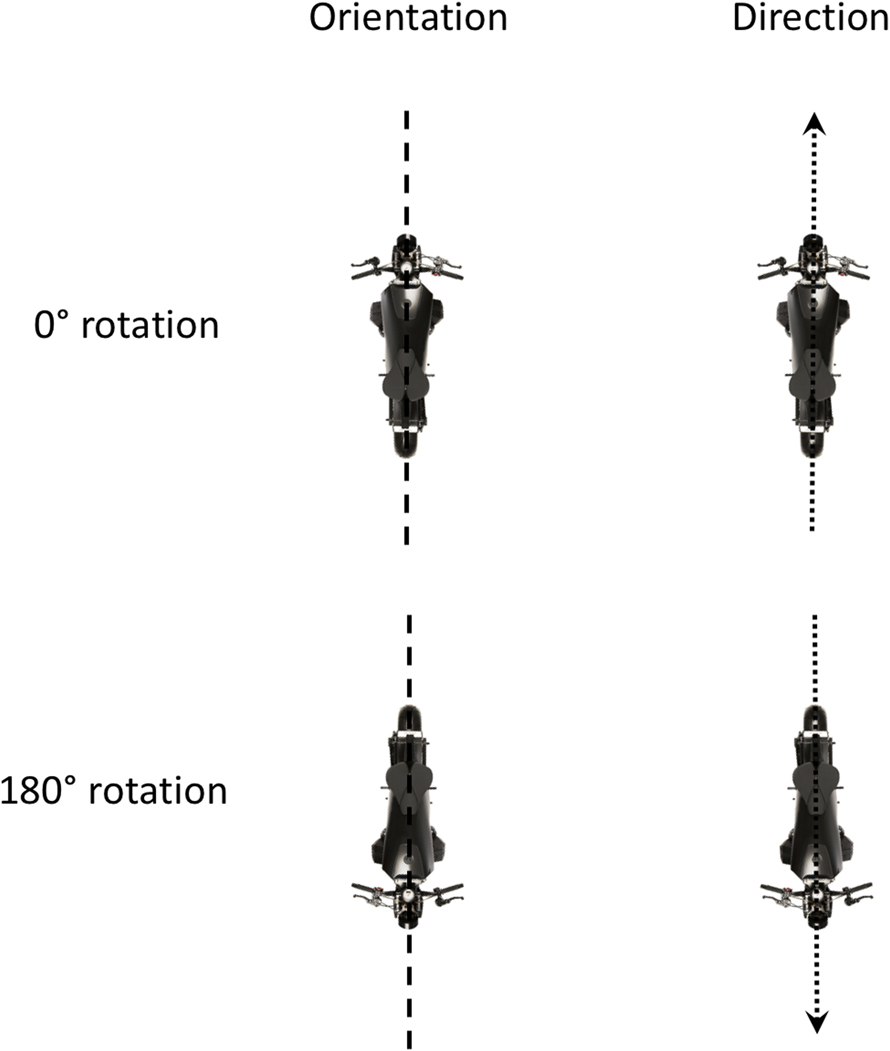
For example, when an object depicted with a bird’s-eye view is presented at 0°, the orientation determined by its elongated axis also has a 0° rotation. When the same object is rotated by 180° its orientation remains the same given that its internal axis occupies the same place it had when it was facing up. But rotating an object has major consequences for its direction: in fact, under 180° rotation the front of the object now has a different location and the object’s direction is opposite to what it was before (see Figure 1). Since the effect of converseness described in previous work depends on the possibility of detecting the LO’s top–bottom or its front–rear (Burigo et al., Reference Burigo, Coventry, Cangelosi and Lynott2016), we expect direction to play a key role in the spatial language apprehension process. Following the observation that the axis of elongation (i.e., object orientation) is an important property in the selection of an intrinsic reference frame (Jackendoff, Reference Jackendoff, Bloom, Peterson, Nadel and Garrett1996) we might expect that the geometric information associated with the orientation of the LO can also be used to evaluate the appropriateness of a spatial description and to compute its converse description.
Examples for how levels of direction and orientation were defined. With the motorcycle rotated by 180°, the orientation does not change, while direction is the opposite compared to the 0° rotation condition.

The present study aims to tease apart the role of direction and orientation of the LO in spatial language comprehension with three experiments in which participants are asked to place the LO in an indicated location. In Experiment 1, we used objects with evident front–rear characteristics to create scenes where the geometrical mismatch originated from a conflicting orientation and direction. In Experiment 2, the same objects were arranged in a way that the conflict concerned only direction. Finally, in Experiment 3, we used objects which did not have any front–rear properties in order to investigate the conflict associated with the orientational information in isolation. To preview the results, we found evidence that the direction but not the orientation of the LO affects the use of spatial language.
2. Experiment 1
In this first experiment, we intended to replicate previous results by showing an effect of the LO on spatial language use, but employing a different combination of objects which prepares us to tease apart the contribution of direction from the contribution of orientation. Previous studies have shown that the effect of the LO was associated with the logic of converseness (if the logic holds, acceptability ratings were higher compared to trials where the logic did not hold) which, in turn, depended on the geometric properties of the LO (Burigo et al., Reference Burigo, Coventry, Cangelosi and Lynott2016). In the same study, the authors also showed that the property of converseness can only be violated within an intrinsic reference frame. For this reason, we used a combination of projective spatial prepositions (prepositions that define the direction in a three-dimensional space in which an object is located with respect to a reference location or object; Jackendoff & Landau, Reference Jackendoff, Landau, Napoli and Kegl1991) such as in front of / behind and bird’s-eye view objects to encourage people to interpret the descriptions relying solely on the intrinsic reference frame. For example, in having to place an object in front of a motorbike, the correct location is computed by imposing an intrinsic reference frame on the motorbike and orienting the reference frame according to the geometric information extracted from the motorbike’s internal axes. As the aim of this first experiment was to replicate the previously observed effect of the geometric features of the LO, we compared trials where the RO and LO matched in direction and orientation (cases where converseness held) and trials where the objects presented a mismatching direction and orientation (cases where converseness did not hold).
2.1. method
2.1.1 Participants
Twenty undergraduate students aged between 21 and 30 (M = 24) from the University of Bielefeld volunteered in this investigation and received 3 euros for their participation. All participants were German native speakers with normal or corrected-to-normal vision and were naive regarding the experimental hypothesis.
2.1.2. Materials and design
Sixteen objects with a clear intrinsic axis were used as located object and reference object (boat, car, lobster, piano, fish, scissors, shoe, spider, airplane, bee, butterfly, crocodile, light, motorbike, mouse, tank; see ‘Appendix A’). All the items used for this and the following studies were pretested to ensure that our assessment of their front/rear matched participants’ judgments. All the objects were bird’s-eye view pictures of real objects edited in order to remove any background. Since it has been shown that a functional relationship between the RO and the LO might affect reference frame selection (Carlson-Radvansky & Radvansky, 1996) and the acceptability of a spatial description (Coventry, Prat-Sala, & Richards, Reference Coventry, Prat-Sala and Richards2001), we carefully selected objects that, when presented together, do not exhibit an obvious functional relationship.
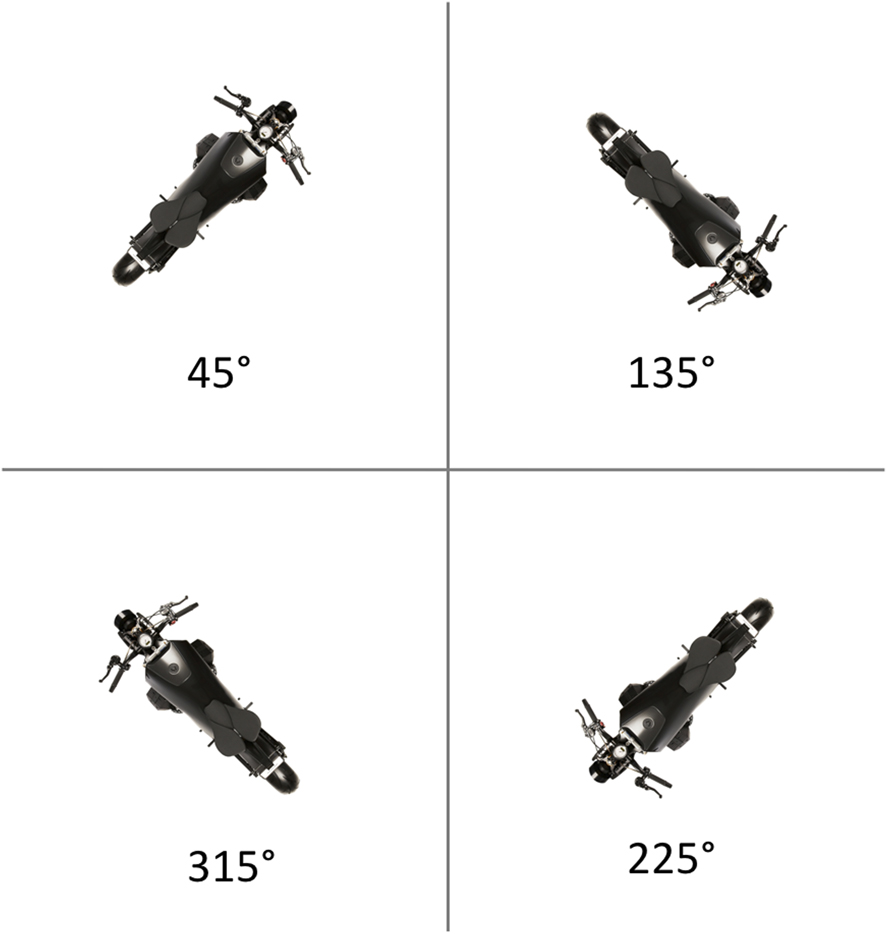
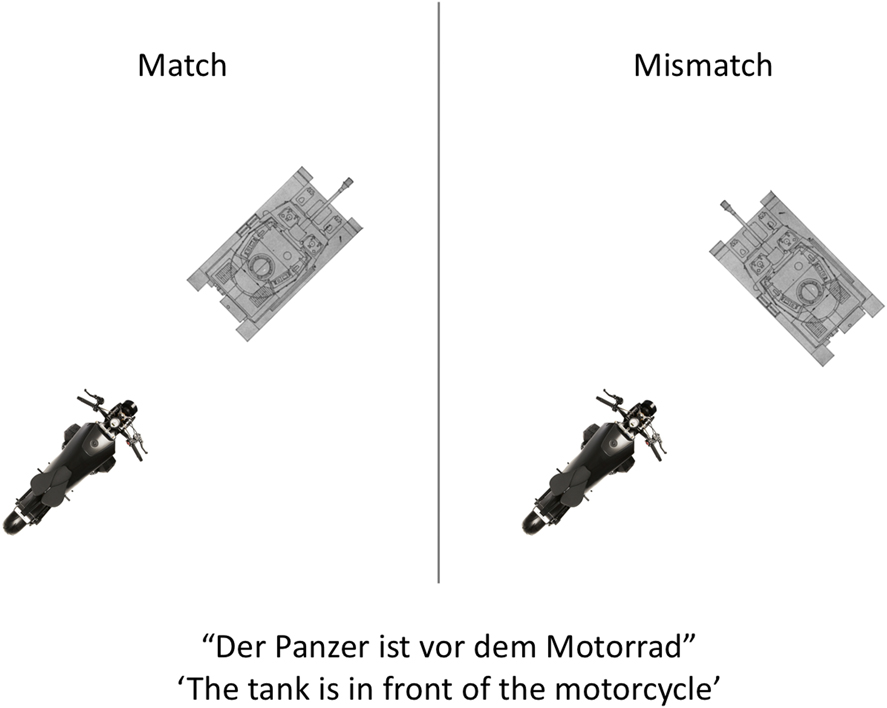
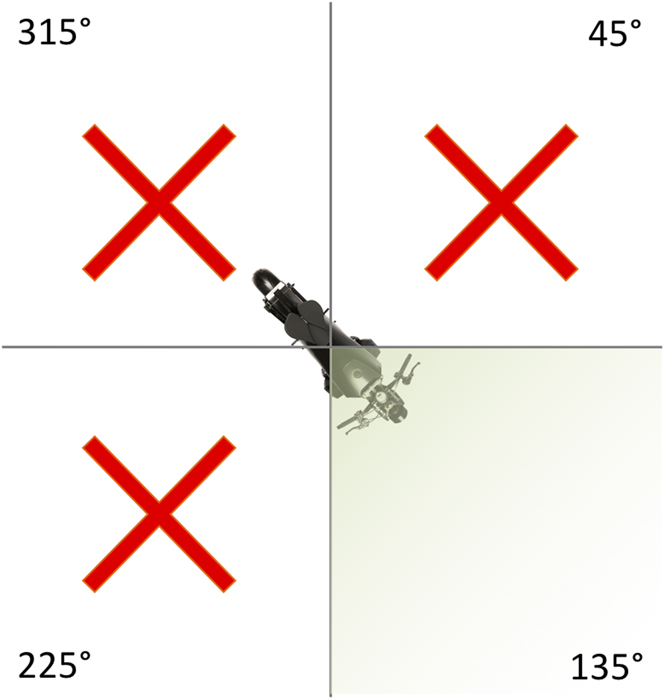
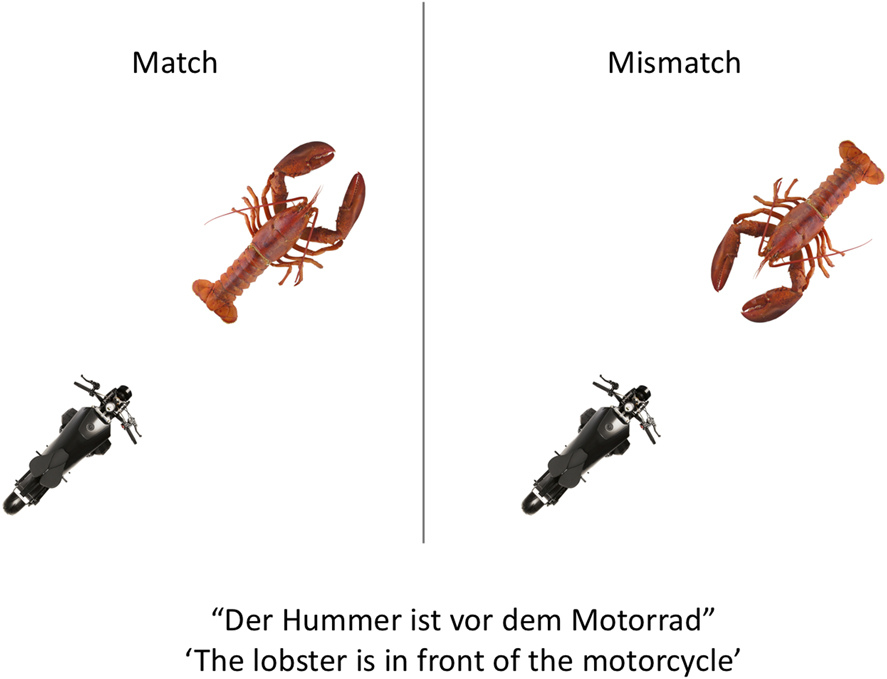
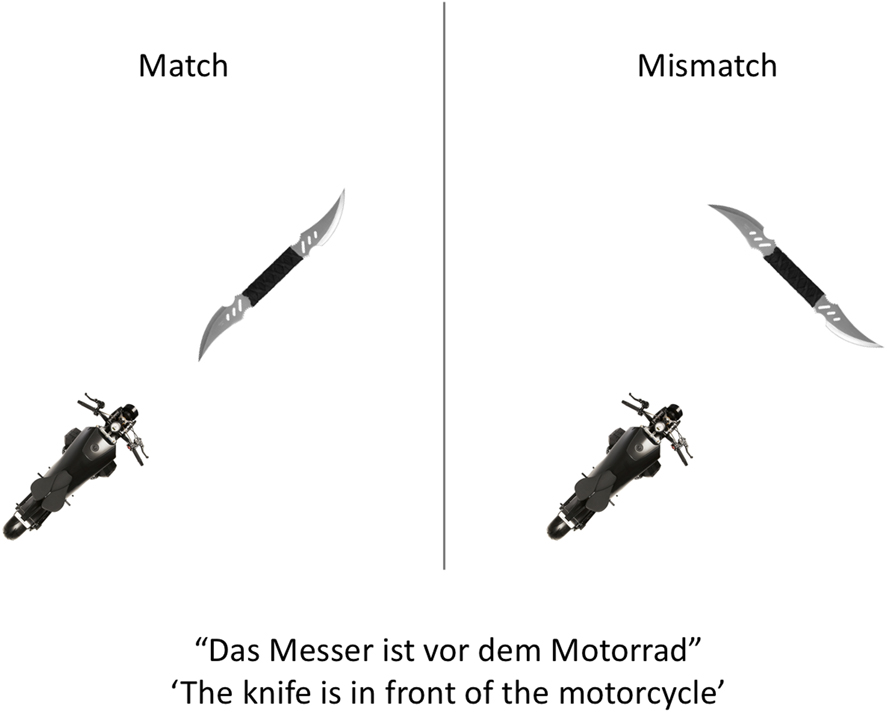
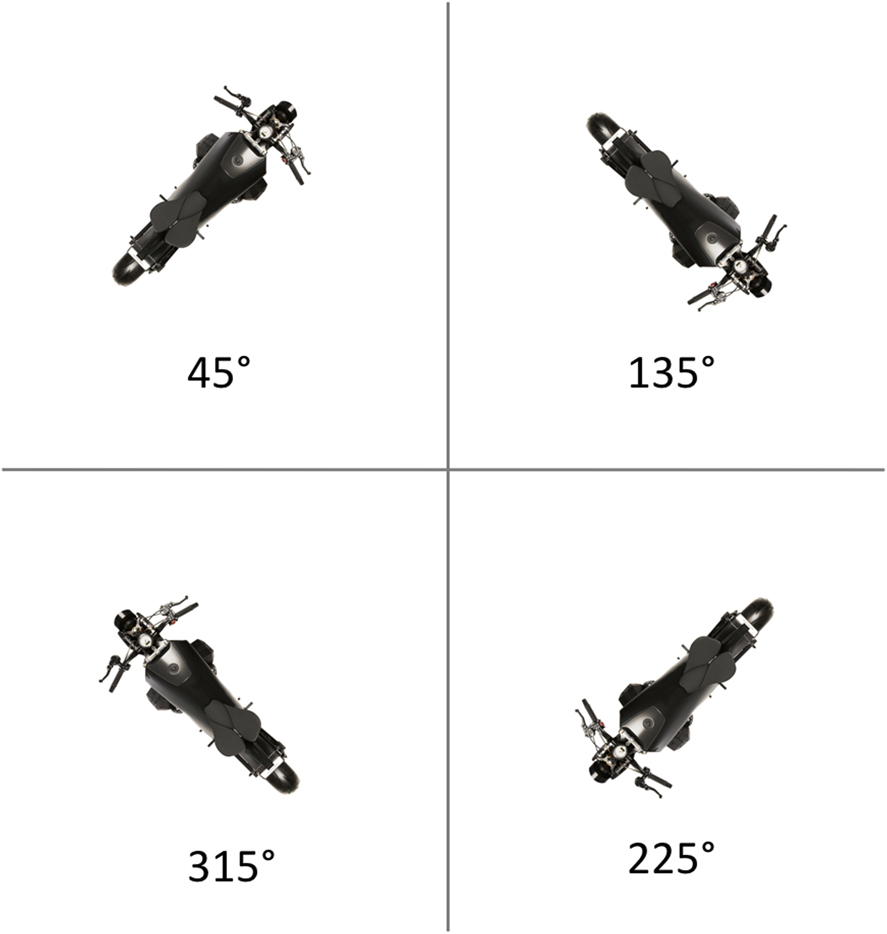
The objects (both the RO and the LO) could be presented in four rotations: 45°, 135°, 225°, and 315° (see Figure 2). For half of the trials the direction and orientation of the LO matched the direction and orientation of the RO, and in the other half they differed by 90° (e.g., RO = 45° and LO = 135°). In doing so, the mismatch concerned both direction and orientation (see Figure 3).
Example of the four rotations used in the study.
Example of a scene used in Experiment 1 illustrating the condition where direction and orientation matched (left) and the condition where they did not (right).

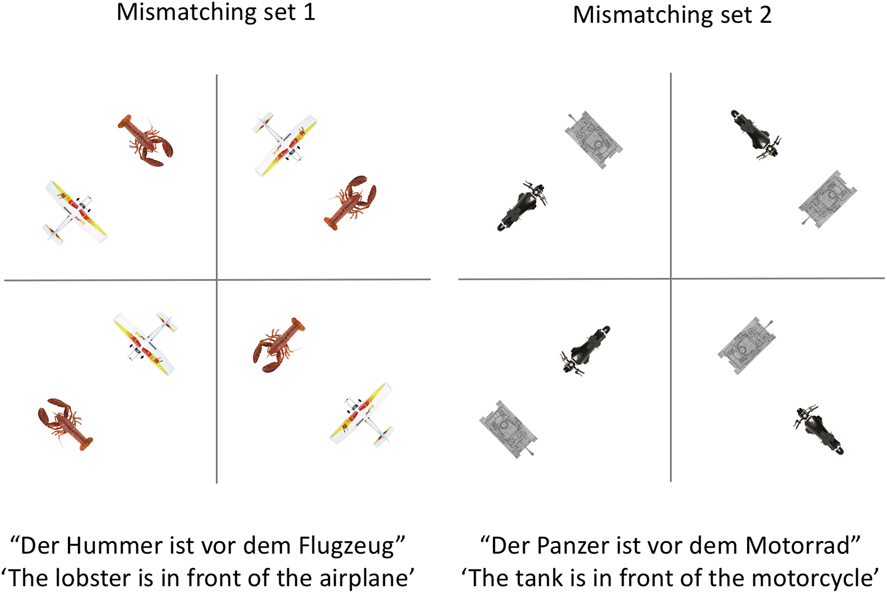
Matching trials presented the objects in four rotations: RO 45° → LO 45°, RO 135° → LO 135°, RO 225° → LO 225°, RO 315° → LO 315°. The geometrical conflict presented in mismatching trials was achieved by showing the LO with a rotation that differed 90° from the RO’s rotation (e.g., RO 45° → LO 135° or LO 315°). In order to keep the number of matching and mismatching trials equal, we balanced the mismatching rotation of the LO across items (see Figure 4).
Example of two possible arrangements for mismatching trials. Note that the located object rotation was balanced across the two sets so that, for example, the RO (airplane) at 45° was associated to the LO (lobster) at 135° in one set (Set 1) and to the LO (tank) at 315° in the other set (Set 2).

It is well known that object recognition takes longer when the object is presented in a non-canonical rotation (Marr, Reference Marr1982; Rock, Reference Rock1983), either as the result of aligning the coordinate system with the internal object axes (Marr & Nishihara, Reference Marr and Nishihara1978) or as a consequence of a mental rotation (Shepard & Metzler, Reference Shepard and Metzler1971; Tarr & Pinker, Reference Tarr and Pinker1989). Both theories assume that the visual image after the transformation or alignment is then matched against a ‘canonical’ representation in memory. According to the claim that canonical representation depends on the probability of encountering the object in a given perspective (Bricolo, Poggio, & Logothetis, Reference Bricolo, Poggio, Logothetis, Mozer, Jordan and Petsche1997; Poggio & Edelman, Reference Poggio and Edelman1990), the fact that people very rarely observe the world from a bird’s-eye view suggests that it is unlikely that they store a canonical representation for objects seen from such a perspective (Tarr, Reference Tarr1995; Tarr & Pinker, Reference Tarr and Pinker1989). This line of thought implies that objects presented from a bird’s-eye view should not present naming or identification costs depending on the rotation angles at which they have been presented, and therefore should not interfere with the understanding of the spatial description used in this study. Moreover, the objects mentioned in the description most of the time correspond to the object in the scene, thus reducing the eventual object recognition costs. Finally, even if plan view object recognition might present some cost associated with its rotation, a well-balanced design with an even combination of RO and LO rotations ensured that this factor did not influence the effect of interest: namely which geometric information extracted from the LO is taken into account during spatial language understanding. Rotations matching the cardinal axes (0°, 90°, 180°, 270°) were not used in order to disentangle the intrinsic frame (based on the object rotation) from the relative frame (based on the viewer perspective), and to increase even more the chance that only an intrinsic reference frame was used during the interpretation of the presented spatial descriptions.
Half of the trials presented a description based on a different spatial preposition set, links von / rechts von ‘on the left of / on the right of’, and were treated as fillers. In half of those fillers (64), instead of placing the LO, participants had to place the RO. All sentences were in German and the LO always corresponded to the subject of the sentence (NP1) and the RO to the object used as a reference (NP2). In order to add some variability to the task and ensure that people were attending to the description, we also added 32 catch trials in which one of the objects mentioned was not in the scene, for a total of 288 trials. As an indication that participants detected the catch trial, they were instructed to move the to-be-placed object to the bottom right part of the screen, regardless of the location or the rotation of the other object. Critical trials included descriptions based on the spatial prepositions vor ‘in front of’ and hinter ‘behind’. We focus on these projective spatial relations given that previous studies showing an effect of the LO used the same spatial term set.
It is crucial to emphasize that for matching trials the description “The tank is in front of the motorcycle” and its converse “The motorcycle is behind the tank” were both good descriptions of the scene and therefore converseness held. In contrast, converseness did not hold for mismatching trials; in fact, people can still find acceptable the description “The tank is in front of the motorcycle” but not its converse, because the motorcycle’s position, in reference to the tank, is on its left instead of being behind (see Figure 3). The experiment used a within-participants design. Given that participants were asked to place an object in the desired location, our dependent variable was the time necessary to complete the placement. The experiment lasted about 30 minutes.
2.1.3. Procedure
Participants sat approximately 60 cm from the screen. Stimulus presentation and reaction time recording were controlled by E-prime® ver. 2 installed on a Dell PC. Before the data collection started, participants familiarized themselves with the procedure with 10 practice trials. The experiment employed a placing task in which participants placed an object in a location specified by a spatial description. The experimental trial started with the presentation of a written sentence displayed in the centre of the screen in the following format: LO – VERB – SPATIAL PREPOSITION – RO that in German will look like “Der Panzer ist vor dem Motorrad” ‘The tank is in front of the motorcycle’. After participants read and understood the description, they were asked to press a designated button that removed the sentence from the screen and started the placing phase. Here participants were instructed to place, using a mouse, the LO or the RO in the specified location. The objects to be placed always appeared at the top-left corner of the monitor while the already-in-place object could be presented in four different locations on the screen to prevent participants from seeing objects in predictable locations. During the placing stage, the movement of the mouse corresponded to the movement of the object such that the object acted as the mouse cursor. Once the object was in the presumably correct location, participants clicked the mouse button to proceed to the next trial. During placement, the object was shown for the entire duration of the placing action to allow participants to process its geometric features. An inter-trial interval of 700 ms closed each trial. Latencies were recorded from scene onset until the mouse button press. Participants used as much time as they needed to complete the task whilst trying to keep accuracy high.
2.2. analysis and results
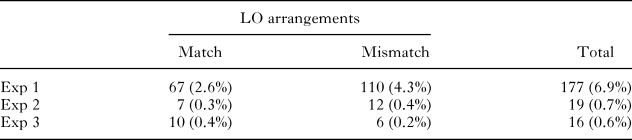
When the LO was placed in an unacceptable location (based on the intrinsic reference frame only; see Figure 5 for an example), the trial was coded as an error. Overall, participants placed the LO in the wrong location in 178 of the critical trials (7%). Participants correctly attended to the objects as indicated by the low number of wrong placements observed in catch trials (N = 8, 2.7%).
Incorrect placements were calculated with respect to the orientation/direction of the RO (here the motorcycle) and the spatial term used in the description. For example, having to place the LO in front of the motorcycle, only placements occurring in the bottom-right quadrant (135°) were considered acceptable. Placements in the other quadrants (45°, 225°, 315°) were coded as errors.

A one-way repeated measures ANOVA on accuracy including RO rotation as a factor was run.Footnote 1 This analysis showed a significant effect of RO rotation (F(3,57) = 16,7, p < .001, η 2 = .467). A further look at the data revealed that the most difficult trials were the ones showing the RO rotated by 315° (37% errors). The other rotations (135°, 225°, and 45°) presented a similar number of errors (approximately 21% errors). Post-hoc analysis suggested that the effect is driven by the comparison between the RO rotated by 315° and the other cases (ps < .001). The same one-way repeated measure ANOVA focusing on the effects of the geometry of the LO revealed a significant effect (F(3,57) = 77,21, p < .001, η 2 = .803). More specifically, participants made the highest number of misplacements with the LO at 45° (38%) and 315° (38%), followed by 225° (22%). Surprisingly, participants placed the LO shown at 135° in the wrong place in only 3 trials (2%). The post-hoc test reported a significant comparison between the following rotations: 45° vs. 135° and 225°, 135° vs. 225 and 315°, and 315° vs. 225° (all ps < .001). Finally, we ran a three-way repeated measures ANOVA including all factors in the experimental design (LO arrangements × 2 spatial prepositions × 4 RO rotations). The statistics replicated the main effect of RO rotations (F(3,57) = 16.67, p < .001, η 2 = .467) and the main effect of LO arrangements (F(1,19) = 79.276, p < .001, η 2 = .807). The analysis also disclosed a main effect of spatial prepositions (F(1,19) = 183, p < .001, η 2 = .906), with more errors for the spatial term behind (79%) than for the term in front of (21%). No further effect reached significance.
A t-test comparing match and mismatch revealed lower accuracy for mismatching trials (62%) than for matching trials (38%) (t(19) = –8.9, p < .001) (see Table 1). The same analysis comparing the distribution of wrong placements across spatial prepositions indicated more misplacements in trials presenting a spatial description with behind (79%) than with in front of (21%) (t(19) = 13.54, p < .001).
Percentages of errors across the three experiments

note: Number of trials (and relative percentages) in which the LO was placed in the wrong location for the two LO arrangements.
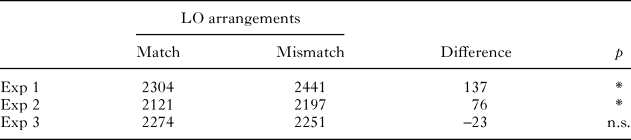
The analysis concerning latency focused on reaction times calculated from scene onset to mouse button press. After removing incorrect placements, 121 outlier responses (5%) were also removed with a filtering procedure based on a 2SD criterion (we also used 3SD and results did not change significantly). All the analyses included only latencies for correct critical trials. The t-test revealed a significant effect of the direction plus orientation on the placement (t(19) = –2.43, p = .025). Placement was faster on trials in which LO orientation/direction was aligned with RO orientation/direction (M = 2304 ms, SD = 557 ms) than on trials where the LO presented a conflicting orientation/direction (M = 2441 ms, SD = 678 ms) (see Table 2). This finding corroborates previous studies and further suggests that the effect of the orientation and direction of the LO extends to a different set of objects that were tied to an intrinsic interpretation.
Mean reaction times across the three experiments

note: Mean reaction times in milliseconds for matching vs. mismatching trials and the absolute difference for each of the three experiments. The last column indicates whether, within an experiment, the comparison between match and mismatch was significant (*) or not (n.s.).
The three-way ANOVA for repeated measures including 2 LO arrangements (match vs. mismatch) × 2 spatial prepositions (in front of vs. behind) × 4 RO rotations (45°, 135°, 225°, 315°) confirmed the significant main effect of the arrangement of the LO (F(1,19) = 5.97, p = .024, η 2 = .239), showing faster placements when the orientation and the direction of the LO were both aligned with the direction and orientation of the RO (M = 2298 ms, SD = 552 ms) compared to trials where these geometrical features differed (M = 2400 ms, SD = 670 ms). The ANOVA also revealed a significant effect of spatial prepositions (F(1,19) = 12.24, p = .002, η 2 = .392), with in front of being processed more slowly (M = 2444 ms, SD = 641 ms) than behind (M = 2287 ms, SD = 576 ms).
Finally, the interaction between spatial terms and RO rotation was also significant (F(3,57) = 3.92, p = .013, η 2 = .171). Follow-up analysis indicated a significant difference between in front of (M = 2583 ms, SD = 747 ms) and behind (M = 2215 ms, SD = 581 ms) only when the RO was presented at 135° (p < .01). The advantage of behind over in front of with the RO rotated by 135° could be a simple distance effect: in fact, presenting the RO at 135°, the distance from the starting point of the LO (top-left corner of the screen) to the target location was considerably larger for in front of than for behind. To test this idea, we ran an ANOVA focusing on the interaction between the RO rotations 135° vs. 315° (these are the geometric arrangements presenting the largest distance difference from the top-left screen corner, i.e., the placing starting point, with 135° being the closest location and 315° the most distant in placing the target object in a behind relation) and spatial terms. The analysis showed a main effect of spatial preposition (F(1,19) = 8.4, p < .001, η 2 = .307), and an interaction between the two RO rotations and spatial terms (F(1,19) = 11.02, p < .001, η 2 = .367), suggesting that the advantage for behind observed with the RO rotated by 135° could be a simple distance effect. No other main effect or interaction was found to be significant.
2.3. discussion
Experiment 1 has shown that placing the LO in the indicated location when the orientation and the direction of the LO mismatched the orientation and direction of the RO took significantly longer than scenes where the objects presented concordant geometric features. This result is in line with previous studies and corroborates the hypothesis that placing a LO whose geometric properties conflict with those of the RO prevents people from applying the converseness inference which, in turn, affects spatial language understanding (Burigo & Sacchi, Reference Burigo and Sacchi2013). Furthermore, this first study indicates that the selected objects and the particular perspective used to illustrate them are appropriate to test the role of direction and orientation in spatial language comprehension.
The main effect of preposition suggests that the spatial relation behind is processed faster than in front of. From a chance perspective, the probability that an object is behind or in front of something should be the same. But, it is reasonable to assume that people should be more likely to be in a situation where they have to describe the location of a hidden object with a behind relation, since an object that is in front of something may be visible (and therefore reachable) without any additional description. However, only a corpus analysis would corroborate this hypothesis.
The analysis on accuracy points out that trials where the LO and the RO present the same geometrical information are less error prone. Whether this can be interpreted as evidence that matching trials are easier to process remains to be established but, at least, it clearly indicates that the geometric information extracted from the objects plays some role in understanding the description and, in turn, in the placement task. The fact that both accuracy and placing latency indicate an advantage for the trials where the LO and RO were shown with aligned rotations rules out explanations of our findings in terms of a speed–accuracy trade-off.
In summary, this first experiment provides clear evidence that the geometric information extracted from the LO affected spatial language comprehension as revealed by the time and the accuracy with which participants placed the LO in the indicated location. However, in this experiment the conflict between LO and RO originates from the manipulation of both the direction and orientation of the LO, without looking at their individual contribution. In the next experiment, mismatching trials will show the LO with the same orientation as the RO, but with a mismatching direction. In doing this, we employed scenes where the internal axes of the objects are aligned so that the conflict concerns direction, but not orientation. If we replicate the advantage for matching trials observed in the first experiment (i.e., faster placements of the LO in the correct location), this can be interpreted as evidence that direction is a relevant geometric feature of the LO for spatial language understanding.
3. Experiment 2
3.1. method
3.1.1. Participants
Twenty-one undergraduate students aged between 19 and 28 (M = 23) from the University of Bielefeld volunteered in this investigation and received 3 euros for their participation. All participants were German native speakers with normal or corrected-to-normal vision, were naive with regard to the purpose of the experiment, and none of them participated in Experiment 1.
3.1.2. Materials and design
The material was the same as in Experiment 1. The design was also the same as Experiment 1, with the difference that in the mismatching trials the direction of the LO mismatched the direction of the RO by 180° (e.g., RO = 45°, LO = 225°). In this case the mismatch concerned only direction but not orientation, as the LO and the RO axes were always aligned (see Figure 6). Critically, this manipulation did not affect the way people computed converseness: as in Experiment 1, converseness held in matching trials but not in mismatching trials. In fact, if the description “The lobster is in front of the motorcycle” is an acceptable description for both matching and mismatching trials, the converse description “The motorcycle is behind the lobster” is not suitable for mismatching scenes, where a more appropriate description would be “The motorcycle is in front of the lobster”.
Examples of direction/orientation match (left) vs. orientation match/direction mismatch (right) conditions for two scenes where the RO (here presented with a 45° rotation) is a picture of a motorcycle. Note that there is no orientation conflict as the axes of the two objects are aligned.

3.1.3. Procedure
The procedure was the same as in Experiment 1.
3.2. analysis and results
For this analysis we first focused on accuracy and then on the reaction times calculated from scene onset to mouse button press. Participants correctly placed the target object in the catch trials and only a few errors were made (N = 3, 0.9%), suggesting that participants correctly attended to the objects. The analysis of accuracy (errors were calculated using the coordinates of the placement, as in Experiment 1) revealed that participants placed the LO in the inappropriate location in only 19 trials (0.7%) (see Table 1). Given the low number of errors, no statistical analysis was conducted.
After removing incorrect placements, 54 outlier responses (1.7%) were also removed with a filtering procedure based on a 2SD criteria (we also used 3SD filtering process and the results did not change significantly). The latency analysis of correct critical trials focused on the geometric effect of the LO. The paired t-test revealed a significant difference (t(20) = –2.27, p = .034), with trials showing the LO and the RO with the same direction placed significantly faster (M = 2121 ms, SD = 633 ms) than trials in which the LO presented an opposite direction in respect to the direction of the RO (M = 2197 ms, SD = 609 ms). This result indicates that a conflict triggered by the direction alone (given that the orientation of the two objects always matched) was able to affect the placement of the LO.
We also ran a three-way repeated measures ANOVA including the following factors: 2 LO arrangements (match vs. mismatch) × 2 spatial prepositions (in front of vs. behind) × 4 RO rotations (45°, 135°, 225°, 315°). The analysis showed a significant main effect of matching condition (F(1,20) = 4.77, p = .041, η 2 = .193), with faster placing time (M = 2121 ms, SD = 633 ms) for trials showing the objects with both direction and orientation aligned, compared to scenes presenting a directional conflict (M = 2197 ms, SD = 609 ms). There was also a significant interaction between the rotations of the RO and the spatial terms (F(3,60) = 13.5, p < .001, η 2 = .403), with an advantage for the behind preposition observed with a 135° orientation (M = 193 ms) and 225° orientation (M = 58 ms), but with an opposite advantage for in front of for trials showing the RO at 45° (M = 23 ms) and at 315° (M = 145 ms). However, the single comparisons analysed via a post-hoc test were not significant (all ps > .05). Finally, the analysis revealed a significant three-way interaction (F(3,60) = 4.12, p < .01, η 2 = .171) between RO rotations, spatial terms, and LO arrangements, but follow-up tests (Scheffé’s) showed no significant difference (all ps > .05).
Despite the fact that post-hoc tests did not show any significant differences, we ran a one-way ANOVA, as in Experiment 1, to evaluate whether the advantage for behind with the RO at 135° and for in front of when the RO presented a 315° rotation could be explained in terms of distance. In this analysis, no significant main effects were found, but a significant interaction between spatial preposition and RO orientation emerged (F(1,20) = 41.8, p < .001, η 2 = .676). This outcome, in line with the analysis in Experiment 1, suggested that the advantage observed under some combination of prepositions/rotations could be associated with the shorter distance participants’ arms had to cover to place the LO in the designated location.
3.3. discussion
The results of Experiment 1 corroborated previous studies showing that spatial language processing is slowed down when the RO and the LO have conflicting direction and orientation. Experiment 2 shows that placing the LO in the correct location requires significantly longer time when the direction of the LO does not match the direction of the RO, even when the orientations of the two objects match. The fact that the mismatching condition was determined exclusively by a directional conflict suggests that direction is a critical factor in setting off the conflict between the geometric properties of the two objects. Moreover, the outcomes described here prove that directionality is certainly important for the computation of converseness, and consequently for spatial language processing.
The advantage for the preposition behind was not replicated in this experiment. Instead, we replicated the interaction between spatial prepositions and RO rotations, and the additional analysis seems to suggest that it has to do with the target location distance. However, the post-hoc analysis did not reveal any significant contrasts, indicating that distance may have only a moderate influence.
The statistical analysis indicated that the task in this experiment was easier than that in Experiment 1 (t(38) = –10.19, p < .001), with a percentage of errors that decreased from 7% to 0.7% in Experiment 2. This is an interesting finding per se as the two experiments were basically the same with the exception of the conflicting geometric information. This might suggest that the influence of orientation and direction was additive. In fact, in Experiment 1 we had two potential sources of conflict, orientation and direction, while in Experiment 2 we had only the directional information that could have generated the conflict. It was thus possible that in the current experiment participants had to solve only one conflict, while in Experiment 1 the conflict was the result of the interplay between two geometric features.
In terms of converseness, such a difference might require a different explanation though. It is possible that the higher number of errors observed in Experiment 1 was caused by the necessity of computing spatial terms that belonged to a different polarity. For example, inferring a converse description in Experiment 1 should have required a spatial term referring to a different set of spatial terms (e.g., “The motorcycle is on the left of the tank” vs. “The tank is in front of the motorcycle”), which might have required extra computation. In the current experiment, instead, the given spatial relation and its converse relation coincide (both relations can be described by the spatial term in front of), making the processing of converseness easier as a consequence of the fact that one spatial term will fit with both descriptions. We will consider this point in more detail in the ‘General discussion’.
In summary, we have provided evidence that direction is involved in understanding projective spatial prepositions. However, the role of orientation needs further clarification. To investigate that, we ran a new experiment using symmetrical objects, allowing us to create mismatching trials where the conflict is based uniquely on an orientation conflict, since symmetrical objects do not contain any distinct information that can be used to assign a direction.
4. Experiment 3
In this third experiment, we aim to investigate whether a geometric conflict between LO and RO observed in previous studies could arise from conflicting orientations while excluding the contribution of directional information. This was achieved by using symmetrical objects that do not carry any distinct information that can be used to assign a direction (Lockwood & Macmillan, Reference Lockwood and Macmillan1978), whilst presenting a distinguished elongated axis that people can take as a cue for assigning an orientation. On the other hand, the absence of clear front–rear information should have made the computation of an acceptable converse description more demanding, if not impossible. Nevertheless, people could still arbitrarily assign a direction to the objects by integrating further contextual information, such as the direction of the RO. If this is the case, then assigning an arbitrary direction should be particularly likely when the objects’ axes are aligned (as in the matching condition; see Figure 7), but it should be more improbable for mismatching trails, where assigning a ‘front’ to an object would be totally arbitrary. Accordingly, there might be two possible outcomes: we either replicate the results of Experiment 1 with an advantage for matching conditions or we do not observe any difference between the match and mismatch conditions. The first case would indicate that people assigned an arbitrary ‘front’ to the LO according to the directional information of the RO and used it to compute the converseness description, which should be an acceptable description for matching trials. If the analysis reveals no difference, it would suggest that people do not arbitrarily assign directional information to the asymmetrical LO and consequently they do not infer the converse descriptions when the LO is a symmetrical object. From a more general point of view, this last pattern of results would indicate that orientation information alone is not capable of triggering the conflict.
Example of the orientation match (left) vs. orientation mismatch (right) condition for two scenes where the RO (here presented with a 45° orientation) is a picture of a motorcycle.

4.1. method
4.1.1. Participants
Twenty undergraduate students aged between 21 and 35 (M = 25) from the University of Bielefeld volunteered in this study and received 3 euros for their participation. All the participants were German native speakers with normal or corrected-to-normal vision and none of them participated in either Experiment 1 or Experiment 2.
4.1.2. Materials and design
Two different sets of objects were used: one set included asymmetrical objects and one included symmetrical objects. The asymmetrical objects were a selection of eight objects from Experiment 1: airplane, bee, butterfly, crocodile, light, motorbike, mouse, and tank. The symmetrical objects were objects that did not present a front–rear polarity and therefore did not carry any distinct information participants could have used to assign a direction. The objects were selected from a pool of items that already look symmetrical, but in order to create perfectly symmetrical objects these were manually edited. First, the object’s image was divided in half. Then we created a mirror image of the truncated object and joined the two parts to form a symmetrical object with two identical parts. In doing this, the resulting objects ended up presenting an elongated axis which, according to previous studies, is taken as the principal axis (Jackendoff, Reference Jackendoff1983, Reference Jackendoff2002) and is used to define its orientation. The objects in this set were: a baguette, a (American) football, a kayak, a knife, a neon light, a pencil, a rolling pin, and a skateboard (see ‘Appendix A’).
The design was identical to Experiment 2 except that critical trials presented symmetrical LOs (see Figure 7). The RO was always an asymmetrical object, while the LO was always a symmetrical object. Matching trials presented the LO and the RO aligned according to their internal axis (same orientation).
In both conditions there is no direction conflict, as symmetrical objects do not have any directional information. However, if people assign an arbitrary ‘front’ to the LO, combining information from its elongated axis and the direction of the RO (e.g., Figure 7 – matching condition: taking the blade that is farther away from the motorcycle as being its ‘front’), then converseness would hold in matching trials (‘The knife is in front of the motorcycle’ vs. ‘The motorcycle is behind the knife’) but not in mismatching trials.
4.1.3. Procedure
The procedure was the same as in Experiment 1 and 2.
4.2. analysis and results
The analysis of accuracy revealed that participants placed the LO in the wrong location on 16 trials (0.6%) (see Table 1). Given the low number of errors, no statistical analysis was conducted. Participants performed a relatively small number of placement errors in catch trials (N = 38, 11%), suggesting that, despite presenting a higher number of inaccuracies compared to the previous experiments, they correctly paid attention to the objects presented. We removed 122 outliers (4.8%) with a filtering procedure based on a 2SD criteria (we also ran an analysis with data filtered by 3SD and the results did not change significantly). As we did for previous experiments, we focused on the effect of the LO including only latencies for correct critical trials. The analyses included reaction times calculated from scene onset to mouse button press. The t-test did not reveal any significant difference in terms of placing latencies. Trials showing the LO and the RO with the same orientation and trials with the LO oriented orthogonally to the RO were not significantly different (t(19) = 1.11, p = .278). This suggested that orientation alone was not able to generate a geometric conflict during the comprehension of a spatial description, probably because directional information was fundamental to applying a converseness inference, and in the absence of a conflict no difference between the LO arrangements emerged.
The three-way ANOVA for repeated measures including 2 LO arrangements (match vs. mismatch) × 2 spatial prepositions (in front of vs. behind) × 4 RO rotations (45°, 135°, 225°, 315°) showed a marginal main effect of RO rotation (F(3,57) = 2.71, p = .053, η 2 = .125). Follow-up analysis did not reveal any significant contrast. A significant interaction between RO rotation and spatial terms (F(3,57) = 5.157, p = .003, η 2 = .213) also emerged in the analysis, but the Scheffé’s post-hoc test did not find any significant contrast. No other effects emerged from this analysis.
The additional analysis focusing on the interaction between prepositions and the two rotations of the RO which represented the largest distance difference from the top-left screen corner revealed a main effect of RO orientation (F(1,19) = 5.01, p = .026, η 2 = 209), (M135° = 2298 ms, SD = 826 ms, M315° = 2200 ms, SD = 705 ms), and a significant interaction (F(1,19) = 11.3, p < .001, η 2 = 373), suggesting again that this effect could be due to the distance between the LO starting point and the target placing location. However, the post-hoc test showed no differences (ps > .05).
4.3. discussion
The simple comparison and the ANOVA did not report any placing latency difference between trials where the LO and RO had the same orientation and trials where the LO presented a mismatching orientation. This outcome indicates that orientation alone is not relevant for spatial language processing.
5. General discussion
Despite what cognitive linguistics suggested (e.g., Talmy, Reference Talmy, Pick and Acredolo1983), the geometric information carried by the located object (LO) matters for spatial language comprehension (Burigo & Sacchi, Reference Burigo and Sacchi2013). In particular, when the LO presents geometric features that conflict with those of the RO, understanding and producing a spatial description takes significantly longer. According to previous theories of spatial language (see Coventry & Garrod, Reference Coventry and Garrod2004; Logan & Sadler, Reference Logan, Sadler, Bloom, Peterson, Nadel and Garrett1996), during the processing of projective spatial prepositions, such as the ones used in this study, the critical geometric features that people extract from the objects in a scene are direction and orientation. Above, we illustrated the results from three experiments that converged in revealing that the direction information arising from the LO had a clear impact on spatial language processing, while orientation seems to be irrelevant. These results are in line with the findings described in previous studies (Burigo et al., Reference Burigo, Coventry, Cangelosi and Lynott2016; Burigo & Sacchi, Reference Burigo and Sacchi2013), where scenes that received lower ratings or scenes for which placing the LO took longer were the ones presenting the two objects with a contrasting direction. But the findings presented in this study do not simply corroborate previous studies; they also add critical information for the understanding of spatial language processing. Previous studies have shown that the geometric information extracted from the LO is important for the inference of converseness (Burigo et al. Reference Burigo, Coventry, Cangelosi and Lynott2016), so that if “A is above B” is a valid description, then “B is below A” must also hold. In particular, the results have suggested that when the LO is presented rotated from the vertical plane, converseness no longer holds and the apprehension of spatial language is affected. In the current study we have extended this finding by showing that the computation of converseness relies primarily on the directional (instead of orientational) information extracted from the objects. This claim is in line with the observation that, within an intrinsic reference frame, it is through the directional information extracted from the object (e.g., the direction of motion, front/rear polarity) that people tend to decide whether something is standing in front of / behind it (Levinson, Reference Levinson, Bloom, Peterson, Nadel and Garrett1996). Furthermore, the results of this study showed, for the first time, that asymmetrical objects do not support the computation of converseness as a consequence of the fact that people were not inclined to assign an arbitrary ‘front’ to ambiguous objects by mapping the geometric information extracted from RO direction on the LO elongation axis.
It has been suggested that the geometric information extracted from the LO for the computation of converseness is relevant only within an intrinsic reference frame (Burigo et al., Reference Burigo, Coventry, Cangelosi and Lynott2016). As a result, direction and orientation may play a different role if the objects were depicted from a perspective that allows selection of an absolute/relative reference frame (e.g., side-view perspective). For example, within a relative reference frame, the salient geometric information may become the direction or the orientation of the viewer, so that the geometric information extracted from the LO may be less relevant. In addition, if the connection between converseness and direction is as firm as we are claiming here, such geometric information should not affect the comprehension of spatial language involving proximity relations (e.g., near and far), given that these terms are less influenced by direction information compared to projective prepositions (Coventry & Garrod, Reference Coventry and Garrod2004). These questions require further investigation, and we plan to address them in our future work.
Despite the fact that the results presented here are in line with previous studies (Burigo et al., Reference Burigo, Coventry, Cangelosi and Lynott2016; Burigo & Sacchi, Reference Burigo and Sacchi2013), showing an effect of the direction of the LO does not exclude that the geometric information extracted from the LO might have affected spatial language apprehension at an early stage, that is, during reference frame selection (Carlson-Radvansky & Logan, Reference Carlson-Radvansky and Logan1997). Under these circumstances, the directional information associated with the LO may have affected the process of assigning a direction to space, which is the stage where the direction of the reference frame applied on the RO has been adjusted (Logan & Sadler, Reference Logan, Sadler, Bloom, Peterson, Nadel and Garrett1996). In this case, it is possible that during such reference frame tuning the direction of the LO is processed as relevant contextual information with the selected reference frame being adjusted accordingly to accommodate the different (conflicting) information extracted from the RO and LO. As a result, the spatial template may have been constructed not only on RO geometric information, but also on LO directional data. This hypothesis is congruent with recent modelling work (Schultheis & Carlson, Reference Schultheis and Carlson2017) and empirical studies (Li, Carlson, Mou, Williams, & Miller, Reference Li, Carlson, Mou, Williams and Miller2011; Miller, Carlson, & Hill, Reference Miller, Carlson and Hill2011) showing that other aspects of the environment (e.g., contextual cues), such as the spatial arrangement of other objects surrounding the RO and the LO, may influence reference frame selection. To what extent the geometric information extracted from the LO affects reference frame selection was not tested in the current study and remains an intriguing aspect for future inquiries.
It is also of some interest to discuss in more detail the difference between what the latency analysis suggested and what the accuracy analysis revealed when comparing the three experiments. The analysis of latencies did not show any significant difference comparing Experiment 1 and Experiment 2 (these were the experiments showing a significant difference between match vs. mismatch trials), suggesting that orientation and direction were not additive (placing times in Experiment 1, M = 2369 ms, were statistically not significantly different from placing times in Experiment 2, M = 2162 ms; t(39) = 0.949, p = .349). However, as previously suggested, the apparent difference between the two experiments might reflect a discrepancy between the spatial relations used for inferring the converse descriptions. To further test this hypothesis, it would be more appropriate to focus on the mismatching conditions of the two experiments instead of including all trials. As a matter of fact, in the mismatching trials, both object arrangements present a conflict and converseness does not hold, but in Experiment 1 the converse description requires a spatial term referring to a different axis system (e.g., “The tank is in front of the motorcycle” vs. “The motorcycle is to the left of the tank”), while in Experiment 2, despite the fact that converseness does not hold either, the converse relation refers to the same axis and the spatial terms correspond (e.g., “The lobster is in front of the motorcycle” → “The motorcycle is in front of the lobster”). This new comparison brings to light a marginally significant effect (placing times for the mismatching condition in Experiment 1, M = 2437 ms, SD = 678 ms, were marginally significantly different from placing times in Experiment 2, M = 2111 ms, SD = 558 ms; t(43) = 1.76, p = .086). This implies that the difference in spatial terms used in computing converseness can be used to predict the latency differences observed in this study. What the data seem to suggest is that it is easier to place the LO in the correct location when its relative converse description is based on the same relation as the target description (e.g., in front of vs. in front of) compared to the situation where the placing requires computing a ‘new’ spatial relation based on a different axis (as for in front of vs. to the left of). This result is particularly relevant for spatial language theories, as it helps to unveil crucial details of how the inference of converseness works and its impact on spatial language comprehension. Further investigation in this regard will help to strengthen such an appealing hypothesis.
On the other hand, accuracy analysis revealed that the comparison between Experiment 2 and Experiment 3 was not significant (p = .975), but it was between Experiment 1 and Experiments 2 and 3 (ps < .001). Given that we could exclude the presence of a speed–accuracy trade-off, since longer reaction times were associated with a higher number of errors, the reduced number of misplacements in Experiment 2 and Experiment 3 may indicate that when the LO carried only one piece of geometric information, placing the LO in the correct position was less demanding compared to the situation where both attributes were available (as in Experiment 1). As such, the results seemed to suggest that, despite not being additive in a strict sense, it was possible that the presence of two geometric attributes has worsened performance and that the two geometric features are intertwined, perhaps in a hierarchical manner. This interpretation is compatible with non-modular frameworks suggesting the parallel integration of competing cues (Duran & Dale, Reference Duran and Dale2014; Duran, Dale, & Galati, Reference Duran, Dale and Galati2016).
The analysis focusing on mismatching trials only replicated the previous outcomes and showed a significantly higher number of misplacements for Experiment 1 (N = 110) compared to Experiment 2 (N = 12) and 3 (N = 6) (ps < .001). This outcome is in line with a hierarchical hypothesis but does not fit with the hypothesis that such a difference reflects the selection of different spatial terms, as also shown by the fact that in Experiment 3 people seem not to infer any converse description. However, such an interpretation might be biased by the limited amount of data available for such analysis and it should be treated with caution.
The hypothesis that the two parameters present a hierarchical structure is in agreement with Carlson and Van Deman’s (2008) claim. In their study the authors suggested that reference frames present a hierarchical structure and this is reflected in the reference frame parameters so that direction can be specified within an orientation. Accordingly, directional information cannot be specified without an orientation, given that direction is incorporated in orientation. This implies that direction is a sub-parameter of orientation, but the fact that direction alone has an impact on spatial language comprehension while orientation alone does not (but can still affect performance when associated with directional information) seems to be in contrast with such a hierarchical structure hypothesis. One possible explanation in line with the hierarchical structure hypothesis is that the orientational information is ignored because it is irrelevant for the assigned task, given that only the direction parameter can be used to determine the front/rear polarity of an object and consequently to verify whether converseness holds or not.
In summary, with the present study, we have shown that the primary information for the apprehension of a spatial description concerns the direction of the objects, which is in agreement with the hypothesis that people evaluate the goodness of fit of a converse description during the understanding of spatial language. The idea that people infer the converse description also explains why orientation turns out to be irrelevant: it does not carry any information concerning the front/rear of an object and this lack of geometric information prevents the computation of the logic of converseness. In the current study, we have also shown that people do not arbitrarily assign directional information to objects that do not have a clear front/rear polarity (symmetrical objects). As a consequence, studies on spatial language and spatial cognition should always put sufficient attention on the geometric information carried by the objects whose locations have been described. This is particularly relevant not just for the LO as shown in this study, but also for the RO, whose geometric properties are fundamental for processing spatial description based on an intrinsic reference frame.
APPENDIX A
Objects used in Experiment 1 and 2: airplane, bee, boat, butterfly, car, crocodile, light, lobster, motorbike, mouse, piano, fish, scissors, shoe, spider, tank (see Figure 8a).
Pictures of the stimuli (here presented at 45° rotation) used across the three experiments.

Symmetrical objects used in Experiment 3: baguette, a (American) football ball, a kayak, a knife, a neon light, a pencil, a rolling pin, and a skateboard (see Figure 8b).
APPENDIX B
All the following analyses were run in R (R Core Team, 2016). The statistical models included items and participants as random factors (Baayen, Reference Baayen2008). Following Barr and colleagues (Barr, Levy, Scheepers, & Tily, Reference Barr, Levy, Scheepers and Tily2013) we started with the most complex converging model, and then performed a stepwise reduction based on model comparison. This procedure continued until the removal of a factor led to a significant decrease in model fit (log-likelihood ratio) or until the model contained only main effects. Predictors were centred in order to prevent statistical inferential errors (Kraemer & Blasey, Reference Kraemer and Blasey2004). For the Multinomial Logistic we use R with the lme4 package (ver. 3.2.3 GUI 1.66 Mavericks build 7060) using the binomial family. For the Multilevel model we used the same package but with the Generalised Linear Mixed Model algorithm (glmer). All data used for the analyses reported in the paper (including the R scripts used for these analyses), are publicly available and can be reached via the following DOI: 10.4119/unibi/2916620.
Experiment 1
The main effect of LO arrangement was significant (Estimated = 143.41, Std. Error = 64.89, t-value = 2.21) and the direction of the effect replicated those revealed by the t-test reported in the paper. To fit reaction times to LO arrangement, spatial prepositions, and direction/orientation of the RO, we started from the most complex model and proceeded with a step-wise reduction of the factors that did not contribute to predicting the variance of the data. The resulting model, which included LO arrangements (match vs. mismatch) and spatial prepositions as fixed effect, LO arrangement in the random slope, and subject and item as random factors, showed a main effect of LO arrangement and a main effect of spatial prepositions, but no effect of direction/orientation of the RO, which was excluded during the step-wise reduction process (see model summary below).
Summary of model for reaction times
RT ~ match_mismatch + sp + (1 + match_mismatch | Subject) + (1 + match_mismatch | Item)

For the analysis on accuracy we fit the data with a Logistic Linear Model assuming a binomial distribution. The analysis focusing on the main effect of LO arrangement revealed a significant effect (Estimated = –0.59, Std. Error = 0.16, t-value = –3.614). The analysis including all factors (see model summary below) revealed a main effect of LO arrangement and a main effect of spatial prepositions. The model also indicates a significant difference between the RO orientations of 0° and orientations of 315°.
Summary of model for accuracy
Accuracy ~ match_mismatch + sp + RO_orientation + (1 | Subject) + (1 | Item)

Experiment 2
Accuracy analysis for this experiment was not performed given the low number of errors. The analysis on latency focusing on LO arrangement revealed a significant main effect (Estimated = 125.63, Std. Error = 62.59, t-value = 2.01). The mixed model including LO arrangement, spatial prepositions, and RO rotation revealed a significant effect of only LO arrangement and spatial prepositions after the step-wise reduction (see model summary below for details). The lack of an interaction and the lack of an effect of RO orientation is also compatible with the results of the ANOVA given that the follow-up analyses did not reveal any significant effects.
Summary of model for reaction times
RT ~ sp + match_mismatch + (1 + match_mismatch | Subject) + (1 + match_mismatch | Item)

Experiment 3
As for Experiment 2, accuracy analysis was not performed given the low number of errors. The analysis on latencies revealed no effect of LO arrangement (Estimated = –15.31, Std. Error = 39.54, t-value = –0.38). Also, the model including all factors (LO arrangement, spatial preposition, RO orientation) did not revealed any significant effect.
Summary of model for reaction times
RT ~ sp + match_mismatch + RO_orientation + (1 + sp | Subject) + (1 + sp | Item)