INTRODUCTION
The water mite family Pontarachnidae Koenike, 1910, is the only family of the Hydrachnidia occurring in the marine environment. The family represents a well-defined monophyletic clade, but almost nothing is known about the distribution and the life cycle of Pontarachnidae (Pešić et al., Reference Pešić, Chatterjee, Ingole, Velip and Pavićević2012a). Knowledge on the pontarachnid fauna from the Caribbean region has increased substantially in recent years (Pešić et al., Reference Pešić, Chatterjee and Schizas2008, Reference Pešić, Chatterjee and Schizas2102b, Reference Pešić, Chatterjee, Alfaro and Schizas2014). So far, four species are known from the Caribbean Sea: Litarachna degiustii Cook, 1958, Litarachna caribica Pešić, Chatterjee & Schizas, 2008, Litarachna lopezae Pešić, Chatterjee, Alfaro & Schizas, 2014 and Pontarachna nemethi Pešić, Chatterjee & Schizas, 2012. However, an understanding of the species composition, distribution, and biogeographic and ecologic relationships of the Caribbean pontarachnid fauna is not yet possible.
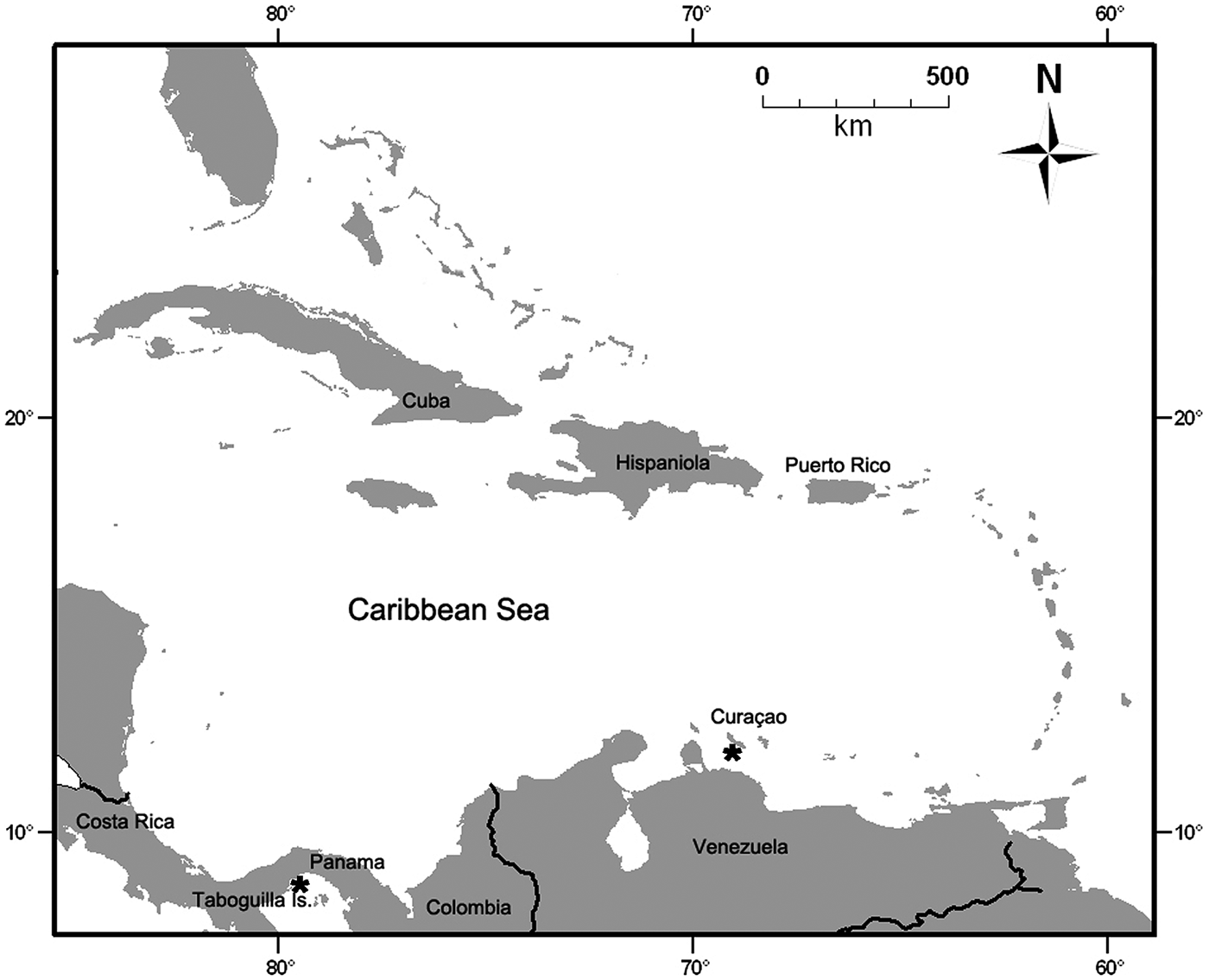
This paper is focused on Litarachna caribica recorded for the first time from the Pacific coast of Panama. Litarachna caribica was described by Pešić et al. (Reference Pešić, Chatterjee and Schizas2008) from Curaçao, Netherlands Antilles (Figure 1). No further record of this species was published, which limits our understanding of its distribution in the southern Caribbean. The pontarachnid fauna of the Pacific coast of the American continents is not well known. At present, only one species, Pontarachna cruciata Hall, Reference Hall1912 from California (Hall, Reference Hall1912), has been described.
Recorded distribution (marked with asterisk) of Litarachna caribica Pešić et al., Reference Pešić, Chatterjee and Schizas2008.

MATERIAL AND METHODS
Substrata samples (algae, rubble) were collected while snorkelling off the coast of Taboguilla Island, Panama, 8°48′5.90″N 79°30′52.19″W, 4 m depth, 3 February 2009. All material was washed through a 500 and 63 μm sieve and the separated fauna were preserved in ethanol. Small metazoans were sorted under a dissecting microscope and pontarachnid mites were isolated in vials filled with ethanol. In total, two males and five deutonymphs of Litarachna caribica Pešić et al., Reference Pešić, Chatterjee and Schizas2008 were collected. Collection permits were secured through the Smithsonian Tropical Research Institute (STRI), Panama City. Slide-mounting was done in Hoyer's fluid and specimens were deposited in the collection belonging to the senior author.
All measurements provided in the results section are given in μm. The following abbreviations are used: Cx-I = first coxae, dL = dorsal length, H = height, L = length, I-Leg-6 = Leg 1, sixth segment (tarsus), P-1 = palp, first segment, W = width.
RESULTS AND DISCUSSION
The specimens examined in this study agree well with the description of Litarachna caribica from the southern Caribbean (Pešić et al., Reference Pešić, Chatterjee and Schizas2008). This species is characterized by the following features: (1) Cx-I medially a partially fused (in adults, fused lightly at the posterior margin of ghantosomal bay, in deutonymphs, fusion more enlarged but not exceeding half of the median length of Cx-I); (2) glandularium-like structure posterior Cx-IV not fused with adjoining coxoglandularia 4 (Figure 2, arrow 1); (3) 45–54 pairs of perigenital setae around male genital field (Figure 2, arrow 2). Although Litarachna caribica is similar to Litarachna degiustii Cook, 1958, and can coexist in the southern Caribbean, the latter can be distinguished by the glandularium-like structure posterior to Cx-IV fused with adjoining coxoglandularia 4, Cx-I medially broadly fused and in males only three pairs of perigenital setae lying around the genital field (Pešić et al., Reference Pešić, Chatterjee and Schizas2008).
Photograph of Litarachna caribica Pešić et al., Reference Pešić, Chatterjee and Schizas2008, male, Taboguilla Island, Panama: coxal and genital field (arrow 1 showing a glandularium-like structure not fused with a platelet with coxoglandularia 4 and associated seta, arrow 2 showing perigenital setae around genital field).
Here, we give some measurements of the male and deutonymph from the island of Taboguilla. Male: Idiosoma L 290–341; coxal field: L 129, Cx-III W 226; genital field L/W 28/25, 48–52 perigenital setae around genital field; palp: total L 198; dL/H (in parentheses dL/H ratio): P-1, 15/19 (0.83); P-2, 60/31 (1.94); P-3, 25/28 (0.9); P-4, 72/19 (3.8); P-5, 26/12 (2.3); dorsal length of I-Leg-3–6: 38, 42, 60, 80.
Deutonymph: Idiosoma L/W 228–237/188; coxal field: L 83, Cx-III W 120; palp: total L 140; dL/H (in parentheses dL/H ratio): P-1, 10/12 (0.8); P-2, 41/20 (2.0); P-3, 19/19 (1.0); P-4, 49/14 (3.6); P-5, 21/8 (2.7).
This is the first record of a pontarachnid mite with a trans-isthmian distribution. If the species passed through the Panama Canal and successfully colonized the opposite coast, this will be the first time such an isthmian transfer has been reported. The Panama Canal represents a potential pathway for the interoceanic dispersal of marine organisms (Ruiz et al., Reference Ruiz, Torchin and Grant2009). However, many studies (Hildebrand, Reference Hildebrand1939; McCosker & Dawson, Reference McCosker and Dawson1975; Davidson et al., Reference Davidson, McCann, Fofonoff, Sytsma and Ruiz2008; Ros et al., Reference Ros, Ashton, Lacerda, Carlton, Vázquez-Luis, Guerra-García and Ruiz2014) have documented that some organisms can survive the passage through the Canal, in most cases associated with fouling on ships or in ballast water.
The trans-isthmian distribution of Litarachna caribica is difficult to explain without testing its potential for surviving freshwater immersion during passage through the Canal. The two freshwater lakes (lakes Gatun and Miraflores) that the boats and marine organisms have to cross, to travel from the Caribbean Sea to the Pacific Ocean, effectively serve as a barrier for most marine species. However, some pontarachnid species have been described from freshwaters (Cook, Reference Cook1996), although, these species were also found to occur in estuaries or locations near the sea (Smit, Reference Smit2009). The influence of the salinity in the particular case of Litarachna denhami has been documented by Witte & Olomski (Reference Witte, Olomski, Needham, Mitchell, Horn and Welbourn1999), which showed that the species is a very effective hyporegulator. Some pontarachnid species are euryhaline and preadapted to successfully colonize brackish water areas. However, despite the possibility that Litarachna caribica has survived the crossing of the Panama Canal, it is not possible to assert whether this species has recently been introduced into the Pacific or if the trans-isthmian distribution is a result of vicariance through the rise of the Panamanian Isthmus. In the late Pliocene, 3.1 million years ago, the rise of the Central American land strip created disjunct populations of previously continuously distributed species. Many studies (Knowlton et al., Reference Knowlton, Weigt, Solórzano, Mills and Bermingham1993; Knowlton & Weigt, Reference Knowlton and Weigt1998; Lessios, Reference Lessios2008) examined the genetic divergence of ‘sibling species’ or ‘geminate species’ with trans-isthmian distribution, showing the effects of the best-known biogeographic barrier on shallow water marine fauna. Similarly, Litarachna caribica should be assessed with molecular markers to test whether the morphologically identical trans-isthmian mite populations are genetically similar, indicating a recent dispersal process, or if they are genetically divergent, indicating an ancient separation.
ACKNOWLEDGEMENTS
We thank the undergraduate students Mairim Ramirez Cruz, Yisenia Nazario Pabon and Rocio Vergara Torres for sorting the sediments and extracting the fauna.