Language processing is an important part of human behavior that enables communication among individuals, and is crucial for nearly all social encounters. One important question is how language processing changes over the life span, particularly in healthy older adults. On the one hand, healthy aging (i.e., aging in the absence of neurological disorders such as dementia) is known to bring a myriad of changes in so-called fluid cognitive functions, including working memory capacity (Caplan & Waters, Reference Caplan and Waters1999, Reference Caplan and Waters2007; Just & Carpenter, Reference Just and Carpenter1992), processing speed (Salthouse, Reference Salthouse1996), or inhibitory function (Hasher & Zacks, Reference Hasher and Zacks1988). On the other hand, healthy aging is known to lead to greater general world and lexical–semantic knowledge (Burke & Shafto, Reference Burke, Shafto, Craik and Salthouse2008; Hedden & Gabrieli, Reference Hedden and Gabrieli2004), often referred to collectively as “frozen” or crystallized cognitive abilities.
Here, we report on one type of language processing that draws on both fluid and crystallized aspects of cognition: the figurative processing of idiomatic expressions (e.g., break the ice and spill the beans). Traditionally, idioms have been defined as multiword expressions whose figurative meaning is distinct from their literal interpretation (Cacciari, Reference Cacciari2014; Cacciari & Glucksberg, Reference Cacciari, Glucksberg and Simpson1991; Nunberg, Sag, & Wasow, Reference Nunberg, Sag and Wasow1994; Swinney & Cutler, Reference Swinney and Cutler1979). According to noncompositional models of processing, idioms are likened to “long words,” which are semantically unanalyzable and syntactically frozen (i.e., the noncompositional view of idioms; see Bobrow & Bell, Reference Bobrow and Bell1973; Gibbs, Reference Gibbs1980; Swinney & Cutler, Reference Swinney and Cutler1979). However, this rather simple definition is insufficient for characterizing the full range and variety of linguistic forms that may be classified as idioms (reviewed in Libben & Titone, Reference Libben and Titone2008; Titone & Connine, Reference Titone and Connine1999). For example, the noncompositional view of idioms cannot easily explain why speakers show considerable agreement as to which idioms are syntactically flexible and which are not. In addition, there is evidence that idioms are syntactically modifiable without disrupting comprehension of their idiomaticity (e.g., He didn’t spill a single bean and Those beans, she didn’t spill; Titone & Connine, Reference Titone and Connine1999). Finally, there is evidence that the component words of some idioms map onto their figurative meanings in a semantically transparent way (e.g., break the ice and steal the show; Cutting & Bock, Reference Cutting and Bock1997; Gibbs & Nayak, Reference Gibbs and Nayak1989; Gibbs, Nayak, & Cutting, Reference Gibbs, Nayak and Cutting1989; Glucksberg, Reference Glucksberg2001; McGlone, Glucksberg, & Cacciari, Reference McGlone, Glucksberg and Cacciari1994). Thus, the noncompositional view is insufficient for describing the full variety of idioms and how they may be differentially understood. Therefore, many researchers now embrace a hybrid view of idioms, which characterizes such expressions as multiword sequences that undergo some degree of semantic and syntactic decomposition during comprehension (Cacciari & Tabossi, Reference Cacciari and Tabossi1988; Caillies & Butcher, Reference Caillies and Butcher2007; Libben & Titone, Reference Libben and Titone2008; Sprenger, Levelt, & Kempen, Reference Sprenger, Levelt and Kempen2006; Tabossi, Fanari, & Wolf, Reference Tabossi, Fanari and Wolf2008; Titone, Columbus, Whitford, Mercier, & Libben, Reference Titone, Columbus, Whitford, Mercier, Libben, Heredia and Cieślicka2015; Titone & Connine, Reference Titone and Connine1999; Titone & Libben, Reference Titone and Libben2014; Titone, Loveseth, Kasparian, & Tiv, Reference Titone, Lovseth, Kasparian and Tiv2019).
Crucial here is that idioms, as a class of language, are also interesting from the perspective of cognitive aging. On the one hand, idiom comprehension requires both lexical–semantic knowledge to retrieve the lexicalized configuration and its meanings from memory. On the other hand, idioms likely require some degree of executive control to inhibit unwanted activation of literal word meanings and maintain a representation of the figurative form and meaning in memory (see Bohrn, Altmann, & Jacobs, Reference Bohrn, Altmann and Jacobs2012; Haeuser, Titone, & Baum, Reference Haeuser, Titone and Baum2016; Papagno, Lucchelli, Muggia, & Rizzo, Reference Papagno, Lucchelli, Muggia and Rizzo2003; Rapp, Mutschler, & Erb, Reference Rapp, Mutschler and Erb2012; Rizzo, Sandrini, & Papagno, Reference Rizzo, Sandrini and Papagno2007; Schettino et al., Reference Schettino, Lauro, Crippa, Anselmetti, Cavallaro and Papagno2010).
Because of this interplay between lexical–semantic knowledge and executive control, idioms draw upon cognitive components that are normally described as hallmarks of cognitive aging: stability or even increase in lexical–semantic knowledge (crystallized abilities) on the one hand (Burke & Shafto, Reference Burke, Shafto, Craik and Salthouse2008), but impairments in executive functions of cognition on the other hand (fluid abilities; Grady & Craik, Reference Grady and Craik2000; Hasher, Stoltzfus, & Zacks, 1991; Li, Lindenberger, & Sikström, Reference Li, Lindenberger and Sikström2001). Age-related decline in fluid aspects of cognition have often been described as impairments in processing speed, inhibitory control, working memory, or context updating (Braver, Paxton, Locke, & Barch, Reference Braver, Paxton, Locke and Barch2009; Hasher, Zacks, & May, Reference Hasher, Zacks, May, Gopher and Koriat1998; Lindenberger, Reference Lindenberger2014; Salthouse, Reference Salthouse2000; Verhaegen & Cerella, Reference Verhaeghen and Cerella2002).
Thus, in the present study, the question we ask concerns how healthy aging impacts idiom processing when idioms are presented in a canonical form, which promotes fast form-based, figurative retrieval, compared to a noncanonical form, which disrupts the familiar idiomatic form and would likely emphasize the literal or compositional nature of the phrase. In building to this experiment, we first selectively review the literature on idiom processing in healthy aging, and on processing of idioms in their noncanonical form.
Idiom processing in aging
Previous work on idiom processing in healthy older adults has shown evidence for both age-related decline in some aspects of idiom comprehension, and stability in others. For example, older adults had difficulty deciding whether an idiom had a possible literal interpretation, suggesting a high degree of automatic activation of the figurative meaning (e.g., drive someone around the bend vs. be on cloud nine; Westbury & Titone, Reference Westbury and Titone2011). In addition, older adults did not show priming for literal target words that followed literally plausible idiomatic primes, as did younger adults (i.e., tie the knot [prime]–rope [literal target]; Grindrod & Raizen, Reference Grindrod and Raizen2019). Similarly, Sprenger, La Roi, and van Rij (Reference Sprenger, La Roi and van Rij2019) found that subjective familiarity ratings for idiomatic expressions significantly increase with age (Study 1). Of interest, in that study the idiom familiarity ratings of older adults were less modulated by absolute corpus frequency than the ratings of younger adults (Study 2), which suggests an age-related increase in idiom familiarity irrespective of whether the idiom is high- or low-frequent in absolute terms.
Taken together, these findings suggest that older adults’ crystallized knowledge of figurative expressions is intact, if not improved (see Sprenger et al., Reference Sprenger, La Roi and van Rij2019), but that older adults have trouble when the experimental task highlights the literal, compositional nature of the phrase (i.e., possibly arising from an impairment in a fluid aspect of cognition, such as executive control). This observation is confirmed by other studies: for example, despite the occasional word finding difficulties that affect idiom naming in old age (Conner et al., Reference Conner, Hyun, O’Connor Wells, Anema, Goral, Monereau-Merry and Obler2011), older adults outperform younger adults in idiom production (Hyun, Conner, & Obler, Reference Hyun, Conner and Obler2014), which also suggests that they rely on their greater crystallized knowledge of language. Consistent with this idea, older adults have shown evidence of greater idiomatic sensitivity than younger adults in some studies (Coane, Sánchez-Gutiérrez, Stillman, & Corriveau, Reference Coane, Sánchez-Gutiérrez, Stillman and Corriveau2014; Hung & Nippold, Reference Hung and Nippold2014; Westbury & Titone, Reference Westbury and Titone2011). For example, older adults provided lexically more elaborate and semantically rich explanations of idioms, and performed at ceiling in a phrase-to-idiom matching task (Hung & Nippold, Reference Hung and Nippold2014), suggesting that knowledge of idiomatic forms and meanings is largely preserved in aging. In a phrase recall task, older adults showed higher false alarm rates for canonical-form idioms; that is, they reported that they recalled seeing kick the bucket after seeing an idiom variant such as kick the pail, presumably because they were more likely to automatically activate the fixed figurative expression during initial processing of the idiom in its noncanonical form (Coane et al., Reference Coane, Sánchez-Gutiérrez, Stillman and Corriveau2014).
Thus, older adults seem to maintain (or even improve) their knowledge of idiomatic forms, but may have difficulty when tasks emphasize the dual, compositional nature of idioms (i.e., that idioms have both literal and figurative meanings). Therefore, as suggested earlier, one important question concerns how older adults process idioms when they are presented in a noncanonical form that disrupts the figurative configuration and highlights their literal, compositional nature (e.g., John broke the cracked ice, bore his own cross, cleared the stale air)?
Processing of noncanonical idioms
Most existing evidence on the production and comprehension of noncanonical form idioms comes from two sources: corpus studies of idiom production (e.g., Langlotz, Reference Langlotz2006; Schröder, Reference Schröder2013; for review see Fellbaum, Reference Fellbaum2019), and acceptability ratings that focus on speakers’ intuitions about noncanonical form idioms (e.g., Geeraert, Newman, & Baayen, Reference Geeraert, Newman and Baayen2017a; Gibbs & Nayak, Reference Gibbs and Nayak1989; McGlone, Glucksberg, & Cacciari, Reference McGlone, Glucksberg and Cacciari1994; Tabossi, Wolf, & Koterle, Reference Tabossi, Wolf and Koterle2009). Very few studies focus on the question of how noncanonical idioms are processed online, for example, during reading (see Geeraert, Baayen, & Newman, Reference Geeraert, Baayen and Newman2017b; Kyriacou, Conklin, & Thompson, Reference Kyriacou, Conklin and Thompson2019, for exceptions). Moreover, the studies that do exist have yielded somewhat conflicting findings.
In contrast, some studies show that idioms have a great deal of internal variability and can undergo some degree of semantic and syntactic modification and still be understood quickly (e.g., Geeraert et al., Reference Geeraert, Newman and Baayen2017a; Smolka & Eulitz, Reference Smolka and Eulitz2019). For example, corpus studies have demonstrated that speakers use idioms very productively in language (e.g., by and not so large; let the tiger/kitten/tomcat out of the bag; and spill the kidney beans; see Fellbaum, Reference Fellbaum2019; Langlotz, Reference Langlotz2006). Similar findings have been obtained by studies that examined acceptability ratings of modified idioms (e.g., the bucket, John kicked or kick the pail; Tabossi et al., Reference Tabossi, Wolf and Koterle2009). Despite the fact that some idiom variants tend to be less acceptable than others (e.g., stocks that go through the ceiling are judged as slightly less acceptable than stocks that go through the investment roof; Geeraert et al., Reference Geeraert, Newman and Baayen2017a), there is evidence that idiom variants maintaining at least some of an idiom’s constituent words are judged as comparably acceptable to canonical-form idioms.
Similarly, passivized idioms (e.g., the bucket was kicked) are read as quickly overall as passivized control phrases (e.g., the apple was kicked; see Kyriacou et al., Reference Kyriacou, Conklin and Thompson2019), and priming for target words that are related to the figurative meaning of an idiomatic phrase (e.g., embarrassment) is maintained when idioms are topicalized (e.g., The ice, John broke, as opposed to John broke the ice; see Mancuso, Elia, Laudanna, & Vietri, Reference Mancuso, Elia, Laudanna and Vietri2019). Both results suggest that presentation of idiom variants does not globally block access to idiomatic configurations and figurative meanings. In another illustration, Smolka and Eulitz (Reference Smolka and Eulitz2019) showed that idiom variants such as She reached for the planets, for which a single word of an idiom was replaced by a close semantic associate (in this case, planets for the canonical noun stars), were more acceptable as paraphrases of the figurative meaning compared to variants that had unrelated word replacements (e.g., She reached for the candy). However, both related and unrelated word paraphrases yielded lower acceptability ratings than canonical form idioms overall, suggesting there might also be limits to idiomatic productivity (at least when there is no pragmatic context available that licenses the use of an idiom variant). Above and beyond these studies, a remaining question is whether findings from acceptability ratings and meta-linguistic judgments readily reflect processes that come to bear during online language processing (e.g., natural reading) when the only task demand is to comprehend the sentence.
With respect to online processing, a study that examined noncanonical form idioms showed that the insertion of an additional word into an idiom leads to longer processing of idiomatic configurations during online reading (even though it should be noted that in that study, not all idiom variants led to slowing). Specifically, Geeraert et al. (Reference Geeraert, Baayen and Newman2017b) found that insertion of an additional concept (e.g., stocks that go through the investment roof or hear something through the judgmental grapevine) increased the number of initial fixations on the idiom region during natural reading. This slowing in online processing is interesting because the same idiom variant was rated as highly acceptable in offline ratings (Geeraert et al., Reference Geeraert, Newman and Baayen2017a). Taken together, these findings suggest that modification or variation of idiomatic forms can increase comprehenders’ processing effort during online comprehension (in contrast to offline acceptability ratings), especially when the idiom variant is not licensed by prior context (Fellbaum, Reference Fellbaum2019). Thus, despite a large body of research attesting to idiom variability and productivity in offline measures, idiom modification seems to slow online comprehension, at least in younger adults.
The present study
We investigated whether idiom modification impacts natural reading, and crucially, whether it does so in a different manner for younger and older adults. To our knowledge, this is the first study to use eye tracking to investigate age differences in idiom processing. We recorded eye movements as younger and older adults read idiomatic (break the ice) and nonidiomatic control phrases (store the ice), which allowed us to investigate age-related changes during a natural task that merely asked participants to read for comprehension (i.e., read without having to make acceptability ratings or meta-linguistic judgments). Previous studies using eye tracking with younger adults (e.g., Carrol & Conklin, Reference Carrol and Conklin2017, Experiments 1 & 2; Cieślicka, Heredia, & Olivares, 2014; Geeraert et al., Reference Geeraert, Baayen and Newman2017b; Milburn & Warren, Reference Milburn and Warren2019; Siyanova-Chanturia, Conklin, & Schmitt, Reference Siyanova-Chanturia, Conklin and Schmitt2011) have sometimes reported an idiom advantage, that is, faster reading for idiomatic compared to literal control phrases in some measures of eye tracking (e.g., faster processing for spill the beans vs. spill the chips; Carrol & Conklin, Reference Carrol and Conklin2017; or faster processing for at the end of the day compared to at the end of the war; Siyanova-Chanturia et al., Reference Siyanova-Chanturia, Conklin and Schmitt2011).
Critical to the present work is a recent study by Titone et al. (Reference Titone, Lovseth, Kasparian and Tiv2019), in which idioms and literal control phrases were presented prior to a disambiguating region that biased either a figurative or a literal interpretations of the phrase (e.g., figurative: Penelope hit the books only two weeks before the dreaded final examination vs. literal: Penelope hit the books with her hand when she sat down quickly at the desk). This design allowed the researchers to assess which meanings of an idiom (literal or figurative) readers integrated during first pass reading, in the absence of any prior context. Nonidiomatic control sentences (e.g., Penelope put the books on the shelf when she returned home from the library) were also presented. Here, we use the same materials as the Titone et al. (Reference Titone, Lovseth, Kasparian and Tiv2019) study in order to ask (a) How do older adults process idioms in these conditions; and (b) what happens when idioms are read in a noncanonical form, that is, with a modifier that disrupts the canonical configuration (e.g., break the cracked ice and kick the black bucket)?
Our rationale for inserting a modifier was that idioms presented in their noncanonical form would disrupt the familiar idiomatic configuration, thus creating greater semantic conflict between literal and figurative meanings of the phrase. We reasoned that such increased literal/figurative conflict may be particularly challenging for older adults, for whom figurative forms may be more entrenched (Grindrod & Raizen, Reference Grindrod and Raizen2019; Sprenger et al., Reference Sprenger, La Roi and van Rij2019). In both conditions, we presented idioms that varied with respect to prior ratings of their subjective familiarity (taken from Libben & Titone, Reference Libben and Titone2008). We expected that idiom processing would be easier for idioms rated as high versus low familiar, though the effects of familiarity might be reduced for older relative to younger adults because of their greater life-long exposure to idiomatic forms.
Our general hypotheses regarding older adults were as follows. First, given prior research showing evidence for an age-related entrenchment of idiomatic forms (Grindrod & Raizen, Reference Grindrod and Raizen2019; Sprenger et al., Reference Sprenger, La Roi and van Rij2019; Westbury & Titone, Reference Westbury and Titone2011), we expected that older adults would show more slowing (indicating comprehension difficulties) when reading sentences that bias a canonical-form idiom toward its literal meaning (e.g., Penelope hit the books with her hand when she sat down quickly at the desk).
Regarding noncanonical form presentation of idioms, there were three possible outcomes pertinent to the age comparison. To the extent that greater (i.e., more crystallized) language knowledge predominates during idiom processing, we would expect that the presence of a modifier would slow idiom reading in older adults more than in younger adults. This hypothesis can also be derived from studies that argue that idiomatic configurations are more entrenched in older adults (Sprenger et al., Reference Sprenger, La Roi and van Rij2019; Westbury & Titone, Reference Westbury and Titone2011). A second possible outcome was that idioms are so thoroughly lexicalized in older adults that they can still be accessed quickly in memory, despite the presence of a modifier. A third possible outcome was that the effects of noncanonical form presentation somehow interact with idiom familiarity, so that, for example, the modifier is less likely to have a negative effect in low-familiar idioms because their figurative configurations are less prominent and the literal meaning is more likely to be entertained during processing.
Method
Participants
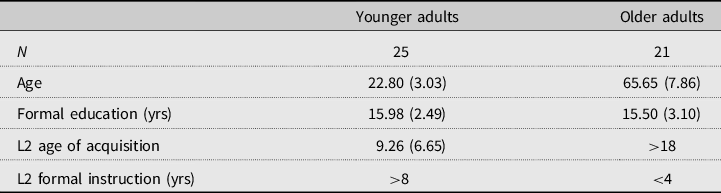
Twenty-one native-English-speaking older adults participated for compensation at a rate of CAD $10/hr. The control group consisted of 25 native-English-speaking younger adults, a subset of younger participants included in Columbus et al. (Reference Columbus, Sheikh, Côté-Lecaldare, Haeuser, Baum and Titone2015). Because data acquisition for this study took place in Montreal, a city with a highly bilingual population, we collected additional information from all participants regarding their language background. All participants had learned English as the first language from birth without exposure to an L2 before the age of 3. For all participants, English was the main language of instruction during early formal schooling (elementary and high school). All subjects rated English as the dominant language at the time of testing, and their current language exposure at the time of testing was highest for English compared to French or other known languages. All participants were matched on the number of years of formal education and had normal or corrected-to-normal vision, and no self-reported history of speech, hearing, language, and/or neurological/psychiatric disorders. All study procedures were carried out with the approval of the McGill University Research Ethics Board. Written consent was obtained from all participants. Demographic information and language background of younger and older adults is presented in Table 1.
Demographic information and language background of younger and older adults (standard deviations in parentheses)

L2, second language.
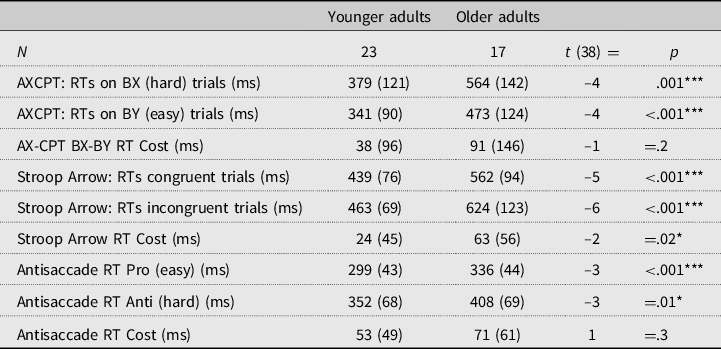
To ensure that the participants examined in this study were norm-typical, we had all participants engage in a cognitive test battery. Due to technical failures during testing, the cognitive test data were incomplete, leaving data from 23 younger and 17 older adults for analysis. Cognitive tests included the AX continuous performance task (AX-CPT) to assess context updating and maintenance (Braver et al., Reference Braver, Barch, Keys, Carter, Cohen, Kaye and Jagust2001), as well as the Anti-Saccade (Hallet, Reference Hallett1978; for review, see Munoz & Everling, Reference Munoz and Everling2004) and Stroop (arrow) tasks to assess inhibition. The critical variable for the AX-CPT task was the reaction time cost score between BX and BY trials per subject (for further information on how this score is computed, see Columbus et al., Reference Columbus, Sheikh, Côté-Lecaldare, Haeuser, Baum and Titone2015). Critical variables for the Anti-Saccade and Stroop tasks were the reaction time cost scores between hard and easy trials per subject. Table 2 shows that older adults were significantly slower on all raw reaction time measures (e.g., reaction times on congruent and incongruent trials), but did not perform consistently worse when cost scores were taken into account (i.e., scores that set performance on congruent and incongruent trials into relation). Overall, this indicated an age-related impairment in processing speed in our group of older adults, but no impairments in inhibitory aspects of cognition (Anti-Saccade and Stroop Arrow tasks) or in the ability to maintain and update contextual information in working memory (AX-CPT task).
Results of the cognitive test battery in younger and older adults
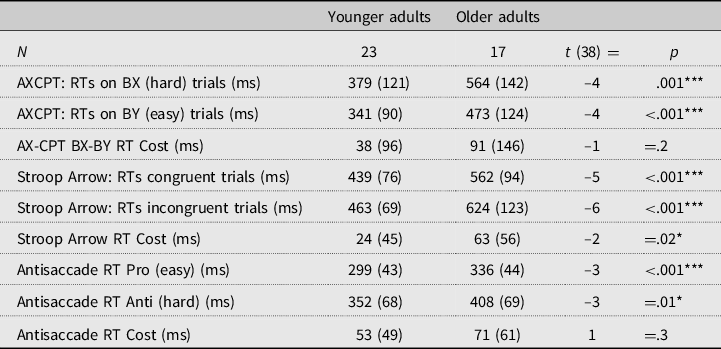
NOTE: RT, reaction time. Standard deviations in parentheses. *p < .05. **p < .05. ***p < .001.
Materials
Experimental materials were 54 familiar English idioms that had a verb–determiner–noun structure (e.g., kicked the bucket, broke the ice, and lost his seat), taken from the idiom corpus provided in Libben and Titone (Reference Libben and Titone2008). These idioms formed a subset of the experimental stimuli presented in Titone et al. (Reference Titone, Lovseth, Kasparian and Tiv2019). In a first step, control phrases were created for each idiom individually by replacing the idiom’s verb with another verb of approximately the same length (e.g., tipped the bucket, put the books, and left his seat). Verbs in literal and idiomatic phrases were matched in number of characters (M idiomatic = 5.31, SD idiomatic = 1.59; M literal = 5.28, SD literal =1.57), t (106) = 0.12, p = .9. They were also matched in frequency, based on the Zipf scale from the SUBTLEX US data base (M idiomatic = 3.33, SD idiomatic = 0.99; M literal = 3.31, SD literal = 0.88), t (106) = 0.09, p = .9 (Brysbaert & New, Reference Brysbaert and New2009).
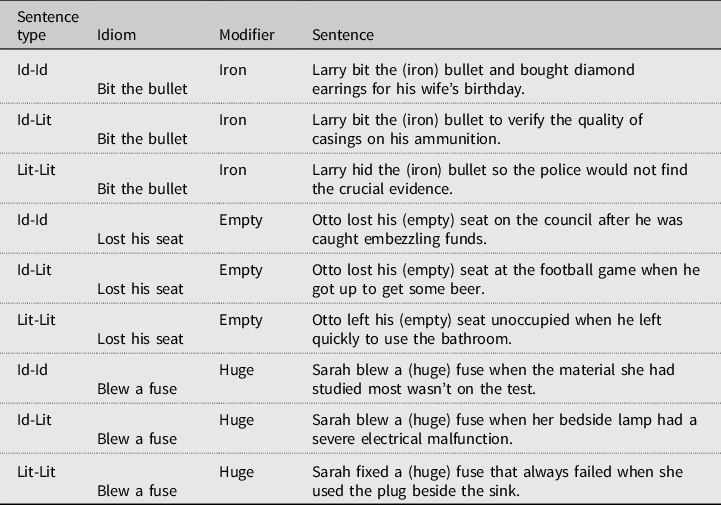
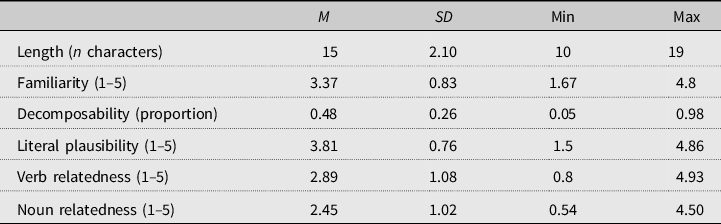
All idioms and literal control phrases were embedded in two-clause sentences, matched in length as closely as possible. The first clause of the sentence contained an agent (always a name; e.g., Bruce …) and was followed by the idiom (or matched literal control phrase), presented in the past tense (e.g., Bruce broke the ice … and Bruce stored the ice …). The second clause of the sentence was a disambiguating region that biased either a figurative reading of the phrase (Bruce broke the ice by quickly introducing himself to everyone at the wedding; sentence type Id-Id) or a literal reading of the phrase (Bruce broke the ice by driving his snowmobile directly onto the thawing lake; sentence type Id-Lit). In literal control phrases, the second clause continued the sentence in a plausible literal way (Bruce stored the ice in his cooler so he could bring it to the holiday party; Lit-Lit condition). Thus, each item had three experimental versions: an idiom biased toward its figurative meaning (Id-Id), an idiom biased toward its literal meaning (Id-Lit), and a literal control sentence (Lit-Lit). A full list of the experimental sentences is presented in the appendix of Titone et al. (Reference Titone, Lovseth, Kasparian and Tiv2019); example stimuli are presented in Table 3. Lexical and idiom characteristics of the 54 idioms used in the present experiment are presented in Table 4.
Example sentences from Id-Id, Id-Lit, and Lit-Lit conditions, including the modifier

Lexical characteristics of the 54 verb–determiner–noun idioms (taken from Libben & Titone, Reference Libben and Titone2008)

In a final step, we chose modifiers for each item that fit the semantics of the constituent words in a meaningful way (e.g., broke/stored the cracked ice, kicked/tipped the black bucket, changed/hummed her sad tune, and bought/loved the old farm). The goal was to select adjectives that were semantically neutral with respect to a figurative versus literal read of the sentences. On average, inserted adjectives were five characters long (range: 3–10) and relatively high frequency (M = 3.44; SD = 0.84), based on the Zipf scale from the SUBTLEX-US database (Brysbaert & New, Reference Brysbaert and New2009), with a minimum of 1.2 (e.g., forced her wavering hand) and a maximum of 4.9 (e.g., spilled the little beans). Note that the modifier was identical across all three experimental versions of an item.
The design resulted in six conditions per experimental item (Id-Id with modifier, Id-Id without modifier; Id-Lit with modifier, Id-Lit without modifier; and Lit-Lit with modifier, Lit-Lit without modifier). During the experiment, literal and idiomatic sentences were randomly presented over 6 experimental lists, so that each participant read only one experimental version of each item, for a total of 54 sentences per participant. That is, each list consisted of 18 Id-Id sentences (9 canonical and 9 noncanonical), 18 Id-Lit sentences (9 canonical and 9 noncanonical), and 18 Lit-Lit sentences (9 canonical and 9 noncanonical). Fillers were 80 metaphor sentences from a prior experiment (Columbus et al., Reference Columbus, Sheikh, Côté-Lecaldare, Haeuser, Baum and Titone2015), yielding a total of 134 sentences per participant in one testing session.
Procedure
Participants were tested in the lab for one session that lasted approximately 2 hr. Upon signing the consent form, participants completed a language history questionnaire, then performed the sentence reading task, and subsequently completed the cognitive test battery. For the reading task, participants were informed that they would read sentences on a screen, one at a time, while their eye movements were recorded. Each trial began with a fixation cross, presented in the middle of the screen, followed by a sentence, aligned to the left side of the screen. Participants were instructed to read each sentence silently for comprehension and to press a button on a control pad to indicate when they finished reading the sentence. Yes–No comprehension questions were included on 25% of trials to ensure participants were reading for content.
Participants were tested in a quiet room on an Eye-link 1000 tower-mounted eye-tracking system (SR-Research, Ontario, Canada), using a 21-inch ViewSonic CRT monitor with a screen resolution of 1024 × 768 pixels. Viewing was binocular, but eye-tracking data were collected for the right eye. All experimental sentences were presented aligned to the left side of the screen on a single line, in yellow 10-point Monaco font on a black background. Eye movements were calibrated using a 9-point grid; recalibrations were performed when necessary. Participants’ heads were stabilized using a headrest throughout the experiment. Three characters subtended approximately 1 degree of visual angle.
Results
The eye-movement record yields a number of measures that are associated with variations in the processing time-course of a target word or region. These are commonly separated into groups of early and late measures (Radach & Kennedy, Reference Radach and Kennedy2004; Rayner, Reference Rayner1998, Reference Rayner2009; see also Carrol & Conklin, Reference Carrol and Conklin2014, for a methodological overview of eye tracking in idiom research). Early measures of reading are supposed to indicate very early, presemantic effects of lexical access in memory (i.e., accessing the form of a lexical entry, irrespective of its meaning). Late measures are thought to tap into later occurring semantic effects, such as comprehension of a word and its integration into the discourse context.
We focused on two early measures and two late measures that are common in eye tracking and idiom research (see Carrol & Conklin, Reference Carrol and Conklin2014; Cieslicka, Reference Cieslicka, Heredia, Olivares, Pawlak and Aronin2014; Milburn & Warren, Reference Milburn and Warren2019; Rayner, Warren, Juhasz, & Liversedge, Reference Rayner, Warren, Juhasz and Liversedge2004; Siyanova-Chanturia et al., Reference Siyanova-Chanturia, Conklin and Schmitt2011; Titone et al., Reference Titone, Lovseth, Kasparian and Tiv2019; Warren, McConnel, & Rayner, Reference Warren, McConnell and Rayner2008). Early measures included first-pass gaze duration on phrase-final nouns (i.e., the sum of all fixation durations made on the noun before exiting either to the left or to the right), and go-past times of phrase-final nouns (i.e., the amount of time that the reader looks at a target word as well as any time spent rereading earlier parts of the sentence before moving ahead).Footnote 1 Late measures included total reading time (henceforth, TRT) on the idiom region (i.e., the sum of all fixation and refixation durations made within the idiom region, e.g., kicked/tipped the bucket), and the proportion of regressive eye movements from the disambiguating region back to earlier regions of the sentence (a binomial variable).
For our statistical analyses, we computed separate linear mixed-effects models for each eye-tracking measure, using the lme4 library in R (R Development Core Team, 2018). This method eliminates the need for separate analyses of random effects variables (i.e., separate analyses if variance for subjects and items). In addition, linear mixed-effects models do not require that continuous variables (such as idiom familiarity or idiom decomposability) be artificially categorized (i.e., there is no requirement for artificial median splits of continuous factors, except perhaps to simplify presentation of the data).
We included three predictors for each model. These were sentence type (idiomatic vs. literal), age group (younger vs. older adults) and idiom familiarity (a scaled continuous variable), including all two- and three-way interactions among these variables. We present findings from canonical form idioms (broke the ice) separately from findings from noncanonical form idioms (broke the cracked ice). The reason for reporting results from the modified sentences in a separate section is that those sentences are fundamentally different in a way that has direct bearing on how the target word or phrase is read. Because all noncanonical sentences had inserted adjectives that canonical sentences did not have, all noncanonical sentences were systematically longer, subject to different parafoveal preview experiences, and the target region was different in terms of lexical characteristics.
In all models, sentence type was a categorical factor consisting of two levels (literal and idiomatic) for early reading measures (gaze duration [GD] noun and go-past noun), given that readers encountered idioms or control phrases prior to accessing the disambiguating region. In contrast, for TRT idiom and regressions out of the disambiguating region, there were three levels of the factor sentence type (Lit-Lit, Id-Lit, and Id-Id), given that these measures included fixations that readers made after accessing the disambiguating region. To compare all three factors with one another, there were necessarily two versions of each model for the late reading measures.
In the first version, Lit-Lit was the baseline, enabling two fixed effect comparisons: (a) Id-Id against the baseline Lit-Lit, and (b) Id-Lit against the baseline Lit-Lit. In the second version, Id-Id was the baseline, also enabling two fixed effect comparisons: (a) Id-Lit against the baseline Id-Id, which was our new contrast of interest, and (b) Lit-Lit against the baseline Id-Id, which was perfectly redundant with the first model version and, by-definition, always had the same qualitative outcome. Thus, in our reporting below, we exclusively focus on the Id-Lit versus Id-Id contrast from the second model version.
Of note, while researchers have at their disposal many methods of regression coding for factors involving three or more levels (e.g., treatment coding with refit baseline, or alternatively Helmert or backward difference coding; Schad, Vasishth, Hohenstein, & Kliegl, Reference Schad, Vasishth, Hohenstein and Kliegl2020), only the approach used here (to our knowledge) makes it possible to statistically evaluate all three contrasts, which was crucial for our experimental goals (i.e., Helmert coding compares the mean of two levels of a factor against another; backward difference coding compares the first two levels of a factor, followed by the next two levels of that factor; thus, neither coding scheme was appropriate for our intended experimental manipulation and hypotheses). The fixed effect for age group in all models was also treatment coded (with younger adults as the reference category). Note that in the event that any treatment-coded model failed to converge, we substituted deviation coding, followed by post hoc treatment-coded submodels to decompose any significant interactions.
Of importance, because the majority of models reported below had treatment-coded categorical predictors (where levels of a factor are compared to a fixed reference category) model coefficients show simple, rather than analysis of variance-style main effects. Thus, b’s indicate the estimated difference in reading times between the baseline category and the comparison category. For example, when b = 80 for the factor age group, this means that there was an 80 ms difference in reading times of older adults compared to younger adults.
In addition to the fixed effects mentioned above, all models contained global idiom decomposability as a control variable (this value was scaled and taken from Libben & Titone, Reference Libben and Titone2008). We also controlled for the length (in number of characters) of the respective region in each model (Kliegl, Grabner, Rolfs, & Engbert, Reference Kliegl, Grabner, Rolfs and Engbert2004; Rayner & Duffy, Reference Rayner and Duffy1986). Both control variables were scaled (i.e., converted to standard scores with M = 0 and SD = 1). All reported models contained random intercepts for subjects and items, and the findings reported below did not change when these models were refit to include the maximal random effects structure warranted by the design (see Barr, Levy, Scheepers, & Tily, Reference Barr, Levy, Scheepers and Tily2013, for method used), or when continuous DVs were log-transformed (Gelman & Hill, Reference Gelman and Hill2007). P values in all model reports were calculated using the Satterthwaite approximation, as implemented in the lmerTest package in R. Confidence intervals for significant model parameters indicate 2.5% and 97.5% limits and were estimated using the Wald method in R’s core function confint.
Behavioral results: Comprehension questions
Accuracy of the comprehension questions was high in both younger (M = 0.96, range: 0.8–1) and older adults (M = 0.94, range: 0.76–1), with no significant differences between the groups, t (44) = –1.13, p = .26. Thus, we may conclude that participants were attentive during the experiment, and successfully read the sentences for comprehension.
Reading times for canonical form idioms (broke the ice)
GD for phrase-final nouns
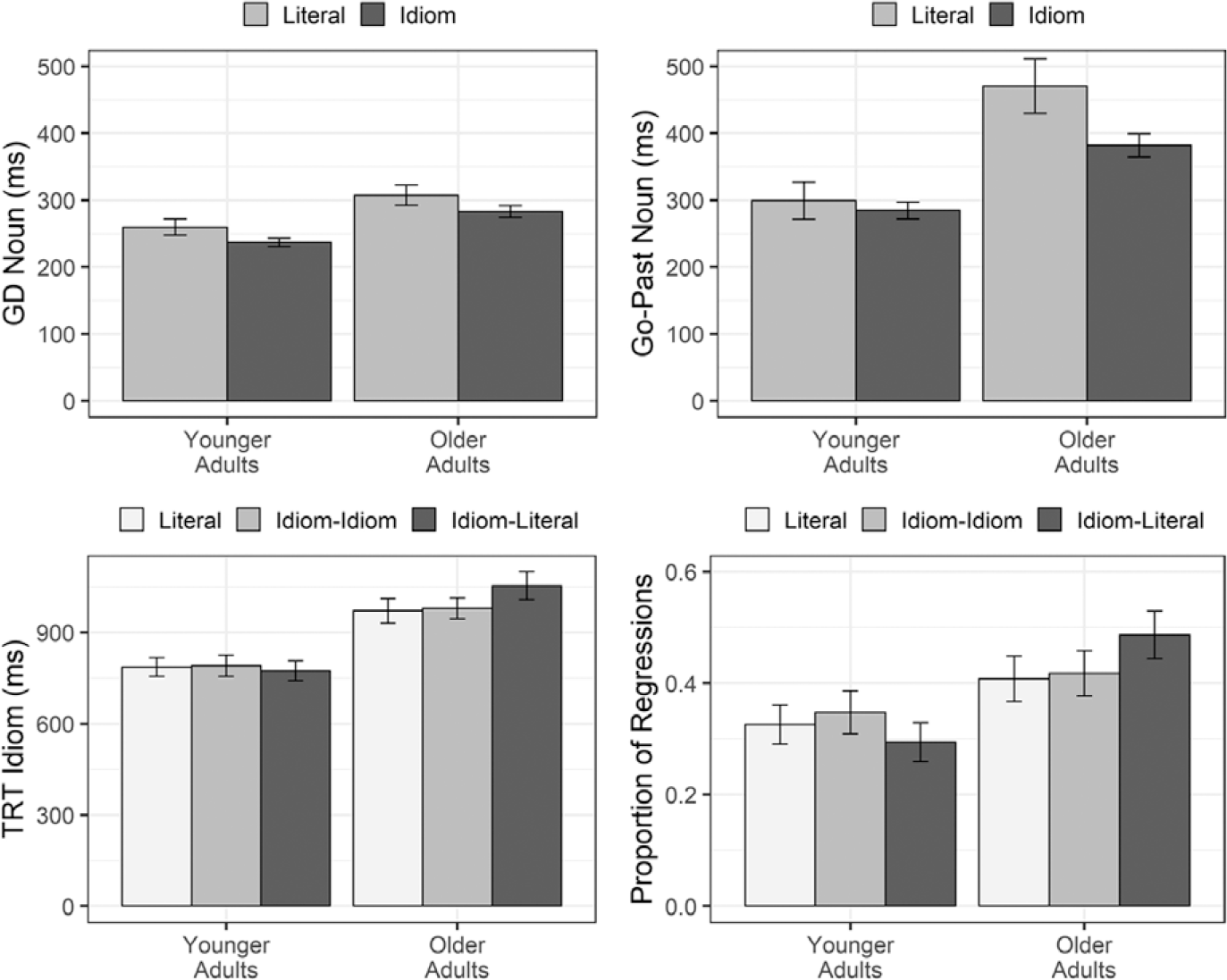
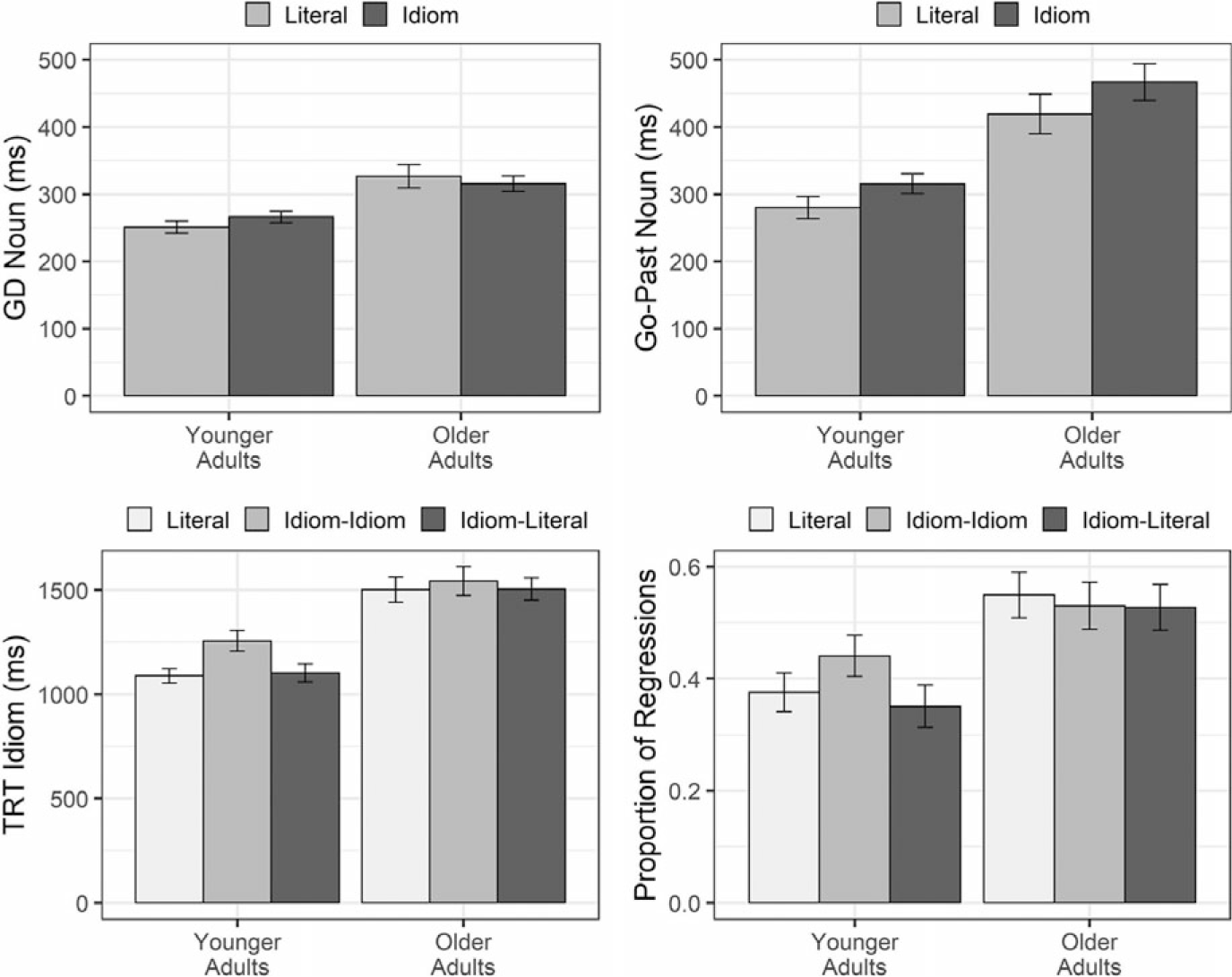
There was a simple effect of age group, b = 43.63, 95% confidence interval (CI) [4.76, 82.50], SE = 19.83, t = 2.20, p < .05 (see Figure 1, upper left panel), indicating that older adults fixated phrase-final nouns approximately 44 ms longer than younger adults, regardless of whether sentences were idiomatic or literal. There was also a simple effect of sentence type, b = –21.47, 95% CI [–41.18, –1.75], SE = 10.06, t = –2.13, p < .05, suggesting that fixations on idiom nouns (e.g., Mary kicked the bucket …) were consistently shorter than fixations on nouns of matched literal phrases (e.g., Mary tipped the bucket …), regardless of age group or idiom familiarity. No other effects were significant.
Canonical idioms (e.g., broke the ice and kicked the bucket) and literal control phrases (e.g., stored the ice and tipped the bucket): gaze durations and go-past times on the phrase-final noun (both in ms), as well as TRT idiom (ms) and proportion of regressions out of the disambiguating region. Error bars indicate standard errors of the mean, adjusted for the within-subjects factor sentence type (Morey, Reference Morey2008).

Go-past times for phrase-final nouns
There was a significant interaction between sentence type and age group, b = –81.33, 95% CI [–144.42, –18.24], SE = 32.19, t = –2.53, p < .05. Figure 1 (upper right panel) suggests that this interaction was driven primarily by older adults, who were relatively faster when reading nouns in idioms versus literal phrases (kicked the bucket vs. tipped the bucket), regardless of idiom familiarity. In contrast, younger adults’ reading times showed no difference between idioms and the literal condition. This interpretation of the data was confirmed by post hoc follow-up models splitting the data by age group. There was a significant simple effect of sentence type only in the model for older adults, b = –90.46, 95% CI [–143.84, –37.07], SE = 27.24, t = –3.32, p < .001, but not in the model for younger adults, b = –6.78, SE = 19.04, t = –0.36, p > .1.
Total reading time of the idiom
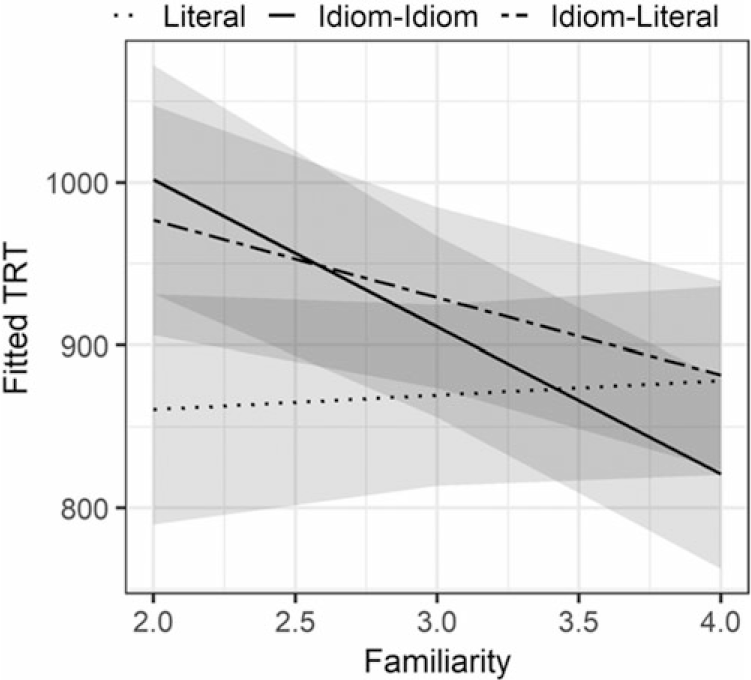
For total reading time, the first version of the model (baseline: Lit-Lit) showed a significant interaction between sentence type Id-Id and idiom familiarity, b = –97.00, 95% CI [–173.62, –20.37], SE = 39.10, t = –2.48, p < .05. The partial effects plot for this interaction (see Figure 2) shows that, irrespective of age group, high-familiar idioms presented with a figuratively biasing context region were read faster than their matched literal items (Lit-Lit items), whereas low-familiar idioms were read more slowly. The second version (baseline: Id-Id) showed no additional effects of interest.
Partial effects plots for TRT idiom in canonical items (kick the bucket), illustrating the relationship between sentence type and familiarity. Gray bands represent 95% confidence intervals.

Proportion of regressions out of the disambiguating region
Because treatment-coded models failed to converge for this dependent variable, we deviation coded all categorical factors for this generalized linear model (i.e., each level of a condition was compared to the grand mean of the model rather than another reference level of condition).
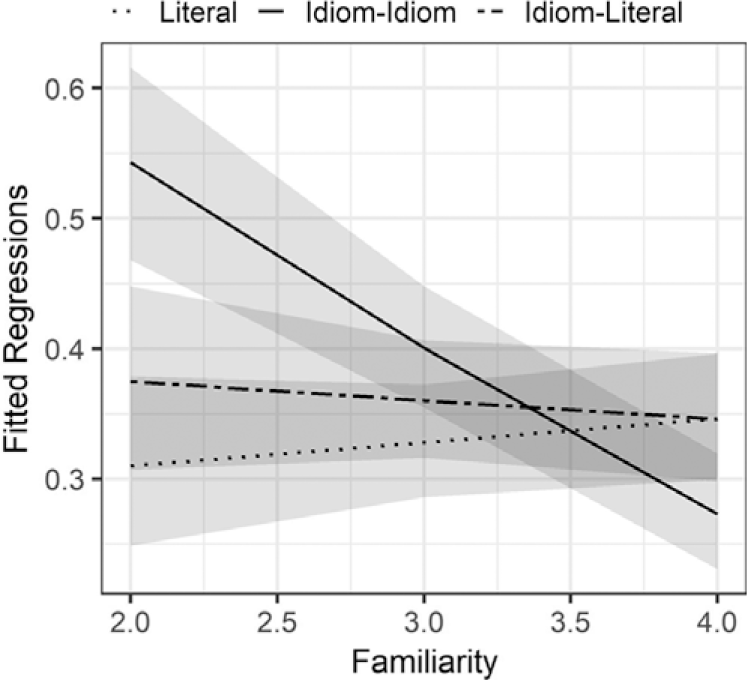
The first model version showed two main findings of interest. First, there was a significant interaction between sentence type Id-Lit (vs. the grand mean) and age group, b = 0.83, 95% CI [0.09, 1.57], SE = 0.38, z = 2.19, p < .05. Second, there was a significant interaction between sentence type Id-Id (vs. the grand mean) and familiarity, b = –0.63, 95% CI [–1.01, –0.25], SE = 0.19, z = –3.27, p < .01. To better understand the source of these interactions, we split items by sentence type (i.e., Lit-Lit, Id-Id, and Id-Lit) and performed a series of post hoc treatment coded models (which now converged). The model for the literal condition (Lit-Lit) showed no simple effects or interactions. However, the model for the idiomatic condition, Id-Id, yielded a main effect of familiarity, b = –0.55, 95% CI [–0.93, –0.18], SE = 0.19, z = –2.90, p < .01, indicating that, regardless of age group, participants were less likely to regress out of figuratively biasing context regions to the extent that the preceding idiom increased in familiarity, irrespective of age group (see Figure 3). Finally, the model for the Id-Lit condition showed a main effect of age group, b = 1.06, 95% CI [0.49, 1.63], SE = 0.29, z = 3.66, p < .001, indicating that older adults showed a greater proportion of regressions when the disambiguating region biased an idiom toward its literal interpretation (see Figure 1, bottom right panel). The second model version showed no additional effects or interactions.
Partial effects plot for proportion of regressions out of the disambiguating region in canonical-form idioms (kick the bucket), illustrating the relationship between sentence type and familiarity. Gray bands represent 95% confidence intervals.

Summary of findings for canonical idioms
The data for canonical form idioms yielded three key findings. First, there was early facilitation for idioms (GD noun), in particular for older adults (go-past noun), suggesting that older adults may have accessed idiomatic configurations in memory more quickly as a group. Second, there was late contextual facilitation as familiarity of idioms increased (TRT idiom; proportion of regressions out of the disambiguating region), across both age groups. Third, older but not younger adults had difficulty reading subsequent contexts that biased idioms’ literal interpretations (proportion of regressions), suggesting that they exhibited special difficulty suppressing an idiom’s figurative interpretation when a following context called for them to do so.
Reading times of noncanonical form idioms (broke the cracked ice)
GD for phrase-final nouns
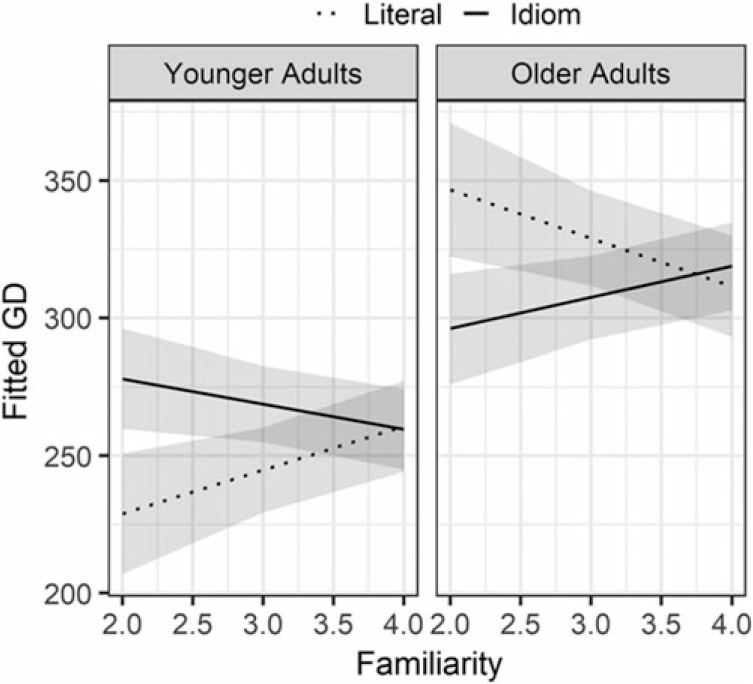
The model for GD nouns showed a significant three-way interaction between sentence type, age group, and idiom familiarity, b = 44.30, 95% CI [11.31, 77.30], SE = 16.84, t = 2.63, p < .01 (see Figure 4). To investigate the source of this interaction, we computed post hoc follow-up models that split subjects by age group.Footnote 2 The model for older adults showed no significant simple effects or interactions, but the model for younger adults showed a significant interaction between sentence type and idiom familiarity, b = –20.69, 95% CI [–39.89, –1.49], SE = 9.80, t = –2.11, p < .05. The partial effects plot of this interaction (Figure 4) shows that younger adults read nouns in noncanonical idioms more quickly as familiarity increased. No other effects were significant.
Partial effects plot for gaze durations on the noun in noncanonical items (kick the black bucket), illustrating the relationship between sentence type and familiarity. Gray bands represent 95% confidence intervals.

Go-past times on phrase-final nouns
There was a significant simple effect of age group, b = 141.10, 95% CI [73.22, 208.97], SE = 34.63, t = 4.07, p < .001 (see Figure 5), upper right panel), indicating that older adults had longer reading times overall. No other effects were significant.
Noncanonical idioms (e.g., broke the cracked ice and kicked the black bucket) and literal control phrases (e.g., stored the cracked ice and tipped the black bucket): gaze durations and go-past times on the phrase-final noun (both in ms), as well as TRT idiom (ms) and proportion of regressions out of the disambiguating region. Error bars indicate standard errors of the mean, adjusted for the within-subjects factor sentence type (Morey, Reference Morey2008).

Total reading time on the idiom
The first version of the model (baseline: Lit-Lit) showed a significant simple effect of age group, indicating longer reading times for older adults overall, b = 412.29, 95% CI [111.11, 713.46], SE = 153.66, t = 2.68, p < .01 (see Figure 5, bottom left panel). There was also a significant simple effect of sentence type Id-Id, b = 148.28, 95% CI [39.16, 257.41], SE = 55.68, t = 2.66, p < .01 see Figure 5, bottom left panel), indicating that noncanonical form idioms biased toward their figurative interpretation were read more slowly than literal control sentences (Lit-Lit), for both age groups. No other effects were significant.
The second model version (baseline: Id-Id) showed a significant simple effect of sentence type Id-Lit, b = –137.80, 95% CI [–247.77, –27.80], SE = 56.11, t = –2.56, p < .05, indicating that noncanonical idioms presented in sentences that had a literally biasing disambiguating region (Id-Lit) were read more quickly than noncanonical idioms presented in sentences that had a figuratively biasing disambiguating region (Id-Id; see Figure 5, bottom left panel). In sum, the TRT data demonstrated that both age groups had integration difficulties when reading noncanonical idioms, when their subsequent context was biased toward the idioms’ figurative meaning.
Proportion of regressive eye movements out of the disambiguating region
As with canonical idioms, treatment coded models failed to converge for this dependent variable, thus we substituted deviation coding (which compared each level to the grand mean). There was a significant simple effect of age group, indicating a greater proportion of regressive eye movements for older versus younger adults overall, b = 0.82, 95% CI [0.15, 1.49], SE = 0.34, z = 2.40 (see Figure 5; right bottom panel). No other effects were significant.
Summary of findings for noncanonical idioms
Presenting idioms in a noncanonical form (i.e., with an adjective before the phrase-final noun, e.g., kicked the black bucket and broke the cold ice) led to processing difficulty for both age groups. Noncanonical idioms that had disambiguating regions biased toward their figurative meaning were read more slowly than literal control sentences (TRT idiom), and more slowly than the same noncanonical idioms that had disambiguating regions biased toward their literal interpretation (TRT idiom). Based on these data, we conclude that both age groups primarily accessed literal meanings when reading noncanonical idioms on the first pass, such that they experienced comprehension difficulties when later encountering a disambiguating region biased toward the figurative meanings.
Discussion
We investigated how younger and older adults naturally read idioms presented in their canonical form (e.g., break the ice) or their noncanonical form (e.g., break the cracked ice) using eye movement measures of reading. Specifically, younger and older adults read idioms at the beginnings of sentences (e.g., Bruce broke the [cracked] ice …) that were followed by disambiguating regions which biased the idioms’ figurative or literal interpretations (e.g., figurative: … by quickly introducing himself to everyone at the wedding; literal: … by driving his snowmobile directly onto the thawing lake). Nonidiomatic control sentences were also presented that were matched to the idioms in length by altering the verb of the idiom and leaving all else the same (e.g., Bruce stored the cracked ice in his cooler so he could bring it to the holiday party). These verbs were specifically selected to avoid semantic ambiguity in the literal condition (see also Columbus et al., Reference Columbus, Sheikh, Côté-Lecaldare, Haeuser, Baum and Titone2015; Titone et al., Reference Titone, Lovseth, Kasparian and Tiv2019). There were several key findings.
We expected all participants to have difficulty reading idioms in their noncanonical form, but expected this effect to be enhanced for older adults who may represent idioms in a more figuratively entrenched manner given prior work suggesting that would be the case (e.g., Geeraert et al., Reference Geeraert, Baayen and Newman2017b). These predictions regarding canonical-form idioms were borne out to some degree, in that there was evidence for increased entrenchment of idiomatic forms in early and late measures of reading for older adults. In contrast, our predictions regarding noncanonical idioms and aging were not borne out: the modifier had similar effects in younger and older adults’ sentence reading in that it slowed comprehension globally, but not disproportionally in older adults.
Age-related differences in idiom comprehension globally
Similar to prior work, we found that age-related processing difficulties with idiomatic sequences emerged primarily in sentences that later emphasized the dual nature of an idiom’s meaning (e.g., when an idiom is presented with a literally biasing context region). In contrast, when idioms were presented in sentences that later emphasized their figurative meanings, we found evidence for greater entrenchment of figurative forms in older adults. Specifically, during early access, older adults read nouns in idioms more quickly than nouns in literal control phrases, a finding that was not evident in younger adults. During late-stage integration, older adults showed similar effects of familiarity as younger adults, in that idioms presented in sentences that had later figurative biases were read faster than literal control sentences as familiarity of the idiom increased. Of note, age group did not further modulate these effects. We believe this pattern is consistent with Sprenger et al. (Reference Sprenger, La Roi and van Rij2019), who found that familiarity ratings of idioms generally increase with age, irrespective of whether the idiom is high or low frequent as estimated by corpus measures of frequency. Thus, this aspect of our findings suggests that semantic representations of figurative meanings, and how they are accessed in memory, are intact, or even improve with age, maybe because older adults have a life-long experience with language at their disposal that has entrenched idiomatic expressions (see Cacciari, Corrardini, & Ferlazzo, Reference Cacciari, Corrardini and Ferlazzo2018, for evidence suggesting that higher levels of verbal knowledge facilitate first-pass idiom recognition).
However, older adults did exhibit reading difficulties when the dual nature of idioms was emphasized. This was apparent primarily in later measures of reading where older adults exhibited difficulty integrating canonical idioms read in sentences where a later disambiguating region was biased toward the literal reading of the phrase (i.e., canonical Id-Lit items). This result implies that older adults primarily accessed figurative meanings when reading the idiom on the first pass, and became confused when they reached a literally biased disambiguating region whose interpretation could not be aligned with the figurative meaning. Collectively, this suggests that older adults may have intact figurative meaning representations of idioms, but that they have difficulty managing the consequences of simultaneously activating literal and figurative meanings of idioms when forces conspire to make that happen. Of note, this aspect of the data aligns with studies demonstrating age differences primarily in tasks that capitalize on quick, rapid processes during online language comprehension (e.g., Grindrod & Raizen, Reference Grindrod and Raizen2019), and in tasks that emphasize the dual nature of idiomatic expressions (Westbury & Titone, Reference Westbury and Titone2011).
Noncanonical versus canonical form idioms
We were also interested in the online processing of noncanonical versus canonical form idioms given evidence of idiom variability and productivity in corpus studies (Fellbaum, Reference Fellbaum2019; Langlotz, Reference Langlotz2006), and in offline ratings from native speakers (Geeraert et al., Reference Geeraert, Newman and Baayen2017a; Gibbs & Nayak, Reference Gibbs and Nayak1989; McGlone et al., Reference McGlone, Glucksberg and Cacciari1994; Tabossi et al., Reference Tabossi, Wolf and Koterle2009). Here, the findings indicated that inserting an adjectival modifier into an idiom (e.g., kick the black bucket and break the cracked ice) induced processing difficulties during reading for both younger and older adults. This slowing in reading times (compared to entirely literal Lit-Lit sentences) was approximately 160 ms in total reading time of the idiom, when data from younger and older adults were collapsed. When noncanonical idioms were presented with a figuratively biasing disambiguating region, readers spent more time fixating idioms, and were more likely to regress back to the idiom, compared to when an adjective was inserted into a nonidiomatic control phrase (e.g., tip the black bucket). Conversely, noncanonical idioms presented with literally biasing disambiguating regions were read more quickly than the same idiom presented with figuratively biasing disambiguating regions.
Collectively, this data pattern suggests that readers primarily accessed the literal meanings of idioms when encoding noncanonical expressions on the first pass, such that when they encountered a literally biased disambiguating region, reading was fast, but when they encountered a figuratively biased disambiguating region, reading was impeded. Of note as well, this effect was present for both age groups, suggesting that the modifier disrupted the canonical configuration of the idiom and induced slower reading times in both younger and older adults alike (see Molinaro, Canal, Vespignani, Pesciarelli, & Cacciari, Reference Molinaro, Canal, Vespignani, Pesciarelli and Cacciari2013, for converging young-adult results on adjectival insertion in lexical bundles; e.g., in the hands of vs. in the capable hands of).
Thus, despite the suggestion of corpus studies that idioms often undergo a great deal of variation in language production (Fellbaum, Reference Fellbaum2019; Langlotz, Reference Langlotz2006), and the observation that idiom variants can still be understood figuratively in offline plausibility or meaningfulness judgments (e.g., Smolka & Eulitz, Reference Smolka and Eulitz2019; Tabossi et al., Reference Tabossi, Wolf and Koterle2009), the current findings from online reading suggest that noncanonical form presentation can impede online comprehension of the figurative meaning, at least when there is no prior discourse context available that could bias or pragmatically license use of an idiom variant. Hence, our data suggest that there are limits to idiomatic variability, at least when it comes to online processing of such expressions. This leads us to ponder potential factors that could explain why our findings differ from that of past work.
Connection with past research
As with any study, several additional considerations must be addressed when integrating present and past data. One important consideration when comparing the present results to past work is task demands, which differ substantially across online and offline studies. Most prior experimental studies assessing idiom variation and productivity have used acceptability judgments (Gibbs et al., Reference Gibbs, Nayak and Cutting1989; Tabossi et al., Reference Tabossi, Wolf and Koterle2009) or similarity ratings between idioms and paraphrases (McGlone et al., Reference McGlone, Glucksberg and Cacciari1994; Smolka & Eulitz, Reference Smolka and Eulitz2019), which tap into native speakers’ overt intuitions about the acceptability of certain phrases. In such ratings, people are asked to establish a post hoc mapping between an idiom and its variant. These conditions might not be accurate reflections of online language processing, where linguistic input unfolds rapidly, and such that readers may have little time to search for hidden or obscure semantic relationships. Consistent with this view, Geeraert et al. (Reference Geeraert, Newman and Baayen2017a) collected both offline acceptability ratings and online reading measures for modified idioms such as hear something through the judgmental grapevine. Despite the fact that the native speakers tested rated this specific idiom variant as highly acceptable offline, their reading data indicated slowing during online processing (Geeraert et al., Reference Geeraert, Baayen and Newman2017b).
These findings echo advances in linguistic theory positing that meta-linguistic grammaticality or acceptability judgments have limited quantitative reliability, and that the nature of these judgments renders them inadequate proxies for online language processing (Gibson & Fedorenko, Reference Gibson and Fedorenko2013; Linzen & Oseki, Reference Linzen and Oseki2018; Schütze, Reference Schütze2016). Thus, to advance psycholinguistic knowledge and theory about idioms (as well as all other linguistic phenomena), we believe that the field needs studies that smartly combine results from meta-linguistic judgments and online processing data.
Another important consideration when comparing experimental studies of idiom productivity is pragmatic context. We know that prior discourse can alter idiom comprehension and justify use of variants (Fellbaum, Reference Fellbaum2019; Langlotz, Reference Langlotz2006). A classic example is the 1988 New York Times editorial entitled “On being wrong: Convicted minimalist spills bean” where US-writer Frederick Barthelme defends his minimalist writings (and the ones of others) against allegations of insufficient depth of character and lack of big ideas. In this particular example, the use of the variant “spills bean” is perfectly motivated by the prior context of the word “minimalist.” For conditions when prior context sufficiently licenses the use of an idiom variant, there may be few limits to idiom productivity (Fellbaum, Reference Fellbaum2019). For example, prior context allows for modification of noncompositional idioms such as fall off the wagon or kick the bucket, for which there is no obvious relationship between literal and figurative meanings (e.g., falling off the exercise wagon; I fell off the daily blog wagon; before I fell off that wagon and started smoking again; or I am young but have experienced more bucket kicking within my immediate family and circle of family friends than I can shake a fist at; see Fellbaum, Reference Fellbaum2019, for more examples).
One puzzling aspect of our data is the question of why older adults failed to show even greater slowing than younger adults when reading noncanonical idioms. We initially hypothesized this would be the case, arising from greater life-long experience with language that should have crystallized words and idiomatic configurations in memory in older compared to younger adults (see Sprenger et al., Reference Sprenger, La Roi and van Rij2019, for experimental evidence that supports this hypothesis). However, even though our data confirm the notion of greater entrenchment of canonical idiom configurations in older adults (see the results from go-past noun and regressions out of the disambiguating region), the modifier had a similar effect in both age groups, in that it slowed reading comprehension globally.
One potential explanation is that the idioms presented in this study, as a group, were so thoroughly lexicalized, even in younger speakers of English, that the modifier could simply not make a dent in that activation. This interpretation is somewhat bolstered by the gaze duration data on phrase-final nouns in noncanonical phrases, which became faster as idiom familiarity increased. This could suggest that during reading of noncanonical high familiar idioms, people could still access the idiomatic configuration in memory (despite the presence of a modifier) relatively quickly, whereas only in less frequently encountered low-familiar idioms, the modifier resulted in slowing. A different pattern of results might have occurred with metaphors or proverbs, given that these are more compositional in nature and more likely to be built by means of their literal constituents during comprehension, as opposed to holistically retrieved from memory (Columbus et al., Reference Columbus, Sheikh, Côté-Lecaldare, Haeuser, Baum and Titone2015).
Another important consideration given our data involves the nature of the nonidiomatic control condition (e.g., tipped/kicked the bucket; stored/broke the ice; and hid/bit the bullet), which consisted of phrases for which an idiom-initial verb had been replaced by a verb of similar length and frequency, which was semantically distinct from the idiomatic verb. We referred to this condition as a “literal control” in keeping with prior literature on idiom reading, which frequently used single-word substitutions in order to yield a nonidiomatic control condition (e.g., at the end of the day vs. at the end of the war [literal control in Siyanova-Chanturia et al., Reference Siyanova-Chanturia, Conklin and Schmitt2011]; spill the beans vs spill the chips [literal control in Carrol & Conklin, Reference Carrol and Conklin2017]; also see Carrol & Conklin, Reference Carrol and Conklin2020; Cieslicka et al., Reference Cieslicka, Heredia, Olivares, Pawlak and Aronin2014; Titone et al., Reference Titone, Lovseth, Kasparian and Tiv2019). In idiom research, literal baselines that preserve most of the idioms’ component words are more or less the only possible way to create a set of well-controlled materials that enables comparisons between phrase types (see Carrol & Conklin, Reference Carrol and Conklin2020, for a systematic investigation of noun vs. verb substitutions in idiom reading).
Nevertheless, the exact choice of a literal baseline is extremely important because it directly impacts what may be interpreted with respect to the idiom condition (see Titone & Connine, Reference Titone and Connine1999, for a discussion of how literal control conditions can impact the interpretation of idiom priming studies). With respect to studies of idiom variation, this is highlighted in a recent paper by Kyriacou et al. (Reference Kyriacou, Conklin and Thompson2019), which found that passivization of high-familiar idioms led to faster TRT reading times in an idiomatic condition (the bucket was kicked) compared to a literal control condition (the apple was kicked), when previously biasing the figurative meaning of the idiom (Old John seemed to respond well to the new treatment at first, but eventually …). Perhaps more on point given our specific materials, Smolka and Eulitz (Reference Smolka and Eulitz2019) found that verb-modified idioms such as grasp for the stars were rated as well formed in capturing the figurative meaning of reach the stars in offline acceptability judgments, thus making it possible that our verb substitutions in creating the literal control conditions did not preclude idiom-driven figurative activation. Taken together, and applied to the present study, the fear of this alternative interpretation would be that the Lit-Lit sentences used here (e.g., Larry hid the bullet so the police would not find the crucial evidence) might have comparably activated the figurative meaning of bit the bullet as sentences containing the idiom itself, e.g., those beginning with, Larry bit the bullet…).Footnote 3
While this account is certainly worthy of consideration, we do not believe it substantially impacts our interpretation of the data for several reasons. First, the details of the present study are fundamentally different from these studies in a manner that may preclude direct comparison. Kyriacou et al. (Reference Kyriacou, Conklin and Thompson2019) presented participants with sentences for which a strong prior context semantically biased an upcoming idiom’s figurative interpretation, and the idiom was sentence final. This would have maximized the likelihood of people figuratively interpreting both canonical and noncanonical idioms (see prior discussion on the role of pragmatic context). By contrast, in the present study, all idioms and literal control phrases were presented at the relative beginnings of sentences in a manner that had no prior biasing context, thus minimizing the chance of initial figurative activation, even for the idioms themselves. Moreover, Smolka and Eulitz (Reference Smolka and Eulitz2019) conducted a rating task where participants were instructed to overtly semantically evaluate the degree of idiom well-formedness, using idioms that may have been inherently semantically decomposable (e.g., reach for the stars), and for which the lexical substitution was highly synonymous with the idiomatic verb (e.g., reach vs. grasp; see the prior section on the role of task demands). In our study, the overall set of items was highly heterogeneous with respect to semantic decomposability (we controlled for this variable in our statistical models). More important, we selected the verbs of literal phrases to be highly semantically distinct from the verbs of idiomatic phrases (e.g., bit the bullet vs. hid the bullet and kick the bucket vs. carry the bucket) in order to create a successful literal control condition.
Second, and perhaps most important, to the extent that our literal control condition generated figurative activation, we would never have observed any reading time differences between the Lit-Lit condition and any of the idiom conditions, which we did. For example, noncanonical Id-Id sentences were read significantly more slowly than noncanonical Lit-Lit sentences (see Carrol & Conklin, Reference Carrol and Conklin2020, for converging results in young-adult eye tracking). Moreover, the impact of increasing idiom familiarity across measures was more apparent for idiomatic sentences than for literal sentences. Thus, as observed here and elsewhere (see also Columbus et al., Reference Columbus, Sheikh, Côté-Lecaldare, Haeuser, Baum and Titone2015; Titone et al., Reference Titone, Lovseth, Kasparian and Tiv2019), to the extent that readers failed to show differences between the literal control and idiom conditions, the most likely interpretation is that they did so because they failed to generate figurative activation, rather than the potential interpretation that they generated figurative activation for both idiomatic and literal sentences.
A final consideration with the findings reported here is that participants could have become aware of the presence of figurative language material over the course of the experiment, and this could have impacted how they read the sentences. However, to the extent that this occurred, we would have expected a systematic shift in how people responded to the different conditions over trials, which did not occur when we computed additional models including trial number as a fixed effect. Under these conditions, neither the size nor the direction of effects changed.
To conclude, our goal was to investigate online processing of canonical and noncanonical idioms in younger and older adults using eye-movement measures of natural reading. We found that older adults can access idiomatic forms in memory more readily than younger adults, which suggests that idiomatic configurations are more entrenched as we age, which in turn aids the online processing of idiomatic forms. With respect to idiom variation, we found that presentations of noncanonical idioms slows access to the figurative configuration in memory and also slows late-stage comprehension of the phrase in discourse, presumably because the modifier emphasizes the literal, compositional nature of the idiom.
Our findings thus add to a growing body of research suggesting that older adults are able to leverage their greater crystallized knowledge during (online) language processing (e.g., Pichora-Fuller, Schneider, & Daneman, Reference Pichora-Fuller, Schneider and Daneman1995; Wingfield, Aberdeen, & Stine, Reference Wingfield, Aberdeen and Stine1991; Wingfield & Lash, Reference Wingfield, Lash, Schaie and Willis2016). Noncanonical form presentation of idiomatic phrases affects idiom reading in younger and older adults alike by slowing quick access to figurative meanings. Future studies could investigate whether age differences in online processing of noncanonical idioms are more likely to occur for other types of idiom variants that were not investigated in this study (e.g., idioms with noun substitution, verb substitutions, or passivized idioms; see Carrol & Conklin, Reference Carrol and Conklin2020; Geeraert et al., Reference Geeraert, Baayen and Newman2017b; Kyriacou et al., Reference Kyriacou, Conklin and Thompson2019; Smolka & Eulitz, Reference Smolka and Eulitz2019).
Acknowledgments
The authors are grateful for research support from a SSHRC Standard Research Grant (PI: Debra Titone), NSERC Discovery Grant (PI: Titone), and NSERC Discovery Grant (PI: Baum). The authors are also grateful for early technical assistance from Naveed Sheikh, Kyle Lovseth, and Georgie Columbus, as well as to Marco Senaldi for insightful comments on the manuscript.