1 Introduction
The three-way contrast in Korean stops, commonly labelled as the lenis (or lax /p t k/), the aspirated (/p h t h k h/), and the fortis (or tense /p* t* k*/) has been well studied and documented in the literature in terms of the stops’ differential laryngeal properties (see Cho, Jun & Ladefoged Reference Cho, Jun and Ladefoged2002 for a review). There are, however, only a few studies reported in the literature that have directly examined the supralaryngeal characteristics of the Korean stops (e.g. Cho & Keating Reference Cho and Keating2001, Brunner, Fuchs & Perrier Reference Brunner, Fuchs and Perrier2011, Son, Kim & Cho Reference Son, Kim and Cho2012), skewing our understanding of the stop contrast towards the laryngeal dimension. Moreover, over the last few decades, quite a few studies have explored how the phonetic realization of these stops is influenced by prosodic position in which they occur (e.g. Jun Reference Jun1996, Cho & Jun Reference Cho and Jun2000, Cho & Keating Reference Cho and Keating2001, Cho, Lee & Kim Reference Cho, Lee and Kim2011). The effort to understand the Korean stops in prosodic contexts resonates with the increasing awareness of the phonetics–prosody interface in the literature, i.e. phonetic properties of speech sounds can never be fully understood without taking into account the systematic influence of prosodic structure on segmental realization (see Fletcher Reference Fletcher, Hardcastle, Laver and Gibbon2010 or Cho Reference Cho, Kula, Botma and Nasukawa2011 for a review). It may in turn inform dynamical aspects of prosodically-conditioned speech variation (e.g. Byrd & Saltzman Reference Byrd and Saltzman2003, Mücke, Grice & Cho Reference Mücke, Grice and Cho2014). However, no study has examined the phonetics–prosody interface directly on the kinematics of the Korean stops, leaving a gap in our understanding of these stops with respect to their kinematic characteristics as well as dynamical aspects of their prosodically-conditioned articulatory variation.
The present study therefore investigates how the three-way contrastive stops in Korean are realized kinematically at the supralaryngeal level and, at the same time, how the articulatory (kinematic) realization of these stops is modulated by prosodic boundaries (or positions) at which they occur. This will further inform how boundary-related kinematic variation of Korean stops can be understood in dynamical terms, which, when compared with existing data in English, will illuminate the dynamical characteristics of boundary-related speech production from a cross-linguistic perspective.
1.1 Laryngeal and supralaryngeal characteristics of Korean stops: A comparison
About a quarter of the world's languages have a three-way stop contrast in their phonemic inventory (Ladefoged & Maddieson Reference Ladefoged and Maddieson1996), where the stops are generally classified as voiced, voiceless unaspirated and voiceless aspirated (e.g. Lisker & Abramson Reference Lisker and Abramson1964, Keating Reference Keating1984, Ladefoged & Maddieson Reference Ladefoged and Maddieson1996). Korean stands out from this universal tendency in that the three stop categories (i.e. the lenis /p t k/, the aspirated /p h t h k h/, and the fortis /p* t* k*/) are all underlyingly voiceless (see Cho et al. Reference Cho, Jun and Ladefoged2002 for a review). The unique ternary distinction is generally agreed to stem primarily from different laryngeal settings. For example, they differ in the size of glottis at the time of the release and VOT (the aspirated > the lenis > the fortis) (see references in Cho et al. Reference Cho, Jun and Ladefoged2002), and the fortis stop, which is produced with the shortest VOT, is associated with the highest intra-oral air pressure during the occlusion but with the least airflow after the release (Kim Reference Kim1965, Dart Reference Dart1987). (Note, however, that VOT for the lenis stop has increased over the past several decades, so that its range overlaps substantially with that of the aspirated stop; see Cho & Keating Reference Cho and Keating2001, Silva Reference Silva2006, Kang & Guion Reference Kang and Guion2008, Beckman et al. Reference Beckman, Li, Kong and Edwards2014). Laryngeal reflexes of the stops are also observed in the production of the following vowels in terms of, for example, voice quality (being breathier for the lenis stop and creakier for the fortis stop), and pitch perturbation (higher after the aspirated/fortis stops) (see Cho et al. Reference Cho, Jun and Ladefoged2002).
However, consonants that are distinguished by their laryngeal settings may also be distinguished by their supralaryngeal articulatory characteristics. An early electromyographic (EMG) study by Kim (Reference Kim1965) showed that the aspirated/fortis labial stops are produced with increased lip muscle activities relative to the lenis stop, suggesting that the aspirated/fortis stops are produced with articulatory tension. An electropalatographic (EPG) study by Cho & Keating (Reference Cho and Keating2001) also showed differences in consonantal strength between the denti-alveolar stops in the supralaryngeal dimension, i.e. the aspirated/fortis denti-alveolar stops are produced with longer articulatory (seal) closure duration and larger linguo-palatal contact than the lenis counterpart. The difference in linguo-palatal contact for denti-alveolar stops was further observed in subsequent stroboscopic-cine MRI studies (Kim, Honda & Maeda Reference Kim, Honda and Maeda2005, Kim, Madea & Honda Reference Kim, Maeda and Honda2010), showing apico-laminality for the aspirated/fortis stops and apicality for the lenis stop, accompanied by a higher and a lower tongue position, respectively. This is presumably because the articulatory tension has an effect of elevating the larynx due to their muscular linkage, which may account for an f0 rise after the aspirated/fortis stops. This led Kim et al. (Reference Kim, Honda and Maeda2005, Reference Kim, Maeda and Honda2010) to propose that aspirated/fortis stops are characterized by muscular tension of both the primary articulator (e.g. the tongue) and the vocal folds, indicating that the Korean stops can be inherently different not only in terms of laryngeal settings but also in their supralaryngeal articulatory characteristics.
More recently, a few other studies have started to investigate the three-way stop contrast in terms of kinematic characteristics. On the one hand, Brunner et al. (Reference Brunner, Fuchs and Perrier2011) examined three-way velar stops in a word-medial /VCV/ context and found that the fortis /k*/ is produced with a higher value in velocity and acceleration than the other two stops, and with a longer articulatory closure (hold) duration than the lenis /k/. In a simulation study, they showed that supralaryngeal characteristics of the three-way velar stops (as reflected, for example, in acceleration and closure duration) can be best modeled by varying the target position (see below for a related discussion). Based on these observations, Brunner et al. (Reference Brunner, Fuchs and Perrier2011) suggested that different stops in Korean are associated with different ‘virtual’ targets that are assumed to be specified beyond the palate. Under the virtual target hypothesis, the fortis stop, being specified intrinsically with a larger virtual target, is supposed to be produced with a faster consonantal closing movement (with a heightened acceleration) as the articulator has to travel a longer distance to reach the target all other things being equal. A faster closing movement is then likely to make a greater impact with the palate, resulting in an increase in constriction degree and duration (due to tissue compression). On the other hand, Son et al. (Reference Son, Kim and Cho2012) examined the lip opening and closing movements for the bilabial stops in a word-medial /VCV/ context. Although Son et al. did not find any significant difference between the stops in terms of movement velocity, they observed differences between the stops in a number of other kinematic parameters. For example, they found that the lip closing movement (as reflected in displacement) was larger for the aspirated /p h/ than for the lenis /p/; the lip opening movement was larger for the fortis /p*/ than for the lenis /p/; and the lip opening movement duration was generally longer for the aspirated/fortis /p h p*/ than for the lenis /p/. They also observed a three-way distinction in terms of consonantal constriction degree and (closure) duration, demonstrating degree of consonantal strength in the order of /p/</p h/</p*/ in both spatial and temporal dimensions during the occlusion.
1.2 Domain-initial strengthening and dynamical accounts
It has been well established in the literature that phonetic manifestation of segments varies systematically depending on prosodic positions in which they occur (see Fletcher Reference Fletcher, Hardcastle, Laver and Gibbon2010 or Cho Reference Cho, Kula, Botma and Nasukawa2011 for a recent review). In Korean, for example, lenis stops are strengthened both at the laryngeal and the supralaryngeal levels, e.g. with larger glottal opening and longer VOT (e.g. Jun Reference Jun1995, Reference Jun1998; Jun et al. Reference Jun, Beckman and Lee1998; Cho & Keating Reference Cho and Keating2001) and with more linguo-palatal contact (e.g. Cho & Keating Reference Cho and Keating2001). In fact, the whole series of coronal stops (/t t h t*/) was found to be produced with greater linguo-palatal contact and longer articulatory seal duration in phrase-initial than in phrase-medial position (Cho & Keating Reference Cho and Keating2001). (For the description of the Korean prosodic system, the reader is referred to Jun Reference Jun1996, Reference Jun1998, Reference Jun2000.) Such a prosodic strengthening phenomenon associated with an initial position of a prosodic domain is often referred to as domain-initial articulatory strengthening, which has been observed across languages (e.g. Fougeron & Keating Reference Fougeron and Keating1997; Cho & Jun Reference Cho and Jun2000; Cho & Keating Reference Cho and Keating2001, Reference Cho and Keating2009; Fougeron Reference Fougeron2001; Keating et al. Reference Keating, Cho, Fougeron, Hsu, Local, Ogden and Temple2003; Tabain Reference Tabain2003; Cho & McQueen Reference Cho and McQueen2005; Cho et al. Reference Cho, Lee and Kim2011; Krivokapić & Byrd Reference Krivokapić and Byrd2012).
More generally, there has been a general consensus among researchers that prosodically-conditioned phonetic variation is not a random noise but a systematic modulation of speech sounds by a higher-order prosodic structure of the utterance (Beckman Reference Beckman1996; Shattuck-Hufnagel & Turk Reference Shattuck-Hufnagel and Turk1996; Fletcher Reference Fletcher, Hardcastle, Laver and Gibbon2010; Cho Reference Cho, Kula, Botma and Nasukawa2011, Reference Cho and Redford2015). Thus, obtaining a comprehensive picture of phonetic properties of speech sounds should entail an understanding of the systematic and ‘dynamical’ modification of speech sounds as a function of prosodic structure (e.g. Mücke et al. Reference Mücke, Grice and Cho2014).
There has indeed been an increasingly growing body of studies that have advanced our knowledge of boundary-related kinematic variation in dynamical terms (Beckman, Edwards & Fletcher Reference Beckman, Edwards and Fletcher1992, Byrd et al. Reference Byrd, Kaun, Narayanan, Saltzman, Broe and Pierrehumbert2000, Byrd & Saltzman Reference Byrd and Saltzman2003, Cho Reference Cho, Goldstein, Whalen and Best2006, to name a few), especially under the rubric of a critically damped mass-spring gestural model (Saltzman & Munhall Reference Saltzman and Munhall1989). In this model, the gesture is defined as a dynamical system in which articulatory realization is determined by a particular setting of dynamical parameters such as target (underlying amplitude), stiffness (or natural frequency), damping ratio, and activation time (see Hawkins Reference Hawkins1992 for an overview for non-specialists). Thus, any systematic modification of articulatory kinematics variation can in principle be understood as being controlled by dynamical parameter settings. For example, variation in displacement and duration may be taken to be controlled by the target and the stiffness parameters, respectively, while a proportional change between displacement and duration may be seen as a result of rescaling (or ‘shrinking’), a combined effect of target and stiffness (e.g. Harrington, Fletcher & Roberts Reference Harrington, Fletcher and Roberts1995). With respect to domain-initial strengthening effects in English, Cho (Reference Cho, Goldstein, Whalen and Best2006), for example, showed that the lip closing gesture into the domain-initial bilabial stop (V-to-#C, # = a prosodic boundary) was longer in duration and larger in displacement (compared to its domain-medial counterpart), which may be seen as a combined effect of stiffness and target. On the other hand, the lip opening gesture into the following vowel (#C-to-V) showed only temporal variation (being longer in duration domain-initially than domain-medially), which may be by and large modeled by a change in stiffness, although, as noted by Cho, it was not an easy task to pinpoint a particular dynamical parameter setting underlying boundary-related kinematic variation due to a complex interaction between parameters.
In order to account for boundary-related kinematic patterns in the framework of the task-dynamic model, Byrd and her colleagues (Saltzman Reference Saltzman1995; Byrd Reference Byrd2000, Reference Byrd, Goldstein, Whalen and Best2006; Byrd et al. Reference Byrd, Kaun, Narayanan, Saltzman, Broe and Pierrehumbert2000; Byrd & Saltzman Reference Byrd and Saltzman2003; Byrd, Krivokapić & Lee Reference Byrd, Krivokapić and Lee2006) have advanced the theory of the ‘π-gesture’ (the prosodic gesture) that modulates the temporal relation of articulatory gestures in the vicinity of a prosodic boundary. In this theoretical framework, the boundary-related temporal variation is understood not as a direct consequence of changes in the values of the dynamical parameters such as the target and the stiffness, but as a result of the influence of the π-gesture. The π-gesture slows down the rate of the clock that controls articulatory activation of gestures at a prosodic boundary, and the clock-slowing effect is stronger at that juncture and becomes weaker as it gets farther away from the boundary.
1.3 Goals of the present study
The results of the aforementioned studies imply that a complete picture of phonetic characteristics of Korean stops, although their contrast may stem primarily from differential laryngeal settings, cannot be obtained without taking into account their suparalaryngeal articulatory characteristics and their dynamical underpinnings altogether. The existing studies on Korean consonants have certainly unveiled some of the important supralaryngeal properties of the three-way Korean stops. But with only a handful of available studies, our understanding of the supralaryngeal characteristics of the three-way stops is still at an embryonic stage in a number of aspects. For example, the existing kinematic studies (e.g. Brunner et al. Reference Brunner, Fuchs and Perrier2011, Son et al. Reference Son, Kim and Cho2012) examined the stops just in one limited prosodic context (i.e. in a word-medial position in isolation). Furthermore, no study, to our best knowledge, has systematically examined kinematic evidence for domain-initial strengthening of the three-way contrastive stops in Korean and their dynamical underpinnings.
The goal of the present study is therefore to fill these gaps in the literature. First, the present study extends the scope of investigation to larger prosodic contexts, in order to investigate supralaryngeal articulatory reflexes of the stops in different prosodic positions and to explore articulatory invariance of these stops across prosodic positions. Second, it investigates kinematic characteristics of Korean stops from the perspective of domain-initial strengthening, and explores the nature of prosodically-conditioned speech production from a dynamical perspective.
1.4 Research questions
In line with the goal of the present study, the most fundamental questions to be explored are:
-
(i) How is the three-way stop contrast manifested kinematically?
-
(ii) What articulatory reflexes of the stops are invariantly observable across prosodic positions?
These questions will be explored by examining kinematic characteristics of the three-way contrastive stops (of the bilabial series /p p h p*/) in phrase-initial and phrase-medial positions. The Intonational Phrase-initial (IP-initial) position will be used for the phrase-initial context and the Word-initial (Wd-initial) for the phrase-medial contextFootnote 1 (see Jun Reference Jun1996, Reference Jun1998, Reference Jun2000 for descriptions of the Korean prosodic structure; and Shattuck-Hufnagel & Turk Reference Shattuck-Hufnagel and Turk1996 for a general review of prosodic structure). The lip closing and opening movements of the stops will be examined in these positions with kinematic parameters such as movement duration, peak velocity, and spatial displacement, as well as consonantal constriction degree and duration.
Among the multiple articulatory parameters to be examined, two parameters – constriction degree and duration – can be taken as more direct measures for intrinsic articulatory characteristics of the stops during the occlusion. As discussed above, if the previously observed differential consonantal strengths (in the order of lenis < aspirated < fortis) as reflected in constriction degree and duration were indeed invariant supralaryngeal reflexes of these stops (e.g. Brunner et al. Reference Brunner, Fuchs and Perrier2011, Son et al. Reference Son, Kim and Cho2012), we should be able to observe a similar consonantal strength pattern regardless of prosodic positions.
Some of the other kinematic parameters such as movement velocity and displacement are not purely direct measures of the consonantal articulation as they are also subject to modification due to neighboring coarticulatory contexts (e.g. velocity and displacement may vary depending on the articulatory posture during the vowel next to the consonant), thus calling for caution in interpreting the results. However, it is still possible that these measures vary, reflecting the consonantal strength of the stops especially in connection with consonantal closing movement. For example, as briefly noted above, under the virtual target hypothesis (Brunner et al. Reference Brunner, Fuchs and Perrier2011), different stops, assumed to be specified with different virtual targets, are expected to be produced with different kinematic characteristics, such that, for example, the fortis stops will be produced with a larger and faster movement along with an increase in constriction degree and duration (due to tissue compression), compared to the other two stops. This will be tested in different prosodic positions, so that we can assess how consistently stops are differentiated in kinematic terms across prosodic positions.
The examination of the stops in different prosodic contexts will also allow us to explore how domain-initial strengthening of the three-way contrastive stops in Korean is expressed kinematically. Given that the present study explores kinematic characteristics of stop production in a V#CV context across different prosodic boundaries, it will provide a basis for understanding how domain-initial strengthening effects are manifested in various kinematic parameters for both the V#C lip closing gesture and the #CV lip opening gesture. A specific question concerns the language-specific scope of domain-initial strengthening, i.e. the degree to which the effect can be extended to the post-consonantal vowel. Korean has been assumed to exhibit more robust domain-initial strengthening than other languages such as English (e.g. Keating et al. Reference Keating, Cho, Fougeron, Hsu, Local, Ogden and Temple2003; Cho et al. Reference Cho, Lee and Kim2011, Reference Cho, Lee and Kim2014; Cho, Yoon & Kim Reference Cho, Yoon and Kim2014), presumably because Korean, given the lack of lexical-level stress, marks prosodic structure primarily by phrasing (e.g. Jun Reference Jun1996, Reference Jun1998) while both phrasing and prominence markings are employed in English. It has also been suggested that prominence marking in Korean is closely related with prosodic phrasing, such that a focused word is likely to start a new phrase which is headed by the focused item followed by one or more lexical items to constitute an informational unit (Jun Reference Jun1996, Reference Jun1998). In an acoustic study of prosodic strengthening in Korean, Cho et al. (Reference Cho, Lee and Kim2011) demonstrated that vowels after the initial consonant were produced with extreme F1 and F2 values, resulting in an expansion of the acoustic vowel space. These findings were clearly different from what had previously been found with English (e.g. Fougeron & Keating Reference Fougeron and Keating1997, Cho Reference Cho, Goldstein, Whalen and Best2006, Cho & Keating Reference Cho and Keating2009, Cho, Lee & Kim Reference Cho, Lee and Kim2014), i.e. no robust evidence on the domain-initial strengthening effect was found beyond the initial consonant in English, except for some boundary-induced lengthening effect of the CV (lip) opening movement (e.g. Cho Reference Cho, Goldstein, Whalen and Best2006). Cho et al. (Reference Cho, Lee and Kim2011) interpreted the apparent cross-linguistic difference between Korean and English as being attributable to language-specific prosodic systems: ‘languages without lexical stress and pitch accent such as Korean are associated with more robust domain-initial strengthening effects as its domain of influence is not restricted by the lexical prominence system’ (p. 358) (see Cho, Yoon & Kim Reference Cho, Yoon and Kim2014 for a related discussion).
In the present study, we will continue to consider the language-specifically determined degree of domain-initial strengthening as a function of prosodic system of the language by comparing the Korean results with existing kinematic data in English (e.g. Cho Reference Cho, Goldstein, Whalen and Best2006, which examined domain-initial strengthening effects on the lip movement data for English bilabial stops in a comparable way). While this is an explorative question, given that Korean showed the domain-initial strengthening effect of a spatial expansion of the vowel space in the acoustic dimension (e.g. Cho et al. Reference Cho, Lee and Kim2011), the lip opening movement into the vowel (i.e. the CV lip opening gesture) is likely to be strengthened in Korean (as opposed to the case in English), which may be reflected kinematically as an increase in movement duration, velocity and/or displacement.
Finally, the investigation of kinematic data will allow us to consider a more theoretical question, i.e. how kinematic characteristics of domain-initial strengthening of the Korean stops can be understood in dynamical terms. As discussed above, the kinematic data of the labial stop production in a V#CV context will illuminate the extent to which boundary effects on both the V#C lip closing gesture and the #CV lip opening gesture can be understood in terms of dynamical parameter settings. Given a possibility that the domain-initial strengthening in Korean may be characterized by not only a temporal expansion, but also by an accompanying spatial expansion (as can be inferred from the results of an acoustic study by Cho et al. Reference Cho, Lee and Kim2011), an attempt will be made to explore the extent to which boundary-induced kinematic patterns can be understood as a modulation of the stiffness (or the clock rate) and the target parameters. The boundary-induced kinematic variation will also be discussed in the framework of the π-gesture model (e.g. Byrd & Saltzman Reference Byrd and Saltzman2003). The V#C lip closing (consonantal) gesture has a lip closing target immediately at the prosodic boundary, whereas the #CV opening gesture is executed towards the lip opening (vocalic) target of the vowel which is farther away from the boundary. Given the differential proximities of gestures to the boundary, the slowing-down effect of the π-gesture is expected to be larger on the V#C lip closing (consonantal) gesture than on the #CV lip opening (vocalic) gesture. While these predictions are generally in line with existing kinematic data of English bilabial stops (Cho Reference Cho, Goldstein, Whalen and Best2006), it will be interesting to examine exactly how the boundary effects in Korean compare to the effects in English in their kinematic details under the postulated influence of the π-gesture that modulates the ‘clock-rate’ parameter. (Note that both the stiffness and the ‘clock-rate’ parameters will have a similar effect on the temporal realization of articulatory movement, although a boundary-related temporal modification of articulation is assumed to be controlled by the ‘clock-rate’ parameter rather than the stiffness parameter in the π-gesture theory.) Furthermore, as the Korean prominence-marking system is closely related with prosodic phrasing, it will be discussed how the boundary-related articulatory phenomena may be understood in relation with a function of prosodic phrasing as prominence-marking.
2 Method
An Electromagnetic Articulography system shown in Figure 1 (EMA, Carstens Articulograph AG200) was used to collect kinematic data from the lips for the three-way contrastive stops /p p h p*/ (lenis, aspirated, and fortis, respectively) in Korean (see Tuller, Shao & Kelso Reference Tuller, Shao and Scott Kelso1990 and Hoole Reference Hoole1996 for more technical information on the Carstens system).
Locations of sensor coils: (a) the tongue dorsum; (b) the tongue body; (c) the tongue tip; (d) the maxillary (upper) central incisors; (e) the mandibular (lower) central incisors (jaw height); (f)–(g) the upper and lower lips; and (h) the nose bridge.

2.1 Participants
Five Seoul-Korean speakers (two male and three female) took part in the EMA experiment. They were either undergraduate or graduate students in their twenties, and none of them had speech or hearing deficits. They were not aware of the purpose of the experiment, and were paid for their participation.
2.2 Speech materials
Speech materials were prepared with three voiceless labial stops /p p h p*/ in /a#Ca/ context (# = a prosodic boundary) and in other vowel contexts which were to be examined to test effects of consonant type and prosodic boundary on V-to-V coarticulation. Speech materials used in the present study were therefore limited to those in the /a#Ca/ context with the bilabial stops. The test consonants in the present study were located in a word initial position, unlike previous studies (e.g. Brunner et al. Reference Brunner, Fuchs and Perrier2011, Son et al. Reference Son, Kim and Cho2012) in which the consonants were placed in a word-medial position (/#VCV/) in isolation. The /#Ca/ sequence was treated as a nonce word, and it was intended to appear either in IP-initial position or IP-medial (Wd-initial) position. The test words were embedded in a carrier phrase written in Korean as in (1).
-
(1)


The placement of a prosodic boundary (an IP or a Wd boundary) before ‘Ca’ was a somewhat arbitrary choice, especially given that no contextual information was provided to the speaker. While different frame sentences could have been used for inducing different prosodic boundaries, we meant to control for the lexical and syntactic factors by using exactly the same sentence, except for allowing two types of prosodic boundary. We therefore used parentheses to guide the speaker to produce sentences with intended prosodic groupings, although parentheses are not normally used in the Korean writing system.Footnote 2 In order to induce an IP boundary before the target consonant, the test sentence was written with parentheses marking prosodic groupings as in ‘(tamoa) (Ca-lako he)’. Speakers were then asked to read the sentence by dividing it into two groups as indicated by the parentheses, but as naturally and smoothly as possible to avoid a pause at the boundary. (The pause would make it difficult to analyze the movement pattern from the pre-boundary /a/ to the post-boundary stop.) To induce a Wd boundary, the test sentence was written within one parenthesis as in ‘(tamoa Ca-lako he)’, and speakers were asked to produce the whole sentence ‘connectedly’, in order to avoid any noticeable phrase juncture before the target consonant.
A noteworthy point regarding the nature of the speech materials is that the target syllable in the frame sentence is likely to bear narrow focus as the position occupied by ‘Ca’ in the sentence meaning ‘altogether it is called Ca’ is likely to be the locus of information. This means that the investigation of the boundary effect (IP vs. Wd) in the present study was limited to the case in which the target syllable received some degree of prominence, most likely a narrow focus.
2.3 Procedures
The articulatory data acquisition took place at the Hanyang Phonetics and Psycholinguistics Laboratory (HPPL). Before participating in the actual EMA experiment, all subjects attended a practice session for about 10 minutes in order to make sure that they could produce sentences with intended prosodic renditions as grouped by parentheses. After the practice session, none reported any difficulty in producing sentences with intended prosodic boundaries. During the experiment, the entire test sentences, along with other sentences in other vowel contexts used for testing V-to-V coarticulatory effects, were randomly ordered in two blocks, i.e. one with Wd boundary sentences and one with IP boundary sentences. Each sentence was written in Korean with an indication of prosodic groupings by a parenthesis, and was presented to speakers on a computer screen. Each speaker was asked to read the test sentence once at a comfortable speech rate over the two blocks. When speakers made an error (e.g. by placing a noticeable pause in the IP boundary condition and by putting a phrase boundary in the Wd boundary condition), they were asked to repeat the sentence a few more times to ensure tokens with intended renditions. Only one token was kept out of them. (Given the simple nature of the carrier sentences, speakers were generally able to produce sentences intended by the parenthesis location.) This (same) procedure was repeated three times, yielding three repetitions of each target sentence. Ninety tokens were collected in total (2 Prosodic boundaries × 3 Consonants × 3 Repetitions × 5 Speakers), excluding the tokens abandoned due to errors during the experiment. Prosodic boundaries of the collected sentences were checked again by all three authors who were trained Korean ToBI transcribers. An IP boundary was marked when there was a boundary tone along with final lengthening whereas a Wd boundary was marked when there was no clear tonal cue for a phrase boundary with no signal of boundary-related lengthening. Speakers consistently used a rising tone with H% for the boundary tone before a test word in the IP boundary condition. (See Jun Reference Jun2000, for a description of Korean ToBI.) Only one token that had been originally labeled with the Word boundary during the experiment was agreed to be misread with an IP boundary, so the token was included as an IP boundary token for the data analysis. Additional eight tokens were excluded from the analysis since some sensor coils were not working properly due to technical errors caused by loosening of sensor coils toward the end of the recording session for a couple of speakers.
As illustrated in Figure 1, seven sensor coils were used in the EMA experiment with five sensors attached on articulators such as the tongue body, the tongue tip, the upper and lower lips at the vermilion borders, and one at the lower gumline of the mandibular incisor. (For the purpose of the present study, the data obtained from the lips were analyzed; see the Measurements section (Section 2.4) for more detail.) When the lips were naturally closed, the two sensor coils at the upper and the lower lips were set apart roughly by 1 cm. Two more sensor coils were used to obtain reference points for the head movement correction: One was attached to the upper incisor and the other to the nose bridge inside the helmet with a set of built-in three transmitters (as seen in Figure 1). The occlusal plane was obtained from two extra sensor coils attached to a plastic bite plate (similar in size to a credit card), and the raw data were rotated so that the occlusal plane became the horizontal (x) axis. (See Westbury Reference Westbury1994, de Jong Reference de Jong1995, Tabain Reference Tabain2003, Son et al. Reference Son, Kim and Cho2012, for similar data processing procedures.) Articulatory data were sampled at 200 Hz. The kinematic data were also smoothed by a low-pass filter of 20 Hz. (The reference sensor positions were filtered at a cut-off frequency of 10 Hz.) All the filtering and rotation processes were performed by the TAILOR program (Carstens’ data processing program).
2.4 Measurements
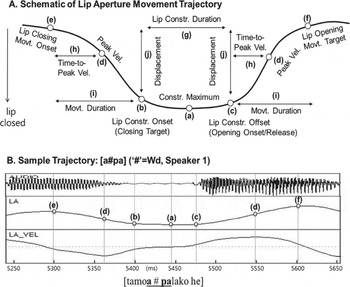
The Euclidean distance between the lower and upper lip sensors was used as an index of Lip Aperture (see Byrd & Saltzman Reference Byrd and Saltzman2003 for discussion on Lip Aperture). Figure 2 shows kinematic measures and relevant kinematic landmarks for both the lip opening and the closing movements associated with Lip Aperture.
Schematized Lip Aperture movement trajectory with kinematic measures (A) and a sample trajectory (B) for [a#pa] from tamoa#palakohe. Kinematic landmarks (a–f) in the sample trajectory in (B) correspond to schematized landmarks (a–f) in (A). A lower point in the movement trajectory refers to a more constriction as a smaller Lip Aperture value indicates that the two sensor coils between the upper and the lower lips are closer to each other.

During the lip closure, the constriction duration and the constriction degree were measured as follows:
-
• Lip constriction duration (ms): The interval between the lip constriction onset (Figure 2b) and the lip constriction offset (Figure 2c) which were defined as the target attainment point of the closing movement (left edge) and the onset point of the opening movement (right edge), respectively (Figure 2g).
-
• Lip constriction degree (mm): The Euclidean distance between the two sensors at the lips measured at three locations, i.e. at the constriction onset (Figure 2b); at the constriction maximum point (Figure 2a); and at the constriction offset (Figure 2c).
During the lip closing and the opening movements, kinematic measurements were made as follows:
-
• Lip Aperture (LA) at the movement onset/target (mm): The spatial (positional) values were obtained at the lip closing movement onset (Figure 2e) and at the lip opening movement target (Figure 2f).
-
• Lip opening/closing displacement (mm): The spatial difference between the lip opening/closing movement onset and the target (Figure 2j).
-
• Peak velocity of the lip closing/opening movement (cm/s): The highest velocity during the movement was obtained from the movement velocity profile (Figure 2d).
-
• Time-to-peak velocity (acceleration duration) of the lip closing/opening movement (ms): The temporal interval from the lip closing/opening onset to the time point of the peak velocity of the movement (Figure 2h).
-
• Deceleration duration of the lip closing/opening movement (ms): The temporal interval from the time point of the peak velocity to the lip constriction onset/the lip opening target (not shown in Figure 2).
-
• (Total) Movement duration of the lip opening/closing movement (ms): The temporal interval from the lip closing/opening movement onset to the lip constriction onset/the lip opening target (Figure 2i).
The kinematic landmarks such as the onset, the peak velocity point, and the target of the movement were identified by using MVIEW (Tiede Reference Tiede2005). The movement onset point was defined as a point in time at which the movement velocity reached 20% of the peak velocity after the zero-crossing point in the velocity profile. Likewise, as a mirror image the target point was obtained at a point in which the velocity value reached 20% of the peak velocity before the zero-crossing point in the velocity profile. It should be noted that some kinematic measures are known to be correlated with each other (e.g. Nelson Reference Nelson1983, Kelso et al. Reference Kelso, Vatikiotis-Bateson, Saltzman and Kay1985, Munhall, Ostry & Parush Reference Munhall, Ostry and Parush1985), so that, for example, peak velocity, displacement and movement duration can be taken as inter-dependent variables. We will nevertheless report the results on all the kinematic measures listed above not only for the sake of completeness (so that the reader may have all the relevant data at hand) but also for a theoretical possibility that kinematic measures may be differentially influenced by dynamical parameters (e.g. target and stiffness) that may be controlled independently either for different stops (Brunner et al. Reference Brunner, Fuchs and Perrier2011) or under different prosodic conditions (Beckman et al. Reference Beckman, Edwards and Fletcher1992, Byrd et al. Reference Byrd, Kaun, Narayanan, Saltzman, Broe and Pierrehumbert2000, Cho Reference Cho, Goldstein, Whalen and Best2006, Mücke & Grice Reference Mücke and Grice2014).
In order to explore effects of boundary on kinematic measures in dynamical terms, the relationships between some of the kinematic measures were further examined:
-
(i) relationship between peak velocity and displacement,
-
(ii) relationship between movement duration and displacement, and
-
(iii) relationship between movement duration and displacement/velocity ratio.
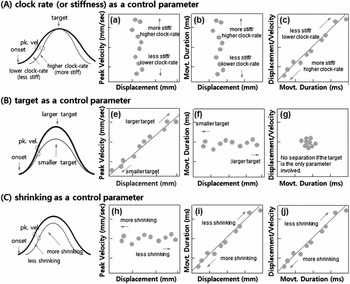
These relational variables allowed us to test the extent to which any boundary-related kinematic variation can be understood in terms of modulation of a particular dynamical parameter such as clock-rate (or stiffness), target or shrinking (the combination of clock-rate and target). (See below for some discussion on clock-rate and stiffness.) These three possibilities will be explored with reference to idealized kinematic relationships that have been discussed in the literature (Beckman et al. Reference Beckman, Edwards and Fletcher1992, Harrington et al. Reference Harrington, Fletcher and Roberts1995, Byrd et al. Reference Byrd, Kaun, Narayanan, Saltzman, Broe and Pierrehumbert2000, Cho Reference Cho, Goldstein, Whalen and Best2006, Mücke & Grice Reference Mücke and Grice2014).
2.4.1 Temporal modulation by clock-rate
Movement duration may be controlled by the clock-rate parameter under the influence of the π-gesture in a mass-spring dynamical system as discussed in the introduction. If the clock-rate parameter is a principal control parameter underlying kinematic differences as a function of boundary strength (IP vs. Wd), there should be a negative relationship between peak velocity and movement duration (i.e. the longer, the slower) with displacement being held constant. As a result, datapoints will be distributed vertically along the velocity (y) dimension plotted against the displacement (x) dimension and along the duration dimension against the displacement (x) dimension (as idealized in Figure 3a–b). In addition, as movement duration increases, the displacement/velocity ratio will also increase (because velocity decreases with displacement being held constant), showing a positive correlation between duration and displacement/velocity ratio with datapoints distributed diagonally (as idealized in Figure 3c). (As mentioned in the introduction, the kinematic relationships described with respect to modulation by clock-rate will effectively be accounted for by a change in stiffness. However, given that stiffness as a control parameter in a dynamical system is not entirely reliable (e.g. Fuchs, Perrier & Hartinger Reference Fuchs, Perrier and Hartinger2011), and that the boundary-related temporal variation may be modeled by a π-gesture that modulates the ‘clock-rate’, we will consider the ‘clock-rate’ parameter as modulating the temporal variation in the present study.)
Schematized hypothetical trajectories that correspond to a change in each parameter (A–C), and relationships between kinematic measures (a–i) in line with each dynamical parameter setting (adapted from Beckman et al. Reference Beckman, Edwards and Fletcher1992, Cho Reference Cho, Goldstein, Whalen and Best2006).

2.4.2 Spatial modulation by target
As schematized in Figure 3(B), if a change in target underlies the kinematic variation, peak velocity is expected to increase as displacement increases, showing a diagonal data distribution (Figure 3d). Because movement duration remains constant in a pure change in target, datapoints will be distributed horizontally along the x dimension in the duration-displacement plot (Figure 3e). Furthermore, because velocity changes in proportion to displacement (the larger, the faster) in a pure change in target, the displacement/velocity ratio will also remain constant, yielding no separation of datapoints as idealized in the duration-displacement/velocity ratio plot (Figure 3f).
2.4.3 Spatio-temporal modulation by shrinking
As schematized in Figure 3C, if boundary induces spatio-temporal variation, it may be understood as a change in both target and clock-rate, which are scaled proportionally (e.g. Harrington et al. Reference Harrington, Fletcher and Roberts1995, Bryd et al. Reference Byrd, Kaun, Narayanan, Saltzman, Broe and Pierrehumbert2000, Cho Reference Cho, Goldstein, Whalen and Best2006, Mücke & Grice Reference Mücke and Grice2014). In a proportional change in target and clock-rate, duration and displacement will have a positive relationship (as idealized in Figure 3h). As a result, peak velocity will remain constant as displacement varies, resulting in a horizontal data distribution in the velocity-displacement plot (Figure 3g). In addition, given that both duration and displacement increase proportionally, displacement/velocity ratio will also increase (as idealized in Figure 3i), i.e. because peak velocity is being held constant in a pure change in shrinking, the displacement/velocity ratio increases as displacement increases.
2.5 Statistical analyses
The raw values taken for each measure were converted to z-scores for the statistical analyses.Footnote 3 (The z-scores were calculated across each set of parameter values per speaker.) A series of repeated measures analyses of variance (RM ANOVA) were performed using the IBM SPSS 21 statistical package. The individual means of the subjects were used per each condition as the units of analyses to avoid overestimating significance levels (Type I, or alpha, error) (Max & Onghena Reference Max and Onghena1999). The within-subject factors were Consonant (Lenis /p/, Aspirated /p h/, Fortis /p*/) and Boundary (IP, Wd). For the Consonant factor, which has more than two levels, F- and p-values are reported based on Huynh–Feldt corrected degrees of freedom in order to reduce the inflation of the effect due to a possible violation of the assumption of sphericity (Huynh & Feldt Reference Huynh and Feldt1970). In order to test a difference between levels within a factor, post-hoc pairwise comparisons were performed with Bonferroni corrections for multiple comparisons to be made for the Consonant factor. Throughout the paper the significance level was p < .05, and a p-value between .05 and .08 was treated as a ‘trend’. We also report eta squared (η2) values when necessary to show differences in effect size.
3 Results
3.1 Lip constriction (closure) duration
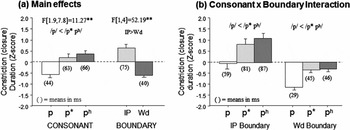
Results of RM ANOVAs showed a significant main effect of Consonant on Lip constriction duration (F(1.9,7.8) = 11.27, p < .01), such that it was significantly shorter for /p/ (lenis) than for /p h p*/ (aspirated/fortis), showing a two-way distinction (/p/</p h p*/, p < .05, Bonferroni) as shown in Figure 4a. There was also a significant main effect of Boundary (F(1,4) = 52.19, p < .01) on Lip constriction duration (IP > Wd). As shown in Figure 4b, no significant interaction was found between the two factors, indicating that the Consonant effect (i.e. longer duration for /p* p h/ than for /p/) holds across boundary conditions, and the Boundary effect (i.e. IP > Wd) across consonant types.
Effects of Consonant and Boundary on Lip constriction (closure) duration of /p p*p h/ (a) and their interaction (b) with means pooled across five speakers and error bars as standard errors calculated over all the z-scores of the raw data.

3.2 Lip constriction degree
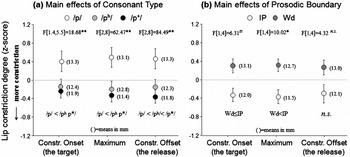
Results regarding Lip constriction degree measured at three constriction locations are summarized in Figure 5. Lip constriction degree showed a significant main effect of Consonant at all three measurement points (Figure 5a): at the lip constriction onset (the target) (F(1.4,5.5) = 18.68, p < .01), at the lip constriction maximum (F(2,8) = 62.47, p < .001), and at the constriction offset (the release) (F(2,8) = 84.49, p < .001). Post-hoc comparisons for the first two measures (at the constriction onset and the maximum points) revealed a two-way distinction (/p/</p h p*/, p < .05, Bonferroni), but at the constriction offset, Lip constriction degree showed a clear three-way distinction (/p/</p h/</p*/, p < .05, Bonferroni). That is, the Consonant effect appeared to become more robust as the constriction progressed further, which was also reflected in (partial) η2 values progressively increasing from .82 to .96. At the constriction onset and the maximum points, /p h/ and /p*/ were not distinguished from each other in the degree of constriction while both being differentiated from /p/. But /p h/ and /p*/ became further differentiated at least statistically at a later phase of closure (i.e. at the constriction offset), although the numerical mean difference between /p h/ and /p*/ was very small. None of these measures showed any interaction with Boundary, indicating that the observed effects were consistent across boundary conditions.
Main effects of Consonant (a) and Boundary (b) on Lip constriction degree of /p p h p*/ at three locations during the lip constriction: the constriction onset (the target of the lip closing movement), the constriction maximum and the constriction offset (the onset of the lip opening movement). Means were pooled across five speakers with error bars as standard errors calculated over all the z-scores of the raw data.

The Boundary factor showed a significant main effect on Lip constriction degree only at the lip constriction maximum (F(1,4) = 10.02, p < .05). As shown in Figure 5b, stops were produced with greater constriction at the constriction maximum point in the IP-initial than in the Wd-initial position (IP > Wd). At the constriction onset, there was a trend effect of Boundary (F(1,4) = 6.3, p < .07) in line with the pattern of IP > Wd. The constriction offset, however, showed no significant difference in Lip constriction degree due to Boundary, although the pattern of IP > Wd was numerically maintained.
3.3 Lip closing kinematics
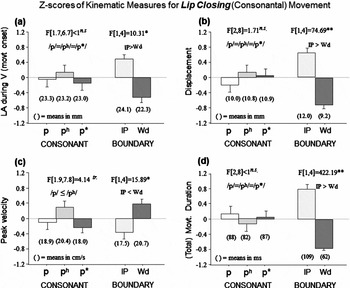
Results for the kinematic measures of the lip closing movement are summarized in Figure 6. Figure 6a shows effects of Consonant and Boundary on the (vocalic) lip aperture (LA) at the onset point of the movement during the pre-boundary vowel. There was no main effect of Consonant on LA (F(1.7,6.7) < 1, p > .1), indicating that the lip opening during the pre-boundary vowel was not conditioned by the type of the following consonant. Boundary, on the other hand, showed a significant main effect on LA which was larger before an IP than before a Wd boundary (F(1,4) = 10.31, p < .05), indicating a spatial expansion of the vocalic articulation in a pre-boundary position. There was no interaction between Consonant and Boundary (F(1.8,7.4) = 1.17, p > .1).
Effects of Consonant and Boundary on kinematic measures during the lip closing movement of /p pʰ p*/ in IP-initial and Wd-initial positions: (a) lip aperture at the movement onset during the preceding vowel, (b) spatial displacement, (c) peak velocity, (d) total movement duration. Means were pooled across five speakers with error bars as standard errors calculated over all the z-scores of the raw data.

As for the other kinematic measures, the effect of Consonant was observed only with Peak velocity as a trend effect (F(1.9,7.8) = 4.14, p < .06). As can be seen in Figure 6c, the lip closing movement tended to be faster (with a higher peak velocity) for /p h/ than for /p/ (p < .07, Bonferroni). Other kinematic measures (i.e. Lip closing displacement, Lip closing movement duration, Lip closing time-to-peak velocity and deceleration duration) showed no significant main effect of Consonant or a trend.Footnote 4 Results of regression analyses showed that variation in peak velocity is related to variation in constriction degree at the target of the movement (i.e. at the constriction onset) (R2 = .36, p < .001), but not to variation in LA at the onset of the movement (R2 < .01, p > .1). This indicates that the tendency towards a higher peak velocity for /p h/ (than for /p/) is at least in part due to the consonantal constriction characteristics.
The effect of Boundary, however, was significant in all kinematic measures during the lip closing movement. Stops were produced with a larger, longer, slower lip closing movement in the IP-initial than in the Wd-initial position. Lip closing displacement was larger for IP-initial than for Wd-initial stops (F(1,4) = 74.69, p < .001; Figure 6b); Lip closing peak velocity was slower for IP-initial than for Wd-initial stops (F(1,4) = 15.89, p < .05; Figure 6c); and Lip closing movement duration was longer for IP-initial than for Wd-initial stops (F(1,4) = 422.19, p < .001; Figure 6d). The observed IP-initial lengthening of the lip closing movement was attributable to both Time-to-peak velocity (acceleration duration) and Deceleration duration, but the first component of the movement duration (Time-to-peak velocity) appears to account for the boundary-induced lengthening to a greater degree than the second component of the movement (Deceleration duration) as suggested by eta statistics (Time-to-peak velocity: F(1,4) = 612.95, p < .001, η2 = .99; Deceleration duration: F(1,4) = 422.19, p < .001, η2 = .94). None of the measures, however, showed any significant interaction between Boundary and Consonant, suggesting that the observed boundary effects were consistent across the stops.
3.4 Lip opening kinematics
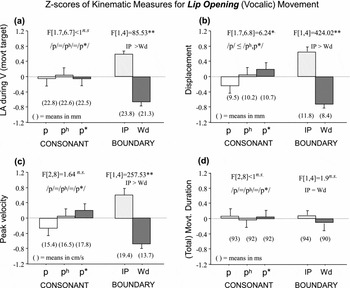
Results for the kinematic measures of the lip opening movement are summarized in Figure 7. Figure 7a shows effects of Consonant and Boundary on the (vocalic) lip aperture (LA) at the target of the movement during the following vowel. As can be seen in the figure, LA was not influenced by the preceding consonant (no main effect of Consonant, F(1.7,6.7) < 1, p > .1). LA, however, was significantly influenced by Boundary, showing a spatial expansion of the vocalic movement in CV after an IP than a Wd boundary (main effect of Boundary, F(1,4) = 85.53, p < .001).
Effects of Consonant and Boundary on kinematic measures during the lip opening movement of /p p h p*/ in IP-initial and Wd-initial positions: (a) lip aperture at the movement target during the following vowel, (b) spatial displacement, (c) peak velocity, (d) total movement duration. Means were pooled across five speakers with error bars as standard errors calculated over all the z-scores of the raw data.

As for other kinematic measures, the effect of Consonant was significant only in one of the five kinematic measures, i.e. Lip opening displacement (F(1.7,6.8) = 6.24, p < .05). Post-hoc pairwise comparisons revealed that the aspirated and the fortis stops (/p h p*/) were produced with a larger spatial displacement than the lenis /p/, showing a pattern of /p/</p h p*/ as a trend effect (p < .08, Bonferroni). Note that there was no consonant effect on LA at the movement onset during the preceding vowel, while constriction degree at the constriction onset (i.e. at the target of the movement) showed a significant consonantal effect with a pattern of /p/</p h p*/. Given that displacement was obtained based on the spatial difference between the time points at the movement onset and the target (the constriction onset), the consonantal effect on displacement may be in part due to constriction characteristics of consonants during occlusion (R2 = .32, p < .001). None of the other kinematic measures showed any significant Consonant effect (see the statistical summaries in Figure 7), nor did they reveal any significant interaction between Consonant and Boundary.
The effect of Boundary on the lip opening movement was observed with two kinematic measures, Lip opening displacement (F(1,4) = 424.02, p < .001) and Lip opening peak velocity (F(1,4) = 257.53, p < .001). As shown in Figure 7b–c, stops were produced with a larger and faster lip opening movement in the IP-initial than in the Wd-initial position. These Boundary effects did not interact with Consonant, suggesting that the effects were consistent across the stops. None of the temporal measures (i.e. Lip opening movement duration, Time-to-peak velocity and Deceleration duration) revealed any significant effect of Boundary (see the statistical summaries in Figure 7) or any interaction with Consonant.
3.5 Relationships between kinematic measures with respect to boundary effects
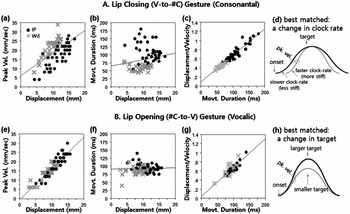
Boundary effects on the V-to-#C lip closing (consonantal) gesture and the #C-to-V lip opening (vocalic) gesture may be further illuminated by the relationships between kinematic measures as illustrated in Figure 8.
Relationships between kinematic measures for boundary-induced kinematic variation for (A) the lip closing (consonantal) gesture (upper panels) and (B) the lip opening (vocalic) gesture (lower panels). (d) is a schematic of the kinematic difference as a result of a change in clock rate (or stiffness) which best accounts for the observed kinematic relationships for the lip closing (consonantal) gesture (upper panels), and (h) is a schematic of the kinematic difference as a result of a change in target which best accounts for the observed kinematic relationships for the lip opening (vocalic) gesture (lower panels). (See Figure 3 and relevant discussion on how to interpret the kinematic relationships in terms of dynamical parameter settings.)

As for the V-to-#C lip closing gesture, kinematic relationships are shown in the upper panels of Figure 8. They have a resemblance to relational patterns under the influence of the clock-rate parameter which modulates temporal realization of articulation near a prosodic boundary without having a direct influence on the spatial dimension. In the velocity-displacement plot (Figure 8a), distribution of datapoints indicates a ‘slower’ articulatory speed for IP (than for Wd) without being accompanied by a change in displacement. The duration-displacement plot (Figure 8b) also shows a longer duration with no noticeable change in displacement, indicating slower movement for IP than for Wd. Finally, and most crucially, the relationship between duration and displacement/velocity ratio shows a clear-cut division for IP and Wd with a diagonal distribution of the datapoints, indicating that variation in duration as a function of boundary is most reliably explained by the change in displacement/velocity ratio. (Recall that in a pure change in clock-rate, as duration increases, velocity decreases with displacement being held constant, resulting in a proportional increase in displacement/velocity ratio.) All three kinematic relationships found with the V-to-#C lip closing gesture converge on supporting the view that boundary-induced articulatory variation is modulated by a clock-rate parameter governed by the π-gesture (as idealized in Figure 8d).
For the #C-to-V lip opening (vocalic) gesture, a very different picture arises. Kinematic relationships as shown in the lower panels of Figure 8 appear to be best accounted for by a change in target which predicts a proportional change in displacement and peak velocity with no change in duration. In the velocity-displacement plot (Figure 8e), the distribution of the datapoints is by and large diagonal, in such a way that an increase in displacement (for IP vs. Wd) is accompanied by an increase in peak velocity. The duration-displacement plot (Figure 8f) showed a horizontal distribution of datapoints along the displacement (x) axis, showing a larger displacement for IP than for Wd with no change in duration. Finally, there is no clear separation of datapoints by IP and Wd in the duration-displacement/velocity ratio plot (Figure 8g). These patterns taken together are best matched with the idealized kinematic relationships under the influence of the target parameter as schematized in Figure 8h.
4 Summary and discussion
In the present study we have investigated kinematic characteristics of the Korean bilabial stops (/p p h p*/) by examining articulatory variation in Lip Aperture as a function of the three-way stop contrast in two different prosodic contexts, i.e. IP-initial and IP-medial (Wd-initial) positions. In this section, we will recapitulate the results along with some discussion in connection with specific research questions of the present study.
4.1 How is the three-way stop contrast manifested kinematically and what articulatory reflexes of the stops are invariantly observable across prosodic positions?
Supralaryngeal articulatory reflexes of the three-way stop contrast in Korean were most clearly observed during the occlusion in terms of constriction degree (/p/</p h/</p*/ at the constriction offset)Footnote 5 and constriction duration (/p/</p h p*/). The observed patterns are largely in line with results of a kinematic study by Son et al. (Reference Son, Kim and Cho2012) which examined the same bilabial stops in a word-medial position, but the present study did not replicate a three-way distinct pattern in constriction duration reported in previous studies (e.g. /p/</p h/</p*/, Son et al. Reference Son, Kim and Cho2012; /t/</t h/</t*/, Cho & Keating Reference Cho and Keating2001; and /k/</k h/</k*/, Brunner et al. Reference Brunner, Fuchs and Perrier2011). The discrepancy may be at least in part due to the fact that while both Son et al. (Reference Son, Kim and Cho2012) and Brunner et al. (Reference Brunner, Fuchs and Perrier2011) examined the stops within a word produced in isolation, the present study examined the stops in more extended prosodic contexts in sentences. In contrast, Cho & Keating (Reference Cho and Keating2001) demonstrated a three-way distinction in constriction duration with their test consonants being produced in similar prosodic contexts as in the present study. As mentioned in the method section, however, the difference between previous studies and the present study may lie in that the present study examined the target syllables in locus of information that is likely to induce narrow focus. It is therefore plausible that the difference between the fortis and the aspirated stops may have disappeared in the present study due to a ceiling effect of domain-initial strengthening and focus-induced strengthening combined.Footnote 6 These mixed results taken together suggest that although constriction duration is an important ‘temporal’ correlate of the distinction between the lenis and the other two stops, it is not invariantly utilized for a distinction between the two ‘strong’ stops (/p h p*/). The degree of constriction, on the other hand, showed a more consistent three-way distinction in both the present study and the previous studies.
Unlike the constriction characteristics during the occlusion, the kinematic characteristics of lip closing (consonantal) movement manifested no clear articulatory evidence for the three-way contrast. We observed only one case of a marginally significant consonant effect on the peak velocity: The lip closing movement tended to be faster (with a higher peak velocity) for the aspirated than for the lenis stop as a trend effect (/p/≤/p h/), while no other comparisons between the consonant types revealed any noteworthy difference. Son et al. (Reference Son, Kim and Cho2012) also reported only one case of the consonant effect, but on a different kinematic measure, the lip closing displacement: It was larger for the aspirated /p h/ than for the lenis /p/, while the fortis /p*/ was not differentiated from the two. The weak and inconsistent consonantal effects both within and between studies suggest that the three-way contrast in labial stops is only partially reflected in the lip closing (consonantal) movement characteristics.
The observed weak and unreliable effect on the consonantal closing movement for labial stops (of both the present study and of Son et al. Reference Son, Kim and Cho2012), however, is quite contradictory to results for velar stops (/k k h k*/) reported by Brunner et al. (Reference Brunner, Fuchs and Perrier2011). They examined the tongue dorsum closing (rising) kinematics in a word-medial position, and observed the following tendency: the fortis /k*/ tended to be produced with a higher peak velocity and acceleration along with a shorter deceleration duration, whereas the lenis /k/ was associated with a lower peak velocity and acceleration along with a longer deceleration duration. The aspirated /k h/ tended to fall in between. Based on these results (along with some other kinematic attributes), Brunner et al. (Reference Brunner, Fuchs and Perrier2011) proposed that the production of the three-way contrast in velar stops can be explained by different positions of their (‘virtual’) target which is set in the order of lenis < aspirated < fortis. (See Löfqvist & Gracco Reference Löfqvist and Gracco1997, Reference Löfqvist and Gracco2002, for more discussion on the virtual target hypothesis.) This assumption is in principle consistent with the three-way distinct degree of consonantal constriction found for labial stops in the present study. But none of the other kinematic parameters (e.g. peak velocity and deceleration duration) examined in the present study (and in Son et al. Reference Son, Kim and Cho2012) showed comparable kinematic patterns as reported in Brunner et al. (Reference Brunner, Fuchs and Perrier2011). A possible reason for the discrepancy may be that the movement characteristics for consonantal constriction formation is intrinsically different for labials and for velars: Labial stops are produced with two active articulators (the upper and the lower lips) which can be further compressed after the initial contact whereas velar stops are produced with one active articulator (the tongue dorsum) against the passive articulator, the palate which has little compressibility. Given that the present study has been limited to examining bilabial stops, more work will certainly be needed to corroborate this possibility and, more broadly, to understand production mechanisms of the three-way stops that may vary as a function of place of articulation. It will be particularly interesting to examine how denti-alveolar stops in Korean (whose kinematic correlates have never been explored in the literature) manifest themselves in kinematic terms in comparison with labial and velar stops. Furthermore, given the limitation that Brunner et al. (Reference Brunner, Fuchs and Perrier2011) examined velar stops only in a word-medial position in isolation, and given that production of lenis stops varies more in laryngeal terms depending on prosodic position (e.g. word-initial vs. word-medial), more data in larger prosodic contexts will provide a balanced basis to compare kinematic characteristics of stops of different places of articulation. Only when all these pieces of information are put together, can we obtain a more complete picture regarding supralaryngeal characteristics of the three-way stop contrast in general, and their interpretations in terms of the virtual target hypothesis in particular.
Similar to the results regarding the lip closing movement, the lip opening kinematics (whose variation could be attributable more to the following vocalic articulation) did not reveal robust consonantal effects, either. Only the lip opening displacement showed a trend effect, such that both the aspirated and the fortis stops (/p h p*/) tended to be produced with larger displacement than the lenis counterpart /p/. Note, however, that given that the degree of LA at the opening target in the following vowel remained unchanged, the larger displacement for /p h p*/ than for /p/ appears to be at least in part due to the differential constriction degree as a function of consonantal strength at the constriction offset (the release onset), i.e. the constriction degree was significantly greater for /p h p*/ than for /p/. These results are in contrast with Son et al.’s (Reference Son, Kim and Cho2012) results which showed more robust consonant effects on the lip opening kinematics, especially with the fortis /p*/ being produced with a larger, longer and faster movement (with an increase in displacement, movement duration, and peak velocity) relative to the lenis /p/. Again the discrepancy between Son et al. and the present study implies that while the lip opening (vocalic) movement may be influenced by the degree of articulatory strength underlying the stops, it is not the primary dimension in which the three-way contrast is invariantly maintained, but is subject to modification conditioned by prosodic positions in which the stop occurs. For example, the VCV word context in isolation used in Son et al. (Reference Son, Kim and Cho2012) appears to provide an optimal phonetic environment in which the vowel after the test consonant undergoes final lengthening. The final vowel with no further constraints coming from the following context is likely to be produced with a greater degree of ‘articulatory’ freedom, showing a full range of consonantal strength effects realized on the C-to-V lip opening movement.
In sum, all the results (of the present and the previous studies) taken together suggest that the three-way contrast in Korean stops which have traditionally been better known for their differential laryngeal settings is indeed reflected in the articulation at the suparalaryngeal level. In particular, the three-way contrast is consistently correlated with the degree of constriction during the occlusion as an invariant supralaryngeal articulatory reflex of the laryngeal contrast associated with the stops. The stop contrast, however, is not invariantly characterized by a particular kinematic (V-to-C lip closing and C-to-V lip opening) pattern, which may be ascribable to variation depending on other factors such as place of articulation and prosodic positions in which the stop occurs.
4.2 How is domain-initial strengthening of the three-way contrastive stops in Korean expressed in kinematic terms?
Results of the present study showed robust boundary effects on the production of Korean three-way labial stops (/p p h p*/) in both lip constriction and closing/opening kinematic characteristics. Labial stops were produced with a longer and more constricted lip closure in IP-initial than in Wd-initial position, demonstrating articulatory evidence for domain-initial strengthening during the occlusion of labial stops in Korean. This is in line with results of previous EPG studies on coronal stops in Korean and other languages (Cho & Keating Reference Cho and Keating2001, Reference Cho and Keating2009; Keating et al. Reference Keating, Cho, Fougeron, Hsu, Local, Ogden and Temple2003). Robust domain-initial strengthening effects were further evident in the lip closing and opening kinematics. The lip closing movement for consonantal constriction was larger, longer and slower in IP-initial than in Wd-initial position. On the other hand, the lip opening (release) movement for the following vocalic articulation was larger and faster, but not longer IP-initially. These results together clearly demonstrated that domain-initial strengthening is kinematically expressed not only during the consonantal closing movement but also in association with the following vocalic articulation, although their detailed kinematic patterns were not the same.
The IP-initial larger, longer and slower lip closing (V-to-C consonantal) movement of the Korean labial stops is similar to that of the English labial stops reported in Cho (Reference Cho, Goldstein, Whalen and Best2006). The two languages, however, diverge sharply in kinematic characteristics of the lip opening (C-to-V vocalic) movement. While the IP-initial lip opening movement in English was found to be simply longer (Cho Reference Cho, Goldstein, Whalen and Best2006), it was found to be larger and faster in Korean. Interestingly, the boundary-induced lip opening (vocalic) pattern in Korean is rather similar to the accent-induced strengthening pattern in English which was also characterized by a larger and faster lip opening movement, except that the lip opening movement was longer in English but not in Korean. Note that in English, lip opening movements were found to be bigger in all ways under accent, i.e. in distance, time and speed (Cho Reference Cho, Goldstein, Whalen and Best2006).
Such a cross-linguistic difference in phonetic manifestation of boundary-related domain-initial strengthening may be interpreted as being attributable to a language-specific prosody system. English has lexical stress and pitch accent in its prosodic system, such that a stressed syllable serves as the head of a prosodic unit which becomes the locus of prominence when accented. Phonetic manifestation of prominence in English has often been found to be differentiated from that of boundary marking (e.g. Edwards, Beckman & Fletcher Reference Edwards, Beckman and Fletcher1991; Beckman et al. Reference Beckman, Edwards and Fletcher1992; Barnes Reference Barnes2002; Cho Reference Cho2005, Reference Cho2008; Cho & Keating Reference Cho and Keating2009; Cho Lee & Kim Reference Cho, Lee and Kim2014), showing clear phonetic signatures of the dual functions (prominence vs. boundary marking) of prosodic structure. Korean, on the other hand, does not employ lexical stress and pitch accent in its prosodic system, so that no particular syllable is phonologically determined as the head of a prosodic unit. In the absence of phonological/lexical constraints for marking prominence, Korean appears to have more degree of freedom to signal prosodic boundaries, giving rise to a robust domain-initial strengthening pattern even on the following vocalic (lip opening) articulation (see Cho et al. Reference Cho, Lee and Kim2011 for related discussion), which may also lead to an increased stability of CV intergestural timing (Cho, Yoon & Kim Reference Cho, Yoon and Kim2014). This possibility is also consistent with the fact that prominence in Korean is often expressed by phrasing, such that a focused word is likely to start a new phrase which is headed by the focused item followed by one or more lexical items to constitute an informational unit (Jun Reference Jun1996, Reference Jun1998).
We therefore propose that in Korean (with no lexically determined head of a prosodic unit), the domain-initial syllable serves the function as a kind of a ‘head’ of the unit, which is phonetically expressed with robust prosodic strengthening comparable to the prominence-induced strengthening effect in English, having a larger and faster lip opening (vocalic) movement in common. This proposal, however, has to be further corroborated given the limitation of the present study with regard to controlling the prominence on the target syllable. As explained in the method section, the target syllable in the frame sentence was likely to bear narrow focus. One might then wonder whether the boundary-induced lip opening characteristics in Korean (which resembled the prominence-induced strengthening pattern in English) may be due to the fact that the target syllable received some degree of prominence. However, as the IP-initial and the Wd-initial syllables were positioned exactly in the same locus of information with both likely to receive narrow focus, the kinematic difference between IP and Wd conditions may well be taken to be a reflex of domain-initial strengthening in Korean. More studies will certainly be called for in order to explore whether the observed boundary effects will be independent of the presence or absence of focus on the target syllable.
4.3 How can kinematic characteristics of domain-initial strengthening of the Korean stops be understood in dynamical terms?
The results of the present study have further implications for theories of speech production that have been advanced in the framework of a mass-spring task-dynamic model (e.g. Saltzman & Munhall Reference Saltzman and Munhall1989, Byrd & Saltzman Reference Byrd and Saltzman2003, Goldstein, Byrd & Saltzman Reference Goldstein, Byrd, Saltzman and Arbib2006). As for the lip closing (consonantal) movement characteristics, the larger movement associated with IP-initial stops in both Korean and English may be interpretable in dynamical terms as an effect of modulating the target parameter (which is responsible for variation in displacement). With the target parameter alone, however, it is difficult to interpret the longer and slower lip closing movements in dynamical terms. As discussed in Cho (Reference Cho, Goldstein, Whalen and Best2006), to account for both the spatial and the temporal effects, other parameters such as stiffness must be at play interactively with the target parameter. Alternatively, the observed kinematic pattern can be understood in the framework of the π-gesture theory (Byrd Reference Byrd2000, Reference Byrd, Goldstein, Whalen and Best2006; Byrd et al. Reference Byrd, Kaun, Narayanan, Saltzman, Broe and Pierrehumbert2000; Byrd & Saltzman Reference Byrd and Saltzman2003; Byrd et al. Reference Byrd, Krivokapić and Lee2006). As introduced at the outset of this paper, a π-gesture modulates the rate of the clock that controls articulatory activation of gestures in such a way that it slows down articulatory movements at a prosodic juncture. Furthermore, in simulations of the kinematic consequences of π-gestures, Byrd & Saltzman (Reference Byrd and Saltzman2003) showed that modulation in the temporal domain can have significant consequences in the spatial domain. (It was assumed that the more the time-stretching of sequenced gestures, the less the intergestural overlap as a result of which gestures are less likely truncated, minimizing the likelihood of spatial reduction.) The π-gesture theory therefore accounts for the boundary-induced spatio-temporal expansion (i.e. larger, longer, and slower) observed in both Korean and English. The V-to-#C consonantal closing gesture which is immediately at the boundary (or ‘transboundary’) appears to be influenced directly by the effect of the π-gesture in a cross-linguistically comparable way, illuminating its applicability across languages.
Recall, however, that the two languages diverge sharply in the kinematic characteristics of the following lip opening (vocalic) movement, i.e. the IP-initial lip opening movement was longer in English, but larger and faster in Korean. In dynamical terms, the longer movement with no spatial effect in English can be understood as coming from a change in stiffness, or alternatively by the influence of the clock-slowing effect of a π-gesture. On the other hand, the larger and faster movement with no change in movement duration in Korean may be best accounted for by an increase in the value of the target parameter. (Note that in order for articulators to travel farther to reach the increased target with no extra time, which is the case when values of other parameters such as stiffness are held constant, the articulators must move faster, resulting in a larger and faster movement with no change in movement duration.) Crucially, however, the faster movement for the lip opening gesture in Korean stands in sharp contrast with the expected slower movement under the influence of the π-gesture. This would call for the theory to devise a way to integrate the influence of the target parameter (or whatever mechanisms that underlie the larger and faster movement) into the system in Korean, which is not necessary in English.
Again we propose that the π-gesture, to the extent that the theory remains valid, is not something that operates over the entire initial syllable in a cross-linguistically comparable way, but rather its function has to be fine-tuned in interaction with other dynamical parameters according to the prosodic system of a given language. Regarding the dynamical complexity in English, Cho (Reference Cho2008) suggested that any theory that attempts to understand the dynamical mechanism underlying prosodically-conditioned kinematic variation must look for a combination of settings of multiple kinematic parameters. The present study adds another aspect of the complexity to it, i.e. such a theory should be further adjusted to accommodate the cross-linguistic differences which may be, as discussed above, in part due to the prosodic system of a given language.
A plausible way to account for the robust domain-initial strengthening in the spatial dimension is to invoke a spatial modulation gesture (so-called ‘μs-gesture’) that may change the spatial target parameters of tract-variable gestures in a task-dynamic model (Saltzman et al. Reference Saltzman, Nam, Krivokapić and Goldstein2008). While a spatial modulation gesture may be taken to regulate prominence-induced spatial variation in English (as proposed by Saltzman et al. Reference Saltzman, Nam, Krivokapić and Goldstein2008), it may also underlie the seemingly boundary-induced spatial variation in Korean. The test word in the present study, as discussed above, is likely to receive narrow focus and its degree of prominence may be further modulated by prosodic phrasing, so that the focused item is phonetically more prominent phrase-initially than phrase-medially in proportion to boundary strength. In dynamical terms, the boundary-induced spatial expansion in Korean may then be accounted for by phasing relationships of tract-variable constriction gestures with a π-gesture (a temporal modulation gesture) and/or a μs-gesture (a spatial modulation gesture), each mediated by prosodic boundary strength. In other words, both the π-gesture and the μs-gesture influence domain-initial constriction gestures with the former being coupled with a boundary-adjacent consonantal constriction gesture (explaining its slower movement) and the latter with the post-boundary vocalic opening gesture (being responsible for its larger and faster movement). In a language like English, on the other hand, a μs-gesture directly operates on a stressed syllable independently of prosodic phrasing. Under the scenario outlined above, cross-linguistic differences in boundary-related kinematic realization may be interpreted as stemming from how the non-tract-variable π-gesture and μs-gesture are phased with tract-variable constriction gestures in relation to boundary marking and prominence marking. It remains to be seen how these possibilities can be modelled and implemented in a dynamical system, which may illuminate the nature of prosodically-conditioned speech production in terms of both cross-linguistic similarities and language-specificities.
5 Conclusion
Results of the study have demonstrated that the three-way stop contrast that has traditionally been known to arise with differential laryngeal characteristics is indeed reflected in articulation at the supralaryngeal level. Among many articulatory parameters examined in the present study, the lip constriction degree during the occlusion was found to be an invariant supralaryngeal articulatory reflex of the three-way stop contrast across prosodic positions, showing a pattern of /p/</p h/</p*/. Constriction duration was another reliable kinematic parameter, although it made a binary distinction between the lenis and the aspirated/fortis stops (/p/</p h p*/). Much less robust consonantal distinction was observed with the kinematic measures for the lip opening/closing movements as these measures were the ones heavily conditioned by surrounding contexts. Results of the present study also showed robust articulatory evidence for domain-initial strengthening of bilabial stops, which was characterized by (i) a larger and longer constriction during the occlusion, (ii) a larger, longer and slower lip closing (consonantal) movement, and (iii) a larger and faster lip opening (vocalic) movement. The robust articulatory strengthening pattern arising with the strength of the prosodic boundary in Korean is similar to boundary-related patterns in English when the articulatory gesture was immediately at the boundary, i.e. in terms of the lip closing (consonantal) movement characteristics (which is best accounted for by a change in the rate of the clock, governed by a π-gesture). But the boundary effect on the lip opening (vocalic) gesture, (which resembled articulatory variation controlled either by the target parameter or by a spatial modulation gesture, or a μs-gesture) was rather comparable to the prominence-induced strengthening pattern in English. It was proposed that such a cross-linguistic difference should be attributable to a language-specific prosodic system, i.e. given that Korean does not have constraints coming from lexical stress/accent, it has greater degree of freedom to express domain-initial strengthening more robustly than English. In dynamical terms, a cross-linguistic difference may be determined by how a temporal modulation gesture and a spatial modulation gesture are phased with constriction gestures. Future research is warranted for exploring this possibility, which will enhance our understanding of the phonetics-prosody interface in terms of both cross-linguistic similarities and language-specificities.
Acknowledgement
We are grateful to the Korean speakers who participated in our EMA experiment. We also thank three anonymous reviewers and the Editor (Adrian Simpson) for very constructive comments. This work was supported by the research fund of Hanyang University (HY-2015) to the first author (T. Cho).