1. INTRODUCTION
The problem of tracking a manoeuvring satellite is investigated in this paper. In general, Kalman Filters (KF) can be used to determine and predict the orbit of satellites successfully, but when the target satellite is non-cooperative, which means there is no prior information of the manoeuvre, the tracking performance of the KF method degrades or even diverges (Fitzgerald, Reference Fitzgerald1971). Because the classical KF method cannot solve this problem, a reform of the KF method or other methods are needed. When the manoeuvre occurs, the mismatch between the navigation model and the real dynamic model causes the tracking of the manoeuvring target to perform poorly. Thus, the technique of handling the model mismatch is the core of the manoeuvre tracking problem.
Some methods solve the problem by tolerating a model mismatch in the tracking process. The Geometry Orbit Determination (GOD) method provides an estimation of the satellite's state with only the measurement data and completely ignores the dynamic model of the target. However, this kind of method cannot provide state estimation of the target with a higher accuracy than the measurement error, which makes it unattractive. Manoeuvre reconstruction is a post-process method to determinate the period, magnitude and direction of the manoeuvre by fitting two separated arcs around the manoeuvre – the pre-manoeuvre and post-manoeuvre trajectories (Kelecy and Jah, Reference Kelecy and Jah2010). This type of method performs better than KFs and the GOD method but may involve difficulty in tuning manoeuvre parameters and computations. The re-initiation of orbit determination is a feasible method to converge the estimation after the occurrence of the manoeuvre. Usually, the manoeuvre is detected as a fault or an abnormal event of the dynamic system by a fault detector or indicator. When the manoeuvre is detected, the filter is re-initiated with a large enough covariance. The post-manoeuvre orbit is determined as a new initial orbit, and the model mismatch caused by the manoeuvre is treated as the initial state error. In general, adaptive Kalman filters are used to re-converge the estimation after the manoeuvre. Patera (Reference Patera2008) proposed a data processing method to detect space events including satellite manoeuvres, but a sequential database or ephemeris of the tracked space object is required. Wei et al. (Reference Wei, Jin, Zhang, Liu, Li and Yan2013) proposed an adaptive Extended Kalman Filter (EKF) for autonomous navigation of a Mars probe in which an adaptive extended Kalman filter showed good robustness and improved the accuracy of state estimation and the speed of convergence. Tan et al. (Reference Tan, Wang, Jin and Meng2015) used an improved adaptive filtering algorithm in Global Positioning System (GPS)/Inertial Navigation System (INS) integrated navigation, which exhibited good robustness in the absence of a covariance matrix. Jwo and Lai (Reference Jwo and Lai2009) and Wang et al. (Reference Wang, Sun and Li2014) used a fading factor to detect the manoeuvre and re-initiate the covariance of the state, which is rooted in a Strong Tracking Filter (STF) method (Zhou and Frank, Reference Zhou and Frank1996). In general, adaptive Kalman filters provide accurate state estimations when the predicted state covariance is inflated properly. The disadvantage of these methods is that they only provide an estimation of the state but not an estimation of the manoeuvre. The magnitude and direction of the manoeuvre cannot be obtained directly through these methods.
Some other methods solve the problem by eliminating model mismatch. The Interacting Multiple Model (IMM) method provides an option (Mazor et al., Reference Mazor, Averbuch, Bar-Shalom and Dayan1998). In this method, multiple sub-filters are organised together. The measurements are separated to the sub-filters, and the outputs of the sub-filters are combined to obtain the final estimation of the integral filter. However, even if the sub-filters are given different magnitudes of unknown acceleration (Lin and Atherton, Reference Lin and Atherton1993) or are set in different dynamic modes (Daeipour and Bar-shalom, Reference Daeipour and Bar-Shalom1998; Kaempchen et al., Reference Kaempchen, Weiss, Schaefer and Dietmayer2004; Lee and Hwang, Reference Lee and Hwang2015), the results of IMM methods rely on the selection of the dynamic model of the sub-filters. If the sub-filters are set far away from the real dynamic model of the manoeuvre, the accuracy of the IMM method decreases. Some modified IMM methods (Munir and Atherton, Reference Munir and Atherton1995; Lee et al., Reference Lee, Park, Lee and Joo2005) have been proposed to provide a better performance, but these methods are complicated to construct and have a significantly larger computation time compared with other methods. The Input Detection and Estimation (IDE) method is a direct and efficient method to solve the manoeuvre tracking problem. In this method, the manoeuvre of the target is modelled as an unknown acceleration input of the dynamic system. With accurate detection and estimation of the manoeuvre, acceleration is added into the navigation model. This eliminates model mismatch and leads to an accurate state estimation. However, this method usually applies some assumptions about the unknown manoeuvre acceleration to simplify the process. For example, Whang et al. (Reference Whang, Lee and Sung1994) assumed the manoeuvre model to be a first-order Markov process. Lee and Tahk (Reference Lee and Tahk1999) assumed that the manoeuvre occurred only once inside the detection window and the acceleration caused by a manoeuvre is constant before and after the occurrence time of the manoeuvre. Khaloozadeh and Karsaz (Reference Khaloozadeh and Karsaz2009) assumed that an unknown acceleration was a constant in the navigation model. Ko and Scheeres (Reference Ko and Scheeres2016) used the thrust-Fourier-coefficient event representation method to detect and estimate the manoeuvre acceleration, and the thrust-Fourier-coefficients are considered as constant in the navigation model. These assumptions are restrictive in practical applications, and the performance of the methods degrades if the assumptions are not satisfied. In order to solve the problem that the unknown manoeuvre is difficult to model, some novel filtering methods have been proposed in recent years. For example, Cao et al. (Reference Cao, Chen and Misra2015; Reference Cao, Chen, Zhang, Li and Misra2017) and Cao and Li (Reference Cao and Li2016) proposed the predictive variable structure filter for estimating the relative position and attitude of satellites. In these studies, a predictive variable structure filter was used to estimate the dynamic model error. They demonstrated that this method can deal with various types of model uncertainties, parameter variations, and noises, showing good robustness. Zhai et al. (Reference Zhai, Bi, Zhao and Liang2018) proposed a variable structure estimator for tracking non-cooperative, unknowingly manoeuvring spacecraft. In this study, an observer was developed for estimating the unknown manoeuvre and then the estimated manoeuvre was used to compensate the dynamic model to enhance tracking performance.
In this paper, a novel Extended Kalman Filter with Input Detection and Estimation (EKF/IDE) is proposed. An unbiased minimum-variance input and state estimation method is applied to provide estimation of the manoeuvre acceleration without any a priori information. The impulsive manoeuvre is detected with a technique based on Mahalanobis distance, then a switch approach between EKF and IDE methods based on manoeuvre detection is proposed to provide state estimation. Furthermore, a covariance inflation coefficient is constructed to improve the performance of the proposed method after an unobserved manoeuvre. The proposed EKF/IDE method is robust to unknown impulsive manoeuvres. When the manoeuvre occurs, this method can detect the manoeuvre in real time and maintain a good estimate of the target state. Compared with the previous Adaptively Robust Unscented Kalman Filter (ARUKF) method, the proposed method has better manoeuvre detection capability, shorter manoeuvre detection delay and faster manoeuvre convergence speed.
The rest of this paper is organised as follows. Section 2 introduces the orbit dynamics model and the measurement model. Section 3 presents the EKF/IDE method for detecting unknown impulsive manoeuvres and estimating the state of the target. Section 4 provides several simulations to show the feasibility of the method in different situations. A comparison between the proposed method and the previous ARUKF method is used to demonstrate the performance of the proposed method. In the last section, some conclusions and discussions of the proposed method are presented.
2. DYNAMIC AND MEASUREMENT MODEL
The orbit dynamic model used in this paper is:
 $$\dot{{\bi x}}={\bi F}\lpar {\bi x}\comma \; t\rpar +B \cdot {\bi d}\lpar t\rpar $$
where  ${\bi x}=\left[\matrix{{\bi r}\lpar t\rpar & \dot{{\bi r}}\lpar t\rpar }\right]^{\rm T}$ is the state of the satellite, including the position and velocity vectors. F(x, t) is the a priori dynamic model of the satellite. d(t) is the unknown manoeuvre acceleration and
 $B=\left[\matrix{0_{3\times 3} & I_{3\times3}}\right]^{\rm T}$ is the auxiliary coefficient matrix of the manoeuvre acceleration. In this paper, only an impulsive manoeuvre is considered:
 $${\bi d}\lpar t\rpar =\left\{\matrix{{\bf 0}\comma \; \hfill & t\, \ne\, t^\ast \hfill \cr \Delta {\bi v}\cdot \delta \lpar t\rpar \comma \; \hfill & t=t^\ast}\right. $$
where Δv is the velocity vector of the impulsive manoeuvre and t* is the occurrence time of the impulsive manoeuvre.
Proper measurements are needed for tracking the manoeuvring satellite. Three radar measurements of range and range-rate are employed in this paper. The measurement data is modelled as:
 $$\eqalign{y_{\rho i} & = \Vert {\bi r}-R_i\Vert +\omega_{\rho i} \cr y_{vi} & = \displaystyle{{\lpar \dot{{\bi r}}-\dot{{\bi R}}_i \rpar \cdot \lpar {\bi r}-{\bi R}_i\rpar }\over{\Vert {\bi r}-{\bi R}_i\Vert }} +\omega_{vi}} $$
where r and Ri are the positions of the satellite and the i-th radar station.  $\dot{{\bi r}}$ and
 $\dot{{\bi R}}_{i}$ are the velocities of the satellite and the i-th radar station. y ρ i and y vi are the range and range-rate measurements of the i-th radar station. ωρi and ωvi are the measurement noises which are considered as zero-mean white Gaussian noises in this paper.
A linear discrete-time system is derived from Equations (1) and (3):
 $${\bi x}_k ={\brPhi}_{k\comma k-1} {\bi x}_{k-1} +G_{k-1} {\bi d}_{k-1} $$
 $${\bi y}_k =H_k {\bi x}_k +{\bi v}_k $$
where xk ∈ ℝn is the state of the satellite at the discrete time t k and  ${\brPhi}_{k\comma k-1} \approx I_{6\times 6} \left.+\displaystyle{{\partial {\bi F}}\over{\partial {\bi x}}}\right\vert _{{\bi x}={\bi x}_{k-1}} \cdot \lpar t_{k} -t_{k-1}\rpar $ is the state transition matrix from time t k−1 to t k. yk ∈ ℝm is the measurement data,
 $H_{k} =\left.\displaystyle{{\partial {\bi y}}\over{\partial {\bi x}}}\right\vert _{{\bi x}={\bi x}_{k}}$ is the measurement mapping matrix and vk is the corresponding measurement error. dk−1 is the manoeuvre acceleration at time t k−1. The value of d k−1 is modelled as:
 $${\bi d}_{k-1} =\left\{\matrix{{\bf 0}\comma \; & t^{\ast} \notin \lsqb t_{k-1} \comma \; t_k \rpar \cr \displaystyle{{\Delta {\bi v}}\over{t_k -t_{k-1}}}\comma \; & t^{\ast} \in \lsqb t_{k-1} \comma \; t_k \rpar }\right. $$
The coefficient matrix G k−1 is defined from Equation (1) as:
 $$G_{k-1} =B\cdot \lpar t_k -t_{k-1} \rpar =\left[\matrix{0_{3\times3} \cr I_{3\times3}}\right]\cdot \Delta t_k $$
3. TRACKING MANOEUVRING SATELLITE WITH EKF/IDE METHOD
3.1. Unbiased minimum-variance method for the input and state estimation
According to Gillijns and De Moor (Reference Gillijns and De Moor2007a; Reference Gillijns and De Moor2007b), the unbiased minimum-variance input and state estimation of a linear discrete-time system described in Equations (4) and (5) are proposed as:
 $$\hat{{\bi x}}_{k\vert k-1} ={\brPhi}_{k\comma k-1} \hat{{\bi x}}_{k-1\vert k-1} $$
 $$\hat{{\bi d}}_{k-1} =M_k \lpar {\bi y}_k -H_k \hat{{\bi x}}_{k\vert k-1}\rpar $$
 $$\hat{{\bi x}}_{k\vert k}^{\ast} =\hat{{\bi x}}_{k\vert k-1} +G_{k-1} \hat{{\bi d}}_{k-1} $$
 $$\hat{{\bi x}}_{k\vert k} =\hat{{\bi x}}_{k\vert k}^\ast +K_k \lpar {\bi y}_k -H_k \hat{{\bi x}}_{k\vert k}^{\ast}\rpar $$
where  $\hat{{\bi d}}_{k-1}$ and
 $\hat{{\bi x}}_{k\vert k}$ are the estimations of the input and state of the system. The derivation of the gain matrices K k and M k is presented in Gillijns and De Moor (Reference Gillijns and De Moor2007a). In this case, it is proven that the estimations for unknown input and state given in Equations (8)~(11) are unbiased and have minimum variance. Therefore, this unbiased minimum-variance input and state estimation method is robust to unknown inputs.
However, it should be noted that this estimation method brings an additional observable requirement compared with the classical EKF method. The gain matrix M k of the unknown input estimation in Equation (9) is presented as:
 $$M_k =\lsqb \lpar H_k G_{k-1} \rpar ^T{\tilde R}_k^{-1} \lpar H_k G_{k-1} \rpar \rsqb ^{-1}\lpar H_k G_{k-1}\rpar ^T{\tilde R}_k^{-1} $$
where  ${\tilde R}_{k} =H_{k} \Phi_{k\comma k-1} P_{k-1} \Phi_{k\comma k-1}^{T} H_{k}^{T} +R_{k}$. It can be observed that the estimation of the unknown input is workable only when the Three-Dimension (3D) square matrix
 $\lpar H_{k} G_{k-1} \rpar ^{T}{\tilde R}_{k}^{-1} \lpar H_{k} G_{k-1} \rpar $ is invertible. Thus, a necessary condition is that the matrix H k G k−1 is column full rank. The measurement vector y is divided into two types: the velocity-related measurement yr and the velocity-independent measurement yv, where:
 $${\bi y}=\left[\matrix{{\bi y}_r & {\bi y}_v}\right]^{\rm T} $$
Then the measurement matrix H k can be presented as:
 $$H_k =\left[\matrix{\displaystyle{{\partial {\bi y}_r}\over{\partial {\bi r}}} & \displaystyle{{\partial {\bi y}_r}\over{\partial {\bi v}}} \cr \displaystyle{{\partial {\bi y}_v}\over{\partial {\bi r}}} & \displaystyle{{\partial {\bi y}_r}\over{\partial {\bi v}}}}\right]=\left[\matrix{\displaystyle{{\partial {\bi y}_r}\over{\partial {\bi r}}} & {\bf 0} \cr \displaystyle{{\partial {\bi y}_v }\over{\partial {\bi r}}} & \displaystyle{{\partial {\bi y}_r}\over{\partial {\bi v}}}}\right]$$
Combining Equations (7) and (14), the matrix H k G k−1 can be presented as:
 $$H_k G_{k-1} =\left[\matrix{{\bf 0} \cr \displaystyle{{\partial {\bi y}_r}\over{\partial {\bi v}}} \cr}\right]_{m\times 3} \cdot \Delta t_k $$
where m is the dimension of the measurement. It can be observed in Equation (15) that there must be at least three independent velocity measurements to make the matrix H k G k−1 column full rank. To satisfy this necessary condition, three ground radar stations are employed in this paper, and the range and range-rate measurements of the ground stations are applied for tracking the manoeuvring satellite.
3.2. EKF/IDE method for manoeuvre tracking
3.2.1. Manoeuvre detection and state estimation
Manoeuvre detection plays an important role in tracking a manoeuvring target. A manoeuvre detection method based on input estimation is proposed in this section.
Combining Equations (4), (5) and (9), the estimation of the unknown manoeuvre acceleration can be presented as:
 $$\hat{{\bi d}}_{k-1} =M_k \lpar H_k G_{k-1} {\bi d}_{k-1} +H_k {\brPhi}_{k\comma k-1} \lpar x_{k-1} -\hat{{\bi x}}_{k-1} \rpar +v_k\rpar $$
The unbiased condition which can be seen in Gillijns and De Moor (Reference Gillijns and De Moor2007a) is:
 $$M_k H_k G_{k-1} =I_{3\times 3} $$
and yields:
 $$\hat{{\bi d}}_{k-1} -{\bi d}_{k-1} =M_k H_k {\brPhi}_{k\comma k-1} \lpar {\bi x}_{k-1} -\hat{{\bi x}}_{k-1}\rpar +M_k {\bi v}_k $$
Equation (18) represents the estimate error of the unknown acceleration, which is affected by the state estimate error  ${\bi x}_{k-1} -\hat{{\bi x}}_{k-1}$ and the measurement error vk. The variance of the acceleration estimate error is derived as:
 $$E_{k-1} =E\lsqb \lpar \hat{{\bi d}}_{k-1} -{\bi d}_{k-1} \rpar \lpar \hat{{\bi d}}_{k-1} -{\bi d}_{k-1} \rpar ^T\rsqb =M_k \lpar H_k {\brPhi}_{k\comma k-1} P_{k-1} \Phi_{k\comma k-1}^T H_k^T +R_k \rpar M_k^T $$
To detect the impulsive manoeuvre, a manoeuvre indicator is proposed as:
 $$MD_{k-1} =\sqrt {\hat{{\bi d}}_{k-1}^T E_{k-1}^{-1} \hat{{\bi d}}_{k-1}} $$
When the target is not manoeuvring at t k−1, the true value of the manoeuvre is dk−1 = 0, therefore Equation (20) can be rewritten as:
 $$MD_{k-1} =\sqrt {\lpar \hat{{\bi d}}_{k-1}^ -{\bi d}_{k-1}\rpar ^TE_{k-1}^{-1} \lpar \hat{{\bi d}}_{k-1}-{\bi d}_{k-1}\rpar } $$
which is the Mahalanobis distance of the acceleration estimate error, thus the value of the manoeuvre indicator stays in a certain range. However, when the impulsive manoeuvre occurs at t k−1 where dk−1 ≠ 0, the manoeuvre indicator MD k−1 diverges from the original value and goes beyond the boundary of the Mahalanobis distance. It can be seen that this boundary plays an important role in distinguishing impulsive manoeuvres from the non-manoeuvre period. If the threshold is too high, the sensitivity of manoeuvre detection will reduce. If the threshold is too low, a false-manoeuvre-alarm will easily occur. To simplify the analysis of the threshold, the variance of the acceleration estimate error is considered as a diagonal matrix, meaning that each dimension of the acceleration estimate error is independent of each other.
 $$E_{k-1}^\ast =\left[\matrix{\sigma_{k-1.1}^2 & & \cr & \sigma_{k-1.2}^2 & \cr & & \sigma_{k-1.3}^2 } \right]$$
where σk−1, 1, σk−1, 2, σk−1, 3 are the main diagonal elements of the matrix E k−1, representing the standard deviations for each dimension.
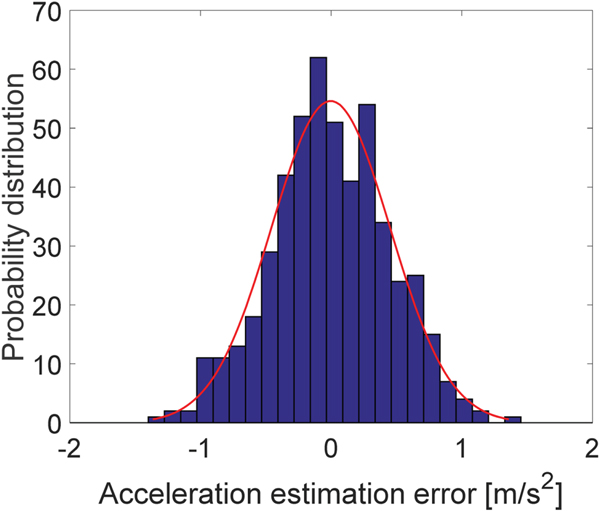
Further, in order to obtain the threshold value of manoeuvre detection, its statistical characteristics need to be considered. Figure 1 shows the probability distribution of the acceleration estimate given by Equation (9) in a non-manoeuvre simulation lasting 500 seconds. The red curve in Figure 1 is a fitted Gaussian distribution. It is shown that the probability distribution of acceleration estimate error is in good agreement with a Gaussian distribution. Therefore, the acceleration estimate error in a non-manoeuvre process can be approximated as a random error following the Gaussian distribution.
The probability distribution of acceleration estimation error in a non-manoeuvre process.

The maximum boundary of the acceleration estimate error in a non-manoeuvre process can be determined as the triple standard deviation as:
 $$\hat{{\bi d}}_{k-1}^\ast =\left[\matrix{3\sigma_{k-1\comma 1} & 3\sigma_{k-1\comma 2} & 3\sigma_{k-1\comma 3} }\right]^{\rm T} $$
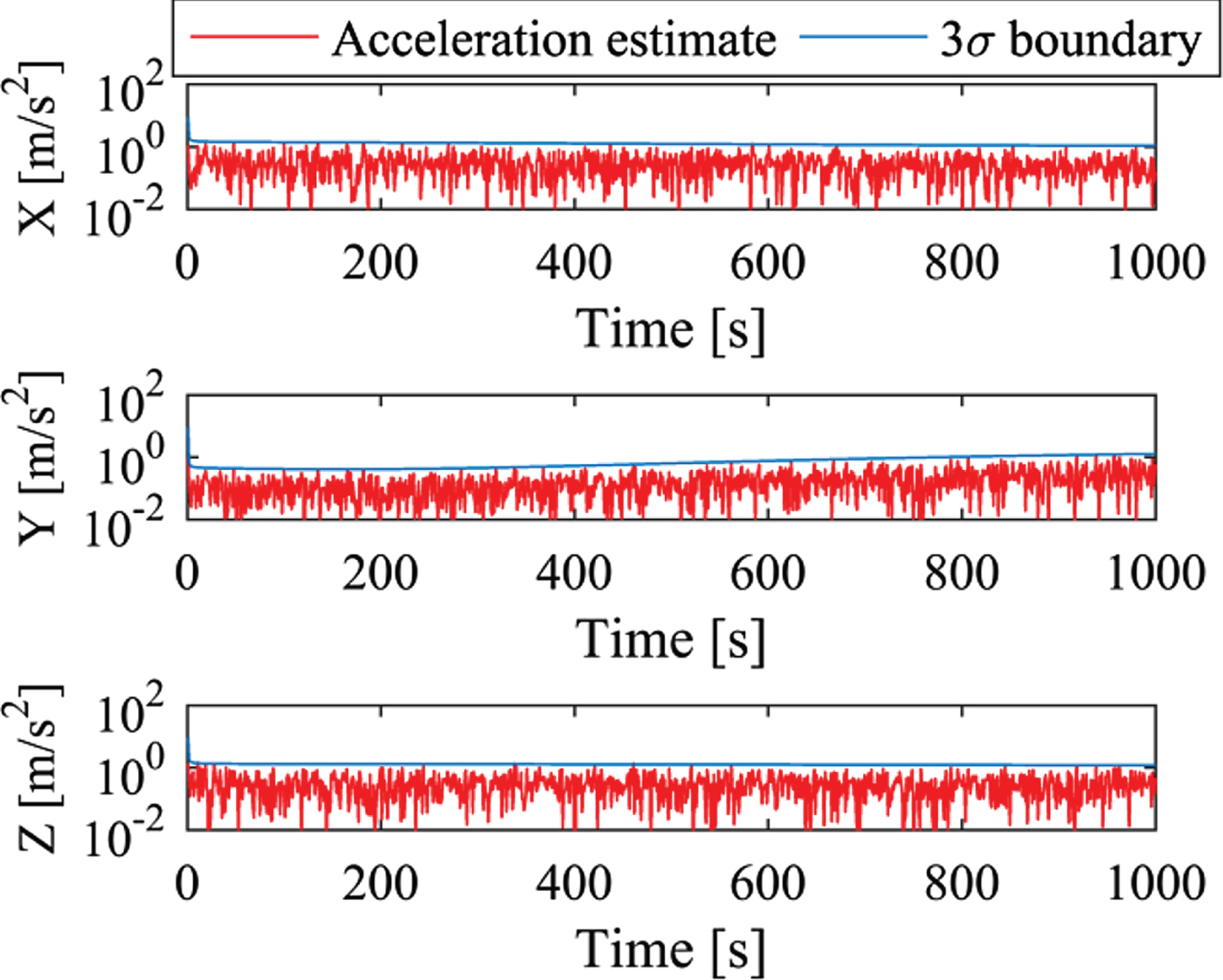
where  $\hat{{\bi d}}_{k-1}^{\ast}$ is the assumed maximum acceleration estimate error. Figure 2 shows the acceleration estimate error and the 3σ boundary in the non-manoeuvre process. It is shown that the 3σ boundary does represent the range that the acceleration estimation error can reach, indicating the validity of Equation (23).
The acceleration estimation and the 3σ boundary in three axes.

Substituting Equations (22) and (23) into Equation (20), the threshold value of the manoeuvre detection is presented as:
 $$MD_T =\sqrt {\lpar \hat{{\bi d}}_{k-1}^\ast \rpar ^{\rm T}\lpar E_{k-1}^\ast\rpar ^{-1}\hat{{\bi d}}_{k-1}^\ast } =3\sqrt 3 $$
MD T represents the largest value of the manoeuvre indicator MD k−1 during the non-manoeuvre process. If the value of MD k−1 is greater than MD T, it means that an unknown manoeuvre has occurred, causing the manoeuvre indicator to deviate from the original range. Therefore, the manoeuvre estimation of the proposed method can be adjusted as follows:
 $$\hat{{\bi d}}_{k-1} = \left\{\matrix{ {\bf 0}\comma \; \hfill & MD_{k-1} \le MD_T \cr \hat{{\bi d}}_{k-1} \comma \; & MD_{k-1} \gt MD_T }\right. $$
When the manoeuvre indicator MD k−1 is below the threshold MD T, a manoeuvre does not occur, thus the acceleration estimate  $\hat{{\bi d}}_{k-1}$ can be directly set to zero. Conversely, when the manoeuvre indicator MD k−1 exceeds the threshold MD T, the acceleration estimate remains the result of the IDE method proposed in Equation (9). With the detection and estimation of impulsive manoeuvres, the state estimation of the target can be proposed. When the manoeuvre is judged as not occurring, a classical EKF method is applied for state estimation. When the manoeuvre is detected as occurring, the state estimation provided by Equation (11) is taken for the manoeuvring target. With the combination of EKF and unbiased minimum-variance input and state estimation method, the manoeuvre tracking method proposed in this paper can provide a good estimation accuracy both in the non-manoeuvre and manoeuvre processes.
A brief summary of the proposed method is shown as follows:
At the k-th time step, for the given state estimation and the covariance at the previous time step  $\hat{{\bi x}}_{k-1\vert k-1}$ and P k−1, and the measurement data at the current time step yk:
1. Calculate the manoeuvre acceleration estimation of the previous time step
 $\hat{{\bi d}}_{k-1}$ according to Equation (9).
2. Calculate the manoeuvre indicator MD k−1 according to Equation (20).
3. Correct the acceleration estimation
$\hat{{\bi d}}_{k-1}$ based on the manoeuvre detection as proposed in Equation (25).4. Obtain the state estimation and the covariance at the current time step
$\hat{{\bi x}}_{k\vert k}$ and P k. If the manoeuvre is detected as not occurring at the previous step, calculate $\hat{{\bi x}}_{k\vert k}$ and P k by the EKF method. Otherwise, calculate them using Equations (8)~(11).


The computational expense of the proposed method also needs to be considered. If it is assumed that the number of impulsive manoeuvres is far less than the total number of intervals in the entire tracking process, which is quite natural in practice, the computational expense of the fourth step can be considered to be the same as for the EKF method. Therefore, the manoeuvre detection and estimation of the proposed method from the first step to the third step results in additional computational costs compared to the EKF method. Table 1 shows a comparison of the computational time for the EKF method, the ARUKF method and the proposed method over 1,000 time steps in the J2 model. It is shown that the EKF/IDE method has a higher computation time. The computation time of the EKF/IDE method is about 2·5 times that of the EKF method and 1·7 times that of the ARUKF method. However, the computation time of EKF/IDE method is still in the same order of magnitude as the EKF method, and it can meet the needs of real-time manoeuvre tracking.
The computation time comparison for EKF, ARUKF and proposed method

3.2.2. Covariance inflation for the unobserved impulsive manoeuvre
In the previous sections, the measurement data is assumed to exist throughout the entire tracking process. However, the target is not always observable in practice due to the constraints of the ground station. Assume that from the epoch k 1 to the epoch k 3, the target is not observed. Then the state estimation of the target can only be obtained by orbit extrapolation due to the lack of measurement data:
 $$\hat{{\bi x}}_{k_3 \vert k_3 } ={\brPhi}_{k_1 \comma k_3 } \hat{{\bi x}}_{k_1 \vert k_1 } $$
 $$P_{k_3 } ={\brPhi}_{k_1 \comma k_3 } P_{k_1 } {\brPhi}_{k_1 \comma k_3 }^{\rm T} $$
If the target does not manoeuvre in the unobserved arc, state estimation based on the orbit extrapolation is feasible, and the tracking performance of the proposed EKF/IDE method after the unobserved arc is still good. However, if the target manoeuvres during the unobserved arc, there will be a mismatch between the state estimation error and the covariance matrix. For example, assuming that an impulsive manoeuvre  ${\bi d}_{k_{2}}$ occurs at the epoch of k 2 during the unobserved arc, where k 1 < k 2 < k 3, the state estimation error at the end of the unobserved arc is:
 $$\hat{{\bi x}}_{k_3 \vert k_3 } -{\bi x}_{k_3 \vert k_3 } ={\brPhi}_{k_1 \comma k_3 } \lpar \hat{{\bi x}}_{k_1 \vert k_1 } -{\bi x}_{k_1 \vert k_1 } \rpar -{\brPhi}_{k_2 +1\comma k_3 } G_{k_2 }{\bi d}_{k_2 } $$
Therefore, there is a mismatch between the state estimation error and the nominal covariance matrix  $P_{k_{3} }$:
 $${\rm E}\lsqb \lpar \hat{{\bi x}}_{k_3 \vert k_3 } -{\bi x}_{k_3 \vert k_3 }\rpar \lpar \hat{{\bi x}}_{k_3 \vert k_3 } -{\bi x}_{k_3 \vert k_3 } \rpar ^{\rm T}\rsqb -P_{k_3 } ={\brPhi}_{k_2 +1\comma k_3 }G_{k_2 } {\bi d}_{k_2 } {\bi d}_{k_2 }^{\rm T} G_{k_2 }^{\rm T} {\brPhi}_{k_2 +1\comma k_3}^{\rm T} $$
The mismatch will reduce the tracking performance of the proposed method and lead to the errors in manoeuvre detection after the unobserved arc. Thus, an approach of covariance inflation is proposed in this section to correct this mismatch.
At the epoch k 3 + 1, the unobserved arc ends and the measurement data  ${\bi y}_{k_{3} +1}$ is available for tracking. The approach of covariance inflation is applied at this time step as follows:
 $${\bf \varepsilon}_{k_3 +1} ={\bi y}_{k_3 +1} -H_{k_3 +1} {\brPhi}_{k_3 +1\comma k_3 } \hat{{\bi x}}_{k_3 \vert k_3} $$
 $$\gamma =\displaystyle{{tr\lpar {\bf \varepsilon}_{k_3 +1} {\bf \varepsilon}_{k_3 +1}^{\rm T} -\beta R_k\rpar }\over{tr\lpar H_{k_3 +1} \Phi_{k_3 +1\comma k_3 } P_{k_3 } \Phi_{k_3 +1\comma k_3 }^T H_{k_3+1}^{\rm T} \rpar }} $$
 $$P_{k_3} = \left\{\matrix{ P_{k_3}\comma \; & \gamma \lt 1 \cr \gamma P_{k_3} &\comma \; \gamma \gt 1 }\right. $$
γ in Equation (30) represents the covariance inflation factor.  ${\bf \varepsilon}_{k_{3} +1}$ is the measurement residual of the orbit prediction and R k is the variance matrix of the measurement error. β is the softening factor to eliminate the interference of the measurement error. In Equation (30), the numerator shows the covariance matrix of the actual measurement residual and the denominator shows the nominal variance of the measurement residual based on orbit extrapolation. Therefore, γ shows the ratio of the actual measurement residual to the nominal covariance. If the ratio is greater than one, it indicates that there is a mismatch between the state estimation error and the covariance matrix at epoch k 3. The covariance matrix is scaled by the factor γ, and can then be used in the state estimation proposed in the previous section. With the inflation of the covariance, the mismatch caused by the unobserved manoeuvre is tolerated, and the tracking performance of the proposed method after the unobserved arc is improved, as demonstrated by the simulations in the next section.
4. SIMULATIONS AND VALIDATION
To illustrate the feasibility of the proposed method, several simulations are presented in this section. In the simulations. the initial true position and velocity of the satellite are [−5,726·21, −3,472·06, 1,156·51] km and [−1·6, 0·15, −7·49] km/s. The initial state estimation errors are [1, 1, 1] km for the position and [1, 1, 1] m/s for the velocity. The standard deviations of the range and the range-rate measurement error are 10 m and 0.1 m/s. The tracking process lasts for 1,000 s in cases 1 to 5 and lasts for 2,000 s in case 6. The measurement sampling step is 1 s. It is assumed that the manoeuvring target has been identified and the tracking association has been done properly. The results of the adaptively robust unscented Kalman filter (ARUKF) method proposed by Wang et al. (Reference Wang, Sun and Li2014) are presented for reference.
In cases 1, 2 and 3, the single impulsive manoeuvre situation is demonstrated. The impulsive manoeuvre occurs at epoch 500 s. The characteristic velocities of the manoeuvres are 100 m/s, 10 m/s and 1 m/s, respectively, in those three cases, and the manoeuvre vectors are along the direction of the satellite's velocity.
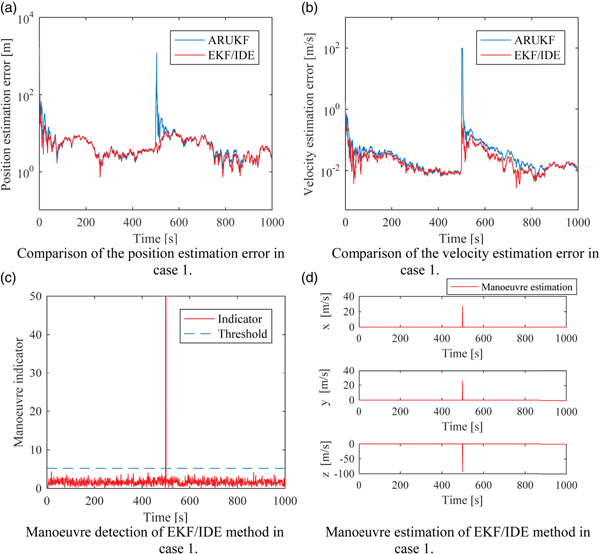
Figure 3 illustrates a comparison between the proposed EKF/IDE method and the ARUKF method in case 1. Figures 3(a) and 3(b) show the position and velocity estimation errors of the methods. Figure 3(c) shows the manoeuvre indicator proposed in Equation (20), and Figure 3(d) shows the manoeuvre estimation provided by the proposed EKF/ IDE method. In Figures 3(a) and 3(b), it can be seen that the proposed EKF/IDE method has almost the same tracking performance as the ARUKF method. After the manoeuvring instance, the EKF/IDE method maintains the accuracy of the position estimation, and the velocity estimation error shows a small jump. The state estimation error of the ARUKF method shows a huge increase at the manoeuvre moment. The largest position and velocity estimation errors of the ARUKF method are 1,200 m and 100 m/s, while the largest estimation error of EKF/IDE method is 12 m and 0·5 m/s after the manoeuvre. However, the state estimation error of the ARUKF method decreases rapidly in this case, and there is almost no difference between the results of these two methods after 550 s. Figure 3(c) shows that the manoeuvre indicator of the EKF/IDE method is always below the threshold during the non-manoeuvre arc and it is beyond the threshold at 500 s which is exactly the moment of occurrence of the impulsive manoeuvre. At this moment, the value of the manoeuvre indicator is about 300 which is much larger than the threshold, and this indicates the occurrence of the impulsive manoeuvre. As shown in Figure 3(d), the proposed EKF/IDE method provides an estimation of the impulsive manoeuvre which is not provided by the ARUKF method.
Tracking performance of EKF/IDE and ARUKF in case 1.

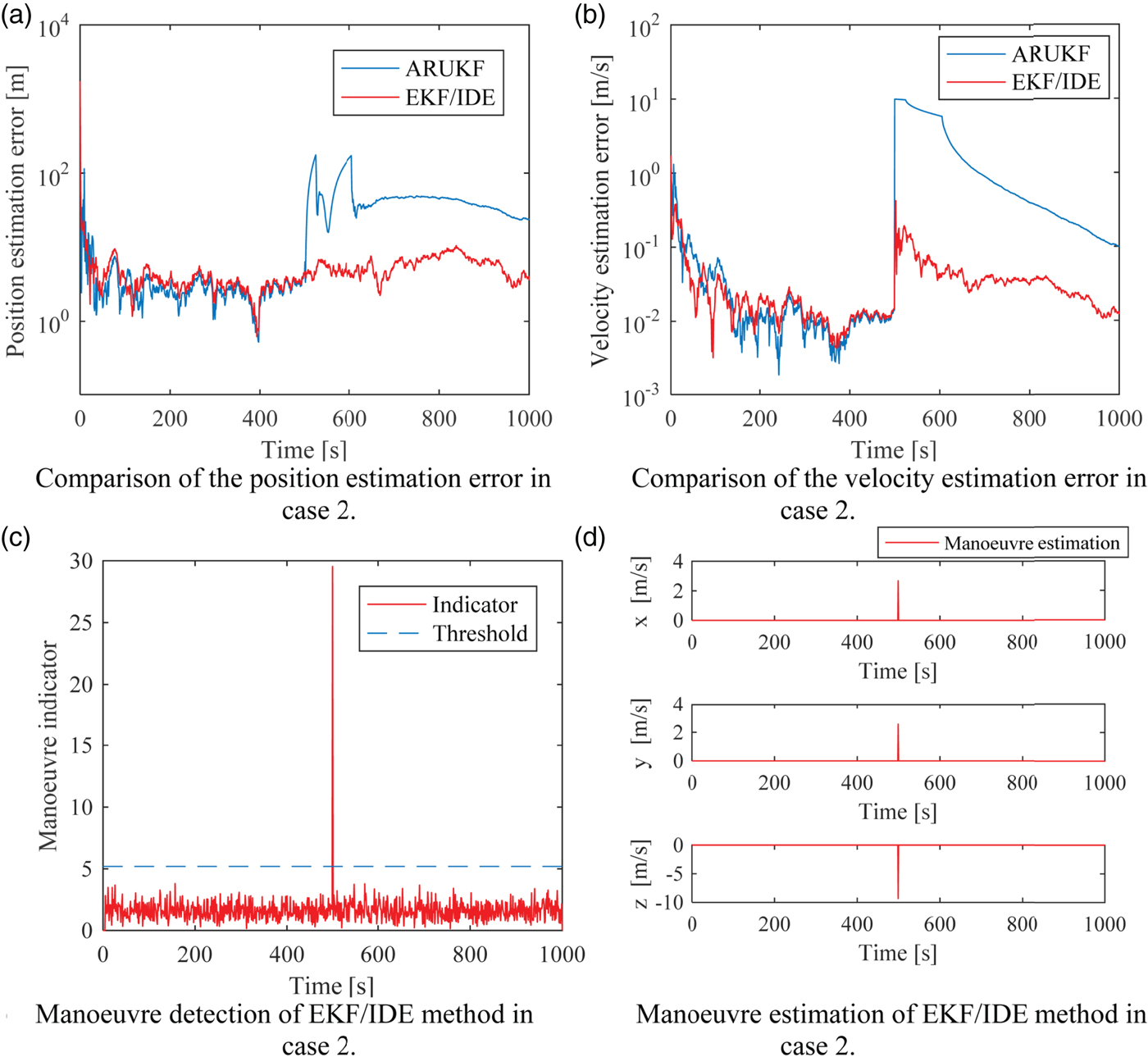
A characteristic velocity of 100 m/s is applied in case 1. In this condition, the advantage of the EKF/IDE method compared to the ARUKF method is not obvious. Therefore, the smaller characteristic velocities are applied in cases 2 and 3. The results are illustrated in Figures 4 and 5.
Estimation performance of EKF/IDE and ARUKF in case 2.

Estimation performance of EKF/IDE and ARUKF in case 3.

In case 2, the characteristic velocity of the manoeuvre is 10 m/s. The largest position and velocity estimation errors of ARUKF method are 175 m and 10 m/s, while the largest estimation errors of EKF/IDE method are 10 m and 0·4 m/s. The proposed EKF/IDE method has a better performance than the ARUKF method from the occurrence of the manoeuvre to the end of the tracking process, which is shown in Figures 4(a) and 4(b). The impulsive manoeuvre is also detected and determined accurately as shown in Figures 4(c) and 4(d).
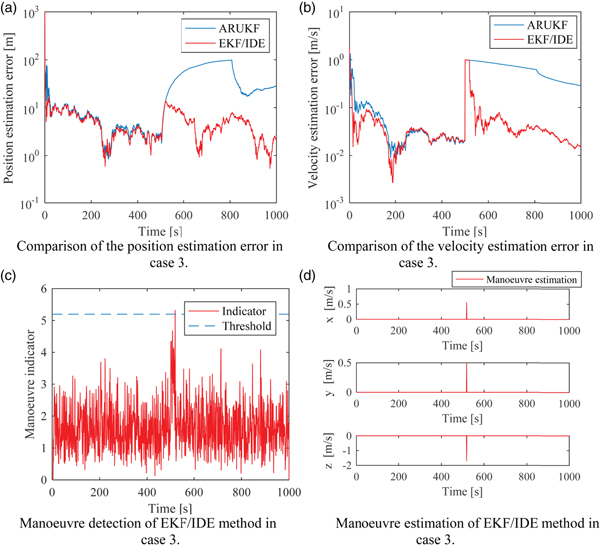
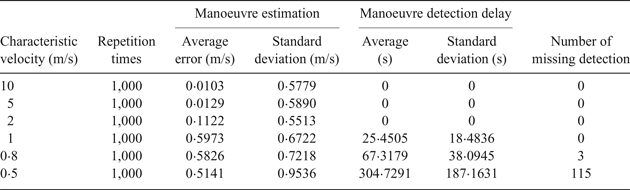
In case 3, the characteristic velocity of the impulsive manoeuvre is 1 m/s. It is shown in Figures 5(a) and 5(b) that the largest position and velocity estimation errors of the ARUKF method are 100 m and 1 m/s while the largest errors of EKF/IDE method are 18·7 m and 1 m/s during the tracking process. The ARUKF method has a large state estimation error from the occurrence of the impulsive manoeuvre, and the convergence speed of the ARUKF method is quite slow. The proposed EKF/IDE method shows a better state estimation result and a faster convergence speed than the ARUKF method. With the decrease of the characteristic velocity of the manoeuvre, the difficulty of manoeuvre detection increases. The ARUKF method detects the impulsive manoeuvre at 848 s, which means the manoeuvre detection delay of the ARUKF method is 348 s in this situation. Meanwhile, the manoeuvre detection delay of EKF/IDE method is 18 s as shown in Figures 5(c) and 5(d), which shows the better manoeuvre detection ability of the proposed EKF/IDE method. It should be noted that the maximum value of the manoeuvre indicator during the whole tracking process is just slightly larger than the threshold value, as shown in Figure 5(c). This shows that a single impulsive manoeuvre with a characteristic velocity smaller than 1 m/s is quite difficult to detect accurately by the proposed EKF/IDE method with the given measurement error. A series of Monte Carlo experiments with different characteristic velocities are implemented to show the manoeuvre detection ability of the proposed method more clearly. The results are shown in Table 2.
Monte Carlo experiments of different characteristic velocities

In Table 2, six groups of Monte Carlo experiments are presented, and the characteristic velocities of the impulsive manoeuvre are set as 10, 5, 2, 1, 0·8 and 0·5 m/s respectively. With the decrease of the characteristic velocity, the average error and the standard deviation of the manoeuvre estimation and the detection delay increase. When the characteristic velocity is smaller than 1 m/s, the manoeuvre estimation has quite a large relative error, and the manoeuvre detection delay rises significantly, which shows that it is difficult to obtain an accurate estimation and detection of an impulsive manoeuvre by the proposed method under this situation. The rate of the missing detection is also a problem when the characteristic velocity is too small. As shown in Table 2, there are three instances of missing detections over 1,000 experiments when the characteristic velocity is 0·8 m/s, and the number of missing detections increases to 115 when the characteristic velocity is 0·5 m/s. This shows that manoeuvre detection easily fails when the characteristic velocity of the impulsive manoeuvre is smaller than a minimum limit of 0·5 m/s under the measurement noise level used in this paper.
In the first three cases, the situations of the single impulsive manoeuvre are tested. After that, the situations of the multiple impulsive manoeuvres are presented.
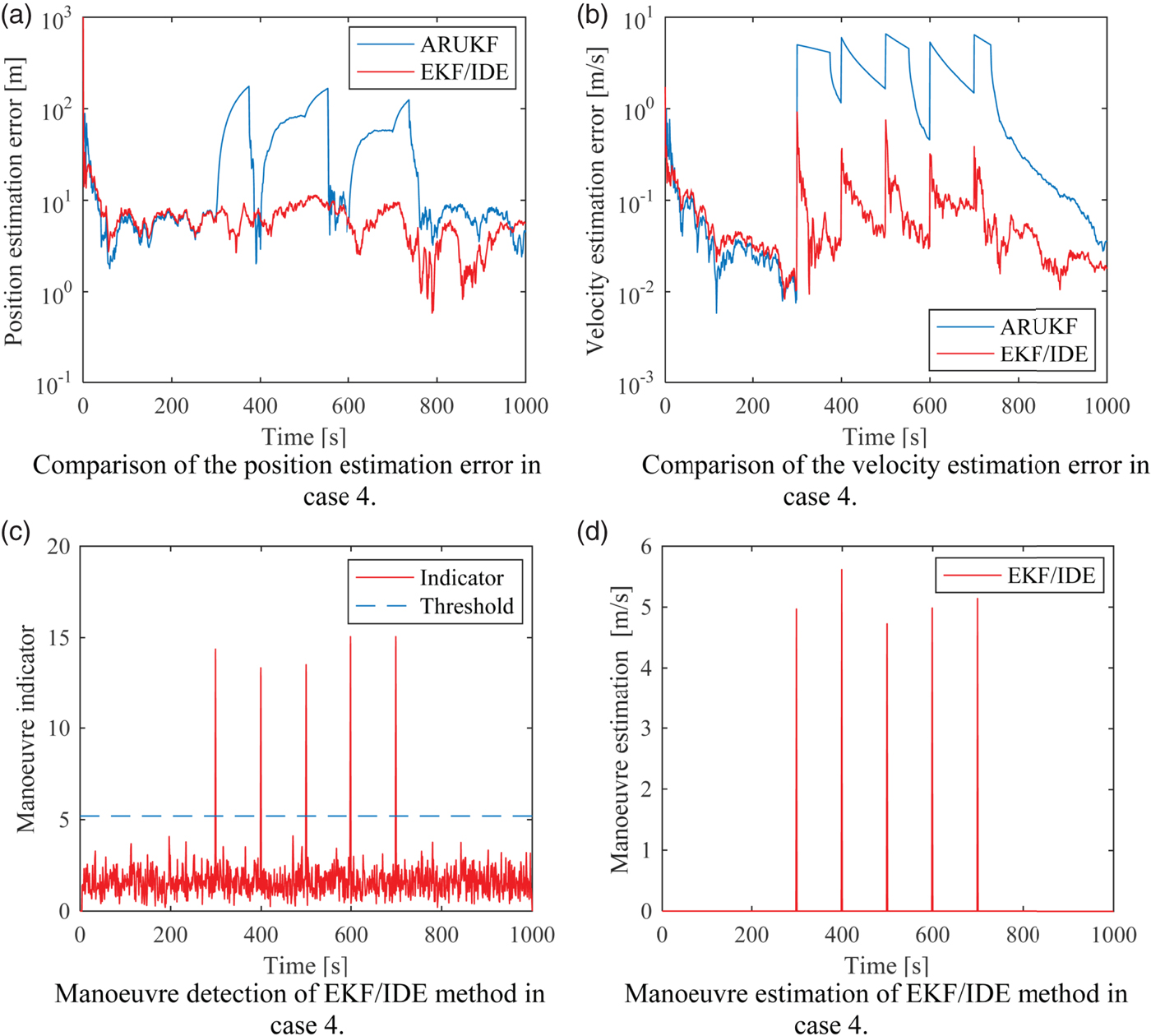
In case 4, five impulsive manoeuvres occur at 300, 400, 500, 600, 700 s, and the characteristic velocity of each manoeuvre is 5 m/s. Figure 6 demonstrates the tracking performance of the EKF/IDE method and the ARUKF method in this case. Figures 6(a) and 6(b) show that the proposed EKF/IDE method has a better tracking performance than the ARUKF method during the manoeuvre process. The position estimation error of the ARUKF method shows a significant fluctuation with a maximum value of 120 m, and the velocity estimation error of the ARUKF method keeps above 1 m/s until the end of the manoeuvre process, while the EKF/IDE method provides a stable tracking result with a smaller estimation error. Figure 6(c) shows the manoeuvre detection result of the EKF/IDE method with which five impulsive manoeuvres are detected accurately without detection delay. Figure 6(d) shows the manoeuvre estimation error of the EKF/IDE method. The manoeuvre estimation error is basically consistent with the result of the single impulsive manoeuvre situation as shown in Table 2.
Estimation result of EKF/IDE and ARUKF in case 4.

When the interval and the characteristic velocity of the impulsive manoeuvres are as large as we set in case 4, the estimation result of the EKF/IDE method is similar to a single manoeuvre situation because the proposed method can be fully convergent between two adjacent manoeuvres. Thus, the situation with a smaller interval and characteristic velocity is tested in the next simulation.
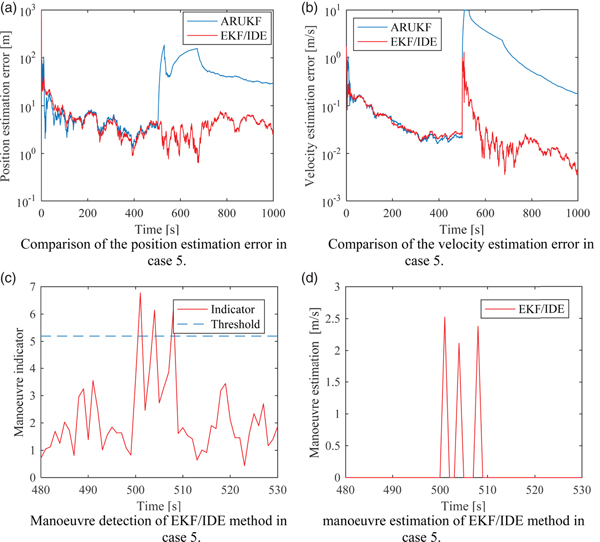
In case 5, there are ten impulsive manoeuvres in the period 500–509 s. The interval between two adjacent manoeuvres is 1 s and the characteristic velocity of each manoeuvre is 1 m/s. The sum of the manoeuvres is 10 m/s, which is similar to case 2. Thus, the state estimation result of EKF/IDE method in case 5 is similar to the result in case 2, as shown in Figures 7(a) and 7(b). However, the result of the manoeuvre estimation and detection shows some differences in case 5. Figures 7(c) and 7(d) demonstrate the manoeuvre detection and estimation result in case 5. There are ten impulsive manoeuvres during the whole tracking process, but only three manoeuvres were detected at 501, 504 and 508 s with estimated magnitudes of 2·5248 m/s, 2·1130 m/s and 2·3813 m/s. The last manoeuvre at 509 s was not detected because the velocity covariance at this moment was large enough to cover the measurement residual caused by this last manoeuvre. Although the manoeuvre estimations were not identical to the true manoeuvres, the proposed EKF/IDE method still provides state estimation with an acceptable precision, which shows its good manoeuvre tracking ability in this situation.
Estimation result of EKF/IDE and ARUKF in case 5.

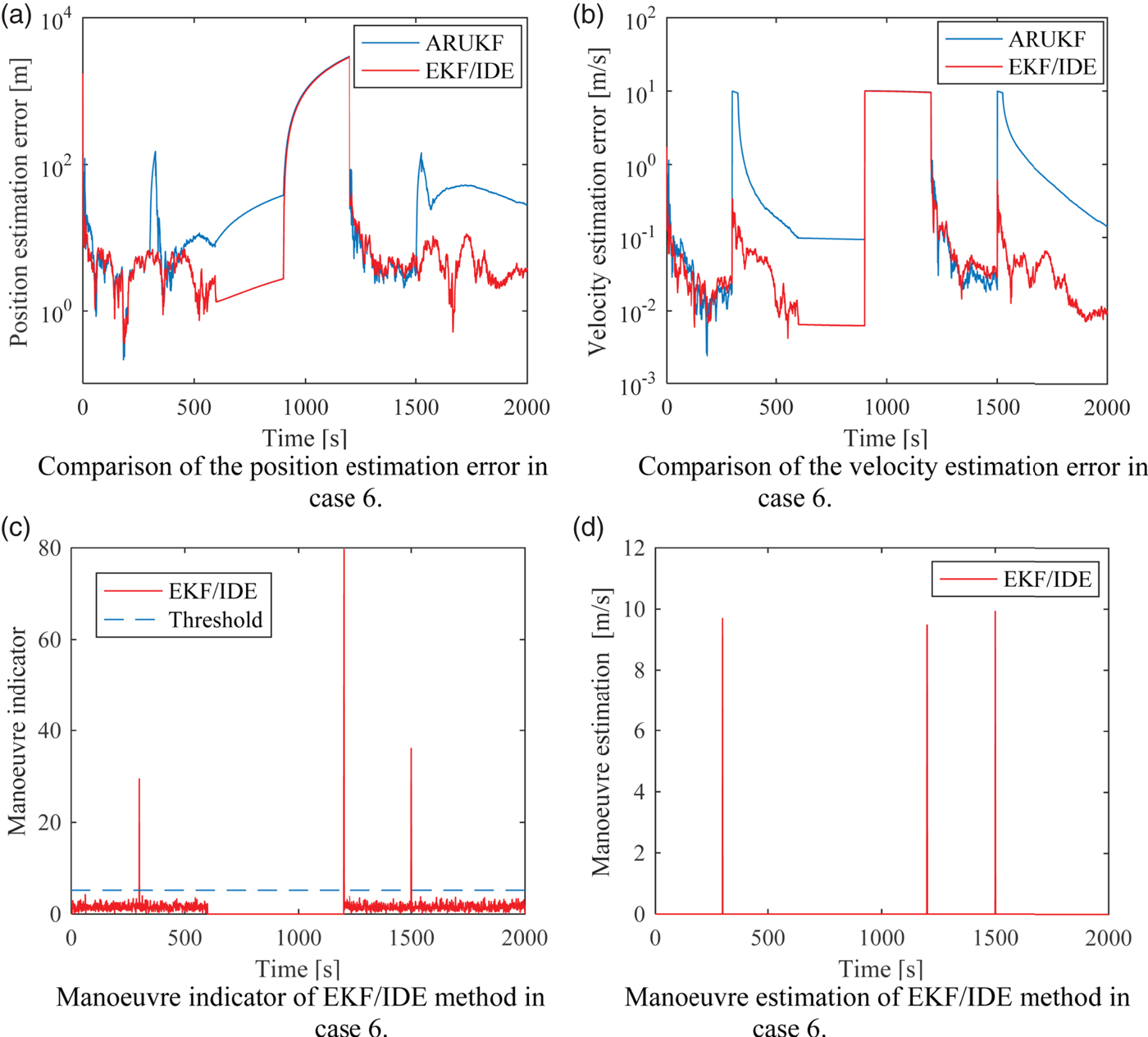
In cases 1 to 5, all the manoeuvres occur when the measurement is available, which is actually an ideal situation. Thus, in case 6, the manoeuvre is set to occur in an unobserved arc. The tracking process in case 6 lasted for 2,000 s, and the measurement data from 600 s to 1,200 s was not available. Three manoeuvres occurred at 300 s, 900 s and 1500 s, and the characteristic velocity of each manoeuvre was 10 m/s. Figure 8 demonstrates the result of this simulation. At 300 s and 1,500 s, the tracking performance of the proposed method was similar to case 2 because those two manoeuvres occurred when the measurement was available, as shown in Figures 8(a) and 8(b). However, the second manoeuvre occurred in an unobserved arc at 900 s. Therefore, the state estimation error of the proposed method increased rapidly from 900 s to 1,200 s because of the lack of the measurement. At 1,201 s, just after the end of the unobserved arc, a manoeuvre was detected by the proposed method, as shown in Figure 8(c). The manoeuvre estimation at this moment was close to 10 m/s, as shown in Figure 8(d), which indicates the manoeuvre in the unobserved arc. After this moment, the state estimation error of the proposed EKF/IDE method decreased rapidly, and the tracking process worked effectively. It should be noted that the manoeuvre estimation after the unobserved arc is not always close to the true unobserved manoeuvre. In case 6, the length of the unobserved arc was only 10 minutes. If the length was much longer than that, for example, 1 or 2 hours, the estimation accuracy of the unobserved manoeuvre will be influenced significantly because of the extrapolation of the state estimation error during the unobserved arc. However, the state estimation after the unobserved arc is always effective even in that type of situation, which relies on the proposed covariance inflating approach.
Estimation result of EKF/IDE and ARUKF in case 6.

Finally, in case 7, an orbit determination process based on actual measurement data was demonstrated to validate the proposed method. The tracking period started from 10:00:00 on 1 June 2016. The entire measurement period lasted 900 seconds and the measurement worked at a frequency of 10 Hz. The position of ground stations were: h 1 = 1·1 km, ϕ1 = 38 · 6°, λ1 = 87 · 2°; h 2 = 1.2 km, ϕ2 = 40 · 1°, λ2 = 98 · 2°; h 3 = 1·0 km, ϕ3 = 35 · 4°, λ3 = 97 · 6°, where h i, ϕ i, λi are the height, latitude and longitude of the i-th ground station respectively. The covariance matrix of measurement noise was set as: R = diag[(10 m) 2, (10 m) 2, (10 m) 2, (0 · 1 m/s) 2, (0 · 1 m/s) 2, (0 · 1 m/s) 2]. In this actual measurement case, unlike in the previous simulation cases, due to the lack of actual position and velocity data of the target, the measurement residual Δ y was used to verify the accuracy of the estimation:
 $$\Delta {\bi y}_k ={\bi y}_k -h\lpar \hat{{\bi x}}_k \comma \; t_k\rpar $$
where yk is the actual measurement, and  $h\lpar \hat{{\bi x}}_{k} \comma \; t_{k} \rpar $ is the nominal measurement obtained from the state estimation
 $\hat{{\bi x}}_{k}$. When the measurement residual remains within triple standard deviation of the measurement error, the state estimation can be considered to be accurate. If the measurement residual exceeds triple the standard deviation of the measurement error, it indicates that the state estimation deviates from the actual value.
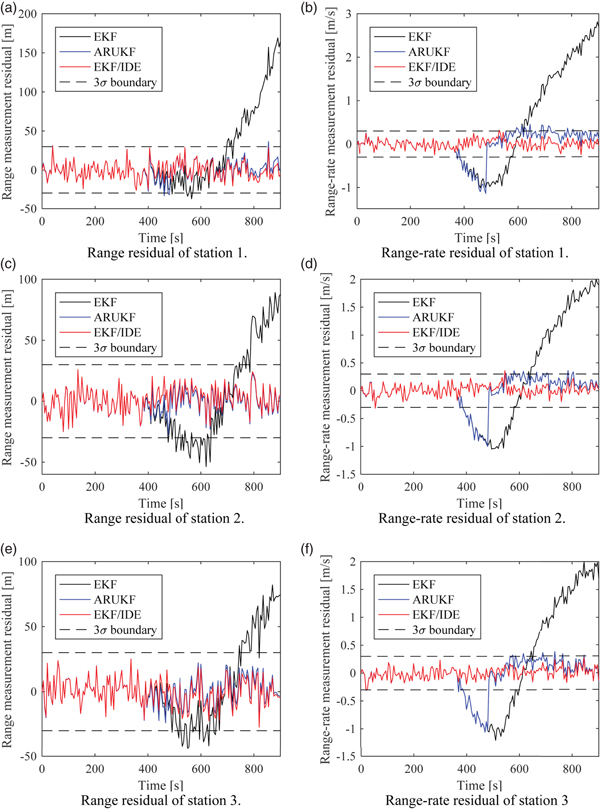
Figure 9 shows measurement residuals of the EKF, ARUKF and proposed EKF/IDE methods. In order to make the image more concise and show the trend of measurement residuals with time more clearly, the sampling interval of measurement residuals in Figure 9 is set as 5 seconds.
Measurement residuals of EKF, ARUKF and EKF/IDE in case 7.

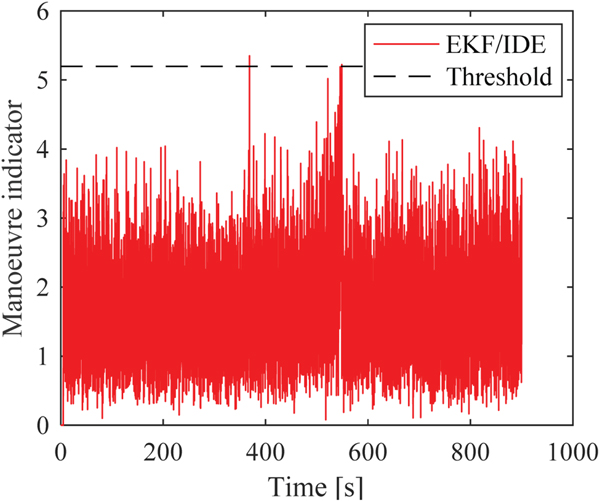
In Figure 9, The residuals of EKF and ARUKF exceeded the 3σ boundary at 385 s, which indicates that an unknown manoeuvre occurred. The residuals of the EKF method continued to increase, indicating that its filtering diverged. At 480 s, the ARUKF method detected the manoeuvre and inflated the covariance, therefore its measurement residuals stopped growing. However, it can be observed in Figures 9(b), 9(d) and 9(f) that the range-rate measurement residuals of the ARUKF method did not return to near zero, but remained at a higher value, and still exceeded the 3σ boundary many times from 600 s to the end of the tracking process. This indicates that the ARUKF method has a long manoeuvre detection delay and takes a long time to re-converge the filter after detecting the manoeuvre. The proposed EKF/IDE method has good robustness against unknown manoeuvres, as shown in Figure 9. The measurement residuals of the proposed method were well maintained within the 3σ boundary throughout the entire tracking process, except for a few points, which were caused by measurement errors of more than three standard deviations. Figure 10 shows the manoeuvre indicator of the proposed EKF/IDE method. The manoeuvre indicator exceeded the threshold for the first time at 368·7 s, indicating the unknown manoeuvre, while the ARUKF method detected it at about 480 s. Then the manoeuvre indicator again exceeded the threshold at 548·8 s, which was caused by the unknown thrust during the period from 368·7 s to 548·8 s. Then, the indicator remained below the threshold due to the end of the manoeuvre. Overall, the proposed EKF/IDE method demonstrates its feasibility and validity in this example with real measurement data. The manoeuvre detection delay was lower than that of the ARUKF method, and the state estimation accuracy during and after the manoeuvres was also better.
Manoeuvre indicator of the EKF/IDE method.

5. CONCLUSION
In this paper, an adaptive extended Kalman filter with input detection and estimation is proposed for tracking a manoeuvring satellite. With the combination of EKF and IDE methods, the proposed method provides a good tracking performance both in the manoeuvre process and the no-manoeuvre process. Several simulations are presented in this paper. The proposed EKF/IDE method was compared with the ARUKF method to show its feasibility. When the characteristic velocity of the impulsive manoeuvre is large, the tracking performances of these two methods were similar. However, the proposed EKF/IDE method outperformed the ARUKF method when the manoeuvre was small, for example, smaller than 10 m/s. In the case of small impulsive manoeuvres, the proposed EKF/IDE method has better manoeuvre detection capability and smaller state estimate error after manoeuvring compared with the ARUKF method. Also, the EKF/IDE method provides the manoeuvre estimation sequentially, while the ARUKF method cannot provide the manoeuvre estimation directly. A series of Monte Carlo experiments are presented to show the performance of the proposed method in different situations. The minimum manoeuvre detection limit under the given measurement error is presented by the simulations. Multiple-impulsive-manoeuvre situations are also demonstrated in the simulations. The measurement gap is also considered. With the covariance inflating approach, the proposed method maintains a good tracking performance when the unobserved impulsive manoeuvre occurs during a measurement gap. Finally, a numerical experiment based on real measurement data is presented to validate the proposed method. In this real-world scenario, the proposed EKF/IDE method exhibits good robustness and sensitive detection capability for real unknown manoeuvres.
It should be noted that the proposed EKF/IDE method still has some drawbacks. First, the method has additional measurement constraints compared with the classical Kalman filter as shown in Section {3.2.1}. The measurement burden may limit the practical application of this method. Second, as can be observed in Table 2, when the impulsive manoeuvre is smaller than 1 m/s, the manoeuvre detection and estimation of the proposed EKF/IDE method is not quite accurate. When the impulsive manoeuvre is smaller than 0·5 m/s, there may even be a case of missing detections, which will lead to degradation of state estimation accuracy. This study only considers the situation of impulsive manoeuvre. The applicability of the proposed EKF/IDE method to the continuous thrust problem needs to be improved. These issues still require further research and will be the topics of our future work.
ACKNOWLEDGEMENTS
This research is supported by The National Science Fund for Distinguished Young Scholars of China (No. 11525208) and the Opening Foundation of State Key Laboratory of Astronautic Dynamics.