Introduction
During the last few decades, a wide variety of research fields, including sociology, psychology, economics and political science, have paid considerable attention to subjective well-being (SWB). SWB is defined as ‘people’s positive evaluations of their lives’ (Diener and Seligman, Reference Diener and Seligman2004: 1) and, in practice, is frequently assessed by questions related to life satisfaction and happiness (Glatz and Eder, Reference Glatz and Eder2020; Helliwell et al., Reference Helliwell, Huang, Wang and Uslaner2018). Based on these measures, a great deal of research has sought to determine the vital factor of SWB. According to Rodríguez-Pose and von Berlepsch (Reference Rodríguez-Pose and von Berlepsch2014), well-being research has contributed one of the key recent developments shaping current social sciences.
On this issue, recent studies have shown growing interest in social capital as a crucial determinant of SWB because the concept of social capital has brought about another key recent development influencing current social science research (Rodríguez-Pose and von Berlepsch, Reference Rodríguez-Pose and von Berlepsch2014). Putnam defined social capital as ‘social networks and the norms of reciprocity and trustworthiness that arise from them’ (Putnam, Reference Putnam2000: 19). Building on this definition, by focusing on social trust, formal social contact, and informal social contact, many researchers have demonstrated a robust positive association between social capital and SWB in various countries (Glatz and Eder, Reference Glatz and Eder2020; Helliwell and Putnam, Reference Helliwell and Putnam2004; Rodríguez-Pose and von Berlepsch, Reference Rodríguez-Pose and von Berlepsch2014).
Although previous studies have enhanced our understanding of the roles of social capital in SWB, it remains unclear how the association between social capital and SWB varies depending on macro country characteristics. This issue warrants more discussion with a focus on welfare provisions for the following reasons. First, since Esping-Andersen’s (Reference Esping-Andersen1990, Reference Esping-Andersen1999) ground-breaking works, the consequences of welfare policies for several outcomes, including social capital and SWB, have become a major concern in international comparative research (Flavin et al., Reference Flavin, Pacek and Radcliff2014; Radcliff, Reference Radcliff2013; Rostila, Reference Rostila2013). In particular, with a focus on the crowding-out perspective and the crowding-in perspective, prior publications have repeatedly examined the main effect of welfare spending on social capital (Brewer et al., Reference Brewer, Oh and Sharma2014; Rostila, Reference Rostila2013; van Oorschot and Arts, Reference van Oorschot and Arts2005). Second, after the worldwide recession that began in 2008, the issue of whether national governments should consider reducing social welfare and government spending gained renewed importance (Reeskens and van Oorschot, Reference Reeskens and van Oorschot2014). To make better decisions on this issue, the actual impact of ‘welfare retrenchment’ and ‘welfare increase’ on the meanings and roles of social capital needs to be clarified because social capital is regarded as the cornerstone of our everyday lives (Bourdieu, Reference Bourdieu and Richardson1986; Coleman, Reference Coleman1988).
Against this backdrop, this paper applies the classic arguments in welfare policy research, such as the crowding-out argument (which suggests that welfare policy erodes social capital among citizens) and the crowding-in argument (which insists that welfare policy enriches social capital among citizens), to shift attention from the main effects to cross-level interactions to explore the moderation effects of welfare provisions on the impacts of social capital on SWB (van Oorschot and Arts, Reference van Oorschot and Arts2005; Rostila, Reference Rostila2013). This approach widens the scope of the research on social capital and SWB. Additionally, this analysis also contributes to broadening the scope of the research on welfare policies by identifying new consequences of welfare spending. Adopting pooled data from nine waves of the European Social Survey (ESS) and a two-way fixed-effects model, the present study evaluates the cross-level interaction effects of welfare spending and of the three dimensions of social capital, including social trust, formal social contact, and informal social contact, on SWB.
An overview of social capital and SWB
To date, social capital has been widely regarded as one of the key determinants of SWB (Helliwell et al., Reference Helliwell, Huang, Wang and Uslaner2018; Helliwell and Putnam, Reference Helliwell and Putnam2004; Rodríguez-Pose and von Berlepsch, Reference Rodríguez-Pose and von Berlepsch2014). Although the concepts of social integration and solidarity have their origin in the classic works of sociology (Durkheim, [1893] Reference Durkheim1964; Tönnies, [1887] Reference Tönnies1957), two sociologists, Bourdieu (Reference Bourdieu and Richardson1986) and Coleman (Reference Coleman1988), reintroduced these concepts as social capital in the context of modern sociology (Rostila, Reference Rostila2013). Moreover, prominent works by Putnam, a political scientist, have raised interest in social capital among scholars in various research fields, and a host of studies have adopted this concept to examine the impact on a broad range of outcomes, including SWB (Helliwell et al., Reference Helliwell, Huang, Wang and Uslaner2018; Putnam, Reference Putnam1993, Reference Putnam2000; Rostila, Reference Rostila2013).
In research exploring its impacts on several outcomes, social capital has been repeatedly divided into two components: cognitive and structural social capital (Akaeda, Reference Akaeda2021; Kroll, Reference Kroll2008; Rostila, Reference Rostila2013). Cognitive social capital is related to ‘people’s perceptions of interpersonal trust, solidarity and reciprocity’ (Rostila, Reference Rostila2013: 24). In particular, numerous studies on social capital have emphasised that social trust is a crucial and the most commonly examined aspect of cognitive social capital related to SWB (Neira et al., Reference Neira, Lacalle-Calderon, Portela and Perez-Trujillo2018; Rodríguez-Pose and von Berlepsch, Reference Rodríguez-Pose and von Berlepsch2014). In the literature on SWB, many researchers have suggested that social trust has a positive impact on people’s SWB because trustful people are likely to think that other citizens will give a helping hand when needed, and they therefore have less fear about the future and higher levels of SWB than those who distrust others (Glatz and Eder, Reference Glatz and Eder2020; Helliwell et al., Reference Helliwell, Huang, Wang and Uslaner2018).
Based on these discussions, a great deal of research has been conducted in various countries, with the results showing that social trust improves happiness and life satisfaction in North American countries and European countries (Helliwell and Wang, Reference Helliwell and Wang2011; Helliwell and Putnam, Reference Helliwell and Putnam2004). For instance, by analysing the data from the Social Capital Benchmark Survey in the United States and from the Canadian Equality, Security and Community survey, Helliwell and Putnam (Reference Helliwell and Putnam2004) reported the positive effect of social trust on SWB. In addition, more recent studies have also focused on the international comparative analysis of many countries and revealed that social trust generally improves SWB in European countries (Glatz and Eder, Reference Glatz and Eder2020; Neira et al., Reference Neira, Lacalle-Calderon, Portela and Perez-Trujillo2018; Rodríguez-Pose and von Berlepsch, Reference Rodríguez-Pose and von Berlepsch2014) and countries around the world (Helliwell et al., Reference Helliwell, Huang, Wang and Uslaner2018; Helliwell and Putnam, Reference Helliwell and Putnam2004). In particular, Rodríguez-Pose and von Berlepsch (Reference Rodríguez-Pose and von Berlepsch2014) compared the association between social trust and SWB among the North, South, East, and West regions of Europe and found that social trust has a positive impact on SWB, but this impact is stronger in North Europe than in South Europe.
In addition to the cognitive component represented by social trust, the structural component has also been treated as another important dimension of social capital (Kroll, Reference Kroll2008; Rostila, Reference Rostila2013). According to previous studies, structural social capital is defined as ‘the extent and intensity of participation in associations and other forms of social activity’ (Rostila, Reference Rostila2013: 24). Based on this definition, previous literature has noted that the structural component of social capital has two dimensions: formal social capital and informal social capital (Pichler and Wallace, Reference Pichler and Wallace2007; Rostila, Reference Rostila2013). In regard to the former, formal social capital pertains to formal social contact through civic and political participation in formally composed organisations and activities (Pichler and Wallace, Reference Pichler and Wallace2007; Rostila, Reference Rostila2013). Notably, Putnam (Reference Putnam1993, Reference Putnam2000) has shed light on this aspect of social capital because civic and political participation are vital for democracy and society to advance (Gesthuizen et al., Reference Gesthuizen, van der Meer and Scheepers2008; Pichler and Wallace, Reference Pichler and Wallace2007). From the perspective of formal social capital, prior publications on SWB have suggested that formal social contact promotes SWB for the following reasons. First, by participating in civic and political activities, citizens are likely to feel integrated into society and to experience social embeddedness. Consequently, formal social contact may improve SWB (Helliwell and Putnam, Reference Helliwell and Putnam2004; Rodríguez-Pose and von Berlepsch, Reference Rodríguez-Pose and von Berlepsch2014). Second, formal social contact is supposed to increase feelings of political and civic effectiveness, self-efficacy, and SWB (Neira et al., Reference Neira, Lacalle-Calderon, Portela and Perez-Trujillo2018; Stutzer and Frey, Reference Stutzer and Frey2006). Third, by taking part in civic and political activities, people may obtain social support and material resources (Rodríguez-Pose and von Berlepsch, Reference Rodríguez-Pose and von Berlepsch2014; Rostila, Reference Rostila2013).
With these discussions in mind, previous studies have also examined the association between formal social contact and SWB among countries in North America and Europe (Helliwell and Wang, Reference Helliwell and Wang2011; Helliwell and Putnam, Reference Helliwell and Putnam2004). Moreover, recent international comparative analyses of many countries have also reported that formal social contact enhances SWB in European countries (Neira et al., Reference Neira, Lacalle-Calderon, Portela and Perez-Trujillo2018; Rodríguez-Pose and von Berlepsch, Reference Rodríguez-Pose and von Berlepsch2014) and in countries around the world (Helliwell and Putnam, Reference Helliwell and Putnam2004). For example, based on analysis of the data from the ESS, Rodríguez-Pose and von Berlepsch (Reference Rodríguez-Pose and von Berlepsch2014) pointed out that formal social contact has a stronger positive impact on SWB in West Europe than in other regions in Europe.
On the other hand, the second aspect of structural social capital – informal social capital – is germane to informal social contact with family, friends, colleagues, and neighbours (Gesthuizen et al., Reference Gesthuizen, van der Meer and Scheepers2008; Rostila, Reference Rostila2013). By contrast to formal social capital, discussions of informal social capital stem from sociological research, such as that by Bourdieu (Reference Bourdieu and Richardson1986) and Coleman (Reference Coleman1988), and from studies of social network theories with a focus on affective ties (Lin et al., Reference Lin, Cook and Burt2001; Pichler and Wallace, Reference Pichler and Wallace2007). Previous studies have suggested that informal social contact with family, friends, colleagues, and neighbours has a positive impact on SWB through the following mechanisms. First, citizens with higher informal social contact tend to have a stronger sense of social embeddedness and belonging in society and therefore higher SWB than those with lower informal social contact (Rodríguez-Pose and von Berlepsch, Reference Rodríguez-Pose and von Berlepsch2014). Second, citizens with higher informal social contact tend to receive more material and emotional support from family, friends, colleagues, and neighbours. As a result, people with higher informal social contact ‘are less likely to experience sadness, loneliness, low self-esteem and problems with eating and sleeping’ (Helliwell and Putnam, Reference Helliwell and Putnam2004: 1437) and therefore have higher SWB than those with lower informal social contact.
Building upon these discussions, prior publications have empirically explored the effect of informal social contact on SWB. Specifically, previous research has clarified that citizens with frequent contact with family and friends tend to report higher assessments of SWB than those with infrequent contact with family and friends in North American countries, such as the United States and Canada, and European countries, such as Germany and the United Kingdom (Helliwell and Wang, Reference Helliwell and Wang2011; Helliwell and Putnam, Reference Helliwell and Putnam2004; Powdthavee, Reference Powdthavee2008). For instance, based on analysis of the data from the British Household Panel Survey, Powdthavee (Reference Powdthavee2008) made clear that meeting frequently with friends and relatives increases SWB and that this impact is larger than the impact of contact with neighbours on SWB. In addition, by adopting data from the ESS, more recent publications have shown a strong positive effect of informal social contact with friends, relatives, and colleagues on SWB among European countries (Neira et al., Reference Neira, Lacalle-Calderon, Portela and Perez-Trujillo2018; Rodríguez-Pose and von Berlepsch, Reference Rodríguez-Pose and von Berlepsch2014).
To summarise, previous studies on social capital and SWB have attested that social capital, including social trust, formal social contact, and informal social contact, is an important source of SWB, while some studies have suggested that the effect of social capital on SWB may vary depending on the macro country context. Although previous studies have contributed to an understanding of the association between social capital and SWB, they had several limitations. First, while previous studies focused primarily on the main effect of social capital on SWB, the question of how the association between social capital and SWB varies depending on macro country characteristics has remained largely untouched (Reeskens and Vandecasteele, Reference Reeskens and Vandecasteele2017). Second, except for some recent studies with a focus on social trust (Glatz and Eder, Reference Glatz and Eder2020), little research has adopted data from international comparative surveys with multiple waves to examine the effect of social capital on SWB.
Moderation effect of welfare provisions: Theory and hypotheses
To go beyond the limitations of previous studies, this study adopts international comparative data with multiple waves to explore the question of how macro country characteristics affect the impact of social capital on SWB. Regarding this issue, the present study sheds light on welfare provisions as a moderator because, in international comparative research, interest in the impact of welfare policies on social capital and SWB has remained high over the last few decades across several fields (Fisher Reference Fisher2022; Flavin et al., Reference Flavin, Pacek and Radcliff2014; Pichler and Wallace, Reference Pichler and Wallace2007; Radcliff, Reference Radcliff2013; Rostila, Reference Rostila2013). In this body of research, it is widely acknowledged that the classic question of whether the welfare state crowds out or crowds in social capital is a crucial issue (Brewer et al., Reference Brewer, Oh and Sharma2014; Kääriäinen and Lehtonen, Reference Kääriäinen and Lehtonen2006; van Oorschot and Arts, Reference van Oorschot and Arts2005). Hence, the present study applies two well-known arguments, the crowding-out and crowding-in perspectives, to the discussion of the moderation effect of welfare spending on the association between social capital and SWB.
The first perspective – the crowding-out argument – suggests that welfare provisions and policies are the ‘moral risk’ of diminishing social capital because by providing material resources and services, welfare spending takes over the role of safety net from social capital and decreases the incentive for citizens to connect with and help each other (van der Meer et al., Reference van der Meer, Scheepers and te Grotenhuis2009; van Oorschot and Arts, Reference van Oorschot and Arts2005; Wolfe, Reference Wolfe1989). As a result, welfare policies may crowd out community and social capital (Janowitz, Reference Janowitz1976; Rostila, Reference Rostila2013; Scheepers et al., Reference Scheepers, Grotenhuis and Gelissen2002). For example, Coleman (Reference Coleman and Garfinkel1982) considered the association between welfare policies and social cohesion and hypothesised that ‘people use economic gains [from welfare provisions] to escape from the bonds of mutual help…into more isolated situations that may be less psychologically healthy’ (Coleman, Reference Coleman and Garfinkel1982: 73). In light of these discussions, the crowding-out argument has regarded social capital as an alternative form of welfare that is in inverse proportion to the extent of welfare provisions; thus, it proposes welfare retrenchment as a solution to restore social capital (van Oorschot and Arts, Reference van Oorschot and Arts2005). In accordance with this perspective, by analysing the data from the Eurobarometer, Scheepers et al. (Reference Scheepers, Grotenhuis and Gelissen2002) elucidated that social security expenditures reduce informal social contact with family and friends.
Bearing the premise of the crowding-out argument in mind, it is reasonable to consider that welfare spending attenuates the role of social capital, including social trust, formal social contact, and informal social contact, in SWB. As noted above, previous studies have discussed that social trust improves SWB because citizens with higher social trust tend to expect others to give a hand when necessary, and they therefore have less stress and fear of the future than those with lower social trust (Glatz and Eder, Reference Glatz and Eder2020; Helliwell et al., Reference Helliwell, Huang, Wang and Uslaner2018). On this point, it could be argued that the role of social trust in SWB may be weakened by welfare provisions because welfare spending and services provide social stability and reduce fear of the future and the need for help among citizens (Janowitz, Reference Janowitz1976; van Oorschot and Arts, Reference van Oorschot and Arts2005). In the same way, it is also reasonable that welfare provisions weaken the role of formal and informal social contact in SWB because welfare spending and services lessen the need to obtain material and emotional support through formal social contact, such as via civic and political participation, and through informal social contact with family, friends, colleagues, and neighbours (Reeskens and Vandecasteele, Reference Reeskens and Vandecasteele2017; van der Meer et al., Reference van der Meer, Scheepers and te Grotenhuis2009; van Oorschot and Arts, Reference van Oorschot and Arts2005). In light of these considerations, based on the crowding-out argument, this study formulates the following hypotheses:
Hypothesis 1-1: Welfare provisions weaken the association between social trust and SWB.
Hypothesis 1-2: Welfare provisions weaken the association between formal social contact and SWB.
Hypothesis 1-3: Welfare provisions weaken the association between informal social contact and SWB.
By contrast, the second perspective – the crowding-in argument – claims that, by creating conditions for the development of social capital, public provisions in fact enrich community, solidarity, and social capital (Ferragina, Reference Ferragina2017; Rothstein, Reference Rothstein2001; van Oorschot and Arts, Reference van Oorschot and Arts2005; Visser et al., Reference Visser, Gesthuizen and Scheepers2018). In terms of social trust, previous research has insisted that welfare spending offers citizens equal opportunities for cash benefits and public services, alleviates inequality, conflict, and violence, and, therefore, bolsters social trust among citizens (Brewer et al., Reference Brewer, Oh and Sharma2014; Kääriäinen and Lehtonen, Reference Kääriäinen and Lehtonen2006). Moreover, prior publications also note that welfare provisions may stimulate formal and informal social contact because welfare policies offer resources and time for citizens to take part in civic and political activities and to connect with others, such as family members, friends, and colleagues (Kääriäinen and Lehtonen, Reference Kääriäinen and Lehtonen2006; van Ingen and van der Meer, Reference van Ingen and van der Meer2011).Footnote 1 For example, Rothstein (Reference Rothstein2001) analysed pooled cross-sectional social survey data and time series data and reported that social trust and volunteering activities actually increased during the period of welfare state development in Sweden. Moreover, based on an analysis of data from the ESS, Rostila (Reference Rostila2013) reported that welfare spending enhances several aspects of social capital, including social trust, formal social contact, and informal social contact.
On the premise of the crowding-in perspective that welfare provisions facilitate social capital, it is possible to imagine that welfare spending reinforces the roles of social capital such as social trust, formal social contact, and informal social contact in SWB for the following reasons. First, in regard to social trust, previous research on social trust mentions that by exhibiting inclusivity and impartiality, universal welfare institutions may widen the radius of social trust among people (Delhey et al., Reference Delhey, Newton and Welzel2011; Draude et al., Reference Draude, Hölck, Stolle, Risse, Börzel and Draude2018). Consequently, in settings with greater welfare provisions, trustful people may tend to think that more citizens will give a hand if necessary, in contrast to people in settings with smaller welfare provisions. Hence, welfare spending may, in fact, boost the impact of social trust in decreasing fear and stress and improving SWB. Second, because welfare spending and services provide resources and time to participate in civic and political activities, welfare provisions may also help citizens take an active and deep part in these activities (Kääriäinen and Lehtonen, Reference Kääriäinen and Lehtonen2006; Rostila, Reference Rostila2013). As a result, welfare spending may facilitate the role of formal social contact in deriving feelings of social embeddedness, political and civic effectiveness, social and material support, and therefore, high SWB. Third, regarding informal social contact, it is not surprising that the resources and time provided by welfare policies may enable people to give more frequent and effective support through informal social contact with family, friends, colleagues, and neighbours (Rostila, Reference Rostila2013). Additionally, some studies have suggested that in shouldering the role of safety net, welfare provisions may reduce the risk of overburden with respect to assistance provided among informal close connections, which was noted by Portes as the dark side of higher social capital (Portes, Reference Portes1998; Villalonga-Olives and Kawachi, Reference Villalonga-Olives and Kawachi2017).Footnote 2 Consequently, welfare spending is expected to heighten the effectiveness of emotional and material support through informal connections, buffer the effects of the dark side of informal social capital, and thereby amplify the positive impact of informal social contact on SWB. Building on these discussions, from the crowding-in perspective, this paper also formulates the following hypotheses:
Hypothesis 2-1: Welfare provisions boost the association between social trust and SWB.
Hypothesis 2-2: Welfare provisions boost the association between formal social contact and SWB.
Hypothesis 2-3: Welfare provisions boost the association between informal social contact and SWB.
Data and variables
Data
The present study utilised pooled data from nine rounds of the ESS from 2002 to 2019 because these data contain key variables for this analysis, such as SWB, social trust, formal social contact, and informal social contact. Additionally, the ESS includes several rounds aiming to measure the changes and stability over time among European countries. Hence, data from the ESS are suitable for exploring the association between social capital and SWB by analysing internationally comparative data with multiple waves (European Social Survey, 2018). After excluding the cases with missing values, this analysis encompasses 274,313 individuals,Footnote 3 180 country-years, 29 countries, and 18 years (European Social Survey, 2018). The 29 countries included in the analysis with two or more rounds of ESS data are as follows: Austria, Belgium, Bulgaria, Croatia, Cyprus, the Czech Republic, Denmark, Estonia, Finland, France, Germany, Greece, Hungary, Iceland, Ireland, Italy, Latvia, Lithuania, Luxemburg, the Netherlands, Norway, Poland, Portugal, Slovakia, Slovenia, Spain, Sweden, Switzerland and the United Kingdom.
Dependent variable
As a dependent variable, this analysis adopted the SWB score. While SWB includes life satisfaction, which relates to the cognitive aspect, and happiness, which is pertinent to the affective aspect, both measure different dimensions of the same latent factor regarding SWB (Diener et al., Reference Diener, Lucas, Oishi, Snyder and Lopez2002; Glatz and Eder, Reference Glatz and Eder2020). To capture the latent factor of SWB, following previous studies, this study calculated the average score for happiness and life satisfaction as a proxy of SWB (Glatz and Eder, Reference Glatz and Eder2020; Helliwell et al., Reference Helliwell, Huang, Wang and Uslaner2018). The questions and response options for happiness and life satisfaction in the ESS are as follows: ‘Taking all things together, how happy would you say you are? Please use this card’ (ranging from 0 (‘Extremely unhappy’) to 10 (‘Extremely happy’)) and ‘All things considered, how satisfied are you with your life as a whole nowadays? Please answer using this card, where 0 means extremely dissatisfied and 10 means extremely satisfied.’ Hence, the SWB score in this analysis ranges from 0 to 10, and a higher score indicates higher SWB. Because the correlation coefficient is .708 and Cronbach’s α is .825, the internal consistency of the SWB score is sufficiently high.
Predictor variables: Social capital
As key independent variables, this study utilised three variables of social capital – namely, social trust, formal social contact, and informal social contact (Kroll, Reference Kroll2008; Rostila, Reference Rostila2013). First, social trust was measured with the following question: ‘[G]enerally speaking, would you say that most people can be trusted or that you can’t be too careful in dealing with people? Please tell me on a score of 0 to 10, where 0 means you can’t be too careful and 10 means that most people can be trusted.’ The social trust score in this analysis ranges from 0 to 10, and a higher score shows higher social trust.
Second, the present study calculated the score for formal social contact based on the response to the following question: ‘There are different ways of trying to improve things in [country] or help prevent things from going wrong. During the last 12 months, have you done any of the following?’ The response options are as follows: ‘1. Yes’ and ‘2. No’. Following previous studies, this study takes into account items such as ‘[c]ontacted a politician, government or local government official’, ‘[w]orked in a political party or action group’, and ‘[w]orked in another organisation or association’ and counts the number of activities that each respondent has engaged in as the formal social contact score (Neira et al., Reference Neira, Lacalle-Calderon, Portela and Perez-Trujillo2018; Rostila, Reference Rostila2013). The formal social contact score ranges from 0 to 3, and a higher score indicates more formal social contact.
Third, as an indicator of informal social contact, this study employed the score for informal social contact obtained from the following question: ‘[H]ow often do you meet socially with friends, relatives or work colleagues?’ The response options for this question are as follows: ‘1. Never’, ‘2. Less than once a month’, ‘3. Once a month’, ‘4. Several times a month’, ‘5. Once a week’, ‘6. Several times a week’, and ‘7. Every day’. Following earlier publications, the present study used the response to the above question as the informal social contact score, which ranges from 1 to 7 (Kislev, Reference Kislev2020; Reeskens and van Oorschot, Reference Reeskens and van Oorschot2014; Rostila, Reference Rostila2013). A higher score indicates more frequent informal social contact.
Macro variables of time-variant country characteristics
With respect to time-variant country characteristics, as a moderator variable, this analysis adopted public social expenditures (PSE) as a percentage of gross domestic product (GDP) as a proxy for welfare provisions. The values for PSE for each country in each survey year were obtained from Eurostat (European Commission, 2021).
In addition to PSE, the present study employed macro-level control variables concerning economic development, income inequality, unemployment rate, and inflation rate because prior studies have suggested that these macro factors are associated with PSE, social capital, and SWB (Brewer et al., Reference Brewer, Oh and Sharma2014; Flavin et al., Reference Flavin, Pacek and Radcliff2014; Glatz and Eder, Reference Glatz and Eder2020; Rodríguez-Pose and von Berlepsch, Reference Rodríguez-Pose and von Berlepsch2014). As an indicator of the development of a country’s economy, this analysis utilised the logarithm of GDP per capita adjusted for purchasing power parity (PPP) in each country in each year. The values of this variable in each country in each year were obtained from Eurostat (European Commission, 2021). This analysis also used the Gini coefficient as a proxy for income inequality (Glatz and Eder, Reference Glatz and Eder2020; Rodríguez-Pose and von Berlepsch, Reference Rodríguez-Pose and von Berlepsch2014). The values of the Gini coefficient in each country in each survey year were obtained from the Standardized World Income Inequality Database (SWIID) (Solt, Reference Solt2019).Footnote 4 Moreover, the present study employs unemployment rate and inflation rate (Glatz and Eder, Reference Glatz and Eder2020; Rodríguez-Pose and von Berlepsch, Reference Rodríguez-Pose and von Berlepsch2014). The values of the unemployment rate and inflation rate are obtained from Eurostat (European Commission, 2021).
Control variables
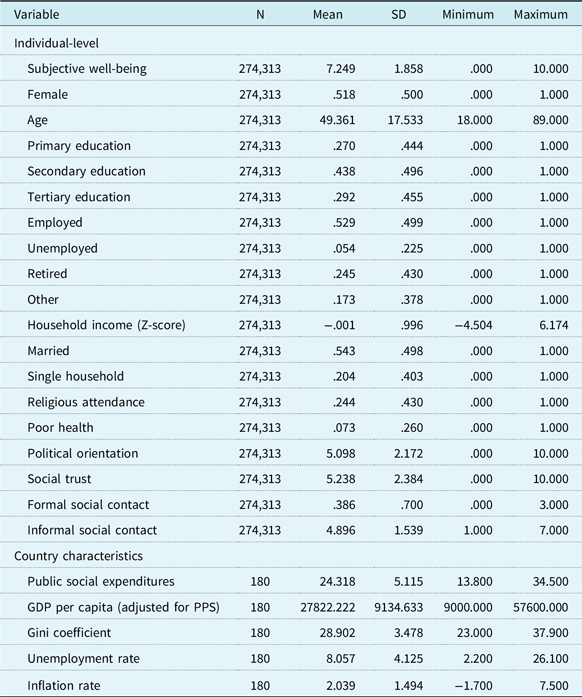
In line with previous studies conducting international comparative analyses of social capital and SWB (Flavin et al., Reference Flavin, Pacek and Radcliff2014; Helliwell and Putnam, Reference Helliwell and Putnam2004; Rodríguez-Pose and von Berlepsch, Reference Rodríguez-Pose and von Berlepsch2014), this study controls for basic individual-level variables, including gender (female = 1, male = 0), age, age squared, educational attainment (primary, secondary, or tertiary), employment status (employed, unemployed, retired, or other status), household income,Footnote 5 marital status (married = 1), household size (single household = 1), religious attendance (once a month or more = 1), self-rated health (poor health = 1), and political orientation (0 (left) to 10 (right)). Table 1 shows the descriptive statistics.
Descriptive statistics of the variables included in this analysis

Analytical strategy
In recent decades, using multilevel models and single-wave international comparative survey data, many researchers have conducted international comparative analyses of social capital and SWB while distinguishing the effects of macro country characteristics and individual-level variables (Gesthuizen et al., Reference Gesthuizen, van der Meer and Scheepers2008; Rostila, Reference Rostila2013; van der Meer et al., Reference van der Meer, Scheepers and te Grotenhuis2009). However, recent research has noted a limitation of multilevel analysis with single-wave international comparative survey data. This shortcoming is called the omitted-variable bias, and it occurs because it is difficult to control for a sufficient number of variables related to country characteristics due to the small degree of freedom at the country level (Moehring, Reference Moehring2012; Yu, Reference Yu2015).
On these grounds, some recent studies have recommended utilising a two-way fixed-effects model with dummies for countries and years when analysing international comparative survey data containing two or more waves because when focusing on the variations within countries, it is possible to evaluate more reliable effects of time-variant country characteristics, thus controlling for all time-constant country characteristics and decreasing omitted-variable bias (Brewer et al., Reference Brewer, Oh and Sharma2014; Flavin et al., Reference Flavin, Pacek and Radcliff2014; Giesselmann and Schmidt-Catran, Reference Giesselmann and Schmidt-Catran2018; Yu, Reference Yu2015). Moreover, this new approach is suitable for addressing the question of whether national governments should carry out welfare retrenchment because this discussion is relevant to the variations in welfare provisions within each country.
For these reasons, the present study adopts the two-way fixed-effects model. The regression for SWB in this analysis in terms of individual i in country c in year t is as follows:
 $$\[SW{B_{ict}} = \;\alpha + {\beta _1}S{T_{ict}} + {\beta _2}FS{C_{ict}} + {\beta _3}IS{C_{ict}} + {\beta _4}PS{E_{ct}}{\rm{ + }}\Gamma {C_{ct}} + \Theta {I_{ict}} + {\zeta _c} + {\eta _t} + {\varepsilon _{ict}}\]$$
α is the intercept, and β 1 to β 3 are the coefficients of social trust (ST), formal social contact (FSC), and informal social contact (ISC) for individual i in country c in year t. Moreover, β 4 is the coefficient of PSE in country c in year t. The variables I ict contain individual-level control variables for individual i in country c in year t, and the time-variant country-year-level control variables C ct include GDP per capita, the Gini coefficient, the unemployment rate, and the inflation rate of country c in year t. This model also includes country fixed effects ζ c and year fixed effects η t to cope with the non-independence of observations within country and year. Country fixed effects control for unobserved time-invariant characteristics of countries, and year fixed effects control for any common time trends constant across countries. Finally, ε ict is the error term. To date, the two-way fixed-effects model has been adopted by previous research to examine the effects of time-variant country characteristics using pooled data from international comparative surveys with two or more waves (Brewer et al., Reference Brewer, Oh and Sharma2014; Flavin et al., Reference Flavin, Pacek and Radcliff2014; Giesselmann and Schmidt-Catran, Reference Giesselmann and Schmidt-Catran2018).Footnote 6
In addition to this basic model, this analysis examines the cross-level interaction effects of PSE and three variables of social capital on SWB. In accordance with Giesselmann and Schmidt-Catran (Reference Giesselmann and Schmidt-Catran2018), this paper contains interaction terms for the dummies of the countries and social capital variables – namely, social trust, formal social contact, and informal social contact, in the evaluations of the cross-level interaction effects.Footnote 7
Results
Table 2 presents the results of the two-way fixed-effects regression of SWB. Country fixed effects and year fixed effects are included in all models in Table 2. In Model 1, this analysis examined the main effects of predictor variables pertinent to social capital on SWB while controlling for individual-level control variables. The results for Model 1 indicate that even after controlling for individual-level control variables, social capital – namely, social trust, formal social contact, and informal social contact – significantly improves SWB (.124, p < .001; .026, p < .01; and .170, p < .001, respectively).
Results of the two-way fixed-effects regressions of SWB

Note: S.E. are the cluster robust standard errors.
†p < 0.1; *p < 0.05; **p < 0.01; ***p < 0.001 (two-tailed tests).
In Model 2, this analysis adds the main effects of time-variant country characteristics, such as PSE, GDP per capita, the Gini coefficient, the unemployment rate, and the inflation rate. Model 2 shows that the unemployment rate has a significant negative impact on SWB (-.033, p < .01), whereas the effects of other time-variant country characteristics on SWB are not significant.
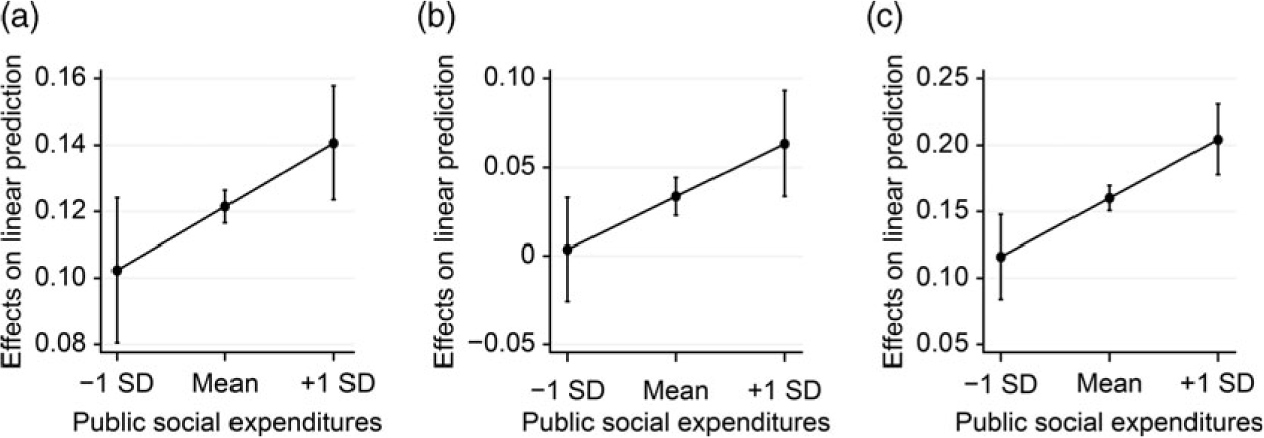
In addition to the main effects of individual and time-variant country characteristics, Models 3 to 5 investigate the cross-level interaction effects of PSE and variables related to social capital on SWB. Model 3 includes the cross-level interaction effect of PSE and social trust on SWB as well as the interaction terms of the country dummies and social trust to evaluate the within-country effect of cross-level interaction. The results for Model 3 show that the cross-level interaction effect of PSE and social trust on SWB is positive and significant (.004, p < .05), indicating that as a country’s PSE increases, the impact of social trust on SWB becomes stronger. This result supports hypothesis 2-1 in this study.
Furthermore, Model 4 examines the cross-level interaction effect of PSE and formal social contact on SWB while controlling for the interaction terms of the country dummies and formal social contact. The results for Model 4 show that the cross-level interaction of PSE and formal social contact on SWB is significantly positive (.006, p < .05). This result indicates that formal social contact in contexts with higher PSE is likely to play a more positive role in SWB than in contexts with lower PSE. Thus, hypothesis 2-2 in this study is supported.
Finally, in Model 5, this study explores the cross-level interaction effect of PSE and informal social contact on SWB. Model 5 also includes the interaction terms of the country dummies and informal social contact. In Model 5, the cross-level interaction of PSE and informal social contact exhibits a significant and positive effect (.009, p < .01). The results for Model 5 reveal that in contexts with higher PSE, informal social contact has a more positive impact on SWB than in contexts with lower PSE. This result supports hypothesis 2-3 in this study. As shown in Figure 1, on balance, the results in this study show that PSE generally strengthens the association between social capital and SWB.
Average marginal effects of social capital on SWB.
Notes: (a) Average marginal effects of social trust on SWB.
(b) Average marginal effects of formal social contact on SWB.
(c) Average marginal effects of informal social contact on SWB.

Furthermore, to check robustness, the present study also conducts additional analyses, presented in the Online Appendix. Because Giesselmann and Schmidt-Catran proposed models to ‘control for effect heterogeneity [between countries] of one or both interacted variables’ (Giesselmann and Schmidt-Catran, Reference Giesselmann and Schmidt-Catran2018: 211), Appendix A1 shows the results including the interaction terms of country dummies and PSE in addition to the analyses in Models 3 to 5 in Table 2. The results in Appendix A1 are not substantially different from those in Models 3 to 5 in Table 2. Additionally, in terms of formal social contact, building on the results of a principal component analysis, Neira et al. (Reference Neira, Lacalle-Calderon, Portela and Perez-Trujillo2018) incorporate the item ‘[w]orn or displayed a campaign badge/sticker’ as an indicator of associational and political participation, in addition to the three items adopted in this study. Therefore, this study also examined the cross-level interaction of PSE and formal social contact, which includes the above item as well as the other three items used in Table 2, on SWB (Supplementary Appendix A2). Alternatively, Kislev (Reference Kislev2020) employed a variable for social participation based on the following question and response options: ‘Compared to other people of your age, how often would you say you take part in social activities?’ and ‘1. Much less than most’, ‘2. Less than most’, ‘3. About the same’, ‘4. More than most’, or ‘5. Much more than most’. This study also explores the cross-level interaction effect of PSE and the above variable as a proxy of formal social contact on SWB (Supplementary Appendix A3). These additional analyses show substantially similar results to those in Model 4 in Table 2 and Supplementary Appendix A1. Moreover, the present study conducts further analysis by taking life satisfaction and happiness separately (Supplementary Appendices A4 to A7). Although the results in terms of both life satisfaction and happiness are similar to those of SWB in Table 2 and Supplementary Appendices A1 to A3, the results concerning happiness are more similar to those of SWB than those regarding life satisfaction.
Discussion and conclusion
To date, the question of how macro country characteristics affect the impact of social capital on SWB has remained largely unexplored. Against this backdrop, the present study has adopted welfare provisions as a moderator to examine the cross-level interaction effects of PSE and three types of social capital on SWB.
Through an international comparative analysis utilising data from the nine rounds of the ESS and the two-way fixed-effects model, this study clarifies that (1) three types of social capital – namely, social trust, formal social contact, and informal social contact, have positive impacts on SWB, and (2) welfare provisions generally reinforce the effects of social capital on SWB. These results indicated that welfare spending facilitates the positive roles of the three types of social capital in SWB and that hypotheses 2-1, 2-2, and 2-3, which follow the crowding-in argument, are supported.
These results have two main implications. First, the present study clarifies that the association between social capital, including social trust, formal social contact, and informal social contact, and SWB varies depending on the macro country context, such as welfare policies. In terms of social trust and SWB, one interpretation is that impartial and inclusive institutions with generous welfare policies may expand the realm of social trust, and therefore, trustful citizens in contexts with higher welfare spending are more likely to think that a wider range of other people will help them than those in contexts with lower welfare spending (Delhey et al., Reference Delhey, Newton and Welzel2011; Draude et al., Reference Draude, Hölck, Stolle, Risse, Börzel and Draude2018). Thus, welfare provisions promote the function of social trust to reduce anxiety and fear of the future and therefore improve SWB. Additionally, in regard to formal social contact and SWB, it can be interpreted that the resources and time provided by welfare policies enable citizens to involve themselves in civic and political activities more deeply and intensively (Kääriäinen and Lehtonen, Reference Kääriäinen and Lehtonen2006; Rostila, Reference Rostila2013). Therefore, welfare provisions allow citizens to reap more benefits from formal social contact, such as social embeddedness, feelings of political and civic effectiveness, self-efficacy, and social and material support, and thereby increase SWB. Moreover, with regard to informal social contact and SWB, by providing resources and time, welfare policies may facilitate more effective support through informal contact with family, friends, and colleagues and reduce the dark side of social capital, such as the risk of overburden with respect to help among members (Portes, Reference Portes1998; Rostila, Reference Rostila2013). Consequently, welfare provisions boost the impact of informal social contact on SWB. These findings contribute to deepening the research on social capital and SWB and widening the scope of this research field by tying it into the study of welfare policies.
Second, this study deepens the research on welfare policies because this analysis provides new evidence regarding welfare provisions. Numerous studies on welfare policies have uncovered a main effect of welfare spending on social capital, while research on the moderating effects on the association between social capital and several outcomes is scarce. The present study found positive moderating effects of welfare provisions on the roles of three types of social capital in SWB, supporting the hypotheses based on the crowding-in argument. These results suggest the positive consequences of increases in welfare provisions and the risk that welfare retrenchment deteriorates the functional role of social capital in SWB. Traditionally, the crowding-out and crowding-in arguments have been discussed in the context of international comparisons with welfare regime theory (Esping-Andersen, Reference Esping-Andersen1990, Reference Esping-Andersen1999; Rostila, Reference Rostila2013). In particular, some studies have reported that because of generous welfare benefits and universal programs, the social-democratic regime, including Nordic countries, crowds in social capital (Rostila, Reference Rostila2013). This analysis indicates that the above discussion is adoptable to the moderation effect of welfare provisions on the association between social capital and SWB and within-country analysis with the two-way fixed-effects model.
Despite these implications, this research is not without limitations. First, although the present study has addressed the moderating effect of welfare provisions on the association between social capital and SWB, the question of how welfare spending influences the impact of social capital on other outcomes remains untouched. Hence, this study recommends future research to clarify this issue. Second, in future research, the analysis in this study should be re-examined using data from other international comparative surveys or further ESS waves because it is important to check the robustness of the results by utilising other data or additional waves. Third, although this study utilised the two-way fixed-effects model to reduce omitted variable bias, this analysis could not control for reverse causality. Therefore, we also recommend that future studies adopt that method to address this issue.
The results of this study speak to the importance of understanding differences in the role of social capital in several outcomes depending on welfare policies. Because the research on this topic is still in its infancy, future research is needed to unpack and articulate these mechanisms.
Supplementary material
To view supplementary material for this article, please visit https://doi.org/10.1017/S0047279423000223
Acknowledgements
This work was supported by JSPS KAKENHI Grant Number JP22K01870. I thank Christopher Deeming and Emanuele Ferragina for their helpful comments as well as participants at the ESPAnet Conference in Leuven (September 2021).
Competing interest
The author(s) declare none.