Introduction
It is generally accepted that feed costs represent about 70% of the cost of poultry production and this makes a bird's ability to use feed efficiently very important. Birds considered to have better feed efficiency typically have a lower proportion of feed intake to body weight gain. Over the past decades feed efficiency has been improved through changes in a number of aspects of meat poultry production. Firstly, changes in management that have contributed to gains in feed efficiency have included optimising temperatures, lighting and bird densities (Charles, Reference CHARLES1986; Davis et al., Reference DAVIS, PRESCOTT, SAVORY and WATHES1999; Havenstein et al., Reference HAVENSTEIN, FERKET and QURESHI2003). Secondly, research in poultry nutrition has played a key role. Understanding the nutritional requirements of poultry has allowed precise diets to be formulated for different growth periods. These dietary formulations have improved feed efficiency by supplying limiting dietary requirements so birds are not eating extra feed to obtain specific nutrients (Havenstein et al., Reference HAVENSTEIN, FERKET and QURESHI2003; Reference HAVENSTEIN, FERKET, GRIMES, QURESHI and NESTOR2007). Lastly, significant advances have been due to genetic selection for feed efficiency. Originally poultry were selected based on body weight gain, this led to significantly larger birds over time, but as feed costs began to increase it became clear that, to maintain profitability, selection should be widened to include other traits. For the past 40 years feed efficiency has been heavily weighted in breeding objectives for meat producing poultry and as a result, major gains have been made (Emmerson, Reference EMMERSON1997).
Defining feed efficiency traits
The concept of feed efficiency is simple. Birds are assessed and ranked based on their ability to convert a certain input to a certain output. In this case the input is quantity of feed, often referred to as feed intake (amount of feed consumed over a given period of time) and the output is body weight or meat gain. There are a number of ways to assess feed efficiency, currently, the most widely used are feed conversion ratio (FCR) and residual feed intake (RFI).
FCR can be defined as the amount of feed consumed per unit of weight gain, and is a composite trait of starting and ending body weight and feed intake (Skinner-Noble and Teeter, Reference SKINNER-NOBLE and TEETER2003). Variability in energy required for body weight maintenance that contributes to feed intake, is not accounted for in FCR. The inverse of FCR, weight gain divided by feed intake, referred to as the gain to feed ratio, is occasionally used in the literature and is also measure of efficiency (Dransfield and Sosnicki, Reference DRANSFIELD and SOSNICKI1999). Residual feed intake (RFI) was originally proposed by Byerly (Reference BYERLY1941) and used by Koch et al. (Reference KOCH, SWIGER, CHAMBERS and GREGORY1963) in beef cattle, and in poultry by Luiting (Reference LUITING1990). RFI is defined as the difference between actual and predicted feed intake based on the regression of requirements for production (e.g. egg production, milk, but in this instance weight gain) and body weight maintenance (Van Der Werf, Reference VAN DER WERF2004). Residual feed intake can then be calculated as: RFI = FI - [μ + (b1*X) + (b2*Y)], where FI represents feed intake over a defined period, μ represents the average feed intake and b1 and b2 represent the partial regression coefficients. X is a coefficient which is seen in the literature as either metabolic mid-weight (MMW) or starting body weight (Luiting et al., Reference LUITING, SCHRAMA, VAN DER HEL and URFF1991; Van Bebber and Mercer, Reference VAN BEBBER and MERCER1994; Aggrey et al., Reference AGGREY, KARNUAH, SEBASTIAN and ANTHONY2010; Case et al., Reference CASE, WOOD and MILLER2012). Where MMW is defined as the mid test body weight raised to the power of 0.75. Y can also represent two different traits, average daily gain (ADG) or weight gain over the test period (Van Bebber and Mercer, Reference VAN BEBBER and MERCER1994; Pakdel et al., Reference PAKDEL, VAN ARENDONK, VEREIJKEN and BOVENHUIS2005; Aggrey et al., Reference AGGREY, KARNUAH, SEBASTIAN and ANTHONY2010; Case et al., Reference CASE, WOOD and MILLER2012). A more efficient bird should have a negative value for RFI, indicating that it uses less energy than predicted. Statistically, the mean RFI within a population is zero, and is phenotypically independent from the constituent production traits (Kennedy et al., Reference KENNEDY, VAN DE WERF and MEUWISSEN1993). Studies across multiple species have found that 60-80% of the inter-animal variation in predicted feed intake is accounted for by differences in body weight and the level of production, leaving RFI to potentially account for the remaining 20-40% of unexplained variation (Bottje and Carstens, Reference BOTTJE and CARSTENS2009).
Recently, alternative measures of feed efficiency have been used, including residual maintenance energy (RMEm) (Romero et al., Reference ROMERO, ZUIDHOF, RENEMA, NAEIMA and ROBINSON2009b), residual gain (RG) and residual intake and gain (RIG) (Romero et al., Reference ROMERO, ZUIDHOF, RENEMA, NAEIMA and ROBINSON2009b; Berry and Crowley, Reference BERRY and CROWLEY2012). RMEm unlike RFI or FCR aims to measure energetic efficiency without being confounded by feed intake. Non-linear methods are used to estimate the maintenance energy requirement (MEm) of each individual bird. Subsequently a linear regression between MEm and feed intake is performed, the residuals representing RMEm (Romero et al., Reference ROMERO, ZUIDHOF, RENEMA, NAEIMA and ROBINSON2009a). While the correlation between feed intake and production is usually assumed to be constant, and therefore linear, it is likely that true biological efficiency depends on the intake and production level, and this may change over an animal's growth trajectory (Van Der Werf, Reference VAN DER WERF2004). This makes a non-linear model for feed intake of interest. In a comparison between RFI and RMEm, where RFI corrects for body weight and RMEm for the effect of dietary thermogenesis, RMEm provided a more consistent estimation of individual energetic efficiency across different feed management schemes (Romero et al., Reference ROMERO, ZUIDHOF, RENEMA, NAEIMA and ROBINSON2009b).
Residual gain, a proposed measure of feed efficiency, is defined as the residuals from the linear regression of average daily gain (ADG) on both FI and BW. Residual gain can then be calculated as: RG = ADG - [μ + (b1*FI) + (b2*BW)]. Where, ADG represents the average daily gain over a defined period, μ represents the average ADG, b1 and b2 represent the partial regression coefficients on FI and BW, respectively. Improved RG is, on average, associated with faster growth rates but not with differences in feed intake (Berry and Crowley, Reference BERRY and CROWLEY2012). Residual intake and gain combines the beneficial characteristics of both RFI and RG such that RIG is independent of body weight, but when used for selection it can increase weight gain and reduce feed intake simultaneously. Residual intake and gain is calculated as: RIG = [(-1*RFI) + RG], where both RFI and RG are standardised to a variance of one. Multiplying RFI by negative one accounts for the fact that birds with a negative RFI have better feed efficiency, where the opposite is true with RG, a positive number would correspond to having greater feed efficiency (Berry and Crowley, Reference BERRY and CROWLEY2012). The impact and use of this relatively new measure has been studied in turkeys and shows some promise in the selection for feed efficiency (Willems, Wood and Miller: unpublished).
Selection concepts for FCR and RFI
Feed conversion ratio is moderately heritable in poultry, consequently, improvement would be possible in feed efficiency using FCR as the selection criterion (Pakdel et al., Reference PAKDEL, VAN ARENDONK, VEREIJKEN and BOVENHUIS2005; Aggrey et al., Reference AGGREY, KARNUAH, SEBASTIAN and ANTHONY2010; Case et al., Reference CASE, MILLER and WOOD2010). In a comparison between a random bred control population and commercially available stock from 1966 and 2003, Havenstein et al. (Reference HAVENSTEIN, FERKET, GRIMES, QURESHI and NESTOR2007) concluded that selection programs alongside management techniques had improved FCR in the turkey by approximately 20%. In a similar comparison between breeding lines from 1957 and 1991, genetics, nutrition, and other management changes over the 34 year period studied resulted in broilers (in 1991) that showed significantly improved FCR (3.00 vs. 2.04) at both a constant age and weight (Havenstein et al., Reference HAVENSTEIN, FERKET, SCHEIDELER and LARSON1994; Emmerson, Reference EMMERSON1997).
As a ratio of two traits, problems arise when selecting for FCR. Once selection intensity increases, direct selection for FCR causes selection to be focused primarily on the information in the numerator regardless of the distributional properties of the components (Gunsett, Reference GUNSETT1984). This leads to selection pressure being placed nonlinearly on feed intake and weight gain. While this will still improve FCR, it will do so at a slower rate compared to linear indexes based on the component traits of FCR (Campo and Rodriguez, Reference CAMPO and RODRIGUEZ1990; Famula, Reference FAMULA1990). The advantages of selection based on component traits decrease as the phenotypic correlations between the two increase, high correlations make selecting for one almost as good as selecting for both (Gunsett, Reference GUNSETT1984). As FCR improvements have been made, growth rate has increased, and age to market has been considerably reduced. While this has improved feed efficiency, it may be due to a shortened growth period as FCR increases with the age of broilers due to higher maintenance energy requirements (Havenstein et al., Reference HAVENSTEIN, FERKET and QURESHI2003).
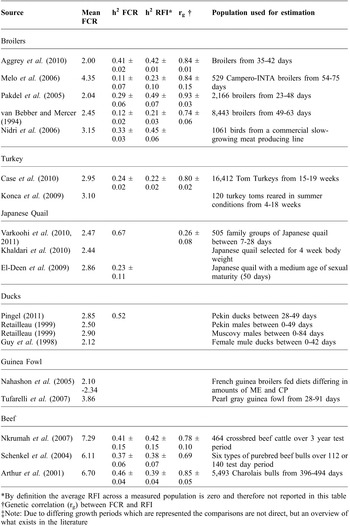
RFI is used to quantify feed efficiency by estimating the amount of feed intake not accounted for by body weight gain. The use of RFI has increased for several reasons. Firstly, there is considerable variation present on which to select in commercial meat-producing species as shown in Table 1. Secondly, RFI is moderately heritable in poultry (Table 1) and appears to be independent of production traits. Independence from production traits allows RFI to be incorporated into a multiple-trait selection index without concern of hampering increases in other economically important traits. This has been demonstrated in selection trials for decreased RFI, which led to a reduction in feed intake, improved feed efficiency and resulted in no change in production (Aggrey et al., Reference AGGREY, KARNUAH, SEBASTIAN and ANTHONY2010). While no large experimental selection trial evidence is available in the literature for poultry, given that RFI and production traits are independent, it is conceivable that improvements in RFI and production can occur concurrently.
As with most traits, there are drawbacks to consider with RFI. The largest problem being that RFI may penalise higher productivity. Higher production requires higher feed intake, as denoted by high phenotypic and genetic correlations between weight gain and feed intake across several RFI studies in meat-producing poultry (Van Bebber and Mercer, Reference VAN BEBBER and MERCER1994; Aggrey et al., Reference AGGREY, KARNUAH, SEBASTIAN and ANTHONY2010; Case et al., Reference CASE, WOOD and MILLER2012). Higher feed intake in turn produces more heat known as diet-induced thermogenesis (Swennen et al., Reference SWENNEN, JANSSENS, DECUYPERE and BUYSE2004). Higher feed intake and more energy lost to heat can contribute to an increased RFI measurement on a high producing animal compared to a low producing animal. Alternatively, a slow growing animal eating relatively small amount of feed may have a good RFI value (Berry and Crowley, Reference BERRY and CROWLEY2012).
Selection strategies for FCR and RFI
The strategies for genetic improvement of FCR and RFI are different, and depend on their specific genetic correlations with important production traits. Both FCR and RFI require the measurement of individual feed intake, which can be difficult to measure in practice. There are a two ways to obtain individual feed intake values. The first requires the use of individually caged birds, which need to have their feed recorded and refilled on a daily basis. The second, an automated electronic feeding system that enables feed intake measurements on specific individuals to be taken in a group-house setting (Howie et al., Reference HOWIE, AVENDANO, TOLKAMP and KYRIAZAKIS2011; Tu et al., Reference TU, DU, TANG, XIN and WOOD2011). Each method has its advantages and disadvantages. The traditional method of using individually caged birds is widely studied, cheap and simple, but requires a significant amount of barn space and doesn't account for social interactions. The automated electronic feeding system can measure a larger number of birds, and due to the group-housed environment, accounts for social interactions between birds.
Selecting for weight gain can make indirect improvements in FCR. By doing this feed intake is increased as a correlated genetic response, but it does so at a slower rate, thereby improving FCR (Varkoohi et al., Reference VARKOOHI, PAKDEL, MORADI SHAHR BABAK, NEJATI JAVAREMI, KAUSE and ZAGHARI2011). In contrast, RFI would not be affected by the indirect selection of weight gain, as it is accounted for in its computation via regression on body weight (Kennedy et al., Reference KENNEDY, VAN DE WERF and MEUWISSEN1993; Van Der Werf, Reference VAN DER WERF2004). Long-term selection trials for FCR are widespread for meat producing birds. Pym and Nicholls (Reference PYM and NICHOLLS1979) reduced FCR by 0.156 to 0.341 per generation vs. a control line over a five-generation selection experiment, making selections based on FCR. Leenstra and Pit (Reference LEENSTRA and PIT1987), measured FCR in a broiler sire strain and, after four generations of selection, FCR was 0.17 lower in the line selected for decreased FCR compared to the line selected for increased body weight. Large-scale selections for RFI in poultry over long periods of time do not exist in the literature. Smaller RFI selection experiments have demonstrated decreased maintenance energy requirements and physical activity in poultry with lower RFI (Luiting, Reference LUITING1999; Luiting et al., Reference LUITING, SCHRAMA, VAN DER HEL and URFF1991).
Selections based on FCR have made significant improvements in feed efficiency and experimental trials utilising RFI show promising theoretical results. However, it is important to recall the contributions of Kennedy et al. (Reference KENNEDY, VAN DE WERF and MEUWISSEN1993), which note that RFI provides no additional information to a breeding program over and above that provided by its component traits. In the meat producing poultry industry, it may be more useful to follow what effect selection for production and other traits can have on RFI, than the reverse.
Comparisons of feed efficiency among meat producing poultry
A summary of phenotypic means, heritability and genetic relationships between FCR and RFI is shown in Table 1. Information on a non-poultry species (beef cattle) is shown for comparison. Mean FCR values in broilers range from 2.00 to 2.45, with outliers as high as 4.35 (Melo et al., Reference MELO, ROMANO, CANET and MIQUEL2006). The highest outlier, from Camperos broilers, is a poultry breed used in free-range systems of production, while a value of 3.15 was estimated for a slow-growing line of chickens (Nidri et al., Reference NIDRI, MIGNON-GRASTEAU, SELLIER, TIXIER-BOICHARD and BEAUMONT2006). In turkeys, FCR estimates ranged from 2.95 to 3.10 (Konca et al., Reference KONCA, KIRKPINAR and ABUK2009; Case et al., Reference CASE, MILLER and WOOD2010). In Japanese quail, FCR has been seen between 2.47 and 2.86 (El-Deen et al., Reference EL-DEEN, EL TAHAWY, ATTIA and MEKY2009; Khaldari et al., Reference KHALDARI, PAKDEL, MEHRABANI YEGANE, NEJATI JAVAREMI and BERG2010; Varkoohi et al., Reference VARKOOHI, MORADI SHAHR BABAK, PAKDEL, NEJATI JAVAREMI, ZAGHARI and KAUSE2010; Reference VARKOOHI, PAKDEL, MORADI SHAHR BABAK, NEJATI JAVAREMI, KAUSE and ZAGHARI2011). In studies across several species of ducks (Pekin, Muscovy and mule ducks) FCR ranged between 2.12 and 2.90 (Guy et al., Reference GUY, ROUSSELOT-PAILLEY and ROUVIER1998; Retailleau, Reference RETAILLEAU1999; Pingel, Reference PINGEL2011). French guinea fowl demonstrated an FCR of 2.10 to 2.34, and pearl gray guinea fowl 3.86 (Nahashon et al., Reference NAHASHON, ADEFOPE, AMENYENU and WRIGHT2005; Tufarelli et al., Reference TUFARELLI, DARIO and LAUDADIO2007).
Heritability of FCR varied substantially from 0.11 to 0.41 (Van Bebber and Mercer, Reference VAN BEBBER and MERCER1994; Pakdel et al., Reference PAKDEL, VAN ARENDONK, VEREIJKEN and BOVENHUIS2005; Melo et al., Reference MELO, ROMANO, CANET and MIQUEL2006; Nidri et al., Reference NIDRI, MIGNON-GRASTEAU, SELLIER, TIXIER-BOICHARD and BEAUMONT2006; Aggrey et al., Reference AGGREY, KARNUAH, SEBASTIAN and ANTHONY2010). Recent commercial broiler estimates had similar moderate heritably values of 0.29, 0.33 and 0.41 (Pakdel et al., Reference PAKDEL, VAN ARENDONK, VEREIJKEN and BOVENHUIS2005; Nidri et al., Reference NIDRI, MIGNON-GRASTEAU, SELLIER, TIXIER-BOICHARD and BEAUMONT2006; Aggrey et al., Reference AGGREY, KARNUAH, SEBASTIAN and ANTHONY2010). These results are likely to represent current population genetics. Heritability of FCR for species of birds other than chickens is difficult to quantify due to the lower number of estimates in the literature. In turkeys, FCR heritability was 0.23 for 105 to 133 day old toms (Case et al., Reference CASE, MILLER and WOOD2010). In Japanese quail FCR heritability was 0.23 for quail between 7 to 28 days old, and 0.67 in 50 day olds (El-Deen et al., Reference EL-DEEN, EL TAHAWY, ATTIA and MEKY2009; Varkoohi et al., Reference VARKOOHI, PAKDEL, MORADI SHAHR BABAK, NEJATI JAVAREMI, KAUSE and ZAGHARI2011). FCR heritability was estimated at 0.52 in Pekin ducks (Pingel, Reference PINGEL2011). Heritability of RFI in broilers ranged from 0.21 to 0.49. Again, the most recent estimates were highest at 0.42, 0.45 and 0.49 (Pakdel et al., Reference PAKDEL, VAN ARENDONK, VEREIJKEN and BOVENHUIS2005; Nidri et al., Reference NIDRI, MIGNON-GRASTEAU, SELLIER, TIXIER-BOICHARD and BEAUMONT2006; Aggrey et al., Reference AGGREY, KARNUAH, SEBASTIAN and ANTHONY2010). Preliminary RFI estimates for turkeys show a moderate heritability (0.22) similar to the lower end of estimated RFI heritability in broilers (Case et al., Reference CASE, MILLER and WOOD2010).
Estimates of the genetic correlations between FCR and RFI are rare in meat producing poultry outside of broilers. In broilers, the estimates range from 0.74 to 0.93. In turkeys there is only one estimate; 0.80 (Case et al., Reference CASE, MILLER and WOOD2010). The high genetic correlation values, from broilers and turkeys, indicate that selection for decreased FCR or RFI would lead to a correlated decrease in the other variable. In Japanese quail estimates are lower (0.26, Varkoohi et al., Reference VARKOOHI, PAKDEL, MORADI SHAHR BABAK, NEJATI JAVAREMI, KAUSE and ZAGHARI2011), this may be due to differences in the age of birds relative to mature age on which estimations were made. The Japanese quail were assessed from 7-28 days of age, where broilers and turkeys ranged from 23-75, and 105-133 days, respectively. Aggrey et al. (Reference AGGREY, KARNUAH, SEBASTIAN and ANTHONY2010) noted a much smaller genetic correlation between FCR and RFI amongst younger birds, 0.31 for broilers aged 28-35 days vs. 0.84 for birds aged 35-42 days. Results appear to differ based on the period of the growth curve on which measurements are taken, and this suggests that the nature of the relationship between FCR and RFI may be dependent on age. Genetic correlations between FCR and RFI, along with their heritabilities, are important to note when considering use of one or the other as a selection criterion.
Impact of feed efficiency on environmental emissions
The environmental impact of poultry production is a continuing challenge. It is predicted that global consumption of poultry meat will increase between 2000 and 2030 at an average annual rate of 2.51% (Fiala, Reference FIALA2008). Although managerial and nutritional strategies have achieved some success in reducing the amount of waste products (manure) and greenhouse gases (GHG), such strategies may not provide sufficient relief nor be able to address ever-increasing levels of poultry production. The most significant emissions from poultry production include ammonia (NH3) and the GHG that are considered to be a component of global warming, nitrous oxide (N2O), carbon dioxide (CO2), and methane (CH4). Even though CH4 and N2O are emitted in lower quantities than CO2, they have global warming potentials of 25 and 298 times of that of CO2, respectively, making them equally important to examine.
Recent estimates of environmental impact of animal production show poultry has the lowest NH3 and GHG emissions. In the European Union (EU-27), total GHG production from livestock farming is 493 teragrams CO2eq per year, with the beef, swine and poultry industries representing approximately 35%, 16% and 6%, respectively. On a per kg product basis, beef had by far the highest GHG emission with 22.6 kg CO2eq, pork 3.5 kg CO2eq and poultry 1.6 kg CO2eq (Lesschen et al., Reference LESSCHEN, VAN DEN BERG, WESTHOEK, WITZKE and OENEMA2011). The largest direct contributor to N2O and CH4 emissions in meat producing poultry operations are from built up litter (Gates et al., Reference GATES, CASEY, WHEELER, XIN and PESCATORE2008; Verge et al., Reference VERGE, DYER, DESJARDINS and WORTH2009), which emit approximately 279 and 29.44 million tonnes (CO2eq), respectively, globally per year (Johnson and Ward, Reference JOHNSON and WARD1996; Oenema et al., Reference OENEMA, WRAGE, VELTHOF, GROENIGEN, DOLFING and KUIKMAN2005).
As feed efficiency improves, the amount of waste products decreases and this lowers emissions in two ways. Firstly, the amount of enteric fermentation decreases as feed conversion improves, lowering N2O and CH4 (Wang and Huang, Reference WANG and HUANG2005). Secondly, decreasing amounts of waste entering the manure storage systems will result in decreased emissions of GHG as by-products (Miles et al., Reference MILES, OWENS and ROWE2006; Hill and Azain, Reference HILL and AZAIN2009). These concepts have recently been demonstrated in selection experiments. Over a four-generation selection experiment, after correcting for feed intake levels, a line of broilers selected for decreased FCR excreted 67.4% less than a random control line (De Verdal et al., Reference DE VERDAL, NARCY, BASTIANELLI, CHAPUIS, MEME, LE BIHAN-DUVAL and MIGNON-GRASTEAU2010). In a separate eight-generation divergent selection experiment, a more efficient line of broilers (FCR of 1.72 vs. 2.72) had a 41.3% decrease in fresh excreta weight. High genetic correlations are also reported between both FCR, RFI, and fresh excreta weight (corrected for body weight), 0.99 and 0.91, respectively (De Verdal et al., Reference DE VERDAL, NARCY, BASTIANELLI, CHAPUIS, MEME, URVOIX, LE BIHAN-DUVAL and MIGNON-GRASTEAU2011). These preliminary results show that selection for lower RFI and/or FCR can improve feed efficiency, reduce feed intake, decrease waste products, and lower GHG emissions.
Economic importance of feed efficiency
Poultry feed costs continue to climb, with corn and soy prices being the primary driver (Schmit et al., Reference SCHMIT, VERTERAMO and TOMEK2009). Clearly increased feed prices have led to an increase in live production costs for both broilers and turkeys, demonstrating the impact on profitability that feed intake and feed efficiency can have (Donohue and Cunningham, Reference DONOHUE and CUNNINGHAM2009). The economic aspects of both the broiler and turkey industries have been examined (Jiang et al., Reference JIANG, GROEN and BRASCAMP1998; Wood, Reference WOOD2009). Economic values for broiler breeding were calculated within an integrated and non-integrated broiler enterprise using a deterministic model (Groen et al., Reference GROEN, JIANG, EMMERSON and VEREIJKEN1998). For the integrated system, increases in the representative feed price by 30% changed the economic value of feed intake from -0.0033 to -0.0043 USD per marketable bird (Jiang et al., Reference JIANG, GROEN and BRASCAMP1998). A 30% increase in feed price ($0.18/kg to $0.235/kg) would increase the cost to produce a 2.5 kg broiler (with an FCR of 2.00) by $0.275. On a per farm basis, with 100,000 broilers per cycle, and six cycles/year, this represents an increased annual cost of approximately $165,000.
Annual improvements in FCR from genetic and nutritional gains continue to be realised for broilers and turkeys. Economic values for turkeys using an integrated deterministic model were estimated by Wood (Reference WOOD2009). Feed intake in the example system was given an economic value of -0.0050 USD per kg. Using the total North American production of turkey meat 2,734,953 tonnes, FAOSTAT (Reference FAOSTAT2009), a feed cost of $250 a ton, and an FCR improvement from 2.60 to 2.59, the total cost savings from feed alone could reach up to 6.8 million dollars.
Market requirements differ from country to country for commercial broiler and turkey production. Consequently, different selection and improvement strategies should be applied. Regardless of these differences, the huge impact that feed efficiency has on the profitability of the meat producing poultry industry is clear and should be an important factor when considering the usage of such traits.
Conclusions
Selection for feed efficiency is driven by multiple dynamic factors. Selection schemes incorporating feed efficiency traits in the poultry industry are a must. Gains in feed efficiency may concurrently reduce the ammonia and GHG emissions from poultry. Increases in feed efficiency have a correlated decrease in manure production, which is responsible in turn for a reduction in GHG and ammonia emissions. As research continues and genetic parameters between efficiency and emissions traits are estimated, the best way to incorporate traits into breeding schemes to select for a decrease in environmental impact will become clear. Genetic improvements in feed efficiency are additionally of great economic importance as the global cost of feed increases over time. Continual economic assessments of poultry production systems are necessary to maintain the optimum inclusion of efficiency traits within multiple-trait selection indexes to keep the industry viable. Aspects of selection for feed efficiency must be especially considered at all industry levels, from the primary breeder to the commercial grower in order to return the greatest results.
Comparison of meat producing poultry feed efficiency traits (Mean FCR, FCR and RFI heritability (h2), genetic correlation between FCR and RFI (rg), using literature values‡).

*By definition the average RFI across a measured population is zero and therefore not reported in this table
†Genetic correlation (rg) between FCR and RFI
‡Note: Due to differing growth periods which are represented the comparisons are not direct, but an overview of what exists in the literature