How is government visible in the lives of Americans? Answers to this question illuminate a shift in public policy over the last half-century. Driven by a rising number of governmental programs providing assistance through tax expenditures and private sector actors (Hackett Reference Hackett2019; Morgan and Campbell Reference Morgan and Campbell2011), the provision of social benefits has moved from direct and visible to indirect and obscured (Mettler and Milstein Reference Mettler and Milstein2007). As a result, “an American can benefit extensively from public social policies and yet never come into contact with a government agency or receive a check from the U.S. Treasury” (Hacker Reference Hacker2016, 778). In capturing this dynamic, scholars have emphasized the American state’s “hidden” or “submerged” nature (Howard Reference Howard1997; Mettler Reference Mettler2011).
This focus on the growing invisibility of the state “has existed in uneasy tension” with scholarship in racial and ethnic politics (REP) which argues that for people of color, “the American state is not hidden, but rather is quite visible and often not for the better” (Thurston Reference Thurston2018, 162). The existence of this tension illuminates a disconnect between the submerged state literature and REP scholarship. Where submerged state scholars have implicitly focused on white Americans and the parts of the state that have become less visible over the last half-century, REP scholarship has centered its analysis on attitudes among people of color and areas of the state that have grown in their visibility. In systematically addressing this disconnect, I ask two interrelated questions. First, how have policy changes that occurred alongside the rise of the submerged state shaped government visibility, and second, how does government visibility vary across racial groups in America?
To answer these questions, I combine semi-structured, in-depth interviews with quantitative analysis to argue that a racial split in American government visibility has been created through five policy trends coming together over the last half-century. First among these policy trends is the rise of social benefits that are “submerged” in the tax code (Mettler Reference Mettler2011). Second, changes in policy eligibility and media attention created a new connection between black Americans and “welfare” policies (Gilens Reference Gilens1999). Third, policy shifts led to increases in conspicuous forms of taxation, such as property taxes (Martin Reference Martin2008). Fourth, criminal legal policy changes generated more aggressive policing and higher levels of incarceration (Alexander Reference Alexander2010).Footnote 1 Fifth and finally, civil rights became a less salient part of the legislative agenda (Weaver Reference Weaver2007).
While each of these five trends has been examined previously, my contribution comes from bringing them together to explain their impact on government visibility and political distrust. Among whites, I show that the declining visibility of benefits brought about by the rise of submerged policies contrasted with the rising visibility of racialized “welfare” programs and taxes to create the perception of government wasting tax dollars on policies benefitting racial others. For people of color, an expansion of punitive policing combined with less attention given to civil rights, leaving the criminal legal system as the state’s most visible manifestation. Through this racial divide, I examine a previously underexplored racial heterogeneity within political distrust attachments. More specifically, I show that people link their distrust to the most visible parts of government in their lives, such that white distrust is connected to welfare attitudes while distrust among people of color is associated with feelings about the police.
In sum, I provide a new understanding of government visibility that is more comprehensive not only due to its inclusion of people of color, but also due to its revelations concerning what is visible among whites. Through this new understanding, I can better explain the rampant political distrust present in America today and suggest remedies for transforming government visibility to increase trust across racial groups.
Theoretical Framework
Government visibility is closely aligned with Arnold’s (Reference Arnold1990) concept of traceability, meaning an entity is “visible” when people can trace a connection between it and the state. Bringing this concept into a policy feedback framework (Pierson Reference Pierson1993), submerged state scholars focus on the growing popularity of policies that utilize tax breaks and private service providers, arguing that these indirect policy designs make it more difficult for Americans to trace their benefits back to government (Hackett Reference Hackett2019; Mettler Reference Mettler2011). In extending this literature to explore racial variation in government visibility, studies analyzing contingencies within policy feedback effects are particularly useful (Gingrich Reference Gingrich2019; Lerman and McCabe Reference Lerman and McCabe2017; Michener Reference Michener2018). Here, research shows that the influence of policy design on people’s political attitudes can vary across individuals.
Within this focus on feedback contingencies, Michener (Reference Michener2019) advances a racialized feedback framework (RFF) to argue that race will be central to feedback processes when policies feature racial disproportionalities in their effects. For example, where whites make up a disproportionate number of Social Security recipients, black Americans disproportionately benefit from Medicaid (Michener Reference Michener2019). According to the RFF, such asymmetries within a policy’s beneficiaries (or “burdenficiaries” if the policy’s impact is negative) make it more likely that racial contingencies will exist in its feedback effects. Applied to government visibility, this assertion suggests that a policy is more likely to be visible to a racial group if they receive a disproportionate share of its benefits or burdens. Drawing on the examples above, one might expect Social Security to be more visible to whites as compared to the greater visibility of Medicaid for black Americans (Michener Reference Michener2018). That racial asymmetries exist across multiple policies illuminates the need to think beyond a single policy to consider “policy system disproportionality” within the study of government visibility (Michener Reference Michener2019). Put differently, the way that government is made visible to a racial group does not rely on the visibility of a single policy, but rather depends on the relative visibility of the complex web of policies within American government. It is only through an appreciation for the racial disproportionalities within this broader network of policies that one can understand how government visibility varies across racial groups.
Just as a policy can provide material benefits in racially disproportionate ways, it can also contain social constructions of its target population that lead people to perceive it as disproportionately rewarding a certain racial group (Schneider and Ingram Reference Schneider and Ingram1997). For example, Americans tend to overestimate the proportion of welfare recipients who are black, routinely claiming that they make up a majority of all beneficiaries (Gilens Reference Gilens1999, 139). Applied to the concept of racial variation in government visibility, the notion of socially constructed target populations suggests that a policy may be more visible to a racial group not because they disproportionately benefit from it (or are disproportionately burdened by it) in a material sense, but also because they feel disproportionately targeted by the policy.
Thus, racial variation in government visibility can work through direct and indirect mechanisms (Larsen Reference Larsen2019). We can expect a part of the state to be more directly visible to a racial group when they disproportionately benefit from it. In addition, a part of the state may be more indirectly visible to a racial group when social constructions create a perception of that group receiving a disproportionate amount of its benefits or burdens. This distinction is notable because it requires attending to different sources of visibility. Where indirect visibility comes from outside sources creating the perception of racial disproportionality (e.g., elite rhetoric, social relationships, media attention, etc.), direct visibility works through racial differences in actual experiences with the state. The end result is the same, however, insofar as racial disproportionalities working through either mechanism can cause racial variation in government visibility.Footnote 2 In short, I expect to find racial differences in government visibility to the extent that America’s policy system confers material and perceived benefits (or burdens) in racially disproportionate ways.
Extending this framework, I further argue that the way government is made visible in a person’s life shapes their political attitudes. To do so, I draw on policy feedback research showing that individuals use their opinions of specific state entities as a cognitive filter for understanding how government, writ large, functions (Soss Reference Soss2000). As an example, Mettler (Reference Mettler2018) argues that contemporary Americans extrapolate from their attitudes on welfare in forming their broader understandings of government. Using this idea, I argue that the visible parts of government in a person’s life act as anchor points, meaning people’s evaluations of government become connected to their evaluations of these visible manifestations of the state.Footnote 3
Psychological theories help to explain why people would create these connections. A large body of psychological literature is built around an understanding of people as cognitive misers (e.g., Tversky and Kahneman Reference Tversky and Kahneman1973). When people are asked to provide their judgment of an object, they will naturally look to expend less effort by using cognitive shortcuts rather than considering all relevant information.Footnote 4 Finding general agreement with this theory is the exemplar model of cognition, which argues that individuals fill in their understanding of an abstract concept (e.g., government) through the use of concrete examples in their life (e.g., visible manifestations of the state) (Medin and Schaffer Reference Medin and Schaffer1978; Ross and Makin Reference Ross, Makin and Sternberg1999). Putting these two psychological mechanisms together within the context of state visibility and political attitudes, I argue that people will reduce their cognitive load when asked for their opinion on government by relying on their evaluations of the most visible parts of the state. Therefore, people are not only capable of tying their political attitudes to visible manifestations of government but are actually likely to do so given the cognitive processes that underlie the formation of government evaluations.
In sum, this framework generates two expectations. First, I expect that racial disproportionalities in America’s policy system, both material and perceived, will cause racial variation in government visibility. Second, I expect this variation in visibility to impact political attitude formation due to people connecting their opinions on government to their evaluations of its most visible manifestations in their life. Ultimately, this framework compliments the literature’s emphasis on hidden policies by centering its focus on an exploration of the most visible parts of the state, while also examining how these parts vary across racial groups and analyzing what impact they have on people’s political attitudes.
Data and Methods
In carrying out this theoretical framework, I construct a research design that simultaneously (1) gives people the freedom to identify how government is visible in their lives, (2) explores how this visibility varies across racial groups, (3) considers how this racial variation in visibility is structured by disproportionalities in America’s policy system, and (4) connects this variation to differences in political attitudes.
At the empirical center of this design are semi-structured, in-depth interviews. These interviews involved questions designed to get people talking about government in different contexts (Schaffer Reference Schaffer2016), such as more abstract uses (e.g., What do you think of when you hear the word government?), as well as more personal, concrete usages of the term (e.g,. Over the last year, can you think of a time that you interacted with government?).Footnote 5 The flexibility of a semi-structured interview gave individuals the freedom to talk about any part of government, while also allowing me to ask follow up questions, such as probing people to talk about a specific part of government they felt exemplified an idea they mentioned (e.g., “government is too big”) (Rubin and Rubin Reference Rubin and Rubin2011).Footnote 6 Through these questions, I identified parts of the state that interviewees brought up with the greatest frequency, giving me a sense of the most visible parts of government in their life. These interviews also included questions about people’s political attitudes (e.g., their level of political trust). Asking these two sets of questions allowed me to establish connections between people’s expressed attitudes and the parts of government made visible in their lives. Finally, subjects filled out a survey following the interview that asked about their receipt of twenty-one government programs. Through this survey, I could see the parts of government that people benefitted from but did not mention during the interview.
To obtain racial variation across interviewees, I engaged in ethnographic work in four areas in an upper Midwest state, attending local meetings and social gatherings to build trust with residents. I utilized the connections made through these ethnographic methods to recruit interviewees, often asking interviewees to recommend someone else in the area I could talk to who spent less time at community gatherings. As such, I avoided interviewing active community members only. In total, I interviewed fifty-eight people between February and December of 2016, with each interview averaging approximately ninety minutes.Footnote 7
While this is a large number of interviews, the goal was not to recruit a representative sample. Instead, I followed a “sequential case study logic,” in which each case (i.e., interviewee) was used to inform the selection of future cases (Small Reference Small2009; Yin Reference Yin2013). As my framework developed, I was consistently working to understand the social cleavages within government visibility and recruiting interviewees from social positions that could either disrupt or confirm my evolving expectations. For example, as I developed my belief that government visibility varied along racial lines, I worked to recruit interviewees within the same racial group who lived in different circumstances (e.g., different educational status, different income, different town, etc.) to see if this racial schism would hold.Footnote 8 Rather than representativeness, a sequential case study logic works towards a saturation point, wherein the final interviews provide “very little new or surprising information,” (Small Reference Small2009, 25). To explore the representativeness of my findings, the interview data is combined with quantitative analysis using the 2016 American National Election Study (ANES). As a nationally representative sample, the ANES can test the statistical generalizability of conclusions drawn from the interview data.
Finally, the interview findings were contextualized within the American policy system through a dialogue between fieldwork and framework (Soss Reference Soss, Yanow and Schwartz-Shea2014). In this dialogue, scholars use existing literature to develop interview questions and to interpret the data provided in response. In addition, scholars use what they are hearing in the interviews to guide their reading, and to help form critiques of that literature. Interviews can be particularly illuminating when accounts from interviewees fail to line up with expectations produced by extant scholarship, forcing researchers to innovate in making sense of interview data. In this case, I was struck by the disconnect between the answers I was hearing in the interviews and the idea of a government that has grown less visible. This disconnect pointed me towards REP scholarship in which government visibility was described in contradictory ways, such as its “omnipresent” nature in certain communities (Fernández-Kelly Reference Fernández-Kelly2015). Ultimately, the movement between fieldwork and framework allowed me to explain this disconnect by illuminating a racial split in government visibility that has emerged due to five public policy trends: (1) the rise of submerged state policies, (2) the racialization of poverty policies, (3) the growing visibility of taxation, (4) the emergence of “get tough” criminal legal policy, and (5) the declining attention given to civil rights legislation. While each of these policy trends has been covered, scholars have not analyzed their interplay within the context of government visibility. The remainder of this article shows how an analysis of this interplay provides a more comprehensive account of contemporary government visibility and political distrust.
White Government Visibility: The Rise of the Submerged State and the Growing Visibility of Welfare and Taxes
Author: Are there any particular government programs that you’ve ever benefited from or drawn on? Are there any that stand out to you that you can remember using?
David: No, not really.
Author: What about government programs? Any government programs you’ve come into contact with or had family members come into contact with?
Eric: No. No.
Author: Are there any interactions you’ve had with a government entity over the course of your life that stand out to you in anyway? Good or bad?
Eric: I’m trying to think. I really haven’t. No.
Beyond Eric and David, numerous white interviewees provided similar answers about a lack of government contact. In contrast, their post-interview survey responses would frequently note the receipt of multiple government programs. In this way, the answers align with the conventional wisdom of an increasingly submerged state, particularly to the extent that these interviewees benefitted from policies hidden within the tax code (Howard Reference Howard1997; Mettler Reference Mettler2011).Footnote 9 These answers illuminate the first policy trend: the rising number and scale of policies that hide their connection to government (Hackett Reference Hackett2019). From 1981 to 2010, the number of hidden tax expenditures increased by 86% with the revenue lost to these policies growing by 130% (Mettler Reference Mettler2011, 121). As a result, 2010 saw the federal government lose $1.1 trillion dollars to 151 different social tax expenditures (Mettler Reference Mettler2018, 45).
Notably, these hidden benefits primarily accrue to middle and upper-class Americans (Howard Reference Howard1997; Mettler Reference Mettler2011, Reference Mettler2018). To the extent that people of color have historically been, and continue to be, disproportionately impoverished, this class-based bias reflects racial inequalities as well. Further, this racial disproportionality is compounded by submerged policies frequently being tied to the private sphere through housing and labor markets that have held steady in their level of racial exclusion over the last seventy years (Hacker Reference Hacker2002; Bruch, Rosenthal, and Soss Reference Bruch, Rosenthal and Soss2019). Thus, while past studies have focused on the class-based inequality within hidden state policies, there is an additional racial dimension. That white Americans disproportionately benefit from these submerged policies explains why the hidden welfare state has been characterized as promoting a form of “white socialism” (Ladd Reference Ladd2017).
Through other interviews, however, it became apparent that there was more to government visibility in white people’s lives than submerged benefits. These excerpts from Kyle and Jane illustrate a common theme.
Author: Are there any government programs that you remember receiving?
Kyle: No. No. I mean the big kind of programs I can think of are things like WIC, or food stamps, or Section 8 housing.
Author: What about government programs? Have you interacted with government programs at all?
Jane: Like Section 8? There’s a lot of related housing programs, I think. I don’t know a lot about the other [programs], but you’re talking about, like, welfare.
While these answers are similar to those that opened this section, they differ in that Kyle and Jane surface specific programs. Importantly, the policies mentioned are not random, but rather are joined together as racialized poverty programs that draw the ire of many Americans. Indeed, people often fail to differentiate between these programs, referring to them collectively as “welfare” programs (Gilens Reference Gilens1999), as hinted at in the answer from Jane.
That these “welfare” policies serve as strong manifestations of the state illuminates the second salient policy trend: the rising conspicuousness of racialized poverty programs. This shifting visibility can be traced back to multiple changes. First, alterations in welfare policy eligibility led to the number of direct-cash assistance recipients tripling from 1965 to 1975 (Gilens Reference Gilens1999, 19). Second, this increase was accompanied by greater media attention and elite rhetoric devoted to welfare programs, with this attention and rhetoric constructing black Americans as the target population (Gilens Reference Gilens1999; Kellstedt Reference Kellstedt2003). Demonstrating this growing visibility, there has been a rise in the number of Americans who name welfare as a major national problem. Where roughly 2% of the country made this claim in 1966, this number had surpassed 10% by 1982, eventually peaking at over 25% in 1996 (Soss, Fording, and Schram Reference Soss, Fording and Schram2011, 67). As Hetherington sums it up,
Americans growing up in the television era have been fed a steady diet of stories about the urban poor buying liquor with food stamps, Cadillac driving “welfare queens,” and teenage mothers intentionally having more children to increase the size of their welfare checks . . . This publicity places such programs on tops of people’s heads when they are asked to evaluate government’s trustworthiness. (2005, 26)
In this way, the first two policy trends combined over the last fifty years to create an important contrast in government visibility. As social programs that disproportionately benefit whites have grown less directly visible due to hidden policy designs, elite rhetoric and media attention has increased the indirect visibility of welfare programs perceived as disproportionately benefitting black people (and therefore, disproportionately burdening white people). Through this contrast, we can understand why white interviewees frequently provided answers like those from Kyle and Jane. When questioned about government, they do not think of the submerged programs they have benefitted from, but rather of the welfare programs that they believe have aided others.
The power of this contrast has been supported by a third policy trend: the rising visibility of taxes. While taxes are often seen as a perennially important issue in American politics, scholarship shows that the public’s fixation on it is a more recent phenomenon. As Martin notes, elected officials “rarely fought over taxes” or “even mentioned the word at election time,” prior to the 1970s (2008, 1). The salience of taxation shifted, however, as more visible forms of taxation grew, such as state and local taxes. Between 1953 and 1973, the average percentage of an American’s income devoted to state and local taxes increased from 7.6% to 12.1% (Morgan Reference Morgan, Soss, Hacker and Mettler2007, 33). Part of this increase was a surge in highly visible property taxes brought on by the end of fractional assessment, a “hidden social policy,” in which homeowners were taxed on a fraction of their property’s value (Martin Reference Martin2008, 7). While this tax privilege began to decline in the early 1970s, fractional assessment saved homeowners approximately $39 billion in taxes at its peak, or just a bit less than the cost of Social Security at the time (Martin Reference Martin2008, 9). This hidden social policy ending in the early 1970s runs counter to the literature’s focus on the submergence of social benefits, but also helps to explain why many Americans became more aware of their tax burden at this time.
This awareness was aided by politicians seizing on these tax policy changes, particularly Republicans, who began to make tax cuts a central part of their political strategy (Morgan Reference Morgan, Soss, Hacker and Mettler2007; Smith Reference Smith, Pierson and Skocpol2007). Attention to taxes has been bipartisan, however, with taxes being the most popular issue priority in presidential advertisements from 1984 to 2004 for both Democratic and Republican candidates (Smith Reference Smith, Pierson and Skocpol2007, 141). Thus, shifts in policy design helped to increase the direct visibility of taxation, while changes in political strategy grew its indirect visibility.
The racial disproportionalities within socially constructed target populations explain why these changes primarily impacted government visibility among whites. Where the construction of black Americans as the primary beneficiaries of welfare is well-documented, other work has similarly shown how whites have been constructed as the primary “burdenficiaries” of taxes (Roediger Reference Roediger2007; Winant Reference Winant1993). As such, whiteness is often “automatically presumed to imply ‘taxpayer.’” (Walsh Reference Walsh2017, 237). This connection between whiteness and taxes was surfaced by the many white interviewees who used possessive pronouns to talk about taxation.Footnote 10
Carol: [Talking about the immigrant population in her neighborhood] But this woman is having one child after another, and they’re living on the welfare system, they’re living off us. This brings resentment. It’s bound to bring resentment. Part of the problem is a lot of the church groups that bring them here, they bring them here and put them on welfare. So you have a middle class that is losing ground and a blue collar that is going under, and you put these people on the welfare system, it’s going to build resentment.
Carol’s invocation of “living off us” highlights the connection between whiteness and taxation, while the remainder of her quote illuminates the belief, common among my white interviewees, that these white tax dollars are used to pay for welfare policies that benefit racial others.Footnote 11 MichMpls further illustrates the commonality of this thinking in his discussion of welfare and taxation as visible manifestations of the state.
MichMpls: When people say I’d take a job, but I make more money sitting at home, we’ve created a problem . . . Do you want to incent people not to work, or do you want to incent people to work? Do you want to incent people to buy their $12 per pound organic blueberries at the [local grocery store] with their food stamps? Is that what welfare’s for? Like, is there a limit? Is it, should it be 100% of the budget goes to it? Like, at what point do you say, I mean every, I can’t say every, the overwhelming majority of houses that are on welfare have cell phones, have cable TV. How about sending them to work instead of giving everything away? And people would feel better about themselves if they only, I know my kids feel better about things when they earn it than when I just give it to them. And we have created an incentive structure that is so costly, and it has created such big government, and it sends all the wrong behaviors.
MichMpls’ claim that nearly 100% of the budget goes to racialized poverty policies shows how powerful these programs are as representations of both where taxes are spent and the broader concept of “big government.” Further, his conflation of welfare and food stamps points to the way in which these programs are often grouped together as manifestations of the state.
In sum, this section shows how the racial disproportionalities embedded in the socially constructed target populations of welfare and taxes worked with the racially disproportionate provision of submerged social policies to shape government visibility for whites. In this account, the growth of hidden social policies remains important, but its role is recast as complimentary. It is the declining visibility of these policies that made the growing conspicuousness of taxation and welfare so powerful. As a result of the interplay between these three policy trends, whites are left with a view of government as a force that takes their tax money to fund programs that primarily benefit racialized others. This dynamic marks whites as the disproportionate “burdenficiaries” of the visible parts of the state while concealing their role as the disproportionate beneficiaries of America’s hidden parts of the state. In this way, attending to state entities that grew in their visibility alongside the rise of the submerged state provides a more comprehensive image of government visibility among whites.
Government Visibility for People of Color: The Rise of “Tough on Crime” Policy and Declining Attention Given to Civil Rights
Author: So have you had any interactions with government that stand out to you?
Coach Y: In terms of, in what capacity?
Author: Any capacity.
Coach Y: Oh man, my first experience [with government] was, I was arrested. My first experience was my, I got into a car accident, and the police ran my registration and said “You have a warrant.” . . . And he said “You failed to pay a seat belt ticket.” I said “It wasn’t me, I assure you that.” And I suspect it was my little brother got the ticket and didn’t tell me about it . . . And so I just put my hands up, and the officer said “It looks like you did this before” And I said “No, this is my first time, but I don’t think I can get out of it.”
In contrast to the visibility of welfare and taxes among whites, this quote from Coach Y provides a common theme among interviewees of color: the visibility of the criminal legal system (CLS). As then-Attorney General Loretta Lynch put it when talking about Ferguson, MO, for many people of color in America today, the police are the “only face of government that they see” (Lynch 2015). These quotes highlight the racial divide in contemporary government visibility; one that mirrors the divide between REP scholarship that has focused on the rising conspicuousness of the CLS and submerged state scholarship that has emphasized the declining presence of social benefits. This section helps to bridge this divide by focusing on accounts of government visibility among people of color.
The visibility of the CLS can be traced to a fourth public policy trend: the emergence of “tough on crime” legislation at the federal, state, and local level (Simon Reference Simon2007). The consequences of these criminal legal policy changes could be heard throughout my interviews with people of color. For example, when I asked Jay, a black interviewee, if she felt government impacted her life on a daily basis, she told me about the frequent times she had been stopped by the police while walking around the downtown area of the city she lives in. The shift towards a system of “broken windows” policing, in which a greater number of officers more aggressively pursue punishment of minor crimes, helps to contextualize Jay’s answer (Wilson and Kelling Reference Wilson and Kelling1982). Through this change, city spending on the police grew from an average of $82 per resident in 1951 to $286 in 2012 (Epp Reference Epp, Maynard-Moody and Haider-Markel2016), with the number people working for police forces doubling between 1960 and 1980 (Weaver Reference Weaver, Jenkins and Patashnik2012). Jay’s discussion specifically invokes the use of “stop and frisk” policies within broken windows policing, which gives the police greater discretionary power to carry out searches of pedestrians they deem suspicious (La Vigne et al. Reference Vigne, Nancy, Matthews and Neusteter2012). These “stops, interrogations, and searches of ordinary people driving down the street, walking home from the bus stop, or riding on the train, have become commonplace—at least for people of color” (Alexander Reference Alexander2010, 63-64).
Alexander’s quote highlights two important aspects of these policies. First, the growth of pedestrian stops has been matched by an equivalent rise in investigatory car stops (Epp, Maynard-Moody, and Haider-Markel Reference Epp, Maynard-Moody and Haider-Markel2014). Multiple interviews revealed the use of this practice, such as the following account from Mohamed, a South Asian immigrant.
Mohamed: I was stopped [by the police] many times. Many times. Speeding. Or my wife was stopped one time at night. My wife was accused, “Are you drinking?” We are Muslim, we don’t drink. Okay, that was that. Then, before this incident in June, May 28th, I was driving on R Road going west, and an SA Town police that was going east, he made a U-turn, and accused me of speeding. Took my license and insurance card . . . He pulled me on C Road, the speed limit on C Road is 40, and I was going 42 miles per hour.Footnote 12
In addition to the frequency of CLS contact discussed by Mohamed, his story of being pulled over for driving two miles per hour over the speed limit stands out in exemplifying the trivial grounds used to justify racially biased investigatory stops (Epp, Maynard-Moody, and Haider-Markel Reference Epp, Maynard-Moody and Haider-Markel2014).
Second, Alexander’s quote focuses on people of color being disproportionately burdened by these policies. In a recent study, Gelman, Fagan, and Kiss (Reference Gelman, Fagan and Kiss2007) found that people of color were 1.5 to 2.5 times more likely than whites to be subject to stop-and-frisk, even after controlling for precinct level crime rates. Similarly, while 12% of all drivers are involved in a traffic stop each year, this figure doubles to 24% among people of color (Engel and Calnon Reference Engel and Calnon2004). Data further shows that this racial gap grows even larger when looking at investigatory stops alone (Epp, Maynard-Moody, and Haider-Markel Reference Epp, Maynard-Moody and Haider-Markel2014; Moore Reference Moore2015).
The CLS’s visibility among people of color has further increased through the growing incarceration rate and the racial disproportionalities embedded within it (Western Reference Western2006). For example, where one in seventeen white men born in 2001 was likely to face imprisonment during their lifetime, this number was one in six among Latino men and one in three among black men. Similar disparities exist for women, with one in one hundred eleven white women facing a likelihood of incarceration compared to one in eighteen for black women and one in forty-five for Latina women (Bonczar Reference Bonczar2003). The same inequality is found within probation and parole rates, with black Americans being 2.9 times more likely to be on probation and 5.2 times more likely to be on parole when compared to whites, while Latinxs are twice as likely as whites to be on parole (Hartney and Vuong Reference Hartney and Vuong2009).
Mass incarceration also extends the CLS’s presence through the indirect visibility it fosters among neighborhoods and social networks (Burch Reference Burch2013; Katzenstein and Waller Reference Katzenstein and Waller2015). This dynamic invokes a gendered component of CLS visibility, wherein women of color experience the system through social connections to men of color in their life (Walker and García-Castañon Reference Walker and García-Castañon2017). This form of indirect CLS visibility can be seen in TJ’s interview.
TJ: But I’m worried something is going to happen to [my kids] because they’re so active. So I’m like, you know, my son is a big person. He doesn’t even look like a kid. I’m afraid the police are gonna stop him on the street. And he’s a big boy too, so with that being said, he wears a lot of hoodies and sweats and things like that. It’s not his choice. He wears suits now a lot, because of it. Just to dress appropriate, so hopefully they won’t pull over and think he’s done something. But my kids worry me.
Author: So your son dresses differently because of the concern of what it looks like to the police?
TJ: Yep. Yeah. And I buy differently. I try not to buy him things with hoodies. I try not to buy things that are baggy, even though in the wintertime, it’s nice because you can wear layers. But yeah, they do. And he has actually been, the police have pulled over and asked him why is he outside and this and that.
TJ’s concern for her son not only makes the CLS more visible in her own life, but also impacts her son through this intergenerational transmission of police mistrust.Footnote 13 In addition to the CLS being more directly visible to black teens due to them being stopped twice as often as white teens (Geller Reference Geller2019), this quote also shows how the CLS is made indirectly visible to children of color through the information they receive about the police from their parents (Russell-Brown Reference Russell-Brown2004). Importantly, political socialization research suggests that CLS exposure during one’s youth can have a particularly significant impact on understandings of government (Sears and Brown Reference Sears, Brown, Huddy, Sears and Levy2013; Weaver and Geller Reference Weaver and Geller2019), meaning it likely has a more pronounced influence on state visibility. Beyond this intergenerational communication, it was common for interviewees of color to respond to questions about government with stories featuring someone in their social network or neighborhood experiencing police harassment (Burch Reference Burch2013; Mondak et al. Reference Mondak, Hurwitz, Peffley and Testa2017), again illustrating the rising indirect visibility of the CLS for people of color.
Finally, the media plays a key role in spreading the indirect visibility of the CLS (Weaver et al. Reference Weaver, Prowse and Piston2019). Sierra, a multiracial interviewee, discussed how she learned about the “importance” of government in her life by seeing videos of police shootings in her social media feed (Thurston Reference Thurston2018). This sentiment aligns with research demonstrating the role that social media plays in providing political knowledge about policing for people of color, and more generally finds agreement with research showing that people of color have greater political knowledge about the CLS (Cohen and Luttig Reference Cohen and Luttig2019; Weaver, Prowse, and Piston Reference Weaver, Prowse and Piston2019).
This evidence points to the many ways that the CLS has disproportionately burdened people of color, working through both direct and indirect mechanisms to become a uniquely visible manifestation of government. First, increasingly aggressive policing and mass incarceration have expanded levels of CLS contact and violence (Miller Reference Miller2014; Soss and Weaver Reference Soss and Weaver2017), with government visibility being particularly high in these instances due to the strong markings of the state carried on the uniforms of CLS actors (Lerman and Weaver Reference Lerman and Weaver2014). Second, the growth of direct visibility fostered by this contact has rippled out through social networks, neighborhoods, and media stories to generate greater indirect visibility among people of color (Burch Reference Burch2013; Mondak et al. Reference Mondak, Hurwitz, Peffley and Testa2017). I also argue that the rising conspicuousness of the CLS has impacted people of color more generally, rather than black Americans specifically. To do so, I draw on the accounts of non-black interviewees of color, such as Mohamed, which show strong similarities to the answers from black interviewees. Further, while the aforementioned inequalities within the CLS impact black Americans most acutely, they also disproportionately impact other communities of color in comparison to whites (e.g., Nichols, LeBrón, and Pedraza Reference Nichols, LeBrón and Pedraza2018; Walker and García-Castañon Reference Walker and García-Castañon2017).
In closing this section, it is important to remember that the policies that promoted the CLS’s increased visibility emerged out of a fifth and final policy trend: the declining salience of civil rights on the legislative agenda. These two trends are connected through the efforts of political elites who worked in the 1960s to tie the rising crime rates of the time to the victories of the Civil Rights Movement. As a result, where the 1960s saw several landmark civil rights laws pass, the legislative productivity on this issue, as well as the overall attention devoted to it, began to decline significantly towards the end of the decade. Weaver’s (Reference Weaver2007) analysis of the Democratic Party’s platform illuminates this shift. After devoting an increasing amount of its platform to civil rights throughout the 1950s and 1960s, the space given to the issue by Democrats dropped precipitously after 1968. Summing up this trend, she notes that “Civil Rights and crime were inversely related on the agenda: as action on civil rights withered, criminal justice expanded” (2007, 258). Weaver’s analysis shows that Democrats largely abandoned civil rights legislation as they sought to counter the surging “law and order” strategy from Republicans. Ultimately, these two trends spell out another form of contrasting visibility within America’s policy system. As the government receded in its visibility as a provider of civil rights for people of color, it stepped up its visibility as an enforcer of controlling criminal legal policies. Thus, while the CLS has been a visible manifestation of government in communities of color for much of American history (Du Bois Reference Du Bois1899), this contrast has worked to exacerbate its visibility in the contemporary era.
In sum, I bridge the divide between REP scholarship and submerged state scholarship by centering people of color’s accounts of state visibility, and in doing so illuminate a racial split in government visibility. By examining the racial disproportionalities in America’s policy system, I find that five policy trends have come together to make racialized poverty programs and taxes stand out as the most visible manifestations of government among whites, while this same role is played by the CLS for people of color. In the next section, I connect this racial gap to the historically low levels of political trust in contemporary America.
Racial Differences in Government Visibility and Political Trust
Jeff: I’m not always for a free handout . . . And to me, welfare is propagating some bad habits. And not always because sometimes people just plain need help. But, there are people that abuse the system greatly and we’re just propagating in and continuing to perpetuate that problem. And then you get some of the other people that could be closed-minded, mind you, that see that and [think] the whole thing is bad. Again, government mistrust and other things happen there. And [imitating these people] "Well I work hard every day and work this many hours in a coal mine or something doing this, and they go to the grocery store and get a free handout.” Well, it’s not quite like that but you get what I’m trying to say.
Amy: I think my upbringing, more of having a negative perception of government a lot. Too intrusive. And not always to be trusted. But my dad was kind of an independent worker. He was a farmer . . . So I heard a lot of complaining from my dad about the government over the years. And he’s very much more of a hands-off type of guy. So that was another thing that went into it. Too much involvement and also he felt like other people got too many handouts. You know, my dad was very much a salt of the earth, working hard, and never really having that much money. So then . . . there was a sense that it wasn’t fair and other people were getting more help.
Amy and Jeff highlight the theme of political distrust that was pervasive in my interviews. This prevalence is not surprising given that only 15% of Americans registered trust in government in 2015, down from 77% in 1964 (Pew Research Center Reference Center2015). Amy and Jeff’s accounts are also tied together through their shared focus on a frequent topic from white interviewees: government “handouts.” This focus aligns with research arguing that the decline in political trust comes from an American public increasingly fixated on welfare (Hetherington Reference Hetherington2005). In the language of the theoretical framework, welfare has become a more powerful anchor point as it has become a more visible manifestation of government. As a result, Americans are more likely to tie their opinions of government (e.g., political trust) to their evaluation of welfare.
The findings from the previous section offer two insights that build on this understanding of political trust. First, they show the complementarity between submerged state research and the association between trust and welfare. Where submerged state scholarship emphasizes people failing to trust a government they cannot see, Hetherington highlights how Americans distrust the government they still can see (Hetherington Reference Hetherington2005; Mettler Reference Mettler2011). Further, the rising visibility of taxation in America demonstrates why disdain for welfare is so powerful (Martin Reference Martin2008, Smith Reference Smith, Pierson and Skocpol2007). Ultimately, the interplay of these three trends explains contemporary distrust in a more satisfying way than each can accomplish in isolation.
Second, racial variation in government visibility illustrates that this picture of distrust is limited to white Americans. Here, it is helpful to build on REP scholars who have consistently demonstrated that political distrust among black Americans differs from white distrust in terms of its levels, roots, and consequences (Avery Reference Avery2006, Reference Avery2009; Nunnally Reference Nunnally2012; Wilkes Reference Wilkes2011). While important, this REP research on black mistrust does not point to the CLS playing a salient role. Differently, other REP scholars show that people of color trust the CLS less than whites (Cohen Reference Cohen2010; Peffley and Hurwitz Reference Peffley and Hurwitz2010; Tuch and Weitzer Reference Tuch and Weitzer1997), but do not extend their findings to investigate a connection between distrust of the police and distrust of government. I seek to improve understandings of political distrust within the REP literature, combining my theoretical framework with the findings presented earlier to argue that just as white distrust has grown more tied to welfare, distrust among people of color is connected to feelings about the CLS.
To investigate this racial heterogeneity in political trust anchor points, I turn to the 2016 ANES. Scholarship has often measured political trust using a four-item scale (e.g., Hetherington Reference Hetherington2005; Miller Reference Miller1974).Footnote 14 This scale includes trust questions based on corruption, how much one believes that government is run by “big interests,” and whether one feels government wastes tax money. This last question is particularly problematic, in that taxes more closely connect to government visibility for whites, and thus could artificially drive any racial contingencies found using this scale. To create a more conservative test, I exclusively rely on a question in the scale that asks respondents “how often they can trust government in Washington to do what is right?”Footnote 15 The ambiguity of this question allows respondents to draw on their own conception of government rather than using one implied by the item. My expectation is that responses to this question will be linked to people’s evaluation of government’s most visible manifestation in their life.
The first set of analyses focuses on the relationship between this trust item and welfare attitudes. Unfortunately, the 2016 ANES does not ask about “people on welfare,” but does include a question asking people about welfare spending (i.e., should it be decreased, kept the same, or increased). This item is included here, with higher values indicating a preference for increased welfare spending. Party ID, ideology, gender, age, income, education, political knowledge, and religiosity are also included as control variables.Footnote 16 I use OLS regression in this analysis given that trust, as the dependent variable, runs on a five-point scale from never to always.Footnote 17 All variables are scaled to run from 0 to 1, meaning that each coefficient represents the proportional change in political trust when moving from the minimum to maximum value of the independent variable.
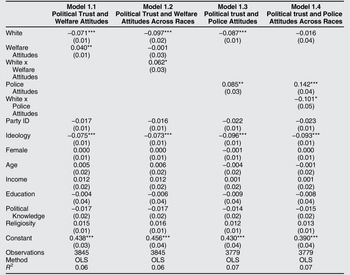
Model 1.1 in table 1 looks at the relationship between political trust and welfare attitudes, with race included as a control variable. Race is measured using a binary indicator of whiteness so that the results create a comparison between whites and people of color, replicating the racial gap in visibility. As expected, welfare spending attitudes show up as significantly linked to political trust, aligning with previous research (Hetherington Reference Hetherington2005). Moving from someone who wishes to see welfare spending decreased to one who wants an increase is associated with a 4% rise in political trust. Ideology and race also show up as significant, indicating that conservatives and whites are less likely to place trust in government.
Racial contingences in the relationship between political trust and welfare attitudes/police attitudes

Source: 2016 ANES, ^p<.1, *p<.05, **p<.01, ***p<.001. Standard errors in parentheses. Significance tests are two-tailed. Survey weights provided by the ANES are employed.
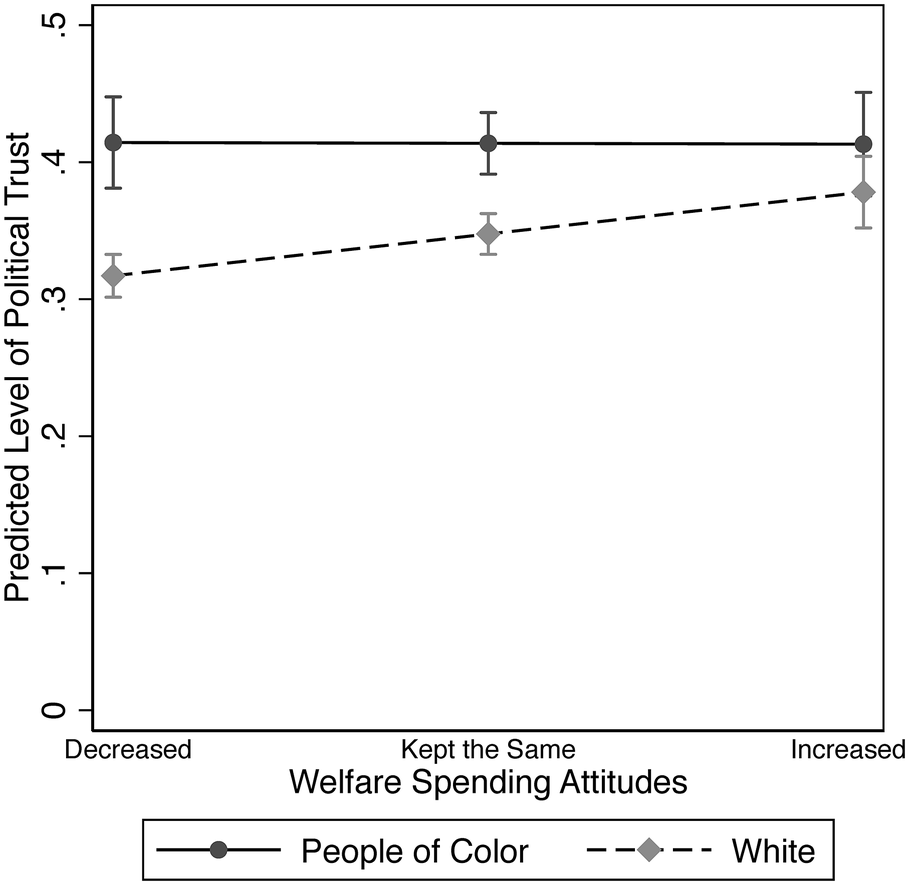
The aim of the analysis, however, is not to identify if whites or people of color trust government more, but rather to identify the parts of the state to which that trust is tied. As such, Model 1.2 includes an interaction between race and welfare attitudes to see if the relationship between welfare and trust is moderated by race. This interaction term is significant and is illustrated using a predicted probabilities plot in figure 1. This figure shows that the relationship between welfare attitudes and trust in government found in Model 1.1, and in previous studies, is entirely driven by the positive association among whites. In strong contrast, the flat line in figure 1 indicates that no significant relationship exists between welfare attitudes and political trust among people of color. A calculation of the simple slopes provided by Model 1.2 reveals that moving from wanting to see welfare spending decreased to increased is associated with a 6% rise in political trust for whites, in contrast to a 0.1% decline among people of color.
Political trust and welfare attitudes by race
Slopes are statistically different at p=.049. 95% confidence intervals shown. All other independent variables are held at their means or modes.
Source: 2016 ANES
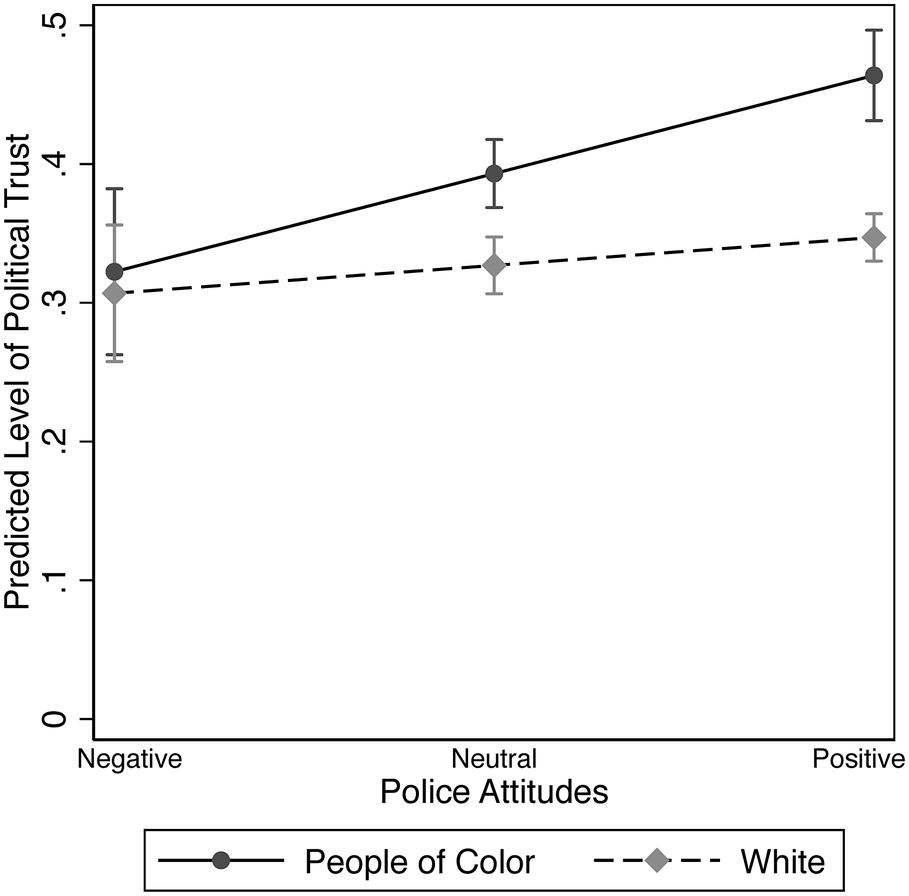
Model 1.3 turns to a focus on the relationship between police attitudes and political trust. Police feeling thermometer scores are substituted for welfare attitudes, with race first included as a control variable. Police attitudes are statistically significant, indicating that individuals grow more trusting of government as they feel more positively about the police. Model 1.4 then investigates the potential for a racial contingency within this relationship by interacting police attitudes with race. The statistical significance of this interaction term demonstrates racial variation in the connection between feelings about the police and political trust, with this variation illustrated in figure 2.Footnote 18
Political trust and police attitudes by race
Slopes are statistically different at p=.048. 95% confidence intervals shown. All other independent variables are held at their means or modes. Source: 2016 ANES
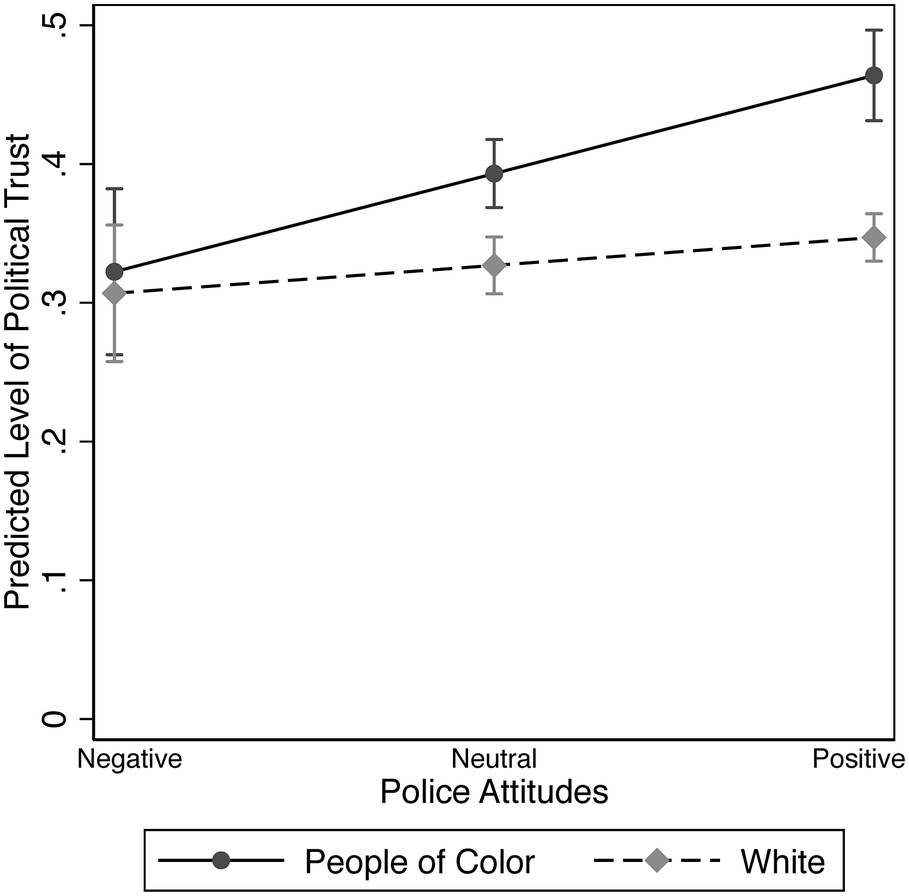
Just as figure 1 showed whites driving the results, figure 2 shows that the significant relationship between feelings about the police and trust is really a reflection of the attitude associations held by people of color. Where the slope for whites in figure 2 is statistically flat, the slope for people of color shows that political trust levels among this population are strongly linked to police attitudes, with the most distrusting people of color being those who feel the most negatively about the police.Footnote 19 The simple slopes from the coefficients in Model 1.4 further show that moving from the most negative to positive police evaluations is associated with a 14% increase in trust among people of color, but just a 4% increase for whites. This fits with the framework’s assertion that the visibility of the CLS for people of color means that one’s feelings about it are tied to one’s understanding of government as a whole.Footnote 20
Conclusion
I began by arguing that attention should be paid not only to parts of government that have become more hidden, but also to parts of the state that have become more visible, as well as the racial variation within that visibility. Through this effort, I uncover five trends within America’s policy system that have created both real and perceived racial disproportionalities, with these trends working together over the last fifty years to generate a racial split in government visibility. For whites, this involved the growth of hidden social policies alongside policy changes and political strategies that grew the visibility of racialized poverty policies and taxation. The combined impact of these three trends has made it more difficult for whites to see how they personally benefit from the state and easier to see how government takes “their” tax dollars to fund programs perceived as benefitting racial others. For people of color, get tough on crime policies clashed with the declining legislative attention devoted to civil rights, making the criminal legal system a uniquely visible manifestation of government. To demonstrate the political importance of this variation, I argue that people use conspicuous manifestations of government as the anchor points to which they tie their broader evaluations of government. As a test of this proposition, the racial split in government visibility is applied to an understanding of the historically low levels of political trust in America. Ultimately, these results show that political trust is attached to the parts of government made most visible in people’s lives, meaning that welfare connects to cynicism among whites, while people of color attach their own mistrust to the police.
Brought together, these findings address a disconnect between the government visibility literature and REP scholarship, ultimately providing contributions to both. For submerged state scholars, I provide a more comprehensive account of government visibility in two ways. First, I show that the conventional wisdom has implicitly focused on white Americans, neglecting policy shifts that primarily impacted state visibility among people of color. Second, the findings show the importance of considering the parts of government that have become more visible for white Americans as well, namely taxes and welfare. For REP scholarship, these findings help to illuminate how a focus on government visibility can improve understandings of political distrust among people of color (Nunnally Reference Nunnally2012). Finally, for both sides of this disconnect, these findings show the value of pursuing more research that connects policy feedback to race (Michener Reference Michener2019).
By studying this previously underexplored racial variation in political trust attachments, these findings have important implications for our understandings of political trust more broadly. First, any effort to increase trust must consider these diverse anchor points. It is important to be mindful of this diversity when discussing the need to make the state more visible to increase political trust. These findings show trust can only be comprehensively increased by making certain parts of the state more visible while decreasing the presence of other entities. Second, considerable scholarship has sought to unlock the connection between political trust and participation (e.g., Gamson Reference Gamson1968; Citrin Reference Citrin1974). Future research might consider how the racial contingencies found within these trust attachments could also lead to political trust having racially divergent participatory consequences.
Additional avenues of research are also opened up, particularly considering the limitations imposed by placing the dividing line in government visibility between whites and people of color. As with any form of boundary placement, I illuminate certain understandings at the expense of others. There are important forms of heterogeneity within each of these racial groups, particularly as they are crossed by other social dimensions, such as class, gender, sexuality, ethnicity, and immigration status. While the interviews showed race to be the strongest dividing line in government visibility, they also showed variation across other dimensions.Footnote 21 Indeed, the earlier reference to women and men of color experiencing police visibility through different mechanisms illuminates the value of taking intersectional differences into account in future scholarship. Importantly, the adaptation of the RFF put forward here can easily be utilized to investigate other forms of social variation within government visibility, helping to create a more comprehensive account of how the state manifests itself in contemporary America.
Supplemental Materials
Appendix A contains the full interview protocol, as well as an explanation of the interview data coding process, interviewee demographic information, the process of selecting interview sites, and a discussion of interviewer bias. Appendix B provides a full list of the survey questions used in the quantitative analysis and the method in which they were coded. Appendix C includes several robustness checks of the quantitative analysis, as discussed in notes 17, 18, and 20.
To view supplementary material for this article, please visit http://dx.doi.org/10.1017/S1537592720002200.