INTRODUCTION
Integrated coastal zone management (ICZM) has been defined as a ‘dynamic process that brings together governments and societies, sciences and decision makers, public and private interests for the production and implementation of a program for the protection and development of coastal systems and resources’ (Cicin-Sain & Knecht Reference Cicin-Sain and Knecht1998, p. 39). Collaborative approaches acknowledge the increasing emphasis on integrating local knowledge and local control in management decisions, engaging political agents and processes through political devolution of authority to a more local context (Margerum Reference Margerum2007). ICZM formally acknowledged the need for opening ‘vertical’ and ‘horizontal’ dialogue. Vertical integration brings together institutions and administrative levels within the same sector at local, regional and national levels, to help communication among political levels and to assist development and enforcement of legislation. Vertical integration in decision-making ensures that information and experience from local sociopolitical scales contribute to policy and governance facilitating effective financial and administrative management. Horizontal integration brings different sectors together at the same administrative and social scale to allow competing interests to cooperate in management (Cummins et al. Reference Cummins, Mahony and Connolly2003; Bonnet et al. Reference Bonnet, Aulong, Goyet, Lutz and Mathevet2005). ICZM practices now tend also to emphasize engagement of civil society in governance (European Commission 2000, 2007).
There has been growing use of ICZM for coastal governance, however ICZM is fully implemented in only 12% of cases, while 50% are developing approaches in ICZM (Sorensen Reference Sorensen2000; Westmacott Reference Westmacott2002). European evaluations have also identified a wide variety of approaches to ICZM (Shipman & Stojanovic Reference Shipman and Stojanovic2007).
Effective application of ICZM in Europe is limited by funding, conflicts of interest and power struggles (Bellamy et al. Reference Bellamy, McDonald, Syme and Butterworth1999; Shipman & Stojanovic Reference Shipman and Stojanovic2007), yet the Barcelona Convention's ICZM protocol now requires all countries bordering the Mediterranean Sea to develop collaborative ICZM strategies (Trumbic Reference Trumbic and Ozhan2009). Extension outside of Europe and the inclusion of participatory processes increase the challenges of ICZM. Diverse systems of governance with a range of civil society traditions mean that mobilizing the same ICZM approaches across different contexts has proved problematic (Hofstede Reference Hofstede2001; Trumbic Reference Trumbic and Ozhan2009; Zikos Reference Zikos2010). Analysing interactions in the process of collaboration is key to understanding the influence of sociopolitical scales in ICZM (Dietz & Stern Reference Dietz and Stern2009; Zikos Reference Zikos2010). The conceptual appeal of ICZM is not necessarily appropriate in every situation (Bellamy et al. Reference Bellamy, McDonald, Syme and Butterworth1999).
Governance relationships of a region may be revealed through social network analysis (SNA) to expose the dynamics of power and interaction between interests and sectors. Social networks are formed by actors connected through their significant relationships (Prell et al.2009). Social capital, reciprocity and relations of trust are key elements of social networks. Activity within networks exposes actors pursuing their interests in addition to the constraints applied by the norms in social structure (Wardell-Johnson Reference Wardell-Johnson2007). Each actor enters into the network with a certain level of power, and the power is accentuated or reduced in response to the interactions in the network (Bagla-Gokalp Reference Bagla-Gokalp2000). Identifying and understanding these horizontal and vertical interactions provides insight into potential limitations and success of cross-scale ICZM governance.
Network form and character are key factors in evaluating the quality of linkages between individuals and groups (Moon Reference Moon, Lawrence, Higgins and Lockie2001). Social networks are activated and mobilized in a differentiated and selective manner. Direction of network interactions depends on the type of social capital available, the currency or resources available, the relationships between the network members, the norms and culture of groups, and the identities of the individuals concerned (Field Reference Field2003).
Social networks are facilitated through horizontal and vertical links. Horizontal networks involve cooperation between agents holding equal status and power. Horizontal networks include both formal and informal relationships with a high potential for civil engagement. Participation processes evident in horizontal networks give rise to cooperation and increase bridging social capital that spans social scales (Steinfield et al. Reference Steinfield, DiMicco, Ellison and Lampe2009). Vertical networks link agents with asymmetrical hierarchical status and dependence in different sociopolitical contexts (Steinfield et al. Reference Steinfield, DiMicco, Ellison and Lampe2009). These formal relationships in vertical networks tend to be more static comprising formal relationships with less flexibility. Formal networks based on formal relationships (with more vertical links) show a lower capacity to generate innovation and adaptive capacity, while informal networks (with more horizontal links) have a lower capacity to consolidate innovation and adaptation to practice (Hanneman & Riddle Reference Hanneman and Riddle2005; Wardell-Johnson Reference Wardell-Johnson2005; Prell et al. Reference Prell, Hubacek, Quinn and Reed2008). To be effective, ICZM governance based on participatory process and striving for collaborative outcomes must accommodate both formal institutional frameworks (vertical links) to link power across social scales and informal networks (through horizontal links) to engage local level collaboration to develop appropriate innovation and adaptive behaviour.
Almost all networks are combinations of horizontal and vertical ties (Putnam Reference Putnam1993). While the different positions in each network offer greater or fewer advantages, the relationships between the positions are dynamic (Mela Reference Mela, Bertuglia, Fischer and Preto1995). The movement (interactions) within a social network transforms the network into a model of organization and action (Bagla-Gokalp Reference Bagla-Gokalp2000) with characteristics comprising a distinct form of social capital. All relationships within a network have both positive and negative aspects. SNA often portrays the positive aspects of relationships within the network. This research also examines the negative, absent or conflicting relationships as they provide insights into the limitations of governance processes in participation (Libianca & Brass Reference Labianca and Brass2006; Csaba & Pal Reference Csaba and Pal2010).
Interactions between individuals, communities and societies and their environment are not well understood or taken into account in environmental politics (Brinkley et al. Reference Brinkley, Fisher, Gray, Lawrence, Higgins and Lockie2001). Lack of understanding of institutional structures and the sociocultural values of the local population has in consequence increased pressure on ecological processes. The participation of local actors can be instrumental in forming social capital and maintaining the resilience of these systems (Moore & Westley Reference Moore and Westley2011; Traerup Reference Trærup2012). Conversely, the lack of consensus and participation within social networks collaborating in ICZM could result in systemic vulnerability reducing resilience and adaptive capacity of both ecological and social systems (Wardell-Johnson Reference Wardell-Johnson2007). A ‘translator’, sometimes played by mixed syndicates or boundary organizations that span and integrate across sociopolitical landscape scales (Cash & Moser Reference Cash and Moser2000; Cash et al. Reference Cash, Adger, Berkes, Garden, Lebel, Olsson, Pritchard and Young2006), can create and consolidate links between competing interests, resulting in the reorganization and redefinition of relationships, and thus stabilize a vulnerable system (Bagla-Gokalp Reference Bagla-Gokalp2000; Labianca & Brass Reference Labianca and Brass2006). Analysis of the entire set of relations allows for the identification of sectoral interests a posteriori in an inductive manner, to better understand how the relationships affect the functioning of a governance network (Bagla-Gokalp Reference Bagla-Gokalp2000). Network analysts describe the way that an actor is embedded in a relational network through constraints on the actor, in addition to opportunities dependent on position in the network. Actors with fewer constraints and in favoured positions often have greater influence (Hanneman & Riddle Reference Hanneman and Riddle2005).
This study analysed social networks evident in ICZM to compare collaborative governance in two Mediterranean deltas, the Camargue (southern France) and Gediz Delta (western Turkey). The research was based on social catchments, standardized questionnaires, face-to-face interviews and SNA to examine the social networks in both deltas. The premise of the study was that distinct differences in the social networks could affect the implementation of integrated management strategies. We addressed three overriding questions: (1) Who are the actors involved in coastal governance? (2) Which relational factors impacted effective ICZM? and (3) What was the role of different governance models and local context in ICZM implementation? Effective cross-scale collaboration in ICZM is critical to achieving both global-scale governance objectives, as well as conservation objectives in local settings. A comparison of social networks of two Mediterranean deltas provided an insight into points of intervention necessary to achieve local-level implementation and consolidation of adaptive behaviour and innovative practice.
METHODS
Study sites
The wetlands in southern Camargue and Gediz Delta have similar habitats, species, levels of human impacts and threats (urbanization, pollution, erosion). The Camargue is a Biosphere Reserve designated through the Man and Biosphere Programme of the United Nations Educational, Scientific and Cultural Organization (UNESCO). The Camargue is one of the largest wetlands in the Mediterranean basin and is of international importance for waterbird breeding, staging and wintering (Ramsar 2007). The water flow of the Rhone River has been completely modified over the past 2000 years with the construction of dams and protective dykes, creating a delta that is highly dependent on human intervention to maintain the existing habitats or to create new ones (Mathevet Reference Mathevet2004; Mullins Reference Mullins2009). The Natural Regional Park of the Camargue encompasses >80 000 ha within the central delta, with c. 15 000 ha of national natural reserve of restricted use. Long-term cultural values of this delta are reflected in the socioeconomic activities, which include horticulture, agriculture, livestock production (equine and bovine), hunting, tourism and salt production. These activities have both defined sociocultural association and ensured economic survival of traditional production in the region. The recent purchase of 6000 ha of ex-salinas by the Conservatoire du Littoral has created a new system of governance in the south of the delta, with tri-party management between a local mixed syndicate (comprised of governmental representatives, private businesses and civil society) and two local non-governmental organizations (NGOs). The Camargue was previously characterized by large and influential private landowners; however, progressively more land has been allocated to public ownership. This evolving situation has resulted in new alliances and power relationships, changing past social network systems. Current management depends on effective collaborative ICZM governance.
The Gediz Delta, adjacent to Izmir, is also among the most important wetlands of the Mediterranean region. The delta extends over 40 000 ha and includes a range of habitats, including alluvium islands, seasonally flooded meadows, reed beds, Mediterranean shrublands, agricultural areas and saline pools. In winter, the Gediz Delta hosts 80 000 wetland birds; among those there are 28 globally- and European-listed endangered species. The delta has been declared a Ramsar site and an ‘Important Bird Area’ (Magnin & Yarar Reference Magnin and Yarar1997). Due to its climate and feeding areas, the delta is an important winter roosting site for water birds commonly found in Eastern Europe. The Gediz Delta also has economic and aesthetic importance. Significant socioeconomic activities include salt production, fishing and agricultural production (cotton, corn and vegetables). The overall management of the delta is currently under the jurisdiction of the Turkish Ministry of the Environment (National Parks division). The daily management of the reserve is undertaken by a governmental union formed by local municipalities (Izkuş). The salinas within this delta are privately owned and managed by a private enterprise. Two of the principal lagoons, set aside for conservation purposes, are managed directly by the Aegean University in Izmir and dedicated to fisheries research.
Social network analysis
Evaluating relationships of actors within a social network analysis involves a range of statistical measures. Key measures relate to ‘centrality’. ‘Centrality’ is most often used to identify key positions, thus giving clues to the power partition within the network (Everett & Borgatti Reference Everett and Borgatti2005a). Centrality can be measured using a variety of indicators including ‘degree’, ‘betweenness’, ‘closeness’ and ‘eigenvector centrality’. ‘Degree’ measures network activity by calculating the number of direct connections an actor has with other actors but does not give information on how they are connected (Hanneman & Riddle Reference Hanneman and Riddle2005). ‘Betweenness’ is the probability of an actor being on the shortest path between any two points in the network, indicating the shortest path between actors (Everett & Borgatti Reference Everett and Borgatti2005b). An actor with high ‘betweenness’ has great influence over process and quality of interactions in the network. ‘Closeness’ determines the actors that have the shortest path to be connected with all of the other actors. Actors with the highest level of ‘closeness’ have the best visibility into what is happening in the network (Hanneman & Riddle Reference Hanneman and Riddle2005). ‘Eigenvector centrality’ is a measure of the influence of an actor in a network. A relative score was attributed to all actors in the network based on the concept that connections to high-scoring actors have more influence than connections to low-scoring actors. The analysis of centrality of social networks allowed for the comparison of the structure and functioning of different networks.
Social catchments and stakeholder selection process
A deliberative sampling strategy was applied in this research to take into account a range of community types and representations (Wardell-Johnson Reference Wardell-Johnson2007; Wardell-Johnson et al. Reference Wardell-Johnson, Selvaratnam, Ramakrishna, Wardell-Johnson, Amram, Selvaratnam and Ramakrishna2011). This included categories for cross-scale governance and social interactions of a social catchment in the context of place. This allowed for both the incorporation of stakeholders legitimately acknowledged in the network and others that are implicated, yet often overlooked as ‘silenced’ communities (Prell et al. Reference Prell, Hubacek, Quinn and Reed2009; Wardell-Johnson Reference Wardell-Johnson, Wardell-Johnson, Amram, Selvaratnam and Ramakrishna2011). Thus, social catchments included communities defined in three principal categories: (1) communities of place, tied to a physical space through geography, (2) communities of identity, tied to each other through social characteristics but may transcend place and, (3) communities of interest, with commonalities in how they relate to a particular ecosystem or resource (after Duane Reference Duane1997). The three types of communities were included in order to account for the full range of human concerns.
Furthermore, actors representing a range of social conflicts were included: (1) cognitive conflict (people with different understanding or judgments), (2) values conflicts (dispute over what is desirable or undesirable in terms of goals and objectives), (3) interest conflicts (difference in the distribution of costs and benefits occurring from an action), and (4) relationship conflicts (power relationships between actors) (Duane Reference Duane1997).
The social catchments also included three principal power relationships: status quo (current normative social arrangement that hold standing); subjugated (groups that at best have minimal influence on decisions being made or at worst have withdrawn into a refuge and developed a collective form of expression as a result of external force); and subject communities (developed around a collective and internal source of commonality arising in relation to other groups, which defines their difference) (Guattari Reference Guattari2000; Wardell-Johnson Reference Wardell-Johnson2007). Other categories included scale of sociopolitical influence (micro, meso and macro scales in both formal and informal relationships) and context of representation (local, government, business/professional, non-governmental and academic). These parameters defined a matrix for stakeholder selection. Understanding ICZM as operating within a social catchment, thus extending the boundaries of a conventional hydrological catchment, allowed the integration of the influences and impacts from an extended sociopolitical world. Local people have a role in decision making about that place, but people acting through political and policy decisions in national and global contexts contribute significant influence (Wardell-Johnson Reference Wardell-Johnson, Wardell-Johnson, Amram, Selvaratnam and Ramakrishna2011).
Participants for the survey were selected using social catchments. This was achieved using a matrix to ensure that all key positions were represented by at least one individual. Four key positions were identified in each delta governance network. Participants were selected by identifying firstly the ‘captured’ actors in the networks, and then by identifying the ‘critical’ actors that did not appear as recommendations or who were not part of status quo decision-making processes. These actors were identified through peers and associates, or through formal positions in organizational structures (such as business managers, or NGO or interest groups) and through word of mouth recommendations. This sampling methodology ensured a comprehensive representation of actors within these governance networks.
At least one representative from each organization (governmental and non-governmental) was selected. Given the different organizational structures and profiles of different actors within the same structure, some organizations were represented twice (one actor for strategy positioning and one for daily operational positioning). The network sample was then edited (some of the original actors were eliminated from the list and others added) to make representation more appropriate to a comprehensive governance network. A total of 23 actors responded favourably to the questionnaire in Camargue (96% response rate). In the Gediz Delta, 22 actors participated (65% response rate).
Social networking questionnaire
The social network questionnaire was developed to provide data on (1) frequency of contacts, (2) quality of contacts, (3) information flow and (4) subject matter. The survey comprised a total of four questions with a total of 56 variables possible for each participant. The first question gathered data on most frequent contacts, information flow and subject matter. The categories for coding frequency were: weekly encounters (5), monthly encounters (4), encounters every three months (3), biannual encounters (2) and encounters once a year or less (1). This question provided data to indicate the quantity of information that was exchanged and identify the actor providing the information (Appendix 1, see supplementary material at Journals.cambridge.org/ENC).
The contribution of the contacts to the structure and flow of network governance interactions was evaluated through questions two and three. The categories were coded as supportive, conflicting or neutral, with a qualitative section providing the opportunity to explain the reasoning. The fourth question gathered data on information sources.
The introduction to the questionnaire stressed the neutrality of the interviewer. Confidentiality of the interviewee was emphasized to reduce the risk of bias in the responses. Each participant also signed an ethics statement form demonstrating willingness to participate and confirming an understanding of confidentiality of information. The interviews were conducted over a three-month period from October to December 2011. The survey questionnaire was administered through face-to-face interviews made by a representative of the research team, and each interview lasted approximately thirty minutes.
Data analysis
Responses were coded into six principal macro structure clusters to differentiate actors (Prell et al. Reference Prell, Hubacek, Quinn and Reed2008). The clusters of actors were coded as: (1) mixed syndicates (syndmix), (2) governmental organizations (go), (3) NGOs/associations (as), (4) universities (univ), (5) private businesses (priv), (6) local residents (lp) and (7) user groups (use). The social network analysis using these a priori clusters of actor categories was conducted using the NetDraw software package (Hanneman & Riddle Reference Hanneman and Riddle2005), which permitted the use of multiple relationships, node attributes and basic analytical procedures (Borgatti et al. Reference Borgatti, Everett and Freeman1999). The cumulative results were then analysed using percentages to determine the relationships between the different types of contacts (such as most frequent contacts, most supportive contacts, most conflictual contacts and information sources). ‘Centrality’ was calculated using ‘degree’, ‘betweenness’, ‘closeness’ and ‘eigenvector indicators’. The results from the two sites were then compared and interpreted.
RESULTS
Camargue
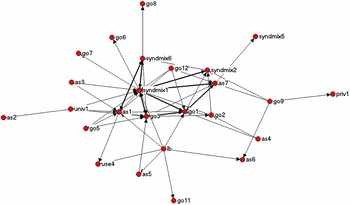
Reciprocal ties were found for 8 of the 23 actors, all of which shared strong central positions within the network (Fig. 1). The key positions were all in the status quo category and are classified by different types of macro structure clusters (a mixed syndicate, two governmental organizations and a NGO). The four key positions accounted for 64% of the contacts within the network (Fig. 1). Grouping all actors by macro structure cluster (mixed syndicate, governmental organization, NGO, private business, local resident and users) demonstrated the relative importance for each cluster within the network. Governmental actors accounted for 46% of the most frequent contacts, followed by 40% for the mixed syndicates and 13% for the NGOs. The actor with the highest centrality was a mixed syndicate, with a centrality degree of 58% and eigenvector score of 0.457. The actors (total n = 7) on the periphery represented communities of interest and conflict. The peripheral actors were from both governmental and non-governmental organizations.
Social network of the most frequent contacts and reciprocal ties between actors in the southern Camargue (go = governmental organizations, syndmix = mixed syndicates, as = NGO, priv = private businesses, univ = universities and use = local users). The dark black lines represent reciprocal relationships between actors, the number of arrows or links represents the strength of each cluster and the direction of the arrows represents who is providing the information.

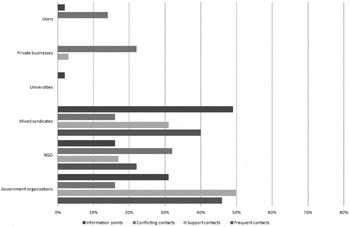
The response rates providing data on supportive and conflicting contacts in the Camargue were 65% and 70%, respectively (n = 15 and 16) as some participants preferred not to share this information. Supportive relationships had fairly tight clusters with some dispersion. Grouping of all actors by macro structure cluster demonstrated that 50% of the support was provided by government actors, 31% by mixed syndicates and 17% by NGOs. The actors that recorded least support were those with values conflicts (involving judgement on the appropriate use of the land). These agents were either disconnected from the central network or located at the periphery. Grouping demonstrated that 32% of the conflicts were related to actors from NGOs, 22% from private businesses, 16% from both mixed syndicates and governmental organizations, followed by 13% from diverse users (Fig. 2). Two of the three actors that ranked the highest scoring for number of conflicting contacts were ‘subjugated’ actors, who were currently changing status or no longer maintained the same land-use rights. The third actor with the most conflicting contacts was cited mostly for personal relationship conflicts. The grouping by category showed that the information sources were mixed syndicates (49%), followed by NGOs (31%), governmental organizations (16%), and universities and users (2%).
The relative weight of each category according to the type of contact (frequency, supportive, conflicting or information source) for the southern Camargue.

The cumulative scores identified a mixed syndicate (Fig. 1, ‘syndmix1’) as the most frequent and most supportive actor, as well as being the most important information source. This same actor was never cited in relation to conflict. This mixed syndicate was in the community of place category and was a meso scale actor holding a status quo power position. A private business that was most often identified as a conflicting relationship was never cited as a most frequent contact by any of the actors (Fig. 1, ‘priv 1’). This actor had a subjugated power position and was categorized by community of place in the social catchment sampling. The three actors that were cited most often as information sources were the comanagers (Fig. 1, ‘syndmix1’, ‘as1’ and ‘as7’) of the protected area and were in the status quo category. The university sector was solely identified in the information source category.
Governmental organizations, NGOs and mixed syndicates were all evident in each type of contact (frequent, supportive and conflicting) and were identified as information sources (Fig. 2). Conversely, private businesses and users were identified principally in conflicting relationships.
Gediz
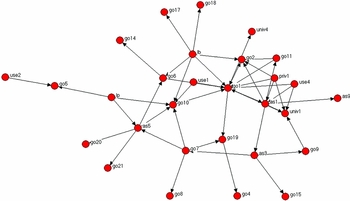
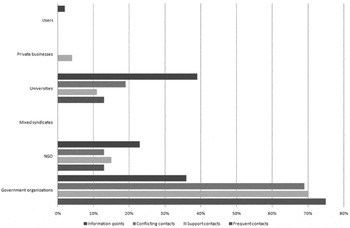
Reciprocal ties were found for three actors, all of which shared strong central ties within the network (Fig. 3). The central positions were shared between two macro structure clusters (governmental organizations and universities). The four most significant actors (Fig. 3, ‘go 1’, ‘go 2’, ‘univ 1’ and ‘gov 10’) accounted for 54% of the contacts within the network. Grouping all actors by macro structure cluster (governmental organization, NGO, private business, local resident and users) demonstrated the relative importance of each category within the network. There were no mixed syndicate groups identified in the sampling matrix, indicating that there were no current structures that integrated governmental and non-governmental structures in a formal institutional relationship. Governmental actors accounted for 75% of the most frequent contacts, followed by 13% for both universities and NGOs (Fig. 4). The actor with the highest centrality was a governmental organization, with a centrality of 42% and eigenvector centrality score of 0.509.
Social network of the most frequent contacts and reciprocal ties between actors in the Gediz Delta (go = governmental organizations, syndmix = mixed syndicates, as = NGO, priv = private businesses, univ = universities and use = local users). The dark black lines represent reciprocal relationships between actors, the number of arrows or links represents the strength of each cluster and the direction of the arrows represents who provided the information.

The relative weight of each category according to the type of contact (frequency, supportive, conflicting or information source) for the Gediz Delta.

Supportive relationships had some distinct clusters, and the three most frequent contacts were also identified as the three most supportive actors (Fig. 3, ‘go1’, ‘go2’ and ‘univ1’). All three of the actors were identified in the sampling matrix as being in the status quo power category, communities of interest and meso scale actors. Two of the three most frequent contacts were also identified as actors with conflicting relationships. The network of actors with conflicting relationships was very dispersed with low indices of multiple responses. The conflicting relationships were due to values and relationship conflicts (power relationships and conflicting personalities).
Seventy per cent of the support was provided by government actors, 13% by non-governmental actors, followed by universities (11%) and private businesses (4%) (Fig. 4). Sixty-nine per cent of the conflicts were related to governmental actors, 19% were related to universities and 13% to NGOs. The cumulative scores identified one actor (Fig. 4, ‘go1’) as the most frequent, most supportive and most conflicting contact.
One actor (Fig. 4, ‘univ1’) was stated as an information source by 34% of the responses, followed by 13% for both a governmental actor and a non-governmental actor (‘go1’ and ‘as1’). The grouping by macro structure cluster redistributed the balance of information sources, with 39% of the actors coming from universities, 36% from governmental organizations and 23% from NGOs.
Relationship conflicts were the most frequent type of conflict in both deltas, followed by values conflicts, cognitive conflicts and interest conflicts.
DISCUSSION
The social catchments used provided a sound basis for identifying the range of actors involved at different scales. We judge this sampling model comprehensive for this research, given that >90% of the actors identified during the interviews had already been identified as potential participants in the study and were included in the sampling for the networks analysis. Potential bias in this model could derive from many actors (particularly in the Camargue) being initially selected for one specific category, but in fact playing multiple roles (for example, the local mayor was also the president of the mixed syndicate and had business investments in the area, or a local businessman was also a hunter and involved in a local association). As most actors were not really capable of separating their different personal and professional associations, there was some overlap in category types. However, this network analysis captured a full range of relationships between the various categories outlined in the deliberative sampling methodology criteria for the social catchment, as well as between the actors contributing as participants in the research.
The study had varying response rates for each of the questions with relatively high rates (>70%) for the questions related to frequency of contacts, supportive contacts and information sources in both sites. The response rate for conflicting interactions was relatively low for the Gediz Delta (36%), which could indicate a lack of confidence during the interviews. Trust is a key facet of social capital (Moore & Westley Reference Moore and Westley2011; Traerup Reference Trærup2012), and the differences in institutional structures may account for the low response rate for this question in the Gediz Delta.
The high level of centrality among different types of actors in the Camargue encouraged communication, trust and the maintenance of norms within the existing social network. Horizontal integration and participation of civil society likely contributed to a collaborative ICZM governance approach there. More reciprocal ties were identified in the Camargue network, suggesting a more stable network of equal relationships compared to the Gediz network, which had limited reciprocity, suggesting more hierarchical relationships (Hanneman & Riddle Reference Hanneman and Riddle2005). The social network in the Gediz Delta relied heavily on government actors with weaker degree centrality. Hierarchical relationships tend to promote the flow of new information and bridge diverse actors and groups (Prell et al. Reference Prell, Hubacek, Quinn and Reed2007, Reference Prell, Hubacek, Quinn and Reed2009), indicating better vertical integration for ICZM in the Gediz Delta.
Despite the higher levels of degree found in the Camargue, the eigenvector score for ‘go1’ in the Gediz Delta was higher than the ‘most influential actor’ in the Camargue. The higher score demonstrates that although degree was important in network centrality, the number of contacts could have less weight or influence than the other centrality indicators (Everett & Borgatti Reference Everett and Borgatti2005a). None of the actors in the Camargue had a score >0.5. However, both networks had several actors with scores >0.3, indicating multiple dynamics of influence in both deltas. The significant influence of a government organization in the Gediz Delta reinforced status quo power. However, the influence of a non-government organization in the network helped redress the power imbalance with the subjugated actor. This reallocation of power in the social network structure contributes to an increase in resilience (Moore & Westley Reference Moore and Westley2011).
In both networks, reciprocal ties were found between actors in the status quo category, suggesting more contact and collaboration between actors holding power (Skvoretz & Willer Reference Skvoretz and Willer1993). There were no ties between subjugated actors in either site, reducing the possibilities of a counterbalance of power or the expression of marginalized voices. This suggests that ICZM in both deltas was based on a collaborative approach favouring status quo actors, with subjugated communities appearing to remain excluded from active participation. There were no reciprocal ties between status quo and subjugated actors, indicating a lack of communication flow or the predominance of hierarchical relationships (Prell et al. Reference Prell, Hubacek, Quinn and Reed2009). Only actors holding official titles or status in organizations were identified as ‘most frequent contact’. This demonstrates the importance of creating formal structures for engaging civil society and local (meso scale) organizations. If protocols and legislative requirements are in place, formal status has a greater potential to ensure the inclusion of civil society and local communities in general in formal processes of decision making. Given the distinct legislation and governance in each delta, these structures take different forms. These results indicate a need for both delta governance processes to incorporate a range of different actors from subjugated communities in order to provide a more locally integrated and inclusive vision for the management of the deltas.
The lack of communication was a source of conflict in both sites; however, it was the status quo community in the Camargue who identified this problem and the subjugated community in the Gediz Delta who indicated this as the limitation to effective collaborative governance. While opening the lines of communication provides a useful starting point for initiating any type of dialogue in collaborative ICZM, the quality and usefulness of communication is also critical.
Evaluating the sources of conflict through SNA provides specific pathways to ensure improved processes of collaborative governance. Relationship conflicts were the most frequent type of conflict in both deltas, demonstrating feelings of acquiring and losing power. Values conflicts were the second most common type of conflict, indicating contrasting goals and objectives based on how value is allocated in each delta. Cognitive conflicts were more evident in the Camargue, indicating that there were different judgements and understandings at play that appeared not to have resulted in a distinct norm. Interest conflicts were least frequent in both deltas, indicating that the perceptions of distribution of costs and benefits of processes of delta management differed slightly between sectors.
The macro structure clusters demonstrated a clear difference between the two networks and highlighted the need to individualize integrated management strategies to obtain effective implementation. The presence of mixed syndicates in the Camargue provided an established structure for coordination and collaboration, linking governmental actors and civil society. High numbers of ties between a mixed syndicate and other actors (including actors from each of the different macro structure clusters) indicated a greater potential for information flow across the governance network with higher potential to engage and adopt recommendations for local-scale application and ownership of ICZM protocols. The absence of mixed syndicate structures in the Gediz Delta shifted the majority of the weight to governmental actors, with low contribution/participation from civil society (other than the local university). The Gediz Delta had a larger number of diverse governmental actors involved in the social network and the most central actor was also from a government organization. Similar to Prell et al. (Reference Prell, Hubacek, Quinn and Reed2009), the relative balance among the macro structure clusters in the Camargue were conducive to the exchange of information. The homogeneity of government agents in the Gediz Delta reduced conflict, yet it also limited the sources of information and quality of exchange across the governance network.
The presence of civil engagement in the networks was evident through the presence of NGOs, local businesses and users groups with a higher level of engagement in the Camargue compared to the Gediz Delta. Frequency of contacts in three macro structure clusters provides evidence of stronger civil society representation in the Camargue compared with the Gediz Delta. The engagement of NGOs in the Gediz Delta is critical to civil society interaction in the governance process, but must be supported actively in a range of contexts to ensure continued contribution. Grassroots support and general social acceptance ensures civil society's contributions through boundary organizations (translators) representing the public at large (Sekercioglu et al. Reference Sekercioglu, Anderson, Akçay, Bilgin, Can, Semiz, Tavzanoglu, Yokeş, Soyumert, Ipekdal, Saglam, Yücel and Dalfes2011). Limited funding support for NGO presence in the Gediz Delta resulted in poor representation of local interests, people and subjugated communities, in contrast to the Camargue. The public and private funding of NGOs in the Camargue (as demonstrated through the annual reports for ‘as1’ and ‘as7’) has allowed NGOs to persist and grow over recent decades (Tour du Valat, unpublished report 2010). The disparity in funding opportunities between the two sites has a potential for direct impact on the governance networks, limiting cross-scale collaborations and inclusive participatory processes.
Trærup (Reference Trærup2012) cautioned that social networks limited to informal networks have less resilience than those that include formal networks based on formally constituted and recognized formal institutions of governance. Funding for civil society organizations facilitates formal networks that effectively link across sociogeographic scale and will withstand systemic shocks more easily. Thus civil society is better able to contribute to ICZM in the longer landscape management timeframe (Rupprecht Consult-Forschung & Beratung GmbH Reference Consult-Forschung2006). Limited support for civil society organizations and NGOs could eventually be a limiting factor for the effective implementation of ICZM in more centralized governance traditions (Hershman et al. Reference Hershman, Good, Bernd-Cohen, Lee and Pogue1999; R. Bolton, personal communication 2006; Sekercioglu et al. Reference Sekercioglu, Anderson, Akçay, Bilgin, Can, Semiz, Tavzanoglu, Yokeş, Soyumert, Ipekdal, Saglam, Yücel and Dalfes2011).
The positioning of universities in the network also presents a strong point of comparison. University actors in the Camargue network were not in evidence, in general contributing through indirect pathways such as NGOs. The university actors played a significant role in the Gediz Delta, contributing to actual management of public lands. Initially this could imply that research and educational components were less present in the Camargue; however, the objectives of the NGOs in the Camargue compensate for a lack of formal university presence. Five of the eight NGOs that participated in the study have strong environmental research objectives with active links to the university sector. Similar to Turkish conservation organizations (Sekercioglu et al. Reference Sekercioglu, Anderson, Akçay, Bilgin, Can, Semiz, Tavzanoglu, Yokeş, Soyumert, Ipekdal, Saglam, Yücel and Dalfes2011), the Camargue conservation organizations operating in the local context played a significant role in the formal education of young biologists in practical training for conservation. The major difference between the university macro structure clusters was the formal management role played by the university in the Gediz Delta (Mermet et al. Reference Mermet, Billé, Leroy, Narcy and Poux2005). Understanding the role of the university in the Gediz Delta context provided an insight into the role of macro structure clusters in civil society. If the university is to represent civil society in the management of the Gediz Delta, careful attention must be given to ensure open access by the local community and actors with less income to opportunities for formal education (Stringer et al. Reference Stringer, Dougill, Fraser, Hubacek, Prell and Reed2006). Including local communities as ‘communities of place’ with specific interests is important for effective consolidation of locally-developed innovation and adaptive capacity in delta management.
Current changes in the Turkish constitution and environmental legislation are recentralizing power to the federal government (Sekercioglu et al. Reference Sekercioglu, Anderson, Akçay, Bilgin, Can, Semiz, Tavzanoglu, Yokeş, Soyumert, Ipekdal, Saglam, Yücel and Dalfes2011; Ernoul & Yilmaz Reference Ernoul and Yilmaz2012). The central role of the governmental structures and limited inclusion of civil society in Gediz Delta governance processes could jeopardize Turkey's potential to deliver collaborative ICZM according to existing protocols. In considering the distinct differences in the structure of governance networks between the two sites, the results of this research indicate a need to question the value of uniform conservation strategies, in this case collaborative ICZM governance across the Mediterranean Basin.
CONCLUSIONS
The structural differences in social networks between the Gediz Delta and the Camargue make it difficult to replicate equivalent management in both sites. Considering the different dimensions of collaborative ICZM governance, vertical and horizontal integration could be applied in accordance with the existing governance networks in both deltas. However, given the differences in stakeholder types, power structures and civil society, the third component of ICZM, namely participation, requires individual approaches to better fit the specific governance context. Given the importance of civil society in nature conservation (Vickers Reference Vickers1994; Stringer et al. Reference Stringer, Dougill, Fraser, Hubacek, Prell and Reed2006; Barreteau et al. Reference Barreteau, Bots and Daniell2010), unique models should accommodate sociopolitical context, as well as the sociocultural values within the context of ICZM practice. In support of previous work by Enserink et al. (Reference Enserink, Patel, Kranz and Maestu2007), we advocate against the standardization of ICZM governance strategies and support the implementation of approaches and protocols that account for local governance approaches and existing local sociocultural values. This would accommodate such values and traditions, providing pathways that support sustainability of governance actions and promote conservation strategies that are adequate and applicable to each reality.
ACKNOWLEDGEMENTS
This study was funded by the Foundation Tour du Valat, Foundation Pro-Valat and the Provence Alpes Côte d'Azur Région. We thank Esra Kartal for her indispensible help carrying out the interviews in Turkey and the three anonymous reviewers for the useful comments and recommendations. We acknowledge the essential contribution of all of the interviewees.