INTRODUCTION
There has been considerable discussion in recent years concerning the concept of generalization and specialization in plant–pollinator interactions (Fenster et al. Reference FENSTER, ARMBRUSTER, WILSON, DUDASH and THOMSON2004, Mitchell et al. Reference MITCHELL, IRWIN, FLANAGAN and KARRON2009, Waser et al. Reference WASER, CHITTKA, PRICE, WILLIAMS and OLLERTON1996). Generalists attract a number of animal species for pollination whereas specialists use a few or just one animal species for pollination. The concept represents two ends of a continuum from extreme generalization to obligate specialization (Mitchell et al. Reference MITCHELL, IRWIN, FLANAGAN and KARRON2009). Obligate reciprocal specialization between a plant and the pollinator is found in a limited number of taxa such as figs, yuccas and some orchids.
Reports on pollination in the nutmeg family (Myristicaceae) are contradictory. Several investigators have reported that it displays a specialized beetle pollination syndrome (Armstrong Reference ARMSTRONG1997, Armstrong & Drummond Reference ARMSTRONG and DRUMMOND1986, Armstrong & Irvine Reference ARMSTRONG and IRVINE1989a, Momose Reference MOMOSE, Roubik, Sakai and Hamid2005). A study of the Australian Myristica insipida reported nine species in five coleopteran families as floral visitors (Armstrong Reference ARMSTRONG1997). Curculionids, staphylinids and chrysomelids were reported as pollinators of three species of Knema and one of Gymnacranthera in Sarawak (Momose Reference MOMOSE, Roubik, Sakai and Hamid2005, Momose et al. Reference MOMOSE, NAGAMITSU and INOUE1998a). However, the flower morphology of this family allows open access to pollinators, suggesting that it might also host non-beetle pollinators. Thrips have almost always been found on Myristicaceae but have been established as pollinators only in Horsfieldia grandis in Sarawak (Momose et al. Reference MOMOSE, NAGAMITSU and INOUE1998a) and the neotropical Compsoneura sprucei (Bawa et al. Reference BAWA, BULLOCK, PERRY, COVILLE and GRAYUM1985a). Small, diverse pollinators were reported in a single study on Virola koschnyi (Bawa et al. Reference BAWA, BULLOCK, PERRY, COVILLE and GRAYUM1985a).
The only published study from the Western Ghats of India on pollination in the Myristicaceae was on Myristica fragrans, the cultivated nutmeg, and was carried out in a low-elevation plantation (Armstrong & Drummond Reference ARMSTRONG and DRUMMOND1986). It revealed an anthicid beetle as the principal pollinator but possibly overlooked a larger pollinator community that might have been encountered in a forested landscape (Armstrong, pers. comm.).
We make preliminary observations on the natural history of Myristica dactyloides – quantifying the floral display and reward in male and female individuals of the species, and hypothesizing that male inflorescences are more attractive to insects. We determine the pollinator assemblage in the tree canopy, sorting them out from a larger array of non-pollinating associates. Myristica dactyloides is dioecious and obligately outcrossing. Based on the open-access structure of the flowers, we hypothesize that the tree species is not specialist pollinated and attracts a number of insect species for pollination services. Our main objective was to test this hypothesis by understanding the pollination biology of the species in its natural habitat. We quantify pollinator frequency, pollination efficiency and fruiting success with experimental pollinations, in order to determine whether the population is reproductively limited by a dearth in pollinators.
METHODS
Study species
Myristica dactyloides Gaertn is endemic to India's Western Ghats and Sri Lanka. In the Western Ghats, it inhabits mid- and high-elevation wet evergreen forests (850–1400 m). Myristica dactyloides grows to about 20–35 m, occupying the intermediate stratum just below the emergent canopy (Giriraj et al. Reference GIRIRAJ, MURTHY and RAMESH2008). Myristica dactyloides faces over-harvesting for its seeds and aril (outgrowth of the seed), two valuable non-timber forest products used in the spice trade.
Study sites
A large part of the study was carried out in a population within the Biligiri Rangan Hills (B.R. Hills) Wildlife Sanctuary (11°54ʹ44ʹʹN, 77°11ʹ18ʹʹE, 1366 m asl) in the State of Karnataka in southern India in the flowering season of December 2006 for 10 d during the flowering peak. Some observations on floral visitors and fruit set were repeated in December 2007. In November 2006, we collected some data on insect foragers from another population in the Brahmagiri Wildlife Sanctuary in Karnataka State (11°57ʹ79ʹʹN, 75°58ʹ38ʹʹE, 1169 m asl). Both populations were spread close to perennial streams. In the B.R. Hills population, flowering trees were identified and ladders constructed using indigenous material along the bole of two male and two female trees to access the canopy. One of the female trees did not flower in the second year of our study.
Floral resource
Floral display and reward in male and female trees were recorded as the size of the inflorescence and quantity of pollen and/or nectar. Flowers on a total of 38 inflorescences from three female trees and 35 inflorescences across four male trees were counted. The difference between male and female inflorescence sizes was tested with an ANOVA in R 2.7 (R version 2.7.1, Vienna, Austria), and flower sex was nested by individual tree in this analysis. Female flowers were dissected to examine the number of ovules. Nectar measurements were made using 10-μl microcapillaries (Microcaps, Drummonds UK). To estimate pollen production, a mature but undehisced anther was torn off the fused androecium of a male flower (n = 20 from six male trees), placed in a drop of auromine O, pollen grains teased out and counted under a compound microscope. Pollen viability was assessed on alternate days beginning from the day of anthesis using the fluorescine diacetate (FDA) test (Heslop-Harrison & Heslop-Harrison Reference HESLOP-HARRISON and HESLOP-HARRISON1970).
Insect assemblage
To calculate frequency of floral visits by insects, observations were made in half-hour blocks from 06h00 to 18h00 on two female trees and two male trees for 10 d. In each observation unit, four to six inflorescences were observed at one time. During the second year of study, in the B.R. Hills population, we hung 5 × 10-cm Yellow Sticky traps (Growing Success Ltd., Wiltshire, UK) near flowering inflorescences to determine the visitor assemblage that might have escaped observation. This also allowed continuous monitoring (Armstrong Reference ARMSTRONG1997, Sakai Reference SAKAI2001). We hung ten sticky traps each, on one male and one female tree. They were retrieved after being left in the canopy for 24 h to scan the arthropods trapped.
Pollination
Insects seen foraging were collected using a sweep net and immobilized with ethyl acetate vapour. They were scanned under the stereomicroscope and those seen with pollen grains on body parts were considered the potential pollinators and the others categorized as non-pollinating associates. Identifications were carried out in the Entomology Laboratory at the Ashoka Trust for Research in Ecology and the Environment (ATREE, India) to the level of family or genus. Our data for both populations comprised a negligible number of insect visits directly observed; most insects were captured on sticky traps in the B.R. Hills sampling. In this population alone, we thus pooled the insect visitation data (number of visits per flower per hour from direct observations and absolute numbers of captured insects from the sticky trap method) for the purpose of analysis. The difference in the numbers of visitors to flowers of different sexes was tested using a linear mixed-effect model in R 2.7 with a Poisson distribution of the error term. Flower sex, again, was nested by individual tree in the analysis.
Stigmas from 2- or 3-d-old flowers were scanned under a field microscope (Magiscope, Forestry Suppliers Inc., USA) to observe pollen deposit. Female flowers (41 flowers from three trees), 0–5 d old, were examined under the stereomicroscope for the presence of pollen. Pollination efficiency was determined as the proportion of the total stigmas that had pollen load. We also used DAB (Sigma Fast™ 3,3ʹ-diaminobenzidine; Sigma D-4) tablets to ascertain the per cent viability of pollen grains that had reached the stigma (Dafni et al. Reference DAFNI, PACINI, NEPI, Kevan and Husband2005). Non-viable pollen grains remain light coloured, while viable ones turn a brown-purple-red in DAB.
Fruiting
Data on fruit set were collected from two female trees in the B.R. Hills population alone in February 2007 and February 2008. As flowers of M. dactyloides were held on short peduncles, they could not be tagged individually; before anthesis, they were covered with butter-paper bags to exclude insects. The following day, when one or two buds were open, a full androecium was brought to the receptive flower (81 flowers on two female trees) and pollen daubed on the stigma, younger buds snipped away and the inflorescence re-bagged. Hand pollinations were not carried out in year two due to a technical hindrance in canopy access. Unbagged inflorescences (178 flowers on two trees in December 2006 and 254 flowers on one tree in December 2007) were tagged as open-pollination controls. Developing fruits were scored from both types of pollination about 4 wk later. Per cent fruit set data were transformed using square root-arcsine transformation before employing the analysis of variance in R 2.7 to test the difference in fruit set between hand-pollinated and open-pollinated flowers. Pollination type was nested by individual tree in this analysis.
RESULTS
The flowering canopy
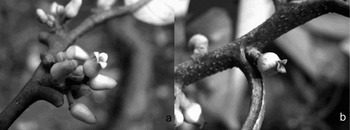
Male trees had an average (± SE) of 9.31 ± 0.38 flowers per inflorescence (n = 4 trees) and female inflorescences (n = 3 trees) were usually smaller with a mean of 6.37 ± 0.45 flowers, and a nested ANOVA showed a significant difference (F = 22.9, P < 0.001, df = 1). Flowers were urceolate, males being narrower and females more rounded (Figure 1a, b). Male flowers lasted 7–9 d and offered no nectar and only pollen as reward; pollen production was estimated to be 786 ± 98 grains per anther (anthers were 6–9 in number and fused). Anthers dehisced at least 24 h before flower opening, as detected when mature buds were dissected. Pollen viability on day one was 28.5% and reduced to 15.5% on day two (FDA test). Female flowers had a wet stigma that remained receptive for 4–5 d and produced no nectar. Some fluid accumulated in the corolla tube of both sexes. The fluid was collected in microcapillaries and tested for sucrose equivalents with a refractometer. The liquid was found to be free from sugars.
Inflorescences on male (a) and female (b) individuals of Myristica dactyloides, Brahmagiri Wildlife Sanctuary, Western Ghats, India.

Insect assemblage
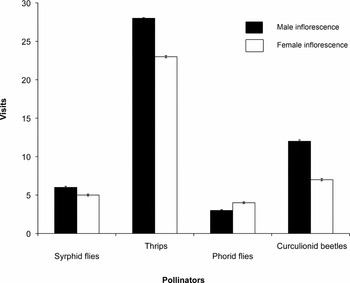
Pollinator visitation as a function of floral display was fitted to a linear mixed-effect model and we found that female inflorescences attracted significantly fewer (Z = 12.7, P < 0.001) pollinators than males (Figure 2).
Visits, as recorded on male and female flowering trees, B.R. Hills, Karnataka, India. Data from direct observations (visit frequency h−1) and sticky trap collections (absolute counts on traps) were pooled in to generate the bar chart.

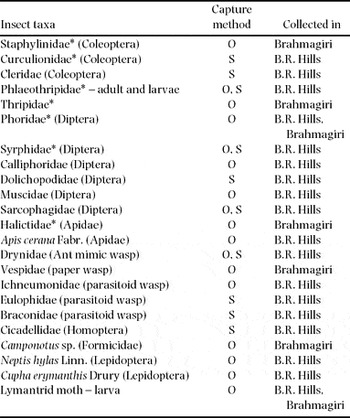
In B.R. Hills, where we used an additional insect capturing technique of sticky traps during the second year of study, a greater diversity of insects was recovered than in the Brahmagiri sampling which consisted of direct observations alone (Table 1). Several beetles belonging to three families were captured; in the Brahmagiri sampling, the staphylinid beetle was detected with a pollen load and in B.R. Hills we found Curculionidae and Cleridae members, of which only Curculionidae showed pollen on their body. Of the two bees seen foraging for pollen, the halictid bee carried a huge pollen load and no pollen was detected on the body of Apis cerana. Two families of thrips were found frequently inside male and female flowers. Three dipterans emerged in the sampling – Syrphidae and Dolichopodidae in B.R. Hills, and a Phoridae captured at both study sites. Syrphid flies had pollen all over their body, mainly on the thorax bristles near shoulders and the phorid fly had a relatively low pollen load. The two dipterans were thus included with curculionid beetles and thrips in the visitation analysis owing to their contribution to pollination. Many of the sticky-trap captures were of non-pollinating associates. Ant-mimicking wasps (Drynidae) and paper wasps (Vespidae) were less frequent visitors at male and female trees in the B.R. Hills population. Butterflies were often seen in the upper canopy, feeding apparently on the fluid stored inside the urceolate flowers.
The insect faunal assemblage captured on direct observations (O) and sticky traps (S) represented in families. Some beetles, thrips and flies were classified as potential pollinators (asterisked) if pollen was detected on their body parts. The two study sites, B.R. Hills and Brahmagiri Wildlife Sanctuaries, are located in the Western Ghats, India.

Pollination efficiency
In the B.R. Hills population, we recorded a high pollination efficiency of 58.5% in December 2006. Presence of pollen on the stigma and age of the flowers appeared to be correlated. Among the 41 flowers examined, >40 pollen grains were located on the stigmas of 4-d-old flowers. Fewer pollen grains (>10) were found on the stigmas of 2-d-old flowers. Pollen was almost always absent on the stigmas of freshly opened and 1-d-old flowers. 67.1% (± 8.9%) of the pollen on the stigma stained deep brown in DAB.
Fruiting success
Fruit production ranged from 1–6 per inflorescence, mean fruit number being 2.1. Mean fruit set in open-pollinated flowers was 22.8% (n = 2) in 2007 (from the December 2006 flowering) and 24.4% (n = 1) in 2008 (from the December 2007 flowering). There was no significant difference (F = 0.62, P = 0.43, df = 1) between fruit set in hand-pollinated (27.2%) and open- or naturally pollinated flowers (22.8%), suggesting that there is no pollination limitation in the B.R. Hills population.
The difference between per cent pollination efficiency (58.5%) and fruit set (22.8%) in the B.R. Hills population indicates that not all flowers that received pollen resulted in fertilization or they were abscised after fertilization or were aborted later as immature fruits. The inflorescence peduncle of a typical Myristica dactyloides is dotted with scars from abscission of flowers and this we noticed during the second and third week of flowering during consecutive surveys. There was a noticeable difference in the total number of buds and flowers originally produced as noted at the time of tagging the inflorescences for monitoring of fruit set (mean = 6.42 per inflorescence) and the number noted about 2 wk later (mean = 4.52 per inflorescence); 29.4% of the flowers had abscised. Apart from flower abscission, at least 20% of the hand-pollinated flowers that had formed young fruits dropped during the first few weeks of development, although we did not quantify this.
DISCUSSION
Looking beyond beetles
Thrips are established pollinators in several dipterocarps of the South-East Asian forests (Appanah & Chan Reference APPANAH and CHAN1981, Ashton et al. Reference ASHTON, GIVNISH and APPANAH1988, Momose et al. Reference MOMOSE, YUMOTO, NAGAMITSU, KATO, NAGAMASU, SAKAI, HARRISON, ITIOKA, HAMID and INOUE1998b), but have been dismissed as pollinators in Myristicaceae studies so far (Armstrong Reference ARMSTRONG1997, Armstrong & Drummond Reference ARMSTRONG and DRUMMOND1986, Armstrong & Irvine Reference ARMSTRONG and IRVINE1989a, Corlett Reference CORLETT2004). We found pollen on some individuals of two thrips of families Phlaeothripidae and Thripidae collected at the female trees in B.R. Hills and Brahmagiri, in contrast to earlier studies on Myristica (Armstrong & Drummond Reference ARMSTRONG and DRUMMOND1986, Armstrong & Irvine Reference ARMSTRONG and IRVINE1989a) that found no pollen on thrips seen abundantly on female trees (Williams et al. Reference WILLIAMS, ADAM and MOUND2001). Flowers and buds of Myristica seemed to act as brood sites for thrips, as in other species (Moog et al. Reference MOOG, FIALA, FEDERLE and MASCHWITZ2002); larvae were often discovered inside the urn-shaped flowers/buds. In a review of thrips pollination, Williams et al. (Reference WILLIAMS, ADAM and MOUND2001) discuss how thrips have the habit of cleaning the pollen off their body when preparing their wings for flight and how this may lead to incorrect conclusions about their effectiveness as pollen transporters. In B.R. Hills, a high density of thrips was observed at one female tree, possibly because it had its branches close to those of the adjacent male tree. Intimate vegetative contact could result in thrips emerging from male flowers causing pollen export to female flowers (Armstrong Reference ARMSTRONG1997). Foraging activity and abundant pollen load on syrphid flies suggested they are significant contributors to pollination. This dipteran family is a key pollinator group in the temperate regions (van der Goot & Grabandt Reference VAN DER GOOT and GRABANDT1970) and in tropical orchids (Pansarin Reference PANSARIN2008) and palms (Schmid Reference SCHMID1970), usually seen along with beetles (Ervik & Feil Reference ERVIK and FEIL1997). Halictid bees were seen foraging at male and female trees. If a bee could gather pollen at a male flower, it could get deceived into visiting a female flower and delivering pollen, just as beetles do (the classical ‘mistake pollination’, Armstrong Reference ARMSTRONG1997). While in M. insipida the stigma filled the perianth opening of the flower, essentially preventing insect entry (Armstrong Reference ARMSTRONG1997), flowers of M. dactyloides were easily visited by bees, flies and butterflies.
Two species of beetle (belonging to families Staphylinidae and Curculionidae) emerged as potential pollinators, and they were encountered in large numbers in comparison to other insects at male as well as female trees. This, however, does not nullify or discount the efficiency of thrips, dipterans and halictid bees as pollinators, all of which were seen to carry pollen load in this study. The chewing mouth-parts of many flower beetles have for long perplexed ecologists (Bernhardt Reference BERNHARDT2000, Grimaldi Reference GRIMALDI1999) since some beetle species are known to combine the roles of floral predator and pollinator. The use of female flowers as suitable sites for agonistic and mating activities (Goldblatt et al. Reference GOLDBLATT, BERNHARDT and MANNING1998, Gottsberger Reference GOTTSBERGER1977, Reference GOTTSBERGER1988) is well known; some beetles prefer the temperature inside the blossom (Bay Reference BAY1995, Bernhardt Reference BERNHARDT2000, Seymour & Schultze-Motel Reference SEYMOUR and SCHULTZE-MOTEL1997), others feed on stigmatic secretion or petals (Momose Reference MOMOSE, Roubik, Sakai and Hamid2005). This appears true in our study too, the wet stigma and urn-shaped flower providing food and shelter for the beetles.
Pollination in Myristica dactyloides is a case of loose mutualistic niche with no single pollinator but a generalist range of them, including possibly a specialist group of beetles, and with increased sampling intensity, a more diverse pollinator assemblage may be found. Early research (Bawa et al. Reference BAWA, PERRY and BEACH1985b, Givnish Reference GIVNISH1980) has suggested that Myristica conforms to a generalized, small-insect pollinator. Corlett (Reference CORLETT2004), in his review of beetle pollination in the South-East Asian forests, emphasizes an overlap between families of Coleoptera in specialist vs. generalist flowers. He points out that taxa belonging to the families Cerambycidae, Curculionidae and Scarabaeidae are most likely to pollinate both specialist and generalists. More recent research (Bascompte et al. Reference BASCOMPTE, JORDANO, MELIAN and OLENSEN2003, Vazquez & Aizen Reference VAZQUEZ and AIZEN2004) produced evidence that generalist plants are often pollinated by specialist and generalist pollinators, while specialist plants tend to be pollinated mostly by generalist animals. Such asymmetry in interactions is only natural in complex tropical system processes. In addition, the pollinator assemblage of individual species is known to vary on a temporal and spatial scale (Fenster & Dudash Reference FENSTER and DUDASH2001, Gomez & Zamora Reference GOMEZ and ZAMORA1999, Lázaro et al. Reference LÁZARO, LUNDGREN and TOTLAND2009, Price et al. Reference PRICE, WASER, IRWIN, CAMPBELL and BRODY2005). Making prior assumptions about specialized ‘syndromes’ can be counterproductive to field studies since generalist pollination is predominant in floral evolution (Corlett Reference CORLETT2004, Waser et al. Reference WASER, CHITTKA, PRICE, WILLIAMS and OLLERTON1996) and plant communities appear to vary along a continuum from generalist to specialist mutualism (Lázaro et al. Reference LÁZARO, LUNDGREN and TOTLAND2009).
Flowering and fruiting
As is true in many tropical dioecious trees (Armstrong & Irvine Reference ARMSTRONG and IRVINE1989b, Wilson Reference WILSON1979), floral display in Myristica dactyloides was higher in male trees than female trees. In addition, the genus displays an exclusive pollen reward system (Armstrong & Irvine Reference ARMSTRONG and IRVINE1989b), making male flowers more attractive to foragers (Eckhart Reference ECKHART1991).
Most of the shortfall in fruit set in our study could be attributed to flower abscission; the rest appeared to have been caused by fruit abortion. The high pollination efficiency and low per cent fruit set in the B.R. Hills population combined with observations on flower abscission and fruit abortion suggest that there is no pollination limitation in the population, though there may be a level of resource limitation (Howe & Westley Reference HOWE, WESTLEY and Crawley1997). Unexplained high abortion rates were encountered in M. fragrans (Armstrong & Drummond Reference ARMSTRONG and DRUMMOND1986) and M. insipida (Armstrong & Irvine Reference ARMSTRONG and IRVINE1989b), and immature fruit abortion has long troubled nutmeg growers in the subcontinent (Flach Reference FLACH1966).
Abscission of flowers and immature fruits is common in cross-pollinated rain-forest trees (Bawa et al. Reference BAWA, PERRY and BEACH1985b). There could be varying adaptive reasons for this, either bet-hedging against uncertainties in resources and pollinators or dispersers, or selective abortion to improve offspring quality (Armstrong Reference ARMSTRONG1997, Stephenson Reference STEPHENSON1981). The function of non-fruiting flowers may be to enhance female display to a level equal to the minimum male display, so these flowers cannot be considered redundant. Female flowers avoid the cost of reward while continuing to invest in the cost of display.
Insects in the evergreen canopy
We found a great diversity of non-pollinating associates of the flowering phase in Myristica dactyloides. The tree's pollinator guild was composed of insects that showed flower constancy at varying levels, with thrips predominantly present during all instances of sampling, and beetles, bees and flies being less constant and prone to spatial variation, as suggested by the site differences in our study (Table 1).
Myristica dactyloides is described as a dominant species (Parthasarathy Reference PARTHASARATHY1999) and a climax species (Giriraj et al. Reference GIRIRAJ, MURTHY and RAMESH2008) in evergreen forests of the Western Ghats, expectedly a component of a mature ecosystem (Turner Reference TURNER2001). In the B.R. Hills Sanctuary, Myristica forms a characteristic canopy component in the Mesua ferrea–Palaquium ellipticum–Olea glandulifera vegetation type (Ramesh Reference RAMESH1989), structurally and floristically different from other formations in the region. Forests in the Western Ghats are severely fragmented and much of the climax vegetation has disappeared (Gadgil & Meher-Homji Reference GADGIL, MEHER-HOMJI, Chopra and Khoshoo1986, Pascal Reference PASCAL1991). Many Myristica populations are victims of unsustainable harvest of fruits – entire fruiting branches are lopped, leaving no branches to flower in the following year (Sharma et al. unpubl. data). These large spatial and temporal gaps between flowering individuals and flowering years in the canopy stratum are in addition to individual variation some female trees show, such as non-flowering years (Queenborough et al. Reference QUEENBOROUGH, BURSLEM, GARWOOD and VALENCIA2007), as was encountered during this study. Floral resource depletion can potentially affect pollinator diversity and movement (Somanathan & Borges Reference SOMANATHAN and BORGES2000), as well as functional guilds that use the floral resource base. Canopy insect studies elsewhere in the tropics have pointed out that beetle families Curculionidae and Chrysomelidae are particularly susceptible to anthropogenic disturbances and that there is distinctly lower faunal diversity in disturbed forests in comparison to primary forests (Floren & Linsenmair Reference FLOREN, LINSENMAIR, Basset, Novotny, Miller and Kitching2003, Speight et al. Reference SPEIGHT, INTACHAT, KHEN, CHUNG, Basset, Novotny, Miller and Kitching2003). We have no studies from the Western Ghats that address canopy fauna at a forest community level (Devy & Ganesh Reference DEVY and GANESH2003). Not knowing enough about what species might be at risk and what processes (including pollination) might be vulnerable up in the canopies puts us in a precarious situation as we draw conclusions on the conservation of trees and insects.
ACKNOWLEDGEMENTS
We thank the Department of Biotechnology, India for funding the study, and the Karnataka State Forest Department for Protected Area permissions. MVS thanks the Wingate Foundation UK for a doctoral scholarship to support this study. Dr Joseph Armstrong, Illinois State University provided clarifications at various stages of research and reviewed an earlier version of this manuscript. Thanks to Dr P.A. Sinu, ATREE for insect identifications, Dr Reinmar Seidler, University of Massachusetts for editorial help, and Mr Kethe Gowda for field assistance.