Implications
The effects of finishing duration were evaluated on animal and carcass performance of Holstein-Friesian (HF) bulls and steers. These systems were also evaluated on the basis of economic performance and greenhouse gas (GHG) emissions. Although extending the finishing duration did not improve carcass weight, fat score or the profitability of the systems, GHG emissions per kg beef were reduced. Results from this study represent opportunities to reduce GHG emissions from the agricultural sector.
Introduction
Maximising animal performance and regulating production costs are central to sustainable beef production systems (Ashfield et al., Reference Ashfield, Wallace, Prendiville and Crosson2014). The traditional blueprint for beef production from male dairy cattle in Ireland incorporated a winter finishing period where cattle were finished indoors on a grass silage ad libitum diet plus concentrates and slaughtered at 24 months of age (Keane and Allen, Reference Keane and Allen1998). However, Murphy et al. (Reference Murphy, Crosson, Kelly and Prendiville2017) recently reported that slaughtering male dairy cattle as bulls and steers at a younger age was more profitable and reduced GHG emissions. In that study greater profit was accrued via higher stocking rates, greater carcass output per ha and dilution of fixed costs compared with the traditional dairy steer production system. In addition, GHG emissions per kilogram of carcass produced was lower when cattle were slaughtered at a younger age.
Murphy et al. (Reference Murphy, Crosson, Kelly and Prendiville2017) demonstrated that pasture-based finishing strategies were more profitable than concentrate intensive finishing strategies despite lower carcass weight and fat score associated with pasture finishing (Murphy et al., Reference Murphy, Crosson, Kelly and Prendiville2017). Prolonging the finishing duration by increasing age at slaughter of beef steers has been shown to increase live weight at slaughter; carcass weight and fat score (Keane et al., Reference Keane, Drennan and Moloney2006). Consequently, increasing the levels of concentrate supplementation during the finishing period or extending finishing duration for cattle finished at pasture represents an opportunity to increase animal performance and reduce GHG emissions.
In the context of a production system sale date is predetermined which influences both age at slaughter and stock carrying capacity. Cattle in production systems that are slaughtered before the second winter are sold in a narrow sales window, with no opportunity to slaughter cattle at an older age. Therefore, the objectives of the current study were to evaluate the effects of extending the finishing duration for the most sustainable bull and steer production systems identified by Murphy et al. (Reference Murphy, Crosson, Kelly and Prendiville2017) and assess the implications of same on overall profit and GHG emissions. A concentrate intensive bull production system and the traditional 24-month steer production system were included as control treatments.
Material and methods
Experimental design and production systems
A total of 90 spring-born HF male calves were assembled in spring 2014 at the Teagasc Johnstown Castle Research centre (52° 17' N, 6° 30' W). Mean date of birth and age at arrival were 6 February 2014 and 23 (SD=6.6) days, respectively. Calves were artificially reared on site until weaning; 80 kg live weight. Post-weaning calves were blocked by date of birth, farm of origin and weaning weight and assigned to one of six treatments in a complete randomised block design; three bull and three steer finishing strategies on 25 April. Calves were pasture grazed during their first season and managed on a rotational grazing system for 193 days. On 4 November calves were housed within treatment group on a slatted floor accommodation and offered grass silage ad libitum plus 1.5 kg DM of concentrate per head daily throughout the winter period.
Bulls were turned out to pasture for the second grazing season on 23 March and fresh pasture was offered daily. Bulls were slaughtered at 19 months of age and were either finished indoors on concentrates ad libitum for 100 days (19AL), finished at pasture supplemented with 5 kg DM of concentrate per head daily for 100 days (19SP) or 150 days (19LP). On 21 April, 19LP were adapted to 5 kg DM of concentrate per head daily in a single feed over a 10 day period at pasture. Similarly on 10 June, 19SP were adapted to 5 kg DM of concentrate per head daily at pasture. Simultaneously, 19AL were housed on a slatted floor accommodation and adapted to a concentrate ad libitum diet over a 21-day period. Straw was available ad libitum to ensure normal rumen function. The 19AL group were penned in three replicates of five bulls per replicate. Fresh concentrates were offered daily with weigh-backs completed twice weekly to estimate concentrate dry matter intake (CDMI). Bulls were slaughtered on 15 September at 586 (SD=8.6) days of age.
Two groups of steers were slaughtered at 21 months of age. These groups were finished at the end of the second grazing season and supplemented with 5 kg DM of concentrate per head daily for either 60 (21SP) or 110 (21LP) days pre-slaughter. The third steer treatment was slaughtered at 24 months of age and finished indoors during the second winter period on a grass silage ad libitum diet plus 5 kg DM of concentrate per head daily (24MO). Steers were turned out to pasture for the second grazing season on 19 March and rotationally grazed in a paddock system. Fresh pasture was allocated daily. On 15 July, 21LP were adapted to 5 kg DM of concentrate per head daily at pasture over a 10-day period. Similarly, on 8 September, 21SP were adapted to 5 kg DM of concentrate per head daily at pasture. Both 21LP and 21SP were slaughtered on 3 November at 635 (SD=10.0) days of age. The 24MO group remained on a pasture only diet for the second season (235 days) and were housed for finishing on 9 November. The 24MO steers were adapted to a grass silage ad libitum diet plus 5 kg DM of concentrate per head daily over a 10-day period and slaughtered on 9 February at 733 (SD=8.1) days of age.
Alternative finishing strategies and finishing durations were inevitably confounded by finishing start date. Calves were sired by 33 HF bulls, including three stock bulls (sired 12 calves), 30 AI bulls representative of the HF breed available in Ireland and 18 calves were recorded by the breeder as being HF but sire was not recorded.
General management
During the first season at pasture Ivomec 1% injection (Merial Limited, Duluth, GA, USA) was administered to calves at 4, 8 and 12 weeks post-turnout for the control of internal parasites. Calves assigned to steer treatments were castrated on 27 August at 202 (SD=9.0) days of age; 2 weeks post-housing, calves were treated with Closamectin pour-on (Norbrook Laboratories Ltd., Monaghan, Ireland).
Cattle were weighed fortnightly throughout the experimental period using the ‘Winweigh’ software package (Tru-test limited, Auckland, New Zealand) and ‘Weigh Crate’ (O’Donovan’s Engineering, Cork, Ireland). Cattle were weighed at housing, turnout and again 4 days post-housing and post-turnout in an attempt to discern accurate average daily gains (ADG). Average daily gain during the first season at pasture, first winter, second season at pasture and finishing period were calculated for each animal using linear regression of live weight against recording date. On the morning of slaughter, cattle were transported to the slaughter plant and weighed 1 h pre-slaughter using a portable ‘Platform Weigher’ (O’Donovan’s Engineering).
Sward management
Pre- and post-grazing sward heights were recorded using a rising plate meter (Jenquip, Fielding, New Zealand). Two pre-grazing strips (1.2×8 m) were cut (>4 cm) using an Etesia mower (Etesia UK Ltd., Warwick, UK) in each paddock. Each cut was weighed to determine herbage mass. A total of 10 grass heights were recorded using a rising plate meter before and after each strip was cut. Sward density was calculated as described by McEvoy et al. (Reference McEvoy, Kennedy, Murphy, Boland, Delaby and O’Donovan2008); (sward density=herbage mass/(pre-cutting height−post-cutting height); kg of DM/cm per ha). The disappearance method was used to estimate daily grass dry matter intake (GDMI) during the second grazing season and for pasture-based finishing strategies. Grass DMI was calculated using sward density and herbage mass available. Estimated daily GDMI was expressed on an individual basis by accounting for group size and latency in each paddock.
Dietary analysis
Feed samples were collected weekly throughout the experimental period. A subsample was oven dried at 100°C for 24 h for DM determination. The remainder of the sample was oven dried at 40°C for 48 h for chemical analysis and milled through a 1 mm metal sieve (C & M Junior Laboratory Mill, Irwindale, CA, USA). Concentrate and grass silage samples were pooled on a monthly basis, with pasture samples pooled on a fortnightly basis. Samples were analysed for NDF using the Ankom method (F57 Ankom Technology, Macedon, NY, USA). The remainder of the analysis was carried out as described by Owens et al. (Reference Owens, McGee, Boland and O’Kiely2008). Grass silage and pasture samples were analysed for CP, ash, in vitro DM digestibility and in vitro organic matter digestibility. In addition, pasture samples were analysed for starch and water soluble carbohydrate. Concentrate samples were analysed for CP, ash and starch. Concentrate offered during the first winter period and subsequent finishing periods consisted of 800 g/kg barley, 140 g/kg soya bean meal, 40 g/kg molasses and 20 g/kg minerals.
Post-slaughter measurements
Cold carcass weight (hot carcass×0.98) was recorded for each animal post-slaughter. Perinephric and retroperitoneal fat was recorded from both sides of each carcass. Each carcass side was assigned a conformation and fat score on a 15 point scale using the video imaging analysis carcass classification system (VBS 2000, E+V, Germany). Carcasses were chilled at 4°C for 48 h. Before deboning ultimate pH and temperature were recorded on the M. longissimus thoracic at the 10th rib using a pH and temperature meter, calibrated at ambient temperature (Hanna Model HI9125; Hanna Instruments, Bedfordshire, UK) and a glass penetration pH probe (Hanna Model FC231D; Hanna Instruments).
Economic and greenhouse gas emissions analysis
Economic and GHG emissions analyses were similar to that previously described by Murphy et al. (Reference Murphy, Crosson, Kelly and Prendiville2017). Briefly the Grange Dairy Beef Systems Model (Ashfield et al., Reference Ashfield, Crosson and Wallace2013) used the biological and production data from the current study to evaluate the economic implications of the alternative finishing strategies described above. Variable (concentrate feed, silage, straw, milk replacer, fertiliser, slurry, reseeding, veterinary and medicine, interest on working capital, transport and marketing) costs were based on experimental data whereas fixed costs (deprecation, machinery operation, land improvement, building maintenance, car, telephone, electricity and interest) were based on data from Connolly et al. (Reference Conant, Paustian and Elliott2010), CSO (2015) and O’Donovan and O’Mahony (Reference O’Donovan and O’Mahony2011). Default parameters included a calf price of €100/head, milk replacer cost of €2124/ton, calf rearing concentrate price of €300/ton, finishing concentrate price of €270/ton and grass silage cost of €150/ton DM. Mortality rate was assumed to be 5% from 0 to 12 months of age and 2% from 13 to 24 months of age. Labour costs were excluded. Each finishing strategy was stocked with 200 calves. Land area was then assigned based on feed demand from calf rearing through to slaughter. Land charge was €300/ha. Grass yield and utilisation were 10.4 ton/ha and 75%, respectively. Inorganic N application rates for grazing, first harvest silage and second harvest silage were 223, 122, and 98 kg/ha; 170, 126 and 101 kg/ha; 177, 125 and 100 kg/ha; 154, 122 and 97 kg/ha; 155, 125 and 100 kg/ha and 166,125 and 102 kg/ha, respectively, for 19AL, 19SP, 19LP, 21SP, 21LP and 24MO, respectively.
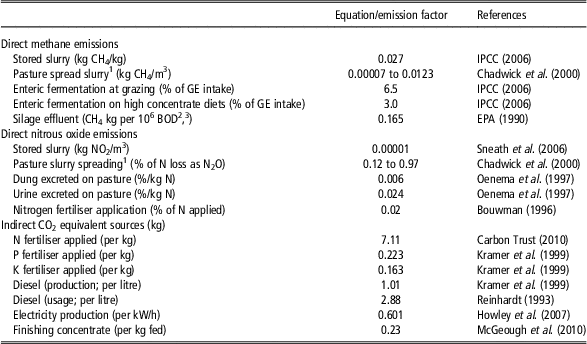
Beef price of €4.00/kg was assumed and sensitivity analysis investigated the effects of fluctuations of €10/head in calf price, €10/ton in finishing concentrate price and €0.10/kg beef price in the margin/head. The Beef Systems Greenhouse Gas Emissions Model (Foley et al., Reference Foley, Crosson, Lovett, Boland, O’Mara and Kenny2011) was used to evaluate GHG emissions of the finishing strategies in the current study. Emission factors (Table 1) were used to evaluate direct and indirect GHG emissions. As beef was the only output of the system and all manure produced was recycled onto grassland areas, the full GHG burden of the systems was applied to the respective finishing strategies. Given that beef produced from dairy systems is largely unavoidable, and as feed energy requirements associated with pregnancy and in the first 3 weeks of life are negligible (Jarrige, Reference Jacksic, Kiely, Albertson, Oren, Katul, Leahy and Byrne1989) it is assumed that the embodied emissions in the purchased calf is zero. The full GHG burden of the finishing strategies was applied to beef output. Greenhouse gas emissions were converted to their 100-year global warming potential (GWP) CO2 equivalents (CO2eq). In the current study the GWP values for CH4 and N2O were 25 and 298 CO2eq, respectively (IPCC, 2006).
Sources of greenhouse gas emissions, emission factors used and the reference sources

1 Dependent on month of spreading.
2 Biological oxygen demand.
3 Assuming a BOD of 65,000.
Statistical analysis
Data normality was assessed using the PROC UNIVARIATE procedure of SAS (Statistical Analysis System, version 9.3; SAS Institute Inc., Cary, NC, USA). Analysis of variance was carried out separately for bulls and steers using the PROC MIXED procedure. Treatment and block were included as fixed effects in the model. The experimental unit was animal for all variables with the exception of CDMI where pen was the experimental unit. Least square means were used to determine the differences between each of the finishing strategies.
Results
Chemical composition, herbage offered and feed intake
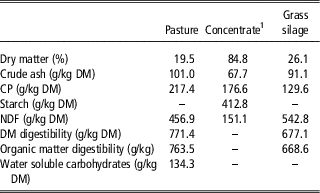
Chemical analysis of the grass, grass silage and finishing concentrate offered during the experimental period is presented in Table 2. During the second season at pasture pre- and post-grazing sward heights were 9.1 (SD=2.13) cm and 4.1 (SD=0.85) cm for 19SP, 19LP and 19AL, respectively. Estimated individual GDMI were 8.1, 7.1 and 8.6 kg DM/head for 19SP, 19LP and 19AL, respectively. During the finishing period pre-grazing (7.2 (SD=1.68) and 7.7 (SD=1.36) cm) and post-grazing sward height (4.7 (SD=0.67) and 4.8 (SD=0.16) cm) were similar for 19SP and 19LP, respectively. Estimated individual GDMI during the finishing phase was similar for 19SP and 19LP; 5.7 and 5.6 kg DM/head, respectively. During the finishing period CDMI per head was greatest for 19AL, lowest for 19SP and intermediate for 19LP was intermediate (1133, 474 and 718 kg DM, respectively).
Chemical composition of feed offered during the experimental period

1 Concentrate composition; 800 g/kg barley, 140 g/kg soya meal, 40 g/kg molasses and 20 g/kg minerals.
During the second season at pasture, pre- and post-grazing sward heights were 12.0 (SD=2.35) and 4.7 (SD=0.80) cm for 21SP, 21LP and 24MO, respectively. Estimated individual GDMI were 8.4, 7.9 and 8.5 kg DM/head for 21SP, 21LP and 24MO, respectively. During the finishing period, pre-grazing (13.9 (SD=2.83) and 11.5 (SD=1.76) cm) and post-grazing sward height (4.7 (SD=0.49) and 4.4 (SD=0.47) cm) were similar for 21SP and 21LP, respectively. Estimated individual GDMI (9.1 and 7.0 kg DM/head) was also similar for 21SP and 21LP, respectively. Concentrate DMI per head during the finishing period was greater for 21LP than 21SP and 24MO was intermediate (542, 283 and 436 kg DM, respectively).
Animal and carcass performance
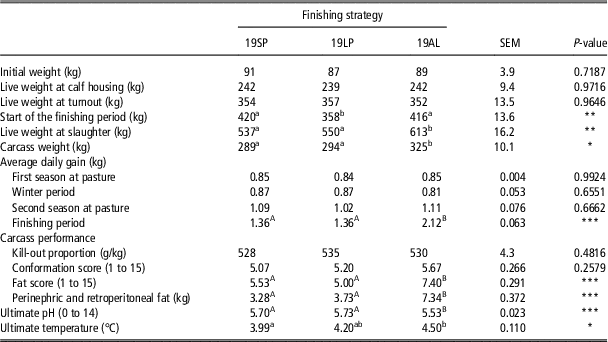
Bull finishing strategies. Average daily gain during the first season at pasture, live weight at calf housing, ADG during the first winter and live weight at turnout were similar for 19SP, 19LP and 19AL (Table 3). During the finishing period ADG was greater (P<0.001) for 19AL than 19SP and 19LP. Similarly, live weight at slaughter (P<0.01) and carcass weight (P<0.05) were greater for 19AL than 19SP and 19LP, respectively.
Effects of finishing duration on animal and carcass performance of Holstein-Friesian bulls

19SP=bulls finished at pasture supplemented with 5 kg DM of concentrates per head daily for 100 days and slaughtered at 19 months of age; 19LP=bulls finished at pasture supplemented with 5 kg DM of concentrates per head daily for 150 days and slaughtered at 19 months of age; 19AL=bulls finished indoors on concentrates ad libitum for 100 days and slaughtered at 19 months of age.
a,b Means within a row with different superscripts differ (P<0.05; P<0.01); A,B Means within a row with different superscripts differ (P<0.001); (*P<0.05, **P<0.01, ***P<0.001).
Kill-out proportion and conformation score were similar across all finishing strategies. However, fat score was 1.87 and 2.40 units greater for 19AL than 19SP and 19LP, respectively (P<0.001). Perinephric and retroperitoneal fat (P<0.001) was greater for 19AL than 19SP and 19LP. Ultimate pH was greater for 19SP and 19LP than 19AL (P<0.001), while ultimate temperature was greater for 19AL than 19SP and intermediate for 19LP (P<0.05).
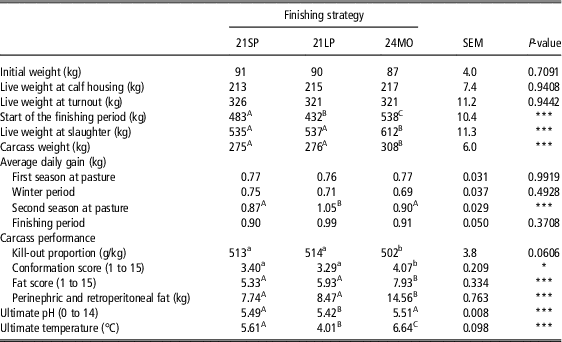
Steer finishing strategies. Average daily gain during the first season at pasture, calf housing weight, ADG during the first winter and live weight at turnout were similar for 21SP, 21LP and 24MO (Table 4). Average daily gain during the second season at pasture was 0.18 kg and 0.15 kg greater for 21LP than 21SP and 24MO, respectively (P<0.001). During the finishing period ADG was similar for all groups, however live weight at slaughter (P<0.001) and carcass weight (P<0.001) were greater for 24MO than 21SP and 21LP, respectively.
Effects of finishing duration on animal and carcass performance of Holstein-Friesian steers

21SP=steers finished at pasture supplemented with 5 kg DM of concentrates per head daily for 60 days and slaughtered at 21 months of age; 21LP=steers finished at pasture supplemented with 5 kg DM of concentrates per head daily for 110 days and slaughtered at 21 months of age; 21MO=steers finished indoors on grass silage plus 5 kg DM of concentrates per head daily for the winter period and slaughtered at 24 months of age.
a,b,c Means within a row with different superscripts differ (P<0.05); A,B,C Means within a row with different superscripts differ (P<0.001); (*P<0.05, ***P<0.001).
Kill-out proportion tended to be 11 and 12 g/kg greater (P=0.06) for 21SP and 21LP than 24MO, respectively. Conformation (P<0.05) and fat score (P<0.001) were greater for 24MO than 21SP and 21LP, respectively. Perinephric and retroperitoneal fat was greater (P<0.001) for 24MO than 21SP and 21LP. Ultimate pH was greater for 21SP and 24MO than 21LP (P<0.001), while ultimate temperature was greatest for 24MO and lowest for 21LP; 21SP was intermediate (P<0.001).
System profitability
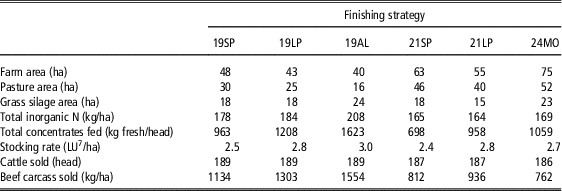
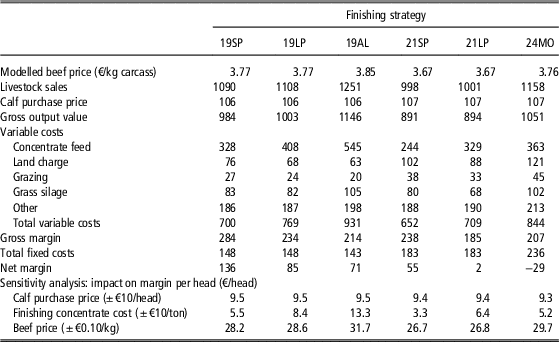
Although land area required for production was lowest for 19LP and 19AL, total inorganic nitrogen and total concentrates fed were greatest for both 19LP and 19AL compared with the remaining bull and steer finishing strategies (Table 5). The combination of greater stocking rate and carcass weight resulted in 19AL having more beef carcass sold per ha. As a result of the superior carcass performance modelled beef price was greater for 19AL than 21SP and 21LP (Table 6). Consequently, gross output value was greater for 19AL than 21SP and 21LP. Total variable costs (TVC) were greatest for 19AL and lowest for 21SP. Gross margin per head was greatest for 19SP, intermediate for 19LP, 19AL, 21SP and 24MO and lowest for 21LP. Fixed costs were greater for 24MO than the alternative finishing strategies. Consequently, net margin per head was lower for 24MO than 19SP. Net margin per ha was greater for bull (19SP, 19LP and 19AL; €332, €236, and €212, respectively) than steer production systems (21SP, 21LP and 24MO; €132, €6, and -€79, respectively). Prolonging the finishing duration resulted in a marginal increase in gross output value, however, concentrate feed costs also increased. Consequently net margin was greater for 19SP than 19LP and 21SP than 21LP, respectively.
Land use, stocking rate and outputs from the modelled production systems

19SP=bulls finished at pasture supplemented with 5 kg DM of concentrates per head daily for 100 days and slaughtered at 19 months of age; 19LP=bulls finished at pasture supplemented with 5 kg DM of concentrates per head daily for 150 days and slaughtered at 19 months of age; 19AL=bulls finished indoors on concentrates ad libitum for 100 days and slaughtered at 19 months of age; 21SP=steers finished at pasture supplemented with 5 kg DM of concentrates per head daily for 60 days and slaughtered at 21 months of age; 21LP=steers finished at pasture supplemented with 5 kg DM of concentrates per head daily for 110 days and slaughtered at 21 months of age; 21MO=steers finished indoors on grass silage plus 5 kg DM of concentrates per head daily for the winter period and slaughtered at 24 months of age; LU=livestock unit (calves <6 months of age=0.2; calves 6 to 12 months of age=0.4; cattle 1 to 2 years of age=0.7).
Economic appraisal (€/head except where specified) of production systems for Holstein-Friesian bulls and steers

19SP=bulls finished at pasture supplemented with 5 kg DM of concentrates per head daily for 100 days and slaughtered at 19 months of age; 19LP=bulls finished at pasture supplemented with 5 kg DM of concentrates per head daily for 150 days and slaughtered at 19 months of age; 19AL=bulls finished indoors on concentrates ad libitum for 100 days and slaughtered at 19 months of age; 21SP=steers finished at pasture supplemented with 5 kg DM of concentrates per head daily for 60 days and slaughtered at 21 months of age; 21LP=steers finished at pasture supplemented with 5 kg DM of concentrates per head daily for 110 days and slaughtered at 21 months of age; 21MO=steers finished indoors on grass silage plus 5 kg DM of concentrates per head daily for the winter period and slaughtered at 24 months of age.
Sensitivity analysis (Table 6) highlighted that changes in finishing concentrate price had a greater effect on the profitability of 19LP and 19AL than the remaining scenarios. Fluctuations in calf price and beef price had a similar effect on margins across all scenarios.
Greenhouse gas emissions
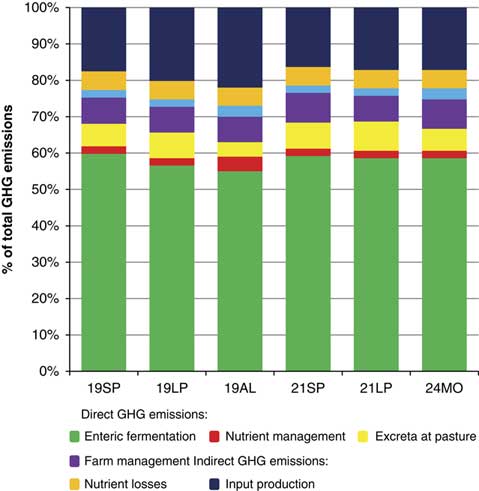
Enteric fermentation was the largest contributor to GHG emissions associated with production for all finishing strategies (Figure 1). The GHG emissions associated with nutrient management were greatest for 19AL. However, excreta at pasture was lowest for 19AL. Emissions associated with fertiliser application, farm management and nutrient loss were similar for all finishing strategies. Greenhouse gas emissions associated with input production was greater for 19AL than the remaining bull and steer finishing strategies.
Contribution analysis for greenhouse gas emissions from Holstein-Friesian bull and steer production systems. 19SP=bulls finished at pasture supplemented with 5 kg DM of concentrates per head daily for 150 days and slaughtered at 19 months of age; 19LP=bulls finished at pasture supplemented with 5 kg DM of concentrates per head daily for 100 days and slaughtered at 19 months of age; 19AL=bulls finished indoors on concentrates ad libitum for 100 days and slaughtered at 19 months of age; 21SP=steers finished at pasture supplemented with 5 kg DM of concentrates per head daily for 60 days and slaughtered at 21 months of age; 21LP=steers finished at pasture supplemented with 5 kg DM of concentrates per head daily for 110 days and slaughtered at 21 months of age; 24MO=steers finished indoors on grass silage plus 5 kg DM of concentrates per head daily for the winter period and slaughtered at 24 months of age.

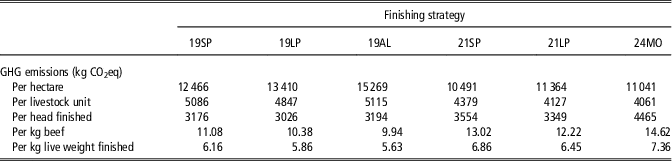
Greenhouse gas emissions on a per ha basis were lowest for 21SP and greatest for 19AL, however per livestock unit GHG emissions were greater for the bull finishing strategies (19SP, 19LP and 19AL) compared with steer finishing strategies (21SP, 21LP and 24MO; Table 7). Greenhouse gas emissions were greater for 24MO than 19SP, 19LP, 19AL, 21SP and 21LP expressed on a per head basis. Expressed per kg of beef produced and per kg live weight finished, GHG emissions were greatest for 24MO and lowest for 19AL, respectively. Increasing the finishing duration for bulls at pasture resulted in a 6% and 5% reduction in GHG emissions per kg beef and per kg live weight produced, respectively. Similarly, finishing steers at pasture over an extended finishing period reduced GHG emissions per kg beef and per kg live weight by 6% and 6%, respectively.
Effects of production systems on greenhouse gas (GHG) emissions of Holstein-Friesian bulls and steer

19SP=bulls finished at pasture supplemented with 5 kg DM of concentrates per head daily for 100 days and slaughtered at 19 months of age; 19LP=bulls finished at pasture supplemented with 5 kg DM of concentrates per head daily for 150 days and slaughtered at 19 months of age; 19AL=bulls finished indoors on concentrates ad libitum for 100 days and slaughtered at 19 months of age; 21SP=steers finished at pasture supplemented with 5 kg DM of concentrates per head daily for 60 days and slaughtered at 21 months of age; 21LP=steers finished at pasture supplemented with 5 kg DM of concentrates per head daily for 110 days and slaughtered at 21 months of age; 21MO=steers finished indoors on grass silage plus 5 kg DM of concentrates per head daily for the winter period and slaughtered at 24 months of age.
Discussion
Previously, Murphy et al. (Reference Murphy, Crosson, Kelly and Prendiville2017) reported greater profitability and reduced GHG emissions for HF bulls and steers finished at pasture at 19 and 21 months of age, respectively, compared with the traditional 24 month steer production system. From a production systems perspective, age at slaughter is dictated by sale date. Extending the finishing duration by increasing the age at slaughter was shown to increase live weight at slaughter, carcass weight and fat score of beef steers (Keane et al., Reference Keane, Drennan and Moloney2006). Consequently, the objectives of this study were to investigate the effects of alternative finishing strategies on animal performance, economic viability and GHG emissions of the most profitable HF bull and steer production systems established by Murphy et al. (Reference Murphy, Crosson, Kelly and Prendiville2017). In the current study, ADG during the first season at pasture, first winter and second season at pasture, and in turn live weight at defined time points, were typical of spring-born dairy calf to beef production systems (Murphy et al., Reference Murphy, Crosson, Kelly and Prendiville2017).
Bull finishing strategies
Consistent with the findings of Murphy et al. (Reference Murphy, Crosson, Kelly and Prendiville2017), carcass weight and fat score were greater for 19AL than finishing bulls at pasture; 19SP and 19LP. Interestingly, no difference in animal performance during the second season at pasture, ADG during the finishing period and live weight at slaughter was observed between 19SP and 19LP. The comparable animal performance and live weight at slaughter of 19SP and 19LP could be attributed to a number of factors. Although both groups were offered a sub-optimal feeding level during the first winter indoor period, both groups were offered good quality grazed pasture during the second grazing season. However, 19LP were offered a pasture only diet for 29 days and were subsequently supplemented with concentrates at pasture for 147 days. In contrast, animal performance of 19SP during the second grazing season, where bulls were offered excellent quality herbage for 79 days, may have facilitated a level of compensatory growth (Wright et al., Reference Wright, Russel and Hunter1986). Indeed, the chemical composition of the herbage offered to both treatment groups during the grazing season is indicative of the high-quality herbage that was available. Similar to the animal performance, no difference in carcass performance was observed between 19LP and 19SP. Previously, Vasconcelos et al. (Reference Vasconcelos, Rathmann, Reuter, Leibovich, McMeniman, Hales, Covey, Miller, Nichols and Galyean2008) reported a 27 mm greater fat thickness on the 12th rib for beef steers finished for an additional 62 days. Although no difference in fat score was observed between 19SP and 19LP in the current study, both groups had inadequate fat scores at slaughter. Adequate fat score at slaughter according to industry standards is 6 and was achieved by 19AL.
Achieving high levels of animal performance and regulating input costs are central to profitable beef production. Fat score is a key determinant of the degree of carcass finish and also a component of carcass value (Bown et al., Reference Bown, Muir and Thomson2016). Consequently, due to the differences in carcass quality, beef price received was greater for 19AL than 19SP and 19LP. However, consistent with the findings of Murphy et al. (Reference Murphy, Crosson, Kelly and Prendiville2017), bulls finished indoors on a concentrate intensive diet were less profitable than low input pasture-based finishing strategies. In the present study, net margin was €51 and €69 greater for 19SP than 19LP and 19AL, respectively. The costs of production were greater for 19AL and 19LP than 19SP; €3.63, €3.48 and €3.30/kg carcass, respectively. Consistent with the findings of the present study, Phetteplace et al. (Reference Phetteplace, Johnson and Seidl2001) and Murphy et al. (Reference Murphy, Crosson, Kelly and Prendiville2017) reported that concentrate intensive production systems had lower GHG emissions than pasture-based systems. Beef carcass sold per ha was 420 and 251 kg greater for 19AL than 19SP and 19LP, respectively. In the current study, 19AL and 19LP produced 7% and 11% less GHG emissions per kg of beef than 19SP.
Steer finishing strategies
Finishing steers in the traditional production system than outdoor finishing had a similar effect on live weight at slaughter, carcass weight and fat score to the bull production systems investigated in the current study. Previously, Keane and Drennan (Reference Keane and Drennan2008) reported live weight gains and carcass weight gains of 0.8 and 0.4 kg/day for steers finished at pasture, respectively. Results from the current study concur with those findings. Unlike bulls finished at pasture in the present study (19SP and 19LP), 21SP and 21LP were vulnerable to sub-optimal performance as slaughter date was in late autumn. Autumn herbage has a lower feed value (McDonald et al., Reference McDonald, Edwards, Greenhalgh and Morgan2002) and an on-farm study concluded that performance of grazing cattle was lower in the latter stages of the grazing season (Devaney et al., Reference Devaney, O’Riordan and Caffrey1997). This was confirmed in the present study where ADG was greater for 21LP than 21SP and 24MO during the second grazing season. In contrast to 21SP and 24MO, 21LP were offered a pasture only diet during the early grazing period during the second season; from turnout to 15 July. Nevertheless, animal performance and carcass traits of 21SP and 21LP were similar. Animal performance of 24MO was similar to that previously reported by Murphy et al. (Reference Murphy, Crosson, Kelly and Prendiville2017).
The traditional dairy steer production system (24MO) was the least profitable steer production system evaluated in the current study. Previously, Ashfield et al. (Reference Ashfield, Wallace, Prendiville and Crosson2014) reported that 24MO was the most profitable of a range of dairy calf to beef production systems. However, in that study, land charge was not included in the analysis. As 24MO have a later slaughter date than 21SP and 21LP in the present study, additional land was required to operate the system which impacted negatively on profit. In agreement with Murphy et al. (Reference Murphy, Crosson, Kelly and Prendiville2017), the cost of production for 24MO in the current study, €3.85/kg carcass, exceeded the beef price received by €0.09/kg carcass. Although net margins were positive for 21LP and 21SP, TVC were €57 greater for 21LP. Consequently, consistent with the findings of Murphy et al. (Reference Murphy, Crosson, Kelly and Prendiville2017), 21SP was the most profitable steer production system in the current study.
Although the proportions of direct and indirect GHG emissions were similar for 21SP, 21LP and 24MO, GHG emissions per kg of beef produced were 11% and 16% lower for 21SP and 21LP than 24MO, respectively. Increasing the proportion of concentrates in the diet for 21LP also resulted in an increase in stocking rate; therefore GHG emissions were greater on a per ha basis. However, the higher stocking rate and greater beef output per ha of 21LP compared to 21SP resulted in lower GHG emissions for 21LP than 21SP expressed on a per kg of beef produced basis.
From a policy perspective it may be of interest to interpret the emissions of GHG from the alternative production systems in the context of the profitability of the respective systems. This provides an opportunity to identify production systems which can concomitantly provide an economic return to farmers while minimising emissions of GHG. Foley et al. (Reference Foley, Crosson, Lovett, Boland, O’Mara and Kenny2011) in a similar analysis for suckler beef production systems introduced the term emissions efficiency which was defined as farm net margin per unit of GHG emissions. In the context of the present study, emissions efficiency for the six systems 19SP, 19LP, 19AL, 21SP, 21LP and 24MO were (in €/t CO2eq) 43, 28, 22, 15, 1 and −6, respectively. This highlighted the greater performance levels attainable in bull finishing systems allied to pasture-based feeding provided the optimal balance of economic and GHG performance levels. It should be highlighted that potential carbon sequestration of permanent grassland is not included in this analysis. Several studies (e.g. Conant et al., Reference Connolly, Kinsella, Quinlan and Moran2001; Soussana et al., Reference Soussana, Loiseau, Vuichard, Ceschia, Balesdent, Chevallier and Arrouays2004) including a number of studies of Irish grassland systems (Byrne et al., Reference Byrne, Kiely and Leahy2005; Jacksic et al., Reference Jarrige2006), have reported that carbon sequestration can contribute significantly to the GHG balance on livestock farms. The inclusion of carbon sequestration from permanent grassland would significantly improve the relative performance of the pasture-based finishing system from an emissions efficiency perspective.
Conclusion
Although increasing the finishing duration at pasture reduced GHG emissions per kg of beef produced for bull and steer production systems; the animal performance and profitability would question finishing bulls and steers over a prolonged period at pasture. This study showed that where high levels of animal performance were maintained, concentrate supplementation over prolonged periods is unnecessary and GHG emissions per kg of beef produced would be lower than those of traditional dairy calf to beef production systems.
Acknowledgements
This project (11/SF/322, ‘BullBeef’) was funded by the Irish Department of Agriculture, Food and the Marine’s competitive research programmes.
Declaration of interest
None.
Ethics statement
Animals in this study were only used for this feeding experiment.
Software and data repository resources
Excel and SAS.