Implications
Ruminal biohydrogenation directly affects milk fat quality for human consumers, and could be modulated by heating fat sources given to cows. This study investigated the effects of heated oil containing lipid oxidation products on dairy cow’s milk quality. Milk fat quality was slightly affected with a decrease of trans-11-C18:1 and cis-9,trans-11-CLA proportions, but no transfer of lipid oxidation products from cow’s diet to milk was observed.
Introduction
Conjugated linoleic acids would have important biological effects on humans like anticarcinogenic, anti-obesity and anti-arteriosclerosis properties (Troegeler-Meynadier and Enjalbert, Reference Troegeler-Meynadier and Enjalbert2005). Generally, cis-9,trans-11-CLA is reported to be beneficial for human health, while trans-10,cis-12-CLA could have adverse effects (Gebauer et al., Reference Gebauer, Chardigny, Jakobsen, Lamarche, Lock, Proctor and Baer2011). Dietary trans-11-C18:1 is also of interest for human because it can be transformed into cis-9,trans-11-CLA in human tissues (Jutzeler van Wijlenand and Colombani, Reference Jutzeler van Wijlen and Colombani2010). Among human foodstuffs, dairy products have the highest concentration of trans-11 isomers, which originate from ruminal biohydrogenation (RBH) of dietary unsaturated fatty acids (FA).
Addition of heated oilseeds into dairy cow’s diet increases trans-11 isomers milk content for consumers compared to unheated seeds (Chilliard et al., Reference Chilliard, Martin, Rouel and Doreau2009; Doreau et al., Reference Doreau, Laverroux, Normand, Chesneau and Glasser2009), while heated oil decrease their percentage in milk fat (Vázquez-Añón et al., Reference Vázquez-Añón, Nocek, Bowman, Hampton, Atwell, Vázquez and Jenkins2008) and in in vitro cultures (Privé et al., Reference Privé, Combes, Cauquil, Farizon, Enjalbert and Troegeler-Meynadier2010). Heating fat generates oxidation products, which are able to modulate RBH (Kaleem et al., Reference Kaleem, Farizon, Enjalbert and Troegeler-Meynadier2013a) and could at least in part explain the modification of milk FA profile observed when supplementing cows with heated oils, and the difference observed between effects of heated oilseeds and heated oils. On the other hand, lipid oxidation products ingested by cows receiving heated fat could also be absorbed and excreted into milk. Indeed, Izaki et al. (Reference Izaki, Yoshikawa and Uchiyama1984) evidenced absorption of oxidative products of fried oil in rats. Hence, the objective of this study was to determine the effects of a strong heating of oil on oxidative products in oils and their effects on rumen and milk FA profile and oxidation product contents, in order to get a step further in the comprehension of effects of oxidative products on RBH and their potential transfer into milk.
Material and methods
Preparation of oils
Heated oil (HO) was prepared every day just before distribution to cows using food grade sunflower oil that was heated at 150°C for 15 h in a ventilated oven, to obtain highly oxidized oil (Vázquez-Añón et al., Reference Vázquez-Añón, Nocek, Bowman, Hampton, Atwell, Vázquez and Jenkins2008; Privé et al., Reference Privé, Combes, Cauquil, Farizon, Enjalbert and Troegeler-Meynadier2010). Thereafter, oil was cooled for about 1 h at room temperature. Samples of 0.3 kg of heated oil were transferred into bottles, each bottle corresponding to one meal for one cow, and all bottles were filled with CO2, hermetically closed, transported to the farm under dark and cold conditions, and kept at 4°C until distribution. Bottles of non-heated oil (NHO) were closed and stored in a similar manner. Samples of 5 ml were taken from all bottles prepared for the morning meal of sampling days for analysis of FA, hydroperoxides (HPOD), hydroxyacids (HOA) and aldehydes, and stored immediately at −80°C.
Animals, diets and samples
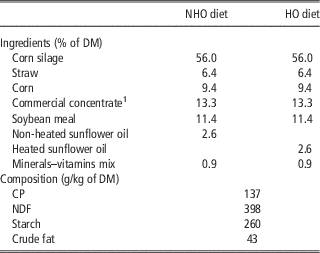
Four lactating Holstein dairy cows, equipped with a rumen cannula, were divided into two groups of two cows. The cows had free access to water and received 23 kg dry matter (DM) of a corn silage-based diet shown in Table 1, given in two equal meals at 0900 and 1700 h. Oil was top-dressed, no refusal was observed. Cows were adapted to dietary oil during 4 weeks with 0.2, 0.4 and 0.6 kg of NHO per day during weeks 1, 2 and weeks 3 and 4, respectively. Thereafter, the experiment comprised 5 weeks: two 2-week experimental periods separated by a 1-week wash out period to avoid carry-over effects. During the first experimental period, one group received the control diet (0.6 kg/day of NHO) while the other group was fed the experimental diet (0.6 kg/day of HO), and cows switched diet during the second experimental period. During the wash out period all cows received 0.6 kg/day of NHO. During the experimental periods, samples were taken on d 3, 5, 7, 10, 12 and 14. Each sampling day, 50 ml of milk were collected during the morning and evening milkings and mixed, and 100 ml of ruminal content were collected with a vacuum pump 5 h after the morning meal, for determination of volatile FA (VFA), 6- to 18-carbon FA profiles and oxidation products (HPOD, HOA and aldehydes). Milk production was recorded every day, and milk fat and protein contents were analyzed at days 5 and 12.
Ingredient and chemical composition of cows’ diets

NHO=non-heated oil; HO=heated oil; DM=dry matter.
1 24% CP concentrate (DM basis), composed of rapeseed, sunflower and palm kernel meals, corn distillers’ grains with solubles, barley, wheat and soybean hulls.
Chemical analysis
The FA of oil, rumen and milk samples were extracted and methylated in situ using the procedure of Park and Goins (Reference Park and Goins1994), except that the solution of 14% of boron trifluoride in methanol was replaced by a solution of methanol–acetylchloride (10 : 1). The FA methyl esters were then quantified by gas chromatography (Agilent 6890N, Network GC System, equipped with a model 7683 auto injector; Agilent Technologies, Palo Alto, CA, USA) using a fused silica capillary column (100 m×0.25 mm i.d., 0.20-μm film thickness, CPSil88;Varian, Middelburg, the Netherlands), as described in Zened et al. (Reference Zened, Troegeler-Meynadier, Nicot, Combes, Cauquil, Farizon and Enjalbert2011).
Oxidation products (HPOD, HOA and aldehydes) were analyzed in rumen contents, oils and milk. Analysis of HPOD and HOA was performed according to the HPLC method of Browne and Armstrong (Reference Browne and Armstrong2000), after extraction and saponification of lipids as described by Kaleem et al. (Reference Kaleem, Enjalbert, Farizon and Troegeler-Meynadier2013b), and using an automated HPLC-UV system using P680 HPLC pump and diode array detection at 320 nm (Agilent Technologies) equipped with Uptisphere C18 ODB column (particle size 3 µm, 15×0.46 cm i.d.; Interchim, Montluçon, France). When analyzing samples for HPOD, saponification induces a reduction of HPOD to their respective HOA (Browne and Armstrong, Reference Browne and Armstrong2000): without saponification (i.e. analysis of free FA) HPOD represented 88% of HPOD+HAO when no HPOD were detected in the analysis of the triacylglycerol forms (Kaleem et al., Reference Kaleem, Farizon, Enjalbert and Troegeler-Meynadier2013a). Results were expressed as HPOD+HOA, assuming that a great part of them were generated during analysis from HPOD. Aldehyde analysis was performed according to the method of Li et al. (Reference Li, Deng, Yao, Shen and Zhang2005), as described by Kaleem et al. (Reference Kaleem, Enjalbert, Farizon and Troegeler-Meynadier2013b) and using a gas chromatograph (Agilent 7890A, GC System, equipped with a model 7683 auto injector; Agilent Technologies) equipped with a capillary column (30 m×0.53 mm i.d., 0.5-μm film thickness, DB-5; Agilent Technologies).
The concentrations of VFA were determined using the gas chromatographic method reported by Zened et al. (Reference Zened, Enjalbert, Nicot and Troegeler-Meynadier2013). True protein and milk fat contents were determined by mid-infrared analysis (Milkoscan 605; Foss Electric, Paris, France).
Statistical analysis
Data were analyzed using the GLM of SYSTAT (Version 9; SPSS Inc., Chicago, IL, USA). The effect of heat treatment on oils FA profiles and oxidation products content was tested according to the model: Variable=mean+‘period’ effect+‘heat treatment’ effect+residual error. Time changes of rumen and milk parameters, including FA and oxidation products were analyzed as repeated measures, using sampling day within period as the repeated factor. The within-subjects error term was used to test the effects of sampling day and of sampling day×oil interactions. Significance was declared at P⩽0.05 and trends at 0.05<P⩽0.10.
Results
Effects on oil
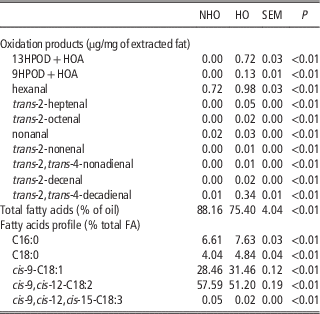
As expected, heating sunflower oil at 150°C for 15 h increased the concentration of oxidation products. The concentration of HPOD+HOA in HO was significantly (P<0.01) higher than in NHO (Table 2), and the major HPOD+HOA were 130OH+OH cis-9,trans-11-C18:2 (85%; 13HPOD+HOA) and 9OOH+OH trans-10,cis-12-C18:2 (15%; 9HPOD+HOA). Hexanal concentration was over 0.7 mg/g in NHO and increased together with the other aldehydes in HO. Hexanal represented the major part (68% in HO, 97% in NHO) of total aldehydes, followed by trans-2,trans-4-decadienal (23% of total aldehydes) in HO. Heating sunflower oil decreased total FA content and cis-9,cis-12-C18:2, and cis-9,cis-12,cis-15-C18:3 percentages, while C16:0, cis-9-C18:1, and C18:0 percentages were higher in HO than in NHO.
Fatty acid profile (% of total fatty acids) and hydroxyacids and aldehydes concentrations in non-heated and heated sunflower oil

NHO=non-heated oil; HO=heated oil; 13HPOD+HOA=13OOH+OH cis-9,trans-11-C18:2; 9HPOD+HOA=9OOH+OH trans-10,cis-12-C18:2.
Effects on ruminal content
No sampling day×heating interaction was observed on parameters measured in rumen contents. Sampling day had no effect on FA profile in the rumen, except for C18:0 (P=0.01) and trans-11-C18:1 (P=0.04) percentages which were lowest and highest at day 10. Table 3 presents average values of samples over the experimental periods.
Effect of heated or non-heated sunflower oil addition to the diet of dairy cows on ruminal fatty acids (values are means of the 6 sampling days)

NHO=non-heated oil; HO=heated oil.
1 P obtained by repeated measures analysis.
2 CLA=sum of CLA assayed; trans-C18:1=sum of trans-C18:1 assayed.
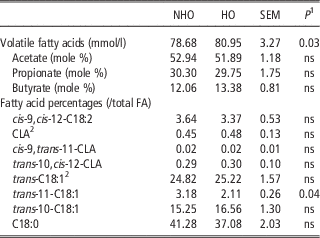
Neither HPOD+HOA nor aldehydes were detected in the rumen contents of cows, including those consuming HO. Few significant effects were evidenced in ruminal FA: total VFA molar concentration was slightly increased, when trans-11-C18:1 percentage was lowered by one-third in the rumen of cows fed HO compared with cows fed NHO.
Effects on milk
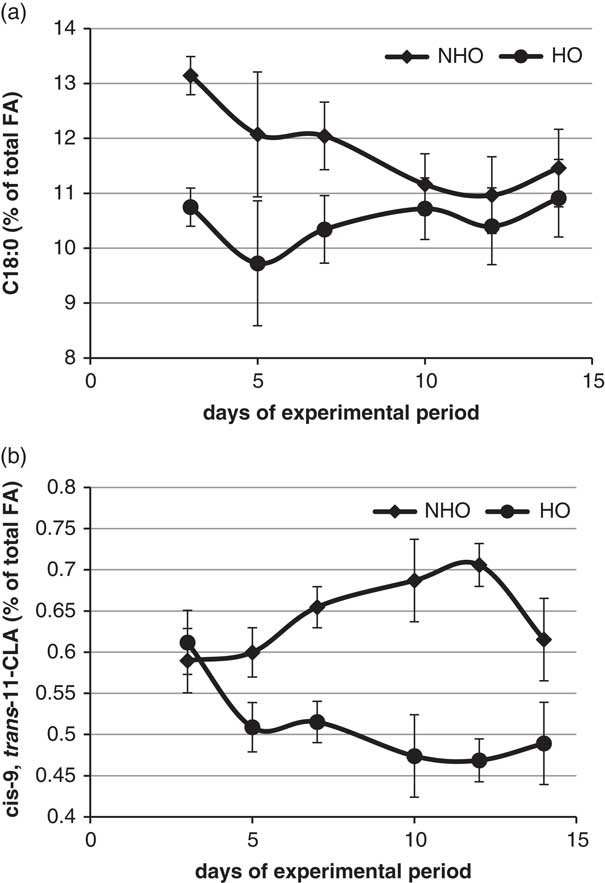
Only the C18:0 (P=0.05) and of cis-9,trans-11-CLA (P=0.03) percentages (/total FA) presented a significant sampling day×heating interaction in milk samples (Figure 1a and b, respectively). During the first week of the experimental period, C18:0 percentage was higher in the milk from cows fed NHO than in the milk from cows fed HO. For cis-9,trans-11-CLA, excepted at day 3, the percentage was higher in the milk of cows fed NHO than in the milk of cows fed HO, with the highest difference at day 12.
Effect of heated (HO) or non-heated (NHO) sunflower oil addition to the diet of dairy cows on milk C18:0 (a) and cis-9,trans-11-CLA (b) percentages (/total FA) according to the sampling day (mean value per day, SEM as error bars).

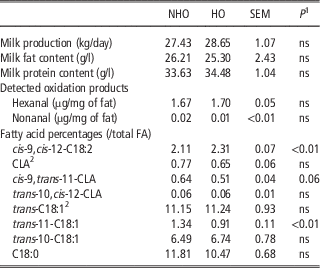
Others parameters presented no sampling day×heating interaction and only trans-C18:1 percentage was slightly affected by sampling day (P=0.04; 10.7% of total FA at d 3, 5, 12 v. 11.7% of total FA on days 7, 10 12). Hence, table 4 presents average values of samples taken over the experimental periods. Feeding heated oil did not affect milk production nor milk fat or protein contents (Table 4). Among oxidation products, HPOD+HOA were not detected in milk samples and only two aldehydes were found: mainly hexanal and a very little amount of nonanal, but without significant difference between cows receiving HO and those receiving NHO diets.
Effect of heated or non-heated sunflower oil addition to the diet of dairy cows on milk production and composition (values are means of the 6 sampling days, excepted milk fat and protein contents for which there were 2 sampling days)

NHO=non-heated oil; HO=heated oil.
1 P obtained by repeated measures analysis.
2 CLA=sum of CLA assayed; trans-C18:1=sum of trans-C18:1 assayed.
Similarly, most of FA profile changes were not significant, except cis-9,cis-12-C18:2, and trans-11-C18:1 percentages, and a trend (P=0,06) was observed for cis-9,trans-11-CLA. The milk percentage of cis-9,cis-12-C18:2 was significantly (P>0.01) but slightly higher with HO compared to NHO delivery to cows, and feeding HO significantly (P<0.01) decreased the percentage of trans-11-C18:1 and tended to decrease that of cis-9,trans-11-CLA in milk compared to feeding NHO.
Discussion
Heating sunflower oil decreased (P>0.01) total FA content of oil due to an oxidation of a part of cis-9,cis-12-C18:2. As previously described by Privé et al. (Reference Privé, Combes, Cauquil, Farizon, Enjalbert and Troegeler-Meynadier2010), in our experiment, the high decrease in cis-9,cis-12-C18:2 content and the simultaneous increase of the cis-9,cis-12-C18:2 oxidation products reflected the great sensitivity of this FA to oxidation during heating. Vázquez-Añón and Jenkins (Reference Vázquez-Añón and Jenkins2007) observed the same trend on polyunsaturated FA content of their high oxidized oil.
Compared to non-heated oilseeds, NHO is rich in aldehydes: 0.75 µg/mg of fat in oil in the present study v. 0.046 µg/mg of fat in soybeans (Kaleem et al., Reference Kaleem, Enjalbert, Farizon and Troegeler-Meynadier2013b). On the contrary, higher HOA content has been reported in soybeans (0.79 µg/mg of fat, Kaleem et al., Reference Kaleem, Enjalbert, Farizon and Troegeler-Meynadier2013b) than observed in oil in our experiment (0.0 µg/mg of fat). Oil is probably more susceptible to oxidation during storage than oilseeds whose fat is protected by the cell wall, but oil refining process removes a big part of oxidative products. Nevertheless refining process seems to be very efficient on peroxides but not on aldehydes: Cuvelier and Maillard (Reference Cuvelier and Maillard2012) found no peroxides in their just refined rapeseed oil when a p-Anisidine value of 8 revealed the presence of aldehydes. Moreover hexanal represented 97% of total aldehyde in our NHO when it represented only 47% of total aldehydes in non-heated oilseeds (Kaleem et al., Reference Kaleem, Enjalbert, Farizon and Troegeler-Meynadier2013b). Such data suggested some difference in the aldehydes content and nature between oil and oilseeds.
Heating at 150°C a high cis-9,cis-12-C18:2 oil increased the concentration of HPOD+HOA to 0.85 µg/mg of fat (P<0.01; Table 2), mostly that of 13HPOD+HOA, which represented 85% of total HPOD+HOA. These values are in agreement with the study of Kaleem et al. (Reference Kaleem, Enjalbert, Farizon and Troegeler-Meynadier2013b) with soybeans, heated during 30 min at 110 or 150°C which contained 1.06 to 0.80 µg of HOA /mg of fat, respectively, of which 84% were 13HOA on average. Similar to the present experiment, a great part of these HOA could have originated from the reduction of HPOD during analysis. And during oxidation of cis-9,cis-12-C18:2, 13HPOD is the major HPOD isomer produced (Spiteller et al., Reference Spiteller, Kern, Reiner and Spiteller2001).
Heating oilseeds only slightly increases aldehydes (+31% for a 30 min heating at 150°C; Kaleem et al., Reference Kaleem, Enjalbert, Farizon and Troegeler-Meynadier2013b) compared with heating oil (P>0.01; Table 2) which, in our experiment, induced a high increase of aldehydes content (+95%). Profile of aldehydes in heated oil and seeds corresponded to those produced by oxidation of cis-9,cis-12-C18:2 (Villière and Genot, Reference Villière and Genot2006). Moreover, heating seeds did not modify the profile of aldehydes in the experiment of Kaleem et al. (Reference Kaleem, Enjalbert, Farizon and Troegeler-Meynadier2013b) whereas heating oil promoted trans-2,trans-4-decadienal in the present experiment. This could be due to a difference between oil and oilseeds behavior during heating, but also to the difference of heating duration between the present study (15 h) and that of Kaleem et al. (2013b) (i.e. 30 min). However, aldehydes would have few effects on RBH (Kaleem et al., Reference Kaleem, Farizon, Enjalbert and Troegeler-Meynadier2013a) making it difficult to conclude that differences between heated oilseeds and heated oil RBH could be explained by different aldehydes proportions.
As reported before (Vázquez-Añón and Jenkins, Reference Vázquez-Añón and Jenkins2007; Kaleem et al., Reference Kaleem, Enjalbert, Farizon and Troegeler-Meynadier2013b), oxidized fat had no real impact on rumen VFA concentration and molar proportions (Table 3). Similarly, heated oilseeds did not affect ruminal fermentation (Gonthier et al., 2004). No oxidative products were detected in the rumen, because HPOD+HOA were probably degraded into small molecules, and aldehydes rapidly reduced to alcohol due to the high reducing conditions of the rumen (Julien et al., Reference Julien, Marden, Enjalbert, Bayourthe and Troegeler-Meynadier2010) or absorbed. Milk contained no HPOD+HOA, and in spite of a greater hexanal content in oil, HO did not affect aldehydes content of milk compared with NHO. This is consistent with our hypothesis of a ruminal reduction of oxidative compounds but we cannot exclude that oxidative compounds could be absorbed but not taken up by the mammary gland.
Heating oil only slightly altered FA profile of rumen content; in particular it induced a decrease (P<0.01; Table 3) by 34% of trans-11-C18:1 percentage while having no effect on cis-9,trans-11-CLA percentage, which is consistent with the rumen study of Vázquez-Añón and Jenkins (Reference Vázquez-Añón and Jenkins2007). This decrease of ruminal trans-11-C18:1 percentage led to a decrease of trans-11-C18:1 percentage in milk (P<0.01; Table 4) but also to a decrease of milk cis-9,trans-11-CLA percentage after day 3 (P=0.03; Figure 1b), because most milk CLA originates from mammary desaturation of trans-11-C18:1 (Palmquist et al., Reference Palmquist, Lock, Shingfield and Bauman2005). Similarly, Vázquez-Añón et al. (Reference Vázquez-Añón, Nocek, Bowman, Hampton, Atwell, Vázquez and Jenkins2008) reported a decrease of cis-9,trans-11-CLA content of milk in their study when heated oil was added to the diet of dairy cows. This decrease of trans-11-C18:1 in milk could be due to a greater activity of the last step of RBH, which would lead to an increase of C18:0 percentage, or to an inhibition of the first step of RBH, which would lead to a decrease of cis-9,cis-12-C18:2 disappearance. No increase of C18:0 percentage was observed with heated oil in the present study; on the contrary, HO lowered C18:0 percentage in milk at the beginning of the trial (Figure 1a). A slightly higher cis-9,cis-12-C18:2 percentage in the milk of cows receiving HO compared to NHO was observed, consistent with an inhibition of cis-9, cis-12-C18:2 isomerization, but such a difference was not observed in the rumen. This lack of effect in the rumen could be due to the difference of dietary concentration of cis-9,cis-12-C18:2 (1.32 v. 1.00% of DM, for cows receiving HNO and HO fed cows, respectively), which could counterbalance a possible difference in the extent of its isomerization. It also could be rely to sampling time in the rumen (5 h after meal), which does not necessarily reflect average rumen metabolism. On the other hand, previous in vitro results (Privé et al., Reference Privé, Combes, Cauquil, Farizon, Enjalbert and Troegeler-Meynadier2010; Kaleem et al., Reference Kaleem, Farizon, Enjalbert and Troegeler-Meynadier2013a) showed that the decrease of trans-11 isomers due to oxidized fat was associated with a reduction of delta-12 isomerization, mainly linked to a decrease of this enzymatic activity by HPOD (Kaleem et al., Reference Kaleem, Farizon, Enjalbert and Troegeler-Meynadier2013a). Indeed, aldehydes have few effects or slightly increased trans-11 isomers (Lee et al., Reference Lee, Huws, Scollan and Dewhurst2007; Kaleem et al., Reference Kaleem, Farizon, Enjalbert and Troegeler-Meynadier2013a). So, the most probable explanation of the decrease of milk fat trans-11 FA is that HPOD contained in oxidized oil inhibited the delta-12 isomerase of cis-9,cis-12-C18:2. In our experiment, HPOD+HOA were not found in our rumen samples taken 5 h after meal, which suggests that their effects would either rely on their metabolism products, or on microbiota changes induced soon after oxidative products arrival in the rumen.
In vitro, Privé et al. (Reference Privé, Combes, Cauquil, Farizon, Enjalbert and Troegeler-Meynadier2010) showed that high temperature heated oil increased trans-10-isomers production during RBH. In our experiment, all dairy cows exhibited a trans-11 to trans-10 shift of RBH, which resulted in a milk fat depression and might have hidden an eventual effect of oil heating on trans-10 isomers. Moreover, the increase of trans-10 isomers due to oxidized fat has only been reported with a high concentration of added 13HPOD (78 µg/mg of fat; Kaleem et al., Reference Kaleem, Farizon, Enjalbert and Troegeler-Meynadier2013a), which is far over concentrations of HPOD+HOA observed in the present study.
Heating oil strongly increased its oxidative products content, especially HPOD+HOA and trans-2,trans-4-decadienal. Adding oxidized sunflower oil to the diet of dairy cows decreased trans-11-C18:1 proportion in milk FA due to an inhibition of the ruminal Δ12 isomerisation of cis-9,cis-12-C18:2, but did not result in a transfer of oxidation products from diet to milk. These results suggest a potent role of ruminal microbiota in the degradation of oxidative compounds from heated fat, but that does not hamper effects on microbiota activity.
Acknowledgments
The authors thank M.L. Chemit and the staff at the experimental station (UMR 1388 GenPhySE).