

After the January 2015 terrorist attacks in Paris, Islam has become central to public debates in Europe.Footnote 1 While the significance of Islam reverberates through the debates of the political mainstream and the left, this issue represents a case of special interest for those studying the far right. As I shall argue, in fact, public debates about Islam represent for the far right both an opportunity and a dilemma. On the one hand, these debates allow the far right to mobilize on its nativist values, focusing on what it considers to be a political enemy, to define the identity of the ingroup. On the other hand, they force the far right to play by the rules of the game, engaging in debates about mainstream values and identities. When coping with this dilemma, thus, do far right organizations maintain an anti-Islam discourse based on race-arguments, running the risk of being marginalized, or do they conform to the political mainstream and its values to attain legitimacy (i.e., become socially acceptable) in the political system?
For many years the anti-Islamic politics of the far right were principally a party-specific phenomenon. More recently, however, far-right non-party organizations have increased the visibility of these issues within society.Footnote 2 Existing research on the far right and Islam tends to focus differentially on how partiesFootnote 3 or grassroots organizations approach the issue of IslamFootnote 4. Indeed, it is only recently that efforts have been made to address discourses on Islam comparatively, i.e. across the entirety of the far-right spectrumFootnote 5. Yet such evidence remains unsystematic since often it does not go beyond the discussion of one party or one movement considered as a representative example of the variety of the far right. Additionally, few studies focus specifically on France, even though the country is generally considered an advantageous cultural context for the far right.Footnote 6
To complement existing research, I have two objectives. First, I examine how far-right organizations have embedded anti-Islam arguments within their nativist rhetoric in France, after the 2015 attacks. I do so by offering an original description of the characteristics of anti-Islam arguments that is applicable to the whole far right, accounting for actors engaged in both the protest and the electoral arenas. Second, I explore the complex interrelations between far-right anti-Islam arguments and national discursive opportunities, discussing the interplay between framing choices and core national values defining the boundaries of the national community.
The study uses a novel mixed-method strategy to analyze political discourse through digital methods and online data. I map the far-right field by means of a social network analysis of the links between seventy-seven far-right websites of both established and non-established organizations. Starting from here, I use a qualitative frame analysis of the material automatically retrieved from these websites, to grasp the descriptions of Muslims as an outgroup. To assess the resonance of anti-Islam frames among the broader online public, I rely on measures of online visibility. This method allows me to compare the discourse of a variety of political organizations—more established ones like parties, but also less established ones that are not easily accessible for fieldwork, such as grassroots movements.
The results illustrate that anti-Islam frames are couched along a spectrum of discursive opportunities, where actors can either opt to justify opposition to Islam based on interpretations of core national values (culture and religion) or rather mobilize on strictly oppositional values (biological racism), and that anti-Islam framing strategies providing most visibility to the French far right (at least online) are those based on neo-racist frames that distort the baseline national values of laïcité (secularity) and republicanism, though without appearing to go against the social contract.
The findings suggest that while anti-Islam discourse responds to ideological and strategic incentives, it is also crucially intertwined with national conceptions and citizenship.Footnote 7 For the far right, often associated with (neo)fascist and (neo)nazi ideologies, the extent to which its anti-Islam discourse is perceived as compatible with baseline national values is thus crucial to its earning legitimacy in the political system. Bridging nativism and mainstream civic values is a way to appear as a credible defender of the nation’s interests in a democratic setting, and as a viable (yet radical) alternative to the alleged inertia or “do-goodism” of political elites. However, by going mainstream the far right risks alienating the support of radical fringes and of becoming associated with the establishment: that same establishment that it opposes.
The limits of an online study, based on a single case at a single point in time, demand caution in generalizing the findings. However, the results hold important implications for future research on Islamophobia, on its intersections with liberal values in contemporary democracies (including issues such as antisemitism, animal rights, women’s rights, and LGBTQ’s rights) and on the so-called “normalization” of the far right. Beyond these specialized audiences, I provide an important methodological contribution to the broader research community interested in the study of political discourse. I offer an example of the advantages (and limitations) of studying political discourses with digital methods and online data, a technique that future research can apply to the study of other political families and issues, and can complement offline data.
I begin by reviewing contributions addressing nativism in the far right, and more recent ones focused on far-right discourse on Islam. Subsequently, I introduce the analytical framework of the research and its methodology. Finally, I present the results, the implications and limitations, which are further discussed in the conclusions.
Far-Right Politics and Islam
To identify the predominant frames of Islam within the whole spectrum of far-right activism, I combine two literatures within scholarship on the far right. First, I look at classic scholarship exploring far-right interpretations of nativism, which is the key ideological feature of this political family. Second, more recent literature deals with far-right discourse on Islam in particular. If the former is useful for understanding the far right’s representations (descriptions) of the national community (and of its enemies), the second allows us to explore how Islam in particular enters the nativist imaginary of the far right.
Classic Understandings of Nativism in the Far Right: Racism, Neo-Racism and the Frontiers of the National Community
Despite the ongoing “war of words” over how to define the far right, most scholars agree that nativism constitutes a key ideological feature of party and non-party organizations in this political camp.Footnote 8 Nativism is an ideology positing that “states should be inhabited exclusively by members of the native group (the nation) and that non-native elements (persons and/or ideas) represent a threat to the homogeneity of the nation-state.”Footnote 9 As such, nativism informs the ways in which the far right envisions the characteristics of the national community, its members (ingroup), and alleged opponents (outgroups).
To construct a native identity, all groups trace boundaries with other identities—those of the non-natives—in a classic process of identity building.Footnote 10. Unlike other political groups, however, far-rightists would be likely to hold a Manichean worldview, dividing the world into “good” and “bad” in which the Other is essentialized, opposed, and demonized.Footnote 11 It is important to underline that both the ingroup and the outgroup are imagined and socially constructed (Mudde in reference to Anderson).Footnote 12 Hence, though the outgroup refers to real existing groups (such as ethnic or religious minorities), the characteristics attributed to it are stereotypical constructs. Thus the representation of the outgroup—i.e., the characteristics attributed to it by the ingroup—might change depending on ideological preferences and on the national context.
Although different outgroups exist in the ideology of the far-right and are important for the construction of the native identity, the classic “enemy” is represented by minorities originating from migration, even if xenophobia may also expand to non-immigrant minorities.Footnote 13 Though the array of far-right prejudices is admittedly plural and historically specific, nativist imaginaries share the idea that non-natives are incompatible with natives. Non-natives are portrayed as a threat for the homogeneity of the national community, whose boundaries do not coincide with those of the state but with those of the nation.Footnote 14 On the far-right, differences between natives (ingroup) and non-natives (outgroup) tend to be justified mainly through racist and neo-racist nativist arguments stressing primordial, cultural, and civic characteristics of the national identity.Footnote 15
One classical way of defining nativism is on the grounds of prejudices related to race. In this case, nativism is grounded in the belief that natural and perennial differences exist between individuals.Footnote 16 Primordialist dimensions of the national identity such as consanguinity, but also language and historical traditions, are used to justify differences and hierarchies between human beings. Accordingly, even if it is accepted that “inferior” races may coexist within the same territory as “superior” races, they should be kept separated or occupy subaltern positions. Classic racism became relatively discredited even within the European far right after the Second World War, though neo-racism, also called ethnopluralism, began from that point onwards to be strategically adopted by more far-right organizations.
Neo-racism justifies differences between individuals mainly by cultural rather than (simply) natural prejudices.Footnote 17 In this understanding, indigenous (western) people would be superior not necessarily (only) in biological terms, but because of the civic and cultural characteristics of their national identity. Neo-racism does not necessarily imply hierarchizing cultures, but it maintains the incompatibility of differences. Hence neo-racists oppose immigration and reject multiculturalism as leading to a contamination of national cultures, lifestyles, and traditions. This form of nativism has roots going back to Schmitt’s idea of “identitarian democracy,” but it reached its current form in the late 1970s under the influence of the French Nouvelle Droite (ND) and the Italian Nuova Destra Footnote 18 and started to be mainstreamed by the French Front National. Footnote 19
Beyond race-based and culture-based prejudices, in far-right discourse the opposition to migrants may also be justified on the basis of securitarian and economic arguments,Footnote 20 where the nativist dimension still prevails.Footnote 21 Hence, while classic racist interpretations of nativism embrace natural prejudices, neo-racist interpretations adopt a cultural version of nativism. Biological and cultural racism are not disconnected—both presuppose the existence of incompatible cultural differences that would disappear through the mixing of different ethnic groups within the same society and territory.Footnote 22
In sum, classic scholarship exploring the far-right core ideological attribute of nativism stresses that both racist and neo-racist understandings of nativism inform far-right arguments. This, along with characteristics attributed to outgroups, provides the justification of social and individual inequalities among human beings.
The Muslim as Outgroup: Nativism and Islam in the Far Right
The widespread debate on Islam is a recent development both in society and academia,Footnote 23 with the result that the topic is a relatively new issue in an otherwise very rich scholarship. Islam plays a key role in contemporary far-right identity politics.Footnote 24 Although the use of the term Islamophobia is not consensual, given in particular its high moralistic dimension,Footnote 25 scholars agree that anti-Islam and anti-Muslim arguments are acquiring increasing importance within the far right, nourishing a specific exclusionary politics addressing Muslims on the basis of their religious practices, and portraying them as subject to well-deserved hostility from Westerners.Footnote 26.
Since—if not before—the terrorist attacks of 9/11 in New York and Washington, a specific anti-Islam cultural nativism has emerged within the far right (but not only here). Largely inspired by Huntington’s thesis on “The Clash of Civilizations,” in this interpretation Islam is simply considered as irreconcilable with the “cultural roots” and “principles” of Western democracies. This form of cultural nativism conceives Islam as a threat to the nation’s tolerance,Footnote 27 to the separation of church and state, to women’s equality, to LGBTQ rights and to animal rights.Footnote 28 If some far-right politicians—such as Matteo Salvini—deny the possibility of a moderate Islam, others, like Geert Wilders, instead differentiate between Muslims and Islam, claiming that tensions arise with the latter and not with the former.Footnote 29 Despite these differences, however, the incompatibility between natives and Muslims—whether born in the host country or not—is mainly justified on the basis of an alleged insurmountable cultural incompatibility between Islam—and its alleged backwardness—and liberal democratic principles of tolerance and freedom.
If empirical studies illustrate that anti-Islam prejudices remain mainly a form of cultural xenophobia,Footnote 30 a specific religious form of nativism has started to accompany the cultural one, and this has targeted mainly individuals coming from the Middle East and Northern Africa.Footnote 31 Religious nativism has contributed to the enlarging of the set of exclusionary arguments deployed by far-right organizations against Islam. This form of nativism encourages far-righters to see migrants not as being, say, Algerian or Syrian, but simply as Muslims, where the religious identity is conceived as a static and essentialized identity endangering “Christian Europe.”Footnote 32 This interpretation has become more visible, and more focused on Islam in particular, since the 2015 and 2016 terrorist attacks in Paris and Nice, more recently in Brussels, Berlin, Manchester, London, and Barcelona. Most far-right organizations describe Islam as an “imperialist religion-cum ideology,”Footnote 33 whose goal would be to replace key aspects of Western democracies and transform Europe into “Eurabia.” In more extreme interpretations, mostly spread in conspiracy theories, Muslim migrants are portrayed as the “fifth column” of an alleged Muslim empire intent on conquering Europe and replacing Christianity.
To summarize, emergent scholarship on the European far right and Islam allows us to identify specific neo-racist cultural and religious interpretations of nativism that are close to classic racist ones. These interpretations deductively inform my framework of analysis, to explore far-right frames of Muslims and Islam as outgroups, i.e., as enemies of the national community.
Anti-Islam Frames within the Far Right: Race, Religion and Culture
Combining insights from previous research on far-right nativism and Islam, I identify three predominant frames commonly used by the far right to express anti-Islam prejudices. A frame is a central organizing idea that attracts attention to specific aspects and interpretations—or dimensions—of an issue.Footnote 34 Given that frames promote “a particular problem definition,”Footnote 35 framing strategies refer to the active effort of an actor to construct a certain meaning for a given phenomenon, in order to process information and cope with complex issues.Footnote 36 This is done by emphasizing certain aspects on which to fix the public’s attention, while obscuring alternative ones. Accordingly, the same issue (in this case opposition to Islam) might be described and interpreted through different attributes or dimensions (race, culture, and religion). On this basis, I look at whether certain frames and dimensions of the opposition to Islam are applicable to the whole far-right spectrum in France, at least online.
One predominant frame is what I call the Race Frame. Inspired by classical racist interpretations of nativism, it emphasizes primordial characteristics of the national community to create antagonism between the ingroup and the outgroup. If this frame is not specific to Islam, what is specific to it is that in this interpretation race and religion may be combined to describe Muslims as a racialized outgroup.
Then, when an actor focuses on cultural characteristics of the national identity or Islam, the Cultural Frame dominates. In this interpretative frame, Islam is primarily seen as a threat to the cultural homogeneity of the natives’ country and Muslims are judged unable (or unwilling) to assimilate into the culture of the host country. Here, it is mainly cultural incompatibility that would make it impossible for natives and non-natives to coexist in the same territory.
Finally, I expect to find a Religious Frame, stressing religion-related characteristics of the national community, such as state-religion relationships. Although connected to culturalist arguments, the religious frame occupies a role apart. Unlike broader cultural assumptions, this deals specifically with religion. It is used to emphasize differences between the alleged religious identity of (European) natives (i.e., secular or Christian) and Muslims, who are portrayed as those who want to replace it.
In a comparative study of this type it is hard to obtain an exhaustive presentation of all far-right anti-Islam arguments without ending up with an endless list of idiosyncratic positions. The goal is to move beyond these idiosyncrasies and establish a general understanding of the main characteristics of the discourse on Islam in the whole of the far-right spectrum. Although in this paper these frames are separated for analytic clarity, they may in reality overlap, since they all share the idea of unbridgeable differences between ingroup and outgroup. That said, the interest in distinguishing them is to have a heuristic tool powerful enough to structure the differences that may emerge in covering the whole camp of far-right activism.
Design and Methodology
The study follows a most different research design to compare the anti-Islam online discourses of seventy-seven far-right organizations in France, after the 2015 terroristic attacks. Even if (far-right) anti-Muslim mobilization exists elsewhere in Europe and in the United States,Footnote 37 the context in which framing takes place makes France particularly suited as a case study.
France hosts the biggest Muslim population in Europe (7.5% of the country’s population)Footnote 38 and one of the most successful Radical Right Populist parties (the Front National), with far-right movements and grassroots organizations that are particularly active both on the streets and on the web.Footnote 39 The recent killings in Paris and Nice, followed by the “burkini affair” in August 2016, as well as the arrival of hundreds of mostly Muslim refugees in Europe have brought Islam to the core of the French political debate. This comes against the background of a cultural climate conventionally considered as advantageous towards the far right, of an open discursive opportunity structureFootnote 40 provided by the French universalist conception of citizenship and of the strict separation between the state and the church/Islam since 1905.Footnote 41 France’s universalist understanding of nationhood adheres to a civic-territorial conception of citizenship demanding a high degree of cultural assimilation and adaptation to the norms of the republican state.Footnote 42 In this context, Islam and Islamic religious practices have become important identity markers,Footnote 43 politicized by the far right, to strengthen the differences between ingroup and outgroup.Footnote 44
I use a mixed-method approach. I rely on a social network analysis (SNA) of links between websites to map the composition of the French far right, and identify relations between clusters of organizations. Subsequently I use qualitative content analysis of the material on the websites, to describe the anti-Islam frames conveyed through the network.Footnote 45 As suggested by Engesser et al.,Footnote 46 when using online data that make it difficult to delineate the boundaries of the population under study, this approach is useful in limiting bias by deducing abstract analytical categories from the literature, before approaching the empirical material and further refining the original categories. First, I look at similarities between frames within clusters to understand the arguments that are likely to be spread on the far-right online network. Second, by looking at anti-Islam frames across clusters, I explore how the definition of Islam as an outgroup creates discrepancies within the far-right spectrum. I also provide indicators about websites’ online visibility, using measures of online audience from SimilarWeb PRO (number of unique visitors per month). While limited to online audiences only, the number of visitors to a website constitutes an indicator of its visibility among the public.
To sketch the network of the French far right I use web links. Although web links between organizations do not mirror real relations between these groups, previous studies on right-wing online radicalism use them as a proxy of exchanges between groups, since “hyperlinks express the fact that the actor who is the source of the hyperlink attributes relevance to the target website.” Footnote 47 In this sense, other scholars go even further, to suggest that “hyperlinks have not to be conceived simply as a technological tool but as a newly emerging social and communicational channel”Footnote 48.
Sampling online can be a hard exercise. Taking into account that social media (Facebook and Twitter in particular) often tend to merely amplify arguments already existing across many websites, I restrict the sample to the official websites of far-right organizations (such as the Front National). Thus the study does not consider websites of far-right news agencies (like Fdesouche), publishers (Editions Les amis d’Alain de Benoist) or online journals (Haut et fort), although these constitute important players of far-right activism on the French dark web.Footnote 49 Even if this choice reduces the sample and may account only for blatant forms of anti-Islam prejudices, official websites can be considered as a window on the organization, where the positions of the groups are represented and are used to create support, by sharing common references. It should be acknowledged that website analysis is difficult for—at least—two main reasons: first, because it is impossible to determine the real dimension and the nature of the populationFootnote 50 and second, because the web is in continuous change.Footnote 51 Hence, on the basis of official reports,Footnote 52 of secondary literature by scholars, and of reports by watchdog organizations, I build an initial purposive sample identifying the most important far-right groups that are active in France and that have a website. The sample includes both established and less established party and non-party organizations (N=14). To enlarge this initial sample, I used Hyphe, a software that allows a single focus on friendly links that are explicitly indicated on the official webpages of these selected organizations. In this way it is possible to discover the websites of less well-known groups, manually checking the pertinence of the choice of each site, and to cope with the shortcomings of classic snowball sampling techniques.Footnote 53 The process is repeated until no additional website can be added. Once the sample has been constituted and manually checked,Footnote 54 I use Gephy to perform the SNA and to calculate statistics to describe the characteristics of the network and identify clusters. Subsequently, I conduct a qualitative frame analysis of the content of each website to identify the major frames and dimensions emerging in and across the different clusters of the far-right network.Footnote 55 I use automated web scraping techniques to extract all text material and stock it in a single dataset (done with Python). As this resulted in many pages of text, to filter the material that is relevant for the analysis I performed a keyword searchFootnote 56 and analyzed qualitatively the content of the text associated to the keywords.
The Online Network of the French Far Right: Actors, Characteristics, and Clusters
The network of the French far-right is represented in figure 1 below. It is composed of seventy-seven websites, grouped into five clusters (in different shades of grey) with a total number of 235 links.
The network of the French far right
Note: The lines indicate ties. Node size varies according to the number of incoming links a group has. The more links, the bigger the node size. Different clusters are in different shades.
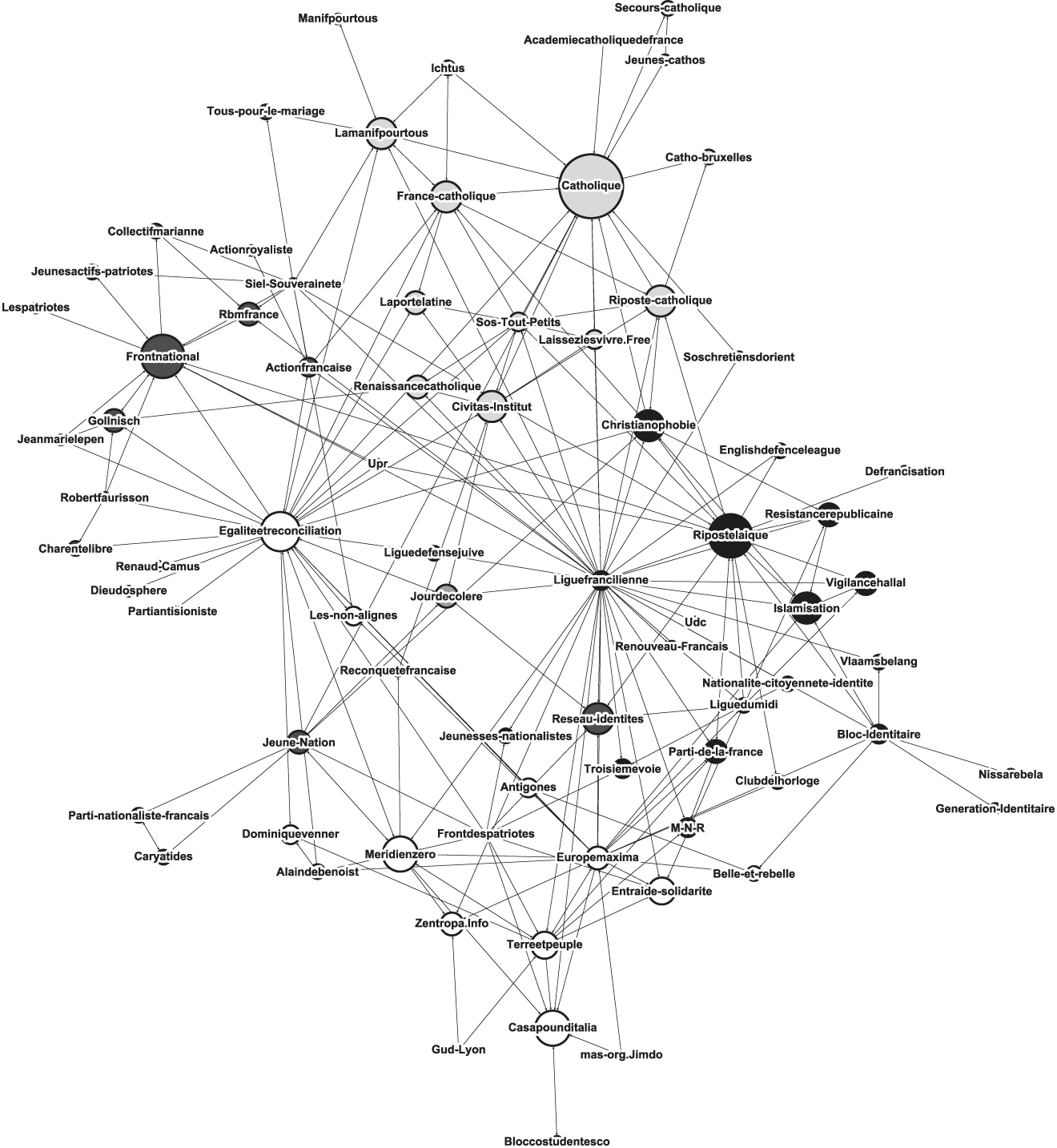
Among the seveenty-seven websites, a small number belong to organizations running for elections at the local or national level, or political parties (3%), whereas the majority of them belong to non-party organizations, i.e., either to social-movement organizations (28%) or, mainly, to poorly structured grassroots groups (69%). Most of the links make reference to far-right organizations based in France; however, websites of non-French organizations also appear in the network (English Defense League, Casa Pound Italia, Zentropa, Catho Bruxelles, and Vlaams Belang). The network includes organizations that vary also in terms of online visibility at the time of the study, with the Front National being the most consulted website (more than 360,000 unique visitors per month, against the average of the network that is 40,900) and the least visible extreme-right movement Reconquête Française (18 unique visitors per month). The global density of the network is 0.04. The values of the density can vary between 0 (a network with no links) and 1 (a network where each node is related to every other). Within the French far-right network I find that active links represent 4% of all the potential links.
To better describe the characteristics of the network, it is important to consider whether there is any specific node or nodes occupying a central position within the network. The measure of degree centrality gives some information about the position of organizations in the network and hence their potential influence.Footnote 57 In general, if a site has a high degree of centrality, the network is said to be centralized and the site is an important one for information flow.Footnote 58 Otherwise, the network structure is considered to be more distributed. In this case, the average degree of centrality is 3.052 which means the French far-right is not a highly centralized network, as the central position is occupied by more than one node. Following Burris et al.’s and Tateo’s methodology, in degree, the number of incoming links from other nodes is assumed to be a measure of an actor’s centrality within the network. In network analysis this measure is also called prestige or popularity.Footnote 59 Within the network of the French far right the results show the significant centrality of both non-party organizations, such as Toulouse Catholique Footnote 60 (with fifteen incoming links), Riposte Laïque (with eleven links), and Egalité et Reconciliation (nine links), and party organizations, such as the Front National (ten links). This suggests that both organizational types need to be considered when investigating the diffusion of ideas and values within the far right.
As an indicator of the existence in the network of clusters or communities with common attributes, the modularity score was calculated. In general, networks with high modularity have dense connections between the nodes within clusters but sparse connections between nodes in different clusters. This network has a modularity score of 0.419 suggesting that the far-right network has a significant community structure grouped around five major clusters highlighted in different shades of grey. I now move on to explore the content of anti-Islam frames and dimensions that emerge in and across clusters.
Anti-Islam Frames and Dimensions in the Online Network of the French Far Right
By looking at the content of the websites, this section examines how the far-right frames opposition to Islam in order to make best use of available discursive opportunities. The results of the qualitative frame analysis are summarized in table 1. For each cluster of websites identified through the shades of grey used in figure 1, table 1 shows the most prominent frames and dimensions, the number of websites in the cluster, and the number of monthly unique visitors for each.
Predominant anti-Islam frames and dimensions in the French far-right network
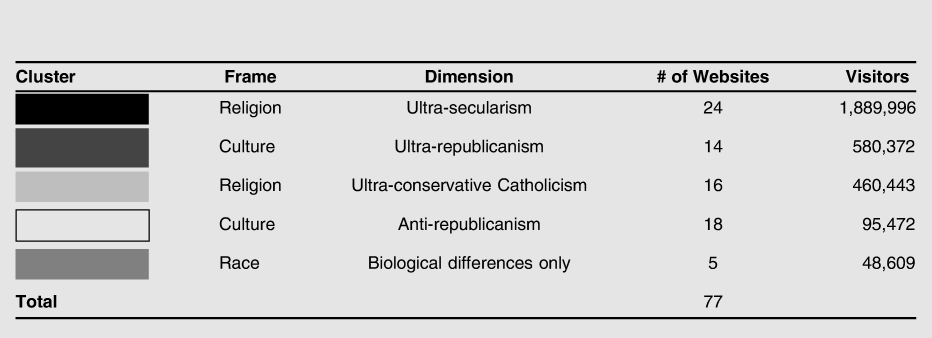
To begin with, all seventy-seven websites mentioned Islam or had specific sections dedicated to it. This confirms that indeed emphasis on Islam is nowadays common to the entire camp of right-wing activism, encompassing established and less established organizations. However, despite this common emphasis, different explanations justifying the tension between natives and non-natives are put forward and some of them enjoy higher online visibility than others. I found three major anti-Islam frames in the French far right: a religious frame (on forty websites), a cultural frame (on thirty-two) and a less widely spread race frame (on five).
Anti-Islam religious frames are mainly shared between far-right organizations for which religion and the regulations of Islam/state relations constitute a key marker of the national identity. These correspond to the clusters in black and light-grey on the right side of the network in figure 1. Anti-Islam cultural frames emerge between far-right organizations for which the defense of or opposition to the universalist principle of French republicanism lies at the core of their understanding of nationhood. These appear in the white and dark-grey clusters on the bottom and on the upper-left side of the network respectively. Finally, race frames are less common in the network and they emerge (at least blatantly) on the websites in the grey cluster on the bottom-left side of the network. For these organizations, natural characteristics such as blood, skin color, and also language, are core elements in defining who is (or is not) part of the French national community. Table 1 also shows that religious and cultural frames enjoy higher online visibility. However, both frames may take different (even opposite) forms. I now discuss these in more detail.
Religious Frames: Ultra-Secularism and Ultra-Conservative Catholicism
The religious frame is the most widespread in the far-right network and it resonates with a religion-based exclusionism to justify tensions between natives and Muslims. The qualitative analysis of the online material reveals that the religious frame takes on two major (opposite) forms or dimensions: first, opposition to Islam grounded in ultra-secular arguments, and second, that grounded in ultra-conservative Catholic arguments, the prefix “ultra” referring in the first case to an exclusionary and xenophobic interpretation of the French principle of strict separation of the state from religious institutions, and in the second to xenophobic interpretations of Catholicism.
More precisely, ultra-secular sub-frames stress the impossibility of reconciling Islam with laïcité and emerge among party and non-party organizations close to Riposte Laïque (refer to figure 1). These websites underline the impossibility of reconciling Islam and its religious practices with a civic (secular) view of citizenship, based on the strict separation between church and state, as exists in France. In this respect, the website of Riposte Laïque explains that “Islam is truly incompatible with France and its secularism”Footnote 61 and that “French secularism went well until the 1990s. If today secularism is challenged, it is simply because there is a new event: Islam. Islam is spearheading the offensive against secularism in our country.”Footnote 62 This interpretation also exists on the website of the Parti de la France (Party of France).Footnote 63 In France, far-right ultra-secular sub-frames distort more consensual opinions about the church/state separation in society and among (left and right wing) mainstream politicians. This may strengthen the access of this type of far-right argument to the public sphere.
Ultra-conservative Catholic sub-frames insist on the defense of France’s religious roots (i.e., European Christianity) and emerge only among websites close to Etudiants Toulouse Catholique (refer to figure 1). These organizations oppose Islam primarily because they consider Islam a competing (monotheistic) religion. For example, on the website of Renaissance Catholique one may read that: “The presence on French territory of a Muslim population estimated at 7 million people presents new challenges to our land of old Christendom.”Footnote 64 Despite the differences, both dimensions portray Islam as a source of external and domestic anxiety. In these interpretations, not only is Europe or the “West” allegedly put in danger by Islam, but Islam is also described as an internal enemy already present in most Western countries.
Cultural Frames: Ultra-Republicanism and Anti-Republicanism
The second frame emerging in the network is the cultural frame and this resonates with a cultural-based exclusionism to justify tensions between natives and Muslims. Like religious frames, I find that cultural frames also take two major (opposing) forms: opposition to Islam rooted either in ultra-republican or anti-republican arguments, where the prefix “ultra” refers to an exclusionary interpretation of the French univesalist model of citizenship, combining xenophobia and nationalism.
Ultra-republican sub-frames posit the incompatibility of Islam with France’s traditional republican principles of tolerance and freedom of expression (equality, freedom and fraternity),Footnote 65 depicting Islam as intrinsically illiberal. Three main arguments are recurrent on the websites grouped around the Front National: those around women’s rights, LGBTQ rights, and animal rights. This position is summarized in a 2010 speech by Marine Le Pen who, talking about neighborhoods where Muslim minorities are concentrated, said that “I hear more and more testimonies about the fact that in certain neighborhoods it is not good to be a woman, not a homosexual, a Jew or even a Frenchman or a white man.”Footnote 66 The issue of women’s rights in general, and of the position of women in Muslim communities, is often used to illustrate opposition to the values of gender equality allegedly shared by the majority population in France and the whole “western world.” Ignoring the view that while Muslim women’s oppression may be regarded as a sign of religious discrimination, it might also be seen as a consequence of discrimination on the side of the majority populations, these frames simply emphasize the impossibility for French republicanism to coexist with Muslims’ cultural practices: practices often wrongly attributed (only) to religion, like the wearing of headscarves, forced-marriages, female genital mutilationFootnote 67 or honor-killingFootnote 68. In recent years these topics have become major themes in the discourse of Marine Le Pen, who, on the basis of her sexual identity, claims to be particularly concerned about gender equality, more so than her father.Footnote 69
In a similar fashion, anti-Islam ultra-republican frames emphasize also the necessity to protect animals from ritual slaughter for the production of halal meat. This is described as being necessary not only to respect animal rights, but also to protect the health of the native population, and the traditional roots of France’s cuisine.Footnote 70 Another topic that is introduced to illustrate tension between France’s republicanism and Islam is that of LGBTQ rights. Voicing a support for the expression of homosexuality and gay rights that is not common for the (French) far right, this discourse links Islamophobia to pride in the French nation for its protection of freedom of sexual expression, contrasting this with the principles of Islam and Muslims that would deny them. As for ultra-secular religious frames, ultra-republican cultural frames distort arguments that are relatively consensual for a broader part of public opinion and mainstream (left and right) politicians. This muddying of the waters makes it often difficult to distinguish what is far right and what is not, thus easing far-right arguments’ access to the public sphere.
Anti-republican sub-frames oppose Islam on the basis of rejection of the republican principle of colorblind universalism, accusing universalism of encouraging the disappearance of differences, e.g., an “authentic” Muslim culture and “authentic” French culture, by promoting mixing between individuals and cultures in France. In these interpretations, republicanism is perceived as undermining the purity of the “français de souche.” This expression designates individuals of French nationality who do not have foreign ancestry and who do not come from recent immigration. On these grounds, these far-right organizations call for a neo-racist interpretation of the “right to difference.” These arguments are shared mainly between organizations located around the website of Egalité et Reconciliation. In these interpretations, Muslim communities must preserve their identities, but not on French soil. On these websites, Islam is mostly described as a source of tension between ingroup and outgroup(s), resulting from the (republican) repressive and discriminatory attitudes towards Muslim minorities. A vaguely defined amalgam of cultural, political, economic, and media actors, called the “elite,” is portrayed as being involved in this process of repression of all minority identities that are not in line with the French republican one. With no expression of empathy, and defending the ethnopluralist idea that different cultures cannot coexist within the same territory, repression of cultural diversity is claimed to trigger the reaction of minorities whose identities are described as being on the edge of being erased.Footnote 71 Often conspiracy theories are used to justify reasons that certain specific minorities’ identities would allegedly be more tolerated than others by elites (Jewish people are often mentioned).
Race Frames
Finally, the race frame uses biological elements to justify cultural belonging to the national community and to make sense of tensions between natives and Muslims.Footnote 72 If there are only a few websites defining nativeness exclusively on the basis of natural characteristics, several other websites merge race-related arguments with culture- and religious- related ones, articulating a neo-racist discourse of “the right to difference.”Footnote 73
In the first case, anti-Islam arguments are integrated within broader anti-immigration concerns, so that ethnic prejudices prevail. Race frames thus treat Muslims like any other migrant or foreign Other, feared primarily because of numbers rather than group characteristics. Accordingly, all five websites reported in table 1 mention the fear of an “invasion” threatening the roots of a “White Europe,”Footnote 74 promoting “ethnic cleansing”Footnote 75 and hence “perverting” its ethnos. Some websites even use genetic metaphors to ground opposition to non-natives, including Muslims.Footnote 76 In the second case, race frames are instead associated with references to mainstream values about culture and the role of religion in society, as already discussed. For instance, some websites in the grey cluster endorse the conspiracy theory of the Grand remplacement (Great replacement)Footnote 77 positing the “Islamo-substitution” of biologically autochthonous populations in the French metropolitan territory, by Muslim minorities mostly coming from sub-Saharan Africa and the Maghreb.Footnote 78 As explained by Bar-On,Footnote 79 through this frame inherited from the Nouvelle Droite, the far right is able to conceal its tendencies towards biological racism, coopting “the pro-multicultural discourse of the liberal left, in order to appear anti-racist and win supporters in a decidedly anti- racist age.”
When it comes to online visibility, table 1 illustrates that the most visible organizations are those opposing Islam by distorting baseline national values in ethnocentric ways. More precisely, far-right ultra-secular and ultra-republican dimensions tend to mirror opposite positions on key principles of France’s social contract: secularity, republicanism, or universalism. Less visible organizations tend to adopt ultra-conservative Catholic and anti-republican frames opposing baseline national values, thus simply locating themselves outside the social contract.
These findings are in line with those on the European far-right offline. On the one hand, studying the case of Radical right populist parties (RRPPs) in Europe, Halikioupoulou et al.Footnote 80 conclude that the far right tries to capitalize on a “civic zeitgeist” in search of political legitimacy in their political systems. The authors show that RRPPs push their ethnic exclusivist agenda by annexing the values of tolerance, liberalism, and diversity of “our nation,” a thesis recently confirmed by Brubaker in his study on far-right parties in Europe and North America. On the other hand, studies on far-right street-based and intellectual movementsFootnote 81 emphasize the important transition from racist to neo-racist understandings of nativeness starting from the late 1960s. By describing the case of the French ND, Bar-On shows that the ND did not abandon racism, but found a way of defending the homogeneity of European ethnic communities “by working within the liberal democratic framework to seek its demise.”Footnote 82 This is a tendency that is common to the contemporary Identitarian movement in Europe, according to Virchow.Footnote 83
Discussion and Conclusions: Nativism, Opposition to Islam and the Legitimacy Dilemma
The increasing importance of Islam in public debates and the centrality of nativism in the ideology of the far right pose for the latter a major ideological and strategic dilemma. The analysis given has tried to assess whether, and to what extent, far-right organizations stick to their traditional race-based arguments, or rather conform to mainstream values in the attempt to attain legitimacy in the political system.
As I have shown, ideological nativism explains opposition to Islam across the whole spectrum of the French far right, in the protest as well as in the electoral arena. Rather than acting as a trigger for unity and cooperation within the far-right milieu, however, the shared opposition to the same enemy—i.e., Islam—is actually a major explanation for its fragmentation.
Anti-Islam frames are couched along a spectrum of discursive opportunities, where actors can either opt to justify opposition to Islam based on interpretations of core national values (culture and religion) or rather mobilize on strictly oppositional values (biological racism). While some organizations discriminate against Muslims on biological grounds only, others wrap nativist arguments in dominant conceptions of citizenship: secularity and republicanism. Further divisions emerge when it comes to the interplay between far-right anti-Islam frames and baseline national values. On the one hand, some groups endorse mainstream values, but promote xenophobic understandings of secularity and republican universalism. On the other side, groups might oppose mainstream values by locating themselves outside the social contract, and by adopting ultra-Catholic religious and anti-republican discourses.
Additionally, the framing strategy providing most visibility to French far-right organizations (at least online) uses neo-racist frames distorting baseline national values, but without rejecting the social contract. In its quest for political legitimacy, the far right may thus make reference to values seen as national, given that understandings of the national identity in civilizational terms may be compatible with at least part of nativist anti-Islam frames (neo-racism). For the far right, often associated with (neo)fascist and (neo)nazi ideologies, the extent to which its anti-Islam discourse is perceived as compatible with democratic baseline national values is fundamental to its acquiring legitimacy within the political system. It is this desire to enter the political system that induces the far right to adapt its nativist discourse to the available political and discursive opportunities defining the belonging to the national community.
At the same time however, going mainstream may have some drawbacks for these political actors. On the one hand, they risk alienating the support of radical fringes (in France, ultra-religious and monarchist groups). On the other, they risk being identified with the political mainstream, and they could thus be challenged by actors focusing on opposition to the establishment. Put differently, the politicization of Islam faces the far right with a contradiction: between capitalizing on nativism to increase its legitimacy, and risking appearing as a mere copy of that same “establishment” that it criticizes.
The findings have important implications for future research. Beyond specialists in French politics, the far right, and Islam, I offer important insights for the study of both nationalism and racism, as well as for methodological advancements in the study of political discourse with online data. Still, it is dangerous to overgeneralize without addressing at least three important factors.
First, nowhere outside France does the distinctive tradition of laïcité and republicanism make secularist (sub)frames so central to the public debate. In this respect, future research might want to investigate these dynamics comparatively, looking at online and offline debates on Islam across Europe and North America, paying specific attention to the concept of “civilizational nationalism”Footnote 84 as well as to ultra-religious argumentation (such as in Italy). Footnote 85
Second, future research might want to include additional online data from Facebook and Twitter and examine similar dynamics over a longer time span. More research is also needed on the audiences of far-right websites and their reception of anti-Islam discourse. Future scholars should, however, consider that, although this method allows comparison of discourses of different established and non-established organizations on different issues, one of its major limitations is that it is extremely time consuming for a single researcher. Offline data would also greatly contribute to the assessment of whether online trends mirror offline ones, and to what extent.
Third, there is need for more work on the interactions between far-right and mainstream discourses on Islam, as well as on other issues that might offer the far right opportunities to bridge nativism and liberal values: issues such as antisemitism, animal rights, civil rights, women’s rights, and LGBTQ rights.
Only future research addressing these major shortcomings can help understand whether, when it comes to the politicization of Islam, it is the far right that moderates or (according to some) “normalizes” itself, or whether instead it is the mainstream that radicalizes itself. To paraphrase Bell’s words in the interpretation by Mudde,Footnote 86 the question is to understand if Islamophobic discourses constitute a “normal pathology” or a “pathological normalcy” of western democracies. In other words, it is the question of whether Islamophobia is fueled by crises, by terrorist attacks, or by the discourse and success of the far right, or even whether Islamophobia is rather a byproduct of mainstream national values and much in line with shared attitudes, as suggested by this research.